“FACE RECOGNITION USING EIGENFACES”
Dr.Sachin.S.Gurav
.
Index
• INTRODUCTION
• FACE RECOGNITION SYSTEM
• EIGENFACE APPROACH
• EIGEN VALUES AND EIGEN VECTORS
• CALCULATIONS OF EIGEN VALUES AND EIGEN
VECTORS
• ALGORITH TO FIND EIGENFACES
• EIGENFACES METHOD
• ADVANTAGE AND DISADVENTAGE
• APPLICATIONS
• CONCLUSION
• REFERENCES
Introduction
Problem Statement :
• Given an image, to identify it as a face and/or
extract face images from it.
• To retrieve the similar images (based on a
heuristic)from the given database of face
images.
Introduction
• Face recognition based on information theory approach of
coding and decoding the face image.
• Proposed methodology is connection of two stages –
• Eigenface approach uses Principal Component Analysis (PCA)
algorithm.
• dynamic images-- images received from the camera.
• static images – modified image.
• Eigenfaces- The scheme is based on an information theory
approach that decomposes face images into a small set of
characteristic feature images
• face recognition techniques can be divided into two-
1) Appearance-based
2) Feature-based,
Face Recognition
• Face recognition is the process of putting a name to a face. Once
you've detected a face, face recognition means figuring out whose
face it is
• Face is the most common biometric used by humans
• Applications range from static, mug-shot verification to a dynamic,
uncontrolled face identification in a cluttered background
• Challenges:
• automatically locate the face
• recognize the face from a general view point under different
illumination conditions, facial expressions, and aging effects
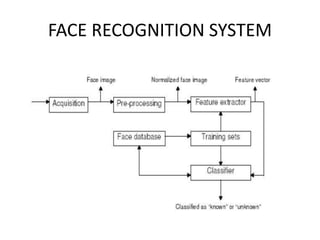
FACE RECOGNITION SYSTEM
There are six main functional blocks
A. The acquisition module
B. The pre-processing module
C. The feature extraction module
D. The classification module
E. Training set
F. Face database
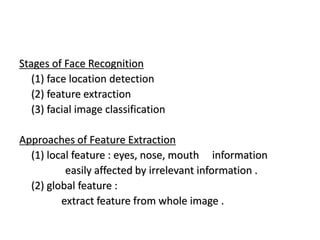
Stages of Face Recognition
(1) face location detection
(2) feature extraction
(3) facial image classification
Approaches of Feature Extraction
(1) local feature : eyes, nose, mouth information
easily affected by irrelevant information .
(2) global feature :
extract feature from whole image .
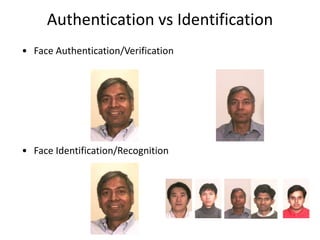
Authentication vs Identification
• Face Authentication/Verification
• Face Identification/Recognition
EIGENFACE APPROACH
• Extract the relevant facial information, which
may or may not be directly related to human
intuition of face features such as the eyes,
nose, and lips.
• Represent face images efficiently. To reduce
the computation and space complexity.
EIGEN VALUES AND EIGEN VECTORS
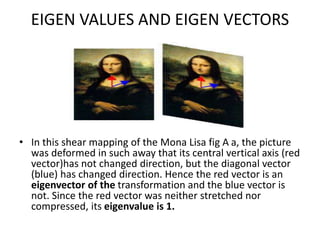
• In this shear mapping of the Mona Lisa fig A a, the picture
was deformed in such away that its central vertical axis (red
vector)has not changed direction, but the diagonal vector
(blue) has changed direction. Hence the red vector is an
eigenvector of the transformation and the blue vector is
not. Since the red vector was neither stretched nor
compressed, its eigenvalue is 1.
CALCULATIONS OF EIGEN
VALUES AND EIGEN VECTORS
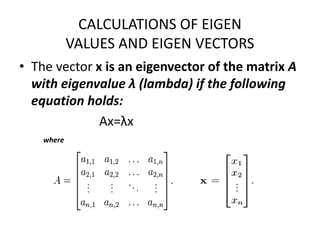
• The vector x is an eigenvector of the matrix A
with eigenvalue λ (lambda) if the following
equation holds:
Ax=λx
where
Eigen values
• This equation can be interpreted geometrically as
follows: a vector x is an eigenvector if
multiplication by A stretches, shrinks, leaves
unchanged, flips (points in the opposite
direction), flips and stretches, or flips and shrinks
x.
• 1) If the eigenvalue λ > 1, x is stretched by this
factor.
• 2) If λ = 1, the vector x is not affected at all by
multiplication by A.
• 3) If 0 < λ < 1, x is shrunk (or compressed).
ALGORITHM TO FIND EIGENFACES
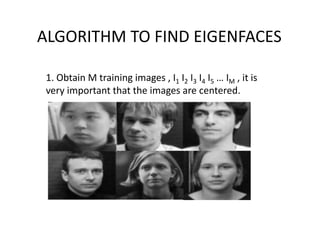
1. Obtain M training images , I1 I2 I3 I4 I5 … IM , it is
very important that the images are centered.
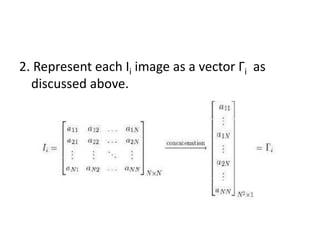
2. Represent each Ii image as a vector Гi as
discussed above.
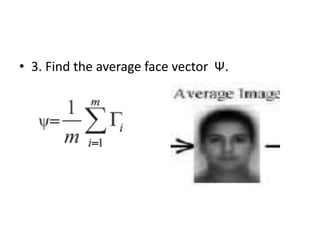
• 3. Find the average face vector Ψ.
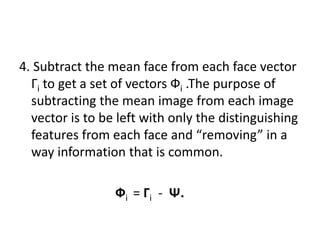
4. Subtract the mean face from each face vector
Гi to get a set of vectors Фi .The purpose of
subtracting the mean image from each image
vector is to be left with only the distinguishing
features from each face and “removing” in a
way information that is common.
Фi = Гi - Ψ.
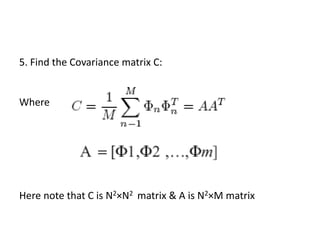
5. Find the Covariance matrix C:
Where
Here note that C is N2×N2 matrix & A is N2×M matrix
• We now need to calculate the Eigenvectors of
C , However note that C is a N2×N2 matrix and
it would return N2 Eigenvectors each being N2
dimensional. For an image this number is
HUGE. The computations required would
easily make your system run out of memory.
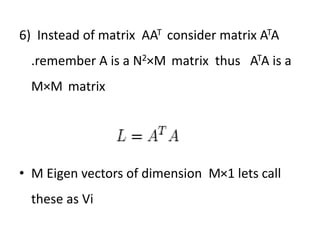
6) Instead of matrix AAT consider matrix ATA
.remember A is a N2×M matrix thus ATA is a
M×M matrix
• M Eigen vectors of dimension M×1 lets call
these as Vi
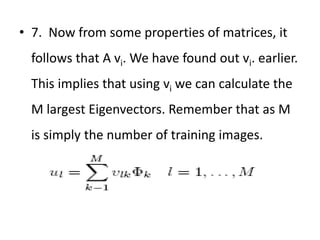
• 7. Now from some properties of matrices, it
follows that A vi. We have found out vi. earlier.
This implies that using vi we can calculate the
M largest Eigenvectors. Remember that as M
is simply the number of training images.
8. Find the best M Eigenvectors of C=AAT by
using the relation discussed above.
9. Select the best Eigenvectors, the selection of
these Eigenvectors is done heuristically
EIGEN FACES
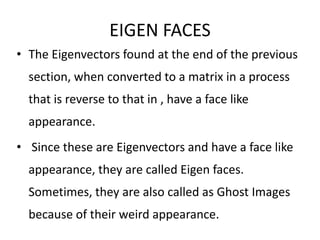
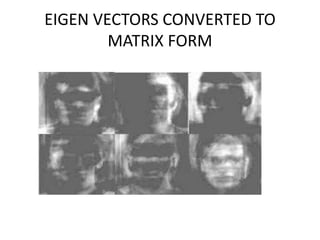
• The Eigenvectors found at the end of the previous
section, when converted to a matrix in a process
that is reverse to that in , have a face like
appearance.
• Since these are Eigenvectors and have a face like
appearance, they are called Eigen faces.
Sometimes, they are also called as Ghost Images
because of their weird appearance.
EIGEN VECTORS CONVERTED TO
MATRIX FORM
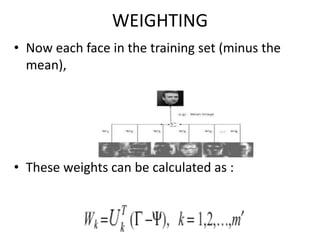
WEIGHTING
• Now each face in the training set (minus the
mean),
• These weights can be calculated as :
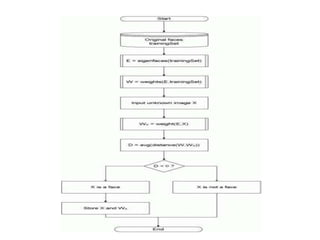
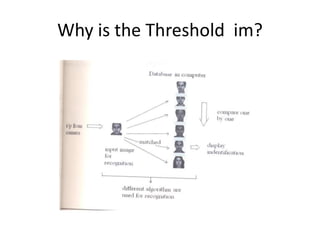
• The Euclidean distance between two weight
vectors d(Ωi, Ωj) provides a measure of similarity
between the corresponding images i and j. If the
Euclidean distance between
ГNEW and other faces exceeds - on average - some
threshold value θ, one can assume
• that ГNEW is no face at all.
er < θ image recognized
er > θ image not recognized
Why is the Threshold im?
Advantages
• Eigen method distills the large dimension
images to Eigen vector which reduces the
processing time .
• Less memory storage .
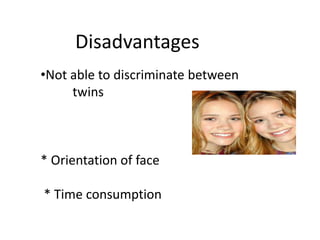
Disadvantages
•Not able to discriminate between
twins
* Orientation of face
* Time consumption
Application
• Voter id
• ATM security
• Airport security purpose
• Offices
• Crime investigation
• Access Control
Future Scope
• Face Detection in motion pictures.
• Investigate whether eigenfaces is a good
solution for this problem by comparing with
other feature extraction techniques such as
DCT.
CONCLUSION
»In this study, we used the eigenfaces to represent the
features vectors for human faces.
»The features are extracted from the original image to
represents unique identity used in classification and
recognition.
» The eigenfaces has proven the capability to provide
the significant features and reduces the input size

Face Recognition using Eigen Values pptx

  • 1.
    “FACE RECOGNITION USINGEIGENFACES” Dr.Sachin.S.Gurav .
  • 2.
    Index • INTRODUCTION • FACERECOGNITION SYSTEM • EIGENFACE APPROACH • EIGEN VALUES AND EIGEN VECTORS • CALCULATIONS OF EIGEN VALUES AND EIGEN VECTORS • ALGORITH TO FIND EIGENFACES • EIGENFACES METHOD • ADVANTAGE AND DISADVENTAGE • APPLICATIONS • CONCLUSION • REFERENCES
  • 3.
    Introduction Problem Statement : •Given an image, to identify it as a face and/or extract face images from it. • To retrieve the similar images (based on a heuristic)from the given database of face images.
  • 4.
    Introduction • Face recognitionbased on information theory approach of coding and decoding the face image. • Proposed methodology is connection of two stages – • Eigenface approach uses Principal Component Analysis (PCA) algorithm. • dynamic images-- images received from the camera. • static images – modified image. • Eigenfaces- The scheme is based on an information theory approach that decomposes face images into a small set of characteristic feature images • face recognition techniques can be divided into two- 1) Appearance-based 2) Feature-based,
  • 5.
    Face Recognition • Facerecognition is the process of putting a name to a face. Once you've detected a face, face recognition means figuring out whose face it is • Face is the most common biometric used by humans • Applications range from static, mug-shot verification to a dynamic, uncontrolled face identification in a cluttered background • Challenges: • automatically locate the face • recognize the face from a general view point under different illumination conditions, facial expressions, and aging effects
  • 6.
  • 7.
    There are sixmain functional blocks A. The acquisition module B. The pre-processing module C. The feature extraction module D. The classification module E. Training set F. Face database
  • 8.
    Stages of FaceRecognition (1) face location detection (2) feature extraction (3) facial image classification Approaches of Feature Extraction (1) local feature : eyes, nose, mouth information easily affected by irrelevant information . (2) global feature : extract feature from whole image .
  • 9.
    Authentication vs Identification •Face Authentication/Verification • Face Identification/Recognition
  • 11.
    EIGENFACE APPROACH • Extractthe relevant facial information, which may or may not be directly related to human intuition of face features such as the eyes, nose, and lips. • Represent face images efficiently. To reduce the computation and space complexity.
  • 12.
    EIGEN VALUES ANDEIGEN VECTORS • In this shear mapping of the Mona Lisa fig A a, the picture was deformed in such away that its central vertical axis (red vector)has not changed direction, but the diagonal vector (blue) has changed direction. Hence the red vector is an eigenvector of the transformation and the blue vector is not. Since the red vector was neither stretched nor compressed, its eigenvalue is 1.
  • 13.
    CALCULATIONS OF EIGEN VALUESAND EIGEN VECTORS • The vector x is an eigenvector of the matrix A with eigenvalue λ (lambda) if the following equation holds: Ax=λx where
  • 14.
    Eigen values • Thisequation can be interpreted geometrically as follows: a vector x is an eigenvector if multiplication by A stretches, shrinks, leaves unchanged, flips (points in the opposite direction), flips and stretches, or flips and shrinks x. • 1) If the eigenvalue λ > 1, x is stretched by this factor. • 2) If λ = 1, the vector x is not affected at all by multiplication by A. • 3) If 0 < λ < 1, x is shrunk (or compressed).
  • 15.
    ALGORITHM TO FINDEIGENFACES 1. Obtain M training images , I1 I2 I3 I4 I5 … IM , it is very important that the images are centered.
  • 16.
    2. Represent eachIi image as a vector Гi as discussed above.
  • 17.
    • 3. Findthe average face vector Ψ.
  • 18.
    4. Subtract themean face from each face vector Гi to get a set of vectors Фi .The purpose of subtracting the mean image from each image vector is to be left with only the distinguishing features from each face and “removing” in a way information that is common. Фi = Гi - Ψ.
  • 19.
    5. Find theCovariance matrix C: Where Here note that C is N2×N2 matrix & A is N2×M matrix
  • 20.
    • We nowneed to calculate the Eigenvectors of C , However note that C is a N2×N2 matrix and it would return N2 Eigenvectors each being N2 dimensional. For an image this number is HUGE. The computations required would easily make your system run out of memory.
  • 21.
    6) Instead ofmatrix AAT consider matrix ATA .remember A is a N2×M matrix thus ATA is a M×M matrix • M Eigen vectors of dimension M×1 lets call these as Vi
  • 22.
    • 7. Nowfrom some properties of matrices, it follows that A vi. We have found out vi. earlier. This implies that using vi we can calculate the M largest Eigenvectors. Remember that as M is simply the number of training images.
  • 23.
    8. Find thebest M Eigenvectors of C=AAT by using the relation discussed above. 9. Select the best Eigenvectors, the selection of these Eigenvectors is done heuristically
  • 24.
    EIGEN FACES • TheEigenvectors found at the end of the previous section, when converted to a matrix in a process that is reverse to that in , have a face like appearance. • Since these are Eigenvectors and have a face like appearance, they are called Eigen faces. Sometimes, they are also called as Ghost Images because of their weird appearance.
  • 25.
  • 26.
    WEIGHTING • Now eachface in the training set (minus the mean), • These weights can be calculated as :
  • 27.
    • The Euclideandistance between two weight vectors d(Ωi, Ωj) provides a measure of similarity between the corresponding images i and j. If the Euclidean distance between ГNEW and other faces exceeds - on average - some threshold value θ, one can assume • that ГNEW is no face at all. er < θ image recognized er > θ image not recognized
  • 28.
    Why is theThreshold im?
  • 29.
    Advantages • Eigen methoddistills the large dimension images to Eigen vector which reduces the processing time . • Less memory storage .
  • 30.
    Disadvantages •Not able todiscriminate between twins * Orientation of face * Time consumption
  • 31.
    Application • Voter id •ATM security • Airport security purpose • Offices • Crime investigation • Access Control
  • 32.
    Future Scope • FaceDetection in motion pictures. • Investigate whether eigenfaces is a good solution for this problem by comparing with other feature extraction techniques such as DCT.
  • 33.
    CONCLUSION »In this study,we used the eigenfaces to represent the features vectors for human faces. »The features are extracted from the original image to represents unique identity used in classification and recognition. » The eigenfaces has proven the capability to provide the significant features and reduces the input size