Linear Discriminant
Analysis
1
2
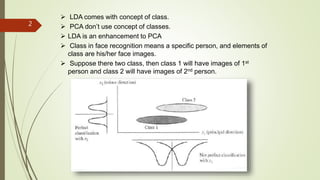
 LDA comes with concept of class.
 PCA don’t use concept of classes.
 LDA is an enhancement to PCA
 Class in face recognition means a specific person, and elements of
class are his/her face images.
 Suppose there two class, then class 1 will have images of 1st
person and class 2 will have images of 2nd person.
3
• Multiple classes and PCA
− Suppose there are C classes in the training data.
− PCA is based on the sample covariance which characterizes the
scatter of the entire data set, irrespective of class-membership.
− The projection axes chosen by PCA might not provide good
discrimination power.
• What is the goal of LDA?
− Perform dimensionality reduction while saving as much of the class
discriminatory information as possible.
− Search to find directions along which the classes are best separated.
− Takes into consideration the scatter within-classes but also the
scatter between-classes.
4
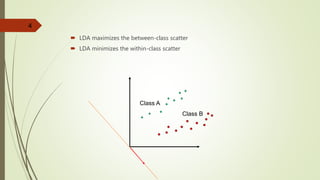
 LDA maximizes the between-class scatter
 LDA minimizes the within-class scatter
Class A
Class B
5 Algorithm
 Assumptions
 Square images with Width=Height=N
 M is the number of images in the database
 P is the number of persons in the database
6
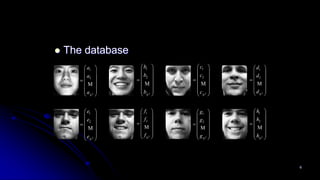
 The database
2
1
2
N
b
b
b
 
 
 
 
  
 
M
2
1
2
N
c
c
c
 
 
 
 
  
 
M
2
1
2
N
d
d
d
 
 
 
 
  
 
M
2
1
2
N
e
e
e
 
 
 
 
  
 
M
2
1
2
N
a
a
a
 
 
 
 
  
 
M
2
1
2
N
f
f
f
 
 
 
 
  
 
M
2
1
2
N
g
g
g
 
 
 
 
  
 
M
2
1
2
N
h
h
h
 
 
 
 
  
 
M
7
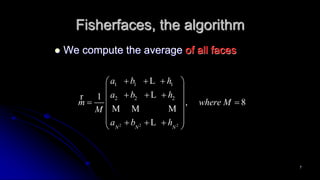
Fisherfaces, the algorithm
 We compute the average of all faces
2 2 2
1 1 1
2 2 21
, 8
N N N
a b h
a b h
m where M
M
a b h
   
 
    
 
     
L
Lr
M M M
L
8
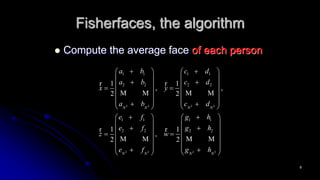
Fisherfaces, the algorithm
 Compute the average face of each person
2 2 2 2
2 2 2 2
1 1 1 1
2 2 2 2
1 1 1 1
2 2 2 2
1 1
, ,
2 2
1 1
,
2 2
N N N N
N N N N
a b c d
a b c d
x y
a b c d
e f g h
e f g h
z w
e f g h
    
   
     
   
          
    
   
     
   
          
r r
M M M M
rr
M M M M
9
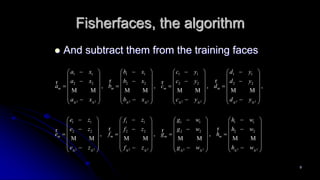
Fisherfaces, the algorithm
 And subtract them from the training faces
2 2 2 2 2 2 2 2
2 2
1 1 1 1 1 1 1 1
2 2 2 2 2 2 2 2
1 1 1 1
2 2
, , , ,
,
m m m m
N N N N N N N N
m m
N N
a x b x c y d y
a x b x c y d y
a b c d
a x b x c y d y
e z f z
e z f
e f
e z
          
       
             
       
                        
  
 
  
 
   
r rr r
M M M M M M M M
rr
M M
2 2 2 2 2 2
1 1 1 1
2 2 2 2 2 2
, ,m m
N N N N N N
g w h w
z g w h w
g h
f z g w h w
      
     
        
     
                 
rr
M M M M M M
10
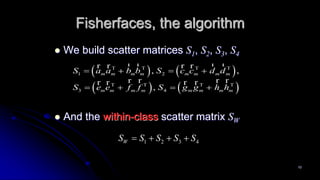
Fisherfaces, the algorithm
 We build scatter matrices S1, S2, S3, S4
 And the within-class scatter matrix SW
   
   
1 2
3 4
, ,
,
m m m m m m m m
m m m m m m m m
S a a b b S c c d d
S e e f f S g g h h
   
   
   
   
r r r rr r r r
r r r rr r r r
1 2 3 4WS S S S S   
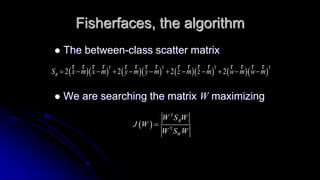
Fisherfaces, the algorithm
 The between-class scatter matrix
 We are searching the matrix W maximizing
           2 2 2 2BS x m x m y m y m z m z m w m w m
   
           
r r r r r r r r r r r r r rr r
 
B
W
W S W
J W
W S W



12
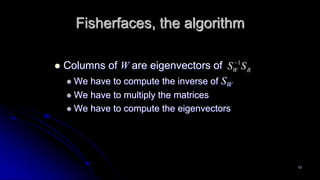
Fisherfaces, the algorithm
 Columns of W are eigenvectors of
 We have to compute the inverse of SW
 We have to multiply the matrices
 We have to compute the eigenvectors
1
W BS S
13
Recognition
 Project faces onto the LDA-space
 To classify the face
 Project it onto the LDA-space
 Run a nearest-neighbor classifier
 Nearest is our answer

Face recognition using LDA

  • 1.
  • 2.
    2  LDA comeswith concept of class.  PCA don’t use concept of classes.  LDA is an enhancement to PCA  Class in face recognition means a specific person, and elements of class are his/her face images.  Suppose there two class, then class 1 will have images of 1st person and class 2 will have images of 2nd person.
  • 3.
    3 • Multiple classesand PCA − Suppose there are C classes in the training data. − PCA is based on the sample covariance which characterizes the scatter of the entire data set, irrespective of class-membership. − The projection axes chosen by PCA might not provide good discrimination power. • What is the goal of LDA? − Perform dimensionality reduction while saving as much of the class discriminatory information as possible. − Search to find directions along which the classes are best separated. − Takes into consideration the scatter within-classes but also the scatter between-classes.
  • 4.
    4  LDA maximizesthe between-class scatter  LDA minimizes the within-class scatter Class A Class B
  • 5.
    5 Algorithm  Assumptions Square images with Width=Height=N  M is the number of images in the database  P is the number of persons in the database
  • 6.
    6  The database 2 1 2 N b b b             M 2 1 2 N c c c              M 2 1 2 N d d d              M 2 1 2 N e e e              M 2 1 2 N a a a              M 2 1 2 N f f f              M 2 1 2 N g g g              M 2 1 2 N h h h              M
  • 7.
    7 Fisherfaces, the algorithm We compute the average of all faces 2 2 2 1 1 1 2 2 21 , 8 N N N a b h a b h m where M M a b h                    L Lr M M M L
  • 8.
    8 Fisherfaces, the algorithm Compute the average face of each person 2 2 2 2 2 2 2 2 1 1 1 1 2 2 2 2 1 1 1 1 2 2 2 2 1 1 , , 2 2 1 1 , 2 2 N N N N N N N N a b c d a b c d x y a b c d e f g h e f g h z w e f g h                                                             r r M M M M rr M M M M
  • 9.
    9 Fisherfaces, the algorithm And subtract them from the training faces 2 2 2 2 2 2 2 2 2 2 1 1 1 1 1 1 1 1 2 2 2 2 2 2 2 2 1 1 1 1 2 2 , , , , , m m m m N N N N N N N N m m N N a x b x c y d y a x b x c y d y a b c d a x b x c y d y e z f z e z f e f e z                                                                                 r rr r M M M M M M M M rr M M 2 2 2 2 2 2 1 1 1 1 2 2 2 2 2 2 , ,m m N N N N N N g w h w z g w h w g h f z g w h w                                               rr M M M M M M
  • 10.
    10 Fisherfaces, the algorithm We build scatter matrices S1, S2, S3, S4  And the within-class scatter matrix SW         1 2 3 4 , , , m m m m m m m m m m m m m m m m S a a b b S c c d d S e e f f S g g h h                 r r r rr r r r r r r rr r r r 1 2 3 4WS S S S S   
  • 11.
    Fisherfaces, the algorithm The between-class scatter matrix  We are searching the matrix W maximizing            2 2 2 2BS x m x m y m y m z m z m w m w m                 r r r r r r r r r r r r r rr r   B W W S W J W W S W   
  • 12.
    12 Fisherfaces, the algorithm Columns of W are eigenvectors of  We have to compute the inverse of SW  We have to multiply the matrices  We have to compute the eigenvectors 1 W BS S
  • 13.
    13 Recognition  Project facesonto the LDA-space  To classify the face  Project it onto the LDA-space  Run a nearest-neighbor classifier  Nearest is our answer