fisherfaces
Face recognition algorithm
Vishnu K N S5 CSE B 59
Federal Institute of Science and Technology
introduction
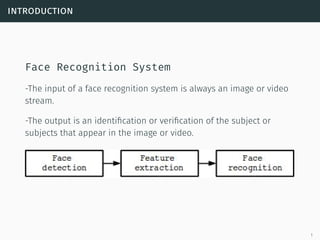
Face Recognition System
-The input of a face recognition system is always an image or video
stream.
-The output is an identification or verification of the subject or
subjects that appear in the image or video.
1
fisherfaces
working
-The Fisherfaces method learns a class-specifc transformation
matrix, so they do not capture illumination as obviously as the
Eigenfaces method.
-The Discriminant Analysis instead fnds the facial features to
discriminate betweenthe persons.
3
-It’s important to mention, that the performance of the Fisherfaces
heavily depends on the input data as well.
-Practically said: if you learn the Fisherfaces for well-illuminated
pictures only and you try to recognize faces in bad-illuminated
scenes, then method is likely to fnd the wrong components (just
because those features may not be predominant on bad illuminated
images).
4
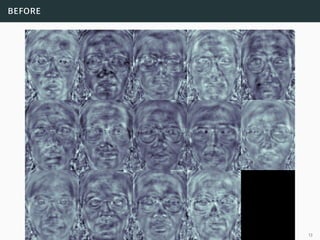
The Fisherfaces allow a reconstruction of the projected image, just
like the Eigenfaces did.
But since we only identifed the features to distinguish between
subjects, you can’t expect a nice reconstruction of the original image.
For the Fisherfaces method we’ll project the sample image onto
each of the Fisherfaces instead.
5
fisherfaces v/s eigenfaces
-The Eigenface method uses Principal Component Analysis (PCA) to
linearly project the image space to a low dimensional feature space.
-The Fisherface method is an enhancement of the Eigenface method
that it uses Fisher’s Linear Discriminant Analysis (FLDA or LDA) for
the dimensionality reduction.
6
-The LDA maximizes the ratio of between-class scatter to that of
within-class scatter, therefore, it works better than PCA for purpose
of discrimination.
-The Fisherface is especially useful when facial images have large
variations in illumination and facial expression.
7
algorithm
Let X be a random vector with samples drawn from c classes:
X = {X1, X2, . . . , Xc}
Xi = {x1, x2, . . . , xn}
The scatter matrices SBandSWarecalculatedas :
SB =
c∑
i=1
Ni(µi − µ)(µi − µ)T
SW =
c∑
i=1
∑
xj∈Xi
(xj − µi)(xj − µi)T
9
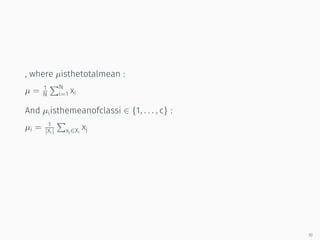
, where µisthetotalmean :
µ = 1
N
∑N
i=1 xi
And µiisthemeanofclassi ∈ {1, . . . , c} :
µi = 1
|Xi|
∑
xj∈Xi
xj
10
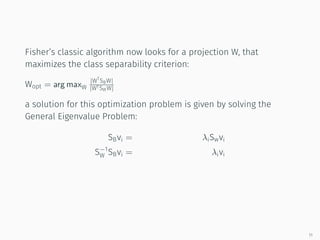
Fisher’s classic algorithm now looks for a projection W, that
maximizes the class separability criterion:
Wopt = arg maxW
|WT
SBW|
|WTSWW|
a solution for this optimization problem is given by solving the
General Eigenvalue Problem:
SBvi = λiSwvi
S−1
W SBvi = λivi
11
The optimization problem can then be rewritten as:
Wpca = arg maxW |WT
STW|
Wfld = arg maxW
|WT
WT
pcaSBWpcaW|
|WTWT
pcaSWWpcaW|
The transformation matrix W, that projects a sample into the
(c-1)-dimensional space is then given by:
W = WT
fldWT
pca
12
before
13
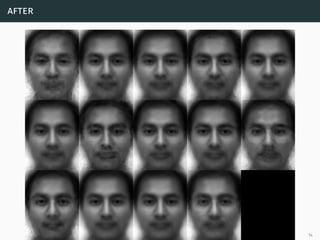
after
14
thank you

Fisherfaces Face Recognition Algorithm

  • 1.
    fisherfaces Face recognition algorithm VishnuK N S5 CSE B 59 Federal Institute of Science and Technology
  • 2.
    introduction Face Recognition System -Theinput of a face recognition system is always an image or video stream. -The output is an identification or verification of the subject or subjects that appear in the image or video. 1
  • 3.
  • 4.
    working -The Fisherfaces methodlearns a class-specifc transformation matrix, so they do not capture illumination as obviously as the Eigenfaces method. -The Discriminant Analysis instead fnds the facial features to discriminate betweenthe persons. 3
  • 5.
    -It’s important tomention, that the performance of the Fisherfaces heavily depends on the input data as well. -Practically said: if you learn the Fisherfaces for well-illuminated pictures only and you try to recognize faces in bad-illuminated scenes, then method is likely to fnd the wrong components (just because those features may not be predominant on bad illuminated images). 4
  • 6.
    The Fisherfaces allowa reconstruction of the projected image, just like the Eigenfaces did. But since we only identifed the features to distinguish between subjects, you can’t expect a nice reconstruction of the original image. For the Fisherfaces method we’ll project the sample image onto each of the Fisherfaces instead. 5
  • 7.
    fisherfaces v/s eigenfaces -TheEigenface method uses Principal Component Analysis (PCA) to linearly project the image space to a low dimensional feature space. -The Fisherface method is an enhancement of the Eigenface method that it uses Fisher’s Linear Discriminant Analysis (FLDA or LDA) for the dimensionality reduction. 6
  • 8.
    -The LDA maximizesthe ratio of between-class scatter to that of within-class scatter, therefore, it works better than PCA for purpose of discrimination. -The Fisherface is especially useful when facial images have large variations in illumination and facial expression. 7
  • 9.
  • 10.
    Let X bea random vector with samples drawn from c classes: X = {X1, X2, . . . , Xc} Xi = {x1, x2, . . . , xn} The scatter matrices SBandSWarecalculatedas : SB = c∑ i=1 Ni(µi − µ)(µi − µ)T SW = c∑ i=1 ∑ xj∈Xi (xj − µi)(xj − µi)T 9
  • 11.
    , where µisthetotalmean: µ = 1 N ∑N i=1 xi And µiisthemeanofclassi ∈ {1, . . . , c} : µi = 1 |Xi| ∑ xj∈Xi xj 10
  • 12.
    Fisher’s classic algorithmnow looks for a projection W, that maximizes the class separability criterion: Wopt = arg maxW |WT SBW| |WTSWW| a solution for this optimization problem is given by solving the General Eigenvalue Problem: SBvi = λiSwvi S−1 W SBvi = λivi 11
  • 13.
    The optimization problemcan then be rewritten as: Wpca = arg maxW |WT STW| Wfld = arg maxW |WT WT pcaSBWpcaW| |WTWT pcaSWWpcaW| The transformation matrix W, that projects a sample into the (c-1)-dimensional space is then given by: W = WT fldWT pca 12
  • 14.
  • 15.
  • 16.