Face Recognition Using Back
Propagation Neural Network
Supervised by Made By
Dr. Nitin Malik Smriti Tikoo
ECE Dept. 14-ECP-015
Mtech-ECE
Agenda
• Literature Survey
• Face detection
• Face detection algorithms
• Viola Jones algorithm
• Flowchart of algorithm
• Feature types and Evaluation
• Haar Features
• Creating an integral image
• Advantages
• Limitations
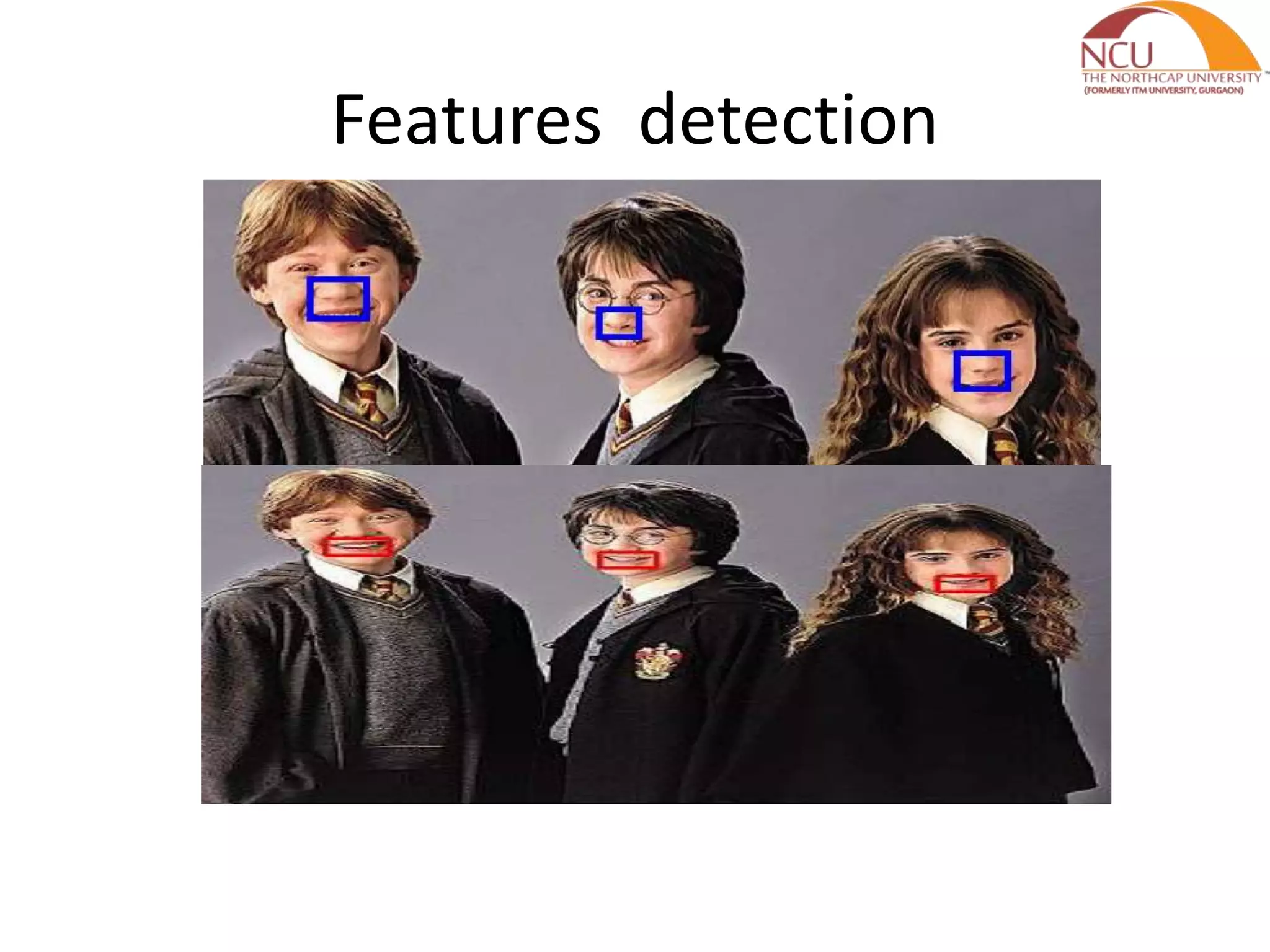
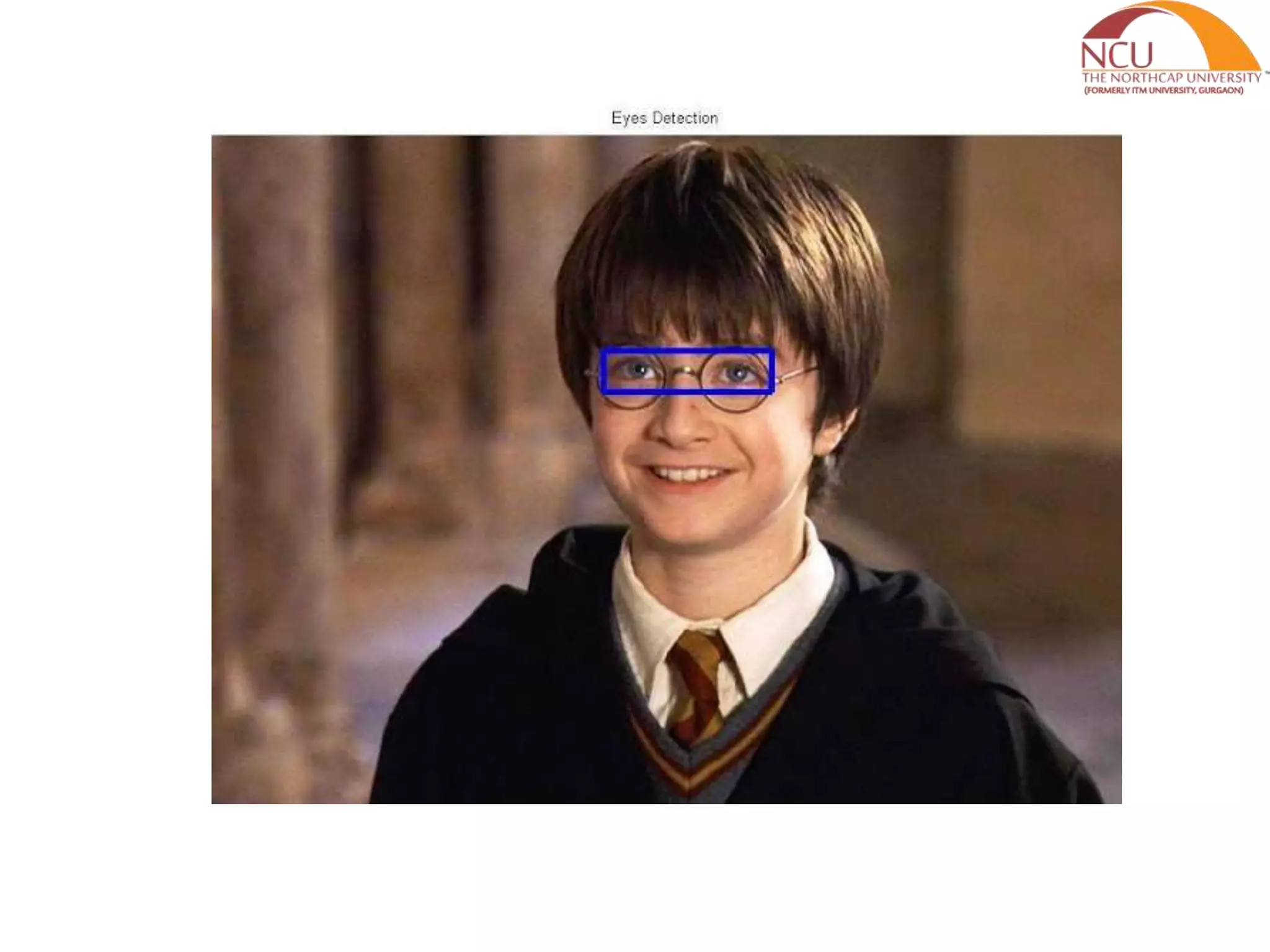
• Faces and features detected
• Conclusion
• Work Plan for next semester
• References
Literature Survey
• Back Propagation-most popular and simplified training
algorithm of feed forward neural network.
• A supervised learning algorithm.
• Uses sigmoid activation function.
• Prescribes a gradient based weight update rule to
learn a pair of input / output vectors in a feed forward
neural network.
• Consists of propagation feed forward and back
propagation of activation and error function.
• In feed forward the weights and biases are fixed is
fixed while in backward they change in accordance
with error correction rule.
• By using Local minimum detector algorithm we can
avoid trapping in local minima problem.
Face Detection
• Face detection /recognition is employed for
surveillance so as to identify or verify a face
from the available facial data base.
• Some facial algorithms identify by doing facial
feature extraction , or by analyzing relative
position , size and or shape of eyes ,
cheekbones etc.
• These features are then used to search images
with matching features.
• Other algorithms normalize a gallery of face
images and then compress the face data ,
saving only the data useful in image
recognition.
• A probe is then compared with face data .
Face Recognition Algorithms
• Viola Jones Face detection algorithm
• Local Binary Pattern
• Adaptive boost algorithm
• Principal Component Analysis
• Independent Component Analysis
• Eigen Space based algorithm
• Kernel methods
• Hidden Markov Model
Viola Jones Algorithm
• The Viola–Jones object detection
framework is the first object
detection framework to provide competitive
object detection rates in real-time proposed in
2001 by Paul Violaand Michael Jones.
• Although it can be trained to detect a variety
of object classes, it was motivated primarily by
the problem of face detection.
• This algorithm is implemented
in OpenCV as cvHaarDetectObjects().k
Feature Types and Evaluation
• The characteristics of Viola–Jones algorithm which
make it a good detection algorithm are:
• Robust – very high detection rate (true-positive rate) &
very low false-positive rate always.
• Real time – For practical applications at least 2 frames
per second must be processed.
• Face detection only (not recognition) - The goal is to
distinguish faces from non-faces (detection is the first
step in the recognition process).
• The algorithm has four stages:
• Haar Feature Selection
• Creating an Integral Image
• Ada boost Training
• Cascading Classifiers
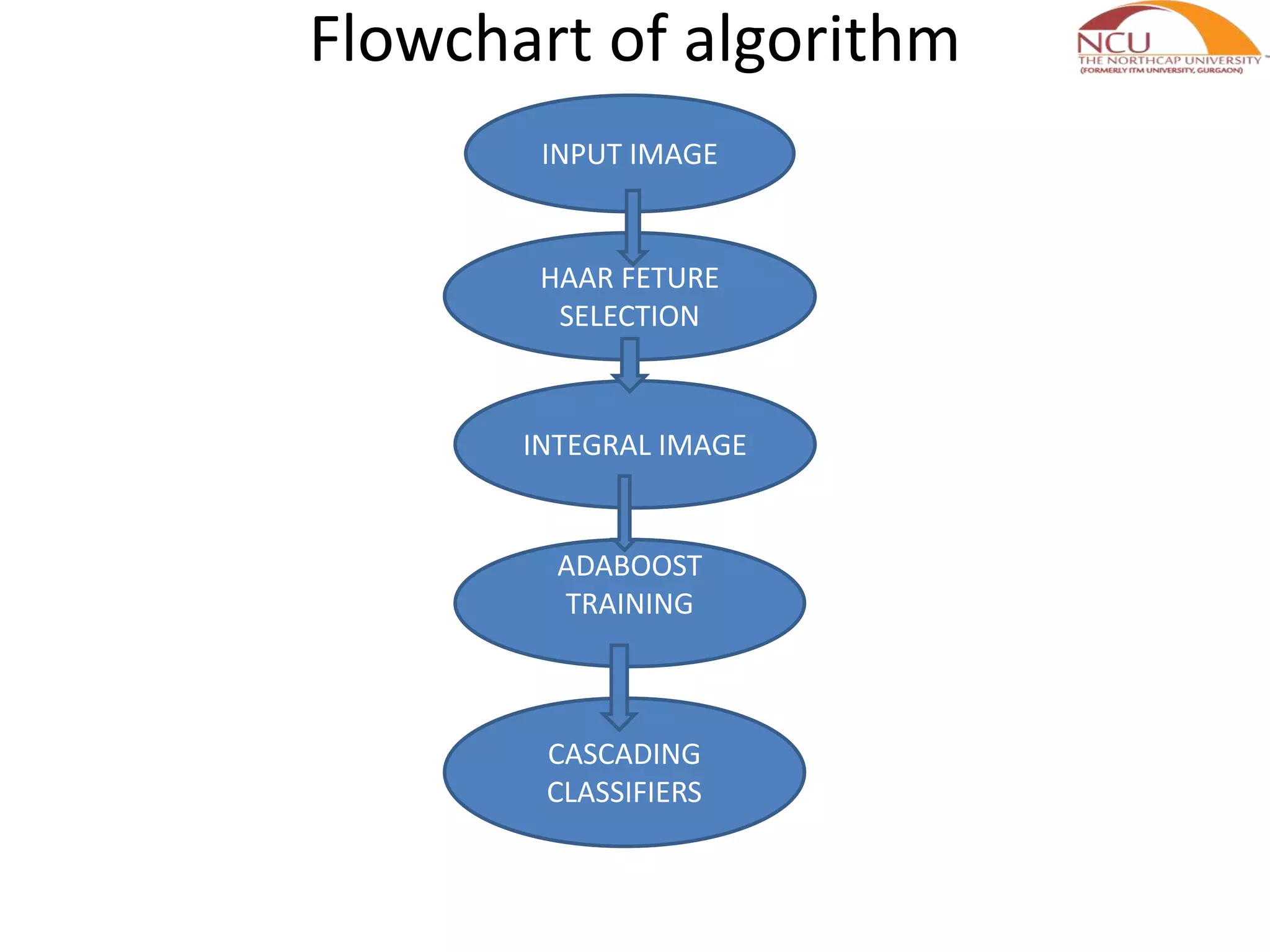
Flowchart of algorithm
INPUT IMAGE
HAAR FETURE
SELECTION
INTEGRAL IMAGE
ADABOOST
TRAINING
CASCADING
CLASSIFIERS
Haar Features
• Haar Features – All human faces share some
similar properties. These regularities may be
matched using Haar Features.
• A few properties common to human faces:
• The eye region is darker than the upper-cheeks.
• The nose bridge region is brighter than the eyes.
• Composition of properties forming matchable
facial features:
• Location and size: eyes, mouth, bridge of nose
• Value: oriented gradients of pixel intensities
Continue….
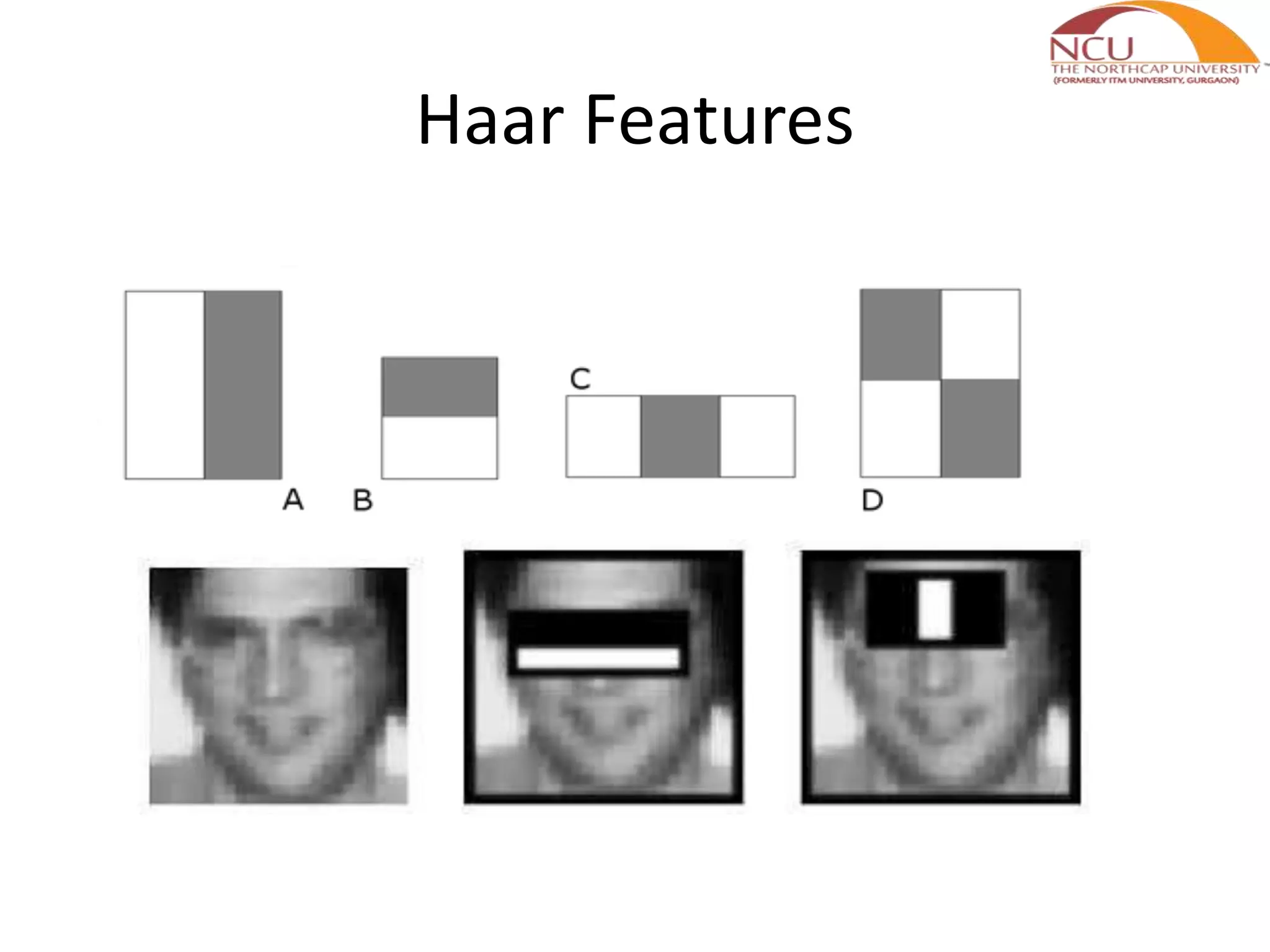
• The four features matched by this algorithm are then
sought in the image of a face (shown at left).
• Rectangle features:
• Value = Σ (pixels in black area) - Σ (pixels in white area)
• Three types: two-, three-, four-rectangles, Viola &
Jones used two-rectangle features
• For example: the difference in brightness between the
white &black rectangles over a specific area
• Each feature is related to a special location in the sub-
window
Haar Features
Creating an integral image
• An image representation called the integral
image evaluates rectangular features in constant time,
which gives them a considerable speed advantage over
more sophisticated alternative features.
• Because each feature's rectangular area is always
adjacent to at least one other rectangle, it follows that
any two-rectangle feature can be computed in six array
references, any three-rectangle feature in eight, and
any four-rectangle feature in nine.
• The integral image at location (x,y), is the sum of the
pixels above and to the left of (x,y), inclusive.
Advantages
• Extremely fast feature computation
• Efficient feature selection
• Scale and location invariant detector
• Instead of scaling the image itself (e.g.
pyramid-filters), we scale the features.
• Such a generic detection scheme can be
trained for detection of other types of objects
(e.g. cars, hands)
Limitations
• Detector is most effective only on frontal
images of faces
• It can hardly cope with 45° face rotation both
around the vertical and horizontal axis.
• Sensitive to lighting conditions
• We might get multiple detections of the same
face, due to overlapping sub-windows.
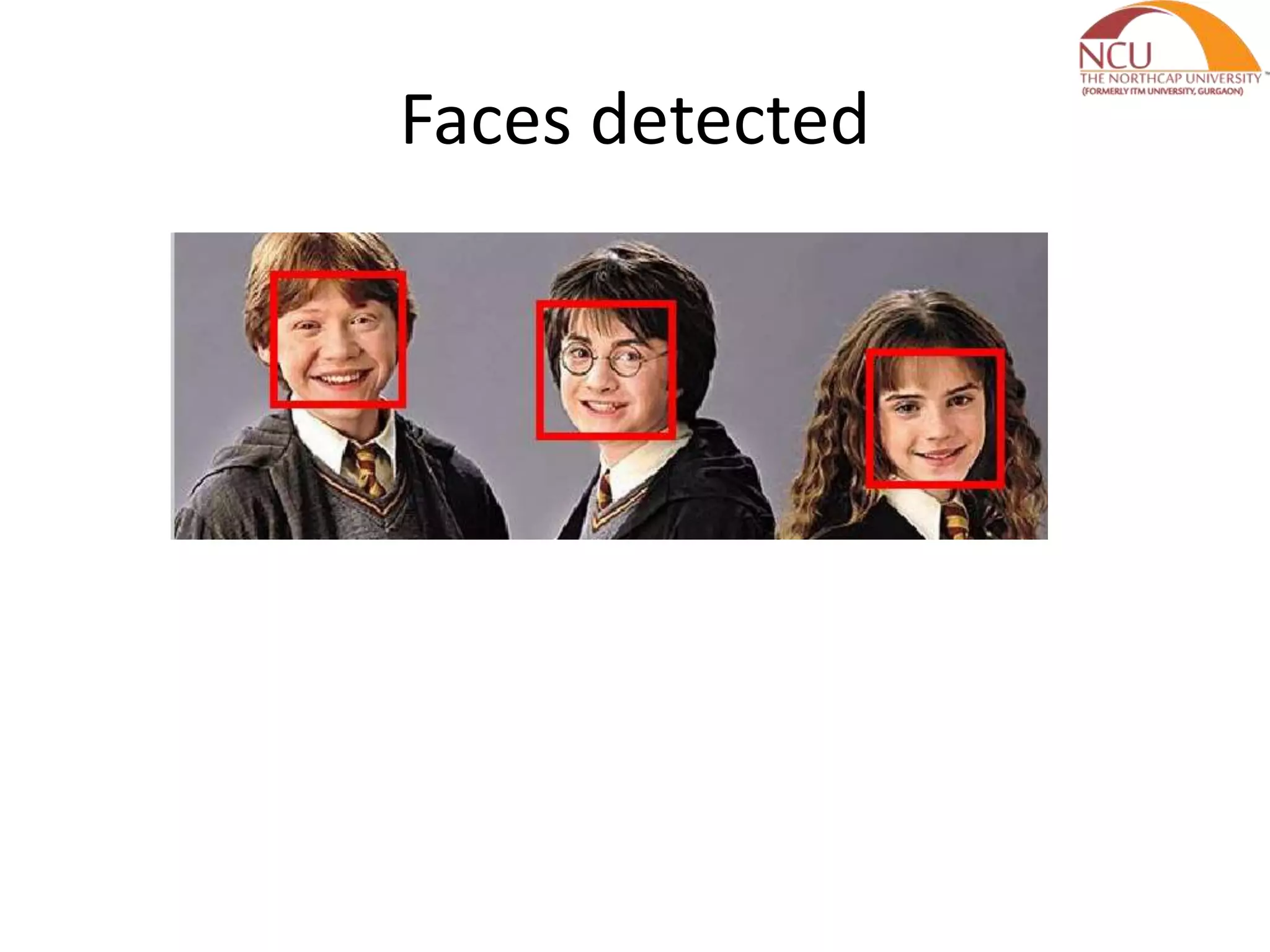
Faces detected
Features detection
Conclusion
• Facial detection is influenced by clarity of the
image , colored or black and white image .
• It can only support frontal detection of
images.
• The training does takes a lot of time in order
to separate a negative face from a positive
face.
• Using Adaptive boost algorithm and cascading
helps in faster detection.
Work Plan for Next semester
• Face Recognition
• Feature extraction and recognition
• Facial image of each person to be collected in n
number of samples for testing and comparison.
• Using Back propagation Neural Network to
contemplate the facial recognition system
• Using Neural Network Fitting Tool for network
generalization and checking the performance in
terms of mean square errors.
• Training to be performed again and again to
reduce the error.
References
• N. Revathy, “Face Recognition using Back Propagation
ANN’s”, International Journal of Advance Engineering
Technology”, Vol-3 issue 1, 2012.
• Tej Pal Singh TIT Bhopal ,“Face recognition using feed
forward back propagation neural network“,
International Journal of Innovative Research in
Technology & Science(IJIRTS) , vol-1
Number1,ISSN:2321-1156 , March 30,2013
• http://utarcvis.blogspot.in/2007/09/robust-real-time-
face-detection-by-paul.html.
• https://www.youtube.com/watch?v=WfdYYNamHZ8.
• https://en.wikipedia.org/wiki/Viola%E2%80%93Jones_
object_detection_framework.

face detection

  • 1.
    Face Recognition UsingBack Propagation Neural Network Supervised by Made By Dr. Nitin Malik Smriti Tikoo ECE Dept. 14-ECP-015 Mtech-ECE
  • 2.
    Agenda • Literature Survey •Face detection • Face detection algorithms • Viola Jones algorithm • Flowchart of algorithm • Feature types and Evaluation • Haar Features • Creating an integral image • Advantages • Limitations • Faces and features detected • Conclusion • Work Plan for next semester • References
  • 3.
    Literature Survey • BackPropagation-most popular and simplified training algorithm of feed forward neural network. • A supervised learning algorithm. • Uses sigmoid activation function. • Prescribes a gradient based weight update rule to learn a pair of input / output vectors in a feed forward neural network. • Consists of propagation feed forward and back propagation of activation and error function. • In feed forward the weights and biases are fixed is fixed while in backward they change in accordance with error correction rule. • By using Local minimum detector algorithm we can avoid trapping in local minima problem.
  • 4.
    Face Detection • Facedetection /recognition is employed for surveillance so as to identify or verify a face from the available facial data base. • Some facial algorithms identify by doing facial feature extraction , or by analyzing relative position , size and or shape of eyes , cheekbones etc. • These features are then used to search images with matching features.
  • 5.
    • Other algorithmsnormalize a gallery of face images and then compress the face data , saving only the data useful in image recognition. • A probe is then compared with face data .
  • 6.
    Face Recognition Algorithms •Viola Jones Face detection algorithm • Local Binary Pattern • Adaptive boost algorithm • Principal Component Analysis • Independent Component Analysis • Eigen Space based algorithm • Kernel methods • Hidden Markov Model
  • 7.
    Viola Jones Algorithm •The Viola–Jones object detection framework is the first object detection framework to provide competitive object detection rates in real-time proposed in 2001 by Paul Violaand Michael Jones. • Although it can be trained to detect a variety of object classes, it was motivated primarily by the problem of face detection. • This algorithm is implemented in OpenCV as cvHaarDetectObjects().k
  • 8.
    Feature Types andEvaluation • The characteristics of Viola–Jones algorithm which make it a good detection algorithm are: • Robust – very high detection rate (true-positive rate) & very low false-positive rate always. • Real time – For practical applications at least 2 frames per second must be processed. • Face detection only (not recognition) - The goal is to distinguish faces from non-faces (detection is the first step in the recognition process). • The algorithm has four stages: • Haar Feature Selection • Creating an Integral Image • Ada boost Training • Cascading Classifiers
  • 9.
    Flowchart of algorithm INPUTIMAGE HAAR FETURE SELECTION INTEGRAL IMAGE ADABOOST TRAINING CASCADING CLASSIFIERS
  • 10.
    Haar Features • HaarFeatures – All human faces share some similar properties. These regularities may be matched using Haar Features. • A few properties common to human faces: • The eye region is darker than the upper-cheeks. • The nose bridge region is brighter than the eyes. • Composition of properties forming matchable facial features: • Location and size: eyes, mouth, bridge of nose • Value: oriented gradients of pixel intensities
  • 11.
    Continue…. • The fourfeatures matched by this algorithm are then sought in the image of a face (shown at left). • Rectangle features: • Value = Σ (pixels in black area) - Σ (pixels in white area) • Three types: two-, three-, four-rectangles, Viola & Jones used two-rectangle features • For example: the difference in brightness between the white &black rectangles over a specific area • Each feature is related to a special location in the sub- window
  • 12.
  • 13.
    Creating an integralimage • An image representation called the integral image evaluates rectangular features in constant time, which gives them a considerable speed advantage over more sophisticated alternative features. • Because each feature's rectangular area is always adjacent to at least one other rectangle, it follows that any two-rectangle feature can be computed in six array references, any three-rectangle feature in eight, and any four-rectangle feature in nine. • The integral image at location (x,y), is the sum of the pixels above and to the left of (x,y), inclusive.
  • 14.
    Advantages • Extremely fastfeature computation • Efficient feature selection • Scale and location invariant detector • Instead of scaling the image itself (e.g. pyramid-filters), we scale the features. • Such a generic detection scheme can be trained for detection of other types of objects (e.g. cars, hands)
  • 15.
    Limitations • Detector ismost effective only on frontal images of faces • It can hardly cope with 45° face rotation both around the vertical and horizontal axis. • Sensitive to lighting conditions • We might get multiple detections of the same face, due to overlapping sub-windows.
  • 16.
  • 17.
  • 19.
    Conclusion • Facial detectionis influenced by clarity of the image , colored or black and white image . • It can only support frontal detection of images. • The training does takes a lot of time in order to separate a negative face from a positive face. • Using Adaptive boost algorithm and cascading helps in faster detection.
  • 20.
    Work Plan forNext semester • Face Recognition • Feature extraction and recognition • Facial image of each person to be collected in n number of samples for testing and comparison. • Using Back propagation Neural Network to contemplate the facial recognition system • Using Neural Network Fitting Tool for network generalization and checking the performance in terms of mean square errors. • Training to be performed again and again to reduce the error.
  • 21.
    References • N. Revathy,“Face Recognition using Back Propagation ANN’s”, International Journal of Advance Engineering Technology”, Vol-3 issue 1, 2012. • Tej Pal Singh TIT Bhopal ,“Face recognition using feed forward back propagation neural network“, International Journal of Innovative Research in Technology & Science(IJIRTS) , vol-1 Number1,ISSN:2321-1156 , March 30,2013 • http://utarcvis.blogspot.in/2007/09/robust-real-time- face-detection-by-paul.html. • https://www.youtube.com/watch?v=WfdYYNamHZ8. • https://en.wikipedia.org/wiki/Viola%E2%80%93Jones_ object_detection_framework.