Neural NetworkGuided byChapala MaharanaSubmitted By-Nilmani SinghBranch-CSERegd. No.-0601289251
Contents.Introduction to Neural Network.Neurons.Activation Function.Types of Neural Network.Learning In Neural Networks.Application of  Neural Network.Advantages of Neural Network.Disadvantages Of Neural Network
Neural NetworksA method of computing, based on the interaction of multiple connected processing elements.
A  powerful technique to solve many real world problems.
The ability to learn from experience in order to improve their performance.
Ability to deal with incomplete informationBasics Of Neural NetworkBiological approach to AI
Developed in 1943
Comprised of one or more layers of neurons
Several types, we’ll focus on feed-forward and feedback networksNeuronsBiologicalArtificial
Neural Network NeuronsReceives n-inputsMultiplies each input by its weightApplies activation function to the sum of resultsOutputs result
Activation FunctionsControls when unit is “active” or “inactive”Threshold function outputs 1 when input is positive and 0 otherwiseSigmoid function = 1 / (1 + e-x)
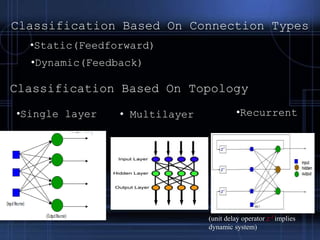
Types of Neural NetworksNeural Network types can be classified based on following attributes:Connection Type	- Static (feedforward)	- Dynamic (feedback)  Topology 	- Single layer	- Multilayer	- Recurrent  Learning Methods	- Supervised	- Unsupervised - Reinforcement
Classification Based On Connection TypesStatic(Feedforward)
Dynamic(Feedback)Classification Based On Topology Recurrent
Single layer
 Multilayer(unit delay operator z-1implies dynamic system)
Classification Based On Learning MethodSupervisedUnsupervisedReinforcementSupervised learning Each training pattern: input + desired output
 At each presentation: adapt weights
 After many epochs convergence to a    local minimumUnsupervised LearningNo help from the outsideNo training data, no information available on the desired outputLearning by doingUsed to pick out structure in the input:ClusteringReduction of dimensionality  compressionExample: Kohonen’s Learning Law

neural network

  • 1.
    Neural NetworkGuided byChapalaMaharanaSubmitted By-Nilmani SinghBranch-CSERegd. No.-0601289251
  • 2.
    Contents.Introduction to NeuralNetwork.Neurons.Activation Function.Types of Neural Network.Learning In Neural Networks.Application of Neural Network.Advantages of Neural Network.Disadvantages Of Neural Network
  • 3.
    Neural NetworksA methodof computing, based on the interaction of multiple connected processing elements.
  • 4.
    A powerfultechnique to solve many real world problems.
  • 5.
    The ability tolearn from experience in order to improve their performance.
  • 6.
    Ability to dealwith incomplete informationBasics Of Neural NetworkBiological approach to AI
  • 7.
  • 8.
    Comprised of oneor more layers of neurons
  • 9.
    Several types, we’llfocus on feed-forward and feedback networksNeuronsBiologicalArtificial
  • 10.
    Neural Network NeuronsReceivesn-inputsMultiplies each input by its weightApplies activation function to the sum of resultsOutputs result
  • 11.
    Activation FunctionsControls whenunit is “active” or “inactive”Threshold function outputs 1 when input is positive and 0 otherwiseSigmoid function = 1 / (1 + e-x)
  • 12.
    Types of NeuralNetworksNeural Network types can be classified based on following attributes:Connection Type - Static (feedforward) - Dynamic (feedback) Topology - Single layer - Multilayer - Recurrent Learning Methods - Supervised - Unsupervised - Reinforcement
  • 13.
    Classification Based OnConnection TypesStatic(Feedforward)
  • 14.
  • 15.
  • 16.
    Multilayer(unit delayoperator z-1implies dynamic system)
  • 17.
    Classification Based OnLearning MethodSupervisedUnsupervisedReinforcementSupervised learning Each training pattern: input + desired output
  • 18.
    At eachpresentation: adapt weights
  • 19.
    After manyepochs convergence to a local minimumUnsupervised LearningNo help from the outsideNo training data, no information available on the desired outputLearning by doingUsed to pick out structure in the input:ClusteringReduction of dimensionality  compressionExample: Kohonen’s Learning Law