Face Recognition
using
Neural Network
by Dong Hyun Roh
Computer Science Department
KAIST
content
 face recognition
 related researches
 my system
 experiments
 analysis
 future work
 references
face recognition
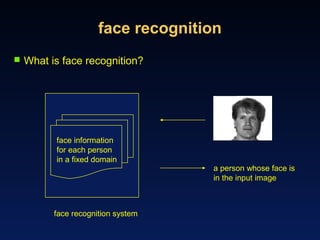
 What is face recognition?
face recognition system
face information
for each person
in a fixed domain
a person whose face is
in the input image
related researches
 Template matching
very simple, very sensitive to noise
 PCA(associative memory)
use PCA to extract important features and to reduce the dimension
of the input data
 Image compression(back propagation network)
use compression network to extract important features and to
reduce the dimension of the input data
this is my approach
 Others
extract visual feature like edges, shape of each components, etc.
My system
 Object
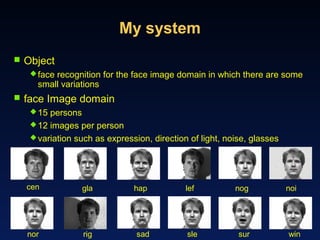
face recognition for the face image domain in which there are some
small variations
 face Image domain
15 persons
12 images per person
variation such as expression, direction of light, noise, glasses
cen gla hap lef nog noi
nor rig sad sle sur win
My system
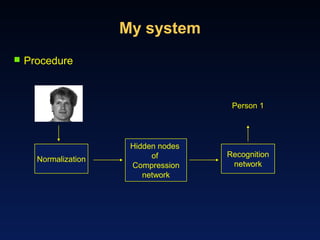
 Procedure
Normalization
Hidden nodes
of
Compression
network
Recognition
network
Person 1
My system
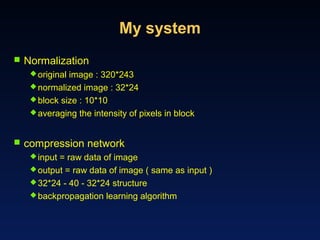
 Normalization
original image : 320*243
normalized image : 32*24
block size : 10*10
averaging the intensity of pixels in block
 compression network
input = raw data of image
output = raw data of image ( same as input )
32*24 - 40 - 32*24 structure
backpropagation learning algorithm
My system
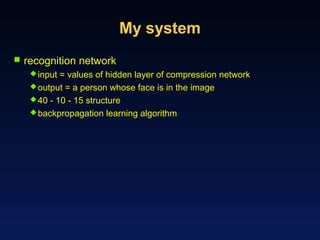
 recognition network
input = values of hidden layer of compression network
output = a person whose face is in the image
40 - 10 - 15 structure
backpropagation learning algorithm
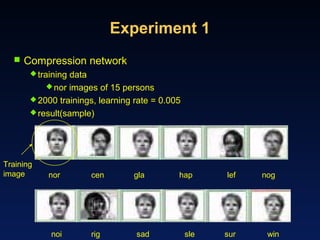
Experiment 1
 Compression network
training data
nor images of 15 persons
2000 trainings, learning rate = 0.005
result(sample)
cen gla hap lef nog
noi
nor
rig sad sle sur win
Training
image
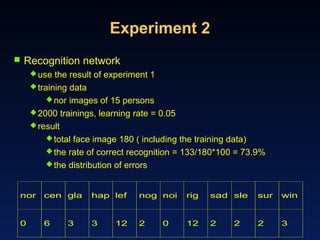
Experiment 2
 Recognition network
use the result of experiment 1
training data
nor images of 15 persons
2000 trainings, learning rate = 0.05
result
total face image 180 ( including the training data)
the rate of correct recognition = 133/180*100 = 73.9%
the distribution of errors
nor cen gla hap lef nog noi rig sad sle sur win
0 6 3 3 12 2 0 12 2 2 2 3
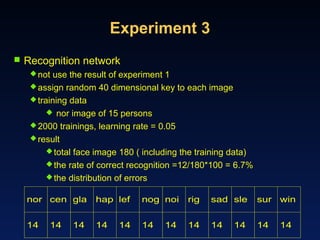
Experiment 3
 Recognition network
not use the result of experiment 1
assign random 40 dimensional key to each image
training data
 nor image of 15 persons
2000 trainings, learning rate = 0.05
result
total face image 180 ( including the training data)
the rate of correct recognition =12/180*100 = 6.7%
the distribution of errors
nor cen gla hap lef nog noi rig sad sle sur win
14 14 14 14 14 14 14 14 14 14 14 14
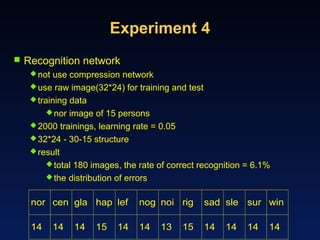
Experiment 4
 Recognition network
not use compression network
use raw image(32*24) for training and test
training data
nor image of 15 persons
2000 trainings, learning rate = 0.05
32*24 - 30-15 structure
result
total 180 images, the rate of correct recognition = 6.1%
the distribution of errors
nor cen gla hap lef nog noi rig sad sle sur win
14 14 14 15 14 14 13 15 14 14 14 14
Analysis
 The hidden of compression network
encode the inputs in a smaller dimensional subspace that retains
most of the important information
if the hidden units are linear, the best solution to this problem is the
least squares solution(i.e. to have the hidden units span the L
principle components with the highest eigenvalues)
Cottrell et al. Found that the weights of 16 hidden units span the
space of the 13 first engenvectors of he covariance matrix of the
inputs.
when transformed to gray scale and graphically displayed, the
hidden unit receptive and projective fields looked “face-like” and
showed some similarity to the eigenvectors or eigenfaces
The hidden value of compression network is very
useful in face recognition!!
Further work
 Improvement of the performance of face recognition
improvement of the compression network
 If the compression network is trained with all face images,
what will be different from experiment 2 ?
The performance of compression network
The performance of recognition network
Reference
 Dominque Valentin, Herve Abdi, Alice J. O’Toole, Garrison
W. Cottrell, “Connectionist Models of Face Processing: A
survey”, 1994

Term11566

  • 1.
    Face Recognition using Neural Network byDong Hyun Roh Computer Science Department KAIST
  • 2.
    content  face recognition related researches  my system  experiments  analysis  future work  references
  • 3.
    face recognition  Whatis face recognition? face recognition system face information for each person in a fixed domain a person whose face is in the input image
  • 4.
    related researches  Templatematching very simple, very sensitive to noise  PCA(associative memory) use PCA to extract important features and to reduce the dimension of the input data  Image compression(back propagation network) use compression network to extract important features and to reduce the dimension of the input data this is my approach  Others extract visual feature like edges, shape of each components, etc.
  • 5.
    My system  Object facerecognition for the face image domain in which there are some small variations  face Image domain 15 persons 12 images per person variation such as expression, direction of light, noise, glasses cen gla hap lef nog noi nor rig sad sle sur win
  • 6.
    My system  Procedure Normalization Hiddennodes of Compression network Recognition network Person 1
  • 7.
    My system  Normalization originalimage : 320*243 normalized image : 32*24 block size : 10*10 averaging the intensity of pixels in block  compression network input = raw data of image output = raw data of image ( same as input ) 32*24 - 40 - 32*24 structure backpropagation learning algorithm
  • 8.
    My system  recognitionnetwork input = values of hidden layer of compression network output = a person whose face is in the image 40 - 10 - 15 structure backpropagation learning algorithm
  • 9.
    Experiment 1  Compressionnetwork training data nor images of 15 persons 2000 trainings, learning rate = 0.005 result(sample) cen gla hap lef nog noi nor rig sad sle sur win Training image
  • 10.
    Experiment 2  Recognitionnetwork use the result of experiment 1 training data nor images of 15 persons 2000 trainings, learning rate = 0.05 result total face image 180 ( including the training data) the rate of correct recognition = 133/180*100 = 73.9% the distribution of errors nor cen gla hap lef nog noi rig sad sle sur win 0 6 3 3 12 2 0 12 2 2 2 3
  • 11.
    Experiment 3  Recognitionnetwork not use the result of experiment 1 assign random 40 dimensional key to each image training data  nor image of 15 persons 2000 trainings, learning rate = 0.05 result total face image 180 ( including the training data) the rate of correct recognition =12/180*100 = 6.7% the distribution of errors nor cen gla hap lef nog noi rig sad sle sur win 14 14 14 14 14 14 14 14 14 14 14 14
  • 12.
    Experiment 4  Recognitionnetwork not use compression network use raw image(32*24) for training and test training data nor image of 15 persons 2000 trainings, learning rate = 0.05 32*24 - 30-15 structure result total 180 images, the rate of correct recognition = 6.1% the distribution of errors nor cen gla hap lef nog noi rig sad sle sur win 14 14 14 15 14 14 13 15 14 14 14 14
  • 13.
    Analysis  The hiddenof compression network encode the inputs in a smaller dimensional subspace that retains most of the important information if the hidden units are linear, the best solution to this problem is the least squares solution(i.e. to have the hidden units span the L principle components with the highest eigenvalues) Cottrell et al. Found that the weights of 16 hidden units span the space of the 13 first engenvectors of he covariance matrix of the inputs. when transformed to gray scale and graphically displayed, the hidden unit receptive and projective fields looked “face-like” and showed some similarity to the eigenvectors or eigenfaces The hidden value of compression network is very useful in face recognition!!
  • 14.
    Further work  Improvementof the performance of face recognition improvement of the compression network  If the compression network is trained with all face images, what will be different from experiment 2 ? The performance of compression network The performance of recognition network
  • 15.
    Reference  Dominque Valentin,Herve Abdi, Alice J. O’Toole, Garrison W. Cottrell, “Connectionist Models of Face Processing: A survey”, 1994