Shri. Shamrao Patil (Yadravkar) Educational & Charitable Trust’s
Sharad Institute of Technology, College of Engineering Yadrav- (Ichalkaranji)
(Approved by AICTE, New Delhi, Recognized by Government of Maharashtra & Affiliated to DBATU, Lonere)
Accredited by NAAC ‘A’ Grade and NBA, ISO 9001:2015 Certified Institute
Recognized u/s 2(f) and 12(B) of the UGC Act 1956
Heat Treatment
Content:
Heat treatment of steels, cooling media, annealing processes,
normalizing, hardening, tempering, quenching and hardenability, surface
hardening processes-nitriding, carbo-nitriding, flame hardening,
induction hardening.
Heat treatment of steels
"A combination of heating and cooling operations timed and applied to a
metal or alloy in the solid state in a way that will produce desired
properties.“
All basic heat-treating processes for steel involve the transformation or
decomposition of austenite.
The nature and appearance of these transformation products determine
the physical and mechanical proper ties of any given steel.
Full Annealing
This process consists in heating the steel to the proper temperature and
then cooling slowly through the transformation range, preferably in the
furnace or in any good heat-insulating material. The slow cooling is
generally continued to low temperatures.
The purpose of annealing may be to refine the grain, induce softness,
improve electrical and magnetic properties, and, in some cases, to
improve machinability.
Since the entire mass of the furnace must be cooled down along with the
material, annealing is a very slow cooling process and therefore comes
closest to following the iron-iron carbide equilibrium diagram.
Fig. 1 Schematic representation of the changes in microstructure during the annealing of a
0.20 percent carbon steel.
(a) Original structure, coarse-grained ferrite and pearlite.
(b) Just above the A1 line; pearlite has transformed to small grains of austenite, ferrite unchanged.
(c) Above the A3 line; only fine-grained austenite.
(d) After cooling to room temperature; fine-grained ferrite and small pearlite areas
Fig. 2 proportion of the constituents present in the microstructure of annealed steels as a
function of carbon content
Fig. 3 Annealing, normalizing and hardening range for plain carbon steel
Stress-relief Annealing This process, sometimes called subcritical annealing is useful in
removing residual stresses due to heavy machining or other cold-working processes. It is
usually carried out at temperatures below the lower critical line (1000 to 1200°F).
Process Annealing This heat treatment is used in the sheet and wire industries and is
carried out by heating the steel to a temperature below the lower critical line (1000 to
1250°F). It is applied after cold working and softens the steel, by recrystallization, for
further working. It is very similar to stress-relief annealing.
Normalizing The normalizing of steel is carried out by heating approximately 100°F
above the upper-critical-temperature (A3 or A cm) line followed by cooling in still air to
room temperature. The temperature range for normalizing The purpose of normalizing is
to produce a harder and stronger steel than full annealing, so that for some applications
normalizing may be a final heat treatment.
Fig. 4 Normalized 0.50 percent carbon steel heated to 18000 F and air cooled
Fig. 5 Schematic picture of the difference in pearlitic structure due to
annealing and normalizing.
Annealed Normalized
Less hardness, tensile strength and
toughness
Slightly more hardness, tensile
strength and toughness
Pearlite is coarse and usually gets
resolved by the optical microscope
Pearlite is fine and usually appears
unresolved with optical microscope
Grain size distribution is more
uniform
Grain size distribution is slightly
less uniform
Internal stresses are least Internal stresses are slightly more
Annealed Vs Normalized
Hardening
Certain applications demand high tensile strength and hardness values so that the components
may be successfully used for heavy duty purposes. High tensile strength and hardness values
can be obtained by a processes known as Hardening.
hardening process consists of four steps. The first step involves heating the steel to above A3
temperature for hypoeutectoid steels and above A1 temperature for hypereutectoid steels by
500C.
The second step involves holding the steel components for sufficient socking time for
homogeneous austenization.
The third step involves cooling of hot steel components at a rate just exceeding the critical
cooling rate of the steel to room temperature or below room temperature.
The final step involves the tempering of the martensite to achieve the desired hardness.
Detailed explanation about tempering is given in the subsequent sections. In this hardening
process, the austenite transforms to martensite. This martensite structure improves the
hardness.
In the hardening process, which involves quenching and tempering. During quenching outer
surface is cooled quicker than the center. In other words the transformation of the austenite is
proceeding at different rates. Hence there is a limit to the overall size of the part in this
hardening process.
A few salient features in hardening of steel
Proper quenching medium should be used such that the component gets cooled at a rate
just exceeding the critical cooling rate of that steel.
Alloy steels have less critical cooling rate and hence some of the alloy steels can be
hardened by simple air cooling.
High carbon steels have slightly more critical cooling rate and has to be hardened by oil
quenching.
Medium carbon steels have still higher critical cooling rates and hence water or brine
quenching is necessary.
Factors affecting Hardening Processes
Chemical composition of steel
Size and shape of the steel part
Hardening cycle (heating/cooling rate, temp, soak time
Homogeneity and grain size of austenite
Quenching media
Surface condition of steel part
Hardening Methods
Conventional or direct quenching
Quenching in stages in sequence in different media
Spray Quenching
Quenching with self tempering
Austempering or Isothermal Quenching
Martempering
Tempering
The hardened steel is not readily suitable for engineering applications. It
possesses following three drawbacks.
Martensite obtained after hardening is extremely brittle and will result in failure
of engineering components by cracking.
Formation of martensite from austenite by quenching produces high internal
stresses in the hardened steel.
Structures obtained after hardening consists of martensite and retained austenite.
Both these phases are metastable and will change to stable phases with time
which subsequently results in change in dimensions and properties of the steel in
service.
Tempering helps in reduce these problems. Tempering is the process of heating
the hardened steel to a temperature maximum up to lower critical temperature
(A1), soaking at this temperature, and then cooling, normally very slowly.
Fig. Variation in properties with tempering temperature
Tempering
Objective
Relieve Internal stresses
Restore ductility and toughness
To improve dimensional stability
To improve magnetic properties
Structure in as Quenched state
Highly supersaturated martensite
Retained austenite
Undissolved carbides
Rods, or plates of carbide particles produced during ‘auto-tempering’
Segregation of carbon
Tempering of plain carbon steels
First stage of Tempering
First Stage of tempering temperature extends from room temperature to 200°C. The
tempering reactions in steels, containing carbon less than 0.2%, differ somewhat from the
steels containing more than 0.2% carbon.
In the former, if carbon atoms have not yet segregated (during quenching) to dislocations,
these diffuse and segregate around the dislocations and lath boundaries in the first stage of
tempering. No ε-carbide forms as all the carbon gets locked up to the dislocations (defects).
Martensite in steels with more than 0.2% carbon is highly unstable because of super
saturation, and interstitial diffusion of carbon in BCT martensite can occur. Thus in the first
stage of Tempering stage of tempering, the decomposition of martensite into low-
tetragonality martensite.
ε-carbide is a separate phase and is not a preliminary step in the formation of cementite, but
it nucleates and grows more rapidly than cementite. It has HCP structure with c = 4.33A°, a
= 2.73A°, c/a = 1.58A° and forms as small (0.015-0.02 μm) platelets, or needles observed
under electron microscope.
The structure at this stage referred to as tempered martensite, which is double phase
mixture of low tetragonal martensite and ε-carbide.
In this stage volume ↓ because specific volume of martensite ↓ due to rejecting of C
at1o54ms.
Second stage of Tempering
Second Stage of tempering temperature lies between 200-300°C. The amount of
retained austenite in the as-quenched steel depends mainly on the composition of
the steel, and the temperature to which steel is quenched.
In the second stage of tempering retained austenite transforms to lower bainite (the
carbide in bainite is ε-carbide). The matrix in lower bainite is cubic ferrite (c/a =
1), where as in tempered martensite, the low tetragonal martensite has c/a ~ 1.014
When retained austenite changes to lower bainite, their takes place increase in
volume.
Third stage of Tempering
Third Stage of tempering temperature lies between 200-350°C. In this stage of
tempering, ε-carbide dissolves in matrix, and low tetragonal martensite losses its
completely its carbon and thus, the tetragonality to become ferrite.
Cementite forms as rods at interfaces of ε-carbide and matrix, twin boundaries,
interlath boundaries, or original austenite grain boundaries.
During this stage, volume decreases just as in stage one, due to complete loss of
tetragonality. In a 1% carbon steel , the total decrease in length in the first and
third stages in around 0.25%
Fourth stage of Tempering
Fourth Stage of tempering temperature lies between 350-700°C.
Growth and spheroidisation of cementite, as well as recovery and Recrystallization of ferrite
occur. Though the growth of cementite starts above 300°C, its spheroidisation starts above
400°C to 700°C.
Spheroidisation takes place due to reduction in interfacial energy of ferrite-cementite
interfaces. As quenched martensite has high concentration of lattice defects. Though their
annealing out starts in the third stage of tempering, but the cementite precipitates retard the
recovery processes.
Substantial recovery processes starts occurring only above 400°C. original lathe boundaries
are stable up to 600°C, but above this, these are replaced by equiaxed-ferrite grain
boundaries – the process, which is best described as ‘Recrystallization’.
In the end, the optical microstructure consists of equiaxed ferrite grains with coarse
Spheroidal particles of cementite, and then the structure is called globular pearlite, or
spheroidized cementite.
The structure perhaps is the most stable of all ferrite- cementite aggregates, and is the softest
with highest ductility with best machinability.
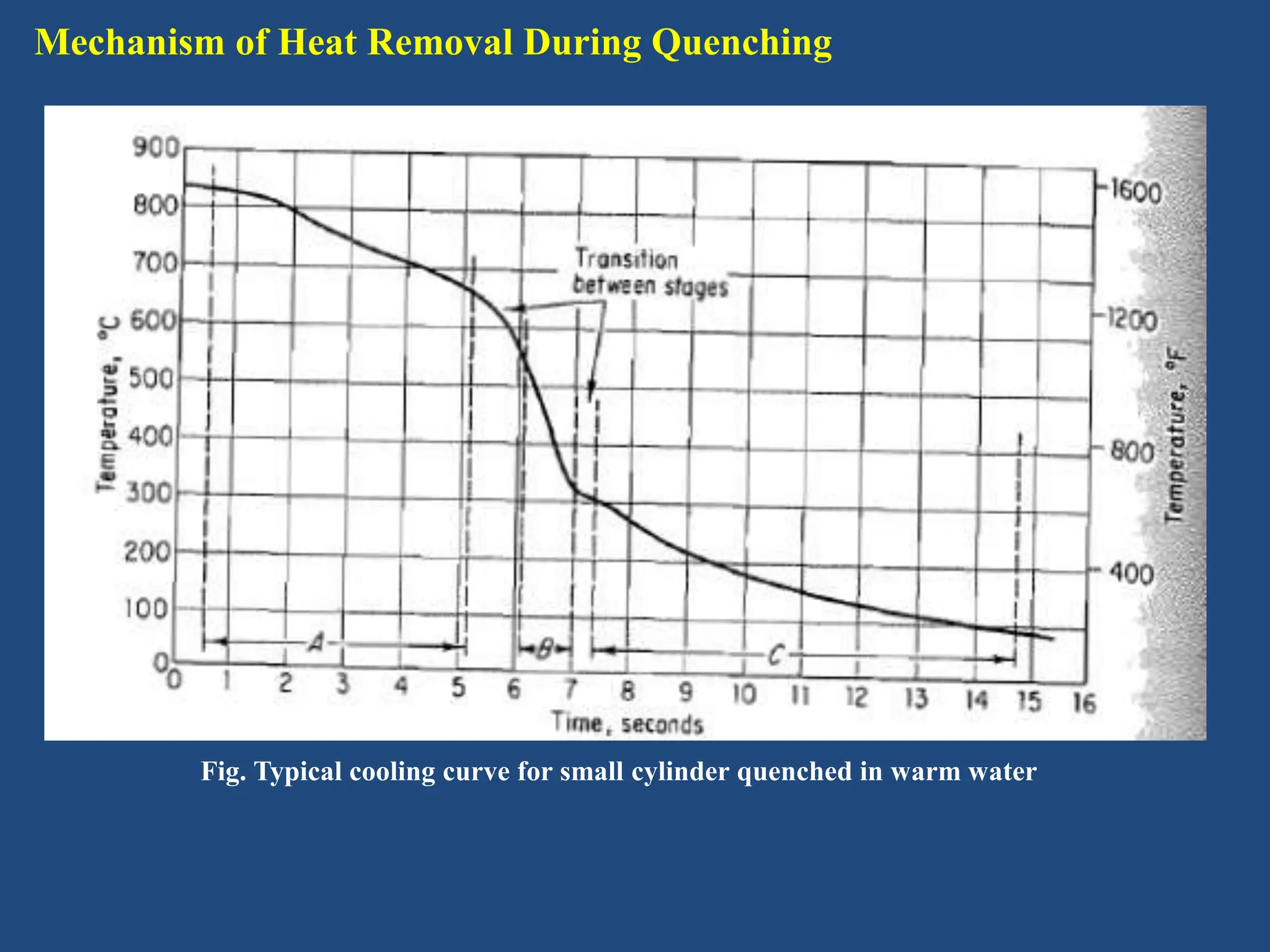
Mechanism of Heat Removal During Quenching
Fig. Typical cooling curve for small cylinder quenched in warm water
Quenching Medium
Fig. Center cooling curves for stainless steel specimens
Fig. center-cooling curves for specimens quenched in tap
water at bath temperatures of 75 and 125°F.

Heat treatment of steels and different processes.ppt

  • 1.
    Shri. Shamrao Patil(Yadravkar) Educational & Charitable Trust’s Sharad Institute of Technology, College of Engineering Yadrav- (Ichalkaranji) (Approved by AICTE, New Delhi, Recognized by Government of Maharashtra & Affiliated to DBATU, Lonere) Accredited by NAAC ‘A’ Grade and NBA, ISO 9001:2015 Certified Institute Recognized u/s 2(f) and 12(B) of the UGC Act 1956 Heat Treatment
  • 2.
    Content: Heat treatment ofsteels, cooling media, annealing processes, normalizing, hardening, tempering, quenching and hardenability, surface hardening processes-nitriding, carbo-nitriding, flame hardening, induction hardening. Heat treatment of steels "A combination of heating and cooling operations timed and applied to a metal or alloy in the solid state in a way that will produce desired properties.“ All basic heat-treating processes for steel involve the transformation or decomposition of austenite. The nature and appearance of these transformation products determine the physical and mechanical proper ties of any given steel.
  • 3.
    Full Annealing This processconsists in heating the steel to the proper temperature and then cooling slowly through the transformation range, preferably in the furnace or in any good heat-insulating material. The slow cooling is generally continued to low temperatures. The purpose of annealing may be to refine the grain, induce softness, improve electrical and magnetic properties, and, in some cases, to improve machinability. Since the entire mass of the furnace must be cooled down along with the material, annealing is a very slow cooling process and therefore comes closest to following the iron-iron carbide equilibrium diagram.
  • 4.
    Fig. 1 Schematicrepresentation of the changes in microstructure during the annealing of a 0.20 percent carbon steel. (a) Original structure, coarse-grained ferrite and pearlite. (b) Just above the A1 line; pearlite has transformed to small grains of austenite, ferrite unchanged. (c) Above the A3 line; only fine-grained austenite. (d) After cooling to room temperature; fine-grained ferrite and small pearlite areas
  • 5.
    Fig. 2 proportionof the constituents present in the microstructure of annealed steels as a function of carbon content
  • 6.
    Fig. 3 Annealing,normalizing and hardening range for plain carbon steel
  • 7.
    Stress-relief Annealing Thisprocess, sometimes called subcritical annealing is useful in removing residual stresses due to heavy machining or other cold-working processes. It is usually carried out at temperatures below the lower critical line (1000 to 1200°F). Process Annealing This heat treatment is used in the sheet and wire industries and is carried out by heating the steel to a temperature below the lower critical line (1000 to 1250°F). It is applied after cold working and softens the steel, by recrystallization, for further working. It is very similar to stress-relief annealing. Normalizing The normalizing of steel is carried out by heating approximately 100°F above the upper-critical-temperature (A3 or A cm) line followed by cooling in still air to room temperature. The temperature range for normalizing The purpose of normalizing is to produce a harder and stronger steel than full annealing, so that for some applications normalizing may be a final heat treatment.
  • 8.
    Fig. 4 Normalized0.50 percent carbon steel heated to 18000 F and air cooled Fig. 5 Schematic picture of the difference in pearlitic structure due to annealing and normalizing.
  • 9.
    Annealed Normalized Less hardness,tensile strength and toughness Slightly more hardness, tensile strength and toughness Pearlite is coarse and usually gets resolved by the optical microscope Pearlite is fine and usually appears unresolved with optical microscope Grain size distribution is more uniform Grain size distribution is slightly less uniform Internal stresses are least Internal stresses are slightly more Annealed Vs Normalized
  • 10.
    Hardening Certain applications demandhigh tensile strength and hardness values so that the components may be successfully used for heavy duty purposes. High tensile strength and hardness values can be obtained by a processes known as Hardening. hardening process consists of four steps. The first step involves heating the steel to above A3 temperature for hypoeutectoid steels and above A1 temperature for hypereutectoid steels by 500C. The second step involves holding the steel components for sufficient socking time for homogeneous austenization. The third step involves cooling of hot steel components at a rate just exceeding the critical cooling rate of the steel to room temperature or below room temperature. The final step involves the tempering of the martensite to achieve the desired hardness. Detailed explanation about tempering is given in the subsequent sections. In this hardening process, the austenite transforms to martensite. This martensite structure improves the hardness. In the hardening process, which involves quenching and tempering. During quenching outer surface is cooled quicker than the center. In other words the transformation of the austenite is proceeding at different rates. Hence there is a limit to the overall size of the part in this hardening process.
  • 11.
    A few salientfeatures in hardening of steel Proper quenching medium should be used such that the component gets cooled at a rate just exceeding the critical cooling rate of that steel. Alloy steels have less critical cooling rate and hence some of the alloy steels can be hardened by simple air cooling. High carbon steels have slightly more critical cooling rate and has to be hardened by oil quenching. Medium carbon steels have still higher critical cooling rates and hence water or brine quenching is necessary.
  • 12.
    Factors affecting HardeningProcesses Chemical composition of steel Size and shape of the steel part Hardening cycle (heating/cooling rate, temp, soak time Homogeneity and grain size of austenite Quenching media Surface condition of steel part Hardening Methods Conventional or direct quenching Quenching in stages in sequence in different media Spray Quenching Quenching with self tempering Austempering or Isothermal Quenching Martempering
  • 13.
    Tempering The hardened steelis not readily suitable for engineering applications. It possesses following three drawbacks. Martensite obtained after hardening is extremely brittle and will result in failure of engineering components by cracking. Formation of martensite from austenite by quenching produces high internal stresses in the hardened steel. Structures obtained after hardening consists of martensite and retained austenite. Both these phases are metastable and will change to stable phases with time which subsequently results in change in dimensions and properties of the steel in service. Tempering helps in reduce these problems. Tempering is the process of heating the hardened steel to a temperature maximum up to lower critical temperature (A1), soaking at this temperature, and then cooling, normally very slowly.
  • 14.
    Fig. Variation inproperties with tempering temperature
  • 15.
    Tempering Objective Relieve Internal stresses Restoreductility and toughness To improve dimensional stability To improve magnetic properties Structure in as Quenched state Highly supersaturated martensite Retained austenite Undissolved carbides Rods, or plates of carbide particles produced during ‘auto-tempering’ Segregation of carbon
  • 16.
    Tempering of plaincarbon steels First stage of Tempering First Stage of tempering temperature extends from room temperature to 200°C. The tempering reactions in steels, containing carbon less than 0.2%, differ somewhat from the steels containing more than 0.2% carbon. In the former, if carbon atoms have not yet segregated (during quenching) to dislocations, these diffuse and segregate around the dislocations and lath boundaries in the first stage of tempering. No ε-carbide forms as all the carbon gets locked up to the dislocations (defects). Martensite in steels with more than 0.2% carbon is highly unstable because of super saturation, and interstitial diffusion of carbon in BCT martensite can occur. Thus in the first stage of Tempering stage of tempering, the decomposition of martensite into low- tetragonality martensite. ε-carbide is a separate phase and is not a preliminary step in the formation of cementite, but it nucleates and grows more rapidly than cementite. It has HCP structure with c = 4.33A°, a = 2.73A°, c/a = 1.58A° and forms as small (0.015-0.02 μm) platelets, or needles observed under electron microscope. The structure at this stage referred to as tempered martensite, which is double phase mixture of low tetragonal martensite and ε-carbide. In this stage volume ↓ because specific volume of martensite ↓ due to rejecting of C at1o54ms.
  • 17.
    Second stage ofTempering Second Stage of tempering temperature lies between 200-300°C. The amount of retained austenite in the as-quenched steel depends mainly on the composition of the steel, and the temperature to which steel is quenched. In the second stage of tempering retained austenite transforms to lower bainite (the carbide in bainite is ε-carbide). The matrix in lower bainite is cubic ferrite (c/a = 1), where as in tempered martensite, the low tetragonal martensite has c/a ~ 1.014 When retained austenite changes to lower bainite, their takes place increase in volume.
  • 18.
    Third stage ofTempering Third Stage of tempering temperature lies between 200-350°C. In this stage of tempering, ε-carbide dissolves in matrix, and low tetragonal martensite losses its completely its carbon and thus, the tetragonality to become ferrite. Cementite forms as rods at interfaces of ε-carbide and matrix, twin boundaries, interlath boundaries, or original austenite grain boundaries. During this stage, volume decreases just as in stage one, due to complete loss of tetragonality. In a 1% carbon steel , the total decrease in length in the first and third stages in around 0.25%
  • 19.
    Fourth stage ofTempering Fourth Stage of tempering temperature lies between 350-700°C. Growth and spheroidisation of cementite, as well as recovery and Recrystallization of ferrite occur. Though the growth of cementite starts above 300°C, its spheroidisation starts above 400°C to 700°C. Spheroidisation takes place due to reduction in interfacial energy of ferrite-cementite interfaces. As quenched martensite has high concentration of lattice defects. Though their annealing out starts in the third stage of tempering, but the cementite precipitates retard the recovery processes. Substantial recovery processes starts occurring only above 400°C. original lathe boundaries are stable up to 600°C, but above this, these are replaced by equiaxed-ferrite grain boundaries – the process, which is best described as ‘Recrystallization’. In the end, the optical microstructure consists of equiaxed ferrite grains with coarse Spheroidal particles of cementite, and then the structure is called globular pearlite, or spheroidized cementite. The structure perhaps is the most stable of all ferrite- cementite aggregates, and is the softest with highest ductility with best machinability.
  • 20.
    Mechanism of HeatRemoval During Quenching Fig. Typical cooling curve for small cylinder quenched in warm water
  • 21.
    Quenching Medium Fig. Centercooling curves for stainless steel specimens
  • 22.
    Fig. center-cooling curvesfor specimens quenched in tap water at bath temperatures of 75 and 125°F.