EXTRUSION
Submitted to:
Ms. Navnidhi
Submitted by:
Ramanpreet kaur
13081005
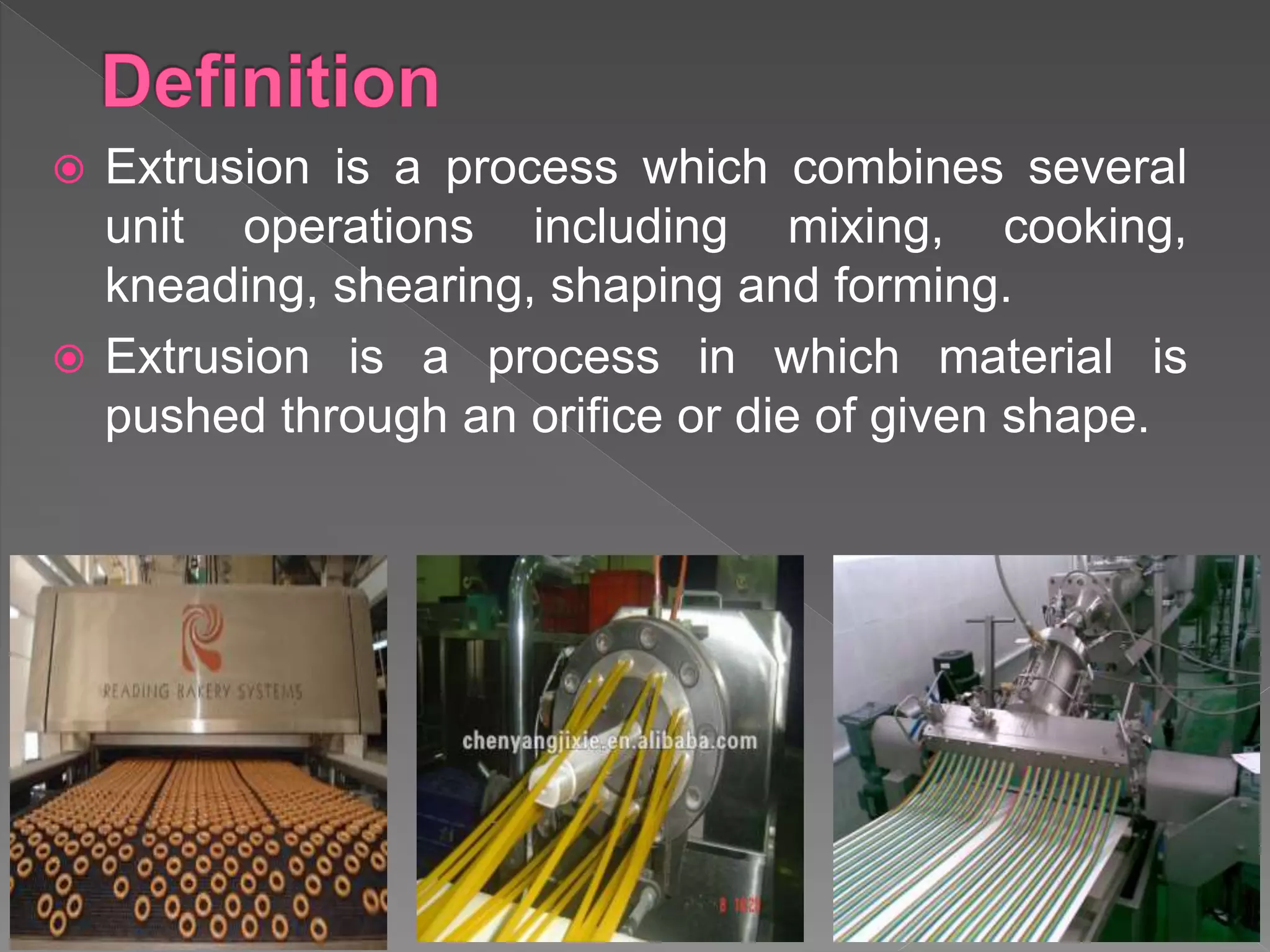
 Extrusion is a process which combines several
unit operations including mixing, cooking,
kneading, shearing, shaping and forming.
 Extrusion is a process in which material is
pushed through an orifice or die of given shape.
Raw materials are fed into bin
Feeder screw conveys the feed
Mixing cylinder mixes and conveys
the feed down to the barrel
Feed fills the barrel and the
spaces between the screw flights
and becomes compressed
Finally, it is forced through die at
the discharge end of the barrel
where the food emerges under
pressure from the die, and
expands to the final shape.
Principle process
 Mixing/degassing ingredients
 Homogenization
 Grinding
 Shearing
 Starch cooking (gelatinization)
 Protein denaturation and texturization
 Enzyme in-activation
 Pasteurization and sterilization of food
pathogenic microorganisms
 Thermal cooking
 Shaping products- Expansion, Puffing
 Dehydration
 Extruders are classified into two types according
to operation:
 Hot extruders (food is heated above 100ºC)
 Cold extruders (the food remains at ambient temp.)
 Based on type of construction extruders are
classified into:
 Single screw extruders.
 Twin screw extruders.
 Cold extrusion is used to gently mix and shape
dough, without direct heating or cooking within
the extruder. In food processing, it is used
mainly for producing pasta.
 Hot extrusion generally consist of thermo-
mechanically transform raw materials in short
time and high temperature (HTST)conditions
under pressure. It is used mainly to produce
textured food and feed products, such as ready-
to-eat breakfast cereals, snacks (savory and
sweet), pet foods, feed pellets, etc.
 Baby foods
 Texturized vegetable protein
 Ready-to-eat breakfast cereal
 Direct expanded corn snacks
 Pet foods
 Floating and sinking aquatic feed
 Precooked or thermally modified starches,
flours and grain
 Breading
 Co-extruded snacks and other food items
 Food gums
 Reformed fruit bits and sheets
 Soup and gravy mixes
 Precooked pasta
 Noodles, Spaghetti and Macaroni
 Texturized vegetable protein from partially
defatted soy flour
 Cereals and Corn flakes
 Fruit snacks
 Fruit leather/Fruit bar
 Licorice or fruit gum
 Licorice rolls
 Chewy candy
 Sugar Coated Products
 Twisted Products
 Chewing Gum
 A Fruit snack is processed fruit that eats like a
traditional snack food.
 It can be deposited, freeze dried, or air dried and
may be called Fruit Leather, Fruit Bars, Freeze
Dried Fruit, or most commonly, is simply known as
"Fruit Snacks".
 The fruit snack most familiar to consumers are
commercial products that are produced by
combining fruit juices and fruit purees with colors
and flavors.
 They may contain other ingredients including
starches, gelatin, sugar and corn syrups. Typically
they contain between 15-20% moisture to give the
product a desirable soft chewy texture.
 A simulated fruit piece is a fruit consisting of
fruit solids, a fruit concentrate, a thickening
agent, edible food grade acid, sweeteners,
coloring, and glycerol.
 The glycerol/sweetener combination functions
as a humectant system which produces a fruit
product with an Aw of between about 0.2 to
0.50.
 A fruit piece is prepared in a solid phase
comprising a fruit solids is combined with a hot
liquid phase and the mixture extruded into fruit
ropes or strands and cut into the desired shape
or form.
Fruit
leather
Fruit snacks
Fruit leather/Fruit
bar
Chewy candy
Licorice or fruit
gum
Licorice rolls
Chewy candy
Sugar Coated
Products
Twisted Products
Chewing Gum
 Laminates containing up to as many as eight
different layers of various flexible materials such as
papers, plastic films, and thin metal foils have
different properties with respect to WVTR,OTR, light
transmission, burst strength, pin holes and crease
hole sensitivity, etc.
 Laminations of different materials may be formed by
various processes including bonding with a wet
adhesive, dry bonding of layers with a thermoplastic
adhesive, hot melt laminating where one or both
layers exhibit thermoplastic properties, and special
extrusion techniques.
extrusion

extrusion

  • 1.
  • 2.
     Extrusion isa process which combines several unit operations including mixing, cooking, kneading, shearing, shaping and forming.  Extrusion is a process in which material is pushed through an orifice or die of given shape.
  • 3.
    Raw materials arefed into bin Feeder screw conveys the feed Mixing cylinder mixes and conveys the feed down to the barrel Feed fills the barrel and the spaces between the screw flights and becomes compressed Finally, it is forced through die at the discharge end of the barrel where the food emerges under pressure from the die, and expands to the final shape. Principle process
  • 5.
     Mixing/degassing ingredients Homogenization  Grinding  Shearing  Starch cooking (gelatinization)  Protein denaturation and texturization  Enzyme in-activation  Pasteurization and sterilization of food pathogenic microorganisms  Thermal cooking  Shaping products- Expansion, Puffing  Dehydration
  • 6.
     Extruders areclassified into two types according to operation:  Hot extruders (food is heated above 100ºC)  Cold extruders (the food remains at ambient temp.)  Based on type of construction extruders are classified into:  Single screw extruders.  Twin screw extruders.
  • 7.
     Cold extrusionis used to gently mix and shape dough, without direct heating or cooking within the extruder. In food processing, it is used mainly for producing pasta.  Hot extrusion generally consist of thermo- mechanically transform raw materials in short time and high temperature (HTST)conditions under pressure. It is used mainly to produce textured food and feed products, such as ready- to-eat breakfast cereals, snacks (savory and sweet), pet foods, feed pellets, etc.
  • 9.
     Baby foods Texturized vegetable protein  Ready-to-eat breakfast cereal  Direct expanded corn snacks  Pet foods  Floating and sinking aquatic feed  Precooked or thermally modified starches, flours and grain  Breading
  • 10.
     Co-extruded snacksand other food items  Food gums  Reformed fruit bits and sheets  Soup and gravy mixes  Precooked pasta  Noodles, Spaghetti and Macaroni  Texturized vegetable protein from partially defatted soy flour  Cereals and Corn flakes
  • 11.
     Fruit snacks Fruit leather/Fruit bar  Licorice or fruit gum  Licorice rolls  Chewy candy  Sugar Coated Products  Twisted Products  Chewing Gum
  • 12.
     A Fruitsnack is processed fruit that eats like a traditional snack food.  It can be deposited, freeze dried, or air dried and may be called Fruit Leather, Fruit Bars, Freeze Dried Fruit, or most commonly, is simply known as "Fruit Snacks".  The fruit snack most familiar to consumers are commercial products that are produced by combining fruit juices and fruit purees with colors and flavors.  They may contain other ingredients including starches, gelatin, sugar and corn syrups. Typically they contain between 15-20% moisture to give the product a desirable soft chewy texture.
  • 13.
     A simulatedfruit piece is a fruit consisting of fruit solids, a fruit concentrate, a thickening agent, edible food grade acid, sweeteners, coloring, and glycerol.  The glycerol/sweetener combination functions as a humectant system which produces a fruit product with an Aw of between about 0.2 to 0.50.  A fruit piece is prepared in a solid phase comprising a fruit solids is combined with a hot liquid phase and the mixture extruded into fruit ropes or strands and cut into the desired shape or form.
  • 14.
  • 15.
  • 16.
  • 17.
  • 18.
     Laminates containingup to as many as eight different layers of various flexible materials such as papers, plastic films, and thin metal foils have different properties with respect to WVTR,OTR, light transmission, burst strength, pin holes and crease hole sensitivity, etc.  Laminations of different materials may be formed by various processes including bonding with a wet adhesive, dry bonding of layers with a thermoplastic adhesive, hot melt laminating where one or both layers exhibit thermoplastic properties, and special extrusion techniques.