FOOD PROCESSING AND
PRESERVATION
PBS-FPP-311
4
EXTRUSION
 The process of pushing mixed ingredients through a
small opening called a die to form and to shape the
materials
 Utilizes a single screw or set of screws to force food
materials through the die
 Used for cereal and meat protein processing of food;
 Expanded snack foods, weaning foods, pasta products,
chewing gum, texturized vegetable protein, sausage
products
 Process combines several unit operations;
 Mixing, cooking, kneading, shearing, shaping and forming
ADVANTAGES OF EXTRUSION
 Flexibility and versatility; can produce a wide variety of
products by changing the ingredients, the operating
conditions of the extruder, and shape of the dies
 Reduced costs; has lower production costs and higher
productivity that other cooking or forming processes
 High product rates; extruders operate continuously and have
high throughputs
 Production quality; involves high temperatures applied for a
short time and limited heat treatment there after – returns
heat sensitive components
 Environmental friendly; no process effluents – is a low
moisture process
DISADVANTAGES OF EXTRUSION
 Loss of vitamins
 Loss of protein
 Loss of flavor
 Maillard browning and caramelization
 High initial cost
 Larger lot size required
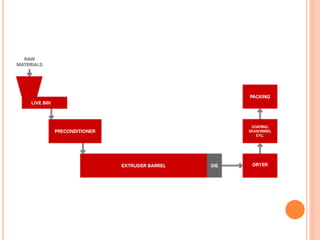
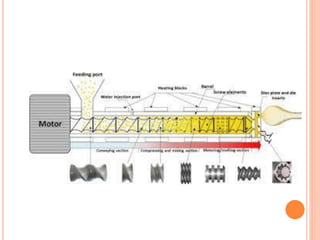
EXTRUSION PROCESS EQUIPMENT
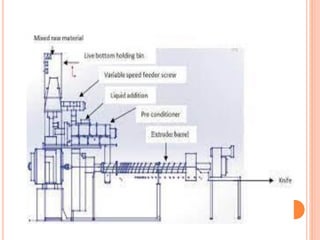
The extrusion system generally consists of
i. a live bin to feed the raw material at a constant rate,
ii. a preconditioner to uniformly mix, hydrate, and initiate partial
cooking of the product (by adding of steam and water).
The preconditioner also provides the option of adding
additional ingredients like fat or fresh meat slurry into the
raw material prior to entering the extruder.
i. an extruder that conveys, compresses, and completely cooks the
material by applying thermal and mechanical energy,
ii. a die attached at the end of the extruder exit (It can have a
single or multiple small openings through which the cooked
product is shaped into different sizes and structures and pushed
out due to the continuous forward motion of the extruder
screw.), and
iii. a cutting knife assembly usually mounted in front of the die
(also called a face-cutting knife) that controls the length of the
product based on its speed of cutting.
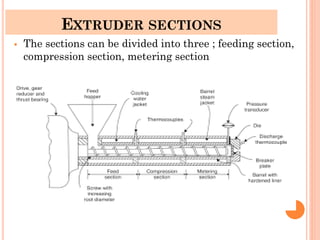
EXTRUDER SECTIONS
▪ The sections can be divided into three ; feeding section,
compression section, metering section
Feeding section
• Portion of screw which accepts the material at feed port
• Characterized by deep flights so that product can easily fall in the
flight
• Ensures sufficient material is conveyed down the screw
Compression section
▪ Food materials are heated and into a continuous dough mass
▪ Materials are partially cooked and elevated in temperature and
pressure
Metering section
▪ Nearest discharge of extruder
▪ Characterized by very shallow flights
▪ Shallow flights increase the shear rate to maximum to maximum
level within the channel
▪ Dough is further cooked and starch granules broken down due to high
shear forces
▪ Section continuously feeds the die with material at high uniform
pressure
EXTRUSION PROCESS
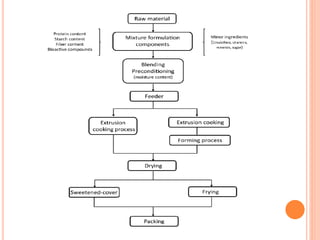
▪ raw materials are forced to flow under controlled
conditions along the length of the extruder barrel and
through a shaped opening (called die assembly) at a
defined throughput.
▪ First, raw materials are commonly ground to the
preferred particle size.
▪ Then are passed through a preconditioner in which
other ingredients are added and steam may be injected.
▪ During extrusion the product is cooked and mixed by
three separate energy sources: mechanical energy
(shear caused by the screw elements), thermal energy
that comes from the heating system, and self-heating
due to the melt viscosity in the barrel.
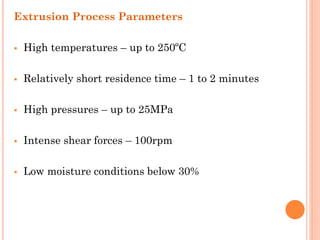
Extrusion Process Parameters
▪ High temperatures – up to 250ºC
▪ Relatively short residence time – 1 to 2 minutes
▪ High pressures – up to 25MPa
▪ Intense shear forces – 100rpm
▪ Low moisture conditions below 30%
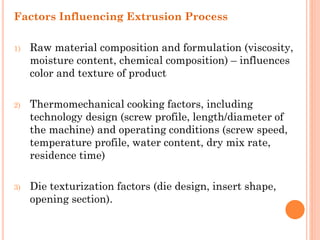
Factors Influencing Extrusion Process
1) Raw material composition and formulation (viscosity,
moisture content, chemical composition) – influences
color and texture of product
2) Thermomechanical cooking factors, including
technology design (screw profile, length/diameter of
the machine) and operating conditions (screw speed,
temperature profile, water content, dry mix rate,
residence time)
3) Die texturization factors (die design, insert shape,
opening section).
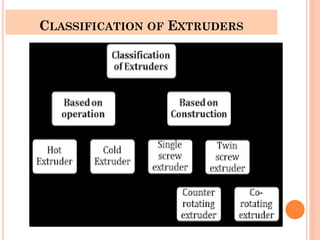
CLASSIFICATION OF EXTRUDERS
Hot extrusion
- Involves thermo-mechanical transformation of raw
materials in a short time and at high temperature
under high pressure
- Food heated above 100ºC
- The material is heated by friction and/or
supplementary heaters in the barrel and it emerges
from the dies under pressure.
- The rapid release of pressure as the food emerges from
the die causes expansion of steam and gas in the
material to form low density product
Hot extrusion
- Mainly used to produce textured food and feed products
such as RTE breakfast cereals, snacks
- extrusion cooking destroys contaminating micro-
organisms and the dry products have a long shelf life.
- They are packaged to prevent them picking up
moisture and to prevent oxidation during storage.
- extruder-cookers are much more expensive and are
likely to only be affordable by larger-scale producers.
Cold extrusion
- Involves gently mixing and shaping dough without direct
heating or cooking within the extruder -when it is forced
through openings in a ‘die’ at the discharge
end of the barrel.
- Temperature is below 100ºC – ambient temperature
- Mainly used for production of pasta
- Cold-extruded products are preserved by chilling, baking or
drying
- Cold extruders are suitable for all scales of operation from
household- to small-scale
- The equipment has a mixing chamber, extruder barrel and a
die for the desired pasta shape
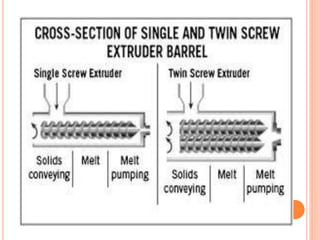
Single screw extruder
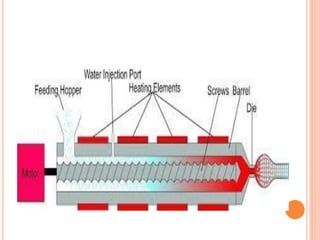
- consists of a cylindrical screw that rotates in a grooved
cylindrical barrel, made from hard alloys or hardened stainless
steel to withstand the frictional wear
- Contains one rotating screw in the barrel
- Raw materials are fed in a granular form at the hopper
- Rotating action of screws conveys the material to the transition
section
- In transition section, the screw becomes shallower and material
becomes compacted
- Mechanical energy is dissipated – results in rise in temperature
- Starch becomes gelatinized and material becomes cohesive
- Single-screw extruders have lower capital and operating costs and
require less skill to operate and maintain
- They are used for straightforward
cooking and forming applications, when the flexibility of a twin-
screw machine is not needed
Twin screw extruder
- A twin- screw extruder has a pair of screws
- The screws rotate within a ‘figure of 8’ shaped
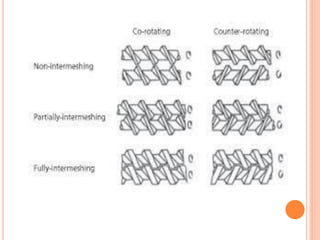
- They are classified according to the direction of rotation and
the way in which the screws intermesh.
- intermeshing or non-intermeshing.
- co-rotating or counter-rotating.
- The twin-screw extruder is more commonly used in the food
industry because of its wide range of operating conditions
and its ability to make wide range of food products
- Co-rotating intermeshing screws which are self wiping are
mostly found in food processing applications
Advantages of twin screw extruder
 Has a wide flexibility for handling diverse ingredients and a
higher production rate than single- screw extruders.
 Can be operated with a greater range of moisture content,
which is a drawback for a single-screw extruder.
 Has a higher efficiency in mixing,
 Has a self-wiping capability that can prevent residues from
accumulating - due to the opposite direction of the speed of
the screw edge and the screw groove in the meshing zone,
the relative speed is high which can scrape off any
accumulated material adhering to the screw.
 Can handle oily, sticky or very wet materials, or other
products that slip in a single screw. The limitations for
single- and twin-screw machines are respectively 4%
and 20% fat, 10% and 40% sugar, and 30% and 65%
moisture.
 A mixture of particle sizes, from fine powders to grains,
may be used, whereas a single screw is limited to a
specific range of granular particle sizes.
Draw back of twin screw extruder
 have relatively high capital and maintenance costs (up
to twice the cost of single-screw equipment) and the
greater constraints on operating ranges.
Effect of Extrusion on Food
 Vitamin losses in extruded foods vary to the type of
food, moisture content, temperature of processing and
holding time
 Losses are minimal in cold extrusion
 the HTST conditions in extrusion cooking and the rapid
cooling as the product emerges from the die, cause
relatively small losses of most vitamins and essential
amino acids
 thiamin, riboflavin and pyridoxine, niacin or folic acid
are well retained in cereals
 However losses of ascorbic acid and carotene may occur
up to 50% depending on the time that the food is held
at elevated temperatures
Effect of Extrusion on Food
 Loss of lysine, cystine and methionine in rice products
varies between 50 and 90% depending on processing
conditions
 In soy flour the changes to proteins depend on the
formulation and processing conditions
 high temperature and low concentrations of sugars
result in an increase in protein digestibility owing to
re-arrangement of the protein structure
 Destruction of anti-nutritional components in soy
products improves the nutritive value of textured
vegetable proteins

Food Processing and preservation 4- Extrusion.pdf

  • 1.
  • 2.
    EXTRUSION  The processof pushing mixed ingredients through a small opening called a die to form and to shape the materials  Utilizes a single screw or set of screws to force food materials through the die  Used for cereal and meat protein processing of food;  Expanded snack foods, weaning foods, pasta products, chewing gum, texturized vegetable protein, sausage products  Process combines several unit operations;  Mixing, cooking, kneading, shearing, shaping and forming
  • 3.
    ADVANTAGES OF EXTRUSION Flexibility and versatility; can produce a wide variety of products by changing the ingredients, the operating conditions of the extruder, and shape of the dies  Reduced costs; has lower production costs and higher productivity that other cooking or forming processes  High product rates; extruders operate continuously and have high throughputs  Production quality; involves high temperatures applied for a short time and limited heat treatment there after – returns heat sensitive components  Environmental friendly; no process effluents – is a low moisture process
  • 4.
    DISADVANTAGES OF EXTRUSION Loss of vitamins  Loss of protein  Loss of flavor  Maillard browning and caramelization  High initial cost  Larger lot size required
  • 5.
    EXTRUSION PROCESS EQUIPMENT Theextrusion system generally consists of i. a live bin to feed the raw material at a constant rate, ii. a preconditioner to uniformly mix, hydrate, and initiate partial cooking of the product (by adding of steam and water). The preconditioner also provides the option of adding additional ingredients like fat or fresh meat slurry into the raw material prior to entering the extruder. i. an extruder that conveys, compresses, and completely cooks the material by applying thermal and mechanical energy, ii. a die attached at the end of the extruder exit (It can have a single or multiple small openings through which the cooked product is shaped into different sizes and structures and pushed out due to the continuous forward motion of the extruder screw.), and iii. a cutting knife assembly usually mounted in front of the die (also called a face-cutting knife) that controls the length of the product based on its speed of cutting.
  • 7.
    EXTRUDER SECTIONS ▪ Thesections can be divided into three ; feeding section, compression section, metering section
  • 8.
    Feeding section • Portionof screw which accepts the material at feed port • Characterized by deep flights so that product can easily fall in the flight • Ensures sufficient material is conveyed down the screw Compression section ▪ Food materials are heated and into a continuous dough mass ▪ Materials are partially cooked and elevated in temperature and pressure Metering section ▪ Nearest discharge of extruder ▪ Characterized by very shallow flights ▪ Shallow flights increase the shear rate to maximum to maximum level within the channel ▪ Dough is further cooked and starch granules broken down due to high shear forces ▪ Section continuously feeds the die with material at high uniform pressure
  • 9.
    EXTRUSION PROCESS ▪ rawmaterials are forced to flow under controlled conditions along the length of the extruder barrel and through a shaped opening (called die assembly) at a defined throughput. ▪ First, raw materials are commonly ground to the preferred particle size. ▪ Then are passed through a preconditioner in which other ingredients are added and steam may be injected. ▪ During extrusion the product is cooked and mixed by three separate energy sources: mechanical energy (shear caused by the screw elements), thermal energy that comes from the heating system, and self-heating due to the melt viscosity in the barrel.
  • 14.
    Extrusion Process Parameters ▪High temperatures – up to 250ºC ▪ Relatively short residence time – 1 to 2 minutes ▪ High pressures – up to 25MPa ▪ Intense shear forces – 100rpm ▪ Low moisture conditions below 30%
  • 15.
    Factors Influencing ExtrusionProcess 1) Raw material composition and formulation (viscosity, moisture content, chemical composition) – influences color and texture of product 2) Thermomechanical cooking factors, including technology design (screw profile, length/diameter of the machine) and operating conditions (screw speed, temperature profile, water content, dry mix rate, residence time) 3) Die texturization factors (die design, insert shape, opening section).
  • 16.
  • 17.
    Hot extrusion - Involvesthermo-mechanical transformation of raw materials in a short time and at high temperature under high pressure - Food heated above 100ºC - The material is heated by friction and/or supplementary heaters in the barrel and it emerges from the dies under pressure. - The rapid release of pressure as the food emerges from the die causes expansion of steam and gas in the material to form low density product
  • 18.
    Hot extrusion - Mainlyused to produce textured food and feed products such as RTE breakfast cereals, snacks - extrusion cooking destroys contaminating micro- organisms and the dry products have a long shelf life. - They are packaged to prevent them picking up moisture and to prevent oxidation during storage. - extruder-cookers are much more expensive and are likely to only be affordable by larger-scale producers.
  • 19.
    Cold extrusion - Involvesgently mixing and shaping dough without direct heating or cooking within the extruder -when it is forced through openings in a ‘die’ at the discharge end of the barrel. - Temperature is below 100ºC – ambient temperature - Mainly used for production of pasta - Cold-extruded products are preserved by chilling, baking or drying - Cold extruders are suitable for all scales of operation from household- to small-scale - The equipment has a mixing chamber, extruder barrel and a die for the desired pasta shape
  • 21.
    Single screw extruder -consists of a cylindrical screw that rotates in a grooved cylindrical barrel, made from hard alloys or hardened stainless steel to withstand the frictional wear - Contains one rotating screw in the barrel - Raw materials are fed in a granular form at the hopper - Rotating action of screws conveys the material to the transition section - In transition section, the screw becomes shallower and material becomes compacted - Mechanical energy is dissipated – results in rise in temperature - Starch becomes gelatinized and material becomes cohesive - Single-screw extruders have lower capital and operating costs and require less skill to operate and maintain - They are used for straightforward cooking and forming applications, when the flexibility of a twin- screw machine is not needed
  • 22.
    Twin screw extruder -A twin- screw extruder has a pair of screws - The screws rotate within a ‘figure of 8’ shaped - They are classified according to the direction of rotation and the way in which the screws intermesh. - intermeshing or non-intermeshing. - co-rotating or counter-rotating. - The twin-screw extruder is more commonly used in the food industry because of its wide range of operating conditions and its ability to make wide range of food products - Co-rotating intermeshing screws which are self wiping are mostly found in food processing applications
  • 24.
    Advantages of twinscrew extruder  Has a wide flexibility for handling diverse ingredients and a higher production rate than single- screw extruders.  Can be operated with a greater range of moisture content, which is a drawback for a single-screw extruder.  Has a higher efficiency in mixing,  Has a self-wiping capability that can prevent residues from accumulating - due to the opposite direction of the speed of the screw edge and the screw groove in the meshing zone, the relative speed is high which can scrape off any accumulated material adhering to the screw.
  • 25.
     Can handleoily, sticky or very wet materials, or other products that slip in a single screw. The limitations for single- and twin-screw machines are respectively 4% and 20% fat, 10% and 40% sugar, and 30% and 65% moisture.  A mixture of particle sizes, from fine powders to grains, may be used, whereas a single screw is limited to a specific range of granular particle sizes. Draw back of twin screw extruder  have relatively high capital and maintenance costs (up to twice the cost of single-screw equipment) and the greater constraints on operating ranges.
  • 26.
    Effect of Extrusionon Food  Vitamin losses in extruded foods vary to the type of food, moisture content, temperature of processing and holding time  Losses are minimal in cold extrusion  the HTST conditions in extrusion cooking and the rapid cooling as the product emerges from the die, cause relatively small losses of most vitamins and essential amino acids  thiamin, riboflavin and pyridoxine, niacin or folic acid are well retained in cereals  However losses of ascorbic acid and carotene may occur up to 50% depending on the time that the food is held at elevated temperatures
  • 27.
    Effect of Extrusionon Food  Loss of lysine, cystine and methionine in rice products varies between 50 and 90% depending on processing conditions  In soy flour the changes to proteins depend on the formulation and processing conditions  high temperature and low concentrations of sugars result in an increase in protein digestibility owing to re-arrangement of the protein structure  Destruction of anti-nutritional components in soy products improves the nutritive value of textured vegetable proteins