BY
MONISHA SELVAN
shrink wrapping, shrink film is used as the basic
material(polyethylene , polypropylene and poly vinyl
chloride) and heat forms an important part of the
operation.
Shrink Wrapping is done in 4 stages
• wrapping (sleeve wrapping or over-wrapping)
• sealing (necessary only for over-wrapping)
• shrinking (with application of hot air), and
• cooling
.
• shrink packaging is most suitable these days for bulk
packaging. bulk packaging will also adopt a technology
called strength film technology .
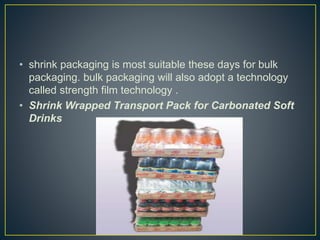
• Shrink Wrapped Transport Pack for Carbonated Soft
Drinks
• Contour fit
• Neat appearance
• Product could easily be seen
• Immobilization
• Improved the product identification with reduced labelling
costs
• Elimination of damage in opening
• Reduction of labour at the store level due to more rapid
product identification and faster container opening
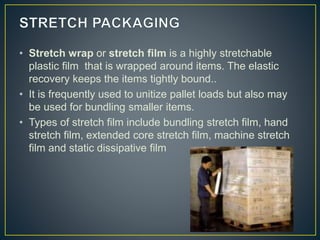
• Stretch wrap or stretch film is a highly stretchable
plastic film that is wrapped around items. The elastic
recovery keeps the items tightly bound..
• It is frequently used to unitize pallet loads but also may
be used for bundling smaller items.
• Types of stretch film include bundling stretch film, hand
stretch film, extended core stretch film, machine stretch
film and static dissipative film
• The most common stretch wrap material is linear low-
density polyethylene or LLDPE, which is produced by
copolymerization of ethylene with alpha-olefins, the most
common of which are butene, hexene and octene.
• The use of higher alpha-olefins (hexene or octene) gives
rise to enhanced stretch film characteristics, particularly in
respect of elongation at break and puncture resistance.
• Other types of polyethylene and PVC can also be used.
• Many films have about 500% stretch at break but are only
stretched to about 100 – 300% in use.
• Once stretched, the elastic recovery is used to keep the
load tight.
• There are two methods of producing stretch wrap.
1) Blown:
The resin is melted and blown out, it is air-cooled. This is a
slower process but provides for higher quality in all the
areas listed below.
The cost of production is also higher due to the quantity
that can be produced per hour.
2) Cast:
The film is passed over cooling rollers. This makes the
cooling process quick.
The quality is not as good as blown but more can be
produced in an hour with lower costs.
In pallet unitizing, stretch wrap can have several functions :
• improved stability of products or packages, forming a unit
load
• more efficient handling and storage of unit loads
• some degree of dust and moisture protection
• some degree of tamper resistance and resistance to
package pilferage
• stretch wrapping affords large energy saving and does
not require the availability of fuel.
• Stretch wrapping offers better protection from hostile
environments and clear, tinted, or opaque films are
available for product identification or pilfer protection.
• stretch films are better suited to withstand shock and
vibration owing to their elasticity and memory
• The cling property that makes stretch wrapping possible,
can also promote load-to-load sticking and abrasion
• Stretch films cannot be used to compress a pallet load in
the vertical direction since it has its primary holding force
in the direction of wrap, i.e. horizontal
• By employing LDPE film in a equal to the width of
collation plus 50% of the height, the stretch wrapped
collation will have excess film on both sides.
• An end closer operation can follow the stretch operation
and here the excess film width is treated with current of
hot air which results in the film shrinking over the side
face of the package, leaving a small opening on the side
face
• Depending upon whether the excess film is equal to the
height of the package or less , the side opening can be
controlled in size
• The wider the film the smaller the hole.In this manner the
package can be made pilfer-proof. In many instances and
depending upon the collation design, it is possible to
have a very short over-width on the collation , and still
obtain pilfer-proof characteristics.
• Such would be case for example where the collation is at
a single level or it is multi level but only two then the film
width should be equal to the collation width plus the
height in order to minimize the side opening.
• pallet wrap is a simple process of wrapping boxes or
items that have been accumulated on a pallet and then
pulled tightly together by the force of the film wrapped
around the boxes or items.
• It is minimising material handling at different stages of
manufacture and wholesale or retail marketing.
The advantage of stretch wrapping of pallets is not only
the reduction in packaging specifications and hence
reduction in packaging cost
Shrink Wrapping Stretch Wrapping
Equipment (heat shrink tunnel) are
more
expensive
Equipment (relatively simpler and
smaller)are generally less expensive
Sealing required, particularly for
overwrapping
Normally, no sealing is required
More energy required: Orientation plus
heat energy to shrink.
Less total energy - only stretching, but
no
heat.
May not be suitable for heat sensitive
items.
Can even be used under cold
conditions
(refrigeration).
Wrapped items (two or more) may
stick
together.
Virtually, no film-to-film sticking.
Can provide better weather protection,
particularly with a total over-wrap.
Less protective, may not be totally
waterproof. Lower climatic protection.
Thank q

Shrink and strech packaging

  • 1.
  • 2.
    shrink wrapping, shrinkfilm is used as the basic material(polyethylene , polypropylene and poly vinyl chloride) and heat forms an important part of the operation. Shrink Wrapping is done in 4 stages • wrapping (sleeve wrapping or over-wrapping) • sealing (necessary only for over-wrapping) • shrinking (with application of hot air), and • cooling .
  • 3.
    • shrink packagingis most suitable these days for bulk packaging. bulk packaging will also adopt a technology called strength film technology . • Shrink Wrapped Transport Pack for Carbonated Soft Drinks
  • 4.
    • Contour fit •Neat appearance • Product could easily be seen • Immobilization • Improved the product identification with reduced labelling costs • Elimination of damage in opening • Reduction of labour at the store level due to more rapid product identification and faster container opening
  • 5.
    • Stretch wrapor stretch film is a highly stretchable plastic film that is wrapped around items. The elastic recovery keeps the items tightly bound.. • It is frequently used to unitize pallet loads but also may be used for bundling smaller items. • Types of stretch film include bundling stretch film, hand stretch film, extended core stretch film, machine stretch film and static dissipative film
  • 6.
    • The mostcommon stretch wrap material is linear low- density polyethylene or LLDPE, which is produced by copolymerization of ethylene with alpha-olefins, the most common of which are butene, hexene and octene. • The use of higher alpha-olefins (hexene or octene) gives rise to enhanced stretch film characteristics, particularly in respect of elongation at break and puncture resistance. • Other types of polyethylene and PVC can also be used. • Many films have about 500% stretch at break but are only stretched to about 100 – 300% in use. • Once stretched, the elastic recovery is used to keep the load tight.
  • 7.
    • There aretwo methods of producing stretch wrap. 1) Blown: The resin is melted and blown out, it is air-cooled. This is a slower process but provides for higher quality in all the areas listed below. The cost of production is also higher due to the quantity that can be produced per hour. 2) Cast: The film is passed over cooling rollers. This makes the cooling process quick. The quality is not as good as blown but more can be produced in an hour with lower costs.
  • 8.
    In pallet unitizing,stretch wrap can have several functions : • improved stability of products or packages, forming a unit load • more efficient handling and storage of unit loads • some degree of dust and moisture protection • some degree of tamper resistance and resistance to package pilferage
  • 9.
    • stretch wrappingaffords large energy saving and does not require the availability of fuel. • Stretch wrapping offers better protection from hostile environments and clear, tinted, or opaque films are available for product identification or pilfer protection. • stretch films are better suited to withstand shock and vibration owing to their elasticity and memory
  • 10.
    • The clingproperty that makes stretch wrapping possible, can also promote load-to-load sticking and abrasion • Stretch films cannot be used to compress a pallet load in the vertical direction since it has its primary holding force in the direction of wrap, i.e. horizontal
  • 11.
    • By employingLDPE film in a equal to the width of collation plus 50% of the height, the stretch wrapped collation will have excess film on both sides. • An end closer operation can follow the stretch operation and here the excess film width is treated with current of hot air which results in the film shrinking over the side face of the package, leaving a small opening on the side face • Depending upon whether the excess film is equal to the height of the package or less , the side opening can be controlled in size
  • 12.
    • The widerthe film the smaller the hole.In this manner the package can be made pilfer-proof. In many instances and depending upon the collation design, it is possible to have a very short over-width on the collation , and still obtain pilfer-proof characteristics. • Such would be case for example where the collation is at a single level or it is multi level but only two then the film width should be equal to the collation width plus the height in order to minimize the side opening.
  • 13.
    • pallet wrapis a simple process of wrapping boxes or items that have been accumulated on a pallet and then pulled tightly together by the force of the film wrapped around the boxes or items. • It is minimising material handling at different stages of manufacture and wholesale or retail marketing.
  • 14.
    The advantage ofstretch wrapping of pallets is not only the reduction in packaging specifications and hence reduction in packaging cost
  • 15.
    Shrink Wrapping StretchWrapping Equipment (heat shrink tunnel) are more expensive Equipment (relatively simpler and smaller)are generally less expensive Sealing required, particularly for overwrapping Normally, no sealing is required More energy required: Orientation plus heat energy to shrink. Less total energy - only stretching, but no heat. May not be suitable for heat sensitive items. Can even be used under cold conditions (refrigeration). Wrapped items (two or more) may stick together. Virtually, no film-to-film sticking. Can provide better weather protection, particularly with a total over-wrap. Less protective, may not be totally waterproof. Lower climatic protection.
  • 16.