EXTRACTION PROCESS
SUKHBIR KAUR
ASSOCIATE PROFESSOR
DEPT. OF PHARMACY PRACTICE
ISF COLLEGE OF PHARMACY
WEBSITE: - www.isfcp.org
EMAIL: k_sukhbir@yahoo.co.in
ISF College of Pharmacy, Moga
Ghal Kalan,G T Road, Moga- 142001, Punjab,
INDIA
Internal Quality Assurance Cell - (IQAC)
Introduction 2
 Extraction is a process of separation or isolation of pharmaceutical active ingredients
from plant or animal drugs with the help of solvent.
 On the basis of the physical nature of crude drug to be extracted i.e. liquid or solid ,the
extraction process may be:
 Liquid –Liquid Extraction Or
 Solid –Liquid Extraction.
The solvent used for extraction is called as ‘Menstruum’ and the residue left after
extracting desired constituents is called ‘Marc’.
Required Ideal Properties of Menstruum :
 Should be inert and non –toxic
 Should extract only the desirable constituent of the crude drug .
 Should be cheap and easily available
3Menstruum Used For Extraction Process
4
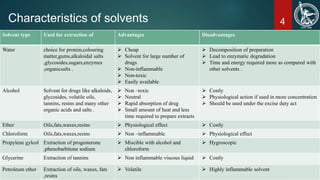
Solvent type Used for extraction of Advantages Disadvantages
Water choice for protein,colouring
matter,gums,alkaloidal salts
,glycosides,sugars,enzymes
,organicsalts .
 Cheap
 Solvent for large number of
drugs
 Non-inflammable
 Non-toxic
 Easily available
 Decomposition of preparation
 Lead to enzymatic degradation
 Time and energy required more as compared with
other solvents .
Alcohol Solvent for drugs like alkaloids,
glycosides, volatile oils,
tannins, resins and many other
organic acids and salts .
 Non –toxic
 Neutral
 Rapid absorption of drug
 Small amount of heat and less
time required to prepare extracts
 Costly
 Physiological action if used in more concentration
 Should be used under the excise duty act
Ether Oils,fats,waxes,resins  Physiological effect  Costly
Chloroform Oils,fats,waxes,resins  Non –inflammable  Physiological effect
Propylene gylcol Extraction of progesterone
,phenobarbitone sodium
 Miscible with alcohol and
chloroform
 Hygroscopic
Glycerine Extraction of tannins  Non inflammable viscous liquid  Costly
Petroleum ether Extraction of oils, waxes, fats
,resins
 Volatile  Highly inflammable solvent
Characteristics of solvents
5INFUSION
 Infusion is the process of extracting chemical compounds or flavors from plant material in a
solvent such as water, oil or alcohol, by allowing the material to remain suspended in the
solvent over time (a process often called steeping).
6Decoction
 Decoction is a process where drug is extracted by boiling with water for
about 10-15 minutes.
 This process is used for hard and woody drugs having thermostable water
soluble constituents .
Maceration
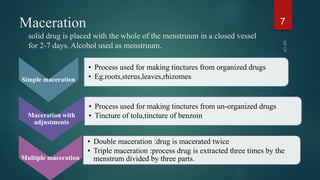
solid drug is placed with the whole of the menstruum in a closed vessel
for 2-7 days. Alcohol used as menstruum.
7
Simple maceration
• Process used for making tinctures from organized drugs
• Eg.roots,sterus,leaves,rhizomes
Maceration with
adjustments
• Process used for making tinctures from un-organized drugs
• Tincture of tolu,tincture of benzoin
Multiple maceration
• Double maceration :drug is macerated twice
• Triple maceration :process drug is extracted three times by the
menstrum divided by three parts.
8Process of maceration :
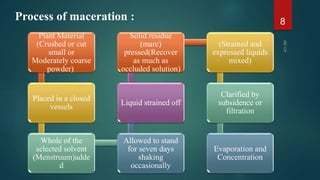
Plant Material
(Crushed or cut
small or
Moderately coarse
powder)
Placed in a closed
vessels
Whole of the
selected solvent
(Menstruum)adde
d
Allowed to stand
for seven days
shaking
occasionally
Liquid strained off
Solid residue
(marc)
pressed(Recover
as much as
occluded solution)
(Strained and
expressed liquids
mixed)
Clarified by
subsidence or
filtration
Evaporation and
Concentration
9Percolation
10Types of Percolation
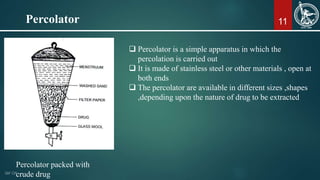
11Percolator
Percolator packed with
crude drug
 Percolator is a simple apparatus in which the
percolation is carried out
 It is made of stainless steel or other materials , open at
both ends
 The percolator are available in different sizes ,shapes
,depending upon the nature of drug to be extracted
12Types of percolator
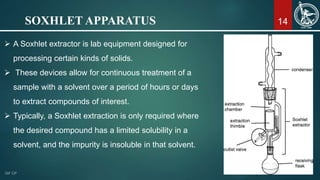
Continuous extraction (soxhlet extraction )
 Soxhlet extraction is a process of continuous extraction in which same
solvent can be circulated through the extractor for several times .
 The extraction is followed by evaporation of the solvents
 The vapours of the solvent are taken to the condensor and the condensed
liquid is returned to the drug for continuous extraction .
 Soxhlet appartus is employed for carrying out extraction .
13
14
 A Soxhlet extractor is lab equipment designed for
processing certain kinds of solids.
 These devices allow for continuous treatment of a
sample with a solvent over a period of hours or days
to extract compounds of interest.
 Typically, a Soxhlet extraction is only required where
the desired compound has a limited solubility in a
solvent, and the impurity is insoluble in that solvent.
SOXHLET APPARATUS
15Extraction procedure
 Solid material is placed inside a thimble made from thick filter paper, which is loaded into the
main chamber of the Soxhlet extractor. The Soxhlet extractor is placed onto a flask containing
the extraction solvent. The Soxhlet is then equipped with a condenser.
 The solvent is heated to reflux. The solvent vapour travels up a distillation arm, and floods
into the chamber housing the thimble of solid. The condenser ensures that any solvent vapour
cools, and drips back down into the chamber housing the solid material.
 The chamber containing the solid material slowly fills with warm solvent and desired
compound will then dissolve in the warm solvent. When the Soxhlet chamber is almost full,
the chamber is automatically emptied by a siphon side arm. This cycle may be allowed to
repeat many times, over hours or days.
16
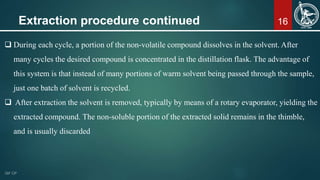
 During each cycle, a portion of the non-volatile compound dissolves in the solvent. After
many cycles the desired compound is concentrated in the distillation flask. The advantage of
this system is that instead of many portions of warm solvent being passed through the sample,
just one batch of solvent is recycled.
 After extraction the solvent is removed, typically by means of a rotary evaporator, yielding the
extracted compound. The non-soluble portion of the extracted solid remains in the thimble,
and is usually discarded
Extraction procedure continued
 Digestion is a type of maceration in which moderate heating is preferred during extraction .
 Heating causes digestion of drug material and increases the solvent efficiency .
 This method is used for those drugs where moderately elevated temperatures does not cause
the degradation of the constituents .
17Digestion
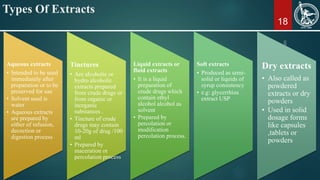
Types Of Extracts
18
Aqueous extracts
• Intended to be used
immediately after
preparation or to be
preserved for use
• Solvent used is
water
• Aqueous extracts
are prepared by
either of infusion,
decoction or
digestion process
Tinctures
• Are alcoholic or
hydro alcoholic
extracts prepared
from crude drugs or
from organic or
inorganic
substances .
• Tincture of crude
drugs may contain
10-20g of drug /100
ml
• Prepared by
maceration or
percolation process
Liquid extracts or
fluid extracts
• It is a liquid
preparation of
crude drugs which
contain ethyl
alcohol alcohol as
solvent
• Prepared by
percolation or
modification
percolation process.
Soft extracts
• Produced as semi-
solid or liquids of
syrup consistency
• e.g: glycerrhiza
extract USP
Dry extracts
• Also called as
powdered
extracts or dry
powders
• Used in solid
dosage forms
like capsules
,tablets or
powders
19

EXTRACTION PROCESS

  • 1.
    EXTRACTION PROCESS SUKHBIR KAUR ASSOCIATEPROFESSOR DEPT. OF PHARMACY PRACTICE ISF COLLEGE OF PHARMACY WEBSITE: - www.isfcp.org EMAIL: k_sukhbir@yahoo.co.in ISF College of Pharmacy, Moga Ghal Kalan,G T Road, Moga- 142001, Punjab, INDIA Internal Quality Assurance Cell - (IQAC)
  • 2.
    Introduction 2  Extractionis a process of separation or isolation of pharmaceutical active ingredients from plant or animal drugs with the help of solvent.  On the basis of the physical nature of crude drug to be extracted i.e. liquid or solid ,the extraction process may be:  Liquid –Liquid Extraction Or  Solid –Liquid Extraction. The solvent used for extraction is called as ‘Menstruum’ and the residue left after extracting desired constituents is called ‘Marc’. Required Ideal Properties of Menstruum :  Should be inert and non –toxic  Should extract only the desirable constituent of the crude drug .  Should be cheap and easily available
  • 3.
    3Menstruum Used ForExtraction Process
  • 4.
    4 Solvent type Usedfor extraction of Advantages Disadvantages Water choice for protein,colouring matter,gums,alkaloidal salts ,glycosides,sugars,enzymes ,organicsalts .  Cheap  Solvent for large number of drugs  Non-inflammable  Non-toxic  Easily available  Decomposition of preparation  Lead to enzymatic degradation  Time and energy required more as compared with other solvents . Alcohol Solvent for drugs like alkaloids, glycosides, volatile oils, tannins, resins and many other organic acids and salts .  Non –toxic  Neutral  Rapid absorption of drug  Small amount of heat and less time required to prepare extracts  Costly  Physiological action if used in more concentration  Should be used under the excise duty act Ether Oils,fats,waxes,resins  Physiological effect  Costly Chloroform Oils,fats,waxes,resins  Non –inflammable  Physiological effect Propylene gylcol Extraction of progesterone ,phenobarbitone sodium  Miscible with alcohol and chloroform  Hygroscopic Glycerine Extraction of tannins  Non inflammable viscous liquid  Costly Petroleum ether Extraction of oils, waxes, fats ,resins  Volatile  Highly inflammable solvent Characteristics of solvents
  • 5.
    5INFUSION  Infusion isthe process of extracting chemical compounds or flavors from plant material in a solvent such as water, oil or alcohol, by allowing the material to remain suspended in the solvent over time (a process often called steeping).
  • 6.
    6Decoction  Decoction isa process where drug is extracted by boiling with water for about 10-15 minutes.  This process is used for hard and woody drugs having thermostable water soluble constituents .
  • 7.
    Maceration solid drug isplaced with the whole of the menstruum in a closed vessel for 2-7 days. Alcohol used as menstruum. 7 Simple maceration • Process used for making tinctures from organized drugs • Eg.roots,sterus,leaves,rhizomes Maceration with adjustments • Process used for making tinctures from un-organized drugs • Tincture of tolu,tincture of benzoin Multiple maceration • Double maceration :drug is macerated twice • Triple maceration :process drug is extracted three times by the menstrum divided by three parts.
  • 8.
    8Process of maceration: Plant Material (Crushed or cut small or Moderately coarse powder) Placed in a closed vessels Whole of the selected solvent (Menstruum)adde d Allowed to stand for seven days shaking occasionally Liquid strained off Solid residue (marc) pressed(Recover as much as occluded solution) (Strained and expressed liquids mixed) Clarified by subsidence or filtration Evaporation and Concentration
  • 9.
  • 10.
  • 11.
    11Percolator Percolator packed with crudedrug  Percolator is a simple apparatus in which the percolation is carried out  It is made of stainless steel or other materials , open at both ends  The percolator are available in different sizes ,shapes ,depending upon the nature of drug to be extracted
  • 12.
  • 13.
    Continuous extraction (soxhletextraction )  Soxhlet extraction is a process of continuous extraction in which same solvent can be circulated through the extractor for several times .  The extraction is followed by evaporation of the solvents  The vapours of the solvent are taken to the condensor and the condensed liquid is returned to the drug for continuous extraction .  Soxhlet appartus is employed for carrying out extraction . 13
  • 14.
    14  A Soxhletextractor is lab equipment designed for processing certain kinds of solids.  These devices allow for continuous treatment of a sample with a solvent over a period of hours or days to extract compounds of interest.  Typically, a Soxhlet extraction is only required where the desired compound has a limited solubility in a solvent, and the impurity is insoluble in that solvent. SOXHLET APPARATUS
  • 15.
    15Extraction procedure  Solidmaterial is placed inside a thimble made from thick filter paper, which is loaded into the main chamber of the Soxhlet extractor. The Soxhlet extractor is placed onto a flask containing the extraction solvent. The Soxhlet is then equipped with a condenser.  The solvent is heated to reflux. The solvent vapour travels up a distillation arm, and floods into the chamber housing the thimble of solid. The condenser ensures that any solvent vapour cools, and drips back down into the chamber housing the solid material.  The chamber containing the solid material slowly fills with warm solvent and desired compound will then dissolve in the warm solvent. When the Soxhlet chamber is almost full, the chamber is automatically emptied by a siphon side arm. This cycle may be allowed to repeat many times, over hours or days.
  • 16.
    16  During eachcycle, a portion of the non-volatile compound dissolves in the solvent. After many cycles the desired compound is concentrated in the distillation flask. The advantage of this system is that instead of many portions of warm solvent being passed through the sample, just one batch of solvent is recycled.  After extraction the solvent is removed, typically by means of a rotary evaporator, yielding the extracted compound. The non-soluble portion of the extracted solid remains in the thimble, and is usually discarded Extraction procedure continued
  • 17.
     Digestion isa type of maceration in which moderate heating is preferred during extraction .  Heating causes digestion of drug material and increases the solvent efficiency .  This method is used for those drugs where moderately elevated temperatures does not cause the degradation of the constituents . 17Digestion
  • 18.
    Types Of Extracts 18 Aqueousextracts • Intended to be used immediately after preparation or to be preserved for use • Solvent used is water • Aqueous extracts are prepared by either of infusion, decoction or digestion process Tinctures • Are alcoholic or hydro alcoholic extracts prepared from crude drugs or from organic or inorganic substances . • Tincture of crude drugs may contain 10-20g of drug /100 ml • Prepared by maceration or percolation process Liquid extracts or fluid extracts • It is a liquid preparation of crude drugs which contain ethyl alcohol alcohol as solvent • Prepared by percolation or modification percolation process. Soft extracts • Produced as semi- solid or liquids of syrup consistency • e.g: glycerrhiza extract USP Dry extracts • Also called as powdered extracts or dry powders • Used in solid dosage forms like capsules ,tablets or powders
  • 19.