NATURAL RESOURCES AND
ASSOCIATED PROBLEMS
SUKHBIR KAUR
ASSOCIATE PROFESSOR
DEPT. OF QUALITY ASSURANCE
ISF COLLEGE OF PHARMACY
WEBSITE: - WWW.ISFCP.ORG
EMAIL: k_sukhbir@yahoo.co.in
ISF College of Pharmacy, Moga
Ghal Kalan,nGT Road, Moga- 142001, Punjab, INDIA
Internal Quality Assurance Cell - (IQAC)
1
2Contents
Resource
Types of resources
Natural resources
Classification of natural resources
List of natural resources
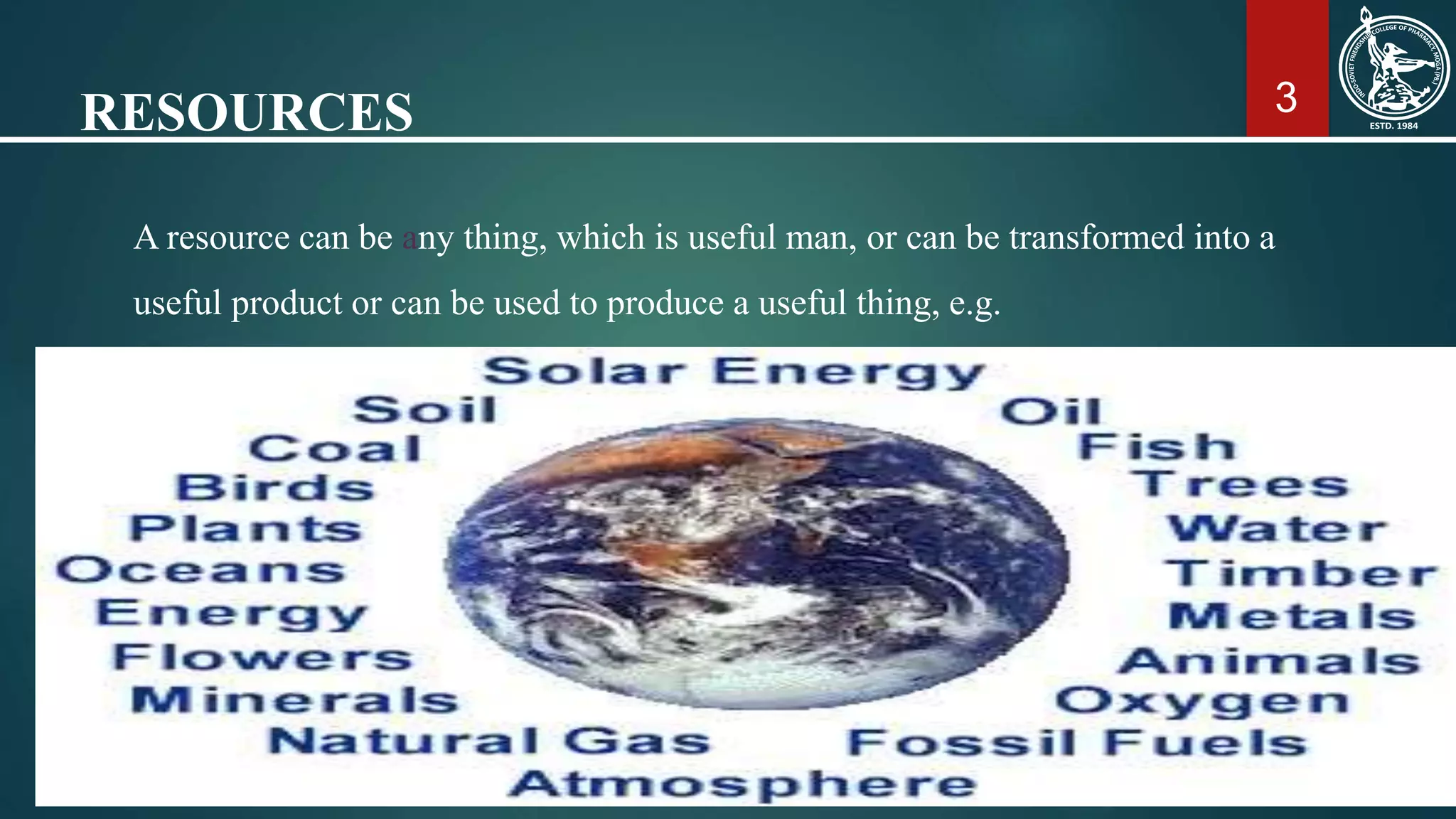
3RESOURCES
A resource can be any thing, which is useful man, or can be transformed into a
useful product or can be used to produce a useful thing, e.g.
4Types of Resources
 Natural Resources
 Human Resources
 Man-made Resources
5Natural resources
Exists without actions of humankind in the form of matter/energy which is
available in the earth and get used by living thing.
Or exist as a separate entity such as fresh water, air and as well as a
living organism such as a fish.
Or it may exist in an alternate form that must be processed to obtain the
resource such as metal ores, petroleum, and most forms of energy.
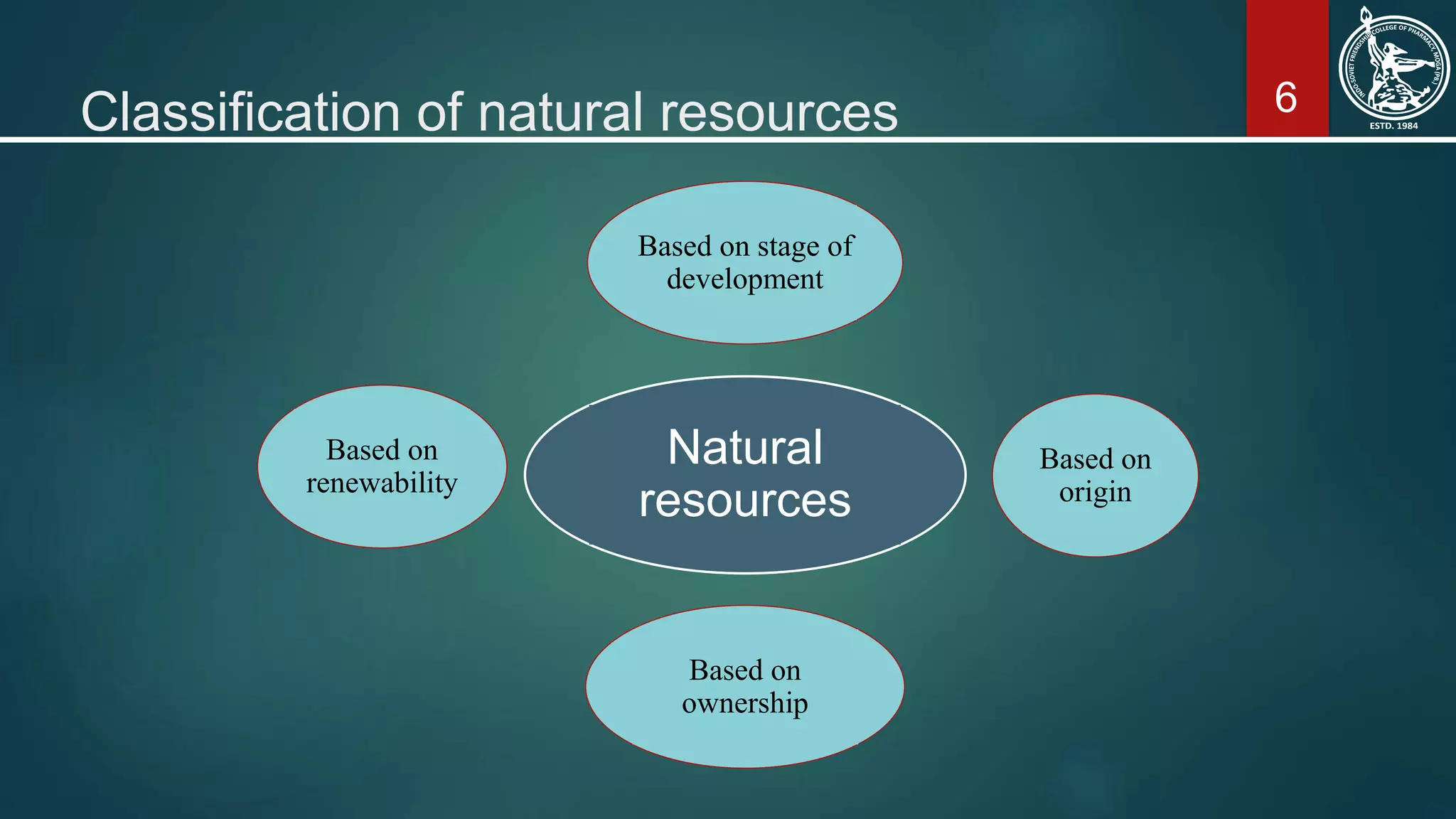
6Classification of natural resources
Natural
resources
Based on stage of
development
Based on
origin
Based on
ownership
Based on
renewability
7Based on Origin
Text
8Based on stage of development
Text
9Based on renewability
Text
10ASSOCIATED PROBLEMS
RENEWABLE RESOURCES
Global livestock and fisheries resources can also not be expanded
beyond certain limits.
Only up to a limited extent resources of biosphere can be safely
exploited.
Though an enormous quantity of water is present, for fresh water life
depends largely on precipitation, which to is available only in a finite
quantity.
Its uneven distribution over earths surface has caused large area to
become infertile deserts
11Non renewable resources
Overexploitation shall exhaust many of our valuable deposits which took
millions of years to form.
They can not be duplicated within human scale of time.
They require time on geological scale to form.
With the sophisticated technology, we may recover these materials from
the highly dispersed state. But the cause shall be enormous & the effort
could be economically non-viable.
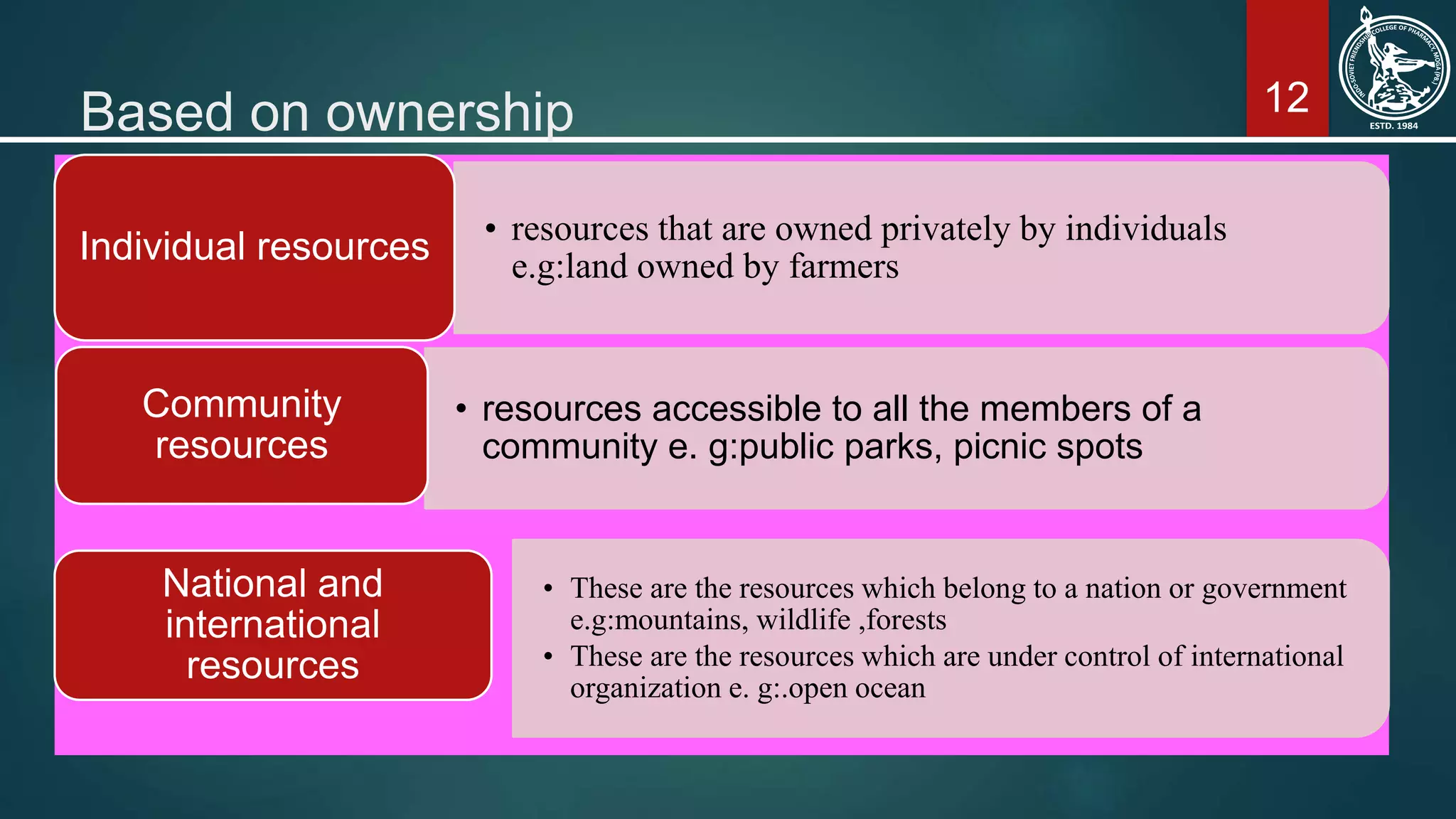
12Based on ownership
Text • resources that are owned privately by individuals
e.g:land owned by farmersIndividual resources
• resources accessible to all the members of a
community e. g:public parks, picnic spots
Community
resources
• These are the resources which belong to a nation or government
e.g:mountains, wildlife ,forests
• These are the resources which are under control of international
organization e. g:.open ocean
National and
international
resources
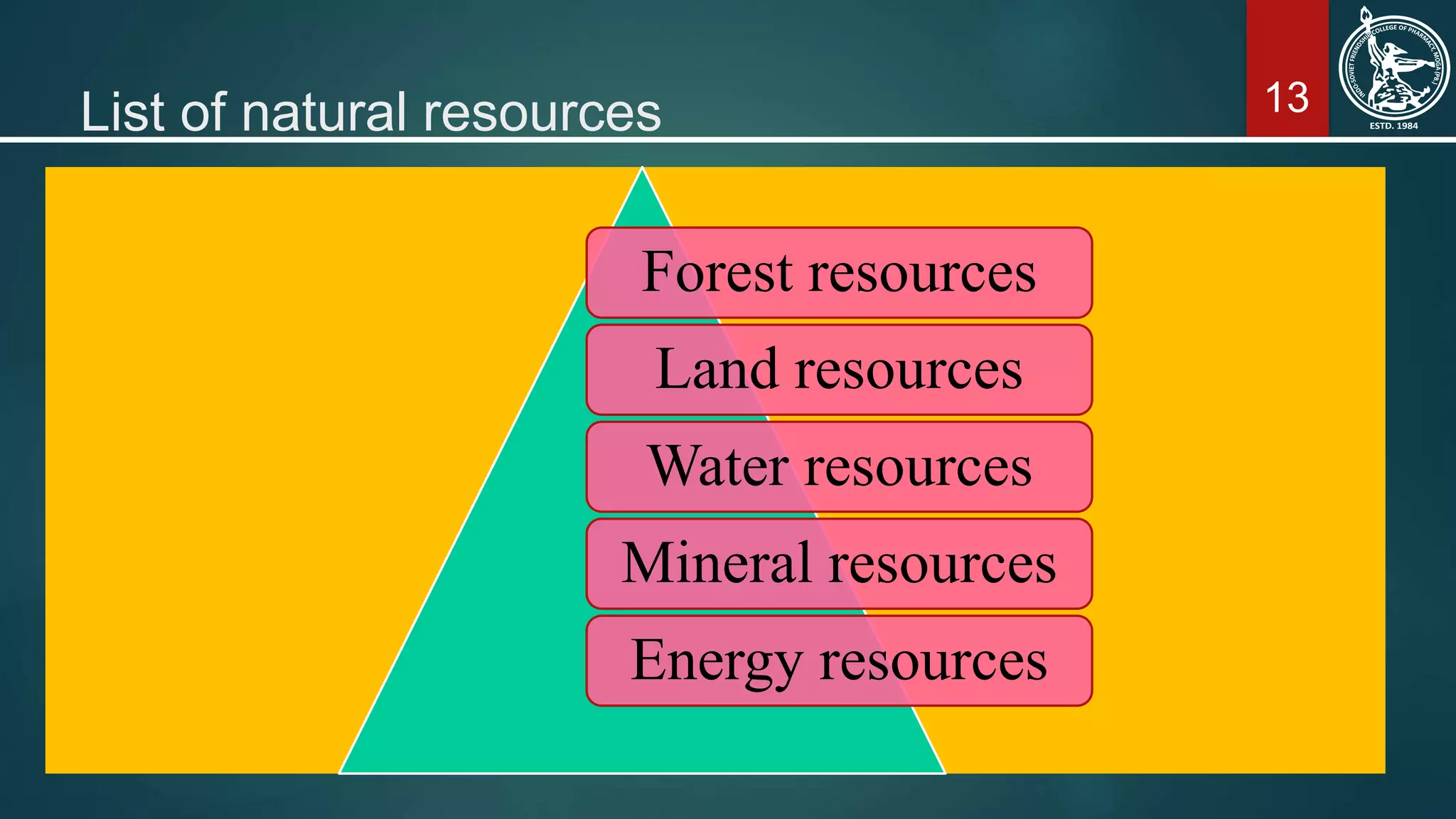
13List of natural resources
Text
Forest resources
Land resources
Water resources
Mineral resources
Energy resources
14FOREST RESOURCES
Originally ,it is uncultivated and uninhabitated natural plants, i.e., trees
and grasses.
Forest is a community of trees and associated organism covering a
considerable area, utilizing air, water and minerals to attain maturity and
to reproduce and capable of furnishing mankind with indispensable
products and services
15Associated Problems
Use and over-exploitation.
Deforestation.
Timber extraction.
Mining and its effects on forest.
Dams and their effects on forests and tribal people.
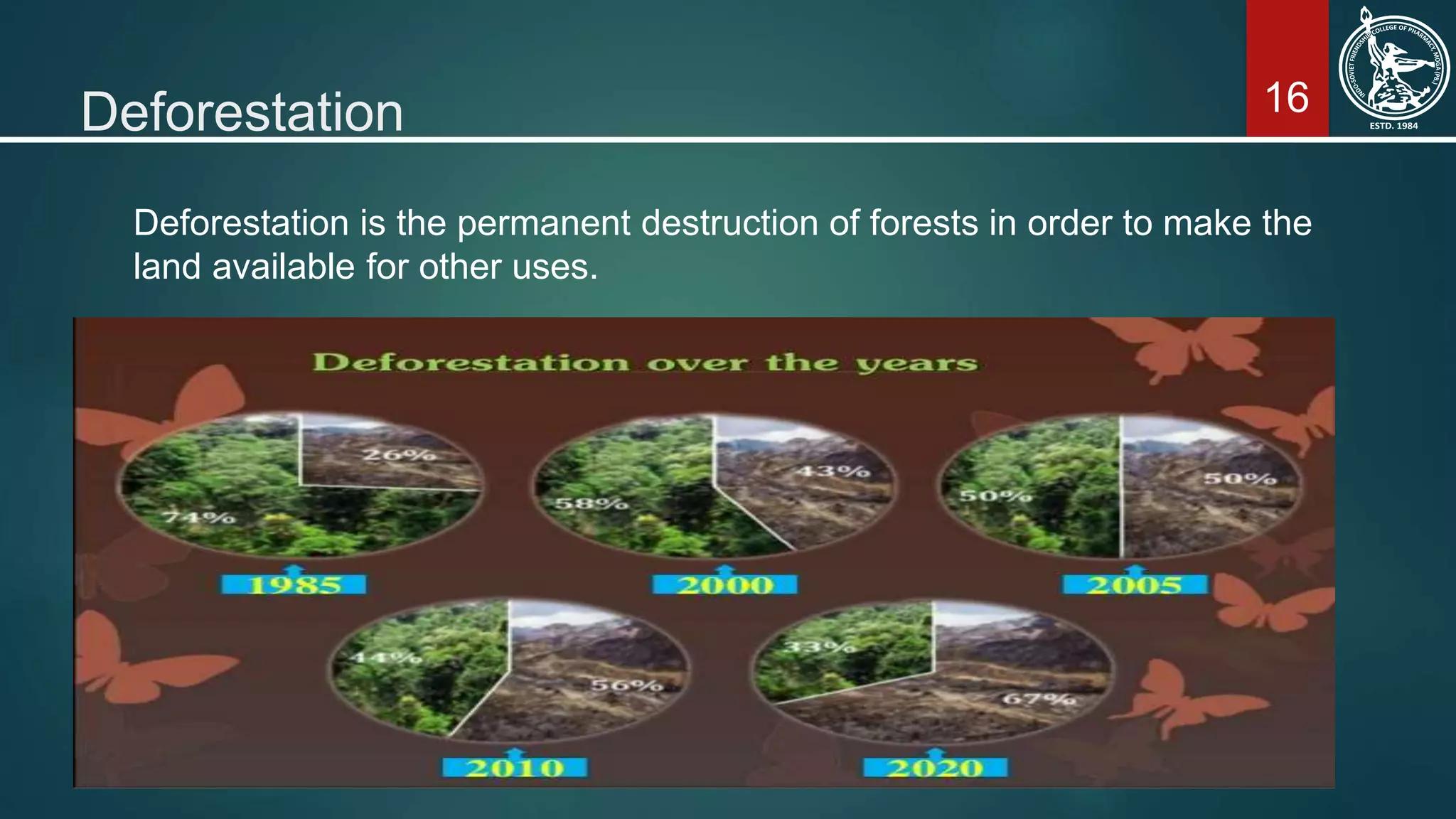
16Deforestation
Deforestation is the permanent destruction of forests in order to make the
land available for other uses.
17Causes of Deforestation
To make more land available for housing and urbanization
To harvest timber to create commercial items such as paper, furniture and
homes
To create ingredients that are highly prized consumer items, such as the
oil from palm trees
To create room for cattle ranching
18Effects of Deforestation
Loss of species: Seventy percent of the world’s plants and animals live in
forests and are losing their habitats due to deforestation, according to
National Geographic.
Loss of habitat can lead to species extinction.
It also has negative consequences for medicinal research and local
populations who rely on the animals and plants in the forests for hunting
and medicine.
Soil erosion: Tree roots anchor the soil. Without trees, the soil is free to
wash or blow away.
Life quality: Soil erosion can also lead to silt entering the lakes, streams
and other water sources. This can decrease local water quality and
contribute to poor health in populations in the area.
19Methods of conserving forests
The cutting of trees in the forests must be stopped at all costs.
Afforestation or special programmes should be launched on grand scale.
Celebrations of all functions, festivals should proceed with tree-plantation.
Cutting of timber and other forest produce should be restricted.
Forest conservation Act 1980 should be strictly implemented to check
deforestation.
Several centers of excellence have been setup and awards should be
instituted.
20WATER RESOURCES
Water resources are sources of water that are potentially useful for
Agricultural
Industrial
Household
Recreational and environmental activities.
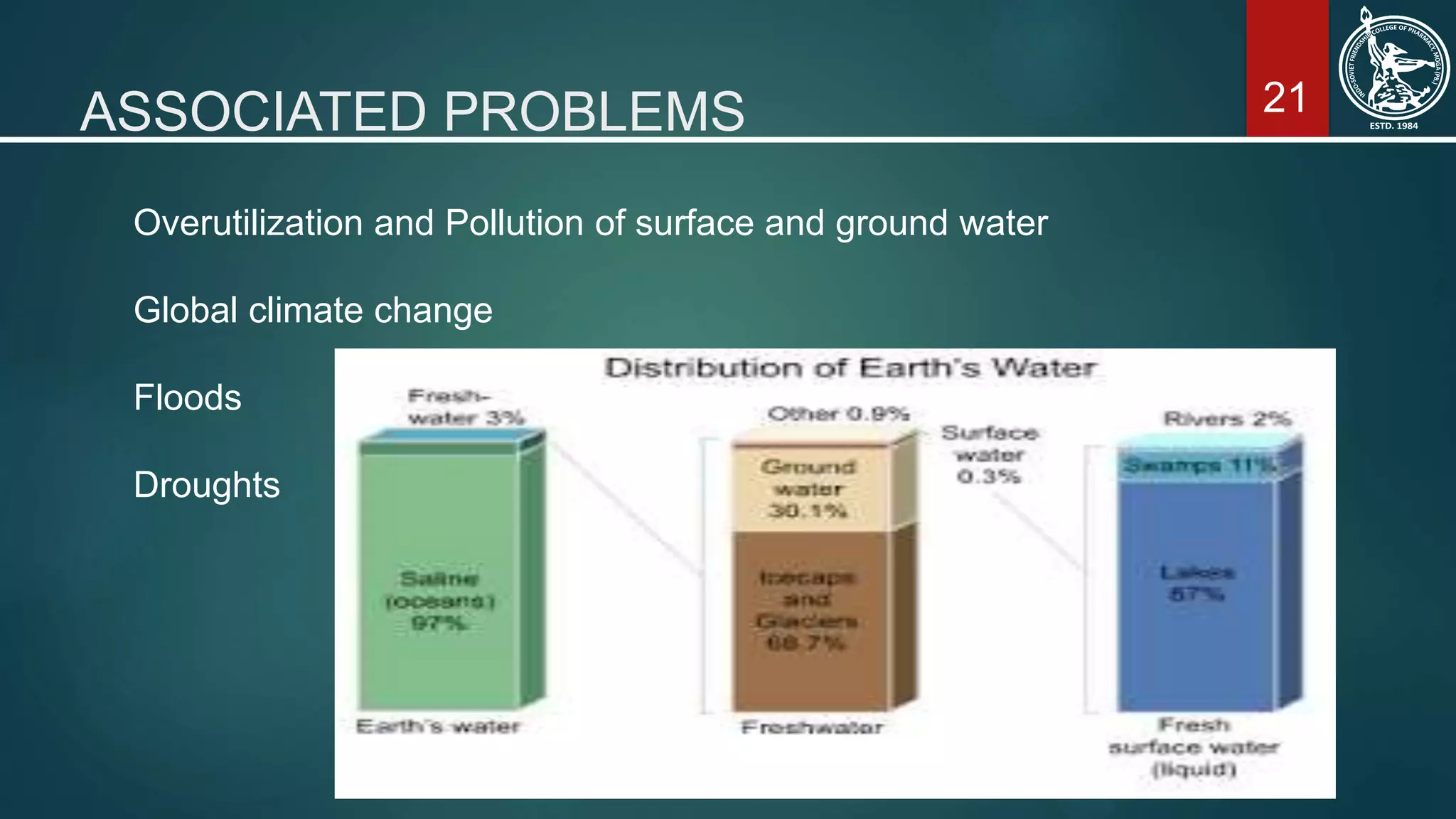
On earth is a 97% of salt water and the 3% is fresh water.
Fresh water is a renewable resource. Fresh water in world is decreasing.
Salt water is like a large amount of salt in the ocean.
21ASSOCIATED PROBLEMS
Overutilization and Pollution of surface and ground water
Global climate change
Floods
Droughts
22Conservation of water
Avoid leakage of water from the taps.
Turn the tap off when not in use especially when you brush your teeth or
wash clothes.
Rainwater harvesting is the another method to conserve water.
The water supply should be limited in those areas which enjoys the
unlimited water supplies.
Technical methods to conserve water : 1.Rainwater Harvesting
2.Historical Water Bodies 3.Ponds
23Land Resources
Land resources are the resources available from the land like:
The agricultural land
the underground water
the various minerals like coal, bauxite, gold and other raw materials.
In a wider sense, land resource can also mean the land available for
exploitation, like non agricultural lands for buildings, developing
townships etc.
24Associated problems
Soil Erosion
loss of soil nutrients
25Soil Erosion
The characteristics of natural ecosystems such as forests and grasslands
depend on the type of soil.
Deforestation thus leads to rapid soil erosion.
Soil erosion is one form of soil degradation. The erosion of soil is a
naturally occurring process on all land
Soil erosion may be a slow process that continues relatively unnoticed, or
it may occur at an alarming rate causing a serious loss of topsoil.
26CAUSES OF SOIL EROSION
There are many different factors that can cause soil erosion, most can be
broken down into two main categories:
Erosion by Water
Erosion by Wind
27Conservation of soil erosion
By educating, informing and sensitizing all landholders about various
aspects of this precious resources and their sustainable use.
Contour ploughing is another measure to conserve our land. By this
method, the fields are ploughed, harrowed and sown along the natural
contour of the hills.
By terracing method: A series of wide steps are made along the slop
following the contours. This method is very common in rice growing
regions.
Under the afforestation and reforestation programs, planting of trees,
bushes and grass help to check the soil erosion,
Strict actions are taken to check reckless felling of trees and overgrazing.
Construction of dams and gully-trap inculcate the water-harvesting.
28Mineral resources
Mineral Resource is defined as a occurrence of natural, solid, inorganic or
fossilized organic material in or on the Earth’s crust in such form and
quantity and of such a grade or quality that it has reasonable prospects
for economic extraction.
29Types of Mineral Resources
Minerals in general have been categorized into three classes:
fuel
Metallic
non-metallic.
Fuel minerals like coal, oil and natural gas have been given prime
importance as they account for nearly 87% of the value of mineral
production whereas metallic and non-metallic constitutes 6 to 7%.
30Fuel Minerals
Coal, oil and natural gas are the basic fossil fuel.
We have good reserves for coal but are very poor in more essential fuel
— oils and natural gas.
31Metallic Minerals
Metallic minerals are extracted from mineral deposits and produced by
geological processes.
Some metallic minerals contain valuable metals, such as copper, gold,
nickel, lead, zinc or platinum.
32Non-metallic Minerals
Nonmetallic minerals are minerals that do not contain metal.
Physically, they are very volatile and have low elasticity.
Chemically, they have high ionization energy.
Examples of nonmetallic minerals include sulfur, phosphorus, iodine,
carbon, selenium, limestone, dolomite, gemstones, clay and mica.
33Associated Problems
Use and exploitation.
Environmental effects of extracting and using minerals.
34Conservation
Strong dependence of industry and agriculture upon mineral deposits and
the substances manufactured from them e.g. metallurgical industries,
cement industries , pharmaceutical industries. Fertilizers, pesticides, etc.
The total volume of workable mineral deposits is an insignificant fraction
i.e. 1% of the earth’s crust.
Recycling of metals using scrap metals and other substitutes are steps in
conserving our mineral resources for the future.
Improved technologies need to be constantly evolved
35

NATURAL RESOURCES AND ASSOCIATED PROBLEMS

  • 1.
    NATURAL RESOURCES AND ASSOCIATEDPROBLEMS SUKHBIR KAUR ASSOCIATE PROFESSOR DEPT. OF QUALITY ASSURANCE ISF COLLEGE OF PHARMACY WEBSITE: - WWW.ISFCP.ORG EMAIL: k_sukhbir@yahoo.co.in ISF College of Pharmacy, Moga Ghal Kalan,nGT Road, Moga- 142001, Punjab, INDIA Internal Quality Assurance Cell - (IQAC) 1
  • 2.
    2Contents Resource Types of resources Naturalresources Classification of natural resources List of natural resources
  • 3.
    3RESOURCES A resource canbe any thing, which is useful man, or can be transformed into a useful product or can be used to produce a useful thing, e.g.
  • 4.
    4Types of Resources Natural Resources  Human Resources  Man-made Resources
  • 5.
    5Natural resources Exists withoutactions of humankind in the form of matter/energy which is available in the earth and get used by living thing. Or exist as a separate entity such as fresh water, air and as well as a living organism such as a fish. Or it may exist in an alternate form that must be processed to obtain the resource such as metal ores, petroleum, and most forms of energy.
  • 6.
    6Classification of naturalresources Natural resources Based on stage of development Based on origin Based on ownership Based on renewability
  • 7.
  • 8.
    8Based on stageof development Text
  • 9.
  • 10.
    10ASSOCIATED PROBLEMS RENEWABLE RESOURCES Globallivestock and fisheries resources can also not be expanded beyond certain limits. Only up to a limited extent resources of biosphere can be safely exploited. Though an enormous quantity of water is present, for fresh water life depends largely on precipitation, which to is available only in a finite quantity. Its uneven distribution over earths surface has caused large area to become infertile deserts
  • 11.
    11Non renewable resources Overexploitationshall exhaust many of our valuable deposits which took millions of years to form. They can not be duplicated within human scale of time. They require time on geological scale to form. With the sophisticated technology, we may recover these materials from the highly dispersed state. But the cause shall be enormous & the effort could be economically non-viable.
  • 12.
    12Based on ownership Text• resources that are owned privately by individuals e.g:land owned by farmersIndividual resources • resources accessible to all the members of a community e. g:public parks, picnic spots Community resources • These are the resources which belong to a nation or government e.g:mountains, wildlife ,forests • These are the resources which are under control of international organization e. g:.open ocean National and international resources
  • 13.
    13List of naturalresources Text Forest resources Land resources Water resources Mineral resources Energy resources
  • 14.
    14FOREST RESOURCES Originally ,itis uncultivated and uninhabitated natural plants, i.e., trees and grasses. Forest is a community of trees and associated organism covering a considerable area, utilizing air, water and minerals to attain maturity and to reproduce and capable of furnishing mankind with indispensable products and services
  • 15.
    15Associated Problems Use andover-exploitation. Deforestation. Timber extraction. Mining and its effects on forest. Dams and their effects on forests and tribal people.
  • 16.
    16Deforestation Deforestation is thepermanent destruction of forests in order to make the land available for other uses.
  • 17.
    17Causes of Deforestation Tomake more land available for housing and urbanization To harvest timber to create commercial items such as paper, furniture and homes To create ingredients that are highly prized consumer items, such as the oil from palm trees To create room for cattle ranching
  • 18.
    18Effects of Deforestation Lossof species: Seventy percent of the world’s plants and animals live in forests and are losing their habitats due to deforestation, according to National Geographic. Loss of habitat can lead to species extinction. It also has negative consequences for medicinal research and local populations who rely on the animals and plants in the forests for hunting and medicine. Soil erosion: Tree roots anchor the soil. Without trees, the soil is free to wash or blow away. Life quality: Soil erosion can also lead to silt entering the lakes, streams and other water sources. This can decrease local water quality and contribute to poor health in populations in the area.
  • 19.
    19Methods of conservingforests The cutting of trees in the forests must be stopped at all costs. Afforestation or special programmes should be launched on grand scale. Celebrations of all functions, festivals should proceed with tree-plantation. Cutting of timber and other forest produce should be restricted. Forest conservation Act 1980 should be strictly implemented to check deforestation. Several centers of excellence have been setup and awards should be instituted.
  • 20.
    20WATER RESOURCES Water resourcesare sources of water that are potentially useful for Agricultural Industrial Household Recreational and environmental activities. On earth is a 97% of salt water and the 3% is fresh water. Fresh water is a renewable resource. Fresh water in world is decreasing. Salt water is like a large amount of salt in the ocean.
  • 21.
    21ASSOCIATED PROBLEMS Overutilization andPollution of surface and ground water Global climate change Floods Droughts
  • 22.
    22Conservation of water Avoidleakage of water from the taps. Turn the tap off when not in use especially when you brush your teeth or wash clothes. Rainwater harvesting is the another method to conserve water. The water supply should be limited in those areas which enjoys the unlimited water supplies. Technical methods to conserve water : 1.Rainwater Harvesting 2.Historical Water Bodies 3.Ponds
  • 23.
    23Land Resources Land resourcesare the resources available from the land like: The agricultural land the underground water the various minerals like coal, bauxite, gold and other raw materials. In a wider sense, land resource can also mean the land available for exploitation, like non agricultural lands for buildings, developing townships etc.
  • 24.
  • 25.
    25Soil Erosion The characteristicsof natural ecosystems such as forests and grasslands depend on the type of soil. Deforestation thus leads to rapid soil erosion. Soil erosion is one form of soil degradation. The erosion of soil is a naturally occurring process on all land Soil erosion may be a slow process that continues relatively unnoticed, or it may occur at an alarming rate causing a serious loss of topsoil.
  • 26.
    26CAUSES OF SOILEROSION There are many different factors that can cause soil erosion, most can be broken down into two main categories: Erosion by Water Erosion by Wind
  • 27.
    27Conservation of soilerosion By educating, informing and sensitizing all landholders about various aspects of this precious resources and their sustainable use. Contour ploughing is another measure to conserve our land. By this method, the fields are ploughed, harrowed and sown along the natural contour of the hills. By terracing method: A series of wide steps are made along the slop following the contours. This method is very common in rice growing regions. Under the afforestation and reforestation programs, planting of trees, bushes and grass help to check the soil erosion, Strict actions are taken to check reckless felling of trees and overgrazing. Construction of dams and gully-trap inculcate the water-harvesting.
  • 28.
    28Mineral resources Mineral Resourceis defined as a occurrence of natural, solid, inorganic or fossilized organic material in or on the Earth’s crust in such form and quantity and of such a grade or quality that it has reasonable prospects for economic extraction.
  • 29.
    29Types of MineralResources Minerals in general have been categorized into three classes: fuel Metallic non-metallic. Fuel minerals like coal, oil and natural gas have been given prime importance as they account for nearly 87% of the value of mineral production whereas metallic and non-metallic constitutes 6 to 7%.
  • 30.
    30Fuel Minerals Coal, oiland natural gas are the basic fossil fuel. We have good reserves for coal but are very poor in more essential fuel — oils and natural gas.
  • 31.
    31Metallic Minerals Metallic mineralsare extracted from mineral deposits and produced by geological processes. Some metallic minerals contain valuable metals, such as copper, gold, nickel, lead, zinc or platinum.
  • 32.
    32Non-metallic Minerals Nonmetallic mineralsare minerals that do not contain metal. Physically, they are very volatile and have low elasticity. Chemically, they have high ionization energy. Examples of nonmetallic minerals include sulfur, phosphorus, iodine, carbon, selenium, limestone, dolomite, gemstones, clay and mica.
  • 33.
    33Associated Problems Use andexploitation. Environmental effects of extracting and using minerals.
  • 34.
    34Conservation Strong dependence ofindustry and agriculture upon mineral deposits and the substances manufactured from them e.g. metallurgical industries, cement industries , pharmaceutical industries. Fertilizers, pesticides, etc. The total volume of workable mineral deposits is an insignificant fraction i.e. 1% of the earth’s crust. Recycling of metals using scrap metals and other substitutes are steps in conserving our mineral resources for the future. Improved technologies need to be constantly evolved
  • 35.