CONVENTIONAL METODS OF EXTRACTION
Introduction:
Extraction:
 Extraction is the method of removing active constituents from a solid or liquid by means of
liquid solvent.
 The separation of medicinally active portions of plant or animal tissues from the inactive or
inert components by using selective solvents.
 In this method the wanted components are dissolved by the use of selective solvents known
as menstruum& undissolved part is a marc. After the extraction unwanted matter is removed.
Extracts are prepared by using ethanol or other suitable solvent.
 Extract: Extracts can be defined as preparations of crude drugs which contain all the
constituents which are soluble in the solvent.
Marc: Solid residue obtain after extraction
Menstruum: Solvent used for extraction
 Type of extracts
 Dry extract (Tab, cap.)
E.g. belladonna extract
 Soft (Ointment, suppository)
E.g. glycerrhiza extract.
 Liquid: As tincture.
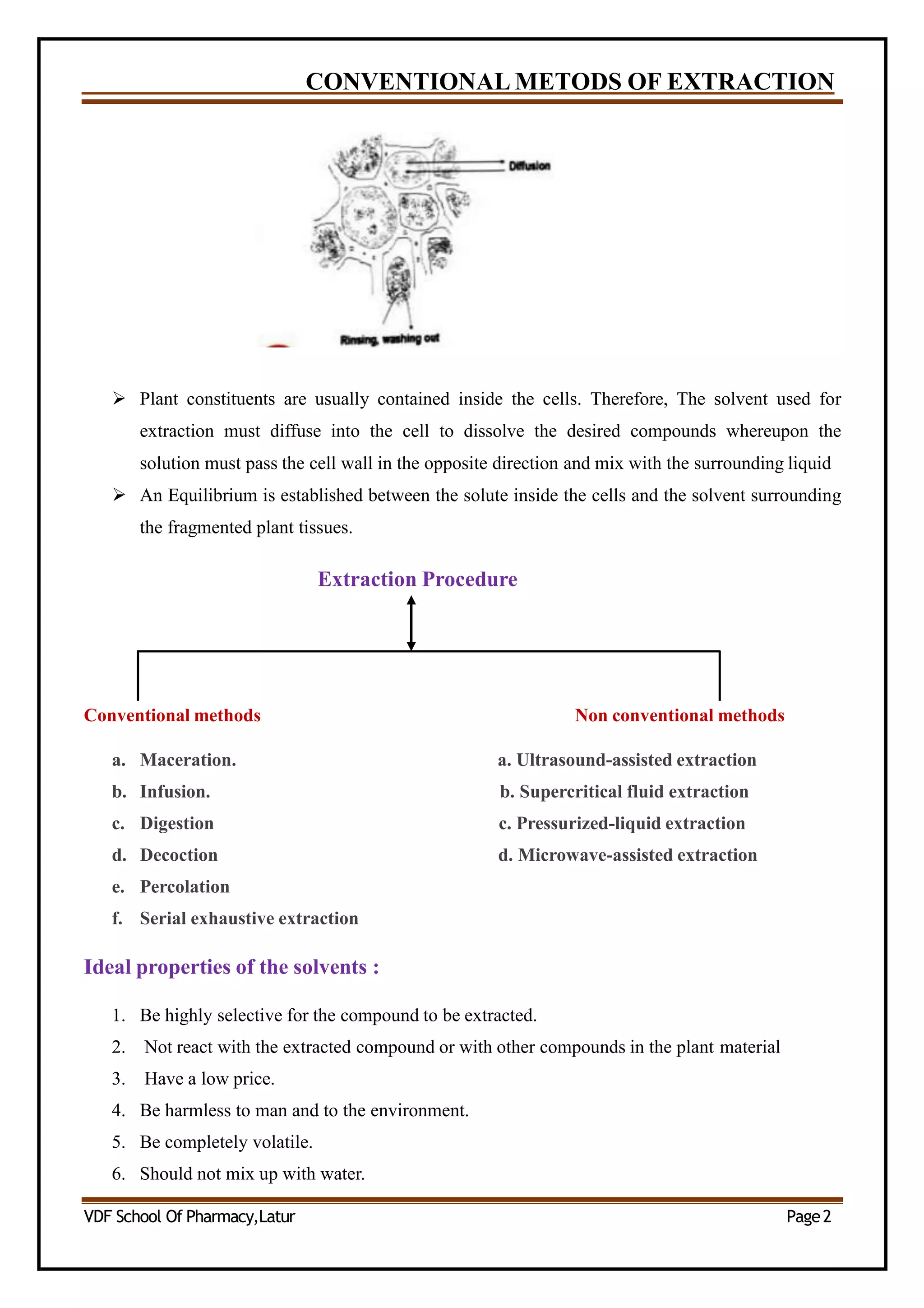
 Dissolution of extractive substances out of disintegrated cells.
 Dissolution of extractive substances out of intact plant cell by diffusion (requires steeping
and swelling)
 Penetration of the solvent into the plant cells and swelling of the cells.
 Diffusion of the dissolved extractive substances out of the cell out. Rinsing, washing.
VDF School Of Pharmacy,Latur Page1
CONVENTIONAL METODS OF EXTRACTION
 Plant constituents are usually contained inside the cells. Therefore, The solvent used for
extraction must diffuse into the cell to dissolve the desired compounds whereupon the
solution must pass the cell wall in the opposite direction and mix with the surrounding liquid
 An Equilibrium is established between the solute inside the cells and the solvent surrounding
the fragmented plant tissues.
Extraction Procedure
Conventional methods Non conventional methods
a. Ultrasound-assisted extraction
b. Supercritical fluid extraction
c. Pressurized-liquid extraction
d. Microwave-assisted extraction
a. Maceration.
b. Infusion.
c. Digestion
d. Decoction
e. Percolation
f. Serial exhaustive extraction
Ideal properties of the solvents :
1. Be highly selective for the compound to be extracted.
2. Not react with the extracted compound or with other compounds in the plant material
3. Have a low price.
4. Be harmless to man and to the environment.
5. Be completely volatile.
6. Should not mix up with water.
VDF School Of Pharmacy,Latur Page2
CONVENTIONAL METODS OF EXTRACTION
7. Should have the big capacity in relation to extractive.
8. The density of solvent should be difference from water density.
9. Should have the minimum viscosity.
Conventional Methods of extraction
Introduction:
Conventional extraction technique such as maceration and novel extraction techniques like
Microwave Assisted Extraction method (MAE) were used for the extraction of mucilage from the
stem of Abroma augusta. The mucilage using both extraction content in the extracts obtained
methods. The conventional and novel extraction techniques were compared on the basis of various
parameters like extraction time and extraction yield.
METHODS OF EXTRACTION :
1. Infusion.
2. Decoction.
3. Digestion.
4. Maceration.
5. Percolation.
6. Continues hot extraction.
7. Supercritical fluid extraction.
8. Counter current extraction.
9. Microwave assisted extraction.
10. Ultra sonitation-Assisted Extraction.
 Infusion :
Fresh infusions are prepared by macerating the crude drug for a short period of time with cold or
boiling water. These are dilute solutions of the readily soluble constituents of crude drugs.
Types of Infusion :
 Fresh Infusion : e.g. Infusion of orange.
 Concentrated Infusion : e.g. Concentrated infusion of Quassia
VDF School Of Pharmacy,Latur Page3
CONVENTIONAL METODS OF EXTRACTION
 Decoction :
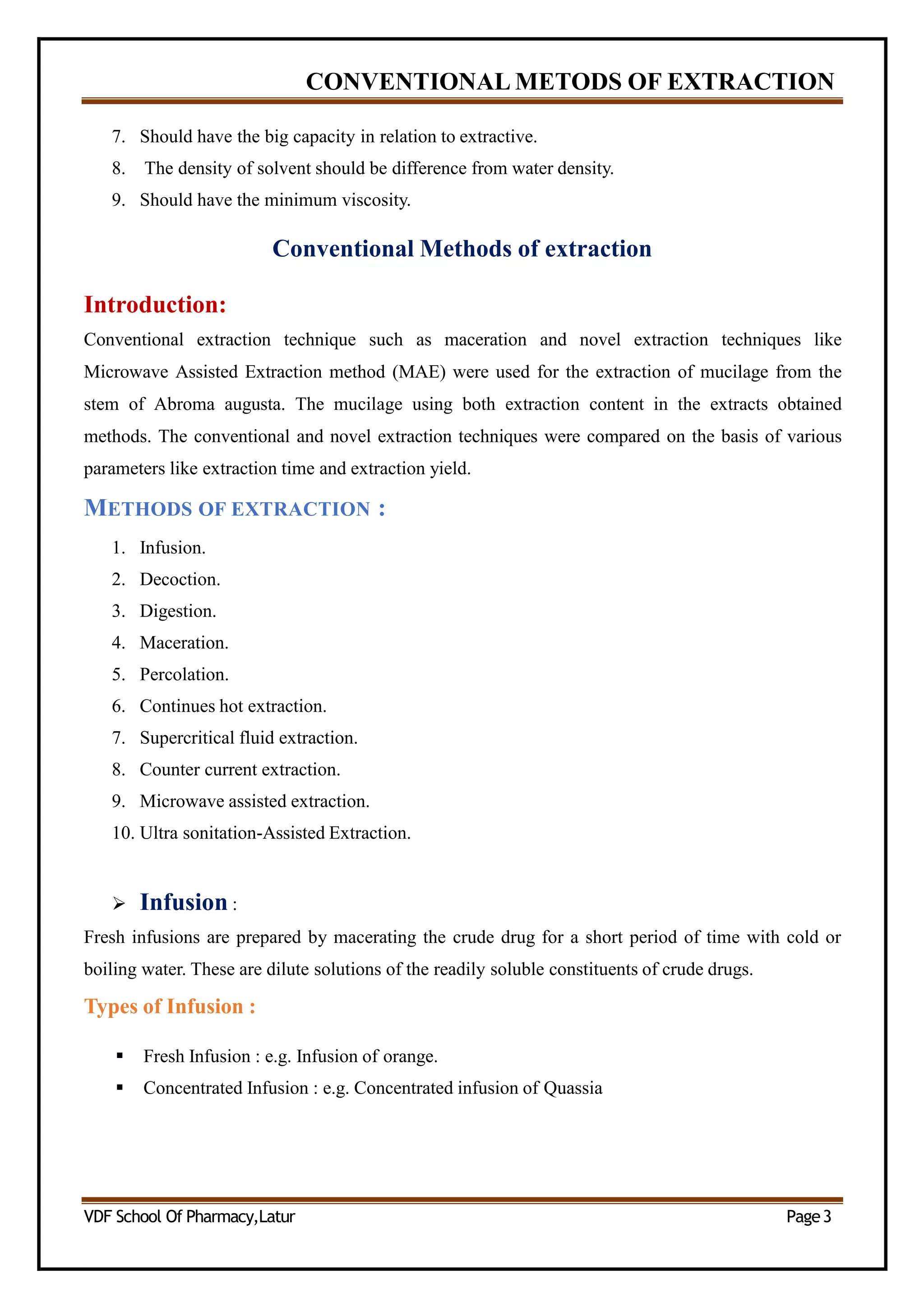
In this process, the crude drug is boiled in a specified volume of water for a defined time; it is then
cooled and strained or filtered. This procedure is suitable for extracting water-soluble, heat stable
constituents. E.g. Tea, Coffee
 Digestion :
 This is a form of maceration in which gentle heat is used during the process of
extraction.
 It is used when moderately elevated temperature is not objectionable. The solvent
efficiency of the menstruum is thereby increased.
e.g. Extraction of Morphine
 Maceration :
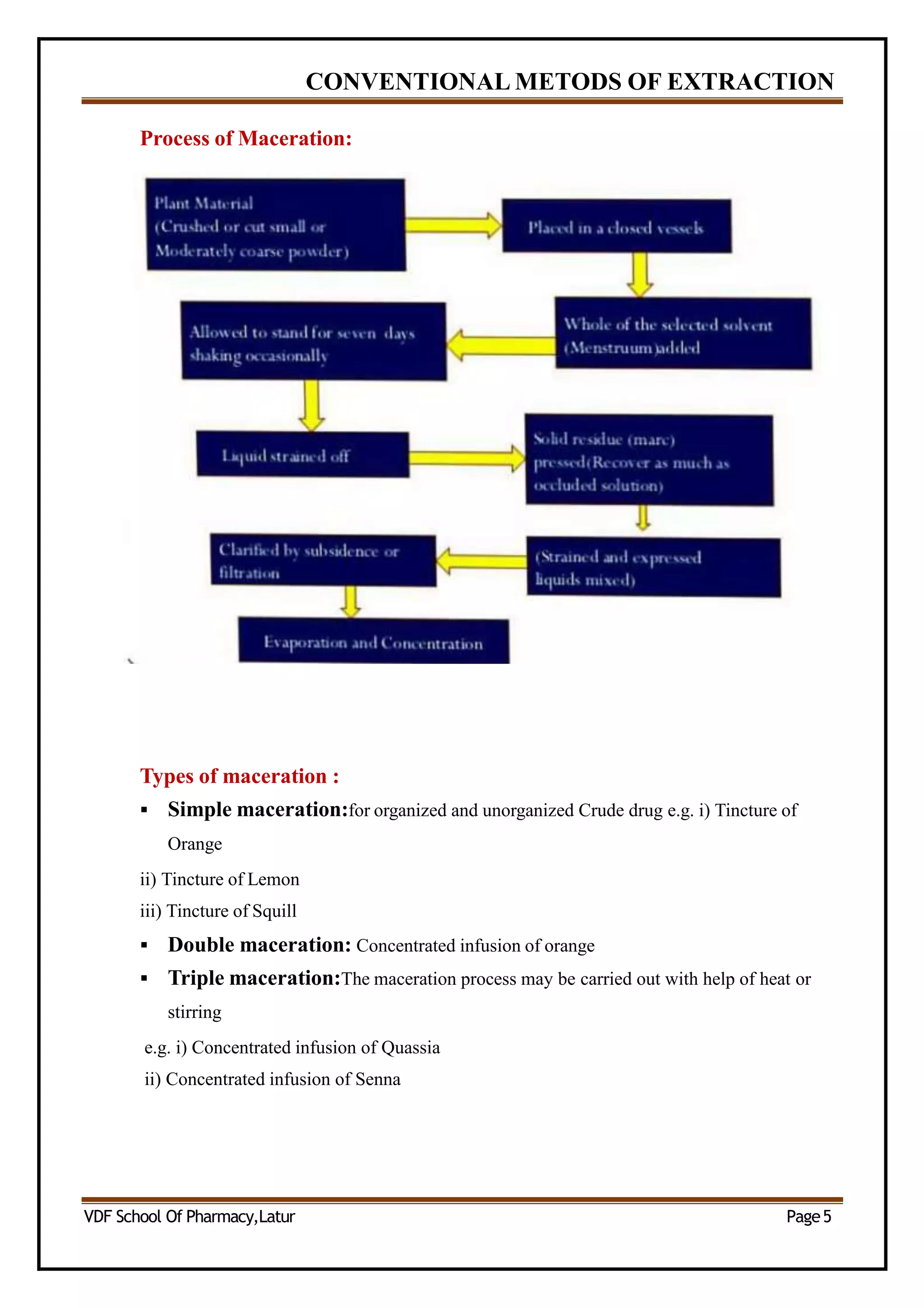
In this process solid ingredients are placed in a stoppered container with the whole of the
solvent and allowed to stand for a period of at least 3 days (3 - 7 days) with frequent
agitation, until soluble matter is dissolved. The mixture is then strained (through sieves /nets),
the marc pressed and the combined liquids clarified (cleaned by filtration) or by decantation,
after standing.
VDF School Of Pharmacy,Latur Page4
CONVENTIONAL METODS OF EXTRACTION
Process of Maceration:
Types of maceration :
 Simple maceration:for organized and unorganized Crude drug e.g. i) Tincture of
Orange
ii) Tincture of Lemon
iii) Tincture of Squill
 Double maceration: Concentrated infusion of orange
 Triple maceration:The maceration process may be carried out with help of heat or
stirring
e.g. i) Concentrated infusion of Quassia
ii) Concentrated infusion of Senna
VDF School Of Pharmacy,Latur Page5
CONVENTIONAL METODS OF EXTRACTION
 SIMPLE MACERATION:-
INTRODUCTION:-
The extraction of the drug with a solvent with several daily shakings or stirrings at room
temperature.
 In this type of maceration, organized drug are used.
TYPES:-
1.Kinetic maceration: is carried out at room temperature, like simple maceration, the
difference being that the material is kept in constant motion.
2.Vortical (turbo) Extraction:-The drug is stirred in the menstrum with a high-speed
mixture or homogenizer
THEORY:-
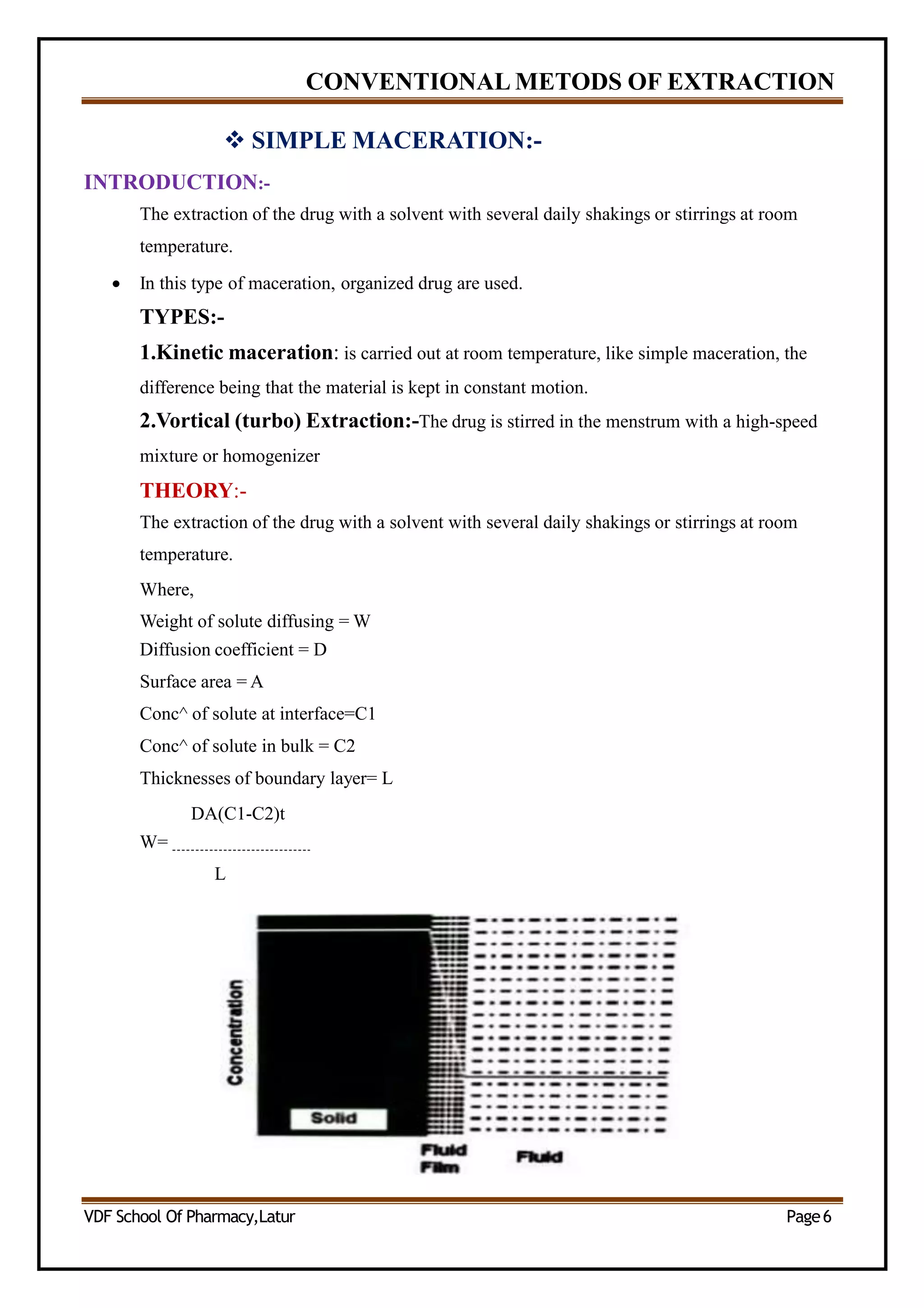
The extraction of the drug with a solvent with several daily shakings or stirrings at room
temperature.
Where,
Weight of solute diffusing = W
Diffusion coefficient = D
Surface area = A
Conc^ of solute at interface=C1
Conc^ of solute in bulk = C2
Thicknesses of boundary layer= L
DA(C1-C2)t
W=
L
VDF School Of Pharmacy,Latur Page6
CONVENTIONAL METODS OF EXTRACTION
THEORIES OF MACERATION:-
 Schoenemann's Diffusion theory
The rate of extraction depends on the rate of diffusion.
 Boucher et al., Soaking theory
Not only the rate of diffusion but also the rate of dissolution of the substances in the solvent
critically affect the rate of extraction.
 Karnowsky's Capillary velocity Theory
It represents the rate of extraction as a function of the rate of flow in the capillaries.
 Schultz & Koltz theory of maceration
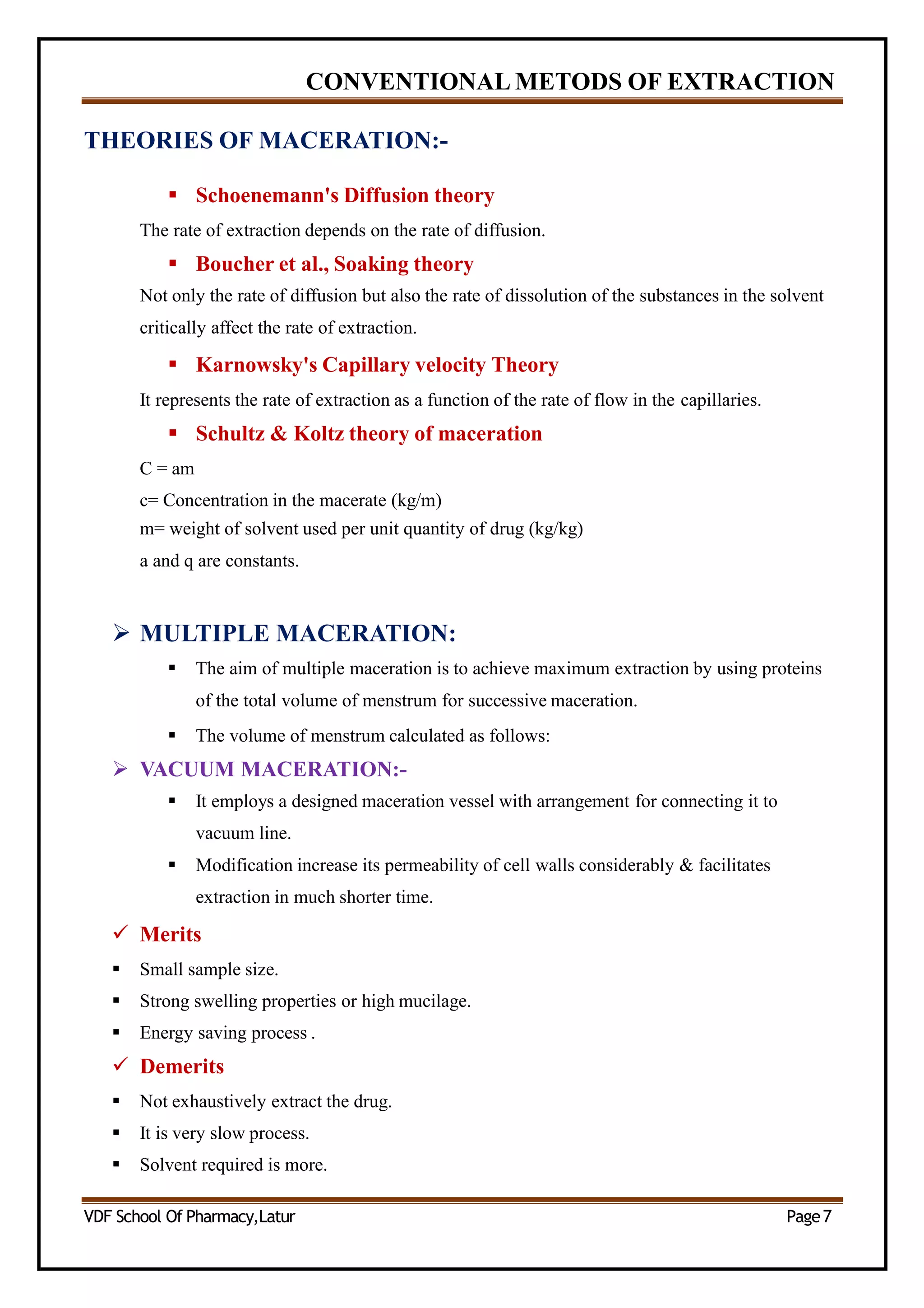
C = am
c= Concentration in the macerate (kg/m)
m= weight of solvent used per unit quantity of drug (kg/kg)
a and q are constants.
 MULTIPLE MACERATION:
 The aim of multiple maceration is to achieve maximum extraction by using proteins
of the total volume of menstrum for successive maceration.
 The volume of menstrum calculated as follows:
 VACUUM MACERATION:-
 It employs a designed maceration vessel with arrangement for connecting it to
vacuum line.
 Modification increase its permeability of cell walls considerably & facilitates
extraction in much shorter time.
 Merits
 Small sample size.
 Strong swelling properties or high mucilage.
 Energy saving process .
 Demerits
 Not exhaustively extract the drug.
 It is very slow process.
 Solvent required is more.
VDF School Of Pharmacy,Latur Page7
CONVENTIONAL METODS OF EXTRACTION
 Percolation :
 It is continuous downward displacement of the solvent through the bed of crude drug material
to get extract.
 Most frequently used to extract active ingredients in the preparation of tinctures and fluid
extracts.
 It is the method of short successive maceration or process of displacement.
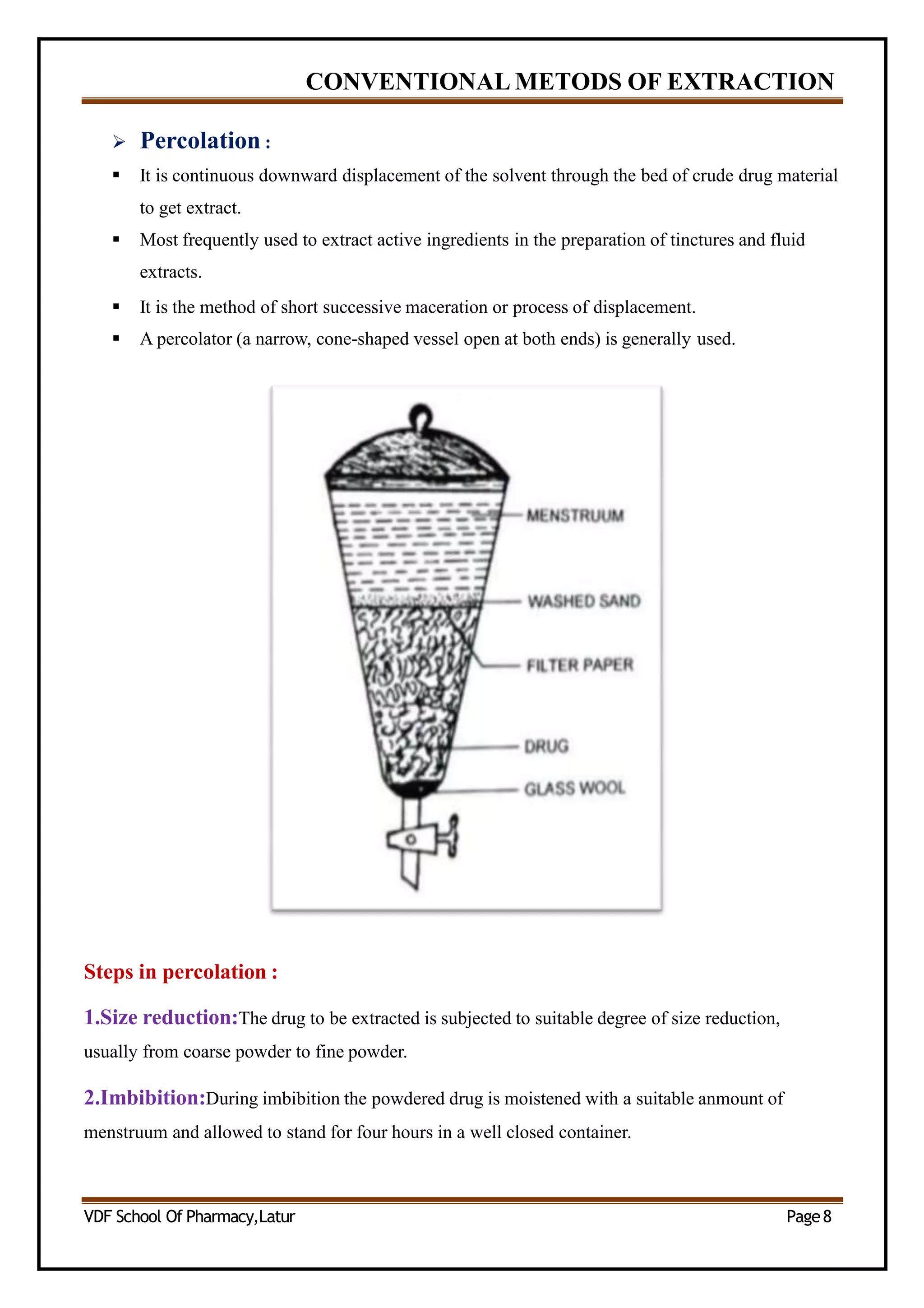
 A percolator (a narrow, cone-shaped vessel open at both ends) is generally used.
Steps in percolation :
1.Size reduction:The drug to be extracted is subjected to suitable degree of size reduction,
usually from coarse powder to fine powder.
2.Imbibition:During imbibition the powdered drug is moistened with a suitable anmount of
menstruum and allowed to stand for four hours in a well closed container.
VDF School Of Pharmacy,Latur Page8
CONVENTIONAL METODS OF EXTRACTION
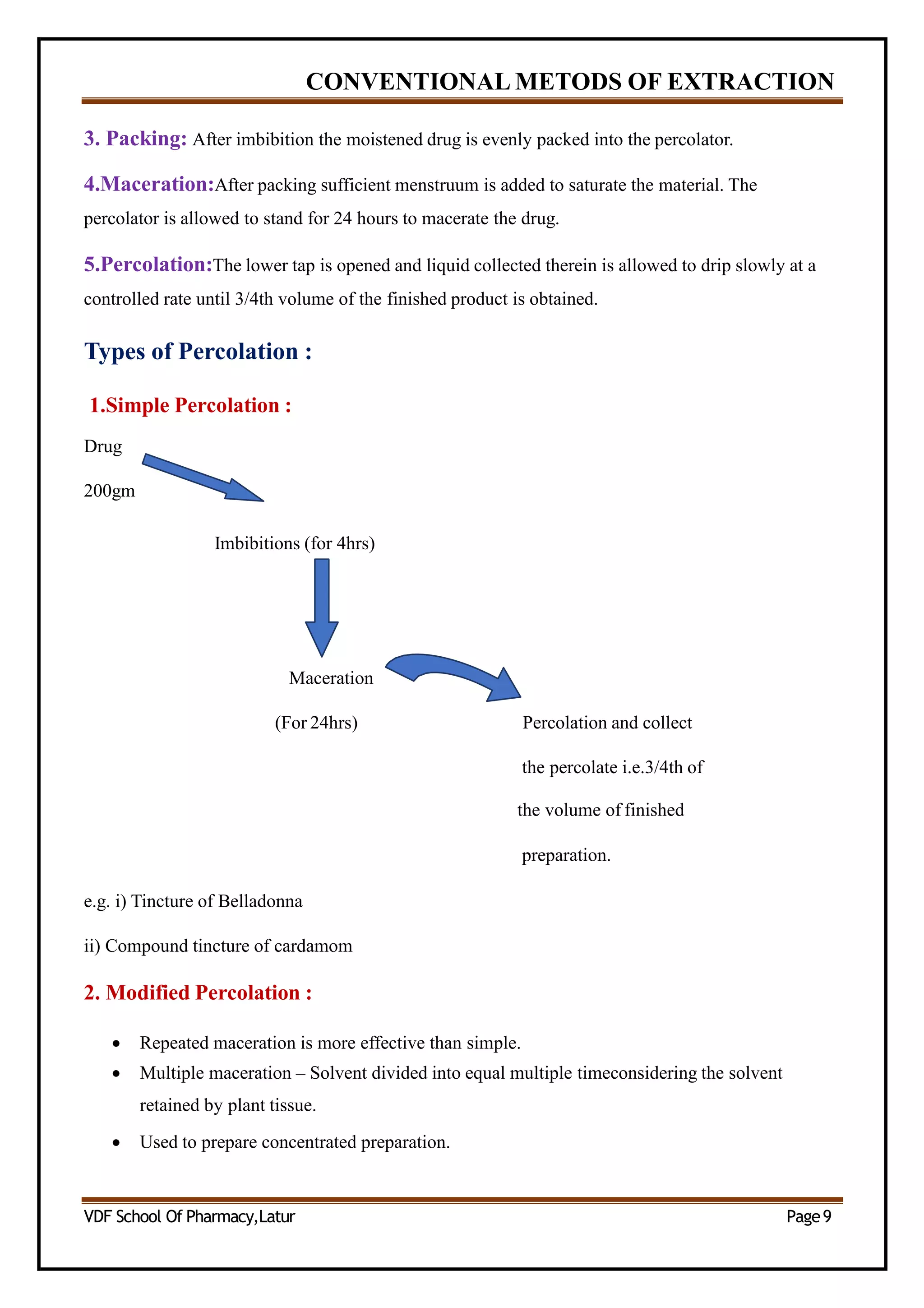
3. Packing: After imbibition the moistened drug is evenly packed into the percolator.
4.Maceration:After packing sufficient menstruum is added to saturate the material. The
percolator is allowed to stand for 24 hours to macerate the drug.
5.Percolation:The lower tap is opened and liquid collected therein is allowed to drip slowly at a
controlled rate until 3/4th volume of the finished product is obtained.
Types of Percolation :
1.Simple Percolation :
Drug
200gm
Imbibitions (for 4hrs)
Maceration
(For 24hrs) Percolation and collect
the percolate i.e.3/4th of
the volume of finished
preparation.
e.g. i) Tincture of Belladonna
ii) Compound tincture of cardamom
2. Modified Percolation :
 Repeated maceration is more effective than simple.
 Multiple maceration – Solvent divided into equal multiple timeconsidering the solvent
retained by plant tissue.
 Used to prepare concentrated preparation.
VDF School Of Pharmacy,Latur Page9
CONVENTIONAL METODS OF EXTRACTION
Reserved percolation:
 In this case the extraction is done through the general percolation procedure.
 At the last, the evaporation is done under reduced pressure in equipment like a Climbing
evaporator to the consistency of a soft extract (semi solid) such that all the water is removed.
 This is then dissolved in the reserved portion which is strongly alcoholic and easily dissolves
the evaporated portion with any risk of precipitation.
Merits :
 Requires less time than maceration.
 Extraction of thermolabile constituents can be possible.
Demerits :
 Requires more time than soxhalation.
 More solvent is required.
 Skilled person is required.
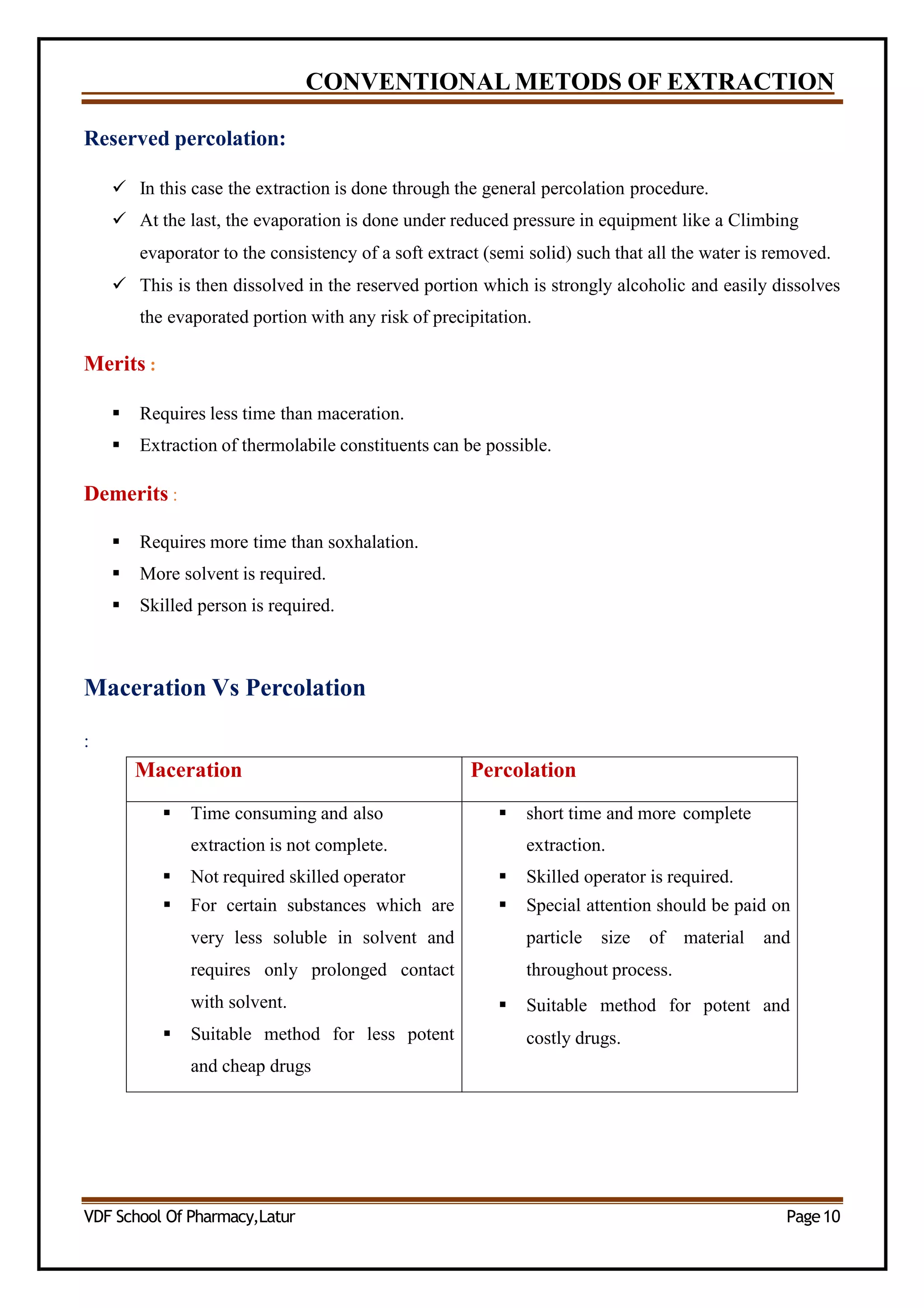
Maceration Vs Percolation
:
Maceration Percolation
 Time consuming and also
extraction is not complete.
 Not required skilled operator
 For certain substances which are
very less soluble in solvent and
requires only prolonged contact
with solvent.
 Suitable method for less potent
and cheap drugs
 short time and more complete
extraction.
 Skilled operator is required.
 Special attention should be paid on
particle size of material and
throughout process.
 Suitable method for potent and
costly drugs.
VDF School Of Pharmacy,Latur Page10
CONVENTIONAL METODS OF EXTRACTION
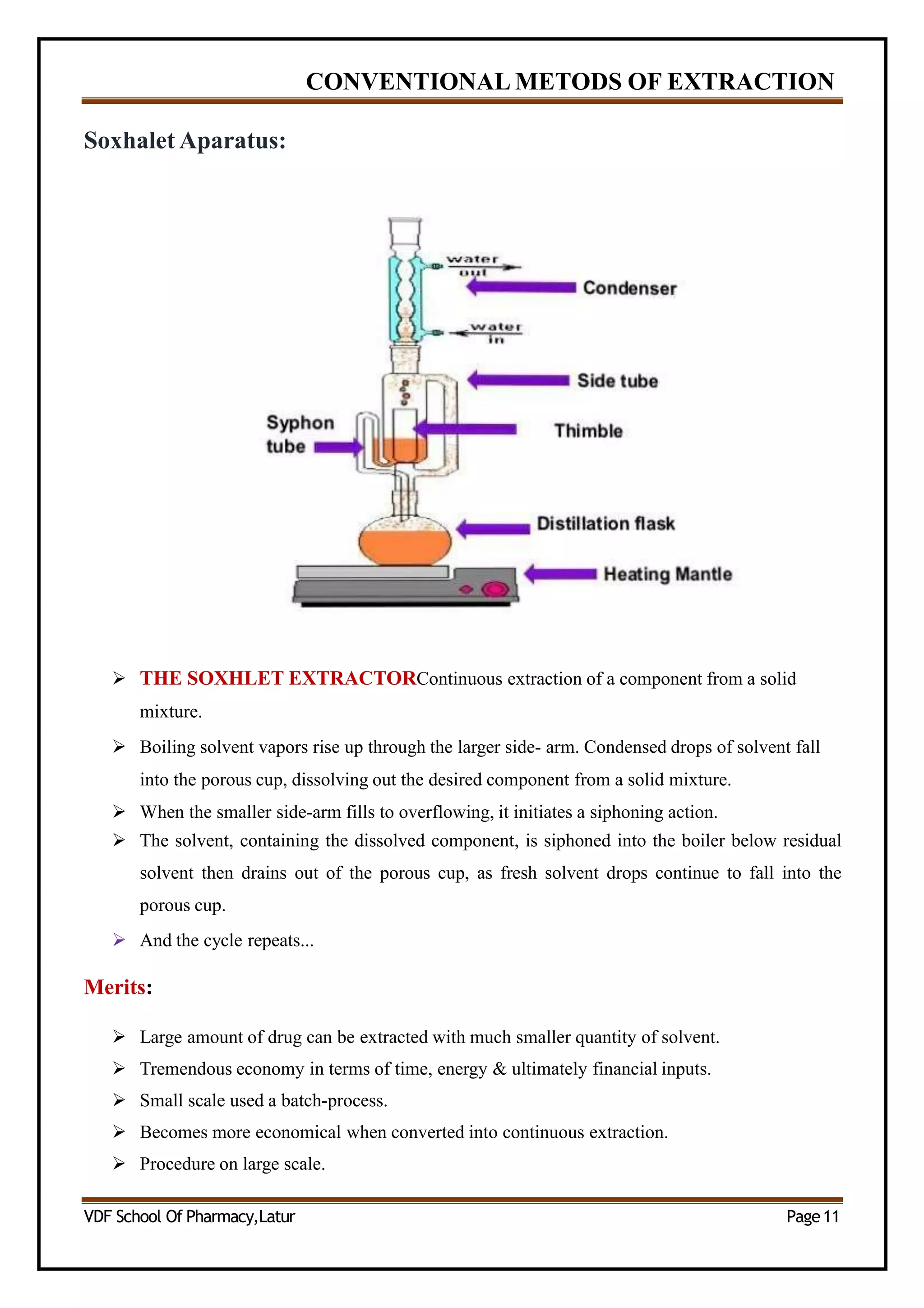
Soxhalet Aparatus:
 THE SOXHLET EXTRACTORContinuous extraction of a component from a solid
mixture.
 Boiling solvent vapors rise up through the larger side- arm. Condensed drops of solvent fall
into the porous cup, dissolving out the desired component from a solid mixture.
 When the smaller side-arm fills to overflowing, it initiates a siphoning action.
 The solvent, containing the dissolved component, is siphoned into the boiler below residual
solvent then drains out of the porous cup, as fresh solvent drops continue to fall into the
porous cup.
 And the cycle repeats...
Merits:
 Large amount of drug can be extracted with much smaller quantity of solvent.
 Tremendous economy in terms of time, energy & ultimately financial inputs.
 Small scale used a batch-process.
 Becomes more economical when converted into continuous extraction.
 Procedure on large scale.
VDF School Of Pharmacy,Latur Page11
CONVENTIONAL METODS OF EXTRACTION
Demerits :
 Physical nature of drug.
 Solvent.
 Chemical constituent of drug.
VDF School Of Pharmacy,Latur Page12
CONVENTIONAL METODS OF EXTRACTION
Reference :
1. Mukharji Pulok K. 2002,Quality Control of Herbal Drugs,1st edition Published by Business
Horizon, p.p 380-421.
2. Mehta R.M. 2010, Introduction to Pharmaceutics, 5th edition Published by Vallabh
Prakashan, p.p150-167.
3. Rangari v.d. 2002 „Pharmacognosy and Phytochemistry ,1stedition ,volume 1st Published by
Career Publication, p.p.95-98
4. Cooper J.W, Gunn's Colin 2010-2011, Register of General Pharmacy p.p.308-393
5. Essentials of botanical extraction principal & Application By Subhash C.Mandal P.P. 152-
160
6. Natural product extraction by Jmaes H.Clark, University of New York .
7. Textbook of Pharmacognosy & Phytochemistry by Avinsh Seth and Biren Shah,.P.P.122-13
8. www.wikpidia.com
VDF School Of Pharmacy,Latur Page13

Conventional methods of extraction ppt

  • 1.
    CONVENTIONAL METODS OFEXTRACTION Introduction: Extraction:  Extraction is the method of removing active constituents from a solid or liquid by means of liquid solvent.  The separation of medicinally active portions of plant or animal tissues from the inactive or inert components by using selective solvents.  In this method the wanted components are dissolved by the use of selective solvents known as menstruum& undissolved part is a marc. After the extraction unwanted matter is removed. Extracts are prepared by using ethanol or other suitable solvent.  Extract: Extracts can be defined as preparations of crude drugs which contain all the constituents which are soluble in the solvent. Marc: Solid residue obtain after extraction Menstruum: Solvent used for extraction  Type of extracts  Dry extract (Tab, cap.) E.g. belladonna extract  Soft (Ointment, suppository) E.g. glycerrhiza extract.  Liquid: As tincture.  Dissolution of extractive substances out of disintegrated cells.  Dissolution of extractive substances out of intact plant cell by diffusion (requires steeping and swelling)  Penetration of the solvent into the plant cells and swelling of the cells.  Diffusion of the dissolved extractive substances out of the cell out. Rinsing, washing. VDF School Of Pharmacy,Latur Page1
  • 2.
    CONVENTIONAL METODS OFEXTRACTION  Plant constituents are usually contained inside the cells. Therefore, The solvent used for extraction must diffuse into the cell to dissolve the desired compounds whereupon the solution must pass the cell wall in the opposite direction and mix with the surrounding liquid  An Equilibrium is established between the solute inside the cells and the solvent surrounding the fragmented plant tissues. Extraction Procedure Conventional methods Non conventional methods a. Ultrasound-assisted extraction b. Supercritical fluid extraction c. Pressurized-liquid extraction d. Microwave-assisted extraction a. Maceration. b. Infusion. c. Digestion d. Decoction e. Percolation f. Serial exhaustive extraction Ideal properties of the solvents : 1. Be highly selective for the compound to be extracted. 2. Not react with the extracted compound or with other compounds in the plant material 3. Have a low price. 4. Be harmless to man and to the environment. 5. Be completely volatile. 6. Should not mix up with water. VDF School Of Pharmacy,Latur Page2
  • 3.
    CONVENTIONAL METODS OFEXTRACTION 7. Should have the big capacity in relation to extractive. 8. The density of solvent should be difference from water density. 9. Should have the minimum viscosity. Conventional Methods of extraction Introduction: Conventional extraction technique such as maceration and novel extraction techniques like Microwave Assisted Extraction method (MAE) were used for the extraction of mucilage from the stem of Abroma augusta. The mucilage using both extraction content in the extracts obtained methods. The conventional and novel extraction techniques were compared on the basis of various parameters like extraction time and extraction yield. METHODS OF EXTRACTION : 1. Infusion. 2. Decoction. 3. Digestion. 4. Maceration. 5. Percolation. 6. Continues hot extraction. 7. Supercritical fluid extraction. 8. Counter current extraction. 9. Microwave assisted extraction. 10. Ultra sonitation-Assisted Extraction.  Infusion : Fresh infusions are prepared by macerating the crude drug for a short period of time with cold or boiling water. These are dilute solutions of the readily soluble constituents of crude drugs. Types of Infusion :  Fresh Infusion : e.g. Infusion of orange.  Concentrated Infusion : e.g. Concentrated infusion of Quassia VDF School Of Pharmacy,Latur Page3
  • 4.
    CONVENTIONAL METODS OFEXTRACTION  Decoction : In this process, the crude drug is boiled in a specified volume of water for a defined time; it is then cooled and strained or filtered. This procedure is suitable for extracting water-soluble, heat stable constituents. E.g. Tea, Coffee  Digestion :  This is a form of maceration in which gentle heat is used during the process of extraction.  It is used when moderately elevated temperature is not objectionable. The solvent efficiency of the menstruum is thereby increased. e.g. Extraction of Morphine  Maceration : In this process solid ingredients are placed in a stoppered container with the whole of the solvent and allowed to stand for a period of at least 3 days (3 - 7 days) with frequent agitation, until soluble matter is dissolved. The mixture is then strained (through sieves /nets), the marc pressed and the combined liquids clarified (cleaned by filtration) or by decantation, after standing. VDF School Of Pharmacy,Latur Page4
  • 5.
    CONVENTIONAL METODS OFEXTRACTION Process of Maceration: Types of maceration :  Simple maceration:for organized and unorganized Crude drug e.g. i) Tincture of Orange ii) Tincture of Lemon iii) Tincture of Squill  Double maceration: Concentrated infusion of orange  Triple maceration:The maceration process may be carried out with help of heat or stirring e.g. i) Concentrated infusion of Quassia ii) Concentrated infusion of Senna VDF School Of Pharmacy,Latur Page5
  • 6.
    CONVENTIONAL METODS OFEXTRACTION  SIMPLE MACERATION:- INTRODUCTION:- The extraction of the drug with a solvent with several daily shakings or stirrings at room temperature.  In this type of maceration, organized drug are used. TYPES:- 1.Kinetic maceration: is carried out at room temperature, like simple maceration, the difference being that the material is kept in constant motion. 2.Vortical (turbo) Extraction:-The drug is stirred in the menstrum with a high-speed mixture or homogenizer THEORY:- The extraction of the drug with a solvent with several daily shakings or stirrings at room temperature. Where, Weight of solute diffusing = W Diffusion coefficient = D Surface area = A Conc^ of solute at interface=C1 Conc^ of solute in bulk = C2 Thicknesses of boundary layer= L DA(C1-C2)t W= L VDF School Of Pharmacy,Latur Page6
  • 7.
    CONVENTIONAL METODS OFEXTRACTION THEORIES OF MACERATION:-  Schoenemann's Diffusion theory The rate of extraction depends on the rate of diffusion.  Boucher et al., Soaking theory Not only the rate of diffusion but also the rate of dissolution of the substances in the solvent critically affect the rate of extraction.  Karnowsky's Capillary velocity Theory It represents the rate of extraction as a function of the rate of flow in the capillaries.  Schultz & Koltz theory of maceration C = am c= Concentration in the macerate (kg/m) m= weight of solvent used per unit quantity of drug (kg/kg) a and q are constants.  MULTIPLE MACERATION:  The aim of multiple maceration is to achieve maximum extraction by using proteins of the total volume of menstrum for successive maceration.  The volume of menstrum calculated as follows:  VACUUM MACERATION:-  It employs a designed maceration vessel with arrangement for connecting it to vacuum line.  Modification increase its permeability of cell walls considerably & facilitates extraction in much shorter time.  Merits  Small sample size.  Strong swelling properties or high mucilage.  Energy saving process .  Demerits  Not exhaustively extract the drug.  It is very slow process.  Solvent required is more. VDF School Of Pharmacy,Latur Page7
  • 8.
    CONVENTIONAL METODS OFEXTRACTION  Percolation :  It is continuous downward displacement of the solvent through the bed of crude drug material to get extract.  Most frequently used to extract active ingredients in the preparation of tinctures and fluid extracts.  It is the method of short successive maceration or process of displacement.  A percolator (a narrow, cone-shaped vessel open at both ends) is generally used. Steps in percolation : 1.Size reduction:The drug to be extracted is subjected to suitable degree of size reduction, usually from coarse powder to fine powder. 2.Imbibition:During imbibition the powdered drug is moistened with a suitable anmount of menstruum and allowed to stand for four hours in a well closed container. VDF School Of Pharmacy,Latur Page8
  • 9.
    CONVENTIONAL METODS OFEXTRACTION 3. Packing: After imbibition the moistened drug is evenly packed into the percolator. 4.Maceration:After packing sufficient menstruum is added to saturate the material. The percolator is allowed to stand for 24 hours to macerate the drug. 5.Percolation:The lower tap is opened and liquid collected therein is allowed to drip slowly at a controlled rate until 3/4th volume of the finished product is obtained. Types of Percolation : 1.Simple Percolation : Drug 200gm Imbibitions (for 4hrs) Maceration (For 24hrs) Percolation and collect the percolate i.e.3/4th of the volume of finished preparation. e.g. i) Tincture of Belladonna ii) Compound tincture of cardamom 2. Modified Percolation :  Repeated maceration is more effective than simple.  Multiple maceration – Solvent divided into equal multiple timeconsidering the solvent retained by plant tissue.  Used to prepare concentrated preparation. VDF School Of Pharmacy,Latur Page9
  • 10.
    CONVENTIONAL METODS OFEXTRACTION Reserved percolation:  In this case the extraction is done through the general percolation procedure.  At the last, the evaporation is done under reduced pressure in equipment like a Climbing evaporator to the consistency of a soft extract (semi solid) such that all the water is removed.  This is then dissolved in the reserved portion which is strongly alcoholic and easily dissolves the evaporated portion with any risk of precipitation. Merits :  Requires less time than maceration.  Extraction of thermolabile constituents can be possible. Demerits :  Requires more time than soxhalation.  More solvent is required.  Skilled person is required. Maceration Vs Percolation : Maceration Percolation  Time consuming and also extraction is not complete.  Not required skilled operator  For certain substances which are very less soluble in solvent and requires only prolonged contact with solvent.  Suitable method for less potent and cheap drugs  short time and more complete extraction.  Skilled operator is required.  Special attention should be paid on particle size of material and throughout process.  Suitable method for potent and costly drugs. VDF School Of Pharmacy,Latur Page10
  • 11.
    CONVENTIONAL METODS OFEXTRACTION Soxhalet Aparatus:  THE SOXHLET EXTRACTORContinuous extraction of a component from a solid mixture.  Boiling solvent vapors rise up through the larger side- arm. Condensed drops of solvent fall into the porous cup, dissolving out the desired component from a solid mixture.  When the smaller side-arm fills to overflowing, it initiates a siphoning action.  The solvent, containing the dissolved component, is siphoned into the boiler below residual solvent then drains out of the porous cup, as fresh solvent drops continue to fall into the porous cup.  And the cycle repeats... Merits:  Large amount of drug can be extracted with much smaller quantity of solvent.  Tremendous economy in terms of time, energy & ultimately financial inputs.  Small scale used a batch-process.  Becomes more economical when converted into continuous extraction.  Procedure on large scale. VDF School Of Pharmacy,Latur Page11
  • 12.
    CONVENTIONAL METODS OFEXTRACTION Demerits :  Physical nature of drug.  Solvent.  Chemical constituent of drug. VDF School Of Pharmacy,Latur Page12
  • 13.
    CONVENTIONAL METODS OFEXTRACTION Reference : 1. Mukharji Pulok K. 2002,Quality Control of Herbal Drugs,1st edition Published by Business Horizon, p.p 380-421. 2. Mehta R.M. 2010, Introduction to Pharmaceutics, 5th edition Published by Vallabh Prakashan, p.p150-167. 3. Rangari v.d. 2002 „Pharmacognosy and Phytochemistry ,1stedition ,volume 1st Published by Career Publication, p.p.95-98 4. Cooper J.W, Gunn's Colin 2010-2011, Register of General Pharmacy p.p.308-393 5. Essentials of botanical extraction principal & Application By Subhash C.Mandal P.P. 152- 160 6. Natural product extraction by Jmaes H.Clark, University of New York . 7. Textbook of Pharmacognosy & Phytochemistry by Avinsh Seth and Biren Shah,.P.P.122-13 8. www.wikpidia.com VDF School Of Pharmacy,Latur Page13