Mr. Dipak Bhingardeve
Assistant professor
Department of Pharmaceutics
Dr.Shivajirao kadam College of
Pharmacy,Kasabe digraj, Sangli.
 Extraction :
 It defined as the treatment of the plant or animal
tissues with solvent , whereby the medicinally active
constituents are dissolved and most of the inert matter
remains undissolved.
 The solvent used for extraction is known as
“menstruum.”
 And the inert insoluble material that remains after
extraction is called “marc”.
 1. Infusion
 2. Decoction
 3. Maceration
 4.Percolation
 5.Digestion
 1. Water :
 Water is a solvent for protein , colouring matter,
gums, glycosides, sugars, alkaloidal salts, enzymes,
many organic acids and most of the organic salts.
 Waxes ,fats ,fixed oils and most alkaloids are
insoluble in water.
 It is cheap.
 Is has a wide solvent action.
 It is non-toxic.
 It is non-inflammable.
 Disadvantages:
 Water helps in growth of moulds and bacteria. Hence
,some preservative is needed during extraction of crude
drugs.
 Water causes hydrolysis of many substances.
 Large amount of heat is required to concentrate the
aqueous preparation than non-aqueous preparation.
 2. Alcohol :
 Alcohol is solvent for alkaloids , glycosides, volatile
oils and resins.
 Alcohol does not dissolve albuminous matter ,gums
,waxes, fats, fixed oils and sugar.
 The mould and bacteria cannot grow in a solution in which
alcohol concentration is 20% or more.
 It is neutral and hence extraction products obtained from it are
compatible with other products.
 A small amount of heat is required to concentrate the
alcoholic preparation.
 It is non-toxic in the concentration mostly present in the
preparations.
 Disadvantages :
 The preparation becomes costly when alcohol is used as
solvent for extraction of API.
 Infusion :
 It consist of pouring water over the drugs and
 Then allowing it to keep in contact with water for the
stated period ,usually 15 minutes ,with occasional
stirring and
 finally filtering off the liquid.
 Drug is placed at the bottom of the pot.
 Water is added and it is well stirred 3 or 4 times.
 Infusion can also be prepared by enclosing the drug in a
muslin bag and then suspending it just below the level
of the water in a beaker.
 Stirring is not required bcz water slowly circulate due to
increase in specific gravity of water near the drug.
 When water comes in contact with the drug ,it dissolves
API and become heavier.
 Heavier layer come down and their place is taken by
fresh water.
 As a result ,there is slow circulation of water & hence
stirring is not required.
 Special pots known as ‘ infusion pot’ used for
preparation of infusion .
 There are two type of infusion:
 1. Fresh infusion
 2. Concentrated infusion
 A fresh infusion is an aqueous solution of active
constituents of a vegetable drug prepared by the process
of infusion .
 e.g fresh infusion of Quassia.
 Coarse powder is used

 Water is used as menstruum bcz it has more penetration
power & dissolves the API.
 Pharmacopoeia states that fresh infusion should be used
within 12 hrs after its preparation bcz it gets spoiled
due to fungal or bacterial growth.
 It is prepared by double or triple maceration process.
 Conc. Infusions are 8 times stronger than fresh infusion.
 Alcohol in the conc of 20-25% is used as menstruum.
 Hence these preparation can be stored for longer period
due to preservatives action of alcohol.
 E.g conc infusion of Quassia & conc compound infusion
of chirata.
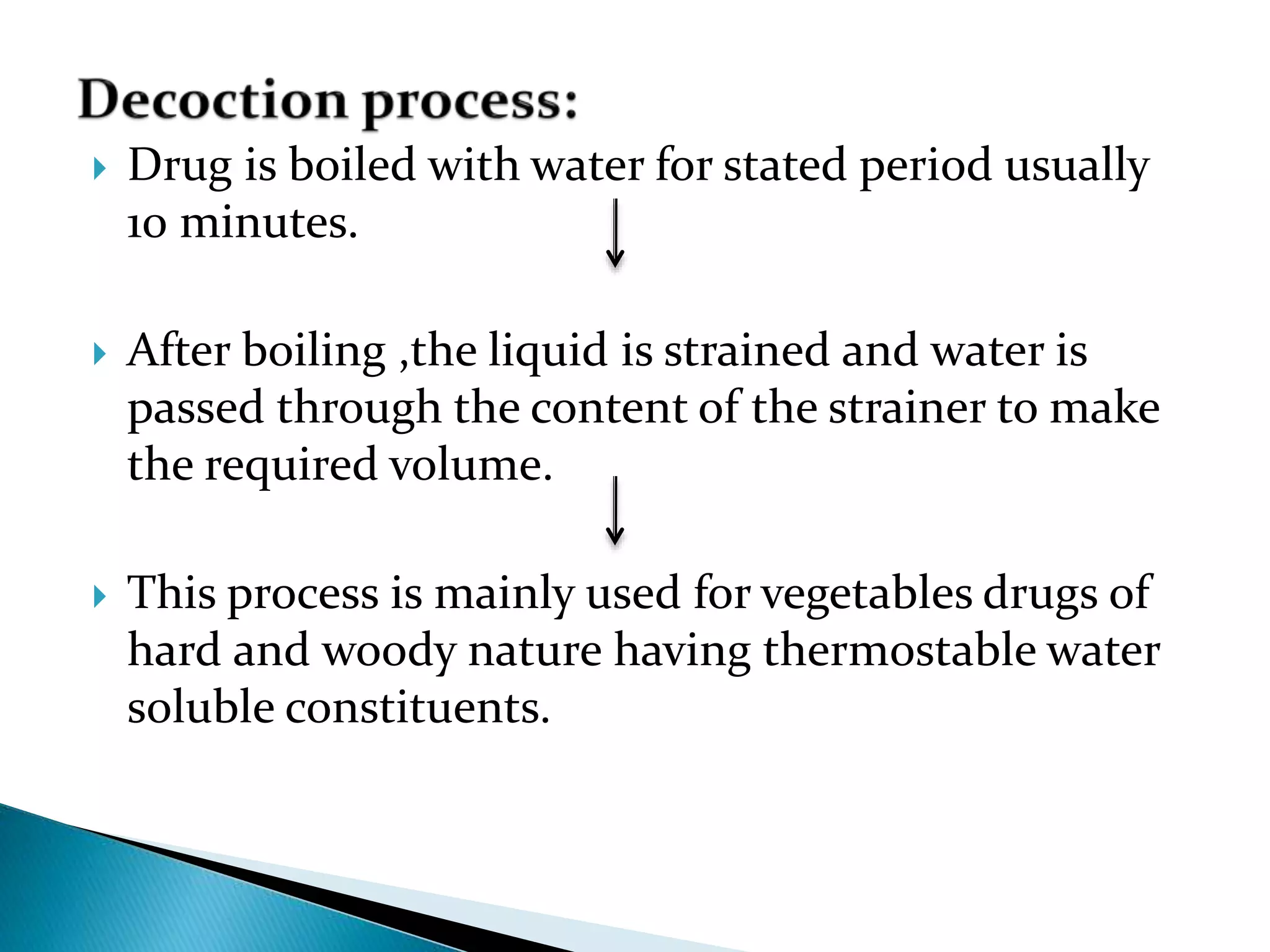
 Drug is boiled with water for stated period usually
10 minutes.
 After boiling ,the liquid is strained and water is
passed through the content of the strainer to make
the required volume.
 This process is mainly used for vegetables drugs of
hard and woody nature having thermostable water
soluble constituents.
 Various types of maceration process:
 1. A process for tincture made from organised drug e.g.
roots,stem,leaves etc. This process is called ‘Simple
Maceration’.
 2.A process for tincture made from unorganised drugs
such as oleo resins and gum resins. This process is
known as ‘Maceration with Adjustment’.
 3. Process for concentrated preparations which
includes both ‘Double maceration’ and ‘Triple
maceration’.
 Apparatus:
 A wide mouth bottle or any other container which can be
well stoppered is used for maceration process.
 A closed container is essential to prevent the evaporation
of menstruum which is mostly concentrated alcohol.
 No adjustment in volume is made.
 Drug is placed with the whole of the menstruum in a
closed vessel for seven days.
 During this period shaking is done occasionally.
 After seven days ,the liquid is strained and marc is
pressed.
 The expressed liquid is mixed with strained liquid .
 It is then filtered to make a clear liquid.
 The final volume is not adjusted.
 1.Tincture of Orange .
 2.Tincture of Lemon.
 3.Tincture of Squill.
 2. Maceration process for Unorganised Drugs or
Maceration with Adjustment.
 Method :
 Unorganised drug is placed with 4/5th of the
menstruum in a closed vessel for period of 2-7 days.
 Shaking is done occasionally.
 After stated period ,liquid is filtered and final
volume is made up by passing remaining 1/5th of
mentruum. The marc is not pressed.
 1. Tincture of tolu
 2. compound tincture of benzoin
 3. Maceration process for Concentrated Preparation
or Multiple Maceration process.
 Maceration process is carried out in the same way as
simple maceration process ,
 but the menstruum used is divided into two parts in
double maceration process and into three parts in
triple maceration process.
 Drug is macerated twice by using the menstruum
which is divided into parts in such a manner that the
same volume is used for each maceration.
 The quantity of menstruum required for two
macerations are calculated as :
 1) Volume of menstruum required for first
maceration=
 Total vol.of menstruum – Vol.to be retained Vol. to
 by drug + be retained by drug
 2
 II) Vol.of menstruum required for second maceration=
total vol.of menstruum – vol. of menstruum used in first
maceration.
 In double maceration process, the whole of the drug is
macerated for 48 hrs with qty of menstruum required for first
maceration .
 Strain the liquid and press the marc.
 Macerated again for 24 hrs with remaining menstruum
required for second maceration.
 Strain the liquid and press the marc.
 Mix the liquid obtained from two macerations and allow it to
stand for 14 days and then filter.
 Example –
 1. concentrated infusion of orange
 2. concentrated compound infusion of chirata
 3. concentrated compound infusion of gelatin.
In this maceration process, the drug is macerated thrice by
using the menstruum which is divided into three parts in
such a manner that the same volume is used for such
each maceration.
The quantity of menstruum required for three maceration
is calculated as follows:
I)Vol. of menstruum required for first maceration=
Total vol.of - vol. to be retained
maceration by the drug + vol. to be retained by drug
3
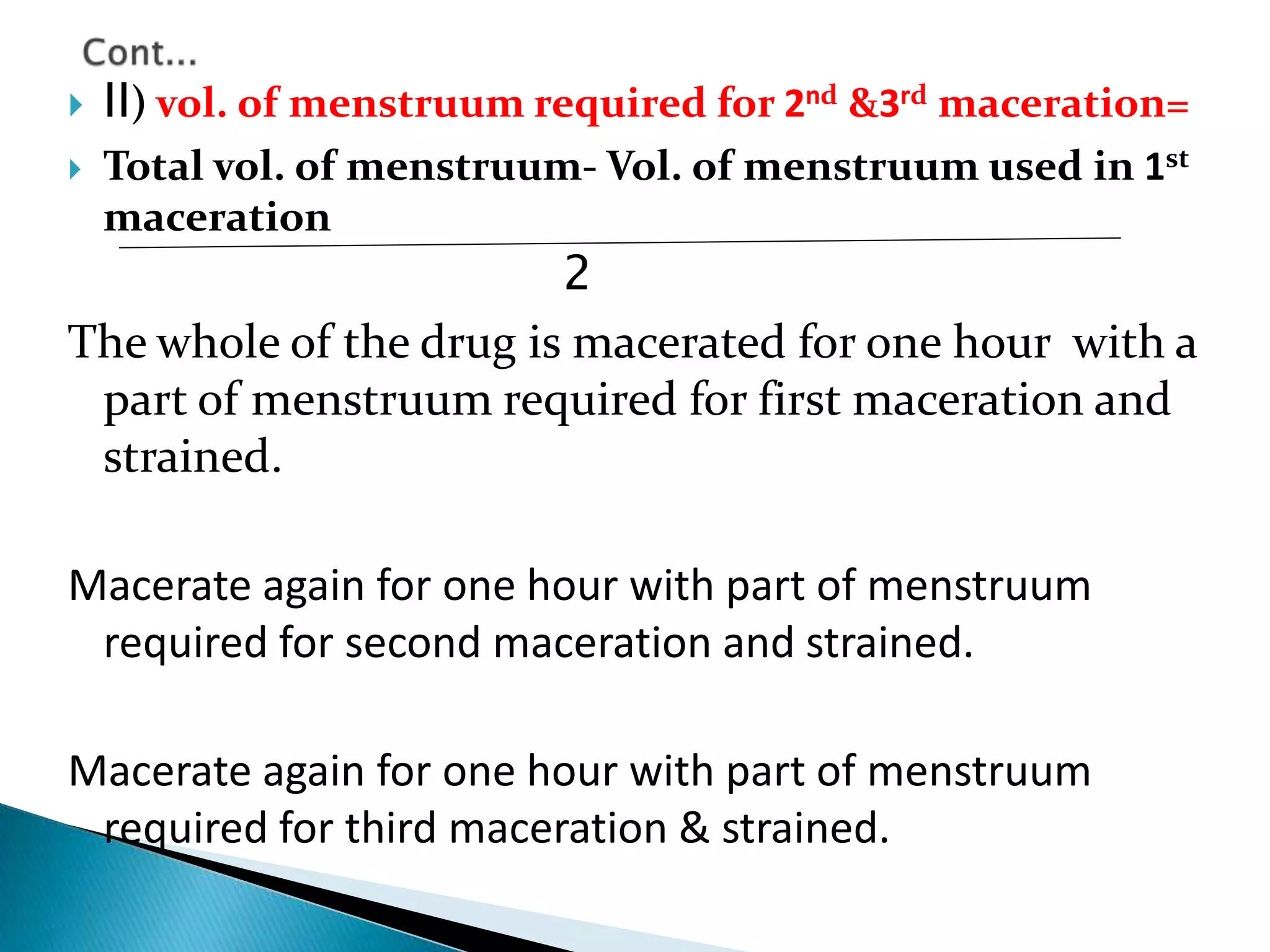
 II) vol. of menstruum required for 2nd &3rd maceration=
 Total vol. of menstruum- Vol. of menstruum used in 1st
maceration
2
The whole of the drug is macerated for one hour with a
part of menstruum required for first maceration and
strained.
Macerate again for one hour with part of menstruum
required for second maceration and strained.
Macerate again for one hour with part of menstruum
required for third maceration & strained.
 Press the marc lightly.
 Then combine the liquid obtained from second &third
maceration &evaporate it to specified extend.
 Mix it with liquid obtained from first maceration .
 Add alcohol 90% equal to 1/4th of the volume of the
finished product .
 Adjust volume with water.
 Allow it to stand for 14 days and filter.
 1.Concentrated infusion of Quassia.
 2.Liquid Extract of Senna.
 Percolation Processes :
 The various percolation processes used for the extraction
of drugs:
 1. Simple percolation or petroleum process for tinctures.
 2. Percolation processes for concentrated preparation
such as:
 A)Reserve percolation process
 B) Modified percolation process
 3. Continuous hot percolation or soxhelation.
 Apparatus:
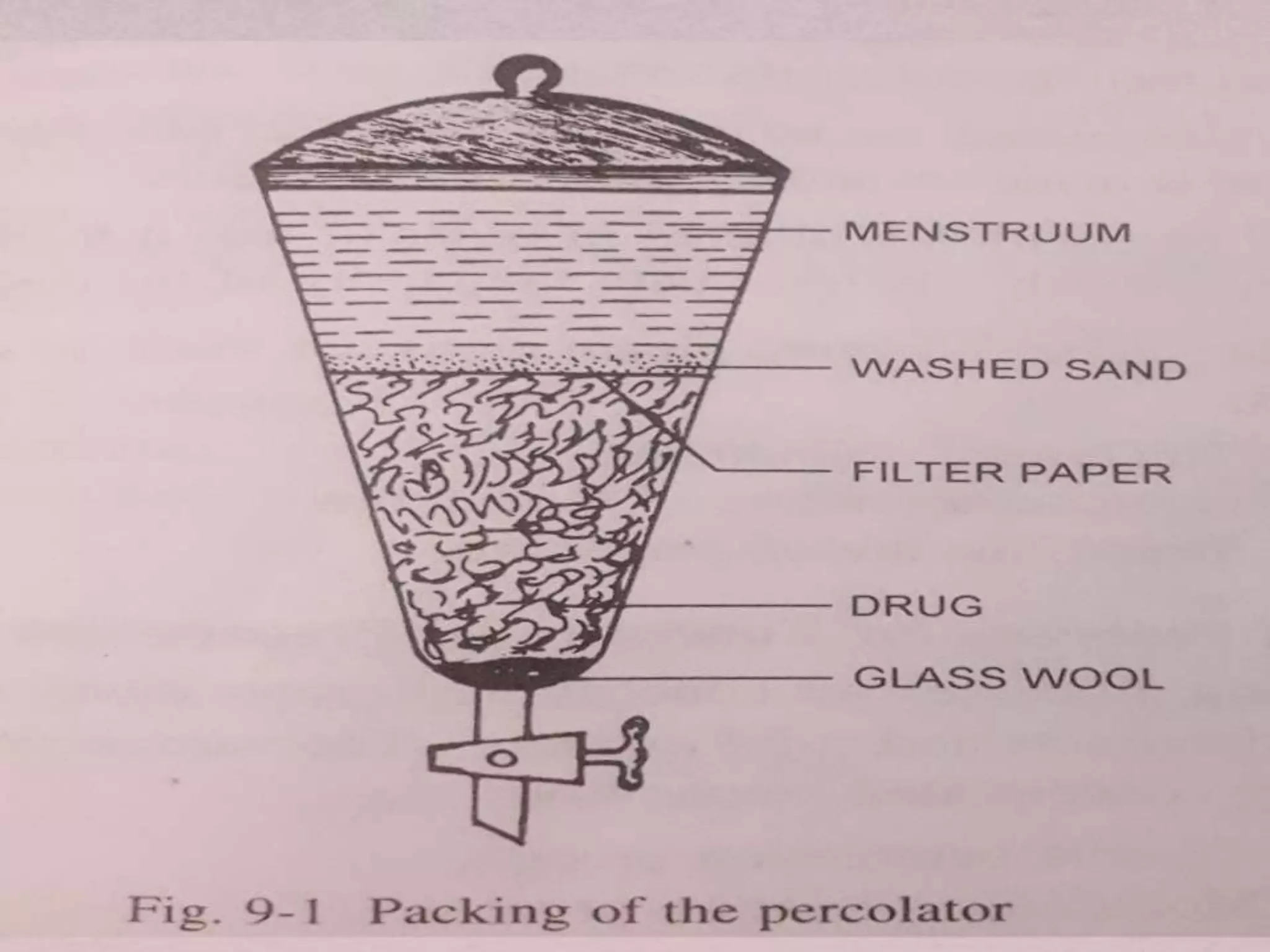
 Three types of percolators are used.
 1. Conical Percolators:
 The percolator is made of glass or of metal, usually
copper ,which is tinned inside.
 It is conical in shape having lower diameter not less
than half of upper diameter.
 There are less chances of choking percolator in case
the drug swells up, because a drug can slope against
the wall of the percolator.
 The percolator is cylindrical in shape i.e. Upper and
lower diameters are same.
 When a higher concentration of alcohol or any other
volatile solvent is used as menstruum a cylindrical
percolator is preferred.
 3. Steam jacketed percolator:
 When percolation is a carried is carried at higher
temperature ,in order to increase the solvent action of the
menstruum, the percolator is heated by steam.
 Simple percolation process is used for the
preparation of tincture.
 There are three stages in the official method for the
preparation of tincture :
 A) Imbibition
 B) Maceration
 C)Percolation
 A) Imbibition :
 The powdered drug is moistened with sufficient quantity
of menstruum and allowed to stand for 4 hrs in closed
vessel.
 Pack the moistened drug into percolators & add sufficient
 Quantity of menstruum to saturate the material.
 When liquid starts coming out from outlet of percolators, the
outlet is closed.
 Then the sufficient quantity of menstruum is added in order to
leave a layer above the drug.
 B) Maceration :
 The moistened drug is left in contact with menstruum for 24 hrs.
 During this period ,the menstruum dissolves the active
constituents of the drug and becomes almost saturated with it.
 It consist of downward displacement of saturated solution
formed in maceration and extraction of the remaining active
constituents present in the drug by slow passage of the
menstruum through the column of the drug .
 After collecting ¾ of the required volume of the finished
product or when drug is completely exhausted, the marc is
pressed.
 Mix the expressed liquid with percolate.
 Add sufficient quantity of menstruum to produce required
volume and then filter.
 During the period of 24 hours of maceration, the menstruum
penetrates into the tissues of the drug and dissolves the active
constituents.
 A short maceration before percolation enables the extraction
of active constituents of the drug with considerably less
quantity of the menstruum.
 After 24 hours of the maceration, open the outlet of the
percolator And collect the percolate which measures about ¾
of the volume required for the finished product.
 The exhaustion of drug may be tested by doing the
specified chemical test depending on the
constituents present in the drug or absence of colour
in percolator.
 After exhaustion of the drug or after collecting the
required quantity of the percolator, the marc is taken
out from percolator. It is pressed to recover costly
solvent.
 The expressed liquid is mixed with percolate and then
final volume is made by adding more of menstruum.
 The preparation is filtered in order to free it from
cell debris or other material which interfere with
clarity of the preparation.
 Example -
 1.Tincture of belladonna.
 2.Compound tincture of cardamom
 3.Strong tincture of ginger
 Percolation processes for concentrated preparation are
used for preparing liquid extracts and solid extracts.
 The various processes used for the preparing
concentrated preparations are:
 A)Reserve percolation process
 B)Modified percolation process
 In this process, a part of the percolate, generally ¾ volume
of finished preparation, is reserved.
 Then the percolation process is continued till the drug is
completely exhausted.
 The percolate is subjected to evaporation or distillation to
convert it into a soft extract.
 This soft extract is dissolved in the reserve portion of
percolate & then sufficient menstruum is added to
produce required volume.
 In percolation process for preparation of tincture, the
drug/percolate (d/p) ratio is about 1:4.
 The d/p ratio is reduced to 1:3 by modifying
percolation process & hence there is lot of saving in
heat, time & menstruum.
 Percolation is a displacement process.
 The strong solution of active constituents of drug
formed during maceration is displaced by a fresh
 Menstruum when percolation process is started.
 It is proved that stationary menstruum (menstruum
remaining in contact with drug ) dissolves more matter
than flowing menstruum.
 Hence ,more menstruum is required to exhaust the
drug when simple percolation process is used.
 But if continuous percolation stage has suitable breaks
by short maceration stages, the d/p ratio can be
reduced to 1:3.
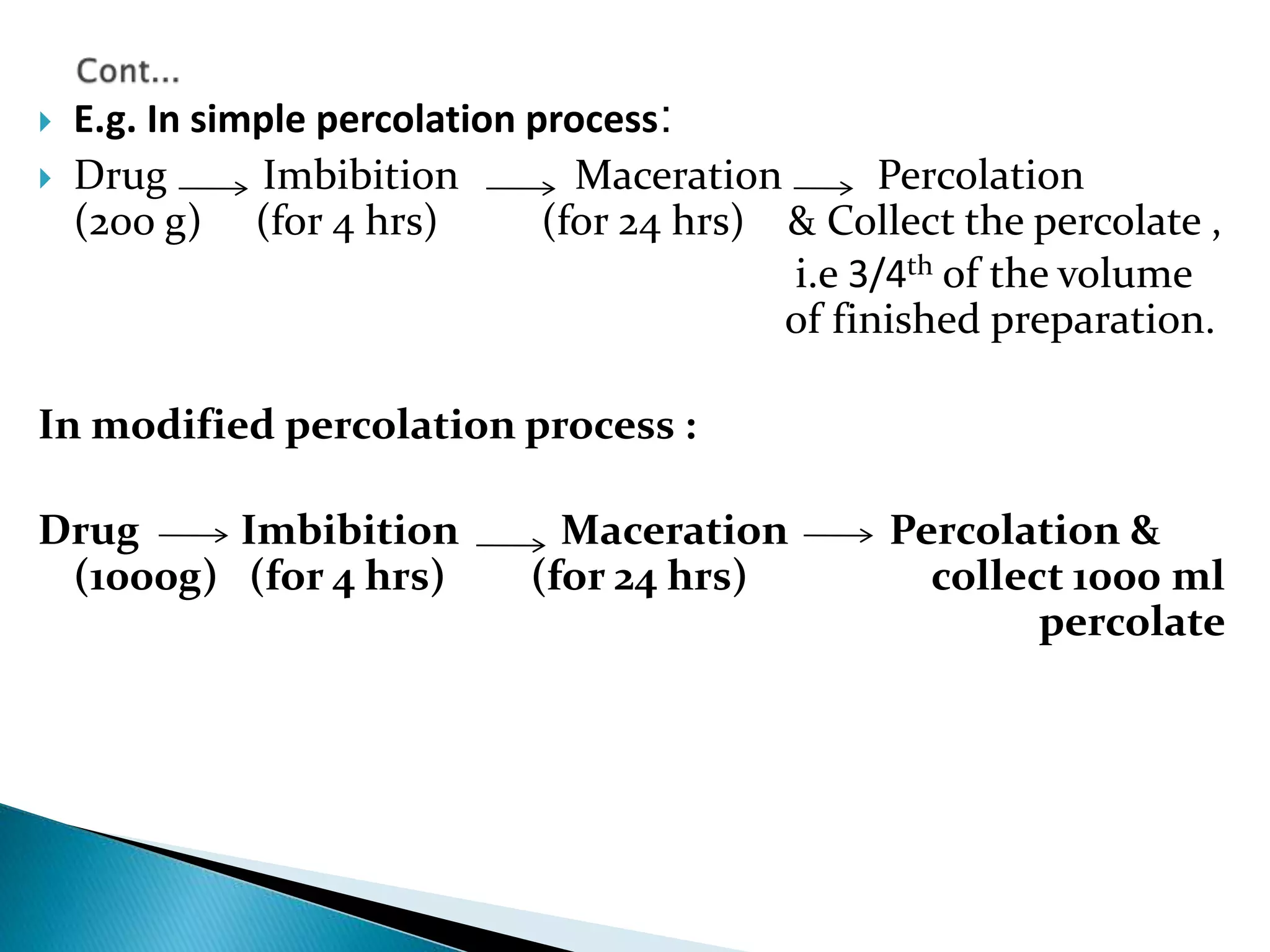
 E.g. In simple percolation process:
 Drug Imbibition Maceration Percolation
(200 g) (for 4 hrs) (for 24 hrs) & Collect the percolate ,
i.e 3/4th of the volume
of finished preparation.
In modified percolation process :
Drug Imbibition Maceration Percolation &
(1000g) (for 4 hrs) (for 24 hrs) collect 1000 ml
percolate
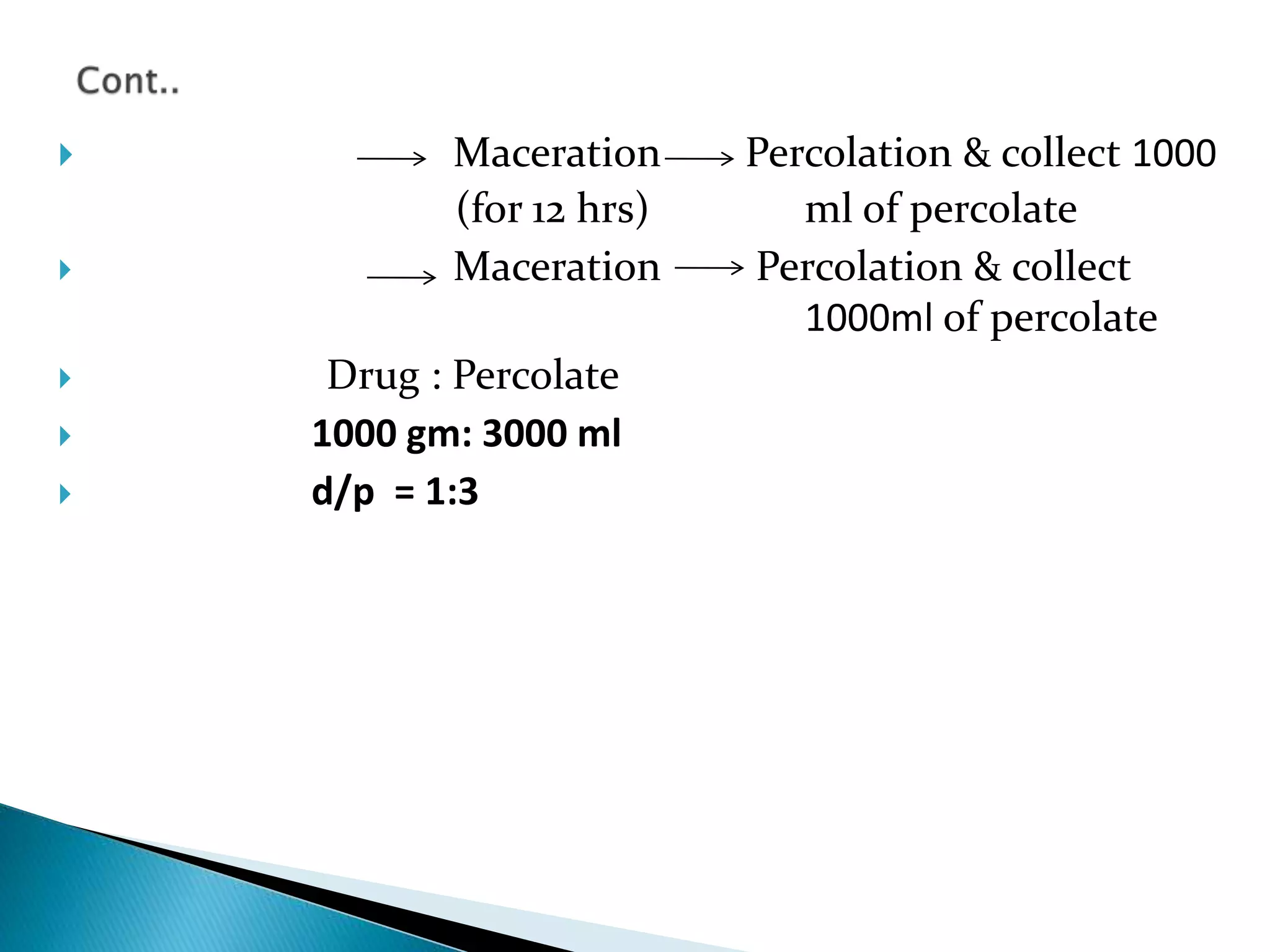
 Maceration Percolation & collect 1000
(for 12 hrs) ml of percolate
 Maceration Percolation & collect
1000ml of percolate
 Drug : Percolate
 1000 gm: 3000 ml
 d/p = 1:3
 When active constituents of the drugs are not freely soluble in
the solvent or difficult to be displaced from the cells of the
drug, then it becomes necessary to extract the crude by the
action of hot menstruum for considerable length of time.
 The fixed oils from seeds and alkaloids from the drugs are
extracted by continuous hot percolation process using
benzene, chloroform, petroleum,ether etc.
 The apparatus used for continuous hot percolation process is
soxhlet apparatus which consist of three parts:
 A. Flask containing the boiling solvent .
 B. Soxhlet Extractor in which drug to be extracted is packed.
 It has side tube which carries vapours of the solvent from the
flask to the condenser and syphon tube which syphon over the
extract from soxhlet extractor to the flask .
 C. A condenser in which the vapours of the solvent are
condensed again into solvent.
 The drug to be extracted is packed in a paper cylinder made
from a filter paper & it is placed in the body of soxhlet
extractor.
 The solvent is placed in the flask and apparatus is then fitted.
 When solvent is boiled on heating the flask, it gets converted
into vapours.
 These vapours enter into condenser trough the side tube &
get condensed into hot liquid which falls on the column of
the drug.
 When extractor gets filled with the solvent , the level of
syphon tube also raises up to its top.
 The solvent containing API in the syphon tube syphon
over & run into the flask , thus emptying the body of
extractor.
 This altering of filling and emptying the body of
extractor goes on continuously.
 This process is repeated until drug is exhausted.
 The process is repeated about 15 times for complete exhaustion
of the drug.
 Limitation of continuous Hot Percolation Process:
 Physical character of the drug :
 The physical character of the drug is such that it would block
the soxhlet apparatus in case it is used for its extraction by
this method
 E.g opium , gum, resin, orange peel etc
 Solvent : only pure solvent or constant boiling mixture can be
used for this process.
 Chemical constituent of the drug: The process is unsuitable
for drugs having thermolabile active constituents such as
enzymes ,alkaloids, antraquinone derivatives etc.
 In digestion process, the drug is extracted by heating at a
particular pressure.
 This will increase the penetration power of the
menstruum , so that there is complete extraction of the
drug.
 Precaution should be taken so that increased
temperature may not harm the active constituents of the
drug.
 The apparatus known as “Digestor” is used for extraction of
the drug by this method.
 It is a vessel made up of metal.
 The whole of the drug along with the menstruum is placed in
the body of the digestor.
 Place the cover over it and bolt it with the help of nuts.
 The drug is treated with menstruum for a definite period
under specified condition of temperature and pressure.
 1.Character of drug
 2.Therapeutic value of the drug
 3.Cost of drug
 4.Stability of drug
 5.Solvent
 6.Concentration of product.
Extraction process

Extraction process

  • 1.
    Mr. Dipak Bhingardeve Assistantprofessor Department of Pharmaceutics Dr.Shivajirao kadam College of Pharmacy,Kasabe digraj, Sangli.
  • 2.
     Extraction : It defined as the treatment of the plant or animal tissues with solvent , whereby the medicinally active constituents are dissolved and most of the inert matter remains undissolved.  The solvent used for extraction is known as “menstruum.”  And the inert insoluble material that remains after extraction is called “marc”.
  • 3.
     1. Infusion 2. Decoction  3. Maceration  4.Percolation  5.Digestion
  • 4.
     1. Water:  Water is a solvent for protein , colouring matter, gums, glycosides, sugars, alkaloidal salts, enzymes, many organic acids and most of the organic salts.  Waxes ,fats ,fixed oils and most alkaloids are insoluble in water.
  • 5.
     It ischeap.  Is has a wide solvent action.  It is non-toxic.  It is non-inflammable.  Disadvantages:  Water helps in growth of moulds and bacteria. Hence ,some preservative is needed during extraction of crude drugs.  Water causes hydrolysis of many substances.
  • 6.
     Large amountof heat is required to concentrate the aqueous preparation than non-aqueous preparation.  2. Alcohol :  Alcohol is solvent for alkaloids , glycosides, volatile oils and resins.  Alcohol does not dissolve albuminous matter ,gums ,waxes, fats, fixed oils and sugar.
  • 7.
     The mouldand bacteria cannot grow in a solution in which alcohol concentration is 20% or more.  It is neutral and hence extraction products obtained from it are compatible with other products.  A small amount of heat is required to concentrate the alcoholic preparation.  It is non-toxic in the concentration mostly present in the preparations.  Disadvantages :  The preparation becomes costly when alcohol is used as solvent for extraction of API.
  • 8.
     Infusion : It consist of pouring water over the drugs and  Then allowing it to keep in contact with water for the stated period ,usually 15 minutes ,with occasional stirring and  finally filtering off the liquid.
  • 9.
     Drug isplaced at the bottom of the pot.  Water is added and it is well stirred 3 or 4 times.  Infusion can also be prepared by enclosing the drug in a muslin bag and then suspending it just below the level of the water in a beaker.  Stirring is not required bcz water slowly circulate due to increase in specific gravity of water near the drug.  When water comes in contact with the drug ,it dissolves API and become heavier.
  • 10.
     Heavier layercome down and their place is taken by fresh water.  As a result ,there is slow circulation of water & hence stirring is not required.  Special pots known as ‘ infusion pot’ used for preparation of infusion .  There are two type of infusion:  1. Fresh infusion  2. Concentrated infusion
  • 11.
     A freshinfusion is an aqueous solution of active constituents of a vegetable drug prepared by the process of infusion .  e.g fresh infusion of Quassia.  Coarse powder is used   Water is used as menstruum bcz it has more penetration power & dissolves the API.  Pharmacopoeia states that fresh infusion should be used within 12 hrs after its preparation bcz it gets spoiled due to fungal or bacterial growth.
  • 12.
     It isprepared by double or triple maceration process.  Conc. Infusions are 8 times stronger than fresh infusion.  Alcohol in the conc of 20-25% is used as menstruum.  Hence these preparation can be stored for longer period due to preservatives action of alcohol.  E.g conc infusion of Quassia & conc compound infusion of chirata.
  • 13.
     Drug isboiled with water for stated period usually 10 minutes.  After boiling ,the liquid is strained and water is passed through the content of the strainer to make the required volume.  This process is mainly used for vegetables drugs of hard and woody nature having thermostable water soluble constituents.
  • 14.
     Various typesof maceration process:  1. A process for tincture made from organised drug e.g. roots,stem,leaves etc. This process is called ‘Simple Maceration’.  2.A process for tincture made from unorganised drugs such as oleo resins and gum resins. This process is known as ‘Maceration with Adjustment’.  3. Process for concentrated preparations which includes both ‘Double maceration’ and ‘Triple maceration’.
  • 15.
     Apparatus:  Awide mouth bottle or any other container which can be well stoppered is used for maceration process.  A closed container is essential to prevent the evaporation of menstruum which is mostly concentrated alcohol.  No adjustment in volume is made.
  • 16.
     Drug isplaced with the whole of the menstruum in a closed vessel for seven days.  During this period shaking is done occasionally.  After seven days ,the liquid is strained and marc is pressed.  The expressed liquid is mixed with strained liquid .  It is then filtered to make a clear liquid.  The final volume is not adjusted.
  • 17.
     1.Tincture ofOrange .  2.Tincture of Lemon.  3.Tincture of Squill.  2. Maceration process for Unorganised Drugs or Maceration with Adjustment.  Method :  Unorganised drug is placed with 4/5th of the menstruum in a closed vessel for period of 2-7 days.  Shaking is done occasionally.  After stated period ,liquid is filtered and final volume is made up by passing remaining 1/5th of mentruum. The marc is not pressed.
  • 18.
     1. Tinctureof tolu  2. compound tincture of benzoin  3. Maceration process for Concentrated Preparation or Multiple Maceration process.  Maceration process is carried out in the same way as simple maceration process ,  but the menstruum used is divided into two parts in double maceration process and into three parts in triple maceration process.
  • 19.
     Drug ismacerated twice by using the menstruum which is divided into parts in such a manner that the same volume is used for each maceration.  The quantity of menstruum required for two macerations are calculated as :  1) Volume of menstruum required for first maceration=  Total vol.of menstruum – Vol.to be retained Vol. to  by drug + be retained by drug  2  II) Vol.of menstruum required for second maceration= total vol.of menstruum – vol. of menstruum used in first maceration.
  • 20.
     In doublemaceration process, the whole of the drug is macerated for 48 hrs with qty of menstruum required for first maceration .  Strain the liquid and press the marc.  Macerated again for 24 hrs with remaining menstruum required for second maceration.  Strain the liquid and press the marc.  Mix the liquid obtained from two macerations and allow it to stand for 14 days and then filter.  Example –  1. concentrated infusion of orange  2. concentrated compound infusion of chirata  3. concentrated compound infusion of gelatin.
  • 21.
    In this macerationprocess, the drug is macerated thrice by using the menstruum which is divided into three parts in such a manner that the same volume is used for such each maceration. The quantity of menstruum required for three maceration is calculated as follows: I)Vol. of menstruum required for first maceration= Total vol.of - vol. to be retained maceration by the drug + vol. to be retained by drug 3
  • 22.
     II) vol.of menstruum required for 2nd &3rd maceration=  Total vol. of menstruum- Vol. of menstruum used in 1st maceration 2 The whole of the drug is macerated for one hour with a part of menstruum required for first maceration and strained. Macerate again for one hour with part of menstruum required for second maceration and strained. Macerate again for one hour with part of menstruum required for third maceration & strained.
  • 23.
     Press themarc lightly.  Then combine the liquid obtained from second &third maceration &evaporate it to specified extend.  Mix it with liquid obtained from first maceration .  Add alcohol 90% equal to 1/4th of the volume of the finished product .  Adjust volume with water.  Allow it to stand for 14 days and filter.
  • 24.
     1.Concentrated infusionof Quassia.  2.Liquid Extract of Senna.  Percolation Processes :  The various percolation processes used for the extraction of drugs:  1. Simple percolation or petroleum process for tinctures.  2. Percolation processes for concentrated preparation such as:  A)Reserve percolation process  B) Modified percolation process  3. Continuous hot percolation or soxhelation.
  • 25.
     Apparatus:  Threetypes of percolators are used.  1. Conical Percolators:  The percolator is made of glass or of metal, usually copper ,which is tinned inside.  It is conical in shape having lower diameter not less than half of upper diameter.  There are less chances of choking percolator in case the drug swells up, because a drug can slope against the wall of the percolator.
  • 26.
     The percolatoris cylindrical in shape i.e. Upper and lower diameters are same.  When a higher concentration of alcohol or any other volatile solvent is used as menstruum a cylindrical percolator is preferred.  3. Steam jacketed percolator:  When percolation is a carried is carried at higher temperature ,in order to increase the solvent action of the menstruum, the percolator is heated by steam.
  • 27.
     Simple percolationprocess is used for the preparation of tincture.  There are three stages in the official method for the preparation of tincture :  A) Imbibition  B) Maceration  C)Percolation  A) Imbibition :  The powdered drug is moistened with sufficient quantity of menstruum and allowed to stand for 4 hrs in closed vessel.  Pack the moistened drug into percolators & add sufficient
  • 28.
     Quantity ofmenstruum to saturate the material.  When liquid starts coming out from outlet of percolators, the outlet is closed.  Then the sufficient quantity of menstruum is added in order to leave a layer above the drug.  B) Maceration :  The moistened drug is left in contact with menstruum for 24 hrs.  During this period ,the menstruum dissolves the active constituents of the drug and becomes almost saturated with it.
  • 29.
     It consistof downward displacement of saturated solution formed in maceration and extraction of the remaining active constituents present in the drug by slow passage of the menstruum through the column of the drug .  After collecting ¾ of the required volume of the finished product or when drug is completely exhausted, the marc is pressed.  Mix the expressed liquid with percolate.  Add sufficient quantity of menstruum to produce required volume and then filter.
  • 31.
     During theperiod of 24 hours of maceration, the menstruum penetrates into the tissues of the drug and dissolves the active constituents.  A short maceration before percolation enables the extraction of active constituents of the drug with considerably less quantity of the menstruum.  After 24 hours of the maceration, open the outlet of the percolator And collect the percolate which measures about ¾ of the volume required for the finished product.
  • 32.
     The exhaustionof drug may be tested by doing the specified chemical test depending on the constituents present in the drug or absence of colour in percolator.  After exhaustion of the drug or after collecting the required quantity of the percolator, the marc is taken out from percolator. It is pressed to recover costly solvent.  The expressed liquid is mixed with percolate and then final volume is made by adding more of menstruum.
  • 33.
     The preparationis filtered in order to free it from cell debris or other material which interfere with clarity of the preparation.  Example -  1.Tincture of belladonna.  2.Compound tincture of cardamom  3.Strong tincture of ginger
  • 34.
     Percolation processesfor concentrated preparation are used for preparing liquid extracts and solid extracts.  The various processes used for the preparing concentrated preparations are:  A)Reserve percolation process  B)Modified percolation process
  • 35.
     In thisprocess, a part of the percolate, generally ¾ volume of finished preparation, is reserved.  Then the percolation process is continued till the drug is completely exhausted.  The percolate is subjected to evaporation or distillation to convert it into a soft extract.  This soft extract is dissolved in the reserve portion of percolate & then sufficient menstruum is added to produce required volume.
  • 36.
     In percolationprocess for preparation of tincture, the drug/percolate (d/p) ratio is about 1:4.  The d/p ratio is reduced to 1:3 by modifying percolation process & hence there is lot of saving in heat, time & menstruum.  Percolation is a displacement process.  The strong solution of active constituents of drug formed during maceration is displaced by a fresh
  • 37.
     Menstruum whenpercolation process is started.  It is proved that stationary menstruum (menstruum remaining in contact with drug ) dissolves more matter than flowing menstruum.  Hence ,more menstruum is required to exhaust the drug when simple percolation process is used.  But if continuous percolation stage has suitable breaks by short maceration stages, the d/p ratio can be reduced to 1:3.
  • 38.
     E.g. Insimple percolation process:  Drug Imbibition Maceration Percolation (200 g) (for 4 hrs) (for 24 hrs) & Collect the percolate , i.e 3/4th of the volume of finished preparation. In modified percolation process : Drug Imbibition Maceration Percolation & (1000g) (for 4 hrs) (for 24 hrs) collect 1000 ml percolate
  • 39.
     Maceration Percolation& collect 1000 (for 12 hrs) ml of percolate  Maceration Percolation & collect 1000ml of percolate  Drug : Percolate  1000 gm: 3000 ml  d/p = 1:3
  • 40.
     When activeconstituents of the drugs are not freely soluble in the solvent or difficult to be displaced from the cells of the drug, then it becomes necessary to extract the crude by the action of hot menstruum for considerable length of time.  The fixed oils from seeds and alkaloids from the drugs are extracted by continuous hot percolation process using benzene, chloroform, petroleum,ether etc.
  • 41.
     The apparatusused for continuous hot percolation process is soxhlet apparatus which consist of three parts:  A. Flask containing the boiling solvent .  B. Soxhlet Extractor in which drug to be extracted is packed.  It has side tube which carries vapours of the solvent from the flask to the condenser and syphon tube which syphon over the extract from soxhlet extractor to the flask .  C. A condenser in which the vapours of the solvent are condensed again into solvent.
  • 43.
     The drugto be extracted is packed in a paper cylinder made from a filter paper & it is placed in the body of soxhlet extractor.  The solvent is placed in the flask and apparatus is then fitted.  When solvent is boiled on heating the flask, it gets converted into vapours.  These vapours enter into condenser trough the side tube & get condensed into hot liquid which falls on the column of the drug.
  • 44.
     When extractorgets filled with the solvent , the level of syphon tube also raises up to its top.  The solvent containing API in the syphon tube syphon over & run into the flask , thus emptying the body of extractor.  This altering of filling and emptying the body of extractor goes on continuously.  This process is repeated until drug is exhausted.
  • 45.
     The processis repeated about 15 times for complete exhaustion of the drug.  Limitation of continuous Hot Percolation Process:  Physical character of the drug :  The physical character of the drug is such that it would block the soxhlet apparatus in case it is used for its extraction by this method  E.g opium , gum, resin, orange peel etc  Solvent : only pure solvent or constant boiling mixture can be used for this process.  Chemical constituent of the drug: The process is unsuitable for drugs having thermolabile active constituents such as enzymes ,alkaloids, antraquinone derivatives etc.
  • 46.
     In digestionprocess, the drug is extracted by heating at a particular pressure.  This will increase the penetration power of the menstruum , so that there is complete extraction of the drug.  Precaution should be taken so that increased temperature may not harm the active constituents of the drug.
  • 47.
     The apparatusknown as “Digestor” is used for extraction of the drug by this method.  It is a vessel made up of metal.  The whole of the drug along with the menstruum is placed in the body of the digestor.  Place the cover over it and bolt it with the help of nuts.  The drug is treated with menstruum for a definite period under specified condition of temperature and pressure.
  • 48.
     1.Character ofdrug  2.Therapeutic value of the drug  3.Cost of drug  4.Stability of drug  5.Solvent  6.Concentration of product.