EXTRACTION PROCESSES
PRESENTED BY
SWAPNIL S. TIRMANWAR
Department of Pharmacognosy
(M. Pharm 1st year)
PRIYADARSHINI J. L. COLLEGE OF PHARMACY
Electronic zone, MIDC, Higna road
NAGPUR-440016
CONTENT
1. Introduction
2. Extraction
3. Imporatance of extraction
4. Classification of extraction
5. Solvents used for extraction
6. Process used for extraction
7. Factors affecting extraction
Introduction
 Extraction may be defined as the removal of soluble constituents from solid or
liquid or semi-solid with means of suitable solvent.
 It is can be termed as the treatment of plants or animal tissues with appropriate
solvent.
 It is the method of removal of soluble fractions in the form of a solution or a
insoluble matrix with the help of suitable solvent.
Example: Boiling of tea
• Tannins
• Theobromine
• caffeine
EXTRACTION
Extraction involves the separation of medicinally active portions of plant or animal
tissues from the inactive components through the use of selective solvents
andstandard extraction process.
• Menstrum: Solvent used for extraction (ex. water,alcohol, ether, acetone, ethyl
acetate)
• Marc: The inert fibrous and other insoluble materials remaining after extraction
• Extractives: Concentrated preparations of vegetable or animal drugs obtained by
removal of the active constituents of the respective drug with suitable menstrum,
evaporation of all or nearly all solvent.
• Tinctures: are alcoholic or hydroalcoholic solutions prepared from vegetable
material or from chemical substances. E. g. belladona tincture
Importance of the extraction
• Easy formulation of medicinal products
• Tableting of crude drug may not be possible
• Preparation of drug bare more easily formulated
• Different route of drug administration
• Injection of crude drug materials maybe undesirable and dangerous
• Storage and transport feasibility
• Extracts are less bulky and covers less space
• Smaller bulk ensure easy storage and transport
CLASSIFICATION OF EXTRACTION
• Solid-liquid extraction (leaching):
The separation of soluble constituent from a solid by extraction with a solvent. It
consists of two stages
1.Contact of solute with the liquid phase
2. Separation of the liquid phase from solid phase.
• Liquid-liquid extraction
Liquid-liquid extraction, also known as solvent extraction and partitioning.
1. It is a method to separate compounds based on their relative solubilities in two
different immiscible liquids, usually water and an organic solvent. It is an extraction
of a substance from one liquid phase into another liquid phase.
2. It is a basic technique-performed using a separatory funnel.
Solvents used for extraction process
The ideal solvent for a certain pharmacologically active constituent should be:
• Be highly selective for the compound to be extracted.
• Have high capacity for extraction.
• Not react with extracted compound or with other compounds in tree pplant
materials.
• Should be less costly.
• Be harmless to the man and the enviornment.
• Be completely volatile.
Solvents used for extraction
The generally used solvents include : water , alcohol , ether , choloroform
Water as a solvent
Advantages:
• Readily available
• Low cost
• Good solvent action
•
Disadvantages:
• It causes hydrolysis of many substances
• More heat is needed to concentrate the extraction than non-aqueous solvent.
• Most plant constituents are highly complex organic chemicals which are less soluble in water.
Alcohol
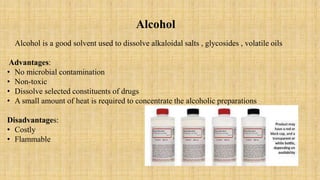
Alcohol is a good solvent used to dissolve alkaloidal salts , glycosides , volatile oils
Advantages:
• No microbial contamination
• Non-toxic
• Dissolve selected constituents of drugs
• A small amount of heat is required to concentrate the alcoholic preparations
Disadvantages:
• Costly
• Flammable
Processes used for extraction
Infusion: It is the process of extracting chemical compounds or flavours from the plant
material in a solvent , by allowing the materials to remain suspended in the solvent
overtime.
Decoction: It is the process of extraction in which the water soluble and heat stable
constituents of hard and woody crude drugs are extracted out
Maceration: It the extraction process in which the crushed particles of the crude drug is
placed in a closed container and allowed to be extracted in the solvent .and the
constituents are recovered from the marc.
Percolation: It is the process in which the drugs are mixed with the solvents and are
allowed to percolate with the help of a percolator
Digestion: It is the process in which the heat as well as pressure is used for extraction
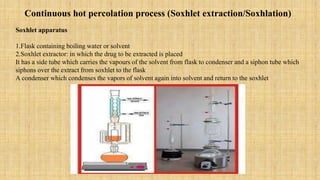
Continuous hot percolation process (Soxhlet extraction/Soxhlation)
Soxhlet apparatus
1.Flask containing boiling water or solvent
2.Soxhlet extractor: in which the drug to be extracted is placed
It has a side tube which carries the vapours of the solvent from flask to condenser and a siphon tube which
siphons over the extract from soxhlet to the flask
A condenser which condenses the vapors of solvent again into solvent and return to the soxhlet
MODERN METHODS OF EXTRACTION
There are some modern methods of extraction
1.Supercritical fluid extraction
2.Microwave assisted extraction
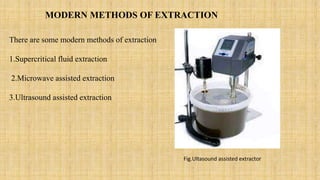
3.Ultrasound assisted extraction
Fig.Ultasound assisted extractor
SUPERCRITICAL FLUID EXTRACTION
• It is the process used to separate one component from another using a supercritical fluid
as the extracting solvent
• It is a novel technique
• Substances with a temperature and pressure above its critical point , where distinct
liquid and gas phase do not exist . e.g. Ethylene , Ammonia , Toulene , Carbon dioxide
MICROWAVE ASSISTED EXTRACTION
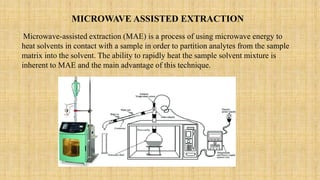
Microwave-assisted extraction (MAE) is a process of using microwave energy to
heat solvents in contact with a sample in order to partition analytes from the sample
matrix into the solvent. The ability to rapidly heat the sample solvent mixture is
inherent to MAE and the main advantage of this technique.
ULTRASOUND ASSISTED EXTRACTION
Ultrasound-assisted extraction (UAE) uses ultrasound energy and solvents to extract target
compounds from various plant matrices . Ultrasound are the mechanical waves having
frequency (>20 kHz) higher than audible frequency range of human hearing (20 Hz to 20
kHz)
Factors affecting extraction
1. Character of drug
2. Therapeutic value of drug
3. Cost of drug
4. Stability of drug
5. Solvent
6. Concentration of product
References
• Pharmaceutics Ⅰ by Mehta
• Tutorial pharmacy by cooper and guns
• Textbook of Pharmacognosy and Phytochemistry
Extraction_swapnil_(1)[1].pptx

Extraction_swapnil_(1)[1].pptx

  • 1.
    EXTRACTION PROCESSES PRESENTED BY SWAPNILS. TIRMANWAR Department of Pharmacognosy (M. Pharm 1st year) PRIYADARSHINI J. L. COLLEGE OF PHARMACY Electronic zone, MIDC, Higna road NAGPUR-440016
  • 2.
    CONTENT 1. Introduction 2. Extraction 3.Imporatance of extraction 4. Classification of extraction 5. Solvents used for extraction 6. Process used for extraction 7. Factors affecting extraction
  • 3.
    Introduction  Extraction maybe defined as the removal of soluble constituents from solid or liquid or semi-solid with means of suitable solvent.  It is can be termed as the treatment of plants or animal tissues with appropriate solvent.  It is the method of removal of soluble fractions in the form of a solution or a insoluble matrix with the help of suitable solvent.
  • 4.
    Example: Boiling oftea • Tannins • Theobromine • caffeine
  • 5.
    EXTRACTION Extraction involves theseparation of medicinally active portions of plant or animal tissues from the inactive components through the use of selective solvents andstandard extraction process. • Menstrum: Solvent used for extraction (ex. water,alcohol, ether, acetone, ethyl acetate) • Marc: The inert fibrous and other insoluble materials remaining after extraction • Extractives: Concentrated preparations of vegetable or animal drugs obtained by removal of the active constituents of the respective drug with suitable menstrum, evaporation of all or nearly all solvent. • Tinctures: are alcoholic or hydroalcoholic solutions prepared from vegetable material or from chemical substances. E. g. belladona tincture
  • 6.
    Importance of theextraction • Easy formulation of medicinal products • Tableting of crude drug may not be possible • Preparation of drug bare more easily formulated • Different route of drug administration • Injection of crude drug materials maybe undesirable and dangerous • Storage and transport feasibility • Extracts are less bulky and covers less space • Smaller bulk ensure easy storage and transport
  • 7.
    CLASSIFICATION OF EXTRACTION •Solid-liquid extraction (leaching): The separation of soluble constituent from a solid by extraction with a solvent. It consists of two stages 1.Contact of solute with the liquid phase 2. Separation of the liquid phase from solid phase. • Liquid-liquid extraction Liquid-liquid extraction, also known as solvent extraction and partitioning. 1. It is a method to separate compounds based on their relative solubilities in two different immiscible liquids, usually water and an organic solvent. It is an extraction of a substance from one liquid phase into another liquid phase. 2. It is a basic technique-performed using a separatory funnel.
  • 8.
    Solvents used forextraction process The ideal solvent for a certain pharmacologically active constituent should be: • Be highly selective for the compound to be extracted. • Have high capacity for extraction. • Not react with extracted compound or with other compounds in tree pplant materials. • Should be less costly. • Be harmless to the man and the enviornment. • Be completely volatile.
  • 9.
    Solvents used forextraction The generally used solvents include : water , alcohol , ether , choloroform Water as a solvent Advantages: • Readily available • Low cost • Good solvent action • Disadvantages: • It causes hydrolysis of many substances • More heat is needed to concentrate the extraction than non-aqueous solvent. • Most plant constituents are highly complex organic chemicals which are less soluble in water.
  • 10.
    Alcohol Alcohol is agood solvent used to dissolve alkaloidal salts , glycosides , volatile oils Advantages: • No microbial contamination • Non-toxic • Dissolve selected constituents of drugs • A small amount of heat is required to concentrate the alcoholic preparations Disadvantages: • Costly • Flammable
  • 11.
  • 12.
    Infusion: It isthe process of extracting chemical compounds or flavours from the plant material in a solvent , by allowing the materials to remain suspended in the solvent overtime. Decoction: It is the process of extraction in which the water soluble and heat stable constituents of hard and woody crude drugs are extracted out Maceration: It the extraction process in which the crushed particles of the crude drug is placed in a closed container and allowed to be extracted in the solvent .and the constituents are recovered from the marc. Percolation: It is the process in which the drugs are mixed with the solvents and are allowed to percolate with the help of a percolator Digestion: It is the process in which the heat as well as pressure is used for extraction
  • 14.
    Continuous hot percolationprocess (Soxhlet extraction/Soxhlation) Soxhlet apparatus 1.Flask containing boiling water or solvent 2.Soxhlet extractor: in which the drug to be extracted is placed It has a side tube which carries the vapours of the solvent from flask to condenser and a siphon tube which siphons over the extract from soxhlet to the flask A condenser which condenses the vapors of solvent again into solvent and return to the soxhlet
  • 15.
    MODERN METHODS OFEXTRACTION There are some modern methods of extraction 1.Supercritical fluid extraction 2.Microwave assisted extraction 3.Ultrasound assisted extraction Fig.Ultasound assisted extractor
  • 16.
    SUPERCRITICAL FLUID EXTRACTION •It is the process used to separate one component from another using a supercritical fluid as the extracting solvent • It is a novel technique • Substances with a temperature and pressure above its critical point , where distinct liquid and gas phase do not exist . e.g. Ethylene , Ammonia , Toulene , Carbon dioxide
  • 17.
    MICROWAVE ASSISTED EXTRACTION Microwave-assistedextraction (MAE) is a process of using microwave energy to heat solvents in contact with a sample in order to partition analytes from the sample matrix into the solvent. The ability to rapidly heat the sample solvent mixture is inherent to MAE and the main advantage of this technique.
  • 18.
    ULTRASOUND ASSISTED EXTRACTION Ultrasound-assistedextraction (UAE) uses ultrasound energy and solvents to extract target compounds from various plant matrices . Ultrasound are the mechanical waves having frequency (>20 kHz) higher than audible frequency range of human hearing (20 Hz to 20 kHz)
  • 19.
    Factors affecting extraction 1.Character of drug 2. Therapeutic value of drug 3. Cost of drug 4. Stability of drug 5. Solvent 6. Concentration of product
  • 20.
    References • Pharmaceutics Ⅰby Mehta • Tutorial pharmacy by cooper and guns • Textbook of Pharmacognosy and Phytochemistry