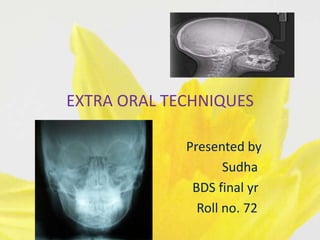
EXTRA ORAL TECHNIQUES

             Presented by
                    Sudha
              BDS final yr
               Roll no. 72
CONTENTS
•   INTRODUCTION
•   EXTRAORAL RADIOGRAPHS
•   CEPHALOMETRIC LANDMARKS
•   DENTAL LANDMARKS
•   SOFT TISSUE LANDMARKS
•   LATERAL SKULL PROJECTION
•   SUBMENTOVERTEX PROJECTION
•   WATERS PROJECTION
•   POSTEROANTERIOR SKULL PROJECTION
•   REVERSE TOWNES PROJECTION
•   CONCLUSION
                       Template copyright 2005
       • REFERENCES     www.brainybetty.com
                                                 3
INTRODUCTION
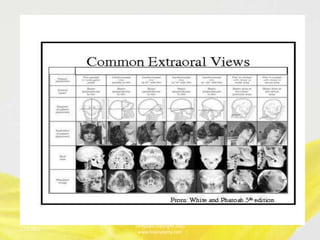
• In extraoral radiographic examination both
  the x ray source and image receptor (film and
  electronic sensor )are placed outside the
  patients mouth.it contains-
Lateral cephalometric projections
Submentovertex projections
Waters
Posteroanterior cephalometric
Reverse-towne projections
1/23/2013
                   Template copyright 2005
                                                  4
                    www.brainybetty.com
Extra oral radiographs
• Cephalometric and skull views require-20X25
  cm (8X10 inches)
• Oblique lateral projections of mandible 13 X18
  cm (5X7 inches)


                   Template copyright 2005
1/23/2013                                      5
                    www.brainybetty.com
CEPHALOMETRIC LANDMARKS
• PORION(P)-most superior point of extrnal
  auditory canal
• SELLA(S)-center of hypophyseal fossa
• NASION(N)-frontonasal suture.
• ORBITALE(O)-most inferior point of the
  infraorbital rim.
• PT point-most posterior point of the
  pterigomxillary fissure
                    Template copyright 2005
1/23/2013                                     6
                     www.brainybetty.com
•    BASION- most ant. Part of foramen mangnum
•    PNS-tip of post. Nasal spine
•    ANS-tip of ant nasal spine
•    A point-deepest point of ant. Border of the
     maxillary alveolar ridge concavity
•    B point-(B)-deepest point in the concavity of
     the anterior border of the mandible
•    POGONION(P)-most ant. Point of symphysis
•    GANTHION-midpoint of the symphysis outline
     b/w pogonion and menton
•    MENTON-(M)-most inferior point of symphysis
                      Template copyright 2005
1/23/2013                                        7
                       www.brainybetty.com
• GONION-most convex point along the inferior
  border of mandibular ramus
• RAMUS POINT-most post. Point of
  posteroinferior point of mandibular ramus
• R1-most inferior point of sigmoid notch
• R2-an arbitrary point on the lower border of
  mandible below R1
• R3-most concave point of the anterior border
  of mandibular ramus
• R4-most convex point of the posterior border
  of mandibular ramus
                   Template copyright 2005
1/23/2013                                        8
                    www.brainybetty.com
• ARTICULARE(AR)-point of intersection b/w the
  bassiphenoid and posterior border of condylar head
• CONDYLE TOP-most superior point of condyle
• DC point-center of condylar head


                     Template copyright 2005
1/23/2013                                              9
                      www.brainybetty.com
Dental landmarks
• U6 MESIAL CUSP-tip of the max. first molar
  mesial buccal cusp
• U6 MESIAL-contact point on mesial surface of
  maxillary first molar
• U6 DISTAL- contact point on the distal surface
  of max. first molar
• L6 MESIAL-contact point on the mesial surface
  of the mandibular first molar
• L6 DISTAL-contact point is on the distal surface
                    Template copyright 2005
1/23/2013                                        10
  of mandibular molarwww.brainybetty.com
• U1 INCISAL-incisal edge of max. central incisor
• U1 FACIAL-most convex point of buccal surface
  of maxillary central incisor
• U1 ROOT-root tip of maxillary central incisor
• L1 INCISAL-incisal edge of mandibular central
  incisor
• L1 FACIAL- most convex point on the buccal
  surface of mandibular central incisor
• L1 ROOT- poot tip of mandibular central
  incisor

                    Template copyright 2005
1/23/2013                                       11
                     www.brainybetty.com
Template copyright 2005
1/23/2013                             12
             www.brainybetty.com
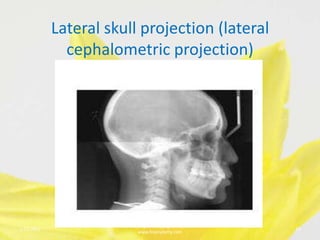
Lateral skull projection (lateral
              cephalometric projection)


                        Template copyright 2005
1/23/2013                                         13
                         www.brainybetty.com
Lateral skull projection (lateral
              cephalometric projection)
 Most commonly used in dentistry
• Made with cephalostat that helps in maintain a
  constant relationship among skull,film and x-ray
  beam.
• Skeletal ,dental,and soft tissue anatomic landmarks
  delineate lines planes,angles and distances .


                        Template copyright 2005
1/23/2013                                               14
                         www.brainybetty.com
• Used in –
                                                     Classify
             Generate                                patients
            measuremen                             craniofacial
                ts                                 morphologic
                                                    features.


IMAGE RECEPTOR AND PATIENT PLACEMENT
Image receptor is positioned parallel to patients
  midsagittal plane


                         Template copyright 2005
1/23/2013                                                         15
                          www.brainybetty.com
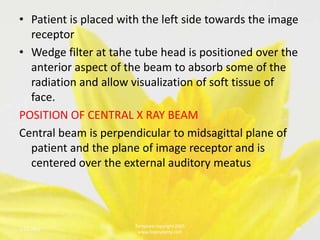
• Patient is placed with the left side towards the image
  receptor
• Wedge filter at tahe tube head is positioned over the
  anterior aspect of the beam to absorb some of the
  radiation and allow visualization of soft tissue of
  face.
POSITION OF CENTRAL X RAY BEAM
Central beam is perpendicular to midsagittal plane of
  patient and the plane of image receptor and is
  centered over the external auditory meatus


                       Template copyright 2005
1/23/2013                                              16
                        www.brainybetty.com
• RESULTANT IMAGE
• Exact superimposition of right and left sides is
  impossible because structure on the side near the
  image receptor are magnified less than the same
  structures on the side far from the image receptor.
• Bilateral structure close to the midsagittal plane
  demonstrate less discrepancy in size compared with
  bilateral structures farther away from the midsagittal
  plane


                       Template copyright 2005
1/23/2013                                              17
                        www.brainybetty.com
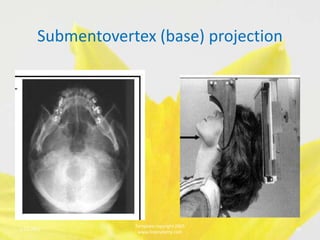
Submentovertex (base) projection


                   Template copyright 2005
1/23/2013                                    18
                    www.brainybetty.com
Submentovertex (base) projection
• IMAGE RECEPTOR AND PATIENT PLACEMENT
The image receptor is positioned parallel to patients
  transverse plane and perpendicular to the
  midsagittal and coronal planes.
Patients neck is extended as far backward as
  possible,with canthomeatal line forming line forming
  a 10 degree angle


                      Template copyright 2005
1/23/2013                                            19
                       www.brainybetty.com
• With the image.
• POSITION OF CENTRAL XRAY BEAM
• The central beam is perpendicular to thr
  image receptor ,directed from below the
  mandible towards the vertex of the skull .
• Centered about 2 cm ant. To a line connecting
  the right and left condyles.
• RESULTANT IMAGE
• The midsagittal plane should divide the skull
  image in two symmetric halves.

                   Template copyright 2005
1/23/2013                                     20
                    www.brainybetty.com
• The buccal and lingual cortical plates of mandible
  should be projected as uniform opaques lines.


                       Template copyright 2005
1/23/2013                                              21
                        www.brainybetty.com
WATERS PROJECTION


                   Template copyright 2005
1/23/2013                                    22
                    www.brainybetty.com
WATER PROJECTIONS
• IMAGE RECEPTOR AND PATIENT PLACEMENT
Image receptor is placed in front of the patient
   and perpendicular to midsagittal plane.
The patients head is tilted upward so that the
   canthomeatal line forms 37 degree angle with
   image receptor
If the patient mouth is open the sphenoid sinus
   will be seen superimposed over the palate
                    Template copyright 2005
1/23/2013                                      23
                     www.brainybetty.com
• POSITION OF X RAY BEAM
• The central beam is perpendicular to the
  image receptor and centered in the area of
  maxillary sinus.
• RESULTANT IMAGE
• The mid sagittal plane should divide the skull
  image in two symmetric halves .
• The petrous ridge of the temporal bone
  should be projected below the floor of the
  maxillary sinus.

                    Template copyright 2005
1/23/2013                                          24
                     www.brainybetty.com
POSTEROANTERIOR SKULL
            PROJECTION(posteroanterior
             cephalometric projection


                     Template copyright 2005
1/23/2013                                      25
                      www.brainybetty.com
POSTEROANTERIOR SKULL
            PROJECTION(posteroanterior
             cephalometric projection
• IMAGE RECEPTOR AND PATIENT PLACEMENT
• Image receptor is placed in front of patient
  ,perpendicular to the mid sagittal palne and
  parallel to coronal plane
• The patient is patient is placed so that the
  canthomeatal line forms 10 degree anglewith
  the horizontal plane and the frankfort plane
  is perpendicular to image receptor
                     Template copyright 2005
1/23/2013                                        26
                      www.brainybetty.com
• Canthomeatal line is perpendicular to the
  image receptor
POSITION OF XRAY BEAM
The central beam is perpendicular to the image
  receptor,directed from the posterior to the
  anterior ,parallel to patients midsagittal plane
  and is centered at the level of the bridge of
  the nose.
RESULTANT IMAGE
The midsagittal plane should divide the skull
  image into two symmetric halves.superior
  border of petrous ridge lie in lower 3rd of orbit
1/23/2013
                    Template copyright 2005
                     www.brainybetty.com
                                                  27
REVERSE TOWNE PROJECTION


                     Template copyright 2005
1/23/2013                                      28
                      www.brainybetty.com
REVERSE-TOWNE PROJECTION(OPEN
              MOUTH)
• IMAGE RECEPTOR AND PATIENT PLACEMENT
• The image receptor is placed in front of the
  patient, perpandicular to midsagittal and
  parallel to the coronal plane .
• Patients head is tilted downwards so that the
  cantomeatal line forms 25-30 degree angle
  with image receptor.


                    Template copyright 2005
1/23/2013                                         29
                     www.brainybetty.com
• The mouth is opened so
• POSITION OF CENTRAL X RAY BEAM
• Central beam is perpendicular to image
  receptor and parallel to patient midsagittal
  and it is centered at the level of the condyles
• RESULTANT IMAGE
• The midsagittal plane should divide the skull
  image into two symmetric halves.petrous
  ridge of the temporal bone should be
  superimposed at the inferior part of the
  occipital bone.condylar heads should be
  projected inferior to articular eminence.
1/23/2013
                    Template copyright 2005
                     www.brainybetty.com
                                                    30
CONCLUSION
• Proper positioning of patient ,x ray sorce, and
  image receptor require patience,attention to
  detail and experience
• .the main anatomic landmarks in extraoral
  radiography is canthomeatalline(joins center
  of eye external auditory canal)


                    Template copyright 2005
1/23/2013                                           31
                     www.brainybetty.com
Extra oral techniques

Extra oral techniques

  • 1.
    EXTRA ORAL TECHNIQUES Presented by Sudha BDS final yr Roll no. 72
  • 3.
    CONTENTS • INTRODUCTION • EXTRAORAL RADIOGRAPHS • CEPHALOMETRIC LANDMARKS • DENTAL LANDMARKS • SOFT TISSUE LANDMARKS • LATERAL SKULL PROJECTION • SUBMENTOVERTEX PROJECTION • WATERS PROJECTION • POSTEROANTERIOR SKULL PROJECTION • REVERSE TOWNES PROJECTION • CONCLUSION Template copyright 2005 • REFERENCES www.brainybetty.com 3
  • 4.
    INTRODUCTION • In extraoralradiographic examination both the x ray source and image receptor (film and electronic sensor )are placed outside the patients mouth.it contains- Lateral cephalometric projections Submentovertex projections Waters Posteroanterior cephalometric Reverse-towne projections 1/23/2013 Template copyright 2005 4 www.brainybetty.com
  • 5.
    Extra oral radiographs •Cephalometric and skull views require-20X25 cm (8X10 inches) • Oblique lateral projections of mandible 13 X18 cm (5X7 inches) Template copyright 2005 1/23/2013 5 www.brainybetty.com
  • 6.
    CEPHALOMETRIC LANDMARKS • PORION(P)-mostsuperior point of extrnal auditory canal • SELLA(S)-center of hypophyseal fossa • NASION(N)-frontonasal suture. • ORBITALE(O)-most inferior point of the infraorbital rim. • PT point-most posterior point of the pterigomxillary fissure Template copyright 2005 1/23/2013 6 www.brainybetty.com
  • 7.
    BASION- most ant. Part of foramen mangnum • PNS-tip of post. Nasal spine • ANS-tip of ant nasal spine • A point-deepest point of ant. Border of the maxillary alveolar ridge concavity • B point-(B)-deepest point in the concavity of the anterior border of the mandible • POGONION(P)-most ant. Point of symphysis • GANTHION-midpoint of the symphysis outline b/w pogonion and menton • MENTON-(M)-most inferior point of symphysis Template copyright 2005 1/23/2013 7 www.brainybetty.com
  • 8.
    • GONION-most convexpoint along the inferior border of mandibular ramus • RAMUS POINT-most post. Point of posteroinferior point of mandibular ramus • R1-most inferior point of sigmoid notch • R2-an arbitrary point on the lower border of mandible below R1 • R3-most concave point of the anterior border of mandibular ramus • R4-most convex point of the posterior border of mandibular ramus Template copyright 2005 1/23/2013 8 www.brainybetty.com
  • 9.
    • ARTICULARE(AR)-point ofintersection b/w the bassiphenoid and posterior border of condylar head • CONDYLE TOP-most superior point of condyle • DC point-center of condylar head Template copyright 2005 1/23/2013 9 www.brainybetty.com
  • 10.
    Dental landmarks • U6MESIAL CUSP-tip of the max. first molar mesial buccal cusp • U6 MESIAL-contact point on mesial surface of maxillary first molar • U6 DISTAL- contact point on the distal surface of max. first molar • L6 MESIAL-contact point on the mesial surface of the mandibular first molar • L6 DISTAL-contact point is on the distal surface Template copyright 2005 1/23/2013 10 of mandibular molarwww.brainybetty.com
  • 11.
    • U1 INCISAL-incisaledge of max. central incisor • U1 FACIAL-most convex point of buccal surface of maxillary central incisor • U1 ROOT-root tip of maxillary central incisor • L1 INCISAL-incisal edge of mandibular central incisor • L1 FACIAL- most convex point on the buccal surface of mandibular central incisor • L1 ROOT- poot tip of mandibular central incisor Template copyright 2005 1/23/2013 11 www.brainybetty.com
  • 12.
    Template copyright 2005 1/23/2013 12 www.brainybetty.com
  • 13.
    Lateral skull projection(lateral cephalometric projection) Template copyright 2005 1/23/2013 13 www.brainybetty.com
  • 14.
    Lateral skull projection(lateral cephalometric projection) Most commonly used in dentistry • Made with cephalostat that helps in maintain a constant relationship among skull,film and x-ray beam. • Skeletal ,dental,and soft tissue anatomic landmarks delineate lines planes,angles and distances . Template copyright 2005 1/23/2013 14 www.brainybetty.com
  • 15.
    • Used in– Classify Generate patients measuremen craniofacial ts morphologic features. IMAGE RECEPTOR AND PATIENT PLACEMENT Image receptor is positioned parallel to patients midsagittal plane Template copyright 2005 1/23/2013 15 www.brainybetty.com
  • 16.
    • Patient isplaced with the left side towards the image receptor • Wedge filter at tahe tube head is positioned over the anterior aspect of the beam to absorb some of the radiation and allow visualization of soft tissue of face. POSITION OF CENTRAL X RAY BEAM Central beam is perpendicular to midsagittal plane of patient and the plane of image receptor and is centered over the external auditory meatus Template copyright 2005 1/23/2013 16 www.brainybetty.com
  • 17.
    • RESULTANT IMAGE •Exact superimposition of right and left sides is impossible because structure on the side near the image receptor are magnified less than the same structures on the side far from the image receptor. • Bilateral structure close to the midsagittal plane demonstrate less discrepancy in size compared with bilateral structures farther away from the midsagittal plane Template copyright 2005 1/23/2013 17 www.brainybetty.com
  • 18.
    Submentovertex (base) projection Template copyright 2005 1/23/2013 18 www.brainybetty.com
  • 19.
    Submentovertex (base) projection •IMAGE RECEPTOR AND PATIENT PLACEMENT The image receptor is positioned parallel to patients transverse plane and perpendicular to the midsagittal and coronal planes. Patients neck is extended as far backward as possible,with canthomeatal line forming line forming a 10 degree angle Template copyright 2005 1/23/2013 19 www.brainybetty.com
  • 20.
    • With theimage. • POSITION OF CENTRAL XRAY BEAM • The central beam is perpendicular to thr image receptor ,directed from below the mandible towards the vertex of the skull . • Centered about 2 cm ant. To a line connecting the right and left condyles. • RESULTANT IMAGE • The midsagittal plane should divide the skull image in two symmetric halves. Template copyright 2005 1/23/2013 20 www.brainybetty.com
  • 21.
    • The buccaland lingual cortical plates of mandible should be projected as uniform opaques lines. Template copyright 2005 1/23/2013 21 www.brainybetty.com
  • 22.
    WATERS PROJECTION Template copyright 2005 1/23/2013 22 www.brainybetty.com
  • 23.
    WATER PROJECTIONS • IMAGERECEPTOR AND PATIENT PLACEMENT Image receptor is placed in front of the patient and perpendicular to midsagittal plane. The patients head is tilted upward so that the canthomeatal line forms 37 degree angle with image receptor If the patient mouth is open the sphenoid sinus will be seen superimposed over the palate Template copyright 2005 1/23/2013 23 www.brainybetty.com
  • 24.
    • POSITION OFX RAY BEAM • The central beam is perpendicular to the image receptor and centered in the area of maxillary sinus. • RESULTANT IMAGE • The mid sagittal plane should divide the skull image in two symmetric halves . • The petrous ridge of the temporal bone should be projected below the floor of the maxillary sinus. Template copyright 2005 1/23/2013 24 www.brainybetty.com
  • 25.
    POSTEROANTERIOR SKULL PROJECTION(posteroanterior cephalometric projection Template copyright 2005 1/23/2013 25 www.brainybetty.com
  • 26.
    POSTEROANTERIOR SKULL PROJECTION(posteroanterior cephalometric projection • IMAGE RECEPTOR AND PATIENT PLACEMENT • Image receptor is placed in front of patient ,perpendicular to the mid sagittal palne and parallel to coronal plane • The patient is patient is placed so that the canthomeatal line forms 10 degree anglewith the horizontal plane and the frankfort plane is perpendicular to image receptor Template copyright 2005 1/23/2013 26 www.brainybetty.com
  • 27.
    • Canthomeatal lineis perpendicular to the image receptor POSITION OF XRAY BEAM The central beam is perpendicular to the image receptor,directed from the posterior to the anterior ,parallel to patients midsagittal plane and is centered at the level of the bridge of the nose. RESULTANT IMAGE The midsagittal plane should divide the skull image into two symmetric halves.superior border of petrous ridge lie in lower 3rd of orbit 1/23/2013 Template copyright 2005 www.brainybetty.com 27
  • 28.
    REVERSE TOWNE PROJECTION Template copyright 2005 1/23/2013 28 www.brainybetty.com
  • 29.
    REVERSE-TOWNE PROJECTION(OPEN MOUTH) • IMAGE RECEPTOR AND PATIENT PLACEMENT • The image receptor is placed in front of the patient, perpandicular to midsagittal and parallel to the coronal plane . • Patients head is tilted downwards so that the cantomeatal line forms 25-30 degree angle with image receptor. Template copyright 2005 1/23/2013 29 www.brainybetty.com
  • 30.
    • The mouthis opened so • POSITION OF CENTRAL X RAY BEAM • Central beam is perpendicular to image receptor and parallel to patient midsagittal and it is centered at the level of the condyles • RESULTANT IMAGE • The midsagittal plane should divide the skull image into two symmetric halves.petrous ridge of the temporal bone should be superimposed at the inferior part of the occipital bone.condylar heads should be projected inferior to articular eminence. 1/23/2013 Template copyright 2005 www.brainybetty.com 30
  • 31.
    CONCLUSION • Proper positioningof patient ,x ray sorce, and image receptor require patience,attention to detail and experience • .the main anatomic landmarks in extraoral radiography is canthomeatalline(joins center of eye external auditory canal) Template copyright 2005 1/23/2013 31 www.brainybetty.com