 The x-ray source and film is placed
outside the patient’s mouth
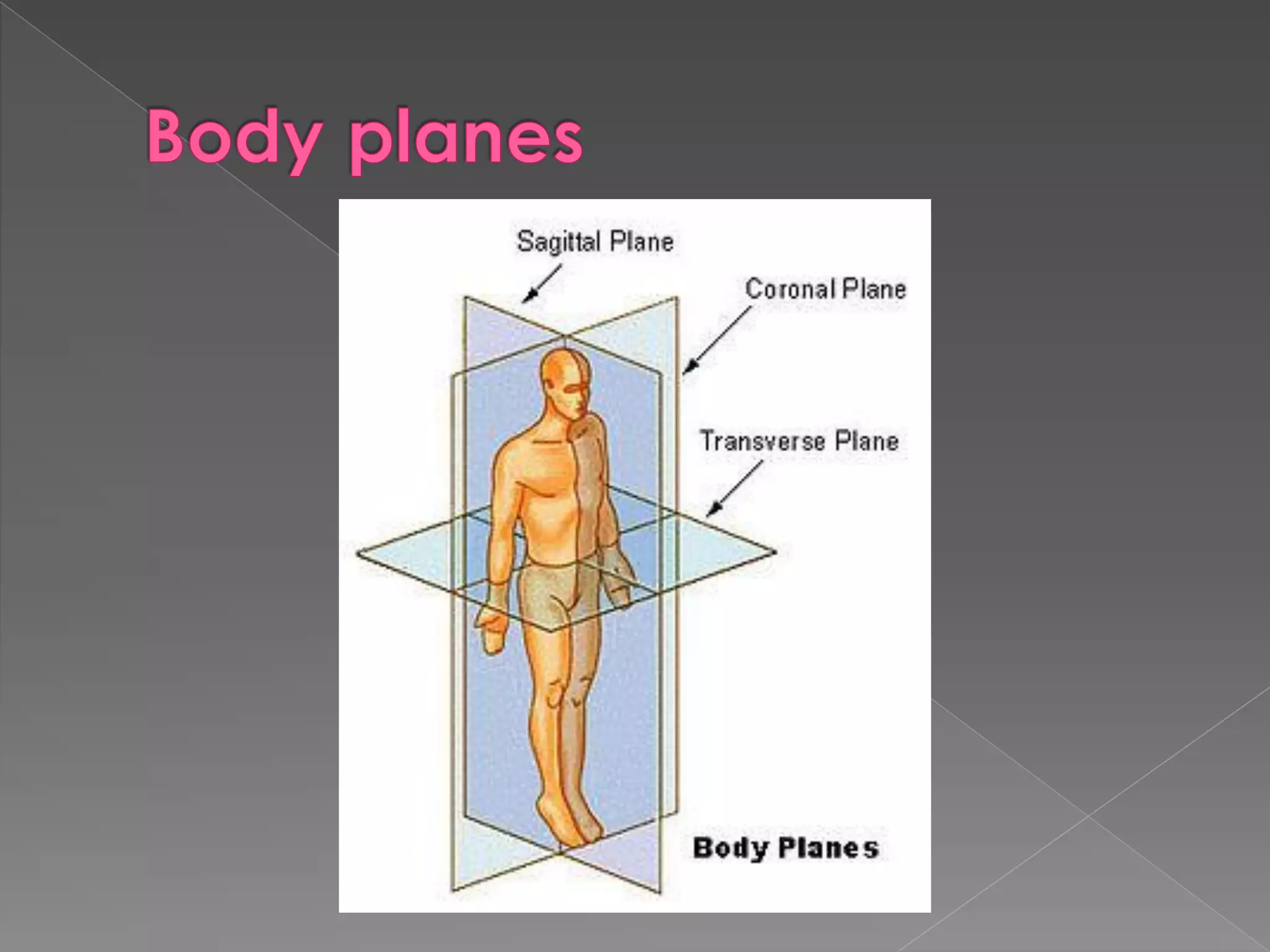
 Lateral Cephalometric projection(Sagittal/
median plane)
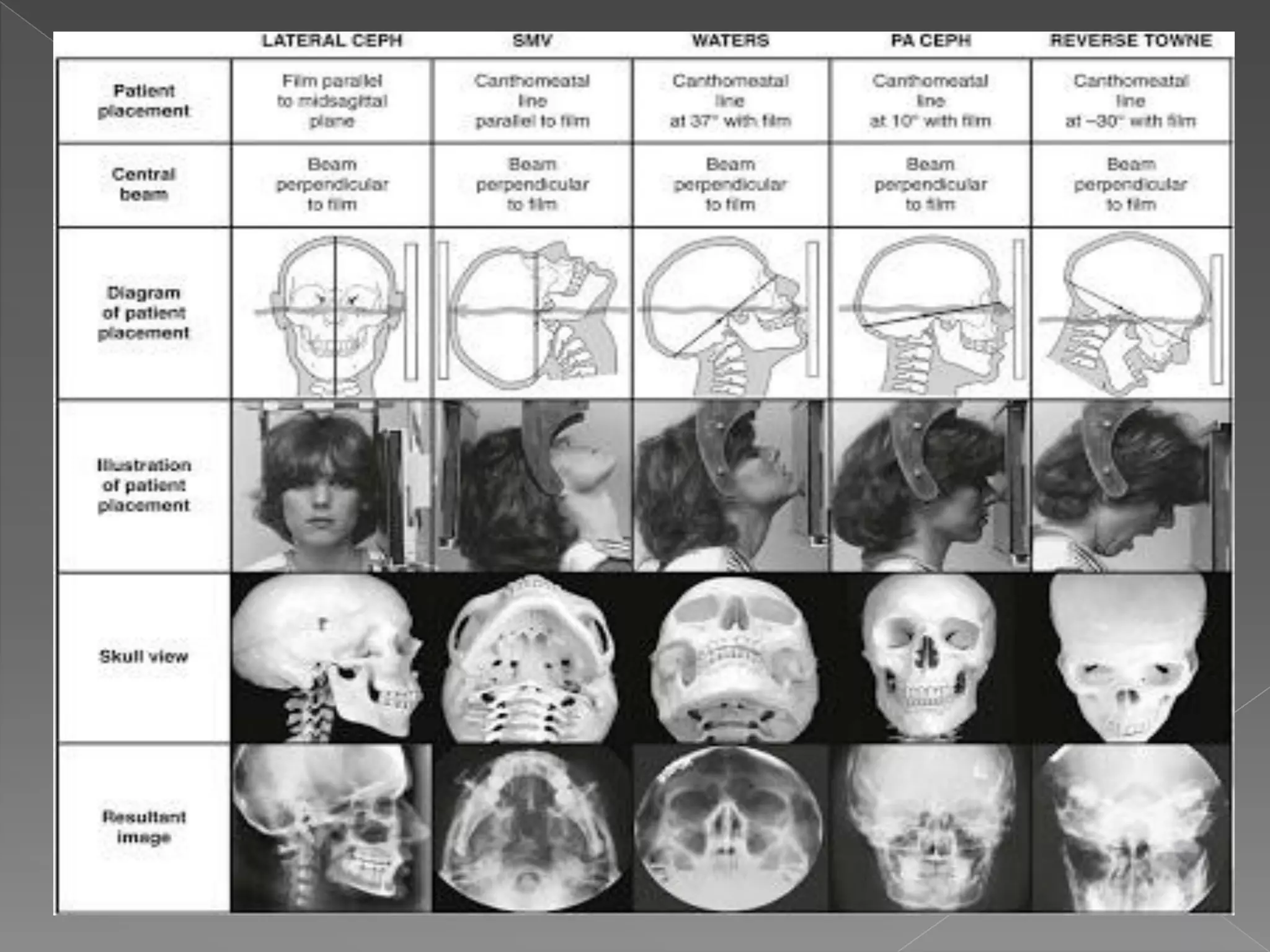
 Submentovertex projection (trasverse/horizontal
plane)
 Waters
 Posteroanterior cephalometric
 Reverse-Towne projections
 Oblique lateral projection
 Panoramic radiography
(Coronal/frontal
plane)
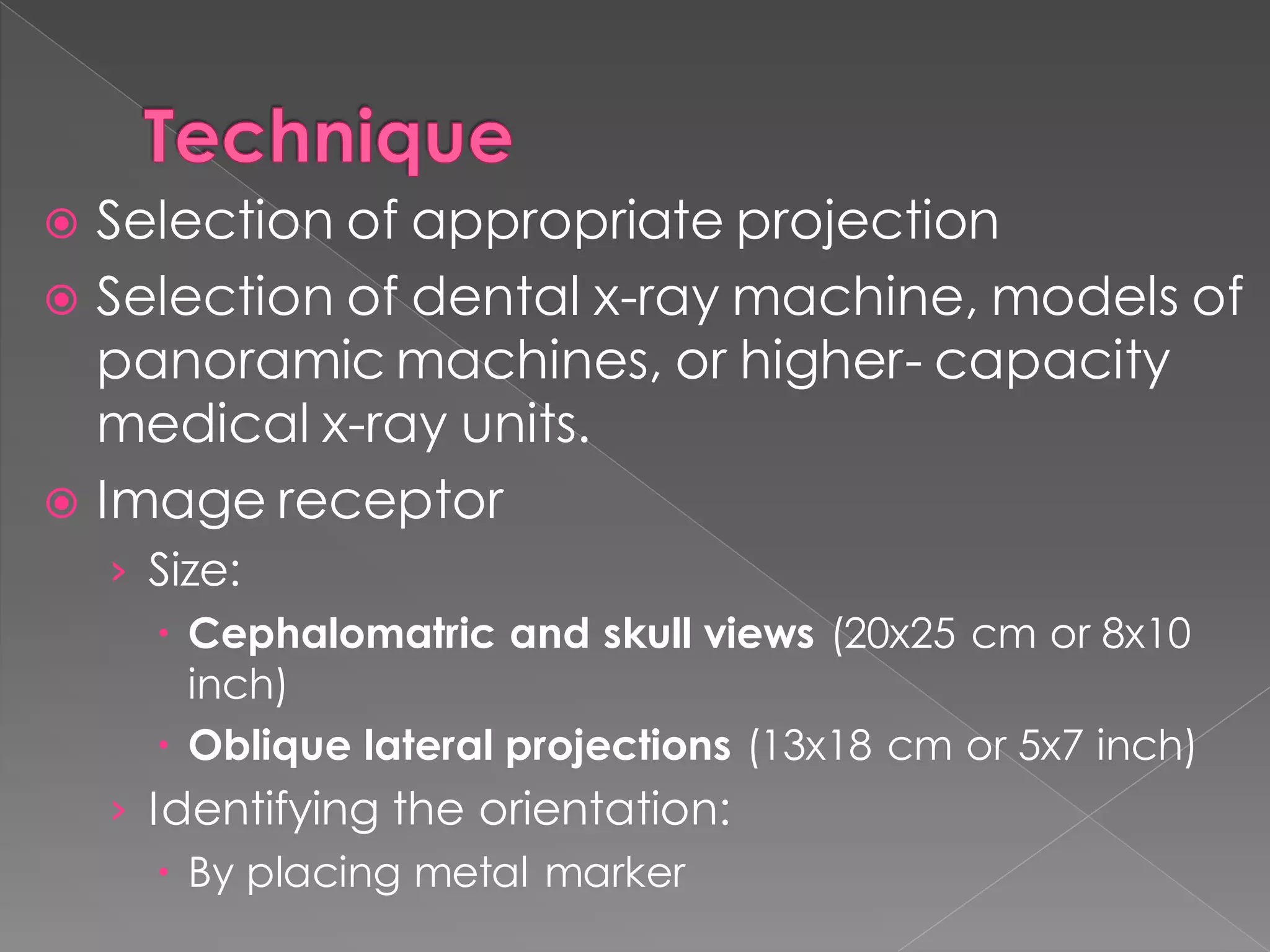
 Selection of appropriate projection
 Selection of dental x-ray machine, models of
panoramic machines, or higher- capacity
medical x-ray units.
 Image receptor
› Size:
 Cephalomatric and skull views (20x25 cm or 8x10
inch)
 Oblique lateral projections (13x18 cm or 5x7 inch)
› Identifying the orientation:
 By placing metal marker
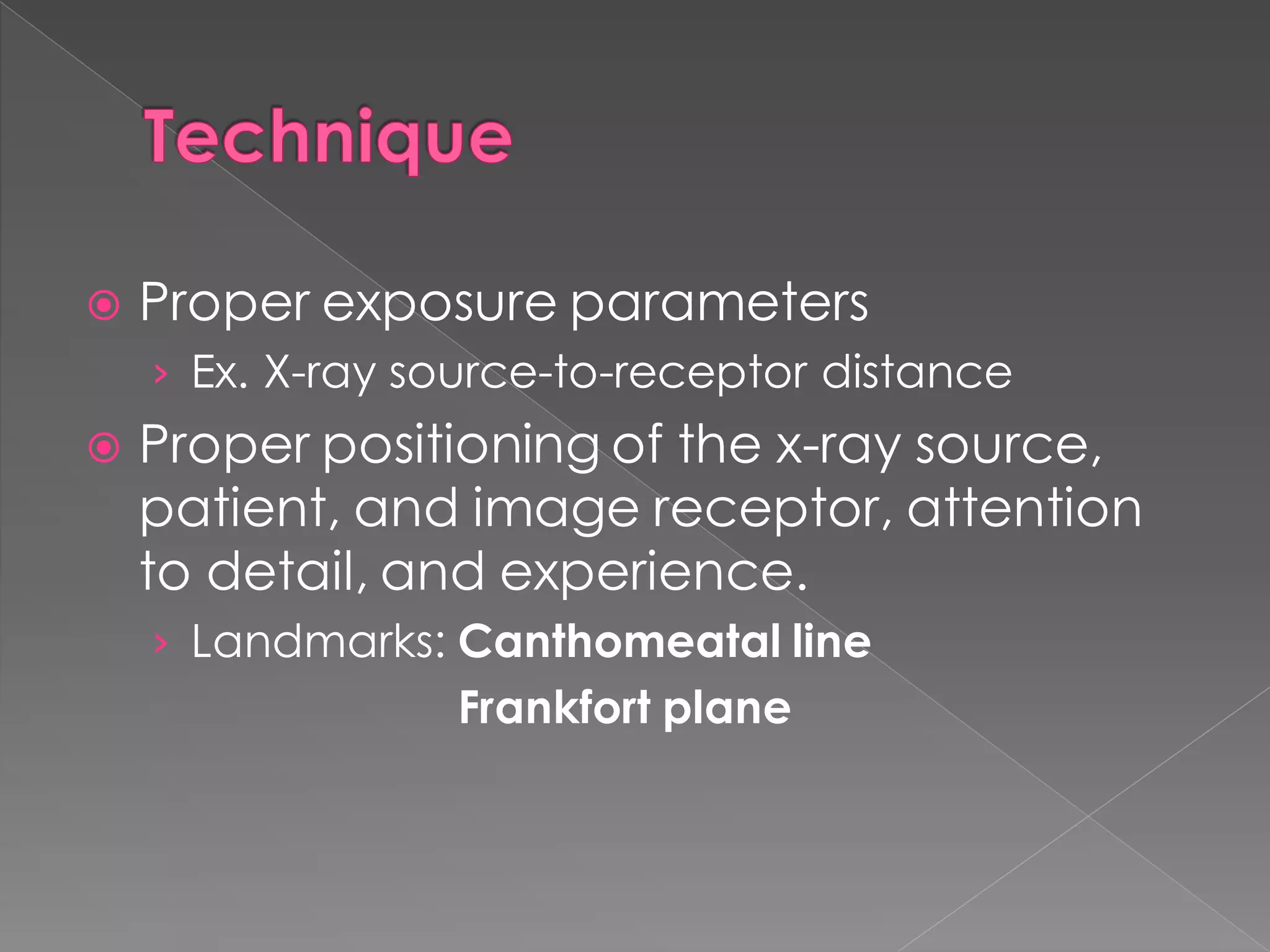
 Proper exposure parameters
› Ex. X-ray source-to-receptor distance
 Proper positioning of the x-ray source,
patient, and image receptor, attention
to detail, and experience.
› Landmarks: Canthomeatal line
Frankfort plane
Wherein:
A= Canthomeatal line
B+c= Frankfort Plane
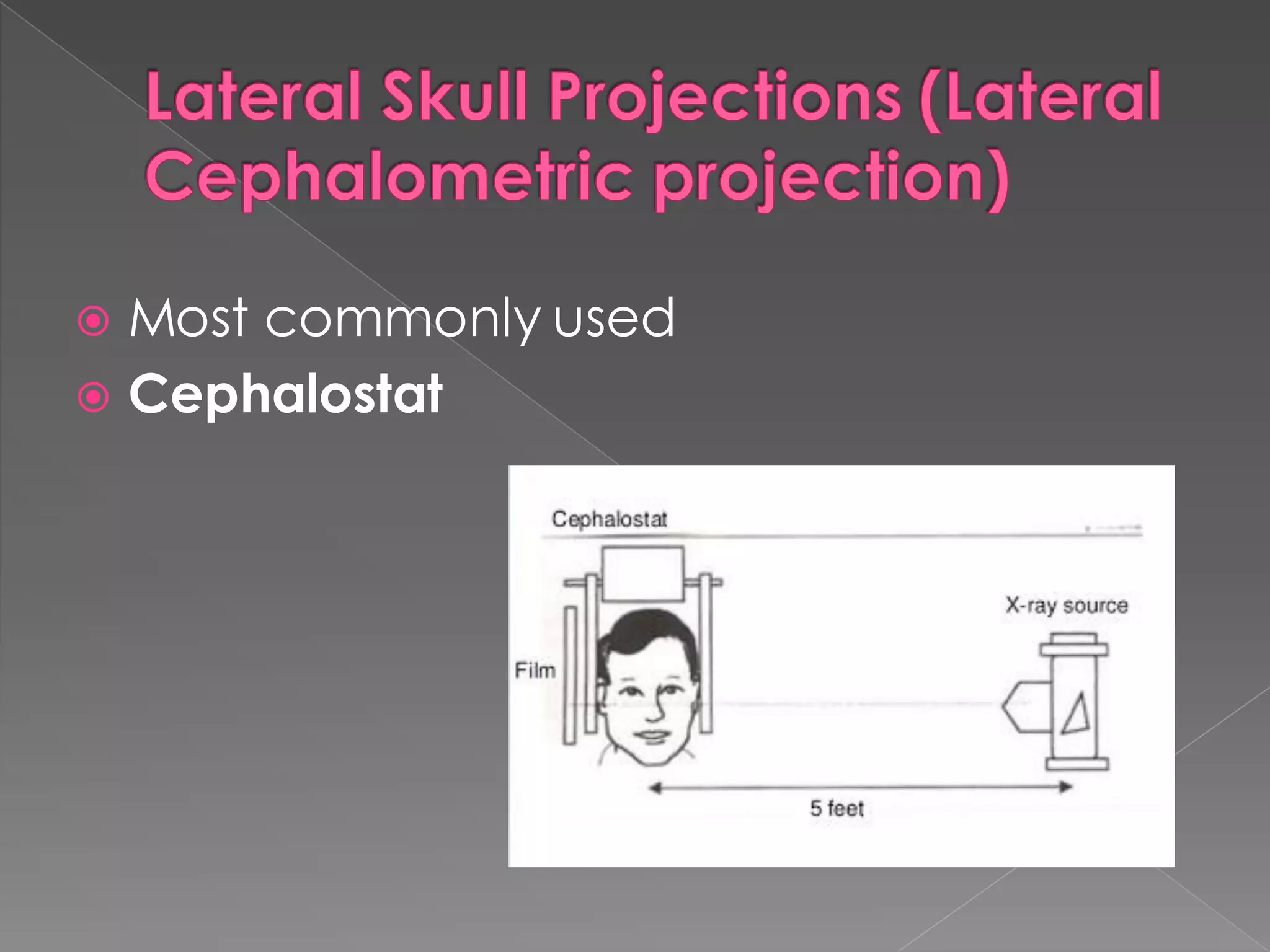
 Most commonly used
 Cephalostat
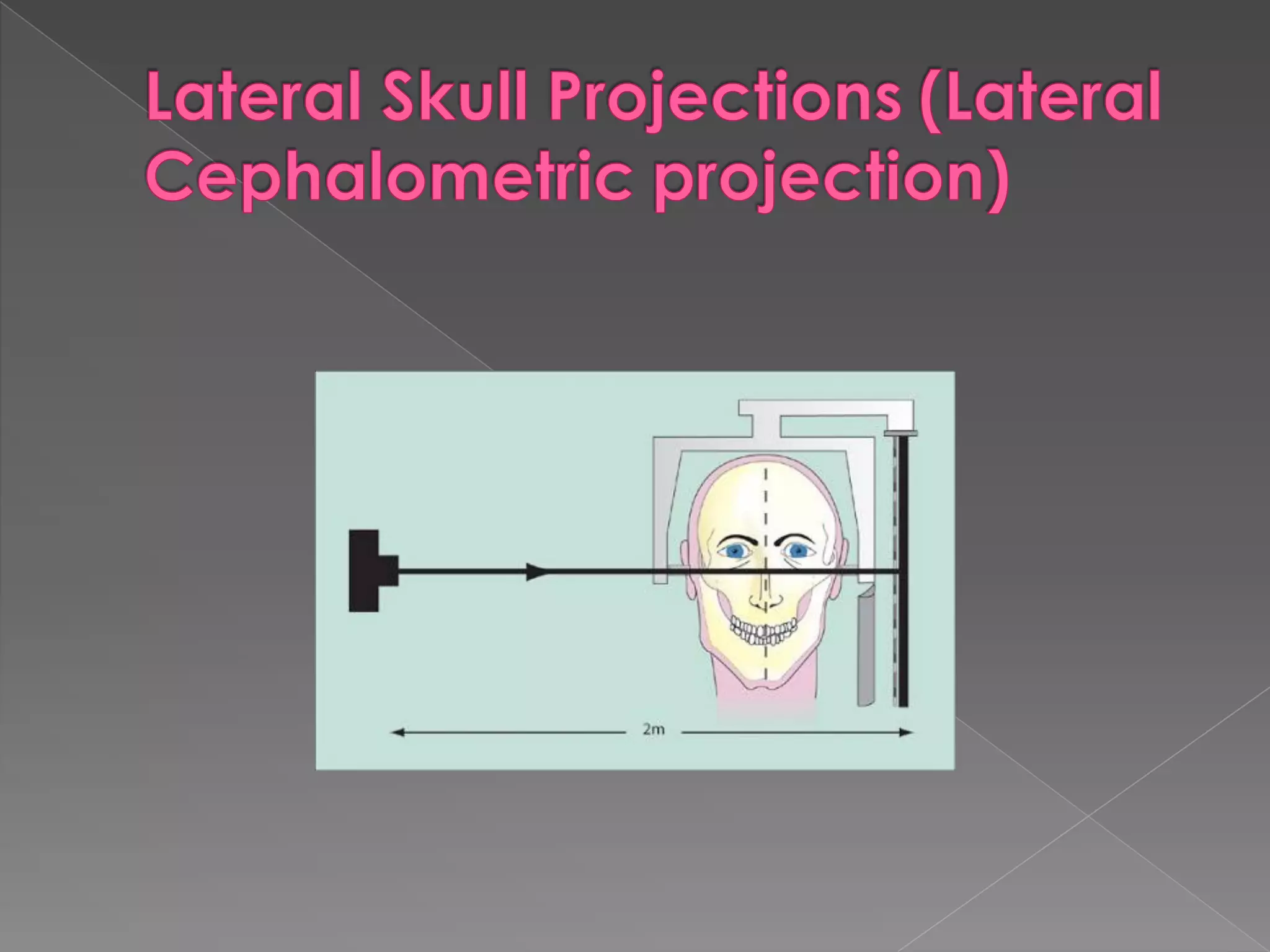
 Image Receptor and Patient Placement
› Image receptor is parallel to midsagittal
plane
› Site of interest placed toward the image
receptor
 Position of the Central X-ray Beam
› Beam is perpendicular to the midsagittal
plane of the patient and of the film
› Centered over the External auditory meatus.
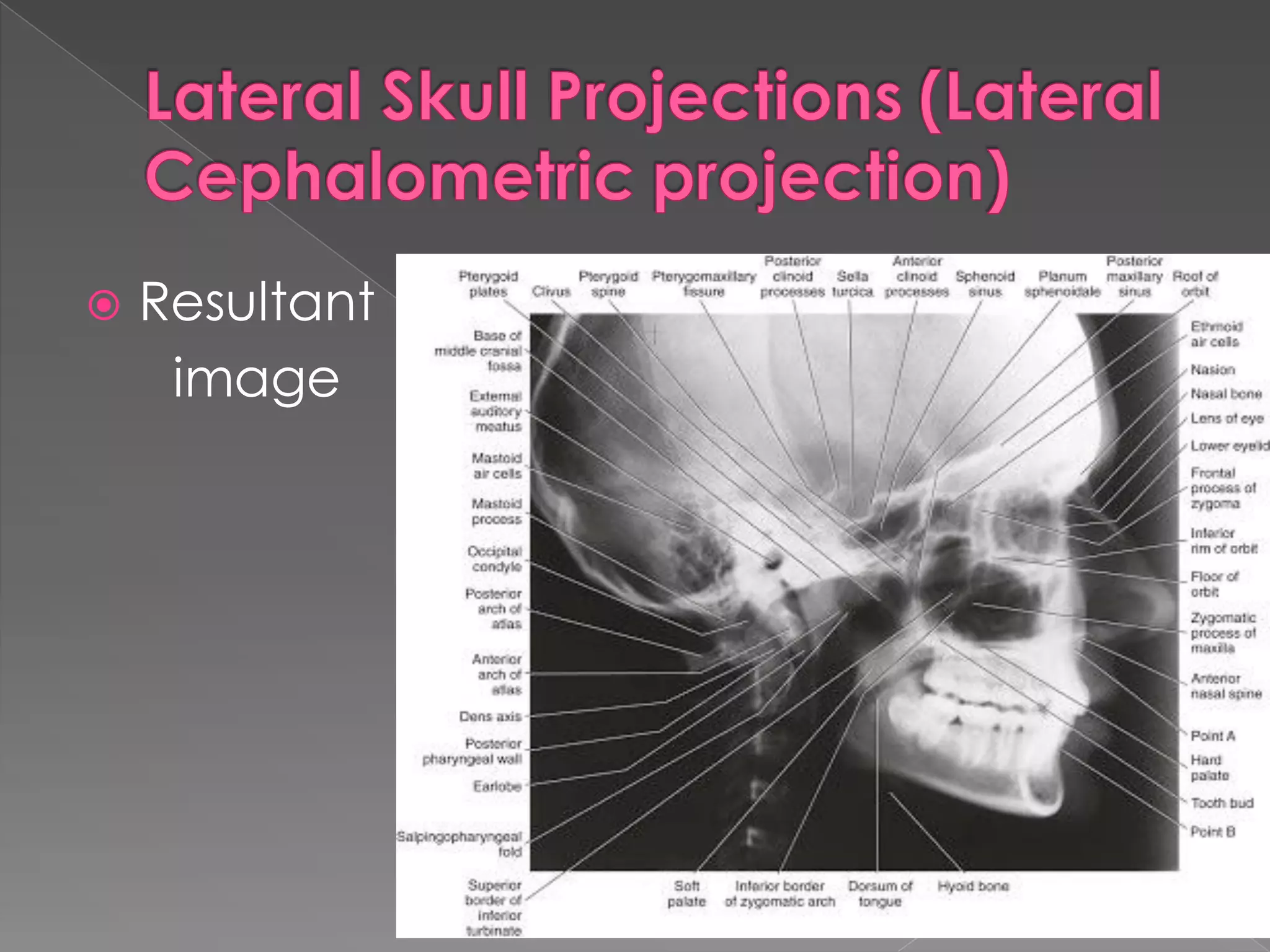
 Resultant
image
 Image Receptor and Patient Placement
› Film is parallel to patient’s transverse plane
› Canthomeatal line forms 10-degree angle with
the film.
 Position of the Central X-ray Beam
› Should be perpendicular to the film
› Below the mandible
› Centered about 2cm anterior to a line
connecting the R and L condyles.
 Resultant image
 Image Receptor and Patient Placement
› Film should be placed in front of the patient
› Perpendicular to the midsagittal plane.
› Canthomeatal line should form a 37-degree angle
with the film.
 Position of the Central X-ray Beam
› Perpendicular to the film
› Centered in the maxillary sinuses.
 Resultant
Image
 The image receptor is placed in front of the
patient, perpendicular to the midsagittal plane
and parallel to the coronal plane
 The patient is placed so that the canthomeatal
line forms a 10-degree angle with the
horizontal plane and the Frankfort plane is
perpendicular to the image receptor.
 In the Posteroanterior skull projecion, the
canthomeatal line is perpendicular to the
image receptor.
 The central beam of is perpendicular to the image
receptor, directed from the posterior to the anterior,
parallel to patient’s midsagittal plane, and is
centered at the level of the bridge of the nose.
 The midsagittal plane should divide the skull image
into two symmetric halves.
 The superior border of the petrous ridge should lie
in the lower third of the orbit
 The image receptor is placed in front of the
patient, perpendicular to the midsagittal
plane and parallel to the coronal plane .
 The patient’s head is tilted downward so that
the canthomeatal line forms a 25 – 30 degree
angle with the image receptor.
 To improve the visualization of the condyles,
the patient’s mouth is opened so that the
condylar heads are located inferior to the
articular eminence.
 The central beam of is perpendicular to the image
receptor and parallel to the patient’s midsagittal
plane and it is centered at the level of the
Condyles.
 The midsagittal plane should divide the skull image into two
symmetric halves.
 The petrous ridge of the temporal bone should be
superimposed at the inferior part of the occipital bone, and
the condylar heads should be projected inferior to the
articular eminence
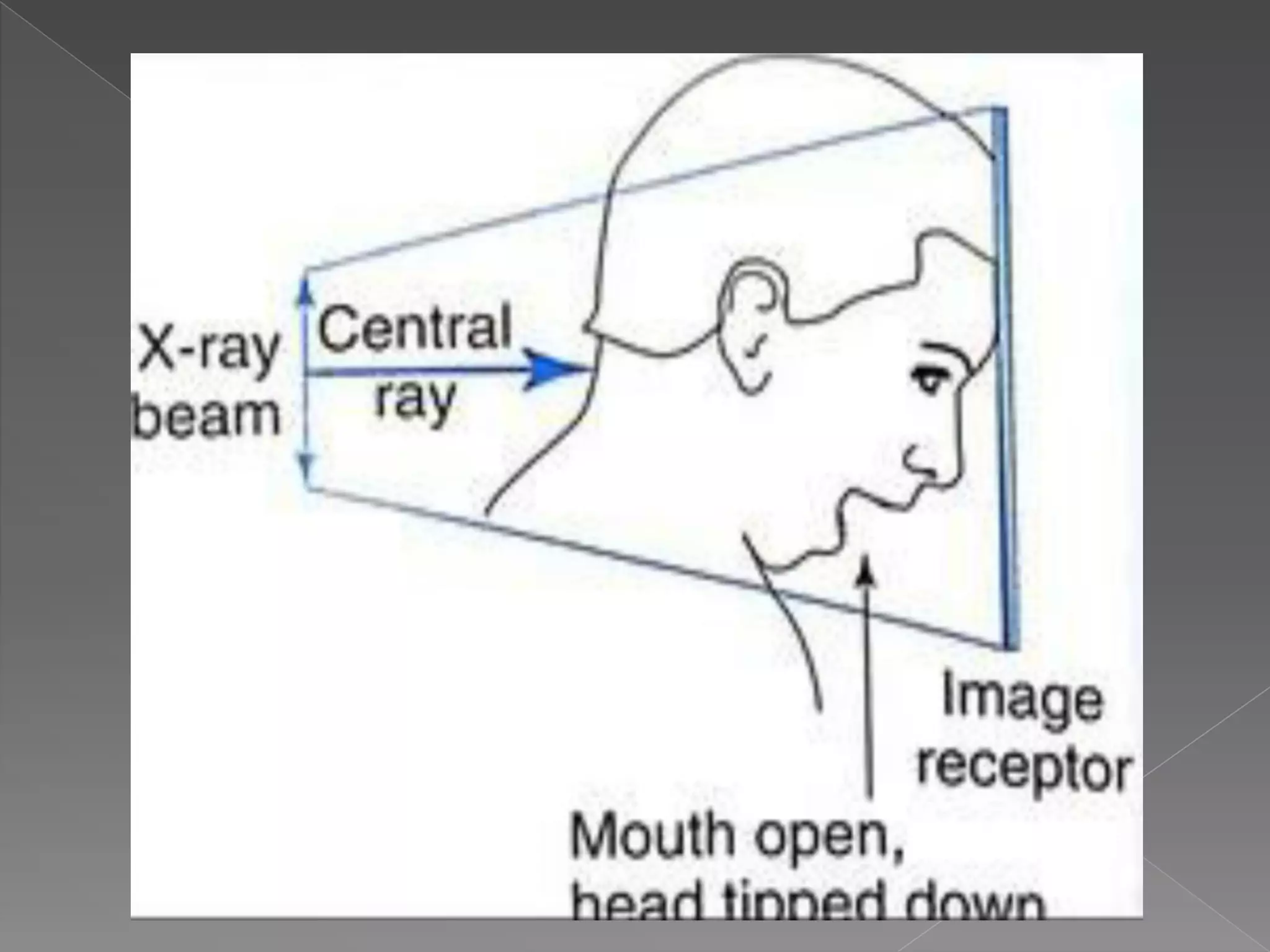
 The image receptor I place against the patient’s cheek on
the side of interest and centered in the molar – premolar
area.
 The lower border of the cassette is parallel and at least 2cm
below the inferior border of the mandible. The head is tilted
toward the side being examined, and the mandible is
protruded.
 The central beam is directed toward the molar –
premolar region from a point 2cm below the angle
of the opposite side of the mandible.
 A clear image of the TEETH, ALVEOLAR BONE,
and the BODY OF THE MANDIBLE should be
obtained.
 If significant distortion is present, the head was
tilted excessively.
 If the contralateral side of the mandible is
superimposed over the area of interest, the
head was not tilted sufficiently.
 The image receptor is placed over the
ramus and far enough posteriorly to
include the condyle.
 The lower border of the cassette is
parallel and at least 2cm below the
inferior border of the mandible. The
head is tilted toward the side being
examined so the condyle of the area of
interest and the contralateral angle of
the mandible form a horizontal line.
 In this case, the mandible is PROTRUDED.
 The central beam is directed toward the center of the imaged
ramus, from 2cm below the inferior border of the opposite
side of the mandible at the area of the first molar.
 A clear image of the THIRD MOLAR-
RETROMOLAR AREA, ANGLE OF THE
MANDIBLE, RAMUS and CONDYLE HEAD
should be obtained.
 If significant distortion is present, the
head was tilted excessively.
 If the contralateral side of the mandible
is superimposed over the area of
interest, the head was not tilted
sufficiently.
 PROPER EXPOSURE AND PROCESSING = image
with good contrast and density.
 PROPER PATIENT POSITIONING = prevents
unwanted superimpositions and distortions and
clear identification of anatomic land marks
 Poor image quality can lead to DIAGNOSTIC
ERRORS and SUBSEQUENTTREATMENT ERRORS.
 IDENTIFICATION OF ANATOMY of the
head region is the first and most crucial
step in interpreting radiographic images.
 Interpretation of extraoral radiographs
should be: THOROUGH, CAREFUL and
METICULUS.
 STEP 1 Evaluate the base
of the skull and
calvarium. Identify the
mastoid air cells, clivus,
clinoid process, sella
turcica, sphenoid sinuses,
and roof of the orbit. In
the calvarium, assess
vessel grooves, sutures,
and diploic space. Look
for intracranial
calcifications.
 STEP 2 Evaluate the upper
and middle face. Identify the
orbits, sinuses(frontal, ethmoid
and maxillary),
pterygomaillary fissures,
pterygoid plates, zygomatic
process of maxilla, anterior
nasal spine and hard palate.
Evaluate the soft tissue of the
upper and middle face, nasal
cavity(turbinates), soft palate
and the dorsum of the tongue
 STEP 3 Evaluate the lower
face. Follow the outline
of the mandible, starting
from the condylar and
coronoid process. To the
rami, angles, and the
bodies, and finally to the
anterior mandible.
Evaluate the soft tissue of
the lower face.
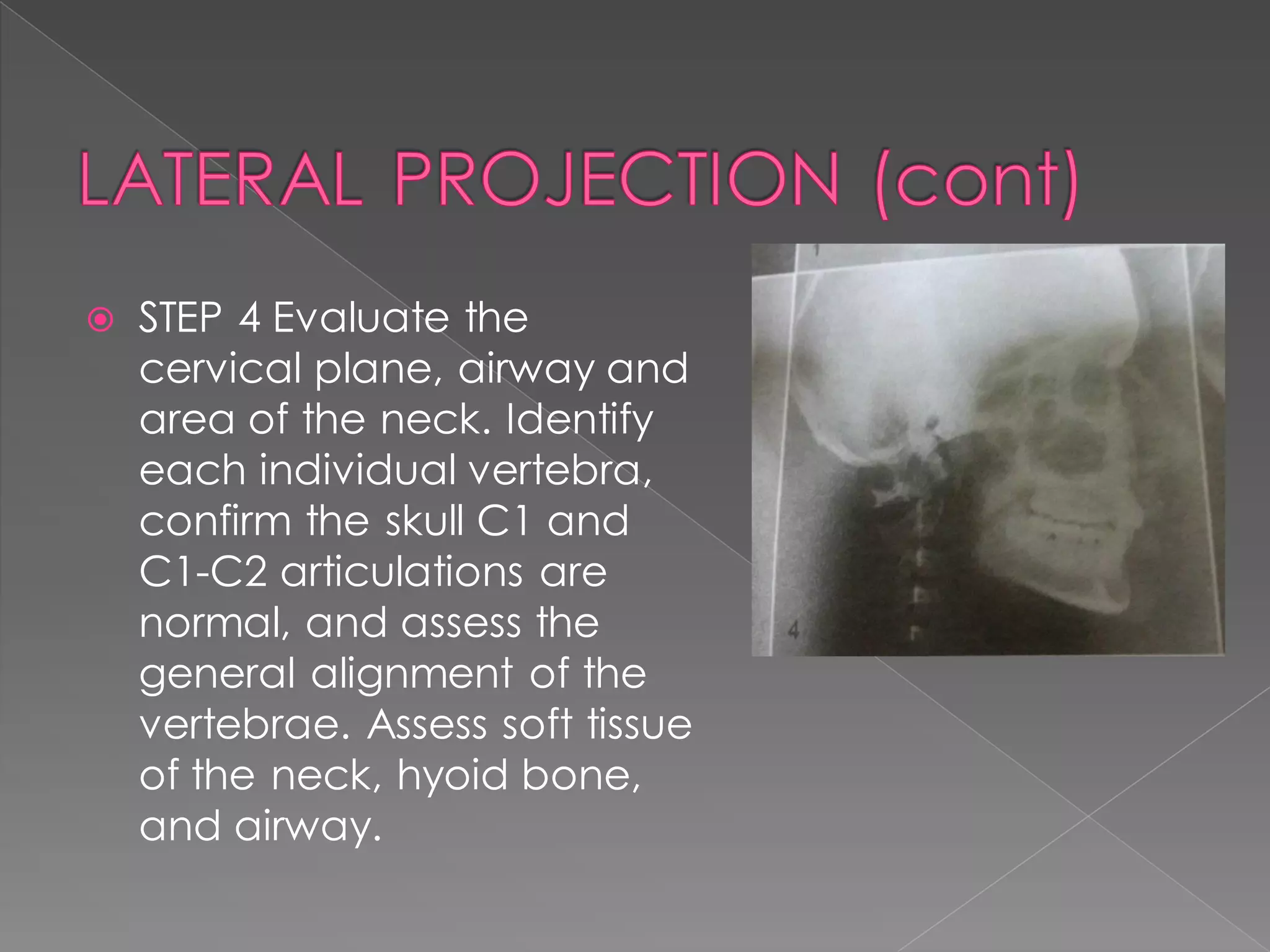
 STEP 4 Evaluate the
cervical plane, airway and
area of the neck. Identify
each individual vertebra,
confirm the skull C1 and
C1-C2 articulations are
normal, and assess the
general alignment of the
vertebrae. Assess soft tissue
of the neck, hyoid bone,
and airway.
 STEP 5 Evaluate the
alveolar bone and
teeth.
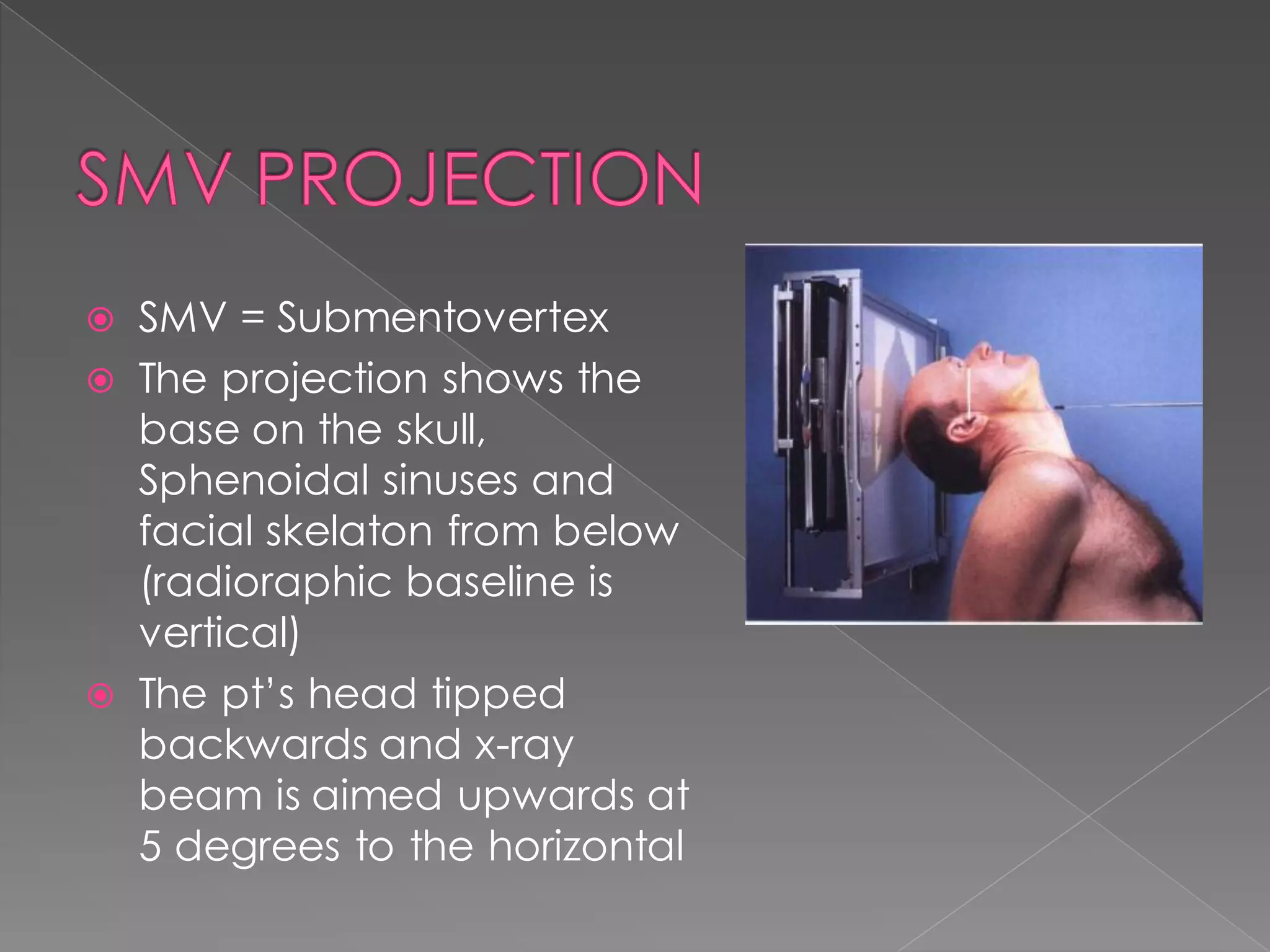
 SMV = Submentovertex
 The projection shows the
base on the skull,
Sphenoidal sinuses and
facial skelaton from below
(radioraphic baseline is
vertical)
 The pt’s head tipped
backwards and x-ray
beam is aimed upwards at
5 degrees to the horizontal
 STEP 1 Evaluate the calvarium
and posteria cranial fossa. Assess
the foramen magnum, atlas
dens, and occipital condyles.
Identify the petrous ridge of the
right and left temporal bones,
the external auditory canals, and
the mastoid air cells. In this and
all subsequent step.
Compare the right and the left
side and look for symmetry.
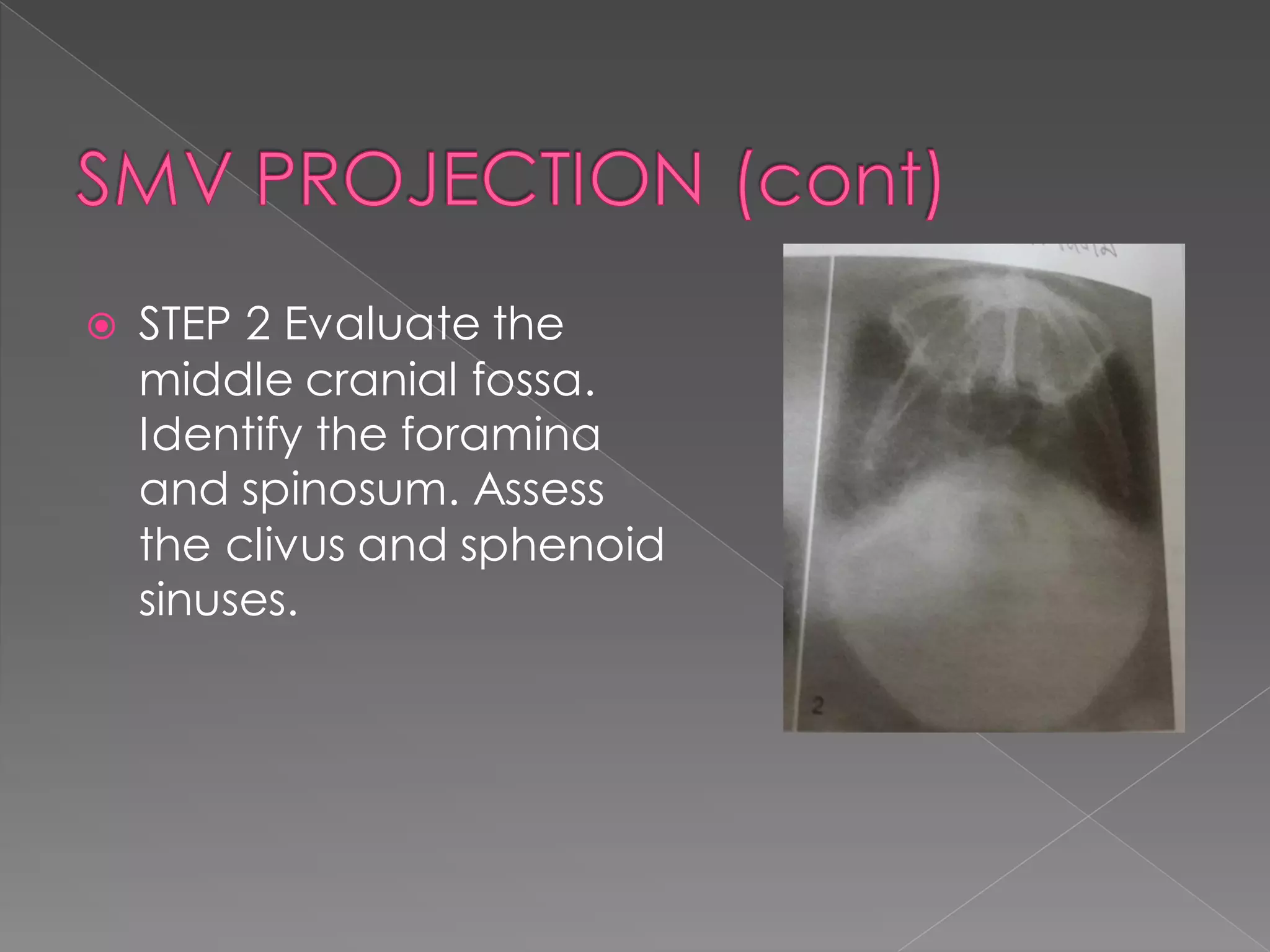
 STEP 2 Evaluate the
middle cranial fossa.
Identify the foramina
and spinosum. Assess
the clivus and sphenoid
sinuses.
 STEP 3 Evaluate the
upper and middle face.
Assess the nasal cavity,
nasal septum, maxillary
and ethmoid sinus and
the orbits. Assess both
the bony borders and
antra or contents of
these structures
 STEP 4 Evaluate the
mandible. Follow the
outline the right
condylar head,
coronoid process,
rami angle and the
body though the
anterior mandible to
the left body, angle,
ramus, coronoid
process and the
condyle.
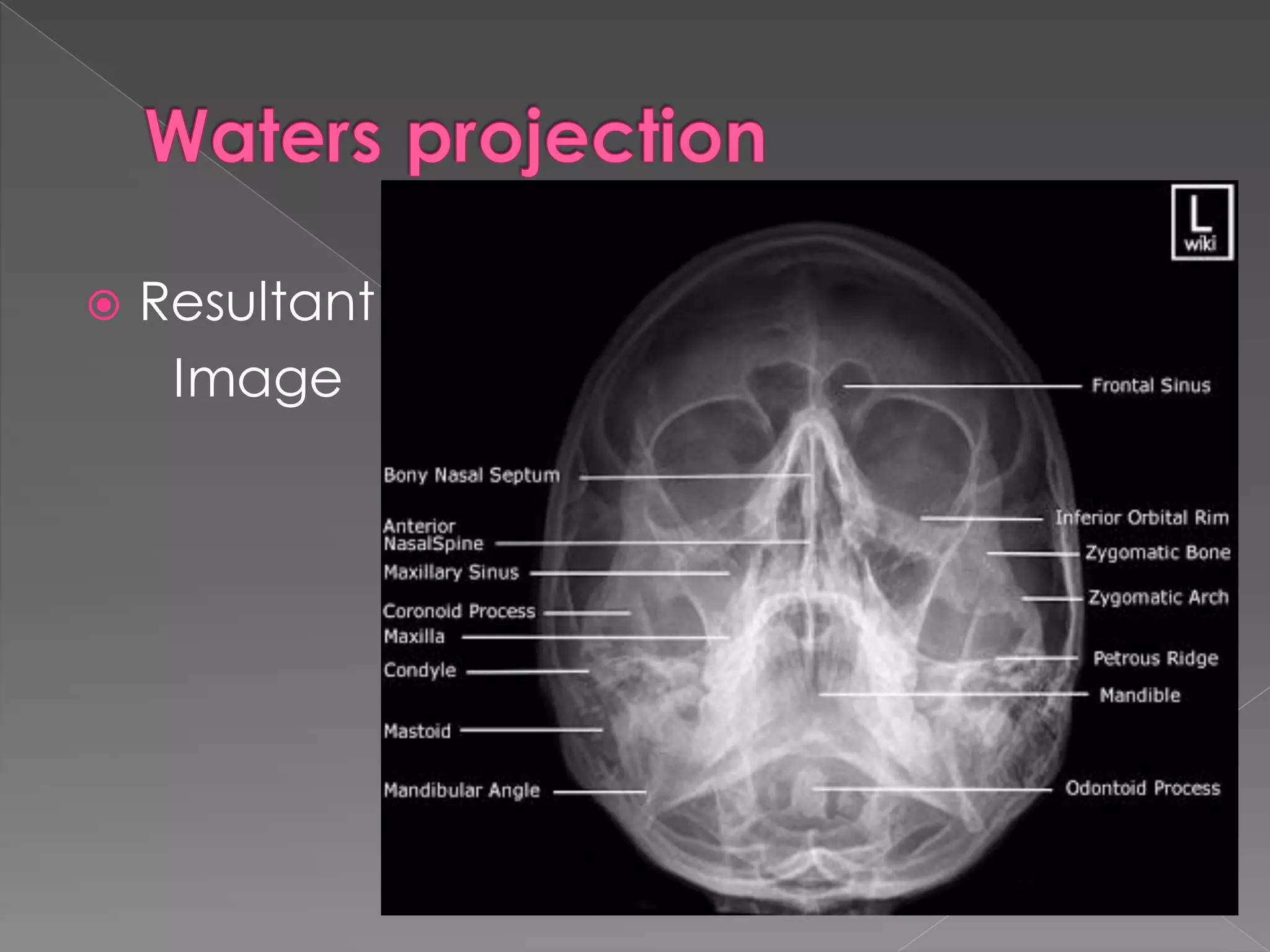
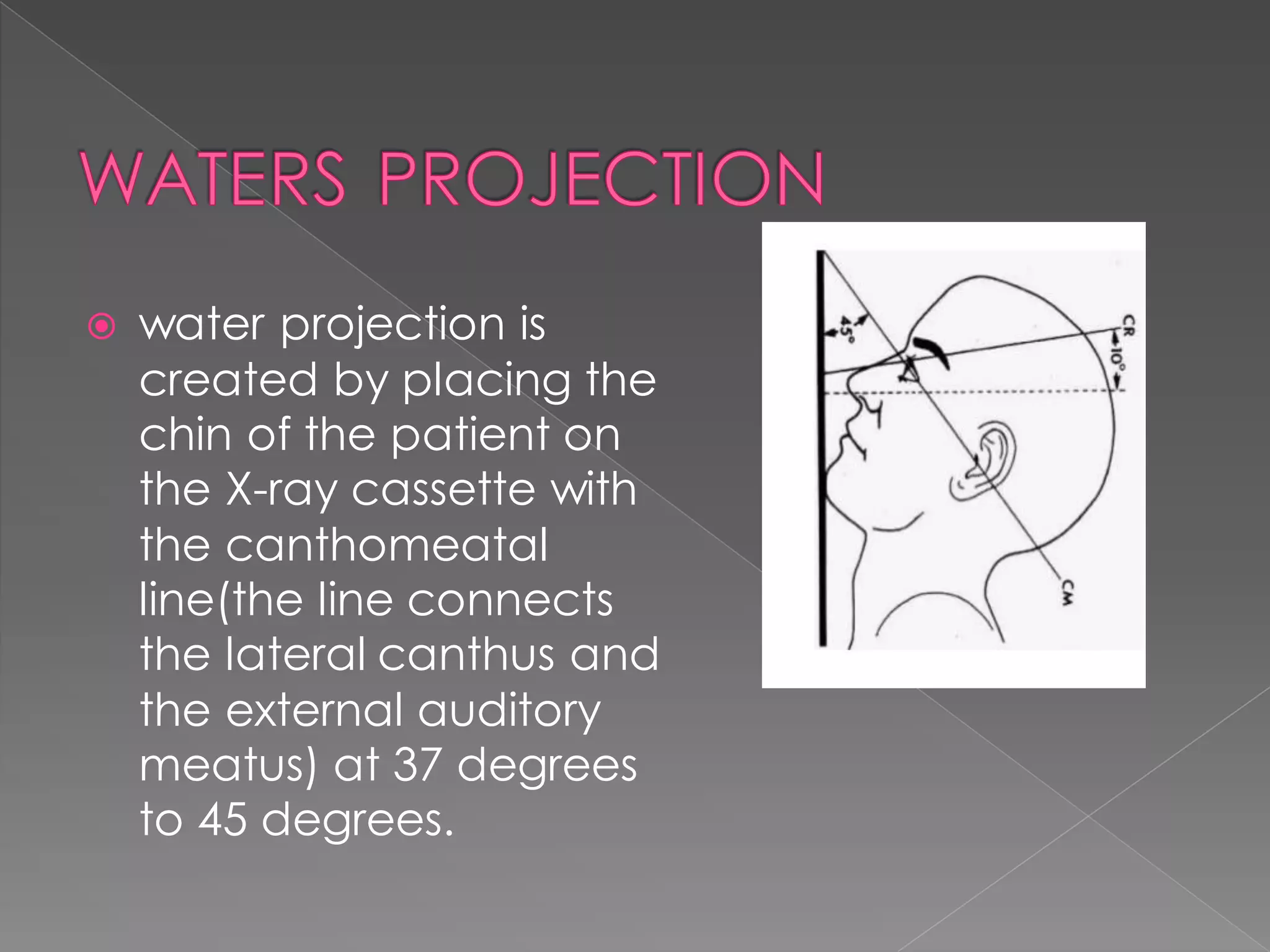
 water projection is
created by placing the
chin of the patient on
the X-ray cassette with
the canthomeatal
line(the line connects
the lateral canthus and
the external auditory
meatus) at 37 degrees
to 45 degrees.
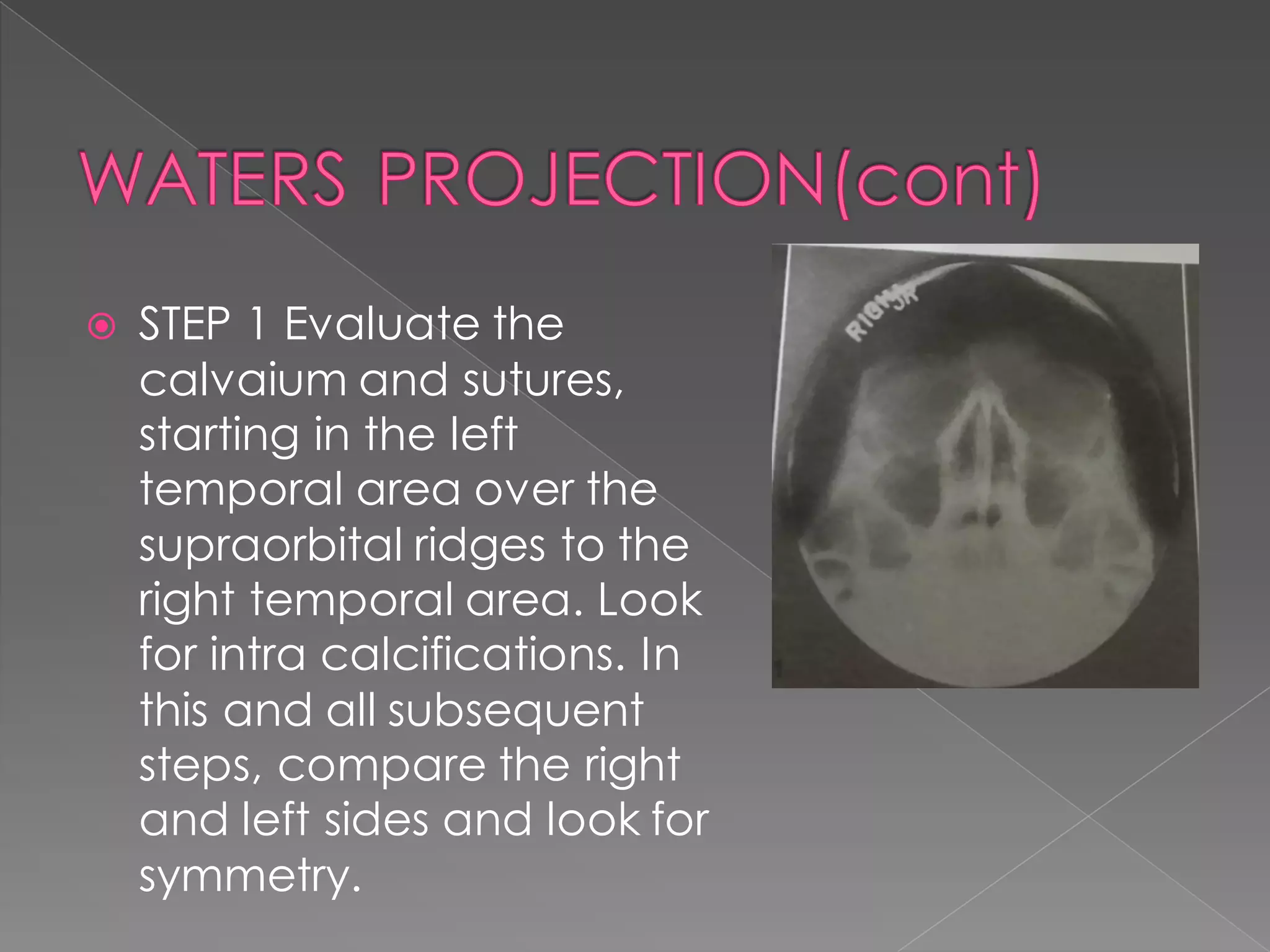
 STEP 1 Evaluate the
calvaium and sutures,
starting in the left
temporal area over the
supraorbital ridges to the
right temporal area. Look
for intra calcifications. In
this and all subsequent
steps, compare the right
and left sides and look for
symmetry.
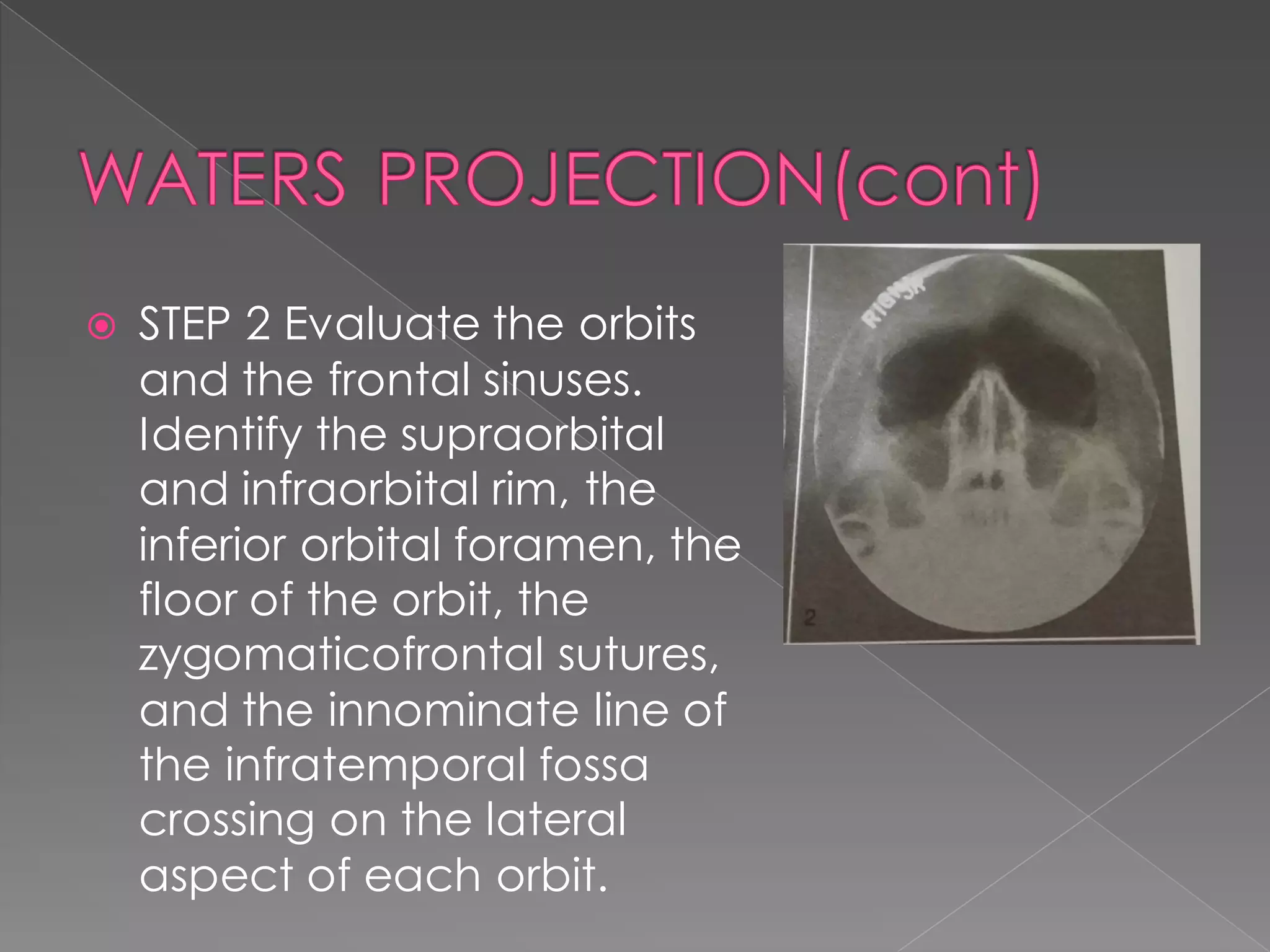
 STEP 2 Evaluate the orbits
and the frontal sinuses.
Identify the supraorbital
and infraorbital rim, the
inferior orbital foramen, the
floor of the orbit, the
zygomaticofrontal sutures,
and the innominate line of
the infratemporal fossa
crossing on the lateral
aspect of each orbit.
 STEP 3 Evaluate the
maxillary sinuses and nasal
cavity. Identify the
superior, medial and
lateral walls and the floor
of maxillary sinuses; the
nasal septum; and the
floor and lateral walls of
the nasal cavity. Try to
identify the foramen
rotundum projected
toward the mesial wall of
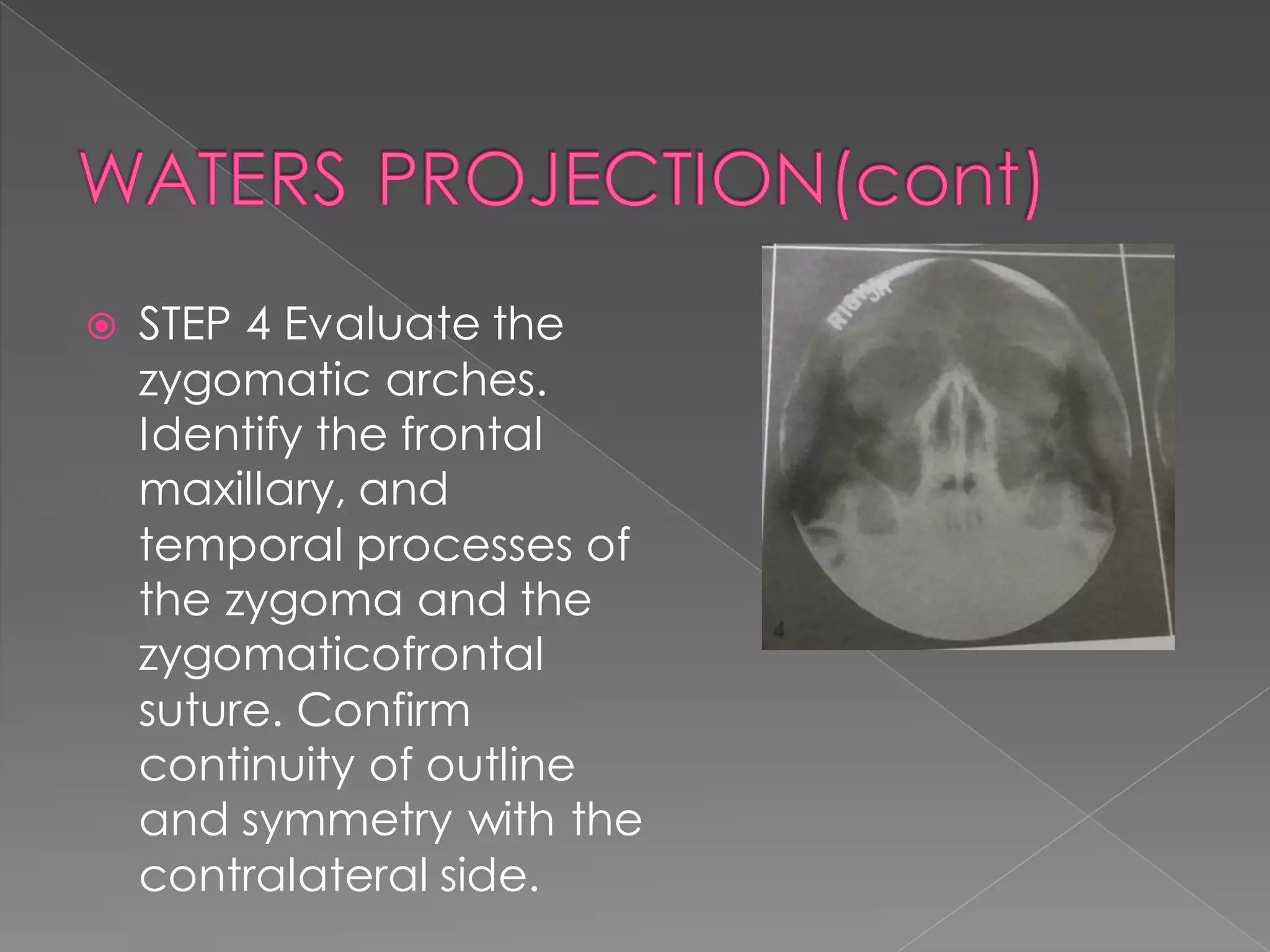
 STEP 4 Evaluate the
zygomatic arches.
Identify the frontal
maxillary, and
temporal processes of
the zygoma and the
zygomaticofrontal
suture. Confirm
continuity of outline
and symmetry with the
contralateral side.
 STEP 5 Evaluate the
condylar and
coronoid processes
of the mandible. This
is one of the the PA
views of the
coronoid process.
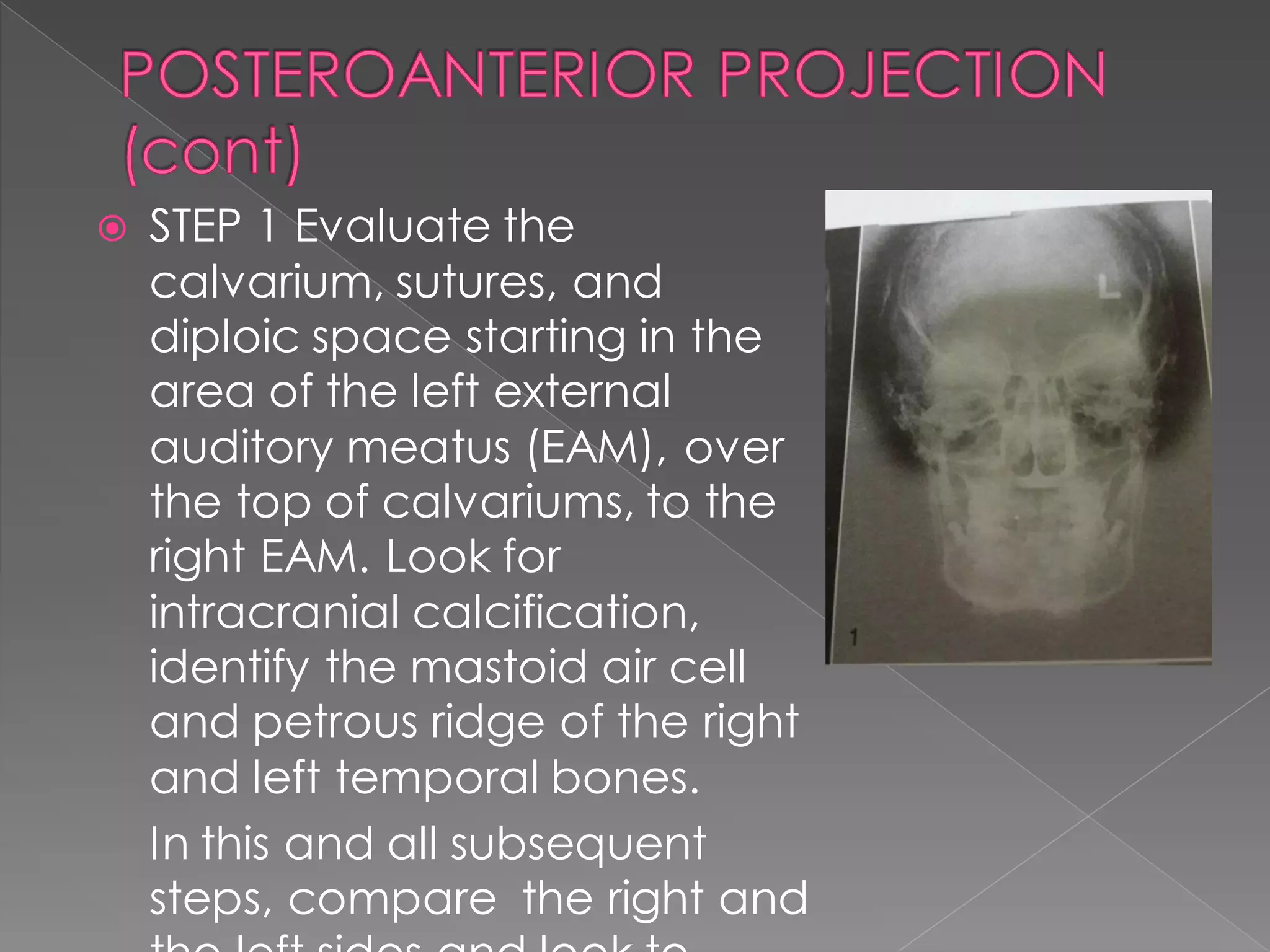
 STEP 1 Evaluate the
calvarium, sutures, and
diploic space starting in the
area of the left external
auditory meatus (EAM), over
the top of calvariums, to the
right EAM. Look for
intracranial calcification,
identify the mastoid air cell
and petrous ridge of the right
and left temporal bones.
In this and all subsequent
steps, compare the right and
 STEP 2 Evaluate the
upper and middle face.
Identify the orbits,
sinuses(frontal, ethmoid
and maxillary), and
zygomatic processes of
the maxilla. Assess the
nasal cavity, middle
and inferior turbinates,
nasal septum and hard
palates.
• STEP 3 Evaluate the
lower face. The outline
of the mandible starting
from the right condylar
and coronoid
processes, ramus, angle,
and body through the
anterior mandible to the
left body, angle , ramus,
coronoid process, and
condyle.
• STEP 4 Evaluate the
cervical spine.
Identify the dens, the
superior border of
C2, and the inferior
border of C1.
• STEP 5 Evaluate the
alveolar bone and
teeth.
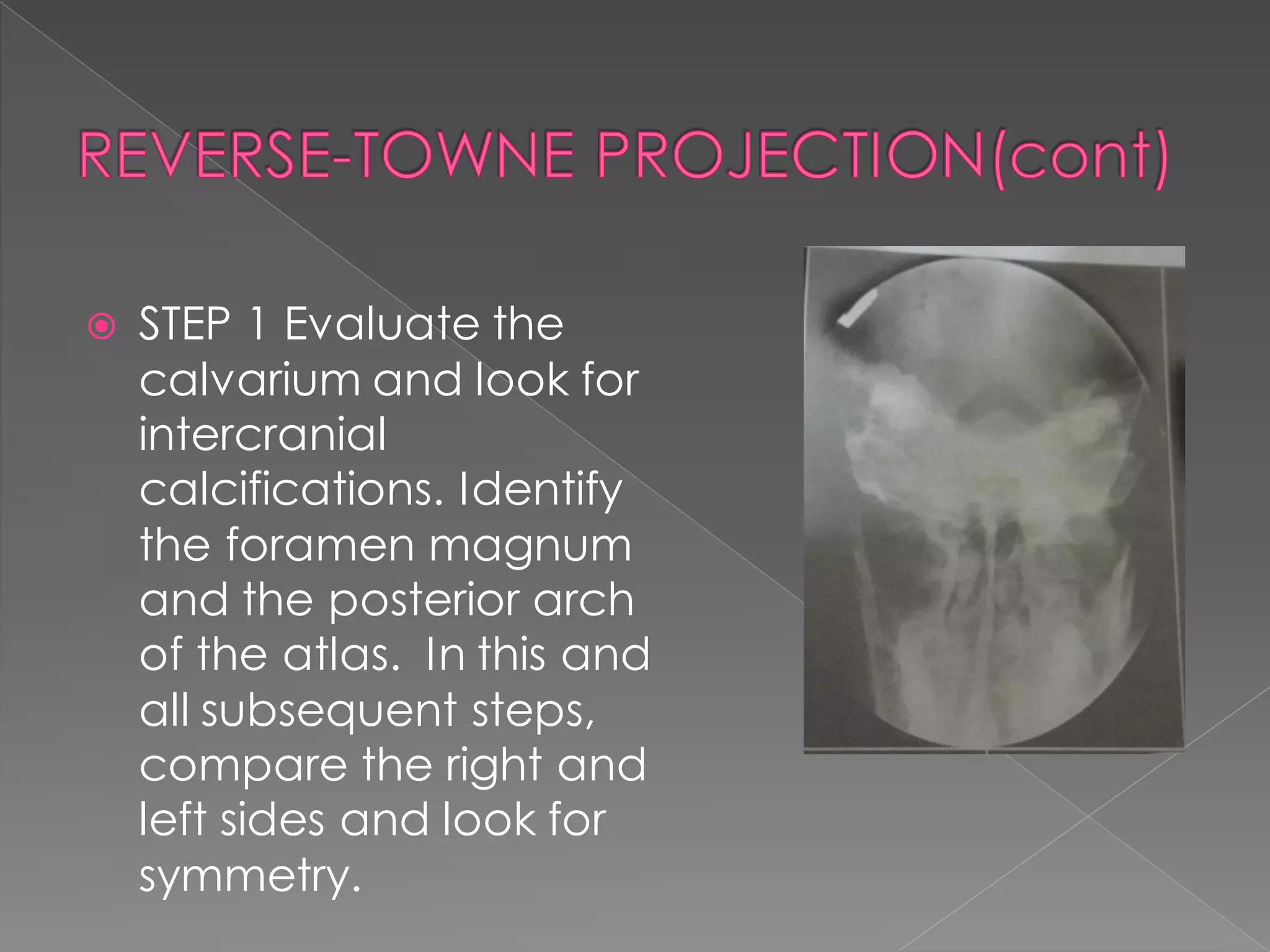
 STEP 1 Evaluate the
calvarium and look for
intercranial
calcifications. Identify
the foramen magnum
and the posterior arch
of the atlas. In this and
all subsequent steps,
compare the right and
left sides and look for
symmetry.
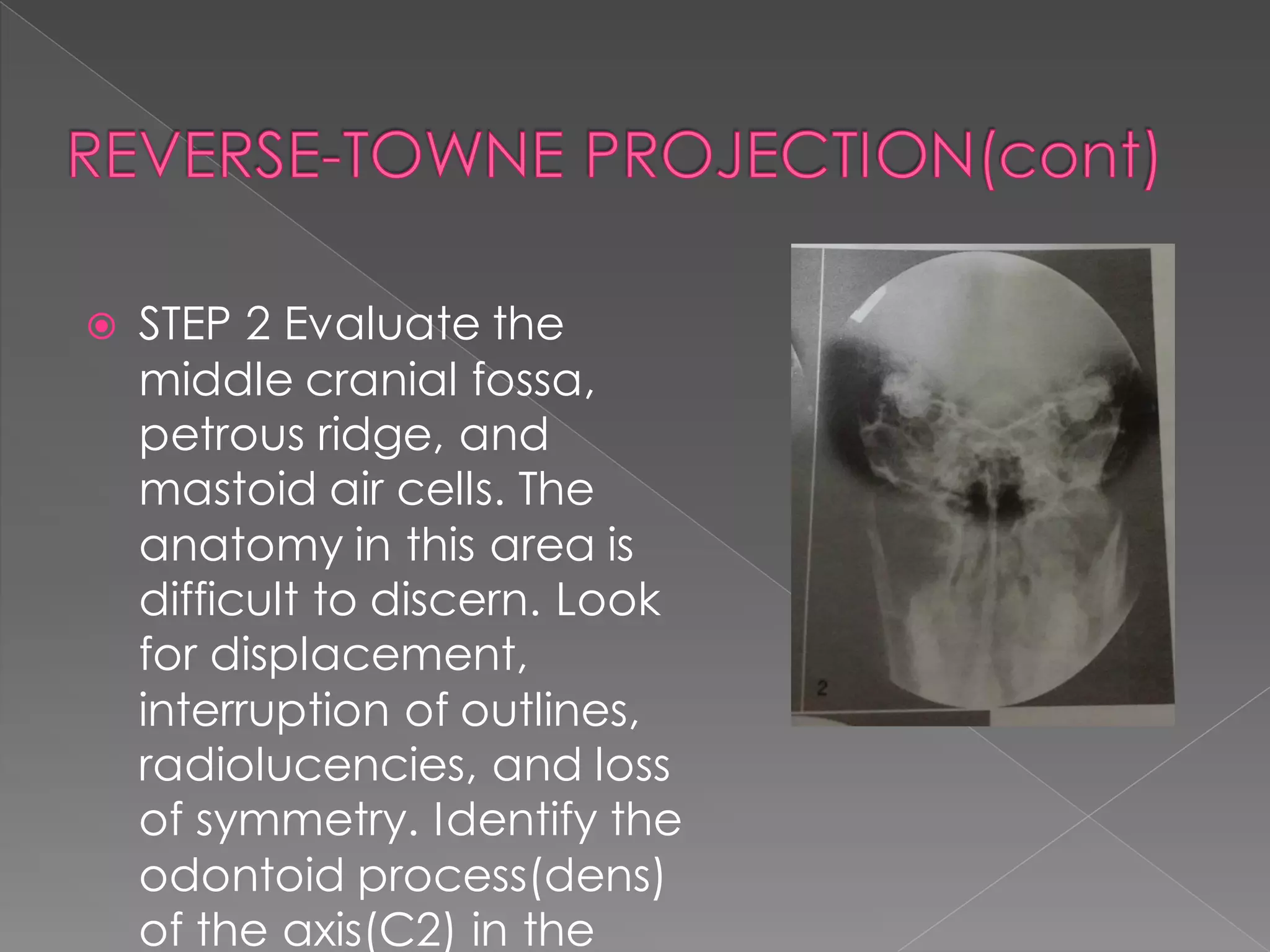
 STEP 2 Evaluate the
middle cranial fossa,
petrous ridge, and
mastoid air cells. The
anatomy in this area is
difficult to discern. Look
for displacement,
interruption of outlines,
radiolucencies, and loss
of symmetry. Identify the
odontoid process(dens)
of the axis(C2) in the
 STEP 3 Evaluate nasal
cavity. Identify the
outline of nasal
cavity, the nasal
septum and the
inferior and the
middle turbinates
 STEP 4 Evaluate the
condylar and the
coronoid process. In the
open mouth projection.
the condylar head,
including its superior
surface and condylar
neck, should be
identified.
Extra

Extra

  • 2.
     The x-raysource and film is placed outside the patient’s mouth
  • 4.
     Lateral Cephalometricprojection(Sagittal/ median plane)  Submentovertex projection (trasverse/horizontal plane)  Waters  Posteroanterior cephalometric  Reverse-Towne projections  Oblique lateral projection  Panoramic radiography (Coronal/frontal plane)
  • 5.
     Selection ofappropriate projection  Selection of dental x-ray machine, models of panoramic machines, or higher- capacity medical x-ray units.  Image receptor › Size:  Cephalomatric and skull views (20x25 cm or 8x10 inch)  Oblique lateral projections (13x18 cm or 5x7 inch) › Identifying the orientation:  By placing metal marker
  • 6.
     Proper exposureparameters › Ex. X-ray source-to-receptor distance  Proper positioning of the x-ray source, patient, and image receptor, attention to detail, and experience. › Landmarks: Canthomeatal line Frankfort plane
  • 7.
  • 9.
     Most commonlyused  Cephalostat
  • 10.
     Image Receptorand Patient Placement › Image receptor is parallel to midsagittal plane › Site of interest placed toward the image receptor  Position of the Central X-ray Beam › Beam is perpendicular to the midsagittal plane of the patient and of the film › Centered over the External auditory meatus.
  • 12.
  • 13.
     Image Receptorand Patient Placement › Film is parallel to patient’s transverse plane › Canthomeatal line forms 10-degree angle with the film.  Position of the Central X-ray Beam › Should be perpendicular to the film › Below the mandible › Centered about 2cm anterior to a line connecting the R and L condyles.
  • 15.
  • 16.
     Image Receptorand Patient Placement › Film should be placed in front of the patient › Perpendicular to the midsagittal plane. › Canthomeatal line should form a 37-degree angle with the film.  Position of the Central X-ray Beam › Perpendicular to the film › Centered in the maxillary sinuses.
  • 18.
  • 20.
     The imagereceptor is placed in front of the patient, perpendicular to the midsagittal plane and parallel to the coronal plane  The patient is placed so that the canthomeatal line forms a 10-degree angle with the horizontal plane and the Frankfort plane is perpendicular to the image receptor.  In the Posteroanterior skull projecion, the canthomeatal line is perpendicular to the image receptor.
  • 21.
     The centralbeam of is perpendicular to the image receptor, directed from the posterior to the anterior, parallel to patient’s midsagittal plane, and is centered at the level of the bridge of the nose.
  • 22.
     The midsagittalplane should divide the skull image into two symmetric halves.  The superior border of the petrous ridge should lie in the lower third of the orbit
  • 25.
     The imagereceptor is placed in front of the patient, perpendicular to the midsagittal plane and parallel to the coronal plane .  The patient’s head is tilted downward so that the canthomeatal line forms a 25 – 30 degree angle with the image receptor.  To improve the visualization of the condyles, the patient’s mouth is opened so that the condylar heads are located inferior to the articular eminence.
  • 26.
     The centralbeam of is perpendicular to the image receptor and parallel to the patient’s midsagittal plane and it is centered at the level of the Condyles.
  • 27.
     The midsagittalplane should divide the skull image into two symmetric halves.  The petrous ridge of the temporal bone should be superimposed at the inferior part of the occipital bone, and the condylar heads should be projected inferior to the articular eminence
  • 31.
     The imagereceptor I place against the patient’s cheek on the side of interest and centered in the molar – premolar area.  The lower border of the cassette is parallel and at least 2cm below the inferior border of the mandible. The head is tilted toward the side being examined, and the mandible is protruded.
  • 32.
     The centralbeam is directed toward the molar – premolar region from a point 2cm below the angle of the opposite side of the mandible.
  • 33.
     A clearimage of the TEETH, ALVEOLAR BONE, and the BODY OF THE MANDIBLE should be obtained.  If significant distortion is present, the head was tilted excessively.  If the contralateral side of the mandible is superimposed over the area of interest, the head was not tilted sufficiently.
  • 36.
     The imagereceptor is placed over the ramus and far enough posteriorly to include the condyle.  The lower border of the cassette is parallel and at least 2cm below the inferior border of the mandible. The head is tilted toward the side being examined so the condyle of the area of interest and the contralateral angle of the mandible form a horizontal line.  In this case, the mandible is PROTRUDED.
  • 37.
     The centralbeam is directed toward the center of the imaged ramus, from 2cm below the inferior border of the opposite side of the mandible at the area of the first molar.
  • 38.
     A clearimage of the THIRD MOLAR- RETROMOLAR AREA, ANGLE OF THE MANDIBLE, RAMUS and CONDYLE HEAD should be obtained.  If significant distortion is present, the head was tilted excessively.  If the contralateral side of the mandible is superimposed over the area of interest, the head was not tilted sufficiently.
  • 41.
     PROPER EXPOSUREAND PROCESSING = image with good contrast and density.  PROPER PATIENT POSITIONING = prevents unwanted superimpositions and distortions and clear identification of anatomic land marks  Poor image quality can lead to DIAGNOSTIC ERRORS and SUBSEQUENTTREATMENT ERRORS.
  • 42.
     IDENTIFICATION OFANATOMY of the head region is the first and most crucial step in interpreting radiographic images.  Interpretation of extraoral radiographs should be: THOROUGH, CAREFUL and METICULUS.
  • 44.
     STEP 1Evaluate the base of the skull and calvarium. Identify the mastoid air cells, clivus, clinoid process, sella turcica, sphenoid sinuses, and roof of the orbit. In the calvarium, assess vessel grooves, sutures, and diploic space. Look for intracranial calcifications.
  • 45.
     STEP 2Evaluate the upper and middle face. Identify the orbits, sinuses(frontal, ethmoid and maxillary), pterygomaillary fissures, pterygoid plates, zygomatic process of maxilla, anterior nasal spine and hard palate. Evaluate the soft tissue of the upper and middle face, nasal cavity(turbinates), soft palate and the dorsum of the tongue
  • 46.
     STEP 3Evaluate the lower face. Follow the outline of the mandible, starting from the condylar and coronoid process. To the rami, angles, and the bodies, and finally to the anterior mandible. Evaluate the soft tissue of the lower face.
  • 47.
     STEP 4Evaluate the cervical plane, airway and area of the neck. Identify each individual vertebra, confirm the skull C1 and C1-C2 articulations are normal, and assess the general alignment of the vertebrae. Assess soft tissue of the neck, hyoid bone, and airway.
  • 48.
     STEP 5Evaluate the alveolar bone and teeth.
  • 49.
     SMV =Submentovertex  The projection shows the base on the skull, Sphenoidal sinuses and facial skelaton from below (radioraphic baseline is vertical)  The pt’s head tipped backwards and x-ray beam is aimed upwards at 5 degrees to the horizontal
  • 50.
     STEP 1Evaluate the calvarium and posteria cranial fossa. Assess the foramen magnum, atlas dens, and occipital condyles. Identify the petrous ridge of the right and left temporal bones, the external auditory canals, and the mastoid air cells. In this and all subsequent step. Compare the right and the left side and look for symmetry.
  • 51.
     STEP 2Evaluate the middle cranial fossa. Identify the foramina and spinosum. Assess the clivus and sphenoid sinuses.
  • 52.
     STEP 3Evaluate the upper and middle face. Assess the nasal cavity, nasal septum, maxillary and ethmoid sinus and the orbits. Assess both the bony borders and antra or contents of these structures
  • 53.
     STEP 4Evaluate the mandible. Follow the outline the right condylar head, coronoid process, rami angle and the body though the anterior mandible to the left body, angle, ramus, coronoid process and the condyle.
  • 54.
     water projectionis created by placing the chin of the patient on the X-ray cassette with the canthomeatal line(the line connects the lateral canthus and the external auditory meatus) at 37 degrees to 45 degrees.
  • 55.
     STEP 1Evaluate the calvaium and sutures, starting in the left temporal area over the supraorbital ridges to the right temporal area. Look for intra calcifications. In this and all subsequent steps, compare the right and left sides and look for symmetry.
  • 56.
     STEP 2Evaluate the orbits and the frontal sinuses. Identify the supraorbital and infraorbital rim, the inferior orbital foramen, the floor of the orbit, the zygomaticofrontal sutures, and the innominate line of the infratemporal fossa crossing on the lateral aspect of each orbit.
  • 57.
     STEP 3Evaluate the maxillary sinuses and nasal cavity. Identify the superior, medial and lateral walls and the floor of maxillary sinuses; the nasal septum; and the floor and lateral walls of the nasal cavity. Try to identify the foramen rotundum projected toward the mesial wall of
  • 58.
     STEP 4Evaluate the zygomatic arches. Identify the frontal maxillary, and temporal processes of the zygoma and the zygomaticofrontal suture. Confirm continuity of outline and symmetry with the contralateral side.
  • 59.
     STEP 5Evaluate the condylar and coronoid processes of the mandible. This is one of the the PA views of the coronoid process.
  • 61.
     STEP 1Evaluate the calvarium, sutures, and diploic space starting in the area of the left external auditory meatus (EAM), over the top of calvariums, to the right EAM. Look for intracranial calcification, identify the mastoid air cell and petrous ridge of the right and left temporal bones. In this and all subsequent steps, compare the right and
  • 62.
     STEP 2Evaluate the upper and middle face. Identify the orbits, sinuses(frontal, ethmoid and maxillary), and zygomatic processes of the maxilla. Assess the nasal cavity, middle and inferior turbinates, nasal septum and hard palates.
  • 63.
    • STEP 3Evaluate the lower face. The outline of the mandible starting from the right condylar and coronoid processes, ramus, angle, and body through the anterior mandible to the left body, angle , ramus, coronoid process, and condyle.
  • 64.
    • STEP 4Evaluate the cervical spine. Identify the dens, the superior border of C2, and the inferior border of C1.
  • 65.
    • STEP 5Evaluate the alveolar bone and teeth.
  • 67.
     STEP 1Evaluate the calvarium and look for intercranial calcifications. Identify the foramen magnum and the posterior arch of the atlas. In this and all subsequent steps, compare the right and left sides and look for symmetry.
  • 68.
     STEP 2Evaluate the middle cranial fossa, petrous ridge, and mastoid air cells. The anatomy in this area is difficult to discern. Look for displacement, interruption of outlines, radiolucencies, and loss of symmetry. Identify the odontoid process(dens) of the axis(C2) in the
  • 69.
     STEP 3Evaluate nasal cavity. Identify the outline of nasal cavity, the nasal septum and the inferior and the middle turbinates
  • 70.
     STEP 4Evaluate the condylar and the coronoid process. In the open mouth projection. the condylar head, including its superior surface and condylar neck, should be identified.