Oral Radilogy
Dr. Rawand Samy Mohamed Abu Nahla
Oral Medicine, Periodontology& Oral Radiology Department.
Dr. Haydar. A. Shafy Faculty Of Dentistry.Dr. Haydar. A. Shafy Faculty Of Dentistry.
El Azhar University.El Azhar University.
Lecture 8:
Extra-oral Radiograph
Radiography
 Extraoral radiograph is defined as: Examination made of
the head and facial region using films located outside
the mouth.
 They allow the dentist to view large areas of the jaws
and skull on a single radiograph not covered by
intraoral films
Purpose and use of extraoral radiographs:
 Examine large areas of the jaws and Skull.
 Study growth and development of bone and teeth.
 Detect fractures and evaluate trauma
 Detect pathological lesions and diseases of the jaws.
 Detect and evaluate impacted teeth.
 Evaluate TMJ Disorders.
Purpose and use of extraoral radiographs:
• Extraoral radiographs can be used alone or in conjunction with intra oral
radiographs.
• Except for the panoramic radiographs, extraoral radiographs are not
frequently used by general practitioners, major users are orthodontists,
prosthodontists, oral surgeons.
Purpose and use of extraoral radiographs:
Orthodontists uses lateral cephalometric radiograph to:
• measure and compare changes in growth and development of bone and the
teeth through pre & progress and post treatment records.
 Prosthodontists: Use facial profile radiographs (lateral cephalometric )
to record :
• The contour of the lips and the face, the relation ship of the teeth before
removal, this will help them construct prosthetic appliances that look natural.
 Oral surgeons: use Extraoral radiographs extensively to:
• evaluate trauma.
• to determine the location and extent of fractures.
• to locate impacted teeth & abnormalities .
• malignancies .
• injuries to TMJ
 Many film positions and techniques require special equipments and a
sound knowledge of the anatomical structures through which the
radiation beam is directed.
 Most of these radiographs are made in hospitals and by highly
experienced operators.
 Films are utilized with intensifying Screens
Patient preparation
• Seat the patient
• Explain the radiographic procedures to the patient
• Adjust chair.
• Place lead apron on the patient
• Remove eyeglasses and objects from mouth.
Extraoral Radiographic techniques:
• Lateral jaw projection.
• Posteroanterior .
• Lateral skull (cephalometric radiograph)
• Water’s view ( Sinus)
• Reverse towne.
• Submentovertex
• Temporomandibular joint projections
1-Lateral jaw projection
• Known also as lateral oblique projection
• It has been largely replaced by panoramic radiographs but still taken when image
details is needed.
Purpose:
• To Examine the posterior region of the mandible.
• Valuable in children, or Senile patients who can’t withstand intraoral films.
• Patients who have fractures or swelling.
• It evaluate the condition of the bone and to locate impacted teeth or large lesions.
A-Mandibular Body Protection
Image Receptor and Patient Placement
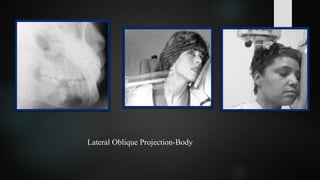
The image receptor is placed against the patient ’ s cheek on the side of
interest and centered in the molar-premolar area.
The lower border of the cassette is parallel and at least 2 cm below the
inferior border of the mandible.
 The head is tilted toward the side being examined, and the mandible is
protruded.
Position of the Central X-Ray Beam
The central beam is directed toward the molar-premolar region from a point 2
cm below the angle of the opposite side of the mandible.
Lateral Oblique Projection-Body
B-Mandibular Ramus Projection
Image Receptor and Patient Placement
The image receptor is placed over the ramus and far enough posteriorly to include
the condyle.
The lower border of the cassette is parallel and at least 2 cm below the inferior
border of the mandible.
The head is tilted toward the side being examined. The mandible is protruded.
Position of the Central X-Ray Beam
The central beam is directed toward the center of the imaged ramus, from 2 cm
below the inferior border of the opposite side of the mandible at the area of the
first molar
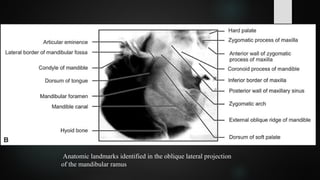
Anatomic landmarks identified in the oblique lateral projection
of the mandibular ramus
2-Posteroanterior View (also known as the
Occipitofrontal Projection of the Nasal Sinuses) of
Ganger(OPG):
Indications:
– Disease
– Trauma
– Developmental abnormalities
– Growth and development
Film Placement
The cassette is placed perpendicular to the floor in a cassette holding device.
The long axis of the cassette is positioned vertically.
Position of Patient
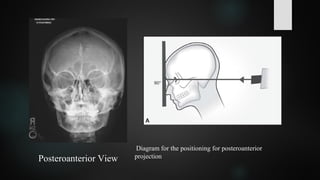
The midsagittal plane should be vertical and perpendicular to the plane of
the cassette.
Only the forehead and nose should touch the cassette.
The radiographic baseline is at 90 degrees to the film.
Central Ray
Is directed to the midline of the skull so that the X-ray beam
passes through the canthomeatal plane perpendicular to the film
plane.
Structures Shown
This view is excellent for evaluating the inner and
middle ear because the petrous pyramid can be viewed
through the orbits.
Frontal sinuses lying above the frontonasal suture,
anterior ethmoidal cells lying each on either side of the
nasal fossa, sphenoidal sinuses projected through the
nasal fossa just below or between the shadows of the
ethmoids. The upper part of the antrum is superimposed
by dense shadows of the petrosae.
Posteroanterior View
Diagram for the positioning for posteroanterior
projection
3-Cephalometric Radiographs
• may be either frontal (posteroanterior) or lateral skull projections
• Cephalometric means measurements of the head.
• Cephalometer is a device used to Standardize the placement of the
head during exposure .
• Either conventional x- ray machines modified for cephalometric work or
special units may be needed.
Cephalometric Radiographs Film placement and head position:
• Device called cephalostats have ear rods that stabilizes the
patient’s head parallel to the film and at right angle to the
direction of the beam
• The patient head will be between the source of radiation and the
cassette.
• The cephalometer allows the Exposure to be taken several times for
the same patient in the same head position
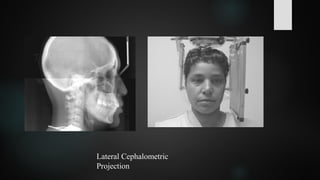
A-Cephalometric Radiographs Lateral skull (cephalometric )projection:
• It shows the entire skull from the side and the X-ray passes from the lateral side
Purpose:
• Orthodontic purpose
1.Pre and post treatment records. 2.Evaluate the growth and development
3.Facial soft tissue profile of the face
• Surgeons also use it for pre and post treatment records
 Trauma
 Pathology
 Developmental Abnormalities
Cephalometric Radiographs Film placement and head position :
• Film is positioned vertically in a holding Device.
• The head is positioned with the left side of the face next to the cassette, the
midsagittal plane is parallel to the cassette.
• If the facial soft tissue profile is desired , a wedge filter is placed over the
anterior side of the beam at the tube head so that filter will absorbs some of
the x-rays in the anterior region.
• The x-rays is directed towards the acoustic meatus perpendicular to the film
Lateral Cephalometric
Projection
B-Posteroanterior (PA) cephalometric projection:
• Shows the entire skull in a postero-anterior plane.
• The beam passes through the skull in a posterior to anterior direction.
Purpose:
• Asymmetry .
• Disease
• Trauma
• Developmental abnormalities
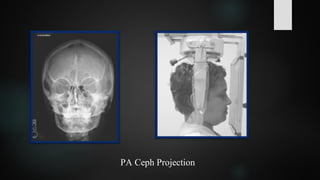
PA Ceph Projection
The image receptor is placed in front of the patient, perpendicular to
the midsagittal plane and parallel to the coronal plane
The patient is placed so that the canthomeatal line forms a 10-degree
angle with the horizontal plane and the Frankfurt plane is
perpendicular to the image receptor.
In the PA skull projection, the C-M line is perpendicular to the image
receptor.
PA Ceph Projection
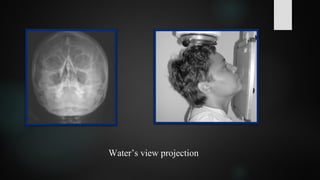
4-Water’s view projection
• Occipeto-Menton Projection Also known as sinus projection
• It’s similar to the posteroanterior projection except that the center of
interest is focused on the middle third of the face.
Purpose:
To Evaluate the maxillary , frontal and ethmoid sinuses.
View of orbit and nasal fossa
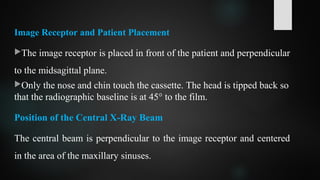
Image Receptor and Patient Placement
The image receptor is placed in front of the patient and perpendicular
to the midsagittal plane.
Only the nose and chin touch the cassette. The head is tipped back so
that the radiographic baseline is at 45° to the film.
Position of the Central X-Ray Beam
The central beam is perpendicular to the image receptor and centered
in the area of the maxillary sinuses.
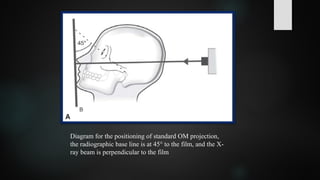
Diagram for the positioning of standard OM projection,
the radiographic base line is at 45° to the film, and the X-
ray beam is perpendicular to the film
Water’s view projection
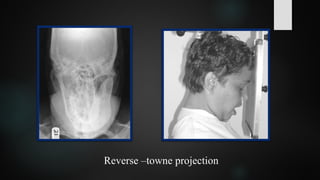
5-Reverse –Towne projection (open mouth)
Purpose:
To examine fractures of the condylar neck of the mandible.
Image Receptor and Patient Placement
The image receptor is placed in front of the patient, perpendicular to the midsagittal and
parallel to the coronal plane.
The patient ’ s head is tilted downward so that the canthomeatal line forms a 25- to 30-
degree angle with the image receptor.
To improve the visualization of the condyles, the patient ’ s mouth is opened so that the
condylar heads are located inferior to the articular eminence. When the clinician requests
this image to evaluate the condyles, it is necessary to specify “ open-mouth, reverse-
Towne ” otherwise a standard Towne view of the occiput may result.
Position of the Central X-Ray Beam
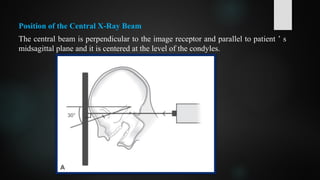
The central beam is perpendicular to the image receptor and parallel to patient ’ s
midsagittal plane and it is centered at the level of the condyles.
Reverse –towne projection
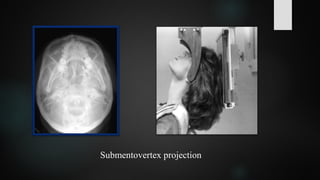
6-Submentovertex projection
Purpose:
 used to show the base of the skull.
The position and orientation of the condyles.
Sphenoid sinus and fractures of the Zygomatic arch.
Image Receptor and Patient Placement
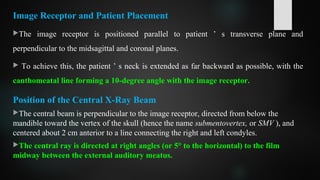
The image receptor is positioned parallel to patient ’ s transverse plane and
perpendicular to the midsagittal and coronal planes.
 To achieve this, the patient ’ s neck is extended as far backward as possible, with the
canthomeatal line forming a 10-degree angle with the image receptor.
Position of the Central X-Ray Beam
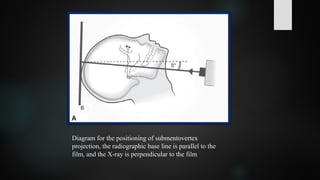
The central beam is perpendicular to the image receptor, directed from below the
mandible toward the vertex of the skull (hence the name submentovertex, or SMV ), and
centered about 2 cm anterior to a line connecting the right and left condyles.
The central ray is directed at right angles (or 5° to the horizontal) to the film
midway between the external auditory meatus.
Diagram for the positioning of submentovertex
projection, the radiographic base line is parallel to the
film, and the X-ray is perpendicular to the film
Submentovertex projection
7-Radiography Of The Temporo Mandibular
Joints
A. Transcranial
Structures Shown
This technique is most useful in detecting arthritic changes on the articular surface. It helps
to evaluate the joint’s bony relationship
Film Position
The cassette is placed flat against the patient’s ear and centered over the TM joint of interest,
against the facial skin parallel to the sagittal plane.
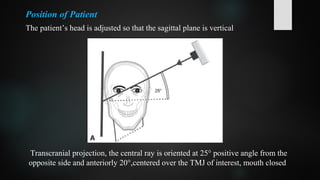
Position of Patient
The patient’s head is adjusted so that the sagittal plane is vertical
Transcranial projection, the central ray is oriented at 25° positive angle from the
opposite side and anteriorly 20°,centered over the TMJ of interest, mouth closed
2. Transpharyngeal
Film Placement
The cassette is placed flat against the patient’s ear and is centered to a
point ½” anterior to the external auditory meatus, over the TM joint of
interest, against the facial skin parallel to the sagittal plane.
Position of Patient
The patient is positioned so that the sagittal plane is vertical and parallel to
the film, with the TM joint of interest adjacent to the film.
The film is centered to a point ½” anterior to the external auditory meatus.
The occlusal plane should be parallel to the transverse axis of the film so that
the soft parts of the nasopharynx are in one line with the TM joint.
The patient is instructed to slowly inhale through the nose during exposure,
so as to ensure filling of the nasopharynx with air during the exposure.
The patient should open his mouth so that the condyles move away from the
base of the skull and the mandibular notch of the opposite side is enlarged
Central Ray
Is directed from the opposite side cranially, at an angle of –5° to –10°
posteriorly.
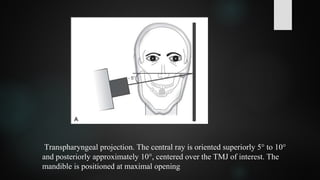
Transpharyngeal projection. The central ray is oriented superiorly 5° to 10°
and posteriorly approximately 10°, centered over the TMJ of interest. The
mandible is positioned at maximal opening
3. Transorbital (Zimmer Projection)
Structures Shown
The anterior view of the temporomandibular joint and medial displacement of
fractured condyle and fracture of neck of condyle are clearly seen in this view.
Film Position
The film is positioned behind the patient’s head at an angle of 45° to the sagittal
plane.
Position of Patient
The patient is positioned so that the sagittal plane is vertical.
The canthomeatal line should be 10° to the horizontal, with the head tipped
downwards.
The mouth should be wide open
Central Ray
The tube head is placed in front of the patient’s face.
The central ray is directed to the joint of interest, at an angle of
+20°, to strike the cassette at right angles.
The point of entry may be taken at:
A. Pupil of the same eye, asking the patient to look straight ahead.
B. Medial canthus of the same eye.
C. Medial canthus of the opposite eye
Transorbital projection, positioning from above,
showing the cassette behind the condyle and X-ray beam
aimed across the orbit
Thank you

Extraoral radiograph lecture

  • 1.
    Oral Radilogy Dr. RawandSamy Mohamed Abu Nahla Oral Medicine, Periodontology& Oral Radiology Department. Dr. Haydar. A. Shafy Faculty Of Dentistry.Dr. Haydar. A. Shafy Faculty Of Dentistry. El Azhar University.El Azhar University.
  • 2.
  • 3.
     Extraoral radiographis defined as: Examination made of the head and facial region using films located outside the mouth.  They allow the dentist to view large areas of the jaws and skull on a single radiograph not covered by intraoral films
  • 4.
    Purpose and useof extraoral radiographs:  Examine large areas of the jaws and Skull.  Study growth and development of bone and teeth.  Detect fractures and evaluate trauma  Detect pathological lesions and diseases of the jaws.  Detect and evaluate impacted teeth.  Evaluate TMJ Disorders.
  • 5.
    Purpose and useof extraoral radiographs: • Extraoral radiographs can be used alone or in conjunction with intra oral radiographs. • Except for the panoramic radiographs, extraoral radiographs are not frequently used by general practitioners, major users are orthodontists, prosthodontists, oral surgeons.
  • 6.
    Purpose and useof extraoral radiographs: Orthodontists uses lateral cephalometric radiograph to: • measure and compare changes in growth and development of bone and the teeth through pre & progress and post treatment records.  Prosthodontists: Use facial profile radiographs (lateral cephalometric ) to record : • The contour of the lips and the face, the relation ship of the teeth before removal, this will help them construct prosthetic appliances that look natural.
  • 7.
     Oral surgeons:use Extraoral radiographs extensively to: • evaluate trauma. • to determine the location and extent of fractures. • to locate impacted teeth & abnormalities . • malignancies . • injuries to TMJ
  • 8.
     Many filmpositions and techniques require special equipments and a sound knowledge of the anatomical structures through which the radiation beam is directed.  Most of these radiographs are made in hospitals and by highly experienced operators.  Films are utilized with intensifying Screens
  • 9.
    Patient preparation • Seatthe patient • Explain the radiographic procedures to the patient • Adjust chair. • Place lead apron on the patient • Remove eyeglasses and objects from mouth.
  • 10.
    Extraoral Radiographic techniques: •Lateral jaw projection. • Posteroanterior . • Lateral skull (cephalometric radiograph) • Water’s view ( Sinus) • Reverse towne. • Submentovertex • Temporomandibular joint projections
  • 11.
    1-Lateral jaw projection •Known also as lateral oblique projection • It has been largely replaced by panoramic radiographs but still taken when image details is needed. Purpose: • To Examine the posterior region of the mandible. • Valuable in children, or Senile patients who can’t withstand intraoral films. • Patients who have fractures or swelling. • It evaluate the condition of the bone and to locate impacted teeth or large lesions.
  • 12.
    A-Mandibular Body Protection ImageReceptor and Patient Placement The image receptor is placed against the patient ’ s cheek on the side of interest and centered in the molar-premolar area. The lower border of the cassette is parallel and at least 2 cm below the inferior border of the mandible.  The head is tilted toward the side being examined, and the mandible is protruded. Position of the Central X-Ray Beam The central beam is directed toward the molar-premolar region from a point 2 cm below the angle of the opposite side of the mandible.
  • 13.
  • 14.
    B-Mandibular Ramus Projection ImageReceptor and Patient Placement The image receptor is placed over the ramus and far enough posteriorly to include the condyle. The lower border of the cassette is parallel and at least 2 cm below the inferior border of the mandible. The head is tilted toward the side being examined. The mandible is protruded.
  • 15.
    Position of theCentral X-Ray Beam The central beam is directed toward the center of the imaged ramus, from 2 cm below the inferior border of the opposite side of the mandible at the area of the first molar
  • 16.
    Anatomic landmarks identifiedin the oblique lateral projection of the mandibular ramus
  • 17.
    2-Posteroanterior View (alsoknown as the Occipitofrontal Projection of the Nasal Sinuses) of Ganger(OPG): Indications: – Disease – Trauma – Developmental abnormalities – Growth and development
  • 18.
    Film Placement The cassetteis placed perpendicular to the floor in a cassette holding device. The long axis of the cassette is positioned vertically. Position of Patient The midsagittal plane should be vertical and perpendicular to the plane of the cassette. Only the forehead and nose should touch the cassette. The radiographic baseline is at 90 degrees to the film.
  • 19.
    Central Ray Is directedto the midline of the skull so that the X-ray beam passes through the canthomeatal plane perpendicular to the film plane.
  • 20.
    Structures Shown This viewis excellent for evaluating the inner and middle ear because the petrous pyramid can be viewed through the orbits. Frontal sinuses lying above the frontonasal suture, anterior ethmoidal cells lying each on either side of the nasal fossa, sphenoidal sinuses projected through the nasal fossa just below or between the shadows of the ethmoids. The upper part of the antrum is superimposed by dense shadows of the petrosae.
  • 21.
    Posteroanterior View Diagram forthe positioning for posteroanterior projection
  • 22.
    3-Cephalometric Radiographs • maybe either frontal (posteroanterior) or lateral skull projections • Cephalometric means measurements of the head. • Cephalometer is a device used to Standardize the placement of the head during exposure . • Either conventional x- ray machines modified for cephalometric work or special units may be needed.
  • 23.
    Cephalometric Radiographs Filmplacement and head position: • Device called cephalostats have ear rods that stabilizes the patient’s head parallel to the film and at right angle to the direction of the beam • The patient head will be between the source of radiation and the cassette. • The cephalometer allows the Exposure to be taken several times for the same patient in the same head position
  • 24.
    A-Cephalometric Radiographs Lateralskull (cephalometric )projection: • It shows the entire skull from the side and the X-ray passes from the lateral side Purpose: • Orthodontic purpose 1.Pre and post treatment records. 2.Evaluate the growth and development 3.Facial soft tissue profile of the face • Surgeons also use it for pre and post treatment records  Trauma  Pathology  Developmental Abnormalities
  • 25.
    Cephalometric Radiographs Filmplacement and head position : • Film is positioned vertically in a holding Device. • The head is positioned with the left side of the face next to the cassette, the midsagittal plane is parallel to the cassette. • If the facial soft tissue profile is desired , a wedge filter is placed over the anterior side of the beam at the tube head so that filter will absorbs some of the x-rays in the anterior region. • The x-rays is directed towards the acoustic meatus perpendicular to the film
  • 26.
  • 27.
    B-Posteroanterior (PA) cephalometricprojection: • Shows the entire skull in a postero-anterior plane. • The beam passes through the skull in a posterior to anterior direction. Purpose: • Asymmetry . • Disease • Trauma • Developmental abnormalities
  • 28.
    PA Ceph Projection Theimage receptor is placed in front of the patient, perpendicular to the midsagittal plane and parallel to the coronal plane The patient is placed so that the canthomeatal line forms a 10-degree angle with the horizontal plane and the Frankfurt plane is perpendicular to the image receptor. In the PA skull projection, the C-M line is perpendicular to the image receptor.
  • 29.
  • 30.
    4-Water’s view projection •Occipeto-Menton Projection Also known as sinus projection • It’s similar to the posteroanterior projection except that the center of interest is focused on the middle third of the face. Purpose: To Evaluate the maxillary , frontal and ethmoid sinuses. View of orbit and nasal fossa
  • 31.
    Image Receptor andPatient Placement The image receptor is placed in front of the patient and perpendicular to the midsagittal plane. Only the nose and chin touch the cassette. The head is tipped back so that the radiographic baseline is at 45° to the film. Position of the Central X-Ray Beam The central beam is perpendicular to the image receptor and centered in the area of the maxillary sinuses.
  • 32.
    Diagram for thepositioning of standard OM projection, the radiographic base line is at 45° to the film, and the X- ray beam is perpendicular to the film
  • 33.
  • 34.
    5-Reverse –Towne projection(open mouth) Purpose: To examine fractures of the condylar neck of the mandible. Image Receptor and Patient Placement The image receptor is placed in front of the patient, perpendicular to the midsagittal and parallel to the coronal plane. The patient ’ s head is tilted downward so that the canthomeatal line forms a 25- to 30- degree angle with the image receptor. To improve the visualization of the condyles, the patient ’ s mouth is opened so that the condylar heads are located inferior to the articular eminence. When the clinician requests this image to evaluate the condyles, it is necessary to specify “ open-mouth, reverse- Towne ” otherwise a standard Towne view of the occiput may result.
  • 35.
    Position of theCentral X-Ray Beam The central beam is perpendicular to the image receptor and parallel to patient ’ s midsagittal plane and it is centered at the level of the condyles.
  • 36.
  • 37.
    6-Submentovertex projection Purpose:  usedto show the base of the skull. The position and orientation of the condyles. Sphenoid sinus and fractures of the Zygomatic arch.
  • 38.
    Image Receptor andPatient Placement The image receptor is positioned parallel to patient ’ s transverse plane and perpendicular to the midsagittal and coronal planes.  To achieve this, the patient ’ s neck is extended as far backward as possible, with the canthomeatal line forming a 10-degree angle with the image receptor. Position of the Central X-Ray Beam The central beam is perpendicular to the image receptor, directed from below the mandible toward the vertex of the skull (hence the name submentovertex, or SMV ), and centered about 2 cm anterior to a line connecting the right and left condyles. The central ray is directed at right angles (or 5° to the horizontal) to the film midway between the external auditory meatus.
  • 39.
    Diagram for thepositioning of submentovertex projection, the radiographic base line is parallel to the film, and the X-ray is perpendicular to the film
  • 40.
  • 41.
    7-Radiography Of TheTemporo Mandibular Joints A. Transcranial Structures Shown This technique is most useful in detecting arthritic changes on the articular surface. It helps to evaluate the joint’s bony relationship Film Position The cassette is placed flat against the patient’s ear and centered over the TM joint of interest, against the facial skin parallel to the sagittal plane.
  • 42.
    Position of Patient Thepatient’s head is adjusted so that the sagittal plane is vertical Transcranial projection, the central ray is oriented at 25° positive angle from the opposite side and anteriorly 20°,centered over the TMJ of interest, mouth closed
  • 43.
    2. Transpharyngeal Film Placement Thecassette is placed flat against the patient’s ear and is centered to a point ½” anterior to the external auditory meatus, over the TM joint of interest, against the facial skin parallel to the sagittal plane.
  • 44.
    Position of Patient Thepatient is positioned so that the sagittal plane is vertical and parallel to the film, with the TM joint of interest adjacent to the film. The film is centered to a point ½” anterior to the external auditory meatus. The occlusal plane should be parallel to the transverse axis of the film so that the soft parts of the nasopharynx are in one line with the TM joint. The patient is instructed to slowly inhale through the nose during exposure, so as to ensure filling of the nasopharynx with air during the exposure. The patient should open his mouth so that the condyles move away from the base of the skull and the mandibular notch of the opposite side is enlarged
  • 45.
    Central Ray Is directedfrom the opposite side cranially, at an angle of –5° to –10° posteriorly.
  • 46.
    Transpharyngeal projection. Thecentral ray is oriented superiorly 5° to 10° and posteriorly approximately 10°, centered over the TMJ of interest. The mandible is positioned at maximal opening
  • 47.
    3. Transorbital (ZimmerProjection) Structures Shown The anterior view of the temporomandibular joint and medial displacement of fractured condyle and fracture of neck of condyle are clearly seen in this view. Film Position The film is positioned behind the patient’s head at an angle of 45° to the sagittal plane.
  • 48.
    Position of Patient Thepatient is positioned so that the sagittal plane is vertical. The canthomeatal line should be 10° to the horizontal, with the head tipped downwards. The mouth should be wide open
  • 49.
    Central Ray The tubehead is placed in front of the patient’s face. The central ray is directed to the joint of interest, at an angle of +20°, to strike the cassette at right angles. The point of entry may be taken at: A. Pupil of the same eye, asking the patient to look straight ahead. B. Medial canthus of the same eye. C. Medial canthus of the opposite eye
  • 50.
    Transorbital projection, positioningfrom above, showing the cassette behind the condyle and X-ray beam aimed across the orbit
  • 51.