Human capital, gender and
             capabilities

Tindara Addabbo*, Maria Laura Di Tommaso** e Anna Maccagnan*
  *Fondazione Marco Biagi - Università di Modena e Reggio Emilia
                      **Università di Torino


           Human Capital: Definition and Measurement
                Istat, Rome 17 November 2010


                                                             1
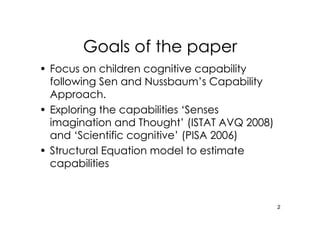
Goals of the paper
• Focus on children cognitive capability
  following Sen and Nussbaum’s Capability
  Approach.
• Exploring the capabilities ‘Senses
  imagination and Thought’ (ISTAT AVQ 2008)
  and ‘Scientific cognitive’ (PISA 2006)
• Structural Equation model to estimate
  capabilities


                                              2
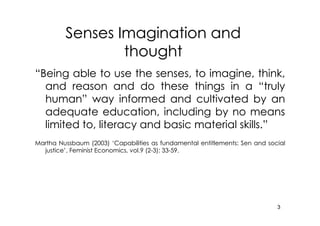
Senses Imagination and
                 thought
“Being able to use the senses, to imagine, think,
  and reason and do these things in a “truly
  human” way informed and cultivated by an
  adequate education, including by no means
  limited to, literacy and basic material skills.”
Martha Nussbaum (2003) ‘Capabilities as fundamental entitlements: Sen and social
  justice’, Feminist Economics, vol.9 (2-3): 33-59.
  justice’                      vol.9


                                                                             3
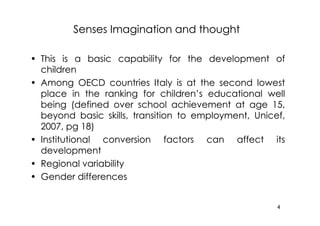
Senses Imagination and thought

• This is a basic capability for the development of
  children
• Among OECD countries Italy is at the second lowest
  place in the ranking for children’s educational well
  being (defined over school achievement at age 15,
  beyond basic skills, transition to employment, Unicef,
  2007, pg 18)
• Institutional conversion factors can affect its
  development
• Regional variability
• Gender differences


                                                      4
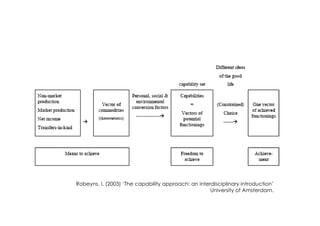
Robeyns, I. (2003) ‘The capability approach: an interdisciplinary introduction’
                                                     University of Amsterdam.
How to measure the
      development of capabilities
• Alkire S., Comim F., Qizilibash M, (eds), (2008) The capability approach:
  concepts, applications and measurement, Cambridge University Press.
• Anand, P., Hunter, G., Carter, I., Dowding, K., Guala, F. and Van Hees,
  M. (2005) “Measuring Human Capabilities”, Open discussion papers in
  economics, 53.

• Chiappero Martinetti, E. (2008) ‘Complexity and vagueness in the
  capability approach: strengths or weaknesses?’ in Alkire S., Comim F.,
  Qizilibash M, (eds), (2008) The capability approach: concepts,
  applications and measurement, Cambridge University Press.
• Di Tommaso, M.L. (2007) ‘Children’s capabilities: a structural equation
  models for India’, Journal of Socioeconomics, vol 36: 436-50.
• Krishnakumar, J. and Ballon, P. (2008). Estimating basic capabilities: a
  structural equation approach. World Development, vol. 36, No. 6, 992-
  1010.
• Kuklys, W. (ed.) (2005) Amartya Sen's Capability Approach: Theoretical
  Insights and Empirical Applications, Berlin, Springer Verlag.
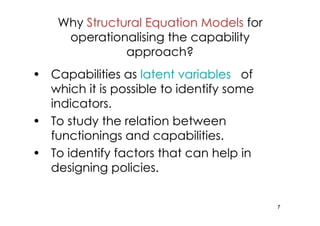
Why Structural Equation Models for
     operationalising the capability
               approach?
• Capabilities as latent variables of
  which it is possible to identify some
  indicators.
• To study the relation between
  functionings and capabilities.
• To identify factors that can help in
  designing policies.


                                          7
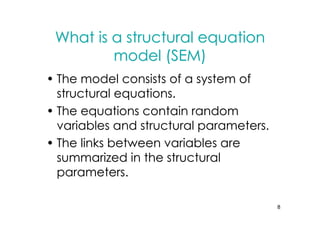
What is a structural equation
         model (SEM)
• The model consists of a system of
  structural equations.
• The equations contain random
  variables and structural parameters.
• The links between variables are
  summarized in the structural
  parameters.

                                         8
What is a structural equation
         model (SEM)
The model consists of two parts:
   Latent variable model: it includes the
   structural equations that summarize the
   relationships between latent variables.
   Measurement model: it includes the
   structural equations that represents the
   link between the latent and the
   observed indicators.


                                              9
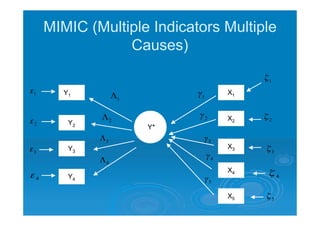
MIMIC (Multiple Indicators Multiple
                Causes)

                                                   1

1      Y1                                 1
                                              X1
                     1        1


                 2                2           X2   2
2       Y2
                         Y*
             3                        3
        Y3                                    X3
3                                                      3
                                      4
             4
                                              X4
4       Y4                                                 4
                                      5


                                              X5       5
Two different applications
• A wider focus on sense imagination
  and thought and its interaction with
  other capabilities
• A finer focus on scientific cognitive
  capability
A wider model
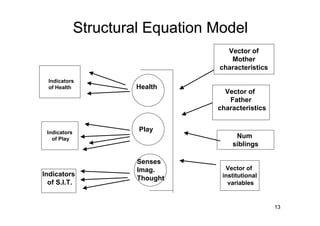
• We have estimated a more complex model for 3
  capabilities using the ISTAT Multipurpose Survey on
  Daily Life 2008.
• The Istat Multipurpose Survey provides information
  on: the household’s sociodemographic
  structure,indicators on health, education, leisure
  time, playing activities and interaction with relatives
  and friends of children aged less than 18.
Structural Equation Model
                                        Vector of
                                         Mother
                                      characteristics
  Indicators
  of Health            Health
                                        Vector of
                                         Father
                                      characteristics

                       Capabilities
 Indicators            Play
   of Play                                 Num
                                          siblings

                       Senses
                       Imag.            Vector of
Indicators                             institutional
                       Thought
  of S.I.T.                              variables


                                                        13
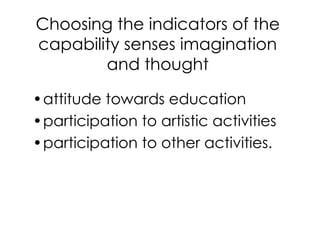
Choosing the indicators of the
capability senses imagination
        and thought

•attitude towards education
•participation to artistic activities
•participation to other activities.
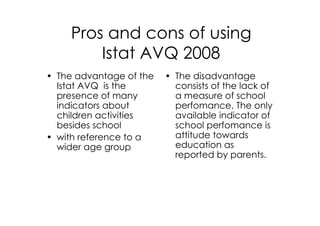
Pros and cons of using
         Istat AVQ 2008
• The advantage of the   • The disadvantage
  Istat AVQ is the         consists of the lack of
  presence of many         a measure of school
  indicators about         perfomance. The only
  children activities      available indicator of
  besides school           school perfomance is
• with reference to a      attitude towards
  wider age group          education as
                           reported by parents.
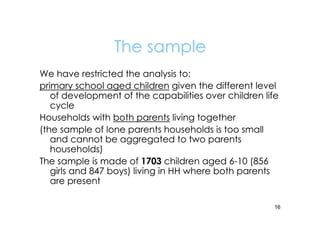
The sample
We have restricted the analysis to:
primary school aged children given the different level
   of development of the capabilities over children life
   cycle
Households with both parents living together
(the sample of lone parents households is too small
   and cannot be aggregated to two parents
   households)
The sample is made of 1703 children aged 6-10 (856
   girls and 847 boys) living in HH where both parents
   are present

                                                      16
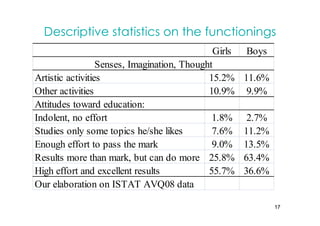
Descriptive statistics on the functionings
                                              Girls   Boys
                  Senses, Imagination, Thought
Artistic activities                          15.2%    11.6%
Other activities                             10.9%     9.9%
Attitudes toward education:
Indolent, no effort                           1.8%     2.7%
Studies only some topics he/she likes         7.6%    11.2%
Enough effort to pass the mark                9.0%    13.5%
Results more than mark, but can do more 25.8%         63.4%
High effort and excellent results            55.7%    36.6%
Our elaboration on ISTAT AVQ08 data

                                                              17
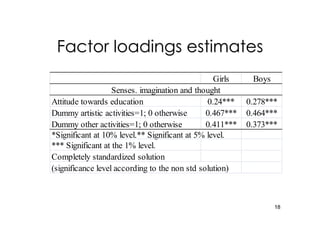
Factor loadings estimates
                                                 Girls     Boys
                   Senses. imagination and thought
Attitude towards education                     0.24***    0.278***
Dummy artistic activities=1; 0 otherwise       0.467***   0.464***
Dummy other activities=1; 0 otherwise          0.411***   0.373***
*Significant at 10% level.** Significant at 5% level.
*** Significant at the 1% level.
Completely standardized solution
(significance level according to the non std solution)


                                                                  18
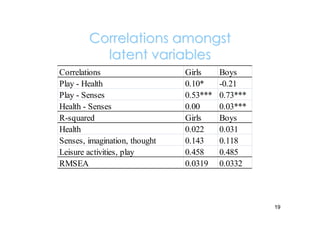
Correlations amongst
          latent variables
Correlations                   Girls     Boys
Play - Health                  0.10*     -0.21
Play - Senses                  0.53***   0.73***
Health - Senses                0.00      0.03***
R-squared                      Girls     Boys
Health                         0.022     0.031
Senses, imagination, thought   0.143     0.118
Leisure activities, play       0.458     0.485
RMSEA                          0.0319    0.0332


                                                   19
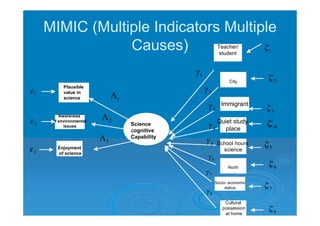
A finer focus on scientific
  cognitive capability
Data set
• PISA 2006: particular focus on science.
• It allows a better specification of the
  science cognitive capability
• We include in the definition of the
  science cognitive capability not only the
  plausible values for science tests but also
  awareness for environmental issues and
  enjoyment of science.
MIMIC (Multiple Indicators Multiple
                Causes)                                       Teacher/
                                                               student         1


                                                 1
                                                                    City           2
          Plausible
            Ccc
1         value in                                   2
          science               1
                                                                Immigrant
                                                         3                         3
        Awareness
     of environmental       2                              Quiet study
2         issues                    Science                                        4
                                    cognitive            4    place
                                    Capability
                        3                            5 School hours
       Enjoyment                                                 science       5
3      of science
                                                         6
                                                                   North           6
                                                     7
                                                             Socio- economic
                                                                  status       7
                                                     8

                                                                 Cultural
                                                                possession
                                                                 at home           8
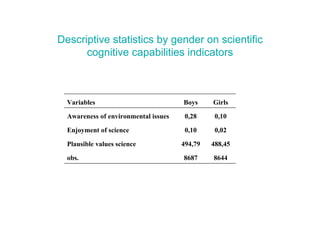
Descriptive statistics by gender on scientific
      cognitive capabilities indicators


  Variables                           Boys     Girls

  Awareness of environmental issues    0,28     0,10

  Enjoyment of science                 0,10     0,02

  Plausible values science            494,79   488,45

  obs.                                8687     8644
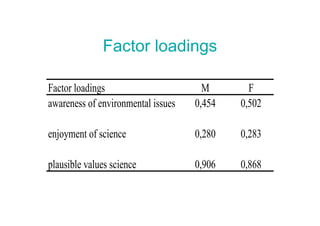
Factor loadings

Factor loadings                       M       F
awareness of environmental issues   0,454   0,502

enjoyment of science                0,280   0,283

plausible values science            0,906   0,868
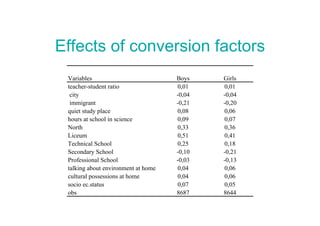
Effects of conversion factors
 Variables                           Boys    Girls
 teacher-student ratio               0,01    0,01
  city                               -0,04   -0,04
  immigrant                          -0,21   -0,20
 quiet study place                   0,08    0,06
 hours at school in science          0,09    0,07
 North                               0,33    0,36
 Liceum                              0,51    0,41
 Technical School                    0,25    0,18
 Secondary School                    -0,10   -0,21
 Professional School                 -0,03   -0,13
 talking about environment at home   0,04    0,06
 cultural possessions at home        0,04    0,06
 socio ec.status                     0,07    0,05
 obs                                 8687    8644
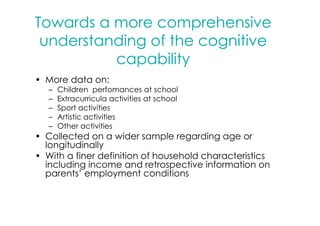
Towards a more comprehensive
 understanding of the cognitive
          capability
• More data on:
   –   Children perfomances at school
   –   Extracurricula activities at school
   –   Sport activities
   –   Artistic activities
   –   Other activities
• Collected on a wider sample regarding age or
  longitudinally
• With a finer definition of household characteristics
  including income and retrospective information on
  parents’ employment conditions
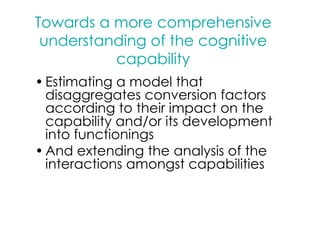
Towards a more comprehensive
 understanding of the cognitive
          capability
• Estimating a model that
  disaggregates conversion factors
  according to their impact on the
  capability and/or its development
  into functionings
• And extending the analysis of the
  interactions amongst capabilities

Human capital, gender and capabilities

  • 1.
    Human capital, genderand capabilities Tindara Addabbo*, Maria Laura Di Tommaso** e Anna Maccagnan* *Fondazione Marco Biagi - Università di Modena e Reggio Emilia **Università di Torino Human Capital: Definition and Measurement Istat, Rome 17 November 2010 1
  • 2.
    Goals of thepaper • Focus on children cognitive capability following Sen and Nussbaum’s Capability Approach. • Exploring the capabilities ‘Senses imagination and Thought’ (ISTAT AVQ 2008) and ‘Scientific cognitive’ (PISA 2006) • Structural Equation model to estimate capabilities 2
  • 3.
    Senses Imagination and thought “Being able to use the senses, to imagine, think, and reason and do these things in a “truly human” way informed and cultivated by an adequate education, including by no means limited to, literacy and basic material skills.” Martha Nussbaum (2003) ‘Capabilities as fundamental entitlements: Sen and social justice’, Feminist Economics, vol.9 (2-3): 33-59. justice’ vol.9 3
  • 4.
    Senses Imagination andthought • This is a basic capability for the development of children • Among OECD countries Italy is at the second lowest place in the ranking for children’s educational well being (defined over school achievement at age 15, beyond basic skills, transition to employment, Unicef, 2007, pg 18) • Institutional conversion factors can affect its development • Regional variability • Gender differences 4
  • 5.
    Robeyns, I. (2003)‘The capability approach: an interdisciplinary introduction’ University of Amsterdam.
  • 6.
    How to measurethe development of capabilities • Alkire S., Comim F., Qizilibash M, (eds), (2008) The capability approach: concepts, applications and measurement, Cambridge University Press. • Anand, P., Hunter, G., Carter, I., Dowding, K., Guala, F. and Van Hees, M. (2005) “Measuring Human Capabilities”, Open discussion papers in economics, 53. • Chiappero Martinetti, E. (2008) ‘Complexity and vagueness in the capability approach: strengths or weaknesses?’ in Alkire S., Comim F., Qizilibash M, (eds), (2008) The capability approach: concepts, applications and measurement, Cambridge University Press. • Di Tommaso, M.L. (2007) ‘Children’s capabilities: a structural equation models for India’, Journal of Socioeconomics, vol 36: 436-50. • Krishnakumar, J. and Ballon, P. (2008). Estimating basic capabilities: a structural equation approach. World Development, vol. 36, No. 6, 992- 1010. • Kuklys, W. (ed.) (2005) Amartya Sen's Capability Approach: Theoretical Insights and Empirical Applications, Berlin, Springer Verlag.
  • 7.
    Why Structural EquationModels for operationalising the capability approach? • Capabilities as latent variables of which it is possible to identify some indicators. • To study the relation between functionings and capabilities. • To identify factors that can help in designing policies. 7
  • 8.
    What is astructural equation model (SEM) • The model consists of a system of structural equations. • The equations contain random variables and structural parameters. • The links between variables are summarized in the structural parameters. 8
  • 9.
    What is astructural equation model (SEM) The model consists of two parts: Latent variable model: it includes the structural equations that summarize the relationships between latent variables. Measurement model: it includes the structural equations that represents the link between the latent and the observed indicators. 9
  • 10.
    MIMIC (Multiple IndicatorsMultiple Causes) 1 1 Y1 1 X1 1 1 2 2 X2 2 2 Y2 Y* 3 3 Y3 X3 3 3 4 4 X4 4 Y4 4 5 X5 5
  • 11.
    Two different applications •A wider focus on sense imagination and thought and its interaction with other capabilities • A finer focus on scientific cognitive capability
  • 12.
    A wider model •We have estimated a more complex model for 3 capabilities using the ISTAT Multipurpose Survey on Daily Life 2008. • The Istat Multipurpose Survey provides information on: the household’s sociodemographic structure,indicators on health, education, leisure time, playing activities and interaction with relatives and friends of children aged less than 18.
  • 13.
    Structural Equation Model Vector of Mother characteristics Indicators of Health Health Vector of Father characteristics Capabilities Indicators Play of Play Num siblings Senses Imag. Vector of Indicators institutional Thought of S.I.T. variables 13
  • 14.
    Choosing the indicatorsof the capability senses imagination and thought •attitude towards education •participation to artistic activities •participation to other activities.
  • 15.
    Pros and consof using Istat AVQ 2008 • The advantage of the • The disadvantage Istat AVQ is the consists of the lack of presence of many a measure of school indicators about perfomance. The only children activities available indicator of besides school school perfomance is • with reference to a attitude towards wider age group education as reported by parents.
  • 16.
    The sample We haverestricted the analysis to: primary school aged children given the different level of development of the capabilities over children life cycle Households with both parents living together (the sample of lone parents households is too small and cannot be aggregated to two parents households) The sample is made of 1703 children aged 6-10 (856 girls and 847 boys) living in HH where both parents are present 16
  • 17.
    Descriptive statistics onthe functionings Girls Boys Senses, Imagination, Thought Artistic activities 15.2% 11.6% Other activities 10.9% 9.9% Attitudes toward education: Indolent, no effort 1.8% 2.7% Studies only some topics he/she likes 7.6% 11.2% Enough effort to pass the mark 9.0% 13.5% Results more than mark, but can do more 25.8% 63.4% High effort and excellent results 55.7% 36.6% Our elaboration on ISTAT AVQ08 data 17
  • 18.
    Factor loadings estimates Girls Boys Senses. imagination and thought Attitude towards education 0.24*** 0.278*** Dummy artistic activities=1; 0 otherwise 0.467*** 0.464*** Dummy other activities=1; 0 otherwise 0.411*** 0.373*** *Significant at 10% level.** Significant at 5% level. *** Significant at the 1% level. Completely standardized solution (significance level according to the non std solution) 18
  • 19.
    Correlations amongst latent variables Correlations Girls Boys Play - Health 0.10* -0.21 Play - Senses 0.53*** 0.73*** Health - Senses 0.00 0.03*** R-squared Girls Boys Health 0.022 0.031 Senses, imagination, thought 0.143 0.118 Leisure activities, play 0.458 0.485 RMSEA 0.0319 0.0332 19
  • 20.
    A finer focuson scientific cognitive capability
  • 21.
    Data set • PISA2006: particular focus on science. • It allows a better specification of the science cognitive capability • We include in the definition of the science cognitive capability not only the plausible values for science tests but also awareness for environmental issues and enjoyment of science.
  • 22.
    MIMIC (Multiple IndicatorsMultiple Causes) Teacher/ student 1 1 City 2 Plausible Ccc 1 value in 2 science 1 Immigrant 3 3 Awareness of environmental 2 Quiet study 2 issues Science 4 cognitive 4 place Capability 3 5 School hours Enjoyment science 5 3 of science 6 North 6 7 Socio- economic status 7 8 Cultural possession at home 8
  • 23.
    Descriptive statistics bygender on scientific cognitive capabilities indicators Variables Boys Girls Awareness of environmental issues 0,28 0,10 Enjoyment of science 0,10 0,02 Plausible values science 494,79 488,45 obs. 8687 8644
  • 24.
    Factor loadings Factor loadings M F awareness of environmental issues 0,454 0,502 enjoyment of science 0,280 0,283 plausible values science 0,906 0,868
  • 25.
    Effects of conversionfactors Variables Boys Girls teacher-student ratio 0,01 0,01 city -0,04 -0,04 immigrant -0,21 -0,20 quiet study place 0,08 0,06 hours at school in science 0,09 0,07 North 0,33 0,36 Liceum 0,51 0,41 Technical School 0,25 0,18 Secondary School -0,10 -0,21 Professional School -0,03 -0,13 talking about environment at home 0,04 0,06 cultural possessions at home 0,04 0,06 socio ec.status 0,07 0,05 obs 8687 8644
  • 26.
    Towards a morecomprehensive understanding of the cognitive capability • More data on: – Children perfomances at school – Extracurricula activities at school – Sport activities – Artistic activities – Other activities • Collected on a wider sample regarding age or longitudinally • With a finer definition of household characteristics including income and retrospective information on parents’ employment conditions
  • 27.
    Towards a morecomprehensive understanding of the cognitive capability • Estimating a model that disaggregates conversion factors according to their impact on the capability and/or its development into functionings • And extending the analysis of the interactions amongst capabilities