METHODS OF RESEARCH
Parts of a Research Paper
 Chapter 1- THE PROBLEM AND REVIEW OF RELATED LITERATURE
 Review of Related Literature and Studies
 Conceptual/Theoretical Framework of the Study
 Statement of the Problem
 Significance of the Study
 Scope and Limitation of the Study
 Definition of Terms
Parts of a Research Paper
 CHAPTER 2 – METHODOLOGY
 Research Design
 Participants of the Study
 Instrumentation
 Data Gathering Procedure
 Data Analysis
 CHAPTER 3 – RESULT AND DISCUSSION
 [Headings are based on Research Questions]
 CHAPTER 4 – CONCLUSIONS AND RECOMMENDATIONS
 Summary of Findings
 Conclusions
 Recommendations
OBJECTIVES
 At the end of the session, the learner is expected to:
1. choose appropriate quantitative research design ;
2. differentiate between :
 Research method and research design;
 Population and sample;
 Probability and non-probability sampling;
3. present with accuracy written research
methodology ; and
4. describe sampling procedure and the sample .
DEEPENING IDEAS
Differences between:
Research design and Research method,
Population and Sample, and
Random and Non-random sampling
Research Methods
Content
Area
Researchable
Questions
Research
Design
Measurement
Methods
Sampling
Data
Collection
Statistical
Analysis
Report
Writing
?
Research Method (Labay, 2016)
 the generalized and established approach in tackling
the research problem
 focus on the step-by-step procedure of every research
process and how data will be gathered and analyzed
 answers the question “how” (it must to done? the data
be gathered?)
Research Design
 The research design is the plan, structure, and
strategy of investigations of answering the research
question and is the overall plan or blueprint the
researchers select to carry out their study.
Choosing
RESEARCH
DESIGNS
QUANTITATIVE METHODS OF RESEARCH
 These are non-experimental designs that involve studying
populations or universes based on the data gathered from
a sample drawn from them. The data are often gathered
using self-report methods, such as a questionnaire
completed by the study subjects.
Survey Research Designs
purpose is to describe existing
conditions, opinions, attitudes,
impressions, perceptions, and
description trending.
Descriptive Survey
Population census studies
Public Opinion surveys
Documentary Analysis
Test Score Analysis
Examples
 Corporate Social Responsibility of Saint Paul University
Philippines
Example
1. there is a possibility of low returns of questionnaire or
other instruments floated to generate data
2. there is a possibility that their assertions in the
questionnaire are not true or correct
3. there is a possibility that the instrument prepared by
the researcher maybe inadequate or insufficient to
gather data for the study.
Disadvantages of survey researches
 uses standardized instruments like mental ability test, stress and
personality questionnaire, morale and job satisfaction
standardized questionnaires and they have some established
norms.
Descriptive normative survey
 It is designed to discover the direction and magnitude of
relationships among variables in a particular population of
subjects.
 concerned with determining the extent of relationship existing
between variables
 the extent of relationship is determined by the magnitude of
coefficients
 Pearson r
Descriptive Correlational Survey
• Mathematics Anxiety and Academic Performance of Selected Freshmen
Students of St. Paul University, School Year 2016 – 2017.
Example
 It judges the goodness of an existing
program
 It is directed to whether or not a program
achieved its goal
 Its purpose is to find out whether set
criterion were met or not; to provide
ongoing feedback to people who are
responsible for carrying out a plan or a
program or to evaluate the effectiveness of
the outcome of the plan or program.
Descriptive Evaluative
Example
The Implementation of Spiral Approach in the Mathematics
Curriculum
The Implementation of 4 P’s in Enrile, Cagayan
19
 It is used to compare or contrast representative samples
from two or more groups of subjects in relation to certain
designated variables.
 compares the characteristics of groups according to some
selected variables since the main purpose is to determine
the difference without determining the cause
Descriptive Comparative
A national survey of attitudes towards “professionalism” among
graduates of baccalaureate and associate degree programs.
Example
I. Ex – Post facto Research Studies
- Same as causal comparative design.
- attempts to determine the possible reason or cause for
existing differences in the behavior of groups or individuals
- Falls under the category of comparative research.
21
Examples
Differences in hearing among smokers and nonsmokers.
22
 used to project the demands that will be made in the
future
 regression equations are formed and the probable
behavior of a variable can be projected
Trends and Projective Studies
• Forecasting Sales of Beverages in Tuguegarao City
• Determining Housing Projects by the Year 2019
Examples
Experimental Methods
of Research
 A method that uses the single-variable approach in
problem-solving, whether the experiment is carried on in
the laboratory, classroom or field, i.e., all other factors are
kept constant except a single factor called the variable,
which is manipulated in various ways in order to
determine the results of its functions.
Experimental Method
1. person – to – person matching - people
are selected on the basis of similar or
identical personal characteristics
2. matching groups – groups are paired
on a variable (ex. sex, age, etc)
3. ranking method – subjects for study are
ranked in some selected variables (ex.
achievement, socio – economic
variables, etc)
Matching Methods in an Experimental Design
1. PRE TEST – POST TEST CONTROL GROUP DESIGN
 Experimental group
experimental treatment
Pre test
Post test
 Control group
Pre test
Post test
PRE TEST – POST TEST CONTROL GROUP DESIGN
 In this design, subjects have been designed randomly to the
experimental or control group
 The experimental treatment is given only to those in the experimental
group, and the pre tests and post tests are those measurements of the
dependent variables that are made before and after the
experimental treatment is performed.
 All true experimental designs have subjects randomly assigned
groups, have an experimental treatment introduced to some of the
subjects and have the effects of the treatment observed.
2. AFTER / POST TEST ONLY CONTROL GROUP DESIGN
 Experimental group
experimental treatment
Post test
 Control group
Post test
2. AFTER / POST TEST ONLY CONTROL GROUP DESIGN
 This design is sometimes called after only control group
design.
 This is composed on two randomly assigned groups, but
neither of which is pretested or premeasured in “the
before” period of time.
 The independent variable is introduced into the
experimental group and withheld from the control group.
3. SOLOMON FOUR GROUP DESIGN
Experimental group I
experimental treatment
Pre test Post test
Control group I
Pre test Post test
Experimental group II
experimental treatment
Post test
Control group II
Post test
SOLOMON FOUR GROUP DESIGN
 This design employs two experimental groups and two control
groups. Initially, the investigator randomly assigns subjects to the
four groups. Those in the experimental group 1 are pretested
and are tested again after the treatment.
 Those in the experimental group 2 also receive the treatment but
are observed only after the treatment, but not before.
 Those in control group 1 are observed, on occasions 1 and 2, but
they are not given the experimental treatment.
 Those in control group 2 are observed only on the second
occasion without previous observation or treatment.
Pre – Experimental Design
- Pre-experimental designs are so named because they
follow basic experimental steps but fail to include a
control group. In other words, a single group is often
studied but no comparison between an equivalent non-
treatment group is made.
33
Pre – Experimental Design
Subdivisions:
- One shot case study/ single case study
- One group pretest – posttest design
- Static group comparison design
34
One shot case study/ single case study
• In single case study, that studies at once, following a
treatment or an agent presumed to cause change.
• Because the study design has a total absence of control, it
is considered to be little value as an experiment.
35
One group pretest – posttest design
Only one group is observed before and after the independent
variable is introduced.
36
Static group comparison design
• The static group that has experienced the independent
variable is compared with one that has not.
• Here the experimental group receives the independent
variable, but control group does not.
37
38
Quasi – Experimental
Research
QUASI EXPERIMENTAL DESIGN
 It is one with full experimental control, usually
randomization, is not possible.
Subdivisions:
 Non equivalent control group design or the four celled design
without use of randomization
 The time series quasi experimental design
 The multiple time series design
1. Non equivalent control group design or the four celled design
without use of randomization
 Experimental group ( not randomly selected)
experimental treatment
Pre test
Post test
 Control group ( not randomly selected)
Pre test
Post test
2. Time series experimental design
experimental treatment
Pre test 1 2 3 4 5 6 6 5 4 3
2 post test 1
The time series experiment design, a single group experiment comprises of
series of observations in the before time period to establish a baseline. The
experimental variable is then introduced, followed by another series of
observation to examine the effect of the independent variable.
3. Multiple time series design
 Experimental group
experimental matter
Pre test 1 2 3 4 5 6 6 5 4 3 2
post test 1
 Control group
Pre test 1 2 3 4 5 6 6 5 4 3 2 post test 1
Case Analysis [What’s my research design?]
A researcher wants to know why individuals in
Community A have a higher rate of a rare form of
cancer when compared to those living in Community B.
To find out the reasons or causes for the differences in
cancer rates in these two communities, the investigator
surveyed residents about their lifestyle, noted the types
of businesses that were present in the community and
searched medical records.
Case Analysis [What’s my research design?]
 An investigator wants to evaluate whether a new technique
to teach math to elementary school students is more effective
than the standard teaching method. the investigator divides
the class randomly (by chance) into two groups and calls
them "Group A" and "Group B." The students cannot choose
their own group. The random assignment process results in two
groups that should share equal characteristics at the
beginning of the experiment. In Group A, the teacher uses a
new teaching method to teach the math lesson. In Group B,
the teacher uses a standard teaching method to teach the
math lesson. The investigator compares test scores at the end
of the semester to evaluate the success of the new teaching
method compared to the standard teaching method.
Case Analysis [What’s my research design?]
 A fitness instructor wants to test the effectiveness of a
performance-enhancing herbal supplement on students in
her exercise class. To create experimental groups that are
similar at the beginning of the study, the students are
assigned into two groups at random (they can not choose
which group they are in). Students in both groups are given a
pill to take every day, but they do not know whether the pill is
a placebo (sugar pill) or the herbal supplement. The
instructor gives Group A the herbal supplement and Group B
receives the placebo (sugar pill). The students' fitness level is
compared before and after six weeks of consuming the
supplement or the sugar pill.
Population and Sample [Talisayon, 2017]
 Sample – a group from
which you collect
data; representative or
typical of a population
 Population – group to
which sample results
will be generalized
BASIC CONCEPTS IN SAMPLING
AND SAMPLING TECHNIQUES
SAMPLING TECHNIQUE
 The process which involves taking a part of a population,
making observation on this representatives and the
generalizing the findings to the bigger population (Zulueta
and Costales, 2003).
Session 3.50
TEACHING BASIC STATISTICS ….
Sampling
Process
Sample
Data
Universe
Inferences/Generalization
(Subject to Uncertainty)
INFERENTIAL STATISTICS
Session 3.51
TEACHING BASIC STATISTICS ….
WHY DO WE USE SAMPLES?
1. Reduced Cost
2. Greater Speed or Timeliness
3. Greater Scope
4. Convenience
Session 3.52
TEACHING BASIC STATISTICS ….
TWO TYPES OF SAMPLES
1. Probability sample
2. Non-probability sample
 Probability sampling – A method of sampling that utilizes
some form of random selection. In order to have a
random selection method, you must set up some
process or procedure that assures that the different units
in your population have equal probabilities of being
chosen.
Session 3.54
TEACHING BASIC STATISTICS ….
Samples are obtained using some objective
chance mechanism, thus involving
randomization.
They require the use of a sampling frame (a
list/map of all the sampling units in the
population).
PROBABILITY SAMPLES
Session 3.55
TEACHING BASIC STATISTICS ….
The probabilities of selection are known.
They are generally referred to as a random sample from a finite
population.
They allow drawing of (valid) generalizations about the
universe/population whose sampling error can be ascertained.
PROBABILITY SAMPLES
 Non – Probability sampling – A sampling technique
where the samples are gathered in a process that does
not give all the individuals in the population equal
chances of being selected.
Session 3.57
TEACHING BASIC STATISTICS ….
Samples are obtained haphazardly,
selected purposively or are taken as
volunteers.
The probabilities of selection are unknown.
NON-PROBABILITY SAMPLES
Session 3.58
TEACHING BASIC STATISTICS ….
BASIC SAMPLING TECHNIQUES
Simple Random Sampling
Stratified Random Sampling
Systematic Random Sampling
Cluster Sampling
Multi – Stage Sampling Slide No. 3.20
Session 3.59
TEACHING BASIC STATISTICS ….
SIMPLE RANDOM SAMPLING
Most basic method of drawing a probability
sample
Assigns equal probabilities of selection to each
possible sample
– the best-known and most widely used probability sample. It is a
method of selecting a sample from a universe such that each
member of the population has an equal chance of being
included in the sample.
 Lottery method
 Fish – bowl technique
 table of random numbers
Simple Random Sampling
Probability Sampling
Session 3.61
TEACHING BASIC STATISTICS ….
STRATIFIED RANDOM SAMPLING
The universe is divided into L mutually
exclusive sub-universes called strata.
Independent simple random samples are
obtained from each stratum.
 A stratum is defined as a sub – population and a strata
consists of two or more homogeneous population.
Steps:
1. construct the population of the participants and
determine the relevant strata.
2. Select the number using either proportional or equal
allocation
3. Choose the participants within each category
according to simple random sampling methods
Stratified Random Sampling
Probability Sampling
Session 3.63
TEACHING BASIC STATISTICS ….
ILLUSTRATION
C
D
B
A
B
Slide No. 3.13
Determining Adequate Sample
Size
Sampling Formula (Slovin’s)
N
n = -----------
1 + e2
N
Where n = sample size
N = population size
e = margin of error
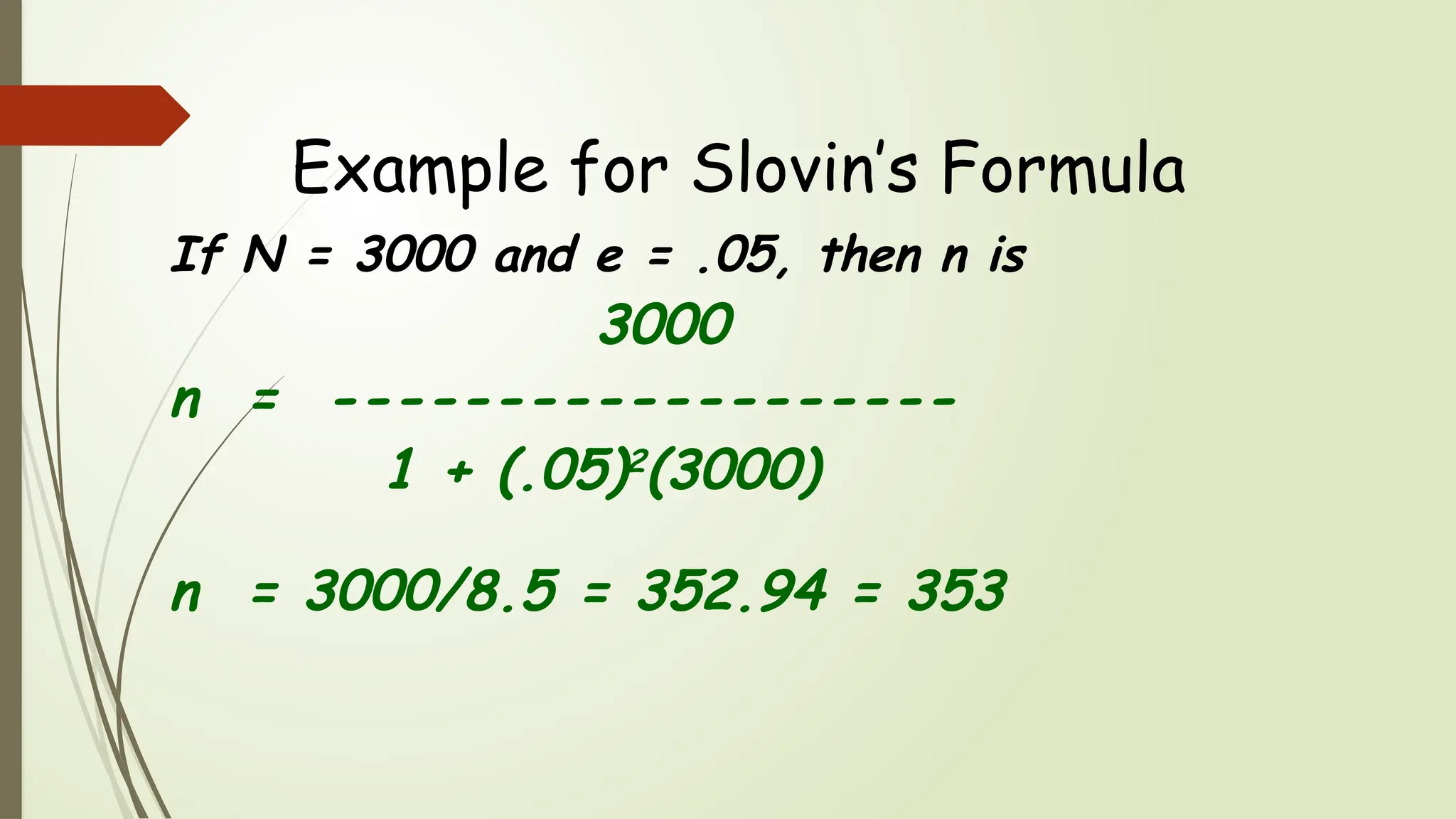
Example for Slovin’s Formula
If N = 3000 and e = .05, then n is
3000
n = -------------------
1 + (.05)2(3000)
n = 3000/8.5 = 352.94 = 353
Strata/Department Number of
respondents
Number of samples
Surgery 800 94
Medical 500 59
Pedia 1000 118
Obygyney 700 82
Total 3000 353
Session 3.68
TEACHING BASIC STATISTICS ….
Advantages of Stratification
1. It gives a better cross-section of the population.
2. It simplifies the administration of the survey/data gathering.
3. It allows one to draw inferences for various subdivisions of the population.
Session 3.69
TEACHING BASIC STATISTICS ….
SYSTEMATIC SAMPLING
Adopts a skipping pattern in the selection of sample units
Gives a better cross-section if the listing is linear in trend
but has high risk of bias if there is periodicity in the listing
of units in the sampling frame
Allows the simultaneous listing and selection of samples
in one operation
Session 3.70
TEACHING BASIC STATISTICS ….
Population
Systematic Sample
ILLUSTRATION
 used when large scale – survey is undertaken. Groups are
chosen and not individuals.
 Homogeneity is considered.
Cluster Sampling
Probability Sampling
Session 3.72
TEACHING BASIC STATISTICS ….
CLUSTER SAMPLING
It considers a universe divided into N mutually exclusive
sub-groups called clusters.
A random sample of n clusters is selected and their
elements are completely enumerated.
It has simpler frame requirements.
It is administratively convenient to implement.
Slide No. 3.19
Slide No. 3.11
Session 3.73
TEACHING BASIC STATISTICS ….
ILLUSTRATION
Population
Cluster Sample
Slide No. 3.18
– a method which is rarely used because of the
complexity of its strategy and it incurs a lot of effort, time
and expense.
Multi – Stage Sampling
Probability Sampling
Session 3.75
TEACHING BASIC STATISTICS ….
MULTI - STAGE SAMPLING
In the first stage, the units are grouped into N sub-groups, called
primary sampling units (psu’s) and a simple random sample of n
psu’s are selected.
Illustration:
A PRIMARY SAMPLING UNIT




Session 3.76
TEACHING BASIC STATISTICS ….
In the second stage, from each of the n psu’s selected with Mi
elements, simple random sample of mi units, called secondary
sampling units ssu’s, will be obtained.
Illustration:
A SECONDARY SAMPLING UNIT
SAMPLE
Types Non - Probability Sampling
Convenience sampling -used based on the convenience of the
researcher. This strategy allows the use of any available
group for the research activity
Example: To investigate the most popular noon time TV
program using telephone interview.
77
Purposive/judgemental sampling –sometimes called
deliberate sampling.The researcher relies on his judgment
as the criterion for the selection and does not use the
rules governing sampling techniques .
Example. To investigate the history of a certain place.
To investigate the effectiveness of a certain
shampoo.
78
Quota sampling – used for infinite population frames and
therefore, the researcher cannot get a random sample.
Like purposive sample, this is not a representative
sample.
Example: To investigate the DIP learning in SPUP. The
researcher will select say 50 participants in each
school/department as a quota.
79
FRIENDLY REMINDER
 REMEMBER: Start Small . . . No matter how
grandly you're planning.
 Great things always come from small
beginnings!
PONDER ON THIS:
Research Design for Chapter 2 for research purposes

Research Design for Chapter 2 for research purposes

  • 1.
  • 2.
    Parts of aResearch Paper  Chapter 1- THE PROBLEM AND REVIEW OF RELATED LITERATURE  Review of Related Literature and Studies  Conceptual/Theoretical Framework of the Study  Statement of the Problem  Significance of the Study  Scope and Limitation of the Study  Definition of Terms
  • 3.
    Parts of aResearch Paper  CHAPTER 2 – METHODOLOGY  Research Design  Participants of the Study  Instrumentation  Data Gathering Procedure  Data Analysis  CHAPTER 3 – RESULT AND DISCUSSION  [Headings are based on Research Questions]  CHAPTER 4 – CONCLUSIONS AND RECOMMENDATIONS  Summary of Findings  Conclusions  Recommendations
  • 4.
    OBJECTIVES  At theend of the session, the learner is expected to: 1. choose appropriate quantitative research design ; 2. differentiate between :  Research method and research design;  Population and sample;  Probability and non-probability sampling; 3. present with accuracy written research methodology ; and 4. describe sampling procedure and the sample .
  • 5.
    DEEPENING IDEAS Differences between: Researchdesign and Research method, Population and Sample, and Random and Non-random sampling
  • 6.
  • 7.
    Research Method (Labay,2016)  the generalized and established approach in tackling the research problem  focus on the step-by-step procedure of every research process and how data will be gathered and analyzed  answers the question “how” (it must to done? the data be gathered?)
  • 8.
    Research Design  Theresearch design is the plan, structure, and strategy of investigations of answering the research question and is the overall plan or blueprint the researchers select to carry out their study.
  • 9.
  • 10.
  • 11.
     These arenon-experimental designs that involve studying populations or universes based on the data gathered from a sample drawn from them. The data are often gathered using self-report methods, such as a questionnaire completed by the study subjects. Survey Research Designs
  • 12.
    purpose is todescribe existing conditions, opinions, attitudes, impressions, perceptions, and description trending. Descriptive Survey
  • 13.
    Population census studies PublicOpinion surveys Documentary Analysis Test Score Analysis Examples
  • 14.
     Corporate SocialResponsibility of Saint Paul University Philippines Example
  • 15.
    1. there isa possibility of low returns of questionnaire or other instruments floated to generate data 2. there is a possibility that their assertions in the questionnaire are not true or correct 3. there is a possibility that the instrument prepared by the researcher maybe inadequate or insufficient to gather data for the study. Disadvantages of survey researches
  • 16.
     uses standardizedinstruments like mental ability test, stress and personality questionnaire, morale and job satisfaction standardized questionnaires and they have some established norms. Descriptive normative survey
  • 17.
     It isdesigned to discover the direction and magnitude of relationships among variables in a particular population of subjects.  concerned with determining the extent of relationship existing between variables  the extent of relationship is determined by the magnitude of coefficients  Pearson r Descriptive Correlational Survey • Mathematics Anxiety and Academic Performance of Selected Freshmen Students of St. Paul University, School Year 2016 – 2017. Example
  • 18.
     It judgesthe goodness of an existing program  It is directed to whether or not a program achieved its goal  Its purpose is to find out whether set criterion were met or not; to provide ongoing feedback to people who are responsible for carrying out a plan or a program or to evaluate the effectiveness of the outcome of the plan or program. Descriptive Evaluative
  • 19.
    Example The Implementation ofSpiral Approach in the Mathematics Curriculum The Implementation of 4 P’s in Enrile, Cagayan 19
  • 20.
     It isused to compare or contrast representative samples from two or more groups of subjects in relation to certain designated variables.  compares the characteristics of groups according to some selected variables since the main purpose is to determine the difference without determining the cause Descriptive Comparative A national survey of attitudes towards “professionalism” among graduates of baccalaureate and associate degree programs. Example
  • 21.
    I. Ex –Post facto Research Studies - Same as causal comparative design. - attempts to determine the possible reason or cause for existing differences in the behavior of groups or individuals - Falls under the category of comparative research. 21
  • 22.
    Examples Differences in hearingamong smokers and nonsmokers. 22
  • 23.
     used toproject the demands that will be made in the future  regression equations are formed and the probable behavior of a variable can be projected Trends and Projective Studies • Forecasting Sales of Beverages in Tuguegarao City • Determining Housing Projects by the Year 2019 Examples
  • 24.
  • 25.
     A methodthat uses the single-variable approach in problem-solving, whether the experiment is carried on in the laboratory, classroom or field, i.e., all other factors are kept constant except a single factor called the variable, which is manipulated in various ways in order to determine the results of its functions. Experimental Method
  • 26.
    1. person –to – person matching - people are selected on the basis of similar or identical personal characteristics 2. matching groups – groups are paired on a variable (ex. sex, age, etc) 3. ranking method – subjects for study are ranked in some selected variables (ex. achievement, socio – economic variables, etc) Matching Methods in an Experimental Design
  • 27.
    1. PRE TEST– POST TEST CONTROL GROUP DESIGN  Experimental group experimental treatment Pre test Post test  Control group Pre test Post test
  • 28.
    PRE TEST –POST TEST CONTROL GROUP DESIGN  In this design, subjects have been designed randomly to the experimental or control group  The experimental treatment is given only to those in the experimental group, and the pre tests and post tests are those measurements of the dependent variables that are made before and after the experimental treatment is performed.  All true experimental designs have subjects randomly assigned groups, have an experimental treatment introduced to some of the subjects and have the effects of the treatment observed.
  • 29.
    2. AFTER /POST TEST ONLY CONTROL GROUP DESIGN  Experimental group experimental treatment Post test  Control group Post test
  • 30.
    2. AFTER /POST TEST ONLY CONTROL GROUP DESIGN  This design is sometimes called after only control group design.  This is composed on two randomly assigned groups, but neither of which is pretested or premeasured in “the before” period of time.  The independent variable is introduced into the experimental group and withheld from the control group.
  • 31.
    3. SOLOMON FOURGROUP DESIGN Experimental group I experimental treatment Pre test Post test Control group I Pre test Post test Experimental group II experimental treatment Post test Control group II Post test
  • 32.
    SOLOMON FOUR GROUPDESIGN  This design employs two experimental groups and two control groups. Initially, the investigator randomly assigns subjects to the four groups. Those in the experimental group 1 are pretested and are tested again after the treatment.  Those in the experimental group 2 also receive the treatment but are observed only after the treatment, but not before.  Those in control group 1 are observed, on occasions 1 and 2, but they are not given the experimental treatment.  Those in control group 2 are observed only on the second occasion without previous observation or treatment.
  • 33.
    Pre – ExperimentalDesign - Pre-experimental designs are so named because they follow basic experimental steps but fail to include a control group. In other words, a single group is often studied but no comparison between an equivalent non- treatment group is made. 33
  • 34.
    Pre – ExperimentalDesign Subdivisions: - One shot case study/ single case study - One group pretest – posttest design - Static group comparison design 34
  • 35.
    One shot casestudy/ single case study • In single case study, that studies at once, following a treatment or an agent presumed to cause change. • Because the study design has a total absence of control, it is considered to be little value as an experiment. 35
  • 36.
    One group pretest– posttest design Only one group is observed before and after the independent variable is introduced. 36
  • 37.
    Static group comparisondesign • The static group that has experienced the independent variable is compared with one that has not. • Here the experimental group receives the independent variable, but control group does not. 37
  • 38.
  • 39.
  • 40.
    QUASI EXPERIMENTAL DESIGN It is one with full experimental control, usually randomization, is not possible. Subdivisions:  Non equivalent control group design or the four celled design without use of randomization  The time series quasi experimental design  The multiple time series design
  • 41.
    1. Non equivalentcontrol group design or the four celled design without use of randomization  Experimental group ( not randomly selected) experimental treatment Pre test Post test  Control group ( not randomly selected) Pre test Post test
  • 42.
    2. Time seriesexperimental design experimental treatment Pre test 1 2 3 4 5 6 6 5 4 3 2 post test 1 The time series experiment design, a single group experiment comprises of series of observations in the before time period to establish a baseline. The experimental variable is then introduced, followed by another series of observation to examine the effect of the independent variable.
  • 43.
    3. Multiple timeseries design  Experimental group experimental matter Pre test 1 2 3 4 5 6 6 5 4 3 2 post test 1  Control group Pre test 1 2 3 4 5 6 6 5 4 3 2 post test 1
  • 44.
    Case Analysis [What’smy research design?] A researcher wants to know why individuals in Community A have a higher rate of a rare form of cancer when compared to those living in Community B. To find out the reasons or causes for the differences in cancer rates in these two communities, the investigator surveyed residents about their lifestyle, noted the types of businesses that were present in the community and searched medical records.
  • 45.
    Case Analysis [What’smy research design?]  An investigator wants to evaluate whether a new technique to teach math to elementary school students is more effective than the standard teaching method. the investigator divides the class randomly (by chance) into two groups and calls them "Group A" and "Group B." The students cannot choose their own group. The random assignment process results in two groups that should share equal characteristics at the beginning of the experiment. In Group A, the teacher uses a new teaching method to teach the math lesson. In Group B, the teacher uses a standard teaching method to teach the math lesson. The investigator compares test scores at the end of the semester to evaluate the success of the new teaching method compared to the standard teaching method.
  • 46.
    Case Analysis [What’smy research design?]  A fitness instructor wants to test the effectiveness of a performance-enhancing herbal supplement on students in her exercise class. To create experimental groups that are similar at the beginning of the study, the students are assigned into two groups at random (they can not choose which group they are in). Students in both groups are given a pill to take every day, but they do not know whether the pill is a placebo (sugar pill) or the herbal supplement. The instructor gives Group A the herbal supplement and Group B receives the placebo (sugar pill). The students' fitness level is compared before and after six weeks of consuming the supplement or the sugar pill.
  • 47.
    Population and Sample[Talisayon, 2017]  Sample – a group from which you collect data; representative or typical of a population  Population – group to which sample results will be generalized
  • 48.
    BASIC CONCEPTS INSAMPLING AND SAMPLING TECHNIQUES
  • 49.
    SAMPLING TECHNIQUE  Theprocess which involves taking a part of a population, making observation on this representatives and the generalizing the findings to the bigger population (Zulueta and Costales, 2003).
  • 50.
    Session 3.50 TEACHING BASICSTATISTICS …. Sampling Process Sample Data Universe Inferences/Generalization (Subject to Uncertainty) INFERENTIAL STATISTICS
  • 51.
    Session 3.51 TEACHING BASICSTATISTICS …. WHY DO WE USE SAMPLES? 1. Reduced Cost 2. Greater Speed or Timeliness 3. Greater Scope 4. Convenience
  • 52.
    Session 3.52 TEACHING BASICSTATISTICS …. TWO TYPES OF SAMPLES 1. Probability sample 2. Non-probability sample
  • 53.
     Probability sampling– A method of sampling that utilizes some form of random selection. In order to have a random selection method, you must set up some process or procedure that assures that the different units in your population have equal probabilities of being chosen.
  • 54.
    Session 3.54 TEACHING BASICSTATISTICS …. Samples are obtained using some objective chance mechanism, thus involving randomization. They require the use of a sampling frame (a list/map of all the sampling units in the population). PROBABILITY SAMPLES
  • 55.
    Session 3.55 TEACHING BASICSTATISTICS …. The probabilities of selection are known. They are generally referred to as a random sample from a finite population. They allow drawing of (valid) generalizations about the universe/population whose sampling error can be ascertained. PROBABILITY SAMPLES
  • 56.
     Non –Probability sampling – A sampling technique where the samples are gathered in a process that does not give all the individuals in the population equal chances of being selected.
  • 57.
    Session 3.57 TEACHING BASICSTATISTICS …. Samples are obtained haphazardly, selected purposively or are taken as volunteers. The probabilities of selection are unknown. NON-PROBABILITY SAMPLES
  • 58.
    Session 3.58 TEACHING BASICSTATISTICS …. BASIC SAMPLING TECHNIQUES Simple Random Sampling Stratified Random Sampling Systematic Random Sampling Cluster Sampling Multi – Stage Sampling Slide No. 3.20
  • 59.
    Session 3.59 TEACHING BASICSTATISTICS …. SIMPLE RANDOM SAMPLING Most basic method of drawing a probability sample Assigns equal probabilities of selection to each possible sample
  • 60.
    – the best-knownand most widely used probability sample. It is a method of selecting a sample from a universe such that each member of the population has an equal chance of being included in the sample.  Lottery method  Fish – bowl technique  table of random numbers Simple Random Sampling Probability Sampling
  • 61.
    Session 3.61 TEACHING BASICSTATISTICS …. STRATIFIED RANDOM SAMPLING The universe is divided into L mutually exclusive sub-universes called strata. Independent simple random samples are obtained from each stratum.
  • 62.
     A stratumis defined as a sub – population and a strata consists of two or more homogeneous population. Steps: 1. construct the population of the participants and determine the relevant strata. 2. Select the number using either proportional or equal allocation 3. Choose the participants within each category according to simple random sampling methods Stratified Random Sampling Probability Sampling
  • 63.
    Session 3.63 TEACHING BASICSTATISTICS …. ILLUSTRATION C D B A B Slide No. 3.13
  • 64.
  • 65.
    Sampling Formula (Slovin’s) N n= ----------- 1 + e2 N Where n = sample size N = population size e = margin of error
  • 66.
    Example for Slovin’sFormula If N = 3000 and e = .05, then n is 3000 n = ------------------- 1 + (.05)2(3000) n = 3000/8.5 = 352.94 = 353
  • 67.
    Strata/Department Number of respondents Numberof samples Surgery 800 94 Medical 500 59 Pedia 1000 118 Obygyney 700 82 Total 3000 353
  • 68.
    Session 3.68 TEACHING BASICSTATISTICS …. Advantages of Stratification 1. It gives a better cross-section of the population. 2. It simplifies the administration of the survey/data gathering. 3. It allows one to draw inferences for various subdivisions of the population.
  • 69.
    Session 3.69 TEACHING BASICSTATISTICS …. SYSTEMATIC SAMPLING Adopts a skipping pattern in the selection of sample units Gives a better cross-section if the listing is linear in trend but has high risk of bias if there is periodicity in the listing of units in the sampling frame Allows the simultaneous listing and selection of samples in one operation
  • 70.
    Session 3.70 TEACHING BASICSTATISTICS …. Population Systematic Sample ILLUSTRATION
  • 71.
     used whenlarge scale – survey is undertaken. Groups are chosen and not individuals.  Homogeneity is considered. Cluster Sampling Probability Sampling
  • 72.
    Session 3.72 TEACHING BASICSTATISTICS …. CLUSTER SAMPLING It considers a universe divided into N mutually exclusive sub-groups called clusters. A random sample of n clusters is selected and their elements are completely enumerated. It has simpler frame requirements. It is administratively convenient to implement. Slide No. 3.19 Slide No. 3.11
  • 73.
    Session 3.73 TEACHING BASICSTATISTICS …. ILLUSTRATION Population Cluster Sample Slide No. 3.18
  • 74.
    – a methodwhich is rarely used because of the complexity of its strategy and it incurs a lot of effort, time and expense. Multi – Stage Sampling Probability Sampling
  • 75.
    Session 3.75 TEACHING BASICSTATISTICS …. MULTI - STAGE SAMPLING In the first stage, the units are grouped into N sub-groups, called primary sampling units (psu’s) and a simple random sample of n psu’s are selected. Illustration: A PRIMARY SAMPLING UNIT    
  • 76.
    Session 3.76 TEACHING BASICSTATISTICS …. In the second stage, from each of the n psu’s selected with Mi elements, simple random sample of mi units, called secondary sampling units ssu’s, will be obtained. Illustration: A SECONDARY SAMPLING UNIT SAMPLE
  • 77.
    Types Non -Probability Sampling Convenience sampling -used based on the convenience of the researcher. This strategy allows the use of any available group for the research activity Example: To investigate the most popular noon time TV program using telephone interview. 77
  • 78.
    Purposive/judgemental sampling –sometimescalled deliberate sampling.The researcher relies on his judgment as the criterion for the selection and does not use the rules governing sampling techniques . Example. To investigate the history of a certain place. To investigate the effectiveness of a certain shampoo. 78
  • 79.
    Quota sampling –used for infinite population frames and therefore, the researcher cannot get a random sample. Like purposive sample, this is not a representative sample. Example: To investigate the DIP learning in SPUP. The researcher will select say 50 participants in each school/department as a quota. 79
  • 80.
    FRIENDLY REMINDER  REMEMBER:Start Small . . . No matter how grandly you're planning.  Great things always come from small beginnings! PONDER ON THIS:

Editor's Notes

  • #40 Randomization refers to the practice of using chance methods (random number tables, flipping a coin, etc.) to assign subjects to treatments. In this way, the potential effects of lurking variables are distributed at chance levels (hopefully roughly evenly) across treatment conditions.
  • #44 Causal comparative research design
  • #45 After/posttest control group design
  • #46 Pretest – posttest control group design