ANALYSING OBSERVATIONAL DATA
Wafa Iqbal roll number 06
• Qualitative data analysis is a search for general
statements about relationships and underlying
themes; it explores ,describes and builds
theory(Strauss & Corbin,1997).
• Description, analysis and interpretation are
bundled into generic term analysis
(Wolcott,1994).
GENERAL DATA ANALYSIS
QUALITATIVE DATA ANALYSIS
• Qualitative Data Analysis (QDA) creates new
understandings by exploring and interpreting
integrates the major themes complex data from:
• interviews
• group discussions
• observation
• journals
• archival documents, etc.
• without the aid of quantification.
Generating categories and themes
Assigning coding schemes to them
Things done while analyzing
GENERIC PROCESS OF DATA
ANALYSIS(steps)
• Organize and prepare the data for analysis which
involves transcribing audio data, optically
scanning material, typing up field notes, or
sorting and arranging the data into different
types according to the sources of information.
• Obtain a general sense of information by reading
all the data and to reflect on its overall meaning.
What general ideas are participants saying, the
tone of the ideas etc.
• Sometimes, qualitative researchers write notes in
margins which are analyzed in this step.
• Begin detailed analysis with a coding process. (Coding is
the process of organizing the material into chunks before
bringing meaning to the chunks. This involves taking text
data or pictures segmenting sentences or paragraphs or
images into categories and labeling those categories with
a term based in the actual language of the participants.
•Use the coding to generate the description of setting or
people then generate codes for this description. Then
use coding to generate themes or categories. Beyond
identifying themes interconnect them.
•Description and themes can be represented in the form
of narrative passage or visual figures or tables.
CODING
• Coding-a primary element in the process of
organizing and sorting data.
• Codes serve as a way to label, compile and
organize data and integrate major themes.
• They also allow the researcher to summarize
and synthesize what is happening in the data.
• while linking data collection and interpreting
the data, coding becomes the basis for
developing the analysis.
CODING
• Coding can be done in any number of ways,
e.g. assigning a word, phrase, number, symbol
or color to each coding category.
• Coding can also be done by color coding
different categories on transcript and field
notes or cut text segments and place them on
note cards.
• It uses labels to classify and assign meaning to
pieces of information.
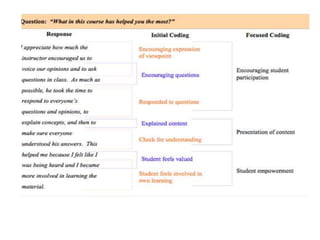
• 1. Initial coding-It’s usually best to start by
generating numerous codes as you read
through responses, identifying data that are
related.
• 2. Focused coding-After initial coding, it is
helpful to review codes and eliminate less
useful ones, combine smaller categories into
larger ones, or if a very large number of
responses have been assigned the same code,
subdivide that category.
coding
8 steps of analysis by Tesch
• Read all the recoded and collected data and
jot down ideas that come to your mind.
• Pick one checklist and think about its
underlying meanings which should be written
in the margin.
• Make a list of relevant data and assign them a
topic. Cluster the similar topics together. Form
them into columns as major or unique
leftover topics etc.
• Abbreviate the topics as codes. See if new
categories emerge.
• Turn the topics into categories and reduce the
total list of categories by grouping the relevant
topics together. Assemble the data material
belonging to each category in one place.
Developing themes-part of analyses
Analyzing the text involves complex task of
discovering themes and subthemes.
• Describing the core and peripheral elements
of themes.
• Building hierarchies of themes or codebooks.
• applying themes i.e. attaching them to chunks
of actual text.
• Linking themes into theoretical models.
Definition of Themes
• Limited number of dynamic affirmations are
called themes which control behavior or
stimulate activity.
Where do themes come from?
• From data(inductive approach).
• From prior theoretical understanding of whatever
phenomenon we are studying.(deductive
approach).
• From characteristics of phenomenon under
study(essance).
• From already agreed upon professional
definitions found in literature review or in local
common sense constructs and from researcher’s
values.
• Rich sources of themes comes from questions
like what topics to cover and how best to
query people.
• The act of discovering themes is called open
coding by grounded theorists and latent
coding or qualitative analysis by content
analyists.
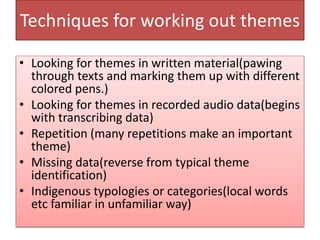
Techniques for working out themes
• Looking for themes in written material(pawing
through texts and marking them up with different
colored pens.)
• Looking for themes in recorded audio data(begins
with transcribing data)
• Repetition (many repetitions make an important
theme)
• Missing data(reverse from typical theme
identification)
• Indigenous typologies or categories(local words
etc familiar in unfamiliar way)
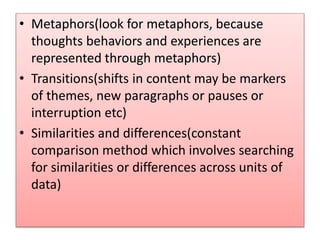
• Metaphors(look for metaphors, because
thoughts behaviors and experiences are
represented through metaphors)
• Transitions(shifts in content may be markers
of themes, new paragraphs or pauses or
interruption etc)
• Similarities and differences(constant
comparison method which involves searching
for similarities or differences across units of
data)
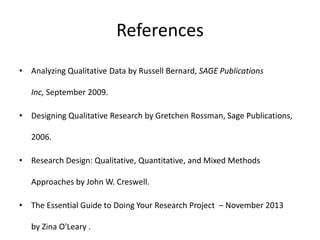
References
• Analyzing Qualitative Data by Russell Bernard, SAGE Publications
Inc, September 2009.
• Designing Qualitative Research by Gretchen Rossman, Sage Publications,
2006.
• Research Design: Qualitative, Quantitative, and Mixed Methods
Approaches by John W. Creswell.
• The Essential Guide to Doing Your Research Project – November 2013
by Zina O'Leary .

Analyzing observational data during qualitative research

  • 1.
  • 2.
    • Qualitative dataanalysis is a search for general statements about relationships and underlying themes; it explores ,describes and builds theory(Strauss & Corbin,1997). • Description, analysis and interpretation are bundled into generic term analysis (Wolcott,1994). GENERAL DATA ANALYSIS
  • 3.
    QUALITATIVE DATA ANALYSIS •Qualitative Data Analysis (QDA) creates new understandings by exploring and interpreting integrates the major themes complex data from: • interviews • group discussions • observation • journals • archival documents, etc. • without the aid of quantification.
  • 4.
    Generating categories andthemes Assigning coding schemes to them Things done while analyzing
  • 5.
    GENERIC PROCESS OFDATA ANALYSIS(steps) • Organize and prepare the data for analysis which involves transcribing audio data, optically scanning material, typing up field notes, or sorting and arranging the data into different types according to the sources of information. • Obtain a general sense of information by reading all the data and to reflect on its overall meaning. What general ideas are participants saying, the tone of the ideas etc. • Sometimes, qualitative researchers write notes in margins which are analyzed in this step.
  • 6.
    • Begin detailedanalysis with a coding process. (Coding is the process of organizing the material into chunks before bringing meaning to the chunks. This involves taking text data or pictures segmenting sentences or paragraphs or images into categories and labeling those categories with a term based in the actual language of the participants. •Use the coding to generate the description of setting or people then generate codes for this description. Then use coding to generate themes or categories. Beyond identifying themes interconnect them. •Description and themes can be represented in the form of narrative passage or visual figures or tables.
  • 7.
    CODING • Coding-a primaryelement in the process of organizing and sorting data. • Codes serve as a way to label, compile and organize data and integrate major themes. • They also allow the researcher to summarize and synthesize what is happening in the data. • while linking data collection and interpreting the data, coding becomes the basis for developing the analysis.
  • 8.
    CODING • Coding canbe done in any number of ways, e.g. assigning a word, phrase, number, symbol or color to each coding category. • Coding can also be done by color coding different categories on transcript and field notes or cut text segments and place them on note cards. • It uses labels to classify and assign meaning to pieces of information.
  • 9.
    • 1. Initialcoding-It’s usually best to start by generating numerous codes as you read through responses, identifying data that are related. • 2. Focused coding-After initial coding, it is helpful to review codes and eliminate less useful ones, combine smaller categories into larger ones, or if a very large number of responses have been assigned the same code, subdivide that category.
  • 10.
  • 11.
    8 steps ofanalysis by Tesch • Read all the recoded and collected data and jot down ideas that come to your mind. • Pick one checklist and think about its underlying meanings which should be written in the margin. • Make a list of relevant data and assign them a topic. Cluster the similar topics together. Form them into columns as major or unique leftover topics etc.
  • 12.
    • Abbreviate thetopics as codes. See if new categories emerge. • Turn the topics into categories and reduce the total list of categories by grouping the relevant topics together. Assemble the data material belonging to each category in one place.
  • 13.
    Developing themes-part ofanalyses Analyzing the text involves complex task of discovering themes and subthemes. • Describing the core and peripheral elements of themes. • Building hierarchies of themes or codebooks. • applying themes i.e. attaching them to chunks of actual text. • Linking themes into theoretical models.
  • 14.
    Definition of Themes •Limited number of dynamic affirmations are called themes which control behavior or stimulate activity.
  • 15.
    Where do themescome from? • From data(inductive approach). • From prior theoretical understanding of whatever phenomenon we are studying.(deductive approach). • From characteristics of phenomenon under study(essance). • From already agreed upon professional definitions found in literature review or in local common sense constructs and from researcher’s values.
  • 16.
    • Rich sourcesof themes comes from questions like what topics to cover and how best to query people. • The act of discovering themes is called open coding by grounded theorists and latent coding or qualitative analysis by content analyists.
  • 17.
    Techniques for workingout themes • Looking for themes in written material(pawing through texts and marking them up with different colored pens.) • Looking for themes in recorded audio data(begins with transcribing data) • Repetition (many repetitions make an important theme) • Missing data(reverse from typical theme identification) • Indigenous typologies or categories(local words etc familiar in unfamiliar way)
  • 18.
    • Metaphors(look formetaphors, because thoughts behaviors and experiences are represented through metaphors) • Transitions(shifts in content may be markers of themes, new paragraphs or pauses or interruption etc) • Similarities and differences(constant comparison method which involves searching for similarities or differences across units of data)
  • 19.
    References • Analyzing QualitativeData by Russell Bernard, SAGE Publications Inc, September 2009. • Designing Qualitative Research by Gretchen Rossman, Sage Publications, 2006. • Research Design: Qualitative, Quantitative, and Mixed Methods Approaches by John W. Creswell. • The Essential Guide to Doing Your Research Project – November 2013 by Zina O'Leary .