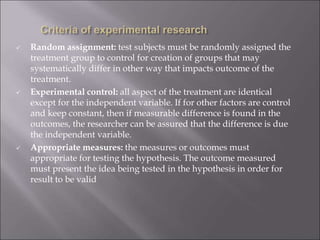
Experimental research involves comparing two groups - a treatment group that receives an intervention and a control group that does not - to test a hypothesis about causation. For example, a study may give a new medication to one group and a placebo to another to see if the medication reduces headaches. Proper experimental design includes randomly assigning subjects to groups, controlling all variables except the intervention, and using appropriate outcome measures. Key aspects of experimental research include identifying independent and dependent variables, establishing experimental and control groups, using random assignment, maintaining experimental control, and selecting appropriate measures. Experimental research provides a systematic way to test hypotheses about causal effects.