MOTHERBOARD 
Created By: Rahul Yadav
Content 
Brief view 
Introduction 
It’s Architecture 
Main Components of Motherboard
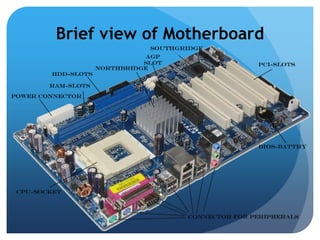
Brief view of Motherboard
What is a Motherboard ? 
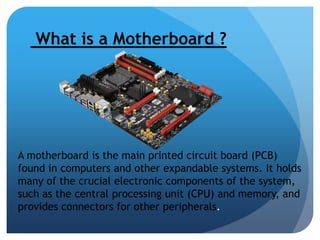
A motherboard is the main printed circuit board (PCB) 
found in computers and other expandable systems. It holds 
many of the crucial electronic components of the system, 
such as the central processing unit (CPU) and memory, and 
provides connectors for other peripherals.
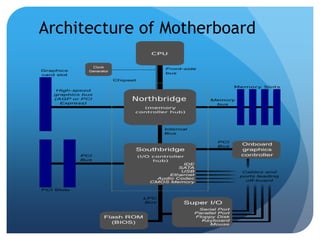
Architecture of Motherboard
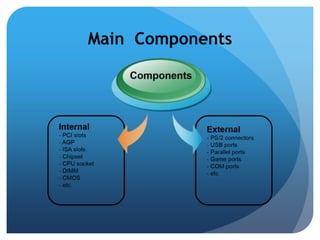
Main Components
CPU SOCKET 
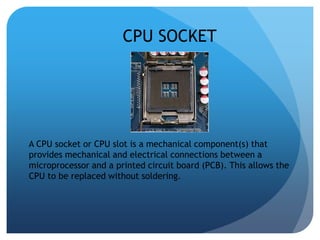
A CPU socket or CPU slot is a mechanical component(s) that 
provides mechanical and electrical connections between a 
microprocessor and a printed circuit board (PCB). This allows the 
CPU to be replaced without soldering.
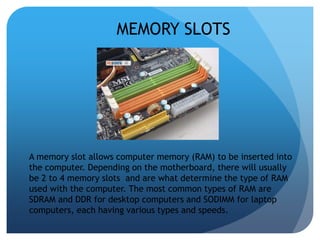
MEMORY SLOTS 
A memory slot allows computer memory (RAM) to be inserted into 
the computer. Depending on the motherboard, there will usually 
be 2 to 4 memory slots and are what determine the type of RAM 
used with the computer. The most common types of RAM are 
SDRAM and DDR for desktop computers and SODIMM for laptop 
computers, each having various types and speeds.
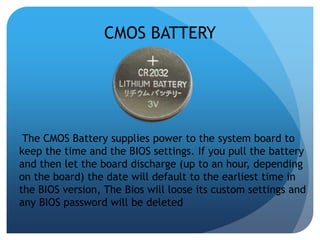
CMOS BATTERY 
The CMOS Battery supplies power to the system board to 
keep the time and the BIOS settings. If you pull the battery 
and then let the board discharge (up to an hour, depending 
on the board) the date will default to the earliest time in 
the BIOS version, The Bios will loose its custom settings and 
any BIOS password will be deleted
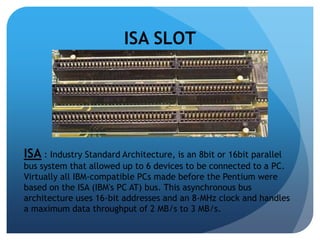
ISA SLOT 
ISA : Industry Standard Architecture, is an 8bit or 16bit parallel 
bus system that allowed up to 6 devices to be connected to a PC. 
Virtually all IBM-compatible PCs made before the Pentium were 
based on the ISA (IBM's PC AT) bus. This asynchronous bus 
architecture uses 16-bit addresses and an 8-MHz clock and handles 
a maximum data throughput of 2 MB/s to 3 MB/s.
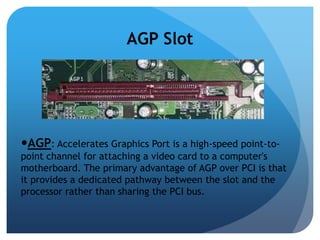
AGP Slot 
AGP: Accelerates Graphics Port is a high-speed point-to-point 
channel for attaching a video card to a computer's 
motherboard. The primary advantage of AGP over PCI is that 
it provides a dedicated pathway between the slot and the 
processor rather than sharing the PCI bus.
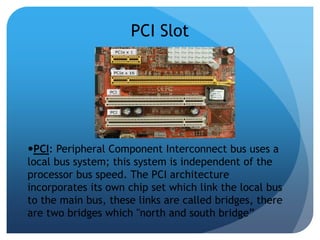
PCI Slot 
PCI: Peripheral Component Interconnect bus uses a 
local bus system; this system is independent of the 
processor bus speed. The PCI architecture 
incorporates its own chip set which link the local bus 
to the main bus, these links are called bridges, there 
are two bridges which "north and south bridge”
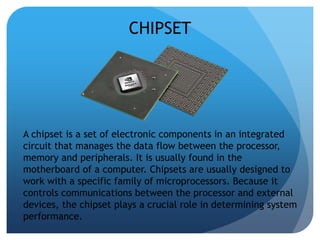
CHIPSET 
A chipset is a set of electronic components in an integrated 
circuit that manages the data flow between the processor, 
memory and peripherals. It is usually found in the 
motherboard of a computer. Chipsets are usually designed to 
work with a specific family of microprocessors. Because it 
controls communications between the processor and external 
devices, the chipset plays a crucial role in determining system 
performance.
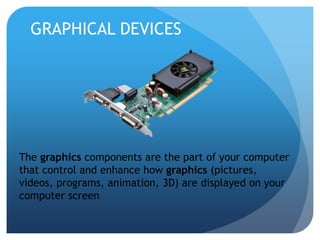
GRAPHICAL DEVICES 
The graphics components are the part of your computer 
that control and enhance how graphics (pictures, 
videos, programs, animation, 3D) are displayed on your 
computer screen
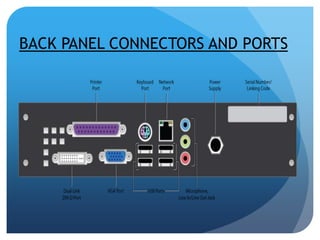
BACK PANEL CONNECTORS AND PORTS
Reffrences 
http://en.wikipedia.com/wiki/Mainboard 
http://www.pantherproducts.co.uk 
Computer Organization and Architecture By William Stallings 
And many other sources
Q & A 
If you have any questions, please don’t 
hesitate to ask me. We’ll be willing to 
answer them.
Thank You

Motherboard arch. & component

  • 1.
  • 2.
    Content Brief view Introduction It’s Architecture Main Components of Motherboard
  • 3.
    Brief view ofMotherboard
  • 4.
    What is aMotherboard ? A motherboard is the main printed circuit board (PCB) found in computers and other expandable systems. It holds many of the crucial electronic components of the system, such as the central processing unit (CPU) and memory, and provides connectors for other peripherals.
  • 5.
  • 6.
  • 7.
    CPU SOCKET ACPU socket or CPU slot is a mechanical component(s) that provides mechanical and electrical connections between a microprocessor and a printed circuit board (PCB). This allows the CPU to be replaced without soldering.
  • 8.
    MEMORY SLOTS Amemory slot allows computer memory (RAM) to be inserted into the computer. Depending on the motherboard, there will usually be 2 to 4 memory slots and are what determine the type of RAM used with the computer. The most common types of RAM are SDRAM and DDR for desktop computers and SODIMM for laptop computers, each having various types and speeds.
  • 9.
    CMOS BATTERY TheCMOS Battery supplies power to the system board to keep the time and the BIOS settings. If you pull the battery and then let the board discharge (up to an hour, depending on the board) the date will default to the earliest time in the BIOS version, The Bios will loose its custom settings and any BIOS password will be deleted
  • 10.
    ISA SLOT ISA: Industry Standard Architecture, is an 8bit or 16bit parallel bus system that allowed up to 6 devices to be connected to a PC. Virtually all IBM-compatible PCs made before the Pentium were based on the ISA (IBM's PC AT) bus. This asynchronous bus architecture uses 16-bit addresses and an 8-MHz clock and handles a maximum data throughput of 2 MB/s to 3 MB/s.
  • 11.
    AGP Slot AGP:Accelerates Graphics Port is a high-speed point-to-point channel for attaching a video card to a computer's motherboard. The primary advantage of AGP over PCI is that it provides a dedicated pathway between the slot and the processor rather than sharing the PCI bus.
  • 12.
    PCI Slot PCI:Peripheral Component Interconnect bus uses a local bus system; this system is independent of the processor bus speed. The PCI architecture incorporates its own chip set which link the local bus to the main bus, these links are called bridges, there are two bridges which "north and south bridge”
  • 13.
    CHIPSET A chipsetis a set of electronic components in an integrated circuit that manages the data flow between the processor, memory and peripherals. It is usually found in the motherboard of a computer. Chipsets are usually designed to work with a specific family of microprocessors. Because it controls communications between the processor and external devices, the chipset plays a crucial role in determining system performance.
  • 14.
    GRAPHICAL DEVICES Thegraphics components are the part of your computer that control and enhance how graphics (pictures, videos, programs, animation, 3D) are displayed on your computer screen
  • 15.
  • 16.
    Reffrences http://en.wikipedia.com/wiki/Mainboard http://www.pantherproducts.co.uk Computer Organization and Architecture By William Stallings And many other sources
  • 17.
    Q & A If you have any questions, please don’t hesitate to ask me. We’ll be willing to answer them.
  • 18.

Editor's Notes