Expanding Scope of Influence Some lecture content courtesy of
Influence is changing Rise of user-generated content YouTube Flickr MySpace Facebook
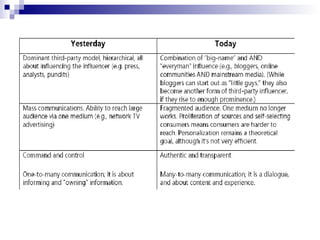
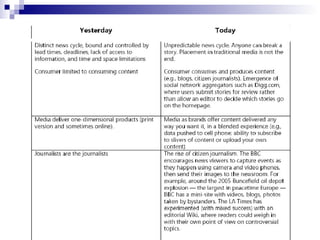
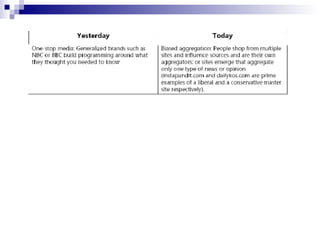
Media Power Shift “Circle of influence” is bigger and more diverse OLD: Discrete and formal “Media gatekeepers” NEW: Open and casual “Citizen-created media”
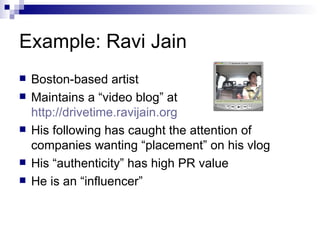
Example: Ravi Jain Boston-based artist Maintains a “video blog” at  http://drivetime.ravijain.org His following has caught the attention of companies wanting “placement” on his vlog His “authenticity” has high PR value He is an “influencer”
OLD vs. NEW “Influencers” OLD: “Gatekeepers” were fairly predictable in how they would treat a news development NEW: Unpredictability of the blogosphere This is both an opportunity and a burden for those in PR
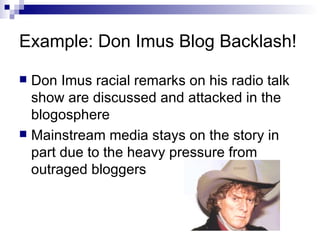
Example: Don Imus Blog Backlash! Don Imus racial remarks on his radio talk show are discussed and attacked in the blogosphere Mainstream media stays on the story in part due to the heavy pressure from outraged bloggers
Example: “Impossible is Nothing” Small events that might normally be overlooked by mainstream media are getting massive attention via the Web Example:  “Impossible is Nothing”  video resume
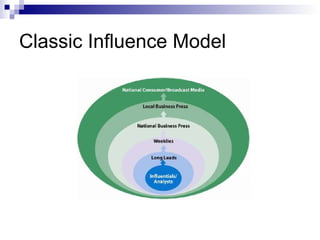
Classic Influence Model
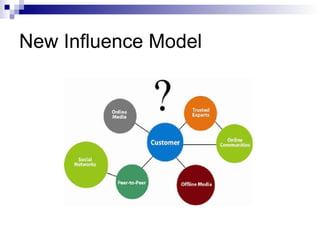
New Influence Model
Today’s Reality Today a blend of both traditional and new influencers rule OLD: Mainstream media, government officials, industry or financial analysts OLD AND NEW: Friends and family (now via online sources) NEW: Like-minded bloggers and media outlets
Less Control PR messengers now have less control as a result of the “new influencers”
Media Consumption Changes Traditional news consumption is declining Blogs and online media increasing
Recent data 54% of U.S. adults read a newspaper this week (62% read the Sunday edition) For 18-24 year-olds, the number drops to 42% Three major U.S. TV nightly newscasts have declined by 59& since 1969. Many are scaling back their operations.
Rise of Blogs The number of blogs doubled this year Technorati periodically issues a list of the most influential bloggers as part of its “State of the Blogosphere” report
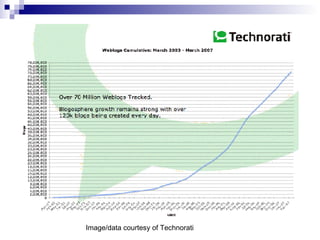
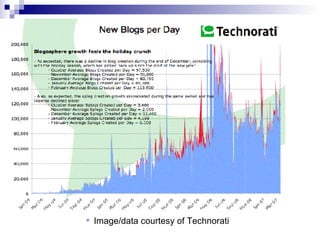
State of the Blogosphere Technorati is now tracking over 70 million weblogs, and we're seeing about 120,000 new weblogs being created worldwide each day.  That's about 1.4 blogs created every second of every day.
Image/data courtesy of Technorati
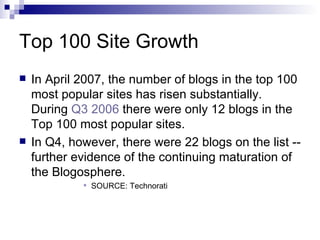
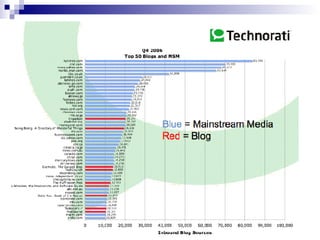
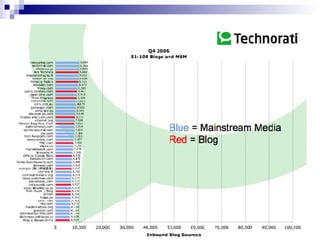
Top 100 Site Growth In April 2007, the number of blogs in the top 100 most popular sites has risen substantially. During  Q3 2006  there were only 12 blogs in the Top 100 most popular sites.  In Q4, however, there were 22 blogs on the list -- further evidence of the continuing maturation of the Blogosphere. SOURCE: Technorati
 
 
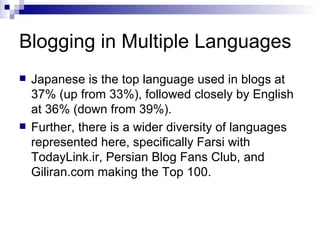
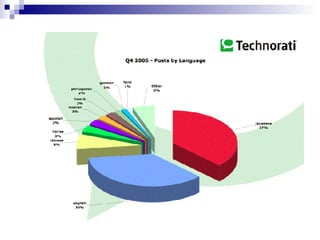
Blogging in Multiple Languages Japanese is the top language used in blogs at 37% (up from 33%), followed closely by English at 36% (down from 39%).  Further, there is a wider diversity of languages represented here, specifically Farsi with TodayLink.ir, Persian Blog Fans Club, and Giliran.com making the Top 100.
 
“ The Millennials” “ Millennials” are those born between 1980 and 2000 Many are creating their own news or leading “news free” lives They select the influence “bits” they want and eliminate/filter out those they don’t want
Time-Shifting Unlike previous generations, the “millennials” are used to “time-shifting” technologies that allow them to consume media in either “real-time” or on-demand
The New “Influencers” Anyone with an online presence can “break” the news Examples: Spyware on Sony-distributed CDs How to pick a lock Dan Rather’s reporting under attack
Faster Pace The pace of news is speeding up News outlets post news immediately, rather than waiting for the print edition or telecast  Consumer demand for immediacy
“Real-time PR” PR communicators are now spending more time in execution and less time in planning PR industry must join the “virtual campfire” to exchange discussion and ideas Some positive, some critical


Where to Start? Companies can take advantage of real-time technologies to communicate to media, customers, employees, partners, consumers and other publics
Audience-Centricity Learn about your audience If you want to influence “me,” then learn about “me.” Don’t assume a third-party gatekeeper can serve as a proxy for me Example: Think beyond relaying your message through the mainstream media
Hyperintegrated Communications Mix up your strategy among multiple media outlets Example: Web site promoted on TV spot
Converse with the Consumer Two-way communication rules Examples: Microsoft’s Channel 9 Audioworld.com
Tell your own story How your company chooses to tell its story can be a powerful form of influence Example: Microsoft XBOX 360 crisis response Facilitate the conversation, but involve the consumers in the communication
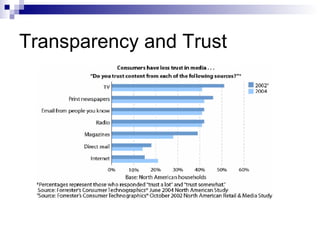
Transparency and Trust

Expanding Scope of Influence

  • 1.
    Expanding Scope ofInfluence Some lecture content courtesy of
  • 2.
    Influence is changingRise of user-generated content YouTube Flickr MySpace Facebook
  • 3.
    Media Power Shift“Circle of influence” is bigger and more diverse OLD: Discrete and formal “Media gatekeepers” NEW: Open and casual “Citizen-created media”
  • 4.
    Example: Ravi JainBoston-based artist Maintains a “video blog” at http://drivetime.ravijain.org His following has caught the attention of companies wanting “placement” on his vlog His “authenticity” has high PR value He is an “influencer”
  • 5.
    OLD vs. NEW“Influencers” OLD: “Gatekeepers” were fairly predictable in how they would treat a news development NEW: Unpredictability of the blogosphere This is both an opportunity and a burden for those in PR
  • 6.
    Example: Don ImusBlog Backlash! Don Imus racial remarks on his radio talk show are discussed and attacked in the blogosphere Mainstream media stays on the story in part due to the heavy pressure from outraged bloggers
  • 7.
    Example: “Impossible isNothing” Small events that might normally be overlooked by mainstream media are getting massive attention via the Web Example: “Impossible is Nothing” video resume
  • 8.
  • 9.
  • 10.
    Today’s Reality Todaya blend of both traditional and new influencers rule OLD: Mainstream media, government officials, industry or financial analysts OLD AND NEW: Friends and family (now via online sources) NEW: Like-minded bloggers and media outlets
  • 11.
    Less Control PRmessengers now have less control as a result of the “new influencers”
  • 12.
    Media Consumption ChangesTraditional news consumption is declining Blogs and online media increasing
  • 13.
    Recent data 54%of U.S. adults read a newspaper this week (62% read the Sunday edition) For 18-24 year-olds, the number drops to 42% Three major U.S. TV nightly newscasts have declined by 59& since 1969. Many are scaling back their operations.
  • 14.
    Rise of BlogsThe number of blogs doubled this year Technorati periodically issues a list of the most influential bloggers as part of its “State of the Blogosphere” report
  • 15.
    State of theBlogosphere Technorati is now tracking over 70 million weblogs, and we're seeing about 120,000 new weblogs being created worldwide each day. That's about 1.4 blogs created every second of every day.
  • 16.
  • 17.
  • 18.
    Top 100 SiteGrowth In April 2007, the number of blogs in the top 100 most popular sites has risen substantially. During Q3 2006 there were only 12 blogs in the Top 100 most popular sites. In Q4, however, there were 22 blogs on the list -- further evidence of the continuing maturation of the Blogosphere. SOURCE: Technorati
  • 19.
  • 20.
  • 21.
    Blogging in MultipleLanguages Japanese is the top language used in blogs at 37% (up from 33%), followed closely by English at 36% (down from 39%). Further, there is a wider diversity of languages represented here, specifically Farsi with TodayLink.ir, Persian Blog Fans Club, and Giliran.com making the Top 100.
  • 22.
  • 23.
    “ The Millennials”“ Millennials” are those born between 1980 and 2000 Many are creating their own news or leading “news free” lives They select the influence “bits” they want and eliminate/filter out those they don’t want
  • 24.
    Time-Shifting Unlike previousgenerations, the “millennials” are used to “time-shifting” technologies that allow them to consume media in either “real-time” or on-demand
  • 25.
    The New “Influencers”Anyone with an online presence can “break” the news Examples: Spyware on Sony-distributed CDs How to pick a lock Dan Rather’s reporting under attack
  • 26.
    Faster Pace Thepace of news is speeding up News outlets post news immediately, rather than waiting for the print edition or telecast Consumer demand for immediacy
  • 27.
    “Real-time PR” PRcommunicators are now spending more time in execution and less time in planning PR industry must join the “virtual campfire” to exchange discussion and ideas Some positive, some critical
  • 28.
  • 29.
  • 30.
  • 31.
    Where to Start?Companies can take advantage of real-time technologies to communicate to media, customers, employees, partners, consumers and other publics
  • 32.
    Audience-Centricity Learn aboutyour audience If you want to influence “me,” then learn about “me.” Don’t assume a third-party gatekeeper can serve as a proxy for me Example: Think beyond relaying your message through the mainstream media
  • 33.
    Hyperintegrated Communications Mixup your strategy among multiple media outlets Example: Web site promoted on TV spot
  • 34.
    Converse with theConsumer Two-way communication rules Examples: Microsoft’s Channel 9 Audioworld.com
  • 35.
    Tell your ownstory How your company chooses to tell its story can be a powerful form of influence Example: Microsoft XBOX 360 crisis response Facilitate the conversation, but involve the consumers in the communication
  • 36.