Nottingham Headteachers’ Conferences University of Nottingham  colin.harrison[at]nottingham.ac.uk Using ICT for literacy development-  What's new? What works? Colin Harrison
Nottingham headteachers’ conferences   colin harrison colin harrison colin harrison University of Nottingham  colin.harrison[at]nottingham.ac.uk Using ICT for literacy development-  What's new? What works? This presentation is downloadable online from  http://www.slideshare.net
Overview Is texting killing reading? Are computer games addling my pupils’ brains? How can ICT help dyslexics/poorer readers? How can I use online books to create a reading community? Internet safety and the Pacific Tree Octopus ICT and whole school change: networks- or networked teachers?
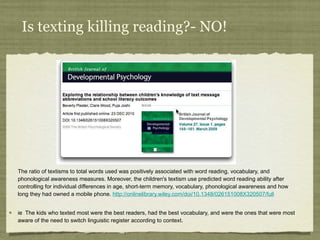
Is texting killing reading?- NO! The ratio of textisms to total words used was positively associated with word reading, vocabulary, and phonological awareness measures. Moreover, the children's textism use predicted word reading ability after controlling for individual differences in age, short-term memory, vocabulary, phonological awareness and how long they had owned a mobile phone.  http://onlinelibrary.wiley.com/doi/10.1348/026151008X320507/full ie  The kids who texted most were the best readers, had the best vocabulary, and were the ones that were most aware of the need to switch linguistic register according to context.
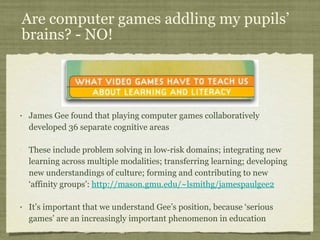
Are computer games addling my pupils’ brains? - NO! James Gee found that playing computer games collaboratively developed 36 separate cognitive areas These include problem solving in low-risk domains; integrating new learning across multiple modalities; transferring learning; developing new understandings of culture; forming and contributing to new ‘affinity groups’:  http://mason.gmu.edu/~lsmithg/jamespaulgee2 It’s important that we understand Gee’s position, because ‘serious games’ are an increasingly important phenomenon in education
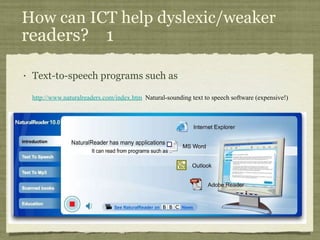
How can ICT help dyslexic/weaker  readers?  1 Text-to-speech programs such as  http://www.naturalreaders.com/index.htm   Natural-sounding text to speech software (expensive!)
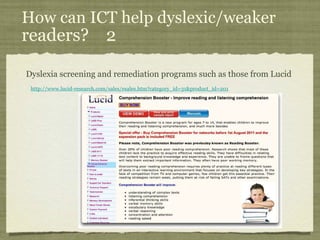
How can ICT help dyslexic/weaker  readers?  2 Dyslexia screening and remediation programs such as those from Lucid   http://www.lucid-research.com/sales/esales.htm?category_id=31&product_id=201
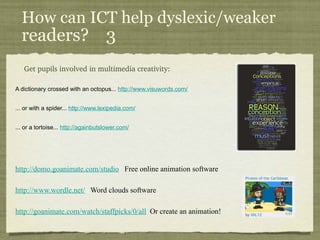
How can ICT help dyslexic/weaker  readers?  3 Get pupils involved in multimedia creativity : A dictionary crossed with an octopus...  http://www.visuwords.com/ ... or with a spider...  http://www.lexipedia.com/ ... or a tortoise...  http://againbutslower.com/   http://domo.goanimate.com/studio    Free online animation software http://www.wordle.net/    Word clouds software http://goanimate.com/watch/staffpicks/0/all     Or create an animation!
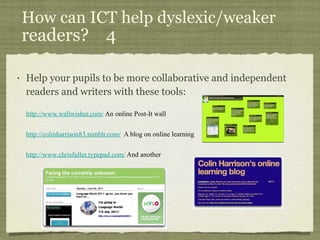
How can ICT help dyslexic/weaker  readers?  4  Help your pupils to be more collaborative and independent readers and writers with these tools: http://www.wallwisher.com/  An online Post-It wall http://colinharrison83.tumblr.com/   A blog on online learning http://www.chrisfuller.typepad.com/  And another
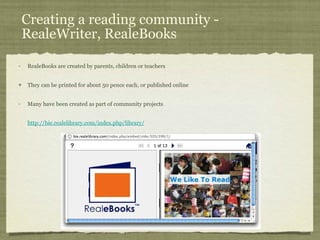
Creating a reading community - RealeWriter, RealeBooks RealeBooks are created by parents, children or teachers They can be printed for about 50 pence each, or published online Many have been created as part of community projects http://bie.realelibrary.com/index.php/library/
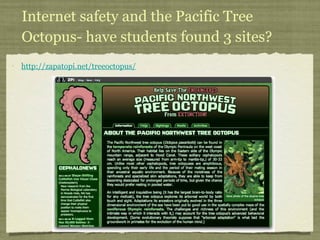
Internet safety and the Pacific Tree Octopus- have students found 3 sites? http://zapatopi.net/treeoctopus/
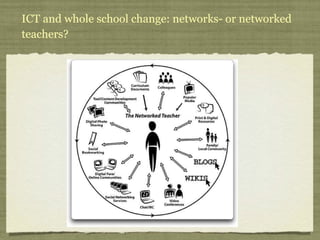
ICT and whole school change: networks- or networked teachers?
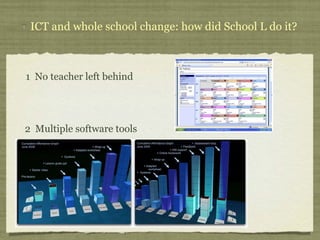
ICT and whole school change: how did School L do it? 1  No teacher left behind 2  Multiple software tools
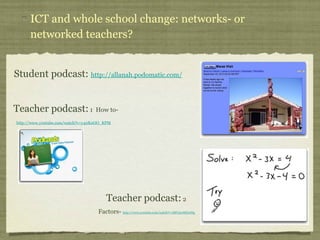
ICT and whole school change: networks- or networked teachers? Student podcast:  http://allanah.podomatic.com/ Teacher podcast:  1  How to-  http://www.youtube.com/watch?v=y4nK0OO_KPM   Teacher podcast:  2  Factors-  http://www.youtube.com/watch?v=lMU5wMDcJNg
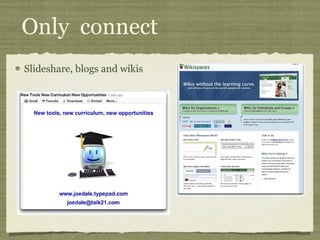
Only  connect Slideshare, blogs and wikis
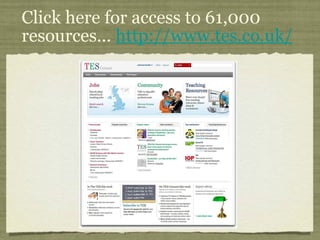
Click here for access to 61,000 resources...  http://www.tes.co.uk/
Find this, and many other valuable presentations on slideshare:  http://www.slideshare.net/category/technology  (n=1554 on ‘teaching’)
Nottingham headteachers’ conferences   colin harrison colin harrison colin harrison University of Nottingham  colin.harrison[at]nottingham.ac.uk Using ICT for literacy development-  What's new? What works?

ICT for Literacy Development - What's New? What works?

  • 1.
    Nottingham Headteachers’ ConferencesUniversity of Nottingham colin.harrison[at]nottingham.ac.uk Using ICT for literacy development- What's new? What works? Colin Harrison
  • 2.
    Nottingham headteachers’ conferences colin harrison colin harrison colin harrison University of Nottingham colin.harrison[at]nottingham.ac.uk Using ICT for literacy development- What's new? What works? This presentation is downloadable online from http://www.slideshare.net
  • 3.
    Overview Is textingkilling reading? Are computer games addling my pupils’ brains? How can ICT help dyslexics/poorer readers? How can I use online books to create a reading community? Internet safety and the Pacific Tree Octopus ICT and whole school change: networks- or networked teachers?
  • 4.
    Is texting killingreading?- NO! The ratio of textisms to total words used was positively associated with word reading, vocabulary, and phonological awareness measures. Moreover, the children's textism use predicted word reading ability after controlling for individual differences in age, short-term memory, vocabulary, phonological awareness and how long they had owned a mobile phone. http://onlinelibrary.wiley.com/doi/10.1348/026151008X320507/full ie The kids who texted most were the best readers, had the best vocabulary, and were the ones that were most aware of the need to switch linguistic register according to context.
  • 5.
    Are computer gamesaddling my pupils’ brains? - NO! James Gee found that playing computer games collaboratively developed 36 separate cognitive areas These include problem solving in low-risk domains; integrating new learning across multiple modalities; transferring learning; developing new understandings of culture; forming and contributing to new ‘affinity groups’: http://mason.gmu.edu/~lsmithg/jamespaulgee2 It’s important that we understand Gee’s position, because ‘serious games’ are an increasingly important phenomenon in education
  • 6.
    How can ICThelp dyslexic/weaker readers? 1 Text-to-speech programs such as http://www.naturalreaders.com/index.htm   Natural-sounding text to speech software (expensive!)
  • 7.
    How can ICThelp dyslexic/weaker readers? 2 Dyslexia screening and remediation programs such as those from Lucid http://www.lucid-research.com/sales/esales.htm?category_id=31&product_id=201
  • 8.
    How can ICThelp dyslexic/weaker readers? 3 Get pupils involved in multimedia creativity : A dictionary crossed with an octopus...  http://www.visuwords.com/ ... or with a spider...  http://www.lexipedia.com/ ... or a tortoise...  http://againbutslower.com/   http://domo.goanimate.com/studio    Free online animation software http://www.wordle.net/    Word clouds software http://goanimate.com/watch/staffpicks/0/all     Or create an animation!
  • 9.
    How can ICThelp dyslexic/weaker readers? 4 Help your pupils to be more collaborative and independent readers and writers with these tools: http://www.wallwisher.com/  An online Post-It wall http://colinharrison83.tumblr.com/   A blog on online learning http://www.chrisfuller.typepad.com/  And another
  • 10.
    Creating a readingcommunity - RealeWriter, RealeBooks RealeBooks are created by parents, children or teachers They can be printed for about 50 pence each, or published online Many have been created as part of community projects http://bie.realelibrary.com/index.php/library/
  • 11.
    Internet safety andthe Pacific Tree Octopus- have students found 3 sites? http://zapatopi.net/treeoctopus/
  • 12.
    ICT and wholeschool change: networks- or networked teachers?
  • 13.
    ICT and wholeschool change: how did School L do it? 1 No teacher left behind 2 Multiple software tools
  • 14.
    ICT and wholeschool change: networks- or networked teachers? Student podcast: http://allanah.podomatic.com/ Teacher podcast: 1 How to- http://www.youtube.com/watch?v=y4nK0OO_KPM Teacher podcast: 2 Factors- http://www.youtube.com/watch?v=lMU5wMDcJNg
  • 15.
    Only connectSlideshare, blogs and wikis
  • 16.
    Click here foraccess to 61,000 resources... http://www.tes.co.uk/
  • 17.
    Find this, andmany other valuable presentations on slideshare: http://www.slideshare.net/category/technology (n=1554 on ‘teaching’)
  • 18.
    Nottingham headteachers’ conferences colin harrison colin harrison colin harrison University of Nottingham colin.harrison[at]nottingham.ac.uk Using ICT for literacy development- What's new? What works?