Exotropia
By
Dr. Alshymaa Moustafa
Ophthalmology Specialist
Introduction
 exodeviations are more uniform in their presentation.
 Exophoria X, intermittent exotropia X (T) and constant exotropia
XT may usually be considered as continuum of the same spectrum
with progressively worsening fusional reserves.
Classification
ofXT
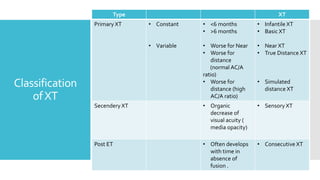
Type XT
Primary XT • Constant
• Variable
• <6 months
• >6 months
• Worse for Near
• Worse for
distance
(normal AC/A
ratio)
• Worse for
distance (high
AC/A ratio)
• Infantile XT
• Basic XT
• Near XT
• True Distance XT
• Simulated
distance XT
Secendery XT • Organic
decrease of
visual acuity (
media opacity)
• Sensory XT
Post ET • Often develops
with time in
absence of
fusion .
• Consecutive XT
Symptoms
Signs
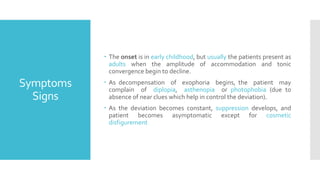
 The onset is in early childhood, but usually the patients present as
adults when the amplitude of accommodation and tonic
convergence begin to decline.
 As decompensation of exophoria begins, the patient may
complain of diplopia, asthenopia or photophobia (due to
absence of near clues which help in control the deviation).
 As the deviation becomes constant, suppression develops, and
patient becomes asymptomatic except for cosmetic
disfigurement
Classification
XT course
 It should be understood that many patients have variability of
fusional control depending on alertness, general health, anxiety
and willingness to cooperate for examination.
 It could vary at different time of the day and from one
examination to the next.
 Calhounz et al. have classified XT into IV phases based on the
fusional control .
1. phase I : X at distance only.
2. phase II : X(T) for distance.
3. phase III : XT for distance and X(T)′ for near.
4. phase IV :constant XT.
 A phase I patient would be asymptomatic, and there would be a
progressive worsening of binocular functions from phase II till
phase IV where they would be largely absent.
Phenomenon
of Panoramic
Vision
 Horizontal enlargement of the visual field during binocular
viewing is sometimes seen in large angle constant XT.
 There is absence of any retinal correspondence and the two eyes
function independently like in lower species.
 These individuals enjoy a large horizontal visual field up to 250° at
the cost of the binocular vision.
XT
Classification
for
Management
 For management it would be also useful to classify XT into the following:
1. Divergence excess:when the deviation for distance fixation is at least 15Δ
(prism dioptres) larger than for near.
2. Convergence insufficiency:when the deviation for near fixation is at
least 15Δ larger than for distance.
3. Basic:when the near and distance deviations are equal or their difference is
lesser than 15Δ .
4. Simulated divergence excess:which on initial testing has a significantly
larger deviation for distance fixation but on elimination of dynamic
factors (by occlusion of either eye for 1 h) the near deviation becomes
equal to or larger than the distance deviation.
 NB:
1. In simulated divergence excess the phenomenon is called convergence
after effect. For this reason all patients with divergence excess type of
deviation should undergo an occlusion test by occluding either eye for 1 h.
2. Before removing the patch for measurements (by prism and cover test),
the fellow eye should be occluded to prevent even a momentary binocular
stimulation that could make the patient control the near deviation.
XT
Management
 As with all types of strabismus, refractive correction should be the
first step in management.
 Although it is believed that uncorrected myopia plays a role in
development to exodeviation by constant under stimulation of
convergence , this factor has a much lesser importance than
hypermetropia in causation of esotropia.
 Myopia should be fully or slightly overcorrected and least possible
hypermetropic correction should be titrated individually to make
the patient comfortable.
 Contact lenses and refractive surgery are known to have a
beneficial effect on ocular deviation and may be tried in suitable
patients
 As in accommodative ET, it has also been suggested to measure
the deviation for near fixation through +3.0 D sphere to eliminate
the need for accommodation and unmask substantially larger
deviation in patients with increased AC/A ratio.
 This exercise, however, has a very limited role in management
planning of XT.
 Stereoacuity assessment for near and distance should routinely be
done in patients with X(T).
 A progressive deterioration can be an indicator for early surgical
intervention.
 Role of prisms and orthoptics is limited to improving binocular
vision, amblyopia treatment and treating obvious convergence
insufficiency.
XTSurgery
 Definite treatment of symptomatic X, X(T) and XT is surgical.
 Surgery for constant deviations should be performed once the
diagnosis is made and reliable measurements made.
 Surgery is not performed for deviations lesser than 15Δ.
Timing of
Surgery inXT
 Timing of Surgery in X(T) Surgery in intermittent exotropia should
be considered when:
• There is progression as evident by:
1. Increased frequency of manifest deviation (>50% of waking
hours).
2. Increase in size of basic deviation.
3. Evidence of deterioration of distance stereoacuity or
development of suppression.
• Newcastle control score (NCS) is ≥3.
NCS
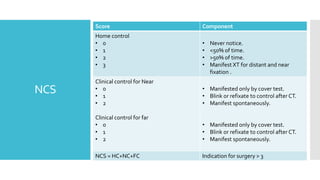
Score Component
Home control
• 0
• 1
• 2
• 3
• Never notice.
• <50% of time.
• >50% of time.
• Manifest XT for distant and near
fixation .
Clinical control for Near
• 0
• 1
• 2
Clinical control for far
• 0
• 1
• 2
• Manifested only by cover test.
• Blink or refixate to control after CT.
• Manifest spontaneously.
• Manifested only by cover test.
• Blink or refixate to control after CT.
• Manifest spontaneously.
NCS = HC+NC+FC Indication for surgery > 3
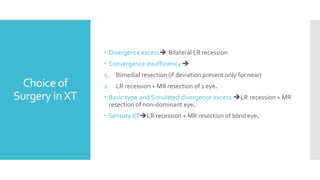
Choice of
Surgery inXT
 Divergence excess Bilateral LR recession
 Convergence insufficiency 
1. Bimedial resection (if deviation present only for near)
2. LR recession + MR resection of 1 eye.
 Basic type and Simulated divergence excess LR recession + MR
resection of non-dominant eye.
 Sensory XTLR recession + MR resection of blind eye.
Thanks

Exotropia

  • 1.
  • 2.
    Introduction  exodeviations aremore uniform in their presentation.  Exophoria X, intermittent exotropia X (T) and constant exotropia XT may usually be considered as continuum of the same spectrum with progressively worsening fusional reserves.
  • 3.
    Classification ofXT Type XT Primary XT• Constant • Variable • <6 months • >6 months • Worse for Near • Worse for distance (normal AC/A ratio) • Worse for distance (high AC/A ratio) • Infantile XT • Basic XT • Near XT • True Distance XT • Simulated distance XT Secendery XT • Organic decrease of visual acuity ( media opacity) • Sensory XT Post ET • Often develops with time in absence of fusion . • Consecutive XT
  • 4.
    Symptoms Signs  The onsetis in early childhood, but usually the patients present as adults when the amplitude of accommodation and tonic convergence begin to decline.  As decompensation of exophoria begins, the patient may complain of diplopia, asthenopia or photophobia (due to absence of near clues which help in control the deviation).  As the deviation becomes constant, suppression develops, and patient becomes asymptomatic except for cosmetic disfigurement
  • 5.
    Classification XT course  Itshould be understood that many patients have variability of fusional control depending on alertness, general health, anxiety and willingness to cooperate for examination.  It could vary at different time of the day and from one examination to the next.  Calhounz et al. have classified XT into IV phases based on the fusional control . 1. phase I : X at distance only. 2. phase II : X(T) for distance. 3. phase III : XT for distance and X(T)′ for near. 4. phase IV :constant XT.  A phase I patient would be asymptomatic, and there would be a progressive worsening of binocular functions from phase II till phase IV where they would be largely absent.
  • 6.
    Phenomenon of Panoramic Vision  Horizontalenlargement of the visual field during binocular viewing is sometimes seen in large angle constant XT.  There is absence of any retinal correspondence and the two eyes function independently like in lower species.  These individuals enjoy a large horizontal visual field up to 250° at the cost of the binocular vision.
  • 7.
    XT Classification for Management  For managementit would be also useful to classify XT into the following: 1. Divergence excess:when the deviation for distance fixation is at least 15Δ (prism dioptres) larger than for near. 2. Convergence insufficiency:when the deviation for near fixation is at least 15Δ larger than for distance. 3. Basic:when the near and distance deviations are equal or their difference is lesser than 15Δ . 4. Simulated divergence excess:which on initial testing has a significantly larger deviation for distance fixation but on elimination of dynamic factors (by occlusion of either eye for 1 h) the near deviation becomes equal to or larger than the distance deviation.  NB: 1. In simulated divergence excess the phenomenon is called convergence after effect. For this reason all patients with divergence excess type of deviation should undergo an occlusion test by occluding either eye for 1 h. 2. Before removing the patch for measurements (by prism and cover test), the fellow eye should be occluded to prevent even a momentary binocular stimulation that could make the patient control the near deviation.
  • 8.
    XT Management  As withall types of strabismus, refractive correction should be the first step in management.  Although it is believed that uncorrected myopia plays a role in development to exodeviation by constant under stimulation of convergence , this factor has a much lesser importance than hypermetropia in causation of esotropia.  Myopia should be fully or slightly overcorrected and least possible hypermetropic correction should be titrated individually to make the patient comfortable.  Contact lenses and refractive surgery are known to have a beneficial effect on ocular deviation and may be tried in suitable patients
  • 9.
     As inaccommodative ET, it has also been suggested to measure the deviation for near fixation through +3.0 D sphere to eliminate the need for accommodation and unmask substantially larger deviation in patients with increased AC/A ratio.  This exercise, however, has a very limited role in management planning of XT.  Stereoacuity assessment for near and distance should routinely be done in patients with X(T).  A progressive deterioration can be an indicator for early surgical intervention.  Role of prisms and orthoptics is limited to improving binocular vision, amblyopia treatment and treating obvious convergence insufficiency.
  • 10.
    XTSurgery  Definite treatmentof symptomatic X, X(T) and XT is surgical.  Surgery for constant deviations should be performed once the diagnosis is made and reliable measurements made.  Surgery is not performed for deviations lesser than 15Δ.
  • 11.
    Timing of Surgery inXT Timing of Surgery in X(T) Surgery in intermittent exotropia should be considered when: • There is progression as evident by: 1. Increased frequency of manifest deviation (>50% of waking hours). 2. Increase in size of basic deviation. 3. Evidence of deterioration of distance stereoacuity or development of suppression. • Newcastle control score (NCS) is ≥3.
  • 12.
    NCS Score Component Home control •0 • 1 • 2 • 3 • Never notice. • <50% of time. • >50% of time. • Manifest XT for distant and near fixation . Clinical control for Near • 0 • 1 • 2 Clinical control for far • 0 • 1 • 2 • Manifested only by cover test. • Blink or refixate to control after CT. • Manifest spontaneously. • Manifested only by cover test. • Blink or refixate to control after CT. • Manifest spontaneously. NCS = HC+NC+FC Indication for surgery > 3
  • 13.
    Choice of Surgery inXT Divergence excess Bilateral LR recession  Convergence insufficiency  1. Bimedial resection (if deviation present only for near) 2. LR recession + MR resection of 1 eye.  Basic type and Simulated divergence excess LR recession + MR resection of non-dominant eye.  Sensory XTLR recession + MR resection of blind eye.
  • 14.