DIVERGENT STRABISMUS
DIVERGENT STRABISMUS/EXOTROPIA
 Exotropia is characterised by outward
deviation of one eye while other eye fixate.
TYPES
 Congenital exotropia /Infantile exotropia
 Primary exotropia
 Sensory/secondary strabismus
 Consecutive exotropia
 XT of divergent excess type.
CONGENITAL EXOTROPIA
 It is an extremely rare condition
 Infantile exotroia has been defined as
large(>30 d) constant exotropia that develops
during first 6 to 12 months of life.
 Size of the angle may increase over time.
 Chance for amblyopia is much greater in this
exotropia.
SYMPTOMS OF INFANTILE EXOTROPIA
 Cosmetic disfigurement.
SIGNS OF INFANTILE XT
 Large angle constant exo deviation mostly more than 35
PD.
 Poor fusion
 Patient may have co existing craniofacial-ocular or
systemic abnormality
 Eg; Albinism, cerebral palsy,
TREATMENT OF INFANTILE XT
 Amblyopia therapy to be treated as early
as possible
 Surgical procedure; recession of
bilateral lateral rectus .
PRIMARY EXOTROPIA
 It may be unilateral or alternating and may present as intermittent
or constant XT.
INTERMITTENT XT
 It is the most common type of exodeviation.
 Age of onset is usually early between 2-5 years.
 Deviation become manifest at times and latent at others.
Precipitating factors include bright lights, fatigue, ill health and day
dreaming.
 Sensory testing usually reveals good fusion, stereopsis and no
amblyopia.
CONSTANT XT
 If not treated in time the intermittent XT may
decompensate to become constant XT.
TYPES
 Convergence insufficiency type :
○ XT greater for near than distance.
 Divergent excess type:
○ XT greater for distance than near.
 Basic or non-specific type:
○ XT equal for near and distance
 It usually starts at the age of 2 yrs &
associated with normal fusion and no
amblyopia.
 Stereopsis is usually absent.
SENSORY/ SECONDARY STRABISMUS
 It is a constant unilateral condition that
develops as a result of poor visual function
in one eye.
 Common causes are traumatic cataract,
unilateral aphakia, corneal opacity, optic
atrophy, anisometropic amblyopia, retinal
detachment, organic macular lesions and
any other organic cause of unilateral loss
of vision.
CLINICAL FEATURES
 Monocular vision loss
 Cosmetic complaints
SIGNS
 Large angle(30-60PD) unilateral
strabismus.
 VA is decreased in the affected eye
 There may be relevant history of
congenital cataract, ROP, trauma etc.
TREATMENT
 Surgery
CONSECUTIVE XT
 It refers to occurrence of XT in an eye which was
previously esotropic.
CLINICAL TYPES
 Surgical overcorrection of esotropia.
 Spontaneous consecutive exotropia is change of
esotropia into exotropia without exogenous mechanical
factors or an acquired paralysis of medial rectus muscle.
 Hypermetropia >+4.50D is the srongest risk factor for
the non-surgical development of XT,
SYMPTOMS
 Cosmetic problems.
 Diplopia is rare, but it may occurs in the strabismus
deviation changes in adulthood.
SIGNS
 Moderate to large angle usually constant exotropia is
present.
 The deviation may not be concomitant if the patient had
prior surgery.
 There may be H/O infantile esotropia that may have been
treated surgicaly.
TREATMENT
 Reduction of the hyperopic correction or
the use pf overcoorecting minus lenses
(it stimulate accommodation).
 Surgery.
XT OF DIVERGENT EXCESS TYPE
 It is an intermittent XT whose angle of
deviation at distance is atleast 10-15PD
grater than at near.
SYMPTOMS
 Photophobia
 Cosmetic problems
 Asthenopic symptoms and diplopia are
rare.
SIGNS
 A concomitant XT is greater at distance
than at near.
 An XT of V-pattern may be present.
 When eyes are in orthoposition ,
patients generally exhibits normal retinal
correspondence, good steriopsis and
good NPC.
 When the deviation is present either
NRC with suppression or ARC.
TREATMENT
 Vision therapy or surgery.
A-V PATTERN
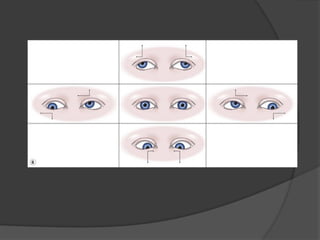
 Horizontal deviations (esotropia & exotropia) which may be
comitant in horizontal gazes, may not be comitant in
vertical gazes, on looking up and looking down. They are
said to be ‘vertically incomitant-comitant horizontal
deviations’.
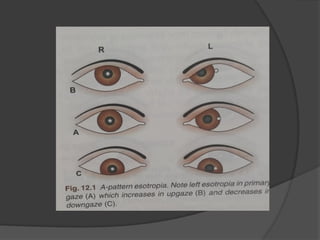
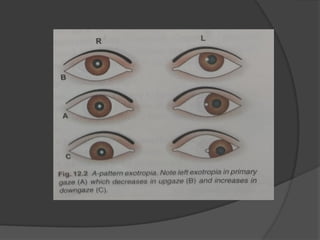
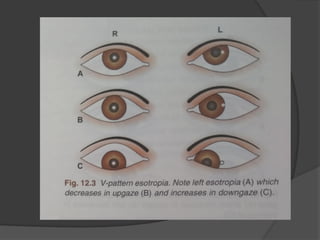
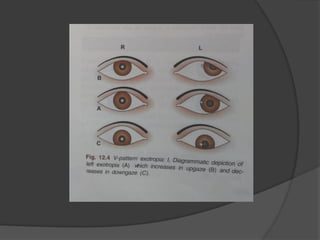
 In simpler terms they are described as A-V pattern.
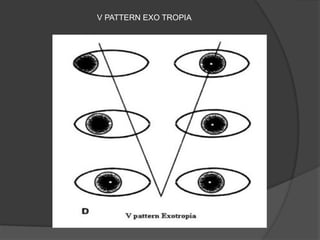
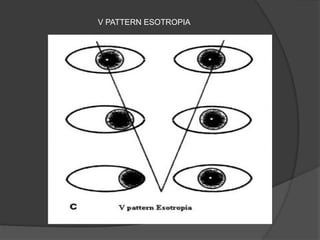
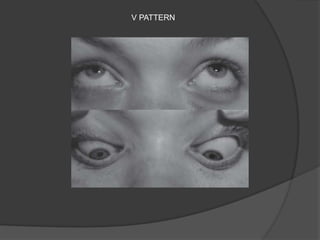
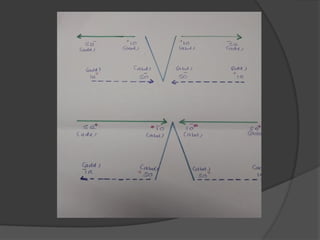
 Thus an exodeviation, which becomes more divergent in
up gaze and less divergent in down gaze is said to have a
‘V’ pattern.
 An eso deviation with ‘V’ pattern would be more converge
in down gaze and less converge in up gaze.
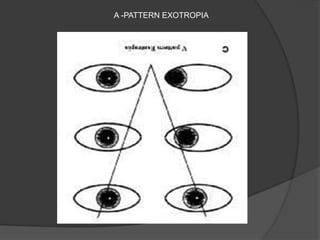
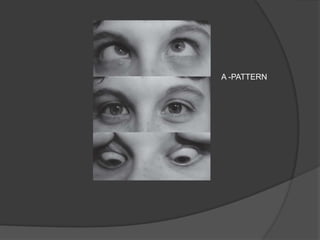
 The reverse is ‘A’ pattern.
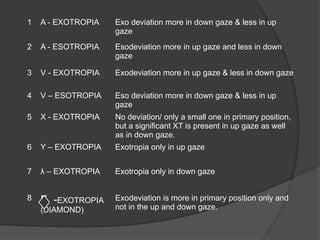
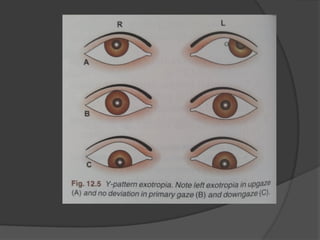
 In addition to these four common
patterns, other patterns are also seen
there.
1 A - EXOTROPIA Exo deviation more in down gaze & less in up
gaze
2 A - ESOTROPIA Esodeviation more in up gaze and less in down
gaze
3 V - EXOTROPIA Exodeviation more in up gaze & less in down gaze
4 V – ESOTROPIA Eso deviation more in down gaze & less in up
gaze
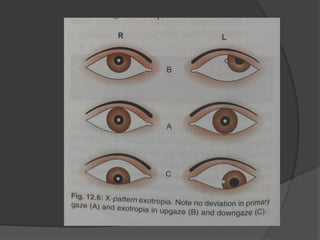
5 X - EXOTROPIA No deviation/ only a small one in primary position,
but a significant XT is present in up gaze as well
as in down gaze.
6 Y – EXOTROPIA Exotropia only in up gaze
7 λ – EXOTROPIA Exotropia only in down gaze
8 E -EXOTROPIA
(DIAMOND)
Exodeviation is more in primary position only and
not in the up and down gaze.
M
ETIOLOGY
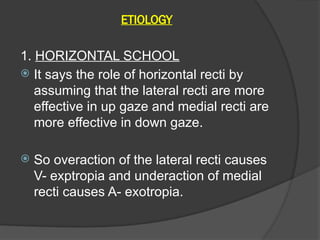
1. HORIZONTAL SCHOOL
 It says the role of horizontal recti by
assuming that the lateral recti are more
effective in up gaze and medial recti are
more effective in down gaze.
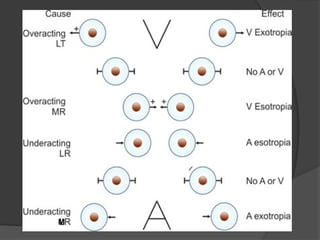
 So overaction of the lateral recti causes
V- exptropia and underaction of medial
recti causes A- exotropia.
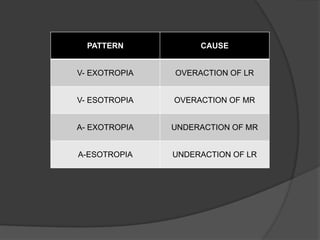
PATTERN CAUSE
V- EXOTROPIA OVERACTION OF LR
V- ESOTROPIA OVERACTION OF MR
A- EXOTROPIA UNDERACTION OF MR
A-ESOTROPIA UNDERACTION OF LR
V PATTERN EXO TROPIA
V PATTERN ESOTROPIA
A -PATTERN EXOTROPIA
A -PATTERN
V PATTERN
2. STRUCTURAL FACTORS
 Variation of skull and orbital bones are
known to have underaction or overaction
of oblique muscle.
 This may be due to variations in the site
of origin or insertion of inferior oblique or
superior oblique.
3. ANOMALIES OF MUSCLE INSERTION
 Anomalies of insertion of vertical and horizontal rectii
or oblique muscle are also known to cause A-V pattern
4. VERTICAL SCHOOL
 It says the role of vertical rectii, in the etiology of A-V
pattern
 The principle behind being the adducting property of
vertical recti.
 Thus weak SR would result in less adducting power in
upgazes causing a V- pattern.
 Since the action of vertical recti and
oblique muscles are linked inseperably.
 Thus underaction of SR would have
underacting SO (ipsilateral antagonist of
contralateral synergist).
 It is also called as cycloverical school.
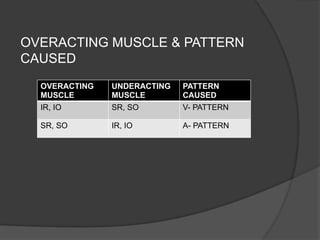
OVERACTING MUSCLE & PATTERN
CAUSED
OVERACTING
MUSCLE
UNDERACTING
MUSCLE
PATTERN
CAUSED
IR, IO SR, SO V- PATTERN
SR, SO IR, IO A- PATTERN
INVESTIGATION
 Horizontal deviations are measured in
25* upgaze and 35* downgaze in
addition to primary position.
 A 15 PD difference is taken as
significant for V- pattern and 10PD
difference is taken as significant for A-
pattern.
Treatment
 Pre Treatment Evaluation
 Detailed History
 Assessment of BCVA
 Cycloplegic Refraction and correction
 Measurement of angle of deviation in all the 9
positions of gaze for near and far, with and
without optical correction
 Uniocular and binocular motility.
 If the pattern is significant and syptomatic it
needs to be operated.
 all cases of exodeviations & esodeviations
should be checked for A & V patterns.
 In case of muscles over action , it should be
weakened
 In case of muscles under action , it should
be strengthen.

Squint Share DIVERGENT STRABISMUS - Copy.pptx

  • 1.
  • 2.
    DIVERGENT STRABISMUS/EXOTROPIA  Exotropiais characterised by outward deviation of one eye while other eye fixate. TYPES  Congenital exotropia /Infantile exotropia  Primary exotropia  Sensory/secondary strabismus  Consecutive exotropia  XT of divergent excess type.
  • 3.
    CONGENITAL EXOTROPIA  Itis an extremely rare condition  Infantile exotroia has been defined as large(>30 d) constant exotropia that develops during first 6 to 12 months of life.  Size of the angle may increase over time.  Chance for amblyopia is much greater in this exotropia.
  • 4.
    SYMPTOMS OF INFANTILEEXOTROPIA  Cosmetic disfigurement. SIGNS OF INFANTILE XT  Large angle constant exo deviation mostly more than 35 PD.  Poor fusion  Patient may have co existing craniofacial-ocular or systemic abnormality  Eg; Albinism, cerebral palsy,
  • 5.
    TREATMENT OF INFANTILEXT  Amblyopia therapy to be treated as early as possible  Surgical procedure; recession of bilateral lateral rectus .
  • 6.
    PRIMARY EXOTROPIA  Itmay be unilateral or alternating and may present as intermittent or constant XT. INTERMITTENT XT  It is the most common type of exodeviation.  Age of onset is usually early between 2-5 years.  Deviation become manifest at times and latent at others. Precipitating factors include bright lights, fatigue, ill health and day dreaming.  Sensory testing usually reveals good fusion, stereopsis and no amblyopia.
  • 7.
    CONSTANT XT  Ifnot treated in time the intermittent XT may decompensate to become constant XT. TYPES  Convergence insufficiency type : ○ XT greater for near than distance.  Divergent excess type: ○ XT greater for distance than near.  Basic or non-specific type: ○ XT equal for near and distance
  • 8.
     It usuallystarts at the age of 2 yrs & associated with normal fusion and no amblyopia.  Stereopsis is usually absent.
  • 9.
    SENSORY/ SECONDARY STRABISMUS It is a constant unilateral condition that develops as a result of poor visual function in one eye.  Common causes are traumatic cataract, unilateral aphakia, corneal opacity, optic atrophy, anisometropic amblyopia, retinal detachment, organic macular lesions and any other organic cause of unilateral loss of vision.
  • 10.
    CLINICAL FEATURES  Monocularvision loss  Cosmetic complaints SIGNS  Large angle(30-60PD) unilateral strabismus.  VA is decreased in the affected eye  There may be relevant history of congenital cataract, ROP, trauma etc.
  • 11.
  • 12.
    CONSECUTIVE XT  Itrefers to occurrence of XT in an eye which was previously esotropic. CLINICAL TYPES  Surgical overcorrection of esotropia.  Spontaneous consecutive exotropia is change of esotropia into exotropia without exogenous mechanical factors or an acquired paralysis of medial rectus muscle.  Hypermetropia >+4.50D is the srongest risk factor for the non-surgical development of XT,
  • 13.
    SYMPTOMS  Cosmetic problems. Diplopia is rare, but it may occurs in the strabismus deviation changes in adulthood. SIGNS  Moderate to large angle usually constant exotropia is present.  The deviation may not be concomitant if the patient had prior surgery.  There may be H/O infantile esotropia that may have been treated surgicaly.
  • 14.
    TREATMENT  Reduction ofthe hyperopic correction or the use pf overcoorecting minus lenses (it stimulate accommodation).  Surgery.
  • 15.
    XT OF DIVERGENTEXCESS TYPE  It is an intermittent XT whose angle of deviation at distance is atleast 10-15PD grater than at near. SYMPTOMS  Photophobia  Cosmetic problems  Asthenopic symptoms and diplopia are rare.
  • 16.
    SIGNS  A concomitantXT is greater at distance than at near.  An XT of V-pattern may be present.  When eyes are in orthoposition , patients generally exhibits normal retinal correspondence, good steriopsis and good NPC.  When the deviation is present either NRC with suppression or ARC.
  • 17.
  • 18.
    A-V PATTERN  Horizontaldeviations (esotropia & exotropia) which may be comitant in horizontal gazes, may not be comitant in vertical gazes, on looking up and looking down. They are said to be ‘vertically incomitant-comitant horizontal deviations’.  In simpler terms they are described as A-V pattern.  Thus an exodeviation, which becomes more divergent in up gaze and less divergent in down gaze is said to have a ‘V’ pattern.  An eso deviation with ‘V’ pattern would be more converge in down gaze and less converge in up gaze.
  • 19.
     The reverseis ‘A’ pattern.  In addition to these four common patterns, other patterns are also seen there.
  • 20.
    1 A -EXOTROPIA Exo deviation more in down gaze & less in up gaze 2 A - ESOTROPIA Esodeviation more in up gaze and less in down gaze 3 V - EXOTROPIA Exodeviation more in up gaze & less in down gaze 4 V – ESOTROPIA Eso deviation more in down gaze & less in up gaze 5 X - EXOTROPIA No deviation/ only a small one in primary position, but a significant XT is present in up gaze as well as in down gaze. 6 Y – EXOTROPIA Exotropia only in up gaze 7 λ – EXOTROPIA Exotropia only in down gaze 8 E -EXOTROPIA (DIAMOND) Exodeviation is more in primary position only and not in the up and down gaze.
  • 21.
  • 22.
    ETIOLOGY 1. HORIZONTAL SCHOOL It says the role of horizontal recti by assuming that the lateral recti are more effective in up gaze and medial recti are more effective in down gaze.  So overaction of the lateral recti causes V- exptropia and underaction of medial recti causes A- exotropia.
  • 23.
    PATTERN CAUSE V- EXOTROPIAOVERACTION OF LR V- ESOTROPIA OVERACTION OF MR A- EXOTROPIA UNDERACTION OF MR A-ESOTROPIA UNDERACTION OF LR
  • 30.
  • 32.
  • 33.
  • 34.
  • 35.
  • 36.
    2. STRUCTURAL FACTORS Variation of skull and orbital bones are known to have underaction or overaction of oblique muscle.  This may be due to variations in the site of origin or insertion of inferior oblique or superior oblique.
  • 37.
    3. ANOMALIES OFMUSCLE INSERTION  Anomalies of insertion of vertical and horizontal rectii or oblique muscle are also known to cause A-V pattern 4. VERTICAL SCHOOL  It says the role of vertical rectii, in the etiology of A-V pattern  The principle behind being the adducting property of vertical recti.  Thus weak SR would result in less adducting power in upgazes causing a V- pattern.
  • 38.
     Since theaction of vertical recti and oblique muscles are linked inseperably.  Thus underaction of SR would have underacting SO (ipsilateral antagonist of contralateral synergist).  It is also called as cycloverical school.
  • 39.
    OVERACTING MUSCLE &PATTERN CAUSED OVERACTING MUSCLE UNDERACTING MUSCLE PATTERN CAUSED IR, IO SR, SO V- PATTERN SR, SO IR, IO A- PATTERN
  • 41.
    INVESTIGATION  Horizontal deviationsare measured in 25* upgaze and 35* downgaze in addition to primary position.  A 15 PD difference is taken as significant for V- pattern and 10PD difference is taken as significant for A- pattern.
  • 42.
    Treatment  Pre TreatmentEvaluation  Detailed History  Assessment of BCVA  Cycloplegic Refraction and correction  Measurement of angle of deviation in all the 9 positions of gaze for near and far, with and without optical correction  Uniocular and binocular motility.
  • 43.
     If thepattern is significant and syptomatic it needs to be operated.  all cases of exodeviations & esodeviations should be checked for A & V patterns.  In case of muscles over action , it should be weakened  In case of muscles under action , it should be strengthen.