ExercisePrescriptionFor
HypertensivePopulation
Dr. Shilpasree Saha (PT),
BPT, MPT (Cardio-Thoracic Disorders)
Content
 Hypertension.
 Stages/Grades of Hypertension.
 Health care burden!!!
 What is the answer of this burden?
 Physical activity & Exercise.
 PA, exercise and prevention of HTN.
 Antihypertensive effects of exercise.
Hypertension
 Hypertension is the most common, costly, and
preventable cardiovascular disease (CVD) risk factor.
 The current definition of hypertension (HTN) is systolic
blood pressure (SBP) values of 130mmHg or more
and/or diastolic blood pressure (DBP) more than 80
mmHg. *
 Prevalence of hypertension in India is at alarming level
and is estimated to account for 10.8% of all the deaths
in the country.**
*Iqbal AM, Jamal SF. Essential Hypertension. [Updated 2022 Jul 4]. In: StatPearls [Internet]. Treasure Island (FL): StatPearls Publishing; 2022 Jan-.
Available from: https://www.ncbi.nlm.nih.gov/books/NBK539859/
**Kurjogi MM, Vanti GL, Kaulgud RS. Prevalence of hypertension and its associated risk factors in Dharwad population: A cross-sectional study.
Indian Heart J. 2021 Nov-Dec;73(6):751-753.doi: 10.1016/j.ihj.2021.10.006.Epub 2021 Oct 22. PMID: 34695447;PMCID: PMC8642654.
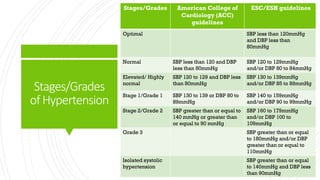
Stages/Grades American College of
Cardiology (ACC)
guidelines
ESC/ESH guidelines
Optimal SBP less than 120mmHg
and DBP less than
80mmHg
Normal SBP less than 120 and DBP
less than 80mmHg
SBP 120 to 129mmHg
and/or DBP 80 to 84mmHg
Elevated/ Highly
normal
SBP 120 to 129 and DBP less
than 80mmHg
SBP 130 to 139mmHg
and/or DBP 85 to 89mmHg
Stage 1/Grade 1 SBP 130 to 139 or DBP 80 to
89mmHg
SBP 140 to 159mmHg
and/or DBP 90 to 99mmHg
Stage 2/Grade 2 SBP greater than or equal to
140 mmHg or greater than
or equal to 90 mmHg
SBP 160 to 179mmHg
and/or DBP 100 to
109mmHg
Grade 3 SBP greater than or equal
to 180mmHg and/or DBP
greater than or equal to
110mmHg
Isolated systolic
hypertension
SBP greater than or equal
to 140mmHg and DBP less
than 90mmHg
Stages/Grades
ofHypertension
Healthcare
burden!!!
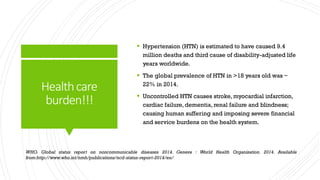
 Hypertension (HTN) is estimated to have caused 9.4
million deaths and third cause of disability-adjusted life
years worldwide.
 The global prevalence of HTN in >18 years old was ~
22% in 2014.
 Uncontrolled HTN causes stroke, myocardial infarction,
cardiac failure, dementia, renal failure and blindness;
causing human suffering and imposing severe financial
and service burdens on the health system.
WHO. Global status report on noncommunicable diseases 2014. Geneva : World Health Organization. 2014. Available
from:http://www.who.int/nmh/publications/ncd-status-report-2014/en/
Whatis the
answerofthis
burden?
 Because of the high prevalence,drug treatment can be
costly and is a challenge for resource-constrained settings.
 The only solution is to control hypertension using an
affordable total-risk approach, and concurrently take
action to reduce its incidence.
 One of the measures that are needed to attain this target is
physical activity; hence WHO has set the goal of a 10%
reduction in physical inactivity and 25% reduction in
hypertension by 2020.
 Lifestyle factors,such as participation in regular exercise,
are recognized as key modifiable determinants of
hypertension.
 Therefore,there is a need for more intensive efforts to
promote strategies to reduce the significant public health
burden of hypertension
 Epidemiologic studies suggest that the relationship
between sedentary behaviour and HTN is so strong that
the National Heart Foundation, World Health
Organisation, International Society of Hypertension,
United States Joint National Committee on Detection,
Evaluation and Treatment of High Blood Pressure, and
American College of Sports Medicine have all
recommended increased physical activity as a first line
intervention for preventing and treating patients with
preHTN and HTN
Baster T, Baster-Brooks C. Exercise and hypertension. Aust Fam Physician. 2005 Jun;34(6):419-24.
Physicalactivity
&
Exercise
 Physical activity (PA) is defined as any bodily
movement produced by contraction of skeletal muscles
that increases energy expenditure above resting levels
and comprises routine daily tasks.
 Exercise is a component of physical activity that is
planned, structured, and repetitive with the intent of
improving or maintaining health.
PA,exerciseand
preventionof
HTN
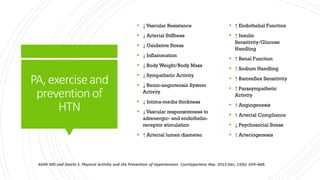
 ↓ Vascular Resistance
 ↓ Arterial Stiffness
 ↓ Oxidative Stress
 ↓ Inflammation
 ↓ Body Weight/Body Mass
 ↓ Sympathetic Activity
 ↓ Renin-angiotensin System
Activity
 ↓ Intima-media thickness
 ↓ Vascular responsiveness to
adrenergic- and endothelin-
receptor stimulation
 ↑ Arterial lumen diameter
 ↑ Endothelial Function
 ↑ Insulin
Sensitivity/Glucose
Handling
 ↑ Renal Function
 ↑ Sodium Handling
 ↑ Baroreflex Sensitivity
 ↑ Parasympathetic
Activity
 ↑ Angiogenesis
 ↑ Arterial Compliance
 ↓ Psychosocial Stress
 ↑ Arteriogenesis
Antihypertensive
effectsof
exercise
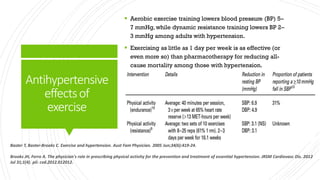
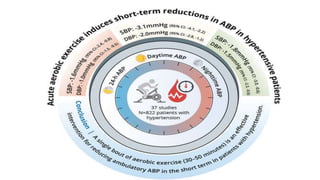
 Aerobic exercise training lowers blood pressure (BP) 5–
7 mmHg, while dynamic resistance training lowers BP 2–
3 mmHg among adults with hypertension.
 Exercising as little as 1 day per week is as effective (or
even more so) than pharmacotherapy for reducing all-
cause mortality among those with hypertension.
Baster T, Baster-Brooks C. Exercise and hypertension. Aust Fam Physician. 2005 Jun;34(6):419-24.
Brooks JH, Ferro A. The physician's role in prescribing physical activity for the prevention and treatment of essential hypertension. JRSM Cardiovasc Dis. 2012
Jul 31;1(4). pii: cvd.2012.012012.
AnExercise
Prescriptionfor
Hypertension
 Frequency: Aerobic exercise on most, preferably all
days of the week and dynamic resistance exercise on 2
to 3 days in that same week.
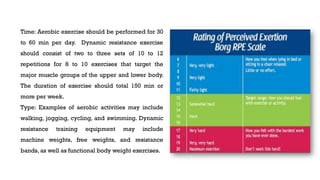
 Intensity: Moderate intensity aerobic exercise (i.e., 40 to
<60 % VO2max or HR reserve; 11–13 rating of
perceived exertion [RPE] on the 6–20 Borg Scale and
moderate intensity dynamic resistance exercise (60 %
to 80 % one repetition maximum [1-RM]).
Time: Aerobic exercise should be performed for 30
to 60 min per day. Dynamic resistance exercise
should consist of two to three sets of 10 to 12
repetitions for 8 to 10 exercises that target the
major muscle groups of the upper and lower body.
The duration of exercise should total 150 min or
more per week.
Type: Examples of aerobic activities may include
walking, jogging, cycling, and swimming. Dynamic
resistance training equipment may include
machine weights, free weights, and resistance
bands, as well as functional body weight exercises.
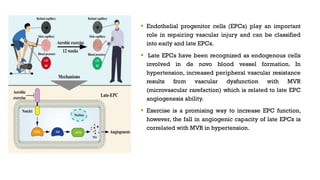
 Endothelial progenitor cells (EPCs) play an important
role in repairing vascular injury and can be classified
into early and late EPCs.
 Late EPCs have been recognized as endogenous cells
involved in de novo blood vessel formation. In
hypertension, increased peripheral vascular resistance
results from vascular dysfunction with MVR
(microvascular rarefaction) which is related to late EPC
angiogenesis ability.
 Exercise is a promising way to increase EPC function,
however, the fall in angiogenic capacity of late EPCs is
correlated with MVR in hypertension.
Medical status
Preparticipation screening and
physical activity advice
1
Asymptomatic, low CVD risk
and BP <140/90 mmHg
Routine evaluation and self-
directed physical activity
2
Asymptomatic, low CVD risk
and hypertensive ≥140/90
mmHg
Routine evaluation and begin with
moderate intensity exercise (<60%
heart rate reserve)
3
Asymptomatic, high CVD
risk and hypertensive
≥140/90 mmHg
Symptomatic exercise testing prior
to start (for example, ECG exercise
test)
4 Symptomatic CVD
Medical supervision during
exercise initially
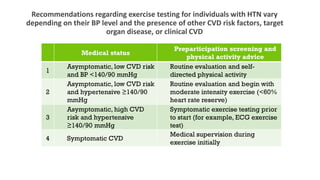
Recommendations regarding exercise testing for individuals with HTN vary
depending on their BP level and the presence of other CVD risk factors, target
organ disease, or clinical CVD
Exercise Prescription For Hypertensive Population.pdf

Exercise Prescription For Hypertensive Population.pdf

  • 1.
  • 2.
    Content  Hypertension.  Stages/Gradesof Hypertension.  Health care burden!!!  What is the answer of this burden?  Physical activity & Exercise.  PA, exercise and prevention of HTN.  Antihypertensive effects of exercise.
  • 3.
    Hypertension  Hypertension isthe most common, costly, and preventable cardiovascular disease (CVD) risk factor.  The current definition of hypertension (HTN) is systolic blood pressure (SBP) values of 130mmHg or more and/or diastolic blood pressure (DBP) more than 80 mmHg. *  Prevalence of hypertension in India is at alarming level and is estimated to account for 10.8% of all the deaths in the country.** *Iqbal AM, Jamal SF. Essential Hypertension. [Updated 2022 Jul 4]. In: StatPearls [Internet]. Treasure Island (FL): StatPearls Publishing; 2022 Jan-. Available from: https://www.ncbi.nlm.nih.gov/books/NBK539859/ **Kurjogi MM, Vanti GL, Kaulgud RS. Prevalence of hypertension and its associated risk factors in Dharwad population: A cross-sectional study. Indian Heart J. 2021 Nov-Dec;73(6):751-753.doi: 10.1016/j.ihj.2021.10.006.Epub 2021 Oct 22. PMID: 34695447;PMCID: PMC8642654.
  • 4.
    Stages/Grades American Collegeof Cardiology (ACC) guidelines ESC/ESH guidelines Optimal SBP less than 120mmHg and DBP less than 80mmHg Normal SBP less than 120 and DBP less than 80mmHg SBP 120 to 129mmHg and/or DBP 80 to 84mmHg Elevated/ Highly normal SBP 120 to 129 and DBP less than 80mmHg SBP 130 to 139mmHg and/or DBP 85 to 89mmHg Stage 1/Grade 1 SBP 130 to 139 or DBP 80 to 89mmHg SBP 140 to 159mmHg and/or DBP 90 to 99mmHg Stage 2/Grade 2 SBP greater than or equal to 140 mmHg or greater than or equal to 90 mmHg SBP 160 to 179mmHg and/or DBP 100 to 109mmHg Grade 3 SBP greater than or equal to 180mmHg and/or DBP greater than or equal to 110mmHg Isolated systolic hypertension SBP greater than or equal to 140mmHg and DBP less than 90mmHg Stages/Grades ofHypertension
  • 5.
    Healthcare burden!!!  Hypertension (HTN)is estimated to have caused 9.4 million deaths and third cause of disability-adjusted life years worldwide.  The global prevalence of HTN in >18 years old was ~ 22% in 2014.  Uncontrolled HTN causes stroke, myocardial infarction, cardiac failure, dementia, renal failure and blindness; causing human suffering and imposing severe financial and service burdens on the health system. WHO. Global status report on noncommunicable diseases 2014. Geneva : World Health Organization. 2014. Available from:http://www.who.int/nmh/publications/ncd-status-report-2014/en/
  • 6.
    Whatis the answerofthis burden?  Becauseof the high prevalence,drug treatment can be costly and is a challenge for resource-constrained settings.  The only solution is to control hypertension using an affordable total-risk approach, and concurrently take action to reduce its incidence.  One of the measures that are needed to attain this target is physical activity; hence WHO has set the goal of a 10% reduction in physical inactivity and 25% reduction in hypertension by 2020.  Lifestyle factors,such as participation in regular exercise, are recognized as key modifiable determinants of hypertension.  Therefore,there is a need for more intensive efforts to promote strategies to reduce the significant public health burden of hypertension
  • 7.
     Epidemiologic studiessuggest that the relationship between sedentary behaviour and HTN is so strong that the National Heart Foundation, World Health Organisation, International Society of Hypertension, United States Joint National Committee on Detection, Evaluation and Treatment of High Blood Pressure, and American College of Sports Medicine have all recommended increased physical activity as a first line intervention for preventing and treating patients with preHTN and HTN Baster T, Baster-Brooks C. Exercise and hypertension. Aust Fam Physician. 2005 Jun;34(6):419-24.
  • 8.
    Physicalactivity & Exercise  Physical activity(PA) is defined as any bodily movement produced by contraction of skeletal muscles that increases energy expenditure above resting levels and comprises routine daily tasks.  Exercise is a component of physical activity that is planned, structured, and repetitive with the intent of improving or maintaining health.
  • 9.
    PA,exerciseand preventionof HTN  ↓ VascularResistance  ↓ Arterial Stiffness  ↓ Oxidative Stress  ↓ Inflammation  ↓ Body Weight/Body Mass  ↓ Sympathetic Activity  ↓ Renin-angiotensin System Activity  ↓ Intima-media thickness  ↓ Vascular responsiveness to adrenergic- and endothelin- receptor stimulation  ↑ Arterial lumen diameter  ↑ Endothelial Function  ↑ Insulin Sensitivity/Glucose Handling  ↑ Renal Function  ↑ Sodium Handling  ↑ Baroreflex Sensitivity  ↑ Parasympathetic Activity  ↑ Angiogenesis  ↑ Arterial Compliance  ↓ Psychosocial Stress  ↑ Arteriogenesis
  • 10.
    Antihypertensive effectsof exercise  Aerobic exercisetraining lowers blood pressure (BP) 5– 7 mmHg, while dynamic resistance training lowers BP 2– 3 mmHg among adults with hypertension.  Exercising as little as 1 day per week is as effective (or even more so) than pharmacotherapy for reducing all- cause mortality among those with hypertension. Baster T, Baster-Brooks C. Exercise and hypertension. Aust Fam Physician. 2005 Jun;34(6):419-24. Brooks JH, Ferro A. The physician's role in prescribing physical activity for the prevention and treatment of essential hypertension. JRSM Cardiovasc Dis. 2012 Jul 31;1(4). pii: cvd.2012.012012.
  • 11.
    AnExercise Prescriptionfor Hypertension  Frequency: Aerobicexercise on most, preferably all days of the week and dynamic resistance exercise on 2 to 3 days in that same week.  Intensity: Moderate intensity aerobic exercise (i.e., 40 to <60 % VO2max or HR reserve; 11–13 rating of perceived exertion [RPE] on the 6–20 Borg Scale and moderate intensity dynamic resistance exercise (60 % to 80 % one repetition maximum [1-RM]).
  • 12.
    Time: Aerobic exerciseshould be performed for 30 to 60 min per day. Dynamic resistance exercise should consist of two to three sets of 10 to 12 repetitions for 8 to 10 exercises that target the major muscle groups of the upper and lower body. The duration of exercise should total 150 min or more per week. Type: Examples of aerobic activities may include walking, jogging, cycling, and swimming. Dynamic resistance training equipment may include machine weights, free weights, and resistance bands, as well as functional body weight exercises.
  • 13.
     Endothelial progenitorcells (EPCs) play an important role in repairing vascular injury and can be classified into early and late EPCs.  Late EPCs have been recognized as endogenous cells involved in de novo blood vessel formation. In hypertension, increased peripheral vascular resistance results from vascular dysfunction with MVR (microvascular rarefaction) which is related to late EPC angiogenesis ability.  Exercise is a promising way to increase EPC function, however, the fall in angiogenic capacity of late EPCs is correlated with MVR in hypertension.
  • 14.
    Medical status Preparticipation screeningand physical activity advice 1 Asymptomatic, low CVD risk and BP <140/90 mmHg Routine evaluation and self- directed physical activity 2 Asymptomatic, low CVD risk and hypertensive ≥140/90 mmHg Routine evaluation and begin with moderate intensity exercise (<60% heart rate reserve) 3 Asymptomatic, high CVD risk and hypertensive ≥140/90 mmHg Symptomatic exercise testing prior to start (for example, ECG exercise test) 4 Symptomatic CVD Medical supervision during exercise initially Recommendations regarding exercise testing for individuals with HTN vary depending on their BP level and the presence of other CVD risk factors, target organ disease, or clinical CVD