KINESIO TAPING DR. ANAND
VAGHASIYA(PT)
ROLE OF TAPING
Initially, tape is applied to protect the injured structure, during
the treatment and rehabilitation program.
to compress recent injury, thus reducing bleeding and swelling
to protect from further injury by supporting ligaments,
tendons and muscles.
to limit unwanted joint movement
to allow optimal healing without stressing the injured
structures
USES:
•relieve your pain
•improve joint stability
•enhance athlete confidence
•reduce injury recurrence
•prevent injury
•reduce strain on injured or vulnerable tissues
•correct faulty biomechanics
•inhibit muscle action
•facilitate muscle action
•enhance proprioception
•compress in the presence of edema or lymphatic drainage
PURPOSES
Some of these purposes may be achieved through a
combination of these possible effects of taping:
•mechanical effects
•neuromuscular effects
•psychological effects
There are different kinds of tape that can be employed:
“TAPING IS NOT A SUBSTITUTE FOR
TREATMENT AND REHABILITATION, BUT IS AN
ADJUNCT TO THE TOTAL-INJURY CARE
PROGRAM.”
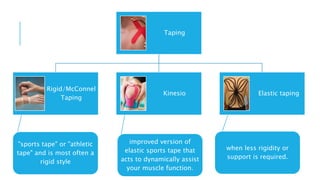
Taping
Rigid/McConnel
Taping
"sports tape" or "athletic
tape" and is most often a
rigid style
Kinesio
improved version of
elastic sports tape that
acts to dynamically assist
your muscle function.
Elastic taping
when less rigidity or
support is required.
MULLIGAN TAPING
Mobilization with Movement (MWM) developed by Brian Mulligan
FNZSP (Hon) of New Zealand is recognized worldwide in manual
therapy approaches.
His concept is the application of manually applied accessory joint
glide with concomitant pain-free active movement.
During the development of MWMs, Brian Mulligan discovered that
treatment in some patients was enhanced when he utilized taping to
compliment the directional forces provided after the MWM treatment
bout.
Taping is applied in directions that complement the applied MWM
passive force to joint or soft tissue.
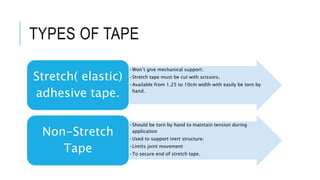
TYPES OF TAPE
•Won’t give mechanical support.
•Stretch tape must be cut with scissors.
•Available from 1.25 to 10cm width with easily be torn by
hand.
Stretch( elastic)
adhesive tape.
•Should be torn by hand to maintain tension during
application
•Used to support inert structure.
•Limits joint movement
•To secure end of stretch tape.
Non-Stretch
Tape
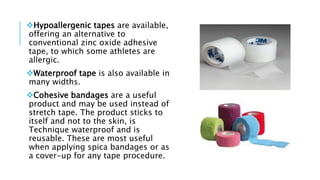
Hypoallergenic tapes are available,
offering an alternative to
conventional zinc oxide adhesive
tape, to which some athletes are
allergic.
Waterproof tape is also available in
many widths.
Cohesive bandages are a useful
product and may be used instead of
stretch tape. The product sticks to
itself and not to the skin, is
Technique waterproof and is
reusable. These are most useful
when applying spica bandages or as
a cover-up for any tape procedure.
TECHNIQUE
Tear the tape close to the roll
keeping it taut
Hold the tape with the thumb and index fingers close together
Rip the tape quickly in scissors fashion.
Practice tearing a strip of tape into very small pieces in both
directions, lengthwise and crossways.
TAPING PRINCIPLES
The application of tape is easy, but if it is not carried out
correctly it will be of little value, and may even be detrimental.
A thorough assessment is necessary before taping any
structure.
ASK FIRST ???
The following questions should be answered:
 Has the injury been thoroughly assessed?
 How did the injury occur?
 What structures were damaged?
 What tissues need protection and support?
 What movements must be restricted?
 Is the injury acute or chronic?
 Is immobilization necessary at this stage?
 Are you familiar with the anatomy and biomechanics of the parts
involved?
 Can you visualize the purpose for which the tape is to be applied?
 Are you familiar with the technique?
 Do you have suitable materials at hand?
GUIDELINES FOR TAPING/ DO’S
Prepare the area to be taped.
 Wash, dry and shave the skin in a downward direction.
 Remove oils for better adhesion.
 Cover broken lesions before taping; an electric shaver avoids cutting
the skin.
 Check if the athlete is allergic to tape or spray.
 Apply lubricated protective padding to friction and pressure areas.
 Apply adhesive spray for skin protection and better tape adhesion.
 Apply under wrap for sensitive skin.
TAPE APPLICATION
 Have all the required materials at hand.
 Have the athlete and yourself in a comfortable position, e.g. couch at
an optimal working height, to avoid fatigue.
 Apply tape to skin which is at room temperature.
 Have the full attention of the athlete.
 Place the joint in a functional position, with minimum stress on the
injured structure.
 Ensure that the ligaments are in the shortened position.
 Use the correct type, width and amount of tape for the procedure.
 Apply strips of tape in a sequential order.
 Overlap successive strips by half to prevent slippage and gapping.
 Apply each strip with a particular purpose in mind.
 Apply tape smoothly and firmly.
 Flow with the shape of the limb.
 Explain the function of the tape to the athlete, and how it should
feel.
 On completion, check that the tape is functional and comfortable.
DON’T
Avoid excessive traction on skin – this may lead to skin
breakdown
 Avoid gaps and wrinkles – these may cause blisters
Avoid continuous circumferential taping – single strips
produce a more uniform pressure
excessive layers of tape – this may impair circulation and
neural transmission
 too tight an application over bony areas – this may cause
bone ache
KINESIOLOGICAL TAPING
Therapeutic taping method
Uniquely designed elastic tape to enhance muscular, joint and
circulatory functions.
Cotton based cloth tape with acrylic glue that allows for ventilation,
good adhesion with minimal negative skin reaction.
Can be applied 24 hours a day, 3-5 days.
PRINCIPLES OF KINESIOLOGICAL
TAPING
Based on science of kinesiology, that body's
muscles are responsible for the movement of and in
the body as well as being in control of blood
circulation and temperature.
That’s why impaired muscles, are high risk area.
Kinesiological principal is to just support the
natural healing power of body itself.
MECHANISM
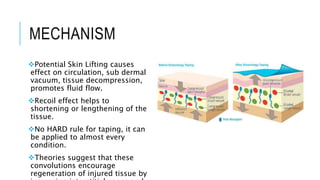
Potential Skin Lifting causes
effect on circulation, sub dermal
vacuum, tissue decompression,
promotes fluid flow.
Recoil effect helps to
shortening or lengthening of the
tissue.
No HARD rule for taping, it can
be applied to almost every
condition.
Theories suggest that these
convolutions encourage
regeneration of injured tissue by
KINESIOLOGICAL TAPPING
Basic Techniques
1. Therapeutic Muscular technique.
2. Therapeutic Ligamentous technique
Corrective technique
1. Therapeutic Lymphatic technique
2. Therapeutic Space technique
3. Therapeutic Positional technique
4. Therapeutic Musculofascial technique
5. Therapeutic Functional technique
APPLICATION
It demand thorough knowledge with anatomy in order to practice.
Its application is totlay different then traditional taping, so unlearn
traditional methods.
On desired application, paper back of tape can be torn, folded back
and removed asper requirement.
It can be worn by 3-5 days, and can be worn during work or sport.
The tape itself can stretch longitudinally upto 60%.
APPLICATION
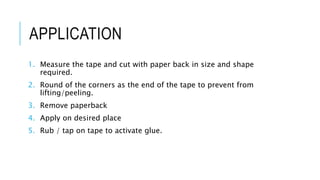
1. Measure the tape and cut with paper back in size and shape
required.
2. Round of the corners as the end of the tape to prevent from
lifting/peeling.
3. Remove paperback
4. Apply on desired place
5. Rub / tap on tape to activate glue.
KINESIOLOGICAL TAPE
TENSIONING
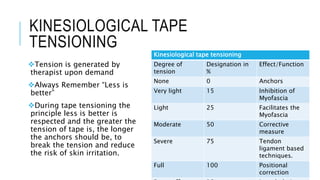
Tension is generated by
therapist upon demand
Always Remember “Less is
better”
During tape tensioning the
principle less is better is
respected and the greater the
tension of tape is, the longer
the anchors should be, to
break the tension and reduce
the risk of skin irritation.
Kinesiological tape tensioning
Degree of
tension
Designation in
%
Effect/Function
None 0 Anchors
Very light 15 Inhibition of
Myofascia
Light 25 Facilitates the
Myofascia
Moderate 50 Corrective
measure
Severe 75 Tendon
ligament based
techniques.
Full 100 Positional
correction
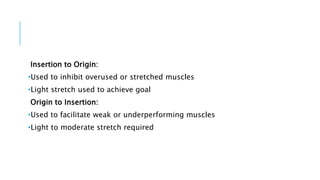
Insertion to Origin:
•Used to inhibit overused or stretched muscles
•Light stretch used to achieve goal
Origin to Insertion:
•Used to facilitate weak or underperforming muscles
•Light to moderate stretch required
THE CUTS
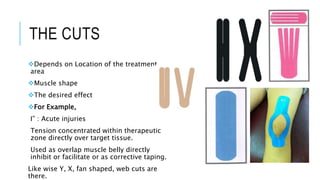
Depends on Location of the treatment
area
Muscle shape
The desired effect
For Example,
I” : Acute injuries
Tension concentrated within therapeutic
zone directly over target tissue.
Used as overlap muscle belly directly
inhibit or facilitate or as corrective taping.
Like wise Y, X, fan shaped, web cuts are
there.
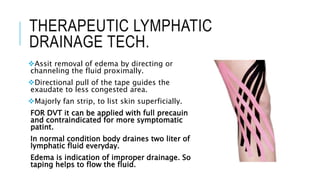
THERAPEUTIC LYMPHATIC
DRAINAGE TECH.
Assit removal of edema by directing or
channeling the fluid proximally.
Directional pull of the tape guides the
exaudate to less congested area.
Majorly fan strip, to list skin superficially.
FOR DVT it can be applied with full precauin
and contraindicated for more symptomatic
patint.
In normal condition body draines two liter of
lymphatic fluid everyday.
Edema is indication of improper drainage. So
taping helps to flow the fluid.
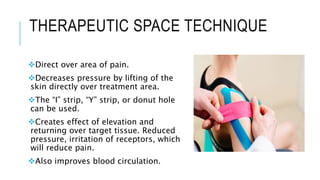
THERAPEUTIC SPACE TECHNIQUE
Direct over area of pain.
Decreases pressure by lifting of the
skin directly over treatment area.
The “I” strip, “Y” strip, or donut hole
can be used.
Creates effect of elevation and
returning over target tissue. Reduced
pressure, irritation of receptors, which
will reduce pain.
Also improves blood circulation.
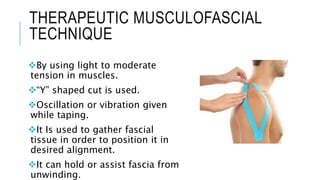
THERAPEUTIC MUSCULOFASCIAL
TECHNIQUE
By using light to moderate
tension in muscles.
“Y” shaped cut is used.
Oscillation or vibration given
while taping.
It Is used to gather fascial
tissue in order to position it in
desired alignment.
It can hold or assist fascia from
unwinding.
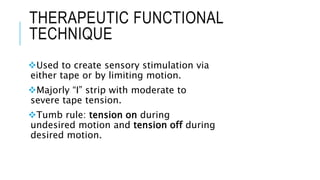
THERAPEUTIC FUNCTIONAL
TECHNIQUE
Used to create sensory stimulation via
either tape or by limiting motion.
Majorly “I” strip with moderate to
severe tape tension.
Tumb rule: tension on during
undesired motion and tension off during
desired motion.
THERAPEUTIC POSITIONAL
TECHNIQUE
Purpose of this technique is to reposition or return
structures to their normal position by positioning of the
structure to stimulate a sensation which results in the
bodys adaption to the stimulus.
Moderate to severe tension is applied top tape.
Functional support is there without losing active ROM.
THANK YOU.
REFERENCE
Taping Techniques, principles and Practise by Rose Macdonald.

Kinesio taping

  • 1.
    KINESIO TAPING DR.ANAND VAGHASIYA(PT)
  • 2.
    ROLE OF TAPING Initially,tape is applied to protect the injured structure, during the treatment and rehabilitation program. to compress recent injury, thus reducing bleeding and swelling to protect from further injury by supporting ligaments, tendons and muscles. to limit unwanted joint movement to allow optimal healing without stressing the injured structures
  • 3.
    USES: •relieve your pain •improvejoint stability •enhance athlete confidence •reduce injury recurrence •prevent injury •reduce strain on injured or vulnerable tissues •correct faulty biomechanics •inhibit muscle action •facilitate muscle action •enhance proprioception •compress in the presence of edema or lymphatic drainage
  • 4.
    PURPOSES Some of thesepurposes may be achieved through a combination of these possible effects of taping: •mechanical effects •neuromuscular effects •psychological effects There are different kinds of tape that can be employed:
  • 5.
    “TAPING IS NOTA SUBSTITUTE FOR TREATMENT AND REHABILITATION, BUT IS AN ADJUNCT TO THE TOTAL-INJURY CARE PROGRAM.”
  • 6.
    Taping Rigid/McConnel Taping "sports tape" or"athletic tape" and is most often a rigid style Kinesio improved version of elastic sports tape that acts to dynamically assist your muscle function. Elastic taping when less rigidity or support is required.
  • 7.
    MULLIGAN TAPING Mobilization withMovement (MWM) developed by Brian Mulligan FNZSP (Hon) of New Zealand is recognized worldwide in manual therapy approaches. His concept is the application of manually applied accessory joint glide with concomitant pain-free active movement. During the development of MWMs, Brian Mulligan discovered that treatment in some patients was enhanced when he utilized taping to compliment the directional forces provided after the MWM treatment bout. Taping is applied in directions that complement the applied MWM passive force to joint or soft tissue.
  • 8.
    TYPES OF TAPE •Won’tgive mechanical support. •Stretch tape must be cut with scissors. •Available from 1.25 to 10cm width with easily be torn by hand. Stretch( elastic) adhesive tape. •Should be torn by hand to maintain tension during application •Used to support inert structure. •Limits joint movement •To secure end of stretch tape. Non-Stretch Tape
  • 9.
    Hypoallergenic tapes areavailable, offering an alternative to conventional zinc oxide adhesive tape, to which some athletes are allergic. Waterproof tape is also available in many widths. Cohesive bandages are a useful product and may be used instead of stretch tape. The product sticks to itself and not to the skin, is Technique waterproof and is reusable. These are most useful when applying spica bandages or as a cover-up for any tape procedure.
  • 10.
    TECHNIQUE Tear the tapeclose to the roll keeping it taut Hold the tape with the thumb and index fingers close together Rip the tape quickly in scissors fashion. Practice tearing a strip of tape into very small pieces in both directions, lengthwise and crossways.
  • 11.
    TAPING PRINCIPLES The applicationof tape is easy, but if it is not carried out correctly it will be of little value, and may even be detrimental. A thorough assessment is necessary before taping any structure.
  • 12.
    ASK FIRST ??? Thefollowing questions should be answered:  Has the injury been thoroughly assessed?  How did the injury occur?  What structures were damaged?  What tissues need protection and support?  What movements must be restricted?
  • 13.
     Is theinjury acute or chronic?  Is immobilization necessary at this stage?  Are you familiar with the anatomy and biomechanics of the parts involved?  Can you visualize the purpose for which the tape is to be applied?  Are you familiar with the technique?  Do you have suitable materials at hand?
  • 14.
    GUIDELINES FOR TAPING/DO’S Prepare the area to be taped.  Wash, dry and shave the skin in a downward direction.  Remove oils for better adhesion.  Cover broken lesions before taping; an electric shaver avoids cutting the skin.  Check if the athlete is allergic to tape or spray.  Apply lubricated protective padding to friction and pressure areas.  Apply adhesive spray for skin protection and better tape adhesion.  Apply under wrap for sensitive skin.
  • 15.
    TAPE APPLICATION  Haveall the required materials at hand.  Have the athlete and yourself in a comfortable position, e.g. couch at an optimal working height, to avoid fatigue.  Apply tape to skin which is at room temperature.  Have the full attention of the athlete.  Place the joint in a functional position, with minimum stress on the injured structure.  Ensure that the ligaments are in the shortened position.
  • 16.
     Use thecorrect type, width and amount of tape for the procedure.  Apply strips of tape in a sequential order.  Overlap successive strips by half to prevent slippage and gapping.  Apply each strip with a particular purpose in mind.  Apply tape smoothly and firmly.  Flow with the shape of the limb.  Explain the function of the tape to the athlete, and how it should feel.  On completion, check that the tape is functional and comfortable.
  • 17.
    DON’T Avoid excessive tractionon skin – this may lead to skin breakdown  Avoid gaps and wrinkles – these may cause blisters Avoid continuous circumferential taping – single strips produce a more uniform pressure excessive layers of tape – this may impair circulation and neural transmission  too tight an application over bony areas – this may cause bone ache
  • 18.
    KINESIOLOGICAL TAPING Therapeutic tapingmethod Uniquely designed elastic tape to enhance muscular, joint and circulatory functions. Cotton based cloth tape with acrylic glue that allows for ventilation, good adhesion with minimal negative skin reaction. Can be applied 24 hours a day, 3-5 days.
  • 19.
    PRINCIPLES OF KINESIOLOGICAL TAPING Basedon science of kinesiology, that body's muscles are responsible for the movement of and in the body as well as being in control of blood circulation and temperature. That’s why impaired muscles, are high risk area. Kinesiological principal is to just support the natural healing power of body itself.
  • 20.
    MECHANISM Potential Skin Liftingcauses effect on circulation, sub dermal vacuum, tissue decompression, promotes fluid flow. Recoil effect helps to shortening or lengthening of the tissue. No HARD rule for taping, it can be applied to almost every condition. Theories suggest that these convolutions encourage regeneration of injured tissue by
  • 21.
    KINESIOLOGICAL TAPPING Basic Techniques 1.Therapeutic Muscular technique. 2. Therapeutic Ligamentous technique Corrective technique 1. Therapeutic Lymphatic technique 2. Therapeutic Space technique 3. Therapeutic Positional technique 4. Therapeutic Musculofascial technique 5. Therapeutic Functional technique
  • 22.
    APPLICATION It demand thoroughknowledge with anatomy in order to practice. Its application is totlay different then traditional taping, so unlearn traditional methods. On desired application, paper back of tape can be torn, folded back and removed asper requirement. It can be worn by 3-5 days, and can be worn during work or sport. The tape itself can stretch longitudinally upto 60%.
  • 23.
    APPLICATION 1. Measure thetape and cut with paper back in size and shape required. 2. Round of the corners as the end of the tape to prevent from lifting/peeling. 3. Remove paperback 4. Apply on desired place 5. Rub / tap on tape to activate glue.
  • 24.
    KINESIOLOGICAL TAPE TENSIONING Tension isgenerated by therapist upon demand Always Remember “Less is better” During tape tensioning the principle less is better is respected and the greater the tension of tape is, the longer the anchors should be, to break the tension and reduce the risk of skin irritation. Kinesiological tape tensioning Degree of tension Designation in % Effect/Function None 0 Anchors Very light 15 Inhibition of Myofascia Light 25 Facilitates the Myofascia Moderate 50 Corrective measure Severe 75 Tendon ligament based techniques. Full 100 Positional correction
  • 25.
    Insertion to Origin: •Usedto inhibit overused or stretched muscles •Light stretch used to achieve goal Origin to Insertion: •Used to facilitate weak or underperforming muscles •Light to moderate stretch required
  • 26.
    THE CUTS Depends onLocation of the treatment area Muscle shape The desired effect For Example, I” : Acute injuries Tension concentrated within therapeutic zone directly over target tissue. Used as overlap muscle belly directly inhibit or facilitate or as corrective taping. Like wise Y, X, fan shaped, web cuts are there.
  • 27.
    THERAPEUTIC LYMPHATIC DRAINAGE TECH. Assitremoval of edema by directing or channeling the fluid proximally. Directional pull of the tape guides the exaudate to less congested area. Majorly fan strip, to list skin superficially. FOR DVT it can be applied with full precauin and contraindicated for more symptomatic patint. In normal condition body draines two liter of lymphatic fluid everyday. Edema is indication of improper drainage. So taping helps to flow the fluid.
  • 28.
    THERAPEUTIC SPACE TECHNIQUE Directover area of pain. Decreases pressure by lifting of the skin directly over treatment area. The “I” strip, “Y” strip, or donut hole can be used. Creates effect of elevation and returning over target tissue. Reduced pressure, irritation of receptors, which will reduce pain. Also improves blood circulation.
  • 29.
    THERAPEUTIC MUSCULOFASCIAL TECHNIQUE By usinglight to moderate tension in muscles. “Y” shaped cut is used. Oscillation or vibration given while taping. It Is used to gather fascial tissue in order to position it in desired alignment. It can hold or assist fascia from unwinding.
  • 30.
    THERAPEUTIC FUNCTIONAL TECHNIQUE Used tocreate sensory stimulation via either tape or by limiting motion. Majorly “I” strip with moderate to severe tape tension. Tumb rule: tension on during undesired motion and tension off during desired motion.
  • 31.
    THERAPEUTIC POSITIONAL TECHNIQUE Purpose ofthis technique is to reposition or return structures to their normal position by positioning of the structure to stimulate a sensation which results in the bodys adaption to the stimulus. Moderate to severe tension is applied top tape. Functional support is there without losing active ROM.
  • 32.
  • 33.
    REFERENCE Taping Techniques, principlesand Practise by Rose Macdonald.