Humidification & Nebulization:
An Adjunct To Chest
Physiotherapy
Dr. Shilpasree Saha (PT)
Assistant Professor,
Nopany Institute Of Healthcare Studies, Kolkata,
India
MPT (Cardio-Thoracic Disorders)
Batch: 2018-20
MMIPR, MMDU
Humidity
 Humidity is the amount of water in vaporous state contained in a gas.
 Absolute humidity (AH) is the weight of water present in a given volume of gas and it is usually
expressed in mg/L.
 Relative humidity (RH) is the ratio of the actual weight of water vapor (AH) relative to the gas
capacity to keep water at a specific temperature.
 Whenever the amount of gas contained in a sample is equal to its water vapor capacity, the RH is
100%and the gas is completely saturated.
Humidification
Humidification is the
method by which
humidified air can be
introduced into the
respiratory system.
Physiological Airway Control of
Heat and Humidity
 Heat and moisture exchange is one of the
most important functions of the respiratory
system.
 Rich vascular system of numerous and thin
walled veins of connective tissues of nose is
responsible for warming the inspired air to
increase its humidity carrying capacity.
 Isothermic saturation boundary (ISB)- usually
located 5 cm below the carina ( temperature
is 37∘C and its relative humidity is 100%)
 Pseudostratified columnar ciliated epithelium of respiratory mucosa, numerous goblet cells and
submucosal glands underneath the epithelium, are responsible for trapping of pathogens and act
an interface for humidity exchange.
 Less goblet cells in terminal bronchioles and scarce submucosal glands leads to limited
humidification.
How does the humidification help?
 Maintain viscosity of airway secretions.
 Protection of respiratory tract (Mucous- line of defence)
 Adequate ciliary function (Dehydration immobilizes cilia).
 Easy mucocilliary clearance.
When do a patient need artificial
humidification?
Any interference with normal function of Upper
respiratory tract.
1) Supplemental oxygen (Dry gas), high flow
oxygen(> 4 L/min)
2) Bypassed upper airway
3) Post extubated irritated airway
4) Thick consistency of mucous.
Delivery methods
1. PATIENT WHO IS NOT INTUBATED
 A face mask
 A mouthpiece which the patient has to hold.
This method is frequently used with a nebulizer
as a method of giving a short period of
humidification prior to chest clearance.
2. INTUBATED PATIENT
 A tracheostomy humidifying T-tube
(Brompton tube) fits directly on to the wide-
bore tubing and the tracheostomy or
endotracheal tube.
 Tracheostomy mask.
3. A PATIENT ON INTERMITTENT POSITIVE PRESSURE VENTILATION (IPPV)
 It is essential that patients receiving IPPV receive humidification.
 A humidifier is usually incorporated into the ventilator.
 The majority of humidifiers used for this purpose are heated.
 The ideal temperature at the entrance to the endotracheal or tracheostomy tube is thought to be
34°C ± 2°C.
Types of humidifiers
 Humidifiers are devices that add molecules of water to gas.
Humidifiers
Active humidifiers
Passive humidifiers
Active humidifiers
 External sources of heat and water is used.
 It could be: heated or non heated.
(1) Bubble;
(2) Passover;
(3) Counter-flow;
(4) Inline vaporizer.
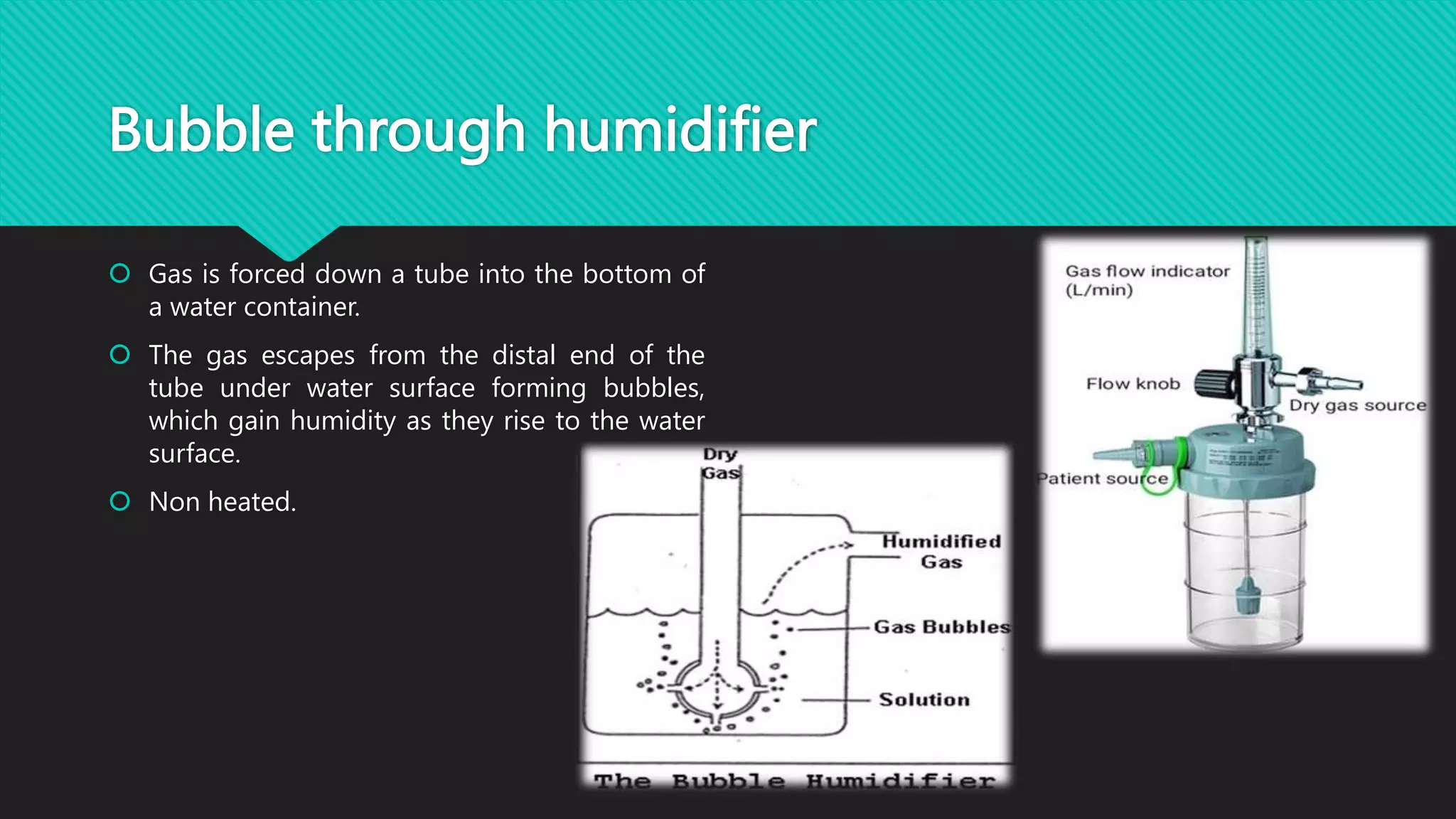
Bubble through humidifier
 Gas is forced down a tube into the bottom of
a water container.
 The gas escapes from the distal end of the
tube under water surface forming bubbles,
which gain humidity as they rise to the water
surface.
 Non heated.
Passover humidifier
 In passover humidifiers, gas passes over a
heated water reservoir carrying water vapor to
the patient.
Counter Flow Humidifier
 Water is heated outside the vaporizer.
 After being heated, water is pumped to the
top of the humidifier, enters the inside of the
humidifier through small diameter pores, and
then runs down a large surface area.
 Gas flows in counter direction.
 During its passage through the chamber of
the humidifier, the air is moisturized and
warmed to body temperature.
Inline vaporizer
 The novel inline vaporizer uses a small plastic capsule where water vapor is injected into the gas in
the inspiratory limb of the ventilator circuit immediately.
Passive humidifiers
 The utilization of patients’ own temperature and hydration to achieve humidification in successive
breaths.
Heat and Moisture
Exchangers (HMEs)
 Heat and moisture exchangers are also called
artificial noses because they mimic the action of
nasal cavity in gas humidification.
 Contain a condenser element, which retains
moisture from every exhaled breath and returns it
back to the next inspired breath.
 Mechanically ventilated patients.
Passive humidifier types
 HYDROSCOPIC: Absorb and hold water.
 HYDROPHOBIC: Contains water repelling substance.
Nebulization
 Nebulization is the process of delivery of
aerosol particles carried into the airways with
inspired gas.
 Aerosol- A suspension of liquid particles
(water/medication) in a gas.
How does it use as an adjunct to chest
Physiotherapy?
 Medication delivery:
 Bronchodilators
 Mucolytic agents
 Corticosteroids
 Antibiotic or antifungal drugs
 Reduction of upper airway edema
 Sputum induction- Hypertonic saline
Components of nebulizers
 Driving force: Compressed air or ultrasonic wave
 Formation of aerosol
 Patient interface: Mouth piece/ Face mask/ Ventilator circuit/ Artificial airway
Forms of nebulizers
Jet nebulizer acts on venturi effect
 Steamed of gas pass through a small hole.
 Low pressure has been created.
 A small tube is introduced with one end near
the area of low pressure and other end
immersed in bronchodilators.
 Liquid medication is drawn up the tube and
pushed on a baffle.
 Baffle splits the liquid into tiny particles,
hence nebulizing.
 Works on piezo-electric effect.
 It also incorporates a baffle but, liquid is set
into motion by vibrating crystals.
Ultrasonic nebulizer acts on piezo-electric
effect
Conclusion
 The effectiveness of the mucocilliary escalator is depend on appropriate temperature and moisture
level within the airways. Humidification of inspired air or nebulization is frequently utilized by
respiratory Physiotherapists to relieve sputum retention.
References
 Cash’s Textbook of Chest, Heart, and Vascular Disorders for Physiotherapists, 4th edition, p-358-60.
 Haitham S. Al Ashry, Ariel M. Modrykamien. Humidification during Mechanical Ventilation in the Adult Patient. BioMed Research
International. 2014;2014;1-12.
 D. Anjalatchi, C. Sugreev. A study to assess the effectiveness of nebulization followed by chest physiotherapy among patients
with respiratory problem, admitted in Era hospital at Lucknow. IP Journal of Nutrition, metabolism and health science.
2021;4(3);121-132.
Humidification & Nebulization.pptx

Humidification & Nebulization.pptx

  • 1.
    Humidification & Nebulization: AnAdjunct To Chest Physiotherapy Dr. Shilpasree Saha (PT) Assistant Professor, Nopany Institute Of Healthcare Studies, Kolkata, India MPT (Cardio-Thoracic Disorders) Batch: 2018-20 MMIPR, MMDU
  • 2.
    Humidity  Humidity isthe amount of water in vaporous state contained in a gas.  Absolute humidity (AH) is the weight of water present in a given volume of gas and it is usually expressed in mg/L.  Relative humidity (RH) is the ratio of the actual weight of water vapor (AH) relative to the gas capacity to keep water at a specific temperature.  Whenever the amount of gas contained in a sample is equal to its water vapor capacity, the RH is 100%and the gas is completely saturated.
  • 3.
    Humidification Humidification is the methodby which humidified air can be introduced into the respiratory system.
  • 4.
    Physiological Airway Controlof Heat and Humidity  Heat and moisture exchange is one of the most important functions of the respiratory system.  Rich vascular system of numerous and thin walled veins of connective tissues of nose is responsible for warming the inspired air to increase its humidity carrying capacity.  Isothermic saturation boundary (ISB)- usually located 5 cm below the carina ( temperature is 37∘C and its relative humidity is 100%)
  • 5.
     Pseudostratified columnarciliated epithelium of respiratory mucosa, numerous goblet cells and submucosal glands underneath the epithelium, are responsible for trapping of pathogens and act an interface for humidity exchange.  Less goblet cells in terminal bronchioles and scarce submucosal glands leads to limited humidification.
  • 6.
    How does thehumidification help?  Maintain viscosity of airway secretions.  Protection of respiratory tract (Mucous- line of defence)  Adequate ciliary function (Dehydration immobilizes cilia).  Easy mucocilliary clearance.
  • 7.
    When do apatient need artificial humidification? Any interference with normal function of Upper respiratory tract. 1) Supplemental oxygen (Dry gas), high flow oxygen(> 4 L/min)
  • 8.
    2) Bypassed upperairway 3) Post extubated irritated airway 4) Thick consistency of mucous.
  • 9.
    Delivery methods 1. PATIENTWHO IS NOT INTUBATED  A face mask  A mouthpiece which the patient has to hold. This method is frequently used with a nebulizer as a method of giving a short period of humidification prior to chest clearance.
  • 10.
    2. INTUBATED PATIENT A tracheostomy humidifying T-tube (Brompton tube) fits directly on to the wide- bore tubing and the tracheostomy or endotracheal tube.  Tracheostomy mask.
  • 11.
    3. A PATIENTON INTERMITTENT POSITIVE PRESSURE VENTILATION (IPPV)  It is essential that patients receiving IPPV receive humidification.  A humidifier is usually incorporated into the ventilator.  The majority of humidifiers used for this purpose are heated.  The ideal temperature at the entrance to the endotracheal or tracheostomy tube is thought to be 34°C ± 2°C.
  • 12.
    Types of humidifiers Humidifiers are devices that add molecules of water to gas. Humidifiers Active humidifiers Passive humidifiers
  • 13.
    Active humidifiers  Externalsources of heat and water is used.  It could be: heated or non heated. (1) Bubble; (2) Passover; (3) Counter-flow; (4) Inline vaporizer.
  • 14.
    Bubble through humidifier Gas is forced down a tube into the bottom of a water container.  The gas escapes from the distal end of the tube under water surface forming bubbles, which gain humidity as they rise to the water surface.  Non heated.
  • 15.
    Passover humidifier  Inpassover humidifiers, gas passes over a heated water reservoir carrying water vapor to the patient.
  • 16.
    Counter Flow Humidifier Water is heated outside the vaporizer.  After being heated, water is pumped to the top of the humidifier, enters the inside of the humidifier through small diameter pores, and then runs down a large surface area.  Gas flows in counter direction.  During its passage through the chamber of the humidifier, the air is moisturized and warmed to body temperature.
  • 17.
    Inline vaporizer  Thenovel inline vaporizer uses a small plastic capsule where water vapor is injected into the gas in the inspiratory limb of the ventilator circuit immediately.
  • 18.
    Passive humidifiers  Theutilization of patients’ own temperature and hydration to achieve humidification in successive breaths.
  • 19.
    Heat and Moisture Exchangers(HMEs)  Heat and moisture exchangers are also called artificial noses because they mimic the action of nasal cavity in gas humidification.  Contain a condenser element, which retains moisture from every exhaled breath and returns it back to the next inspired breath.  Mechanically ventilated patients.
  • 20.
    Passive humidifier types HYDROSCOPIC: Absorb and hold water.  HYDROPHOBIC: Contains water repelling substance.
  • 21.
    Nebulization  Nebulization isthe process of delivery of aerosol particles carried into the airways with inspired gas.  Aerosol- A suspension of liquid particles (water/medication) in a gas.
  • 22.
    How does ituse as an adjunct to chest Physiotherapy?  Medication delivery:  Bronchodilators  Mucolytic agents  Corticosteroids  Antibiotic or antifungal drugs  Reduction of upper airway edema  Sputum induction- Hypertonic saline
  • 23.
    Components of nebulizers Driving force: Compressed air or ultrasonic wave  Formation of aerosol  Patient interface: Mouth piece/ Face mask/ Ventilator circuit/ Artificial airway
  • 24.
    Forms of nebulizers Jetnebulizer acts on venturi effect  Steamed of gas pass through a small hole.  Low pressure has been created.  A small tube is introduced with one end near the area of low pressure and other end immersed in bronchodilators.  Liquid medication is drawn up the tube and pushed on a baffle.  Baffle splits the liquid into tiny particles, hence nebulizing.
  • 25.
     Works onpiezo-electric effect.  It also incorporates a baffle but, liquid is set into motion by vibrating crystals. Ultrasonic nebulizer acts on piezo-electric effect
  • 26.
    Conclusion  The effectivenessof the mucocilliary escalator is depend on appropriate temperature and moisture level within the airways. Humidification of inspired air or nebulization is frequently utilized by respiratory Physiotherapists to relieve sputum retention.
  • 27.
    References  Cash’s Textbookof Chest, Heart, and Vascular Disorders for Physiotherapists, 4th edition, p-358-60.  Haitham S. Al Ashry, Ariel M. Modrykamien. Humidification during Mechanical Ventilation in the Adult Patient. BioMed Research International. 2014;2014;1-12.  D. Anjalatchi, C. Sugreev. A study to assess the effectiveness of nebulization followed by chest physiotherapy among patients with respiratory problem, admitted in Era hospital at Lucknow. IP Journal of Nutrition, metabolism and health science. 2021;4(3);121-132.