HYPERTENSION
AS NUUR ASYHERA ASLEH
(201462324)
Prepare for:
ASSOC.PROF HJ ZULKIFLI ABD KADIR
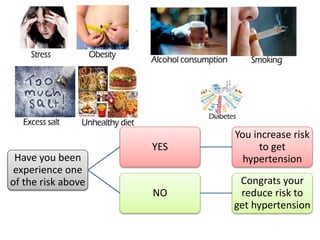
Have you been
experience one
of the risk above
YES
You increase risk
to get
hypertension
NO
Congrats your
reduce risk to
get hypertension
INTRODUCTION TO HYPERTENSION
Hypertension also known as high or
raised blood pressure (World Health
Organisation, 2015).
Hypertension condition in which blood
vessels have persistently raised pressure,
putting them under increased stress
(World Health Organisation, 2015).
Hypertension, or High blood pressure is
persistent SBP ≥140 mmHg and DBP ≥ 90
mmHg(American College of Sport
Medicine, 2014)
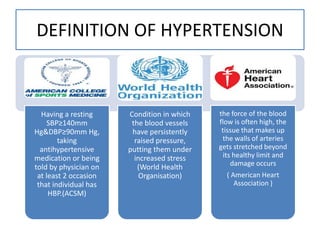
DEFINITION OF HYPERTENSION
Having a resting
SBP≥140mm
Hg&DBP≥90mm Hg,
taking
antihypertensive
medication or being
told by physician on
at least 2 occasion
that individual has
HBP.(ACSM)
Condition in which
the blood vessels
have persistently
raised pressure,
putting them under
increased stress
(World Health
Organisation)
the force of the blood
flow is often high, the
tissue that makes up
the walls of arteries
gets stretched beyond
its healthy limit and
damage occurs
( American Heart
Association )
GLOBAL PREVALENCE OF
HYPERTENSION
Year:2000
972 million
(26.4%)
Year: 2025
1560 million
(29.2%)
60%
-Kearney,D.M (2005)-
PREVALENCE OF HYPERTENSION IN
MALAYSIA
(Rampal,L.,Rampal,S.,Azhar,M.Z.,Rahman,A.R. , 2007)
PREVALENCE RURAL VS URBAN IN
MALAYSIA
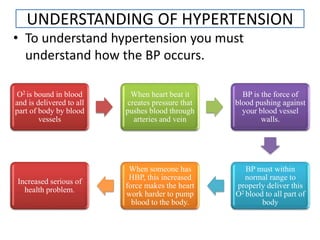
UNDERSTANDING OF HYPERTENSION
• To understand hypertension you must
understand how the BP occurs.
O2 is bound in blood
and is delivered to all
part of body by blood
vessels
When heart beat it
creates pressure that
pushes blood through
arteries and vein
BP is the force of
blood pushing against
your blood vessel
walls.
BP must within
normal range to
properly deliver this
O2 blood to all part of
body
When someone has
HBP, this increased
force makes the heart
work harder to pump
blood to the body.
Increased serious of
health problem.
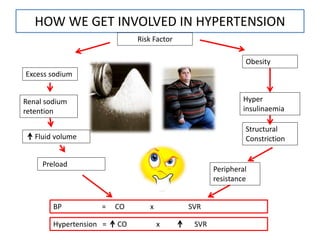
• BP: Cardiac Output(CO) x Systemic Vascular
Resistance(SVR)
• CO: total blood flow through systemic or
pulmonary circulation per minute.
• SVR: Force opposing movement of blood in
vessels.
CO=Stroke Volume x HR
HOW WE GET INVOLVED IN HYPERTENSION
Risk Factor
Excess sodium
Obesity
Renal sodium
retention
Fluid volume
Preload
Hyper
insulinaemia
Structural
Constriction
Peripheral
resistance
BP = CO x SVR
Hypertension = CO x SVR
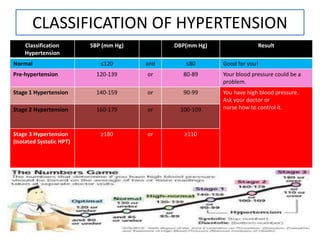
CLASSIFICATION OF HYPERTENSION
Classification
Hypertension
SBP (mm Hg) DBP(mm Hg) Result
Normal ≤120 and ≤80 Good for you!
Pre-hypertension 120-139 or 80-89 Your blood pressure could be a
problem.
Stage 1 Hypertension 140-159 or 90-99 You have high blood pressure.
Ask your doctor or
nurse how to control it.Stage 2 Hypertension 160-179 or 100-109
Stage 3 Hypertension
(Isolated Systolic HPT)
≥180 or ≥110
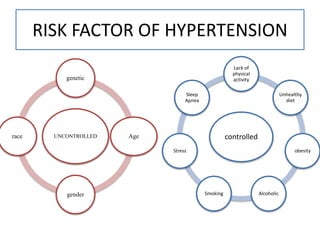
RISK FACTOR OF HYPERTENSION
UNCONTROLLED
genetic
Age
gender
race controlled
Lack of
physical
activity
Unhealthy
diet
obesity
AlcoholicSmoking
Stress
Sleep
Apnea
SYMPTOMS & COMPLICATIONS OF HYPERTENSION
Symptoms Complication
stroke
Kidney
failure
Heart
attack
Heart
failure
Cognitive
impairment
Headache
Shortness
of Breath
Dizziness
Chest
pain
Nose
bleed
TESTS ARE USED TO DIAGNOSE
HYPERTENSION
TEST TO
DIAGNOSE
HYPERTENSION
Ambulatory BP Stress Test
Ambulatory Blood Pressure
Diagnosed using blood pressure
monitor(Ambulatory BP)
monitoring by physician.
Ambulatory BP monitoring give
information about BP during
daily activities and sleep.
Measured SBP and DBP
Stress Test
Purpose:
• Help the doctor find out
how well your heart
handle work as your body
works harder such as
during do exercise.
• Helps the doctor know the
appropriate level of
exercise for a patient.
Diagnose
Coronary
Artery
Disease(CAD)
Diagnose a
possible
heart related
cause of
symptoms
Determine
safe level of
exercise
Check the
effectiveness
of Circulation
in patient
with CAD
Predict the
risk
dangerous
heart related
condition.
Objective
IMPLICATION OF FAILURE TO MANAGED
HYPERTENSION
* Therefore early diagnosis is essential to minimize cardiovascular risk and damage to
target organs.
PROGRAM OBJECTIVE
The fundamental goal for management of
Hypertension is lower high blood pressure to normal
state (SBP ≥140 and DBP ≥90 mmHg) through:
• Exercise
• Diet(DASH)
• Medications (Dieuretics)
DIET PLAN FOR HYPERTENSION
• Dietary Approaches to Stop Hypertension(DASH)-healthy diet for HBP
include limiting sodium intake and including a variety of nutritious foods.
Food Serving per day/ week example
Grains 6 – 8/day Cereal
Vegetable 4-5/day Tomatoes
Broccoli
Fruits 4-5/day Grape
Apple
Dairy product 2 -3/ day Yogurt
Milk
Lean meat,poultry&fish 6 / fewer per day Salmon
Tuna
Nuts,seeds&legumes 4 -5/week Beans
Peas
Soybean product
Fats&oils(unsaturated fat) 2 – 3/day Margarine
Sweat 5/fewer a week 1 table spoon sugar for one
servings
BENEFIT OF PHYSICAL ACTIVITY FOR
HYPERTENSION
Achieved normal BP.
Reduce visceral fat
Reduce contribution of
hypertension to CV risk
Increased sodium
elimination
Boost mood
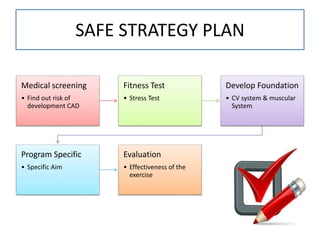
SAFE STRATEGY PLAN
Medical screening
• Find out risk of
development CAD
Fitness Test
• Stress Test
Develop Foundation
• CV system & muscular
System
Program Specific
• Specific Aim
Evaluation
• Effectiveness of the
exercise
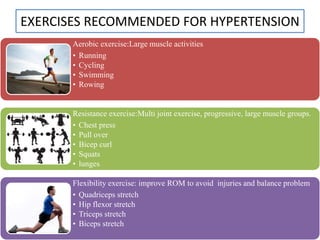
EXERCISES RECOMMENDED FOR HYPERTENSION
Aerobic exercise:Large muscle activities
• Running
• Cycling
• Swimming
• Rowing
Resistance exercise:Multi joint exercise, progressive, large muscle groups.
• Chest press
• Pull over
• Bicep curl
• Squats
• lunges
Flexibility exercise: improve ROM to avoid injuries and balance problem
• Quadriceps stretch
• Hip flexor stretch
• Triceps stretch
• Biceps stretch
ALTERNATIVE EXERCISE
RECOMMENDED
QI GONG YOGA TAICHI
No Pain , Big Gains
HOW EXERCISE LOWER THE BLOOD
PRESSURE?
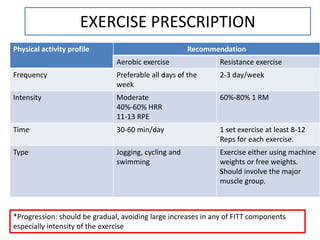
EXERCISE PRESCRIPTION
Physical activity profile Recommendation
Aerobic exercise Resistance exercise
Frequency Preferable all days of the
week
2-3 day/week
Intensity Moderate
40%-60% HRR
11-13 RPE
60%-80% 1 RM
Time 30-60 min/day 1 set exercise at least 8-12
Reps for each exercise.
Type Jogging, cycling and
swimming
Exercise either using machine
weights or free weights.
Should involve the major
muscle group.
*Progression: should be gradual, avoiding large increases in any of FITT components
especially intensity of the exercise
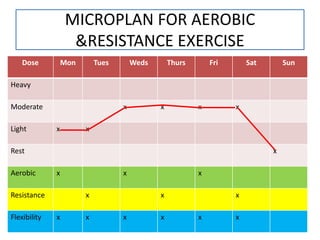
MICROPLAN FOR AEROBIC
&RESISTANCE EXERCISE
Dose Mon Tues Weds Thurs Fri Sat Sun
Heavy
Moderate x x x x
Light x x
Rest x
Aerobic x x x
Resistance x x x
Flexibility x x x x x x
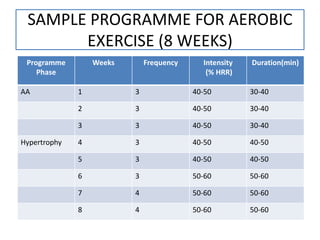
SAMPLE PROGRAMME FOR AEROBIC
EXERCISE (8 WEEKS)
Programme
Phase
Weeks Frequency Intensity
(% HRR)
Duration(min)
AA 1 3 40-50 30-40
2 3 40-50 30-40
3 3 40-50 30-40
Hypertrophy 4 3 40-50 40-50
5 3 40-50 40-50
6 3 50-60 50-60
7 4 50-60 50-60
8 4 50-60 50-60
SAMPLE PROGRAMME FOR AEROBIC
EXERCISE(3 DAYS/WEEK)
CV MON TUE WED THUR FRI SAT SUN
Mode Swimming Jogging cycling
Duration
(min)
30-40 30-40 30-40
Intensity
(% HRR)
40-50 40-50 40-50
SAMPLE PROGRAMME FOR
RESISTANCE EXERCISE (8 WEEKS)
Programme
Phase
Weeks Frequency Intensity
(% HRR)
Duration(min)
AA 1 2 30-40 30-40
2 2 30-40 30-40
3 2 40-50 30-40
Hypertrophy 4 3 40-50 40-50
5 3 50-55 40-50
6 3 50-55 40-50
7 3 55-60 50-60
8 3 55-60 50-60
SAMPLE PROGRAMME FOR RESISTANCE EXERCISE
Exercise Implement Set Reps RI
(min)
Muscle Target
Leg press LP machine 2 8-8 1-2 Quadriceps
Gluteal
Hamstring
Chest press Dumbbell 2 8-8 1-2 Pectoralis major &
minor
Deltoid
Biceps
Leg curls LC machine 2 8-8 1-2 Hamstring
Calves
Hip flexor
Lat pull down LP machine 2 8-8 1-2 Latisimus dorsi
Trapezius
Erector spinae
Biceps curl Dumbbell 2 8-8 1-2 Triceps
Biceps
Brachialis
brachioradialis
CONT..
Exercise Implement Set Reps RI (min) Muscle
Target
Lunges Dumbbell 2 8-8 1-2 Gluteus max
Quadriceps
Triceps
extension
Dumbbell 2 8-8 1-2 Triceps
Deltoid
Biceps brachi
Squat Dumbbell 2 8-8 1-2 Gluteal
Quadriceps
Femoral
Leg raise Yoga mat 2 8-8 1-2 Rectus
Abdominal
Abdominal
oblique
plank Yoga mat 2 1 min - Rectus
Abdominal
External
oblique
Quadriceps
AEROBIC VS RESISTANCE EXERCISE
Aerobic training
Should be more
recommended to
reduce blood
pressure in
hypertensive
individuals, while
Resistance exercise
prescribed as a
complementary
strategy.
Cardoso
et al.
(2010) Dynamic Aerobic
endurance reduces
resting SBP&DBP
among hypertensive
group. Even
moderate levels of
exercise lowered
blood pressure and
reduces body
weight, body fat and
waist circumference.
Cornelissan
& Fagard
(2005)
Reduce 2 mm
HG in mean SBP
yield 7%reduces
in risk of
Coronary Artery
Diseases(CAD)
Lewington
et al.
(2002)
SPECIAL CONSIDERATIONS
Patients with uncontrolled
severe hypertension should add
exercise training to their
treatment plan only after first
being evaluated by physician.
For individual documented
CVD, vigorous exercise must
under medical supervision.
When exercise is prudent to
maintain SBP ≤220 & DBP ≤
150mm Hg
Beta blockers & diuretics may adversely affect
thermoregulatory function and cause hypoglycaemia
in some individuals. In this situations, educate
patients about sign and symptoms of heat intolerance
and hypoglycaemia, and precaution should be taken
to avoid these situation.
Antihypertensive medication such as,
calcium channel blockers may lead to
sudden reduction in post exercise BP.
Extend & monitor the cool down period
carefully in this situations.
Beta blockers, particularly the non-
selective types, may reduce sub
maximal and maximal exercise
capacity in patient without myocardial
ischemia. Consider using perceived
exertion to monitor exercise intensity
in this individual.
Individuals with hypertension
are often overweight or obese
.This individuals should focus
on increasing caloric
expenditure coupled reducing
caloric intake .
TIPS CONTROLLING HBP
TIPS TO CONTROLLING HBP :3C
•CHECK
•CHANGE
•CONTROLLING
REFERENCES
Pescatello,L.S.,Arena,R.&Thomson,P.D.(2013).ACSM’s Guidelines for exercise testing and prescription(9th edition).American
College of Sports Medicine.
World Health organization.(2015). Hypertension. Retrieved from the http://www.who.int/features/qa/82/en/.
American Heart Association.(2015).Hypertension. Retrieved from the http://www.heart.org/HEARTORG/.
Kearney,D.M.(2005).Pharmacogenetics of essential hypertension. Journal of Medicine and Biotechnology,10,(196-204).
Rampal ,L.,Rampal , S., Azhar , M.Z., Rahman,A.R.(2007).Prevalence , awareness, treatment and control of hypertension in
Malaysia: A national study of 16 440 subjects. Journal of The Royal Institute of Public Health.122.(11-18).
National Institute of health.(2003).Guide to lowering blood pressure. United State.
Cordoso,C.G.,Gomides,R.S.,Cristane,A.,Queiroz,C.,Pinto,G.,Lodo,F.S.,Tinucci,T.,Mion,D.&Forjaz,C.L.M.(2010).Acute and
chronic effects of aerobic and resistance exercise on ambulatory blood pressure.Journal of Physiology and Health,3,(25-
317).
Cornelissein,R.&Fagard,R.(2005).Twenty four hour blood pressure after exercise in patients with coronary artery disease.Journal
of Human Hypertension,5,41-231.
Lewigton,S.,Park,S.,Jastremski,C.A.,Wallace,J.P.(2005).Time of day for exercise on blood pressure reduction in dipping and non
dipping hypertension.Journal of human and hypertension,39,(82-676).
Healthy lifestyle nutrition and healthy eating.(2015).DASH diet: Healthy eating to lower your blood pressure reviewed from
http://www.mayoclinic.org/healthy-lifestyle/nutrition-and-healthy-eating/in-depth/dash-diet/art-20048456 .
• Thank you for your cooperation and attention.
• Get ready for our practical session.

Hypertension and exercise

  • 1.
    HYPERTENSION AS NUUR ASYHERAASLEH (201462324) Prepare for: ASSOC.PROF HJ ZULKIFLI ABD KADIR
  • 2.
    Have you been experienceone of the risk above YES You increase risk to get hypertension NO Congrats your reduce risk to get hypertension
  • 3.
    INTRODUCTION TO HYPERTENSION Hypertensionalso known as high or raised blood pressure (World Health Organisation, 2015). Hypertension condition in which blood vessels have persistently raised pressure, putting them under increased stress (World Health Organisation, 2015). Hypertension, or High blood pressure is persistent SBP ≥140 mmHg and DBP ≥ 90 mmHg(American College of Sport Medicine, 2014)
  • 4.
    DEFINITION OF HYPERTENSION Havinga resting SBP≥140mm Hg&DBP≥90mm Hg, taking antihypertensive medication or being told by physician on at least 2 occasion that individual has HBP.(ACSM) Condition in which the blood vessels have persistently raised pressure, putting them under increased stress (World Health Organisation) the force of the blood flow is often high, the tissue that makes up the walls of arteries gets stretched beyond its healthy limit and damage occurs ( American Heart Association )
  • 5.
    GLOBAL PREVALENCE OF HYPERTENSION Year:2000 972million (26.4%) Year: 2025 1560 million (29.2%) 60% -Kearney,D.M (2005)-
  • 7.
    PREVALENCE OF HYPERTENSIONIN MALAYSIA (Rampal,L.,Rampal,S.,Azhar,M.Z.,Rahman,A.R. , 2007)
  • 8.
    PREVALENCE RURAL VSURBAN IN MALAYSIA
  • 9.
    UNDERSTANDING OF HYPERTENSION •To understand hypertension you must understand how the BP occurs. O2 is bound in blood and is delivered to all part of body by blood vessels When heart beat it creates pressure that pushes blood through arteries and vein BP is the force of blood pushing against your blood vessel walls. BP must within normal range to properly deliver this O2 blood to all part of body When someone has HBP, this increased force makes the heart work harder to pump blood to the body. Increased serious of health problem.
  • 11.
    • BP: CardiacOutput(CO) x Systemic Vascular Resistance(SVR) • CO: total blood flow through systemic or pulmonary circulation per minute. • SVR: Force opposing movement of blood in vessels. CO=Stroke Volume x HR
  • 13.
    HOW WE GETINVOLVED IN HYPERTENSION Risk Factor Excess sodium Obesity Renal sodium retention Fluid volume Preload Hyper insulinaemia Structural Constriction Peripheral resistance BP = CO x SVR Hypertension = CO x SVR
  • 14.
    CLASSIFICATION OF HYPERTENSION Classification Hypertension SBP(mm Hg) DBP(mm Hg) Result Normal ≤120 and ≤80 Good for you! Pre-hypertension 120-139 or 80-89 Your blood pressure could be a problem. Stage 1 Hypertension 140-159 or 90-99 You have high blood pressure. Ask your doctor or nurse how to control it.Stage 2 Hypertension 160-179 or 100-109 Stage 3 Hypertension (Isolated Systolic HPT) ≥180 or ≥110
  • 15.
    RISK FACTOR OFHYPERTENSION UNCONTROLLED genetic Age gender race controlled Lack of physical activity Unhealthy diet obesity AlcoholicSmoking Stress Sleep Apnea
  • 16.
    SYMPTOMS & COMPLICATIONSOF HYPERTENSION Symptoms Complication stroke Kidney failure Heart attack Heart failure Cognitive impairment Headache Shortness of Breath Dizziness Chest pain Nose bleed
  • 17.
    TESTS ARE USEDTO DIAGNOSE HYPERTENSION TEST TO DIAGNOSE HYPERTENSION Ambulatory BP Stress Test
  • 18.
    Ambulatory Blood Pressure Diagnosedusing blood pressure monitor(Ambulatory BP) monitoring by physician. Ambulatory BP monitoring give information about BP during daily activities and sleep. Measured SBP and DBP
  • 19.
    Stress Test Purpose: • Helpthe doctor find out how well your heart handle work as your body works harder such as during do exercise. • Helps the doctor know the appropriate level of exercise for a patient. Diagnose Coronary Artery Disease(CAD) Diagnose a possible heart related cause of symptoms Determine safe level of exercise Check the effectiveness of Circulation in patient with CAD Predict the risk dangerous heart related condition. Objective
  • 20.
    IMPLICATION OF FAILURETO MANAGED HYPERTENSION * Therefore early diagnosis is essential to minimize cardiovascular risk and damage to target organs.
  • 21.
    PROGRAM OBJECTIVE The fundamentalgoal for management of Hypertension is lower high blood pressure to normal state (SBP ≥140 and DBP ≥90 mmHg) through: • Exercise • Diet(DASH) • Medications (Dieuretics)
  • 22.
    DIET PLAN FORHYPERTENSION • Dietary Approaches to Stop Hypertension(DASH)-healthy diet for HBP include limiting sodium intake and including a variety of nutritious foods. Food Serving per day/ week example Grains 6 – 8/day Cereal Vegetable 4-5/day Tomatoes Broccoli Fruits 4-5/day Grape Apple Dairy product 2 -3/ day Yogurt Milk Lean meat,poultry&fish 6 / fewer per day Salmon Tuna Nuts,seeds&legumes 4 -5/week Beans Peas Soybean product Fats&oils(unsaturated fat) 2 – 3/day Margarine Sweat 5/fewer a week 1 table spoon sugar for one servings
  • 24.
    BENEFIT OF PHYSICALACTIVITY FOR HYPERTENSION Achieved normal BP. Reduce visceral fat Reduce contribution of hypertension to CV risk Increased sodium elimination Boost mood
  • 25.
    SAFE STRATEGY PLAN Medicalscreening • Find out risk of development CAD Fitness Test • Stress Test Develop Foundation • CV system & muscular System Program Specific • Specific Aim Evaluation • Effectiveness of the exercise
  • 26.
    EXERCISES RECOMMENDED FORHYPERTENSION Aerobic exercise:Large muscle activities • Running • Cycling • Swimming • Rowing Resistance exercise:Multi joint exercise, progressive, large muscle groups. • Chest press • Pull over • Bicep curl • Squats • lunges Flexibility exercise: improve ROM to avoid injuries and balance problem • Quadriceps stretch • Hip flexor stretch • Triceps stretch • Biceps stretch
  • 27.
    ALTERNATIVE EXERCISE RECOMMENDED QI GONGYOGA TAICHI No Pain , Big Gains
  • 28.
    HOW EXERCISE LOWERTHE BLOOD PRESSURE?
  • 29.
    EXERCISE PRESCRIPTION Physical activityprofile Recommendation Aerobic exercise Resistance exercise Frequency Preferable all days of the week 2-3 day/week Intensity Moderate 40%-60% HRR 11-13 RPE 60%-80% 1 RM Time 30-60 min/day 1 set exercise at least 8-12 Reps for each exercise. Type Jogging, cycling and swimming Exercise either using machine weights or free weights. Should involve the major muscle group. *Progression: should be gradual, avoiding large increases in any of FITT components especially intensity of the exercise
  • 30.
    MICROPLAN FOR AEROBIC &RESISTANCEEXERCISE Dose Mon Tues Weds Thurs Fri Sat Sun Heavy Moderate x x x x Light x x Rest x Aerobic x x x Resistance x x x Flexibility x x x x x x
  • 31.
    SAMPLE PROGRAMME FORAEROBIC EXERCISE (8 WEEKS) Programme Phase Weeks Frequency Intensity (% HRR) Duration(min) AA 1 3 40-50 30-40 2 3 40-50 30-40 3 3 40-50 30-40 Hypertrophy 4 3 40-50 40-50 5 3 40-50 40-50 6 3 50-60 50-60 7 4 50-60 50-60 8 4 50-60 50-60
  • 32.
    SAMPLE PROGRAMME FORAEROBIC EXERCISE(3 DAYS/WEEK) CV MON TUE WED THUR FRI SAT SUN Mode Swimming Jogging cycling Duration (min) 30-40 30-40 30-40 Intensity (% HRR) 40-50 40-50 40-50
  • 33.
    SAMPLE PROGRAMME FOR RESISTANCEEXERCISE (8 WEEKS) Programme Phase Weeks Frequency Intensity (% HRR) Duration(min) AA 1 2 30-40 30-40 2 2 30-40 30-40 3 2 40-50 30-40 Hypertrophy 4 3 40-50 40-50 5 3 50-55 40-50 6 3 50-55 40-50 7 3 55-60 50-60 8 3 55-60 50-60
  • 34.
    SAMPLE PROGRAMME FORRESISTANCE EXERCISE Exercise Implement Set Reps RI (min) Muscle Target Leg press LP machine 2 8-8 1-2 Quadriceps Gluteal Hamstring Chest press Dumbbell 2 8-8 1-2 Pectoralis major & minor Deltoid Biceps Leg curls LC machine 2 8-8 1-2 Hamstring Calves Hip flexor Lat pull down LP machine 2 8-8 1-2 Latisimus dorsi Trapezius Erector spinae Biceps curl Dumbbell 2 8-8 1-2 Triceps Biceps Brachialis brachioradialis
  • 35.
    CONT.. Exercise Implement SetReps RI (min) Muscle Target Lunges Dumbbell 2 8-8 1-2 Gluteus max Quadriceps Triceps extension Dumbbell 2 8-8 1-2 Triceps Deltoid Biceps brachi Squat Dumbbell 2 8-8 1-2 Gluteal Quadriceps Femoral Leg raise Yoga mat 2 8-8 1-2 Rectus Abdominal Abdominal oblique plank Yoga mat 2 1 min - Rectus Abdominal External oblique Quadriceps
  • 36.
    AEROBIC VS RESISTANCEEXERCISE Aerobic training Should be more recommended to reduce blood pressure in hypertensive individuals, while Resistance exercise prescribed as a complementary strategy. Cardoso et al. (2010) Dynamic Aerobic endurance reduces resting SBP&DBP among hypertensive group. Even moderate levels of exercise lowered blood pressure and reduces body weight, body fat and waist circumference. Cornelissan & Fagard (2005) Reduce 2 mm HG in mean SBP yield 7%reduces in risk of Coronary Artery Diseases(CAD) Lewington et al. (2002)
  • 37.
    SPECIAL CONSIDERATIONS Patients withuncontrolled severe hypertension should add exercise training to their treatment plan only after first being evaluated by physician. For individual documented CVD, vigorous exercise must under medical supervision. When exercise is prudent to maintain SBP ≤220 & DBP ≤ 150mm Hg Beta blockers & diuretics may adversely affect thermoregulatory function and cause hypoglycaemia in some individuals. In this situations, educate patients about sign and symptoms of heat intolerance and hypoglycaemia, and precaution should be taken to avoid these situation. Antihypertensive medication such as, calcium channel blockers may lead to sudden reduction in post exercise BP. Extend & monitor the cool down period carefully in this situations. Beta blockers, particularly the non- selective types, may reduce sub maximal and maximal exercise capacity in patient without myocardial ischemia. Consider using perceived exertion to monitor exercise intensity in this individual. Individuals with hypertension are often overweight or obese .This individuals should focus on increasing caloric expenditure coupled reducing caloric intake .
  • 38.
    TIPS CONTROLLING HBP TIPSTO CONTROLLING HBP :3C •CHECK •CHANGE •CONTROLLING
  • 39.
    REFERENCES Pescatello,L.S.,Arena,R.&Thomson,P.D.(2013).ACSM’s Guidelines forexercise testing and prescription(9th edition).American College of Sports Medicine. World Health organization.(2015). Hypertension. Retrieved from the http://www.who.int/features/qa/82/en/. American Heart Association.(2015).Hypertension. Retrieved from the http://www.heart.org/HEARTORG/. Kearney,D.M.(2005).Pharmacogenetics of essential hypertension. Journal of Medicine and Biotechnology,10,(196-204). Rampal ,L.,Rampal , S., Azhar , M.Z., Rahman,A.R.(2007).Prevalence , awareness, treatment and control of hypertension in Malaysia: A national study of 16 440 subjects. Journal of The Royal Institute of Public Health.122.(11-18). National Institute of health.(2003).Guide to lowering blood pressure. United State. Cordoso,C.G.,Gomides,R.S.,Cristane,A.,Queiroz,C.,Pinto,G.,Lodo,F.S.,Tinucci,T.,Mion,D.&Forjaz,C.L.M.(2010).Acute and chronic effects of aerobic and resistance exercise on ambulatory blood pressure.Journal of Physiology and Health,3,(25- 317). Cornelissein,R.&Fagard,R.(2005).Twenty four hour blood pressure after exercise in patients with coronary artery disease.Journal of Human Hypertension,5,41-231. Lewigton,S.,Park,S.,Jastremski,C.A.,Wallace,J.P.(2005).Time of day for exercise on blood pressure reduction in dipping and non dipping hypertension.Journal of human and hypertension,39,(82-676). Healthy lifestyle nutrition and healthy eating.(2015).DASH diet: Healthy eating to lower your blood pressure reviewed from http://www.mayoclinic.org/healthy-lifestyle/nutrition-and-healthy-eating/in-depth/dash-diet/art-20048456 .
  • 40.
    • Thank youfor your cooperation and attention. • Get ready for our practical session.