By
Radhika Chintamani
Cyriax Concept
Content
*Introduction.
*History.
*Principles of diagnosis.
*Assessment by function.
*Principles of treatment.
*Evidence.
*References.
Introduction
*Cyriax is one of the form of diagnostic and treatment based
approach of manual therapy.
* It is both invasive and non-invasive technique which
depends on the type, extent and position of the disorder
present.
*Cyriax method of diagnosis is mainly by “Selective Tissue
Tension’’ which is basically application of specific amount of
manually applied pressure on selective tissue which is to be
assessed and treated.
J H Cyriax & P J Cyriax. Cyriax's Illustrated Manual Of Orthopedic Medicine, 2nd
Edition,1993.
*Cyriax school of manual therapy consists of various
treatment concepts:
a. Transverse Friction Massage.
b. Infiltration.
c. Traction.
d. Manipulation.
J H Cyriax & P J Cyriax. Cyriax's Illustrated Manual Of Orthopedic Medicine, 2nd
Edition,1993.
History
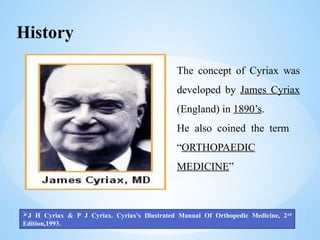
The concept of Cyriax was
developed by James Cyriax
(England) in 1890’s.
He also coined the term
“ORTHOPAEDIC
MEDICINE”
J H Cyriax & P J Cyriax. Cyriax's Illustrated Manual Of Orthopedic Medicine, 2nd
Edition,1993.
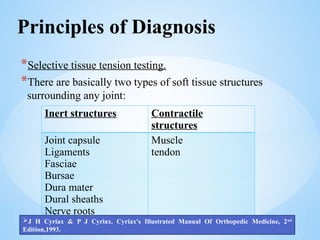
Principles of Diagnosis
*Selective tissue tension testing.
*There are basically two types of soft tissue structures
surrounding any joint:
Inert structures Contractile
structures
Joint capsule
Ligaments
Fasciae
Bursae
Dura mater
Dural sheaths
Nerve roots
Muscle
tendon
J H Cyriax & P J Cyriax. Cyriax's Illustrated Manual Of Orthopedic Medicine, 2nd
Edition,1993.
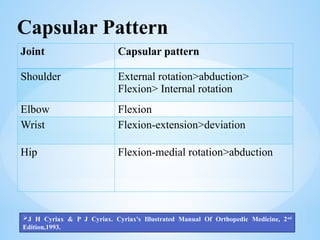
Capsular Pattern
Joint Capsular pattern
Shoulder External rotation>abduction>
Flexion> Internal rotation
Elbow Flexion
Wrist Flexion-extension>deviation
Hip Flexion-medial rotation>abduction
J H Cyriax & P J Cyriax. Cyriax's Illustrated Manual Of Orthopedic Medicine, 2nd
Edition,1993.
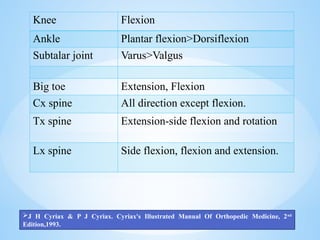
Knee Flexion
Ankle Plantar flexion>Dorsiflexion
Subtalar joint Varus>Valgus
Big toe Extension, Flexion
Cx spine All direction except flexion.
Tx spine Extension-side flexion and rotation
Lx spine Side flexion, flexion and extension.
J H Cyriax & P J Cyriax. Cyriax's Illustrated Manual Of Orthopedic Medicine, 2nd
Edition,1993.
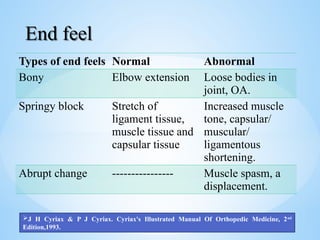
End feelEnd feel
Types of end feels Normal Abnormal
Bony Elbow extension Loose bodies in
joint, OA.
Springy block Stretch of
ligament tissue,
muscle tissue and
capsular tissue
Increased muscle
tone, capsular/
muscular/
ligamentous
shortening.
Abrupt change ---------------- Muscle spasm, a
displacement.
J H Cyriax & P J Cyriax. Cyriax's Illustrated Manual Of Orthopedic Medicine, 2nd
Edition,1993.
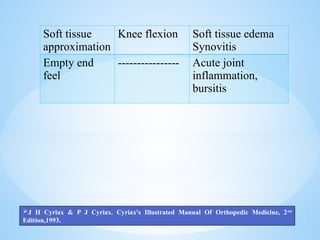
Soft tissue
approximation
Knee flexion Soft tissue edema
Synovitis
Empty end
feel
---------------- Acute joint
inflammation,
bursitis
J H Cyriax & P J Cyriax. Cyriax's Illustrated Manual Of Orthopedic Medicine, 2nd
Edition,1993.
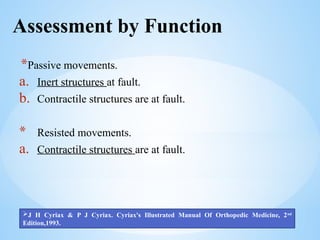
Assessment by Function
*Passive movements.
a. Inert structures at fault.
b. Contractile structures are at fault.
* Resisted movements.
a. Contractile structures are at fault.
J H Cyriax & P J Cyriax. Cyriax's Illustrated Manual Of Orthopedic Medicine, 2nd
Edition,1993.
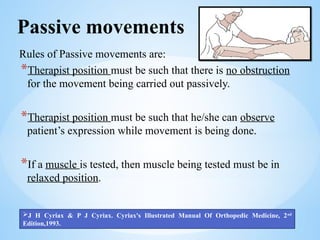
Passive movements
Rules of Passive movements are:
*Therapist position must be such that there is no obstruction
for the movement being carried out passively.
*Therapist position must be such that he/she can observe
patient’s expression while movement is being done.
*If a muscle is tested, then muscle being tested must be in
relaxed position.
J H Cyriax & P J Cyriax. Cyriax's Illustrated Manual Of Orthopedic Medicine, 2nd
Edition,1993.
Findings of Passive movements
*If passive movements are painful: usually inert structures are
at fault.
*Extra-articular limitation: two joint musculature tightness.
*Capsular lesion: Capsular pattern.
*Ligamentous sprains: painful if torn.
*Muscular: painful if torn, spasm, adhesions present.
*Internal derangement: loose bodies, degeneration.
J H Cyriax & P J Cyriax. Cyriax's Illustrated Manual Of Orthopedic Medicine, 2nd
Edition,1993.
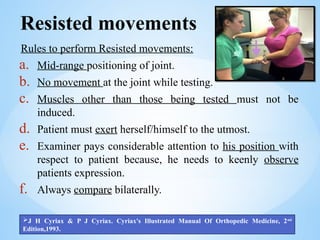
Resisted movements
Rules to perform Resisted movements:
a. Mid-range positioning of joint.
b. No movement at the joint while testing.
c. Muscles other than those being tested must not be
induced.
d. Patient must exert herself/himself to the utmost.
e. Examiner pays considerable attention to his position with
respect to patient because, he needs to keenly observe
patients expression.
f. Always compare bilaterally.
J H Cyriax & P J Cyriax. Cyriax's Illustrated Manual Of Orthopedic Medicine, 2nd
Edition,1993.
Findings of Resisted movements
Resisted Isometric Grading:
*Strong and painless: normal
*Strong and painful: minor lesion of some part of muscle or
tendon or its attachment.
*Weak and painless: complete rupture of relevant muscle or
tendon.
*Weak and painful: fracture or secondary deposits
*Painful on repetition: intermittent claudication.
*All resisted movements painful: gross lesion lying proximally
usually capsular.
J H Cyriax & P J Cyriax. Cyriax's Illustrated Manual Of Orthopedic Medicine, 2nd
Edition,1993.
SHIFTING
PAIN
Shifting of a
lesion
Shifting disc
fragments
Back pain
EXPANDING
PAIN
Increase in the
reference area
Local pain
intensifies
REFERRED
PAIN
Originates in
fixed location
Perceived at
location other
than site of
painful stimulus
Cyriax divided pain into 3 types
Pain
J H Cyriax & P J Cyriax. Cyriax's Illustrated Manual Of Orthopedic Medicine, 2nd
Edition,1993.
*Referred pain: pain perceived elsewhere than its true site is
termed so.
*Pain is referred to the area of the skin connected with those
particular cortical cells.
*There are further two types of referred pain
a. Segementally referred pain
b. Extra-segmentally referred pain.
J H Cyriax & P J Cyriax. Cyriax's Illustrated Manual Of Orthopedic Medicine, 2nd
Edition,1993.
Rules of referred pain
*Pain is referred segmentally.
*Pain is referred distally.
*Referred pain never crosses midline.
*The extent of reference is controlled by:
-Size of dermatome and position in that dermatome of
the tissue at fault.
-Strength of the stimulus.
-Depth of the tissue at fault.
J H Cyriax & P J Cyriax. Cyriax's Illustrated Manual Of Orthopedic Medicine, 2nd
Edition,1993.
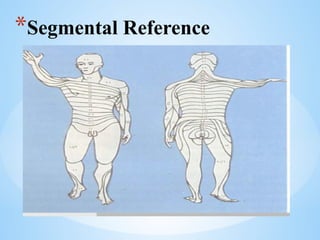
*Segmental Reference
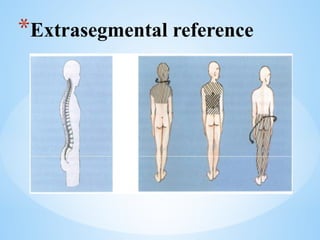
*Extrasegmental reference
*Interference with motor conduction will display as weakness
on resisted movements.
*Interference with sensory conduction will show itself as
cutaneous analgesia.
*Pressure on nerve roots: refer to segmentally referred pain.
*Compression of dura refers to pain extrasegmentally.
Interpretation
J H Cyriax & P J Cyriax. Cyriax's Illustrated Manual Of Orthopedic Medicine, 2nd
Edition,1993.
Basic principles of treatment
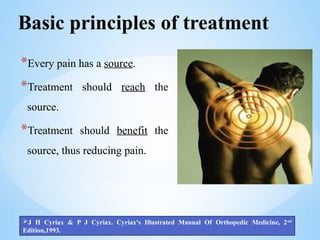
*Every pain has a source.
*Treatment should reach the
source.
*Treatment should benefit the
source, thus reducing pain.
J H Cyriax & P J Cyriax. Cyriax's Illustrated Manual Of Orthopedic Medicine, 2nd
Edition,1993.
Types of Cyriax treatment
*Transverse Friction Massage.
*Infiltration.
*Traction.
*Manipulation.
J H Cyriax & P J Cyriax. Cyriax's Illustrated Manual Of Orthopedic Medicine, 2nd
Edition,1993.
Deep Transverse Friction Massage
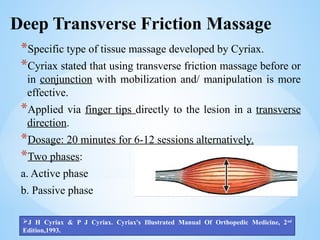
*Specific type of tissue massage developed by Cyriax.
*Cyriax stated that using transverse friction massage before or
in conjunction with mobilization and/ manipulation is more
effective.
*Applied via finger tips directly to the lesion in a transverse
direction.
*Dosage: 20 minutes for 6-12 sessions alternatively.
*Two phases:
a. Active phase
b. Passive phase
J H Cyriax & P J Cyriax. Cyriax's Illustrated Manual Of Orthopedic Medicine, 2nd
Edition,1993.
Principle of performing Transverse
Friction Massage
*Lesion must be brought within reach of therapist fingers.
a. If a muscle is to be treated, then it must be placed in a
relaxed position.
b. If tendon without sheath must be treated then it is placed in
most accessible point.
c. Tenosynovitis: tendon must be tautened.
d. Ligament: most palpable position.
* Treatment is applied by therapists finger tips.
* Hand and forearm should be in a straight line parallel to the
movement plane with interphalangeal joints slightly flexed.
J H Cyriax & P J Cyriax. Cyriax's Illustrated Manual Of Orthopedic Medicine, 2nd
Edition,1993.
*Amount of pressure applied depends on the
following points:
•Depth of lesion.
•Age of lesion.
•Tenderness.
J H Cyriax & P J Cyriax. Cyriax's Illustrated Manual Of Orthopedic
Medicine, 2nd
Edition,1993.
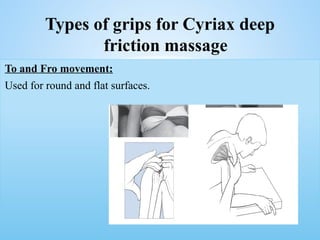
To and Fro movement:
Used for round and flat surfaces.
To and Fro movement:
Used for round and flat surfaces.
Types of grips for Cyriax deep
friction massage
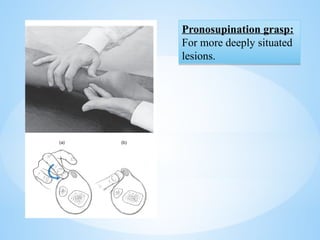
Pronosupination grasp:
For more deeply situated
lesions.
Pronosupination grasp:
For more deeply situated
lesions.
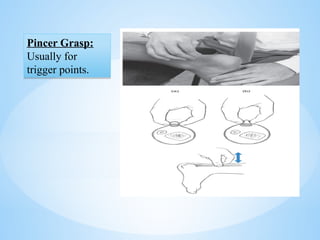
Pincer Grasp:
Usually for
trigger points.
Pincer Grasp:
Usually for
trigger points.
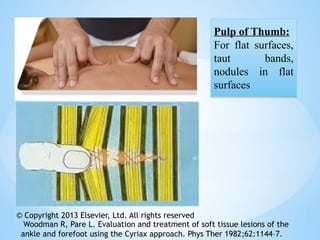
Pulp of Thumb:
For flat surfaces,
taut bands,
nodules in flat
surfaces
Pulp of Thumb:
For flat surfaces,
taut bands,
nodules in flat
surfaces
© Copyright 2013 Elsevier, Ltd. All rights reserved
Woodman R, Pare L. Evaluation and treatment of soft tissue lesions of the
ankle and forefoot using the Cyriax approach. Phys Ther 1982;62:1144–7.
Uses of Deep Friction Massage:
*Better than steroids: because effect is long term
compared to steroids and doesn’t interfere in healing
process.
*Used often before and in conjunction with mobilization
technique.
*Effect is local: Performed only at the site of
inflammation.
*Relief of pain: gate control theory.
*Effect on connective tissue repair.
*Breaks adhesion.
*Increases mobility of muscles.
General principles of manual therapy. Principles of treatment. 2013.
pg no: 83-115.
Indications Contraindications
Sub-acute stage
Myosynovitis
Open wound
Sub-acute stage
Tenosynovitis
Local metastasis
Sub-acute stage
Tendinitis
Haematoma
Adhesions Extensive ossification in muscles,
tendons, ligaments or capsules.
Partial rupture Complete rupture
Scar tissue Acute stages of Tendinitis,
Tenosynovitis, Myosynovitis.
General principles of manual therapy. Principles of treatment. 2013.
pg no: 83-115.
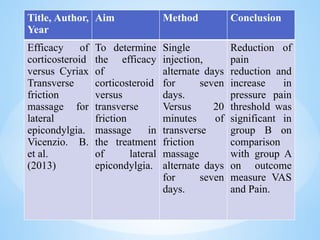
Title, Author,
Year
Aim Method Conclusion
Efficacy of
corticosteroid
versus Cyriax
Transverse
friction
massage for
lateral
epicondylgia.
Vicenzio. B.
et al.
(2013)
To determine
the efficacy
of
corticosteroid
versus
transverse
friction
massage in
the treatment
of lateral
epicondylgia.
Single
injection,
alternate days
for seven
days.
Versus 20
minutes of
transverse
friction
massage
alternate days
for seven
days.
Reduction of
pain
reduction and
increase in
pressure pain
threshold was
significant in
group B on
comparison
with group A
on outcome
measure VAS
and Pain.
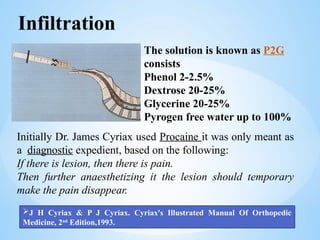
Infiltration
The solution is known as P2G
consists
Phenol 2-2.5%
Dextrose 20-25%
Glycerine 20-25%
Pyrogen free water up to 100%
Initially Dr. James Cyriax used Procaine it was only meant as
a diagnostic expedient, based on the following:
If there is lesion, then there is pain.
Then further anaesthetizing it the lesion should temporary
make the pain disappear.
J H Cyriax & P J Cyriax. Cyriax's Illustrated Manual Of Orthopedic
Medicine, 2nd
Edition,1993.
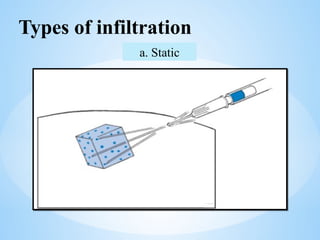
Types of infiltration
a. Static
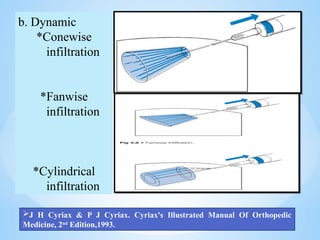
b. Dynamic
*Conewise
infiltration
*Fanwise
infiltration
*Cylindrical
infiltration
J H Cyriax & P J Cyriax. Cyriax's Illustrated Manual Of Orthopedic
Medicine, 2nd
Edition,1993.
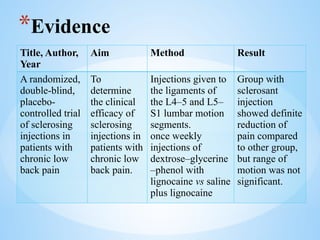
*Evidence
Title, Author,
Year
Aim Method Result
A randomized,
double-blind,
placebo-
controlled trial
of sclerosing
injections in
patients with
chronic low
back pain
To
determine
the clinical
efficacy of
sclerosing
injections in
patients with
chronic low
back pain.
Injections given to
the ligaments of
the L4–5 and L5–
S1 lumbar motion
segments.
once weekly
injections of
dextrose–glycerine
–phenol with
lignocaine vs saline
plus lignocaine
Group with
sclerosant
injection
showed definite
reduction of
pain compared
to other group,
but range of
motion was not
significant.
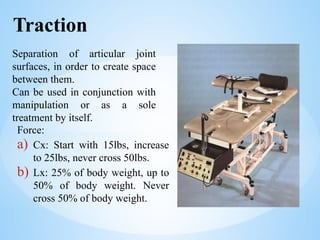
Traction
Separation of articular joint
surfaces, in order to create space
between them.
Can be used in conjunction with
manipulation or as a sole
treatment by itself.
Force:
a) Cx: Start with 15lbs, increase
to 25lbs, never cross 50lbs.
b) Lx: 25% of body weight, up to
50% of body weight. Never
cross 50% of body weight.
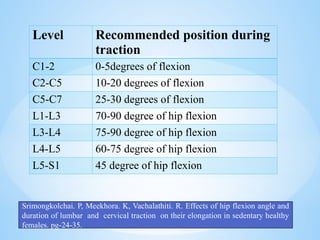
Level Recommended position during
traction
C1-2 0-5degrees of flexion
C2-C5 10-20 degrees of flexion
C5-C7 25-30 degrees of flexion
L1-L3 70-90 degree of hip flexion
L3-L4 75-90 degree of hip flexion
L4-L5 60-75 degree of hip flexion
L5-S1 45 degree of hip flexion
Srimongkolchai. P, Meekhora. K, Vachalathiti. R. Effects of hip flexion angle and
duration of lumbar and cervical traction on their elongation in sedentary healthy
females. pg-24-35.
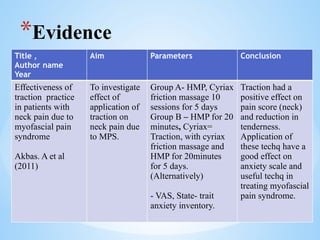
*Evidence
Title ,
Author name
Year
Aim Parameters Conclusion
Effectiveness of
traction practice
in patients with
neck pain due to
myofascial pain
syndrome
Akbas. A et al
(2011)
To investigate
effect of
application of
traction on
neck pain due
to MPS.
Group A- HMP, Cyriax
friction massage 10
sessions for 5 days
Group B – HMP for 20
minutes, Cyriax=
Traction, with cyriax
friction massage and
HMP for 20minutes
for 5 days.
(Alternatively)
- VAS, State- trait
anxiety inventory.
Traction had a
positive effect on
pain score (neck)
and reduction in
tenderness.
Application of
these techq have a
good effect on
anxiety scale and
useful techq in
treating myofascial
pain syndrome.
Manipulation
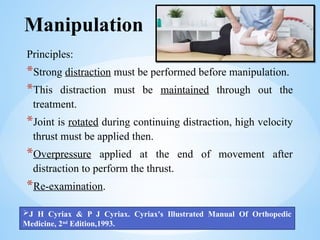
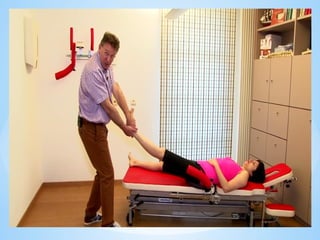
Principles:
*Strong distraction must be performed before manipulation.
*This distraction must be maintained through out the
treatment.
*Joint is rotated during continuing distraction, high velocity
thrust must be applied then.
*Overpressure applied at the end of movement after
distraction to perform the thrust.
*Re-examination.
J H Cyriax & P J Cyriax. Cyriax's Illustrated Manual Of Orthopedic
Medicine, 2nd
Edition,1993.
Uses of manipulation:
*Decreases pain.
*Restores Range of motion.
*Unlocks the joint.
*Decreases pain through range of motion.
*Systemic hypoalgesia.
*Disruption of articular and peri-articular adhesions.
J H Cyriax & P J Cyriax. Cyriax's Illustrated Manual Of Orthopedic
Medicine, 2nd
Edition,1993.
Indications Contraindications
Hypomobility Osteoporosis
Facet lock Haematoma.
Presence of loose
bodies
Unstable fractures.
Intra-articular
displacement
Nerve root compression, Cord
compression.
Articular and
periarticular adhesions
Rheumatoid arthritis, psoriatic
arthritis, Reiter’s syndrome and
ankylosing spondylitis
Local tumours
J H Cyriax & P J Cyriax. Cyriax's Illustrated Manual Of Orthopedic
Medicine, 2nd
Edition,1993.
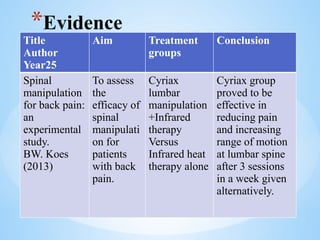
*Evidence
Title
Author
Year25
Aim Treatment
groups
Conclusion
Spinal
manipulation
for back pain:
an
experimental
study.
BW. Koes
(2013)
To assess
the
efficacy of
spinal
manipulati
on for
patients
with back
pain.
Cyriax
lumbar
manipulation
+Infrared
therapy
Versus
Infrared heat
therapy alone
Cyriax group
proved to be
effective in
reducing pain
and increasing
range of motion
at lumbar spine
after 3 sessions
in a week given
alternatively.
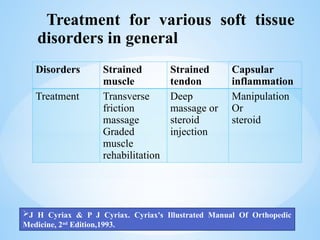
Disorders Strained
muscle
Strained
tendon
Capsular
inflammation
Treatment Transverse
friction
massage
Graded
muscle
rehabilitation
Deep
massage or
steroid
injection
Manipulation
Or
steroid
Treatment for various soft tissue
disorders in general
J H Cyriax & P J Cyriax. Cyriax's Illustrated Manual Of Orthopedic
Medicine, 2nd
Edition,1993.
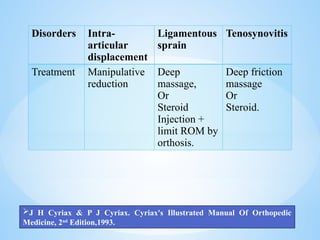
Disorders Intra-
articular
displacement
Ligamentous
sprain
Tenosynovitis
Treatment Manipulative
reduction
Deep
massage,
Or
Steroid
Injection +
limit ROM by
orthosis.
Deep friction
massage
Or
Steroid.
J H Cyriax & P J Cyriax. Cyriax's Illustrated Manual Of Orthopedic
Medicine, 2nd
Edition,1993.
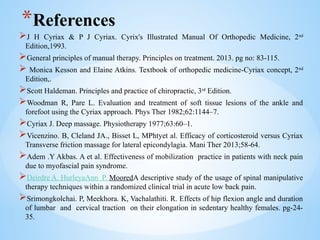
*References
J H Cyriax & P J Cyriax. Cyrix's Illustrated Manual Of Orthopedic Medicine, 2nd
Edition,1993.
General principles of manual therapy. Principles on treatment. 2013. pg no: 83-115.
 Monica Kesson and Elaine Atkins. Textbook of orthopedic medicine-Cyriax concept, 2nd
Edition,.
Scott Haldeman. Principles and practice of chiropractic, 3rd
Edition.
Woodman R, Pare L. Evaluation and treatment of soft tissue lesions of the ankle and
forefoot using the Cyriax approach. Phys Ther 1982;62:1144–7.
Cyriax J. Deep massage. Physiotherapy 1977;63:60–1.
Vicenzino. B, Cleland JA., Bisset L, MPhtyet al. Efficacy of corticosteroid versus Cyriax
Transverse friction massage for lateral epicondylagia. Mani Ther 2013;58-64.
Adem .Y Akbas. A et al. Effectiveness of mobilization practice in patients with neck pain
due to myofascial pain syndrome.
Deirdre A. HurleyaAnn P. MooredA descriptive study of the usage of spinal manipulative
therapy techniques within a randomized clinical trial in acute low back pain.
Srimongkolchai. P, Meekhora. K, Vachalathiti. R. Effects of hip flexion angle and duration
of lumbar and cervical traction on their elongation in sedentary healthy females. pg-24-
35.

Cyraix 23rd jan

  • 1.
  • 2.
    Content *Introduction. *History. *Principles of diagnosis. *Assessmentby function. *Principles of treatment. *Evidence. *References.
  • 3.
    Introduction *Cyriax is oneof the form of diagnostic and treatment based approach of manual therapy. * It is both invasive and non-invasive technique which depends on the type, extent and position of the disorder present. *Cyriax method of diagnosis is mainly by “Selective Tissue Tension’’ which is basically application of specific amount of manually applied pressure on selective tissue which is to be assessed and treated. J H Cyriax & P J Cyriax. Cyriax's Illustrated Manual Of Orthopedic Medicine, 2nd Edition,1993.
  • 4.
    *Cyriax school ofmanual therapy consists of various treatment concepts: a. Transverse Friction Massage. b. Infiltration. c. Traction. d. Manipulation. J H Cyriax & P J Cyriax. Cyriax's Illustrated Manual Of Orthopedic Medicine, 2nd Edition,1993.
  • 5.
    History The concept ofCyriax was developed by James Cyriax (England) in 1890’s. He also coined the term “ORTHOPAEDIC MEDICINE” J H Cyriax & P J Cyriax. Cyriax's Illustrated Manual Of Orthopedic Medicine, 2nd Edition,1993.
  • 6.
    Principles of Diagnosis *Selectivetissue tension testing. *There are basically two types of soft tissue structures surrounding any joint: Inert structures Contractile structures Joint capsule Ligaments Fasciae Bursae Dura mater Dural sheaths Nerve roots Muscle tendon J H Cyriax & P J Cyriax. Cyriax's Illustrated Manual Of Orthopedic Medicine, 2nd Edition,1993.
  • 7.
    Capsular Pattern Joint Capsularpattern Shoulder External rotation>abduction> Flexion> Internal rotation Elbow Flexion Wrist Flexion-extension>deviation Hip Flexion-medial rotation>abduction J H Cyriax & P J Cyriax. Cyriax's Illustrated Manual Of Orthopedic Medicine, 2nd Edition,1993.
  • 8.
    Knee Flexion Ankle Plantarflexion>Dorsiflexion Subtalar joint Varus>Valgus Big toe Extension, Flexion Cx spine All direction except flexion. Tx spine Extension-side flexion and rotation Lx spine Side flexion, flexion and extension. J H Cyriax & P J Cyriax. Cyriax's Illustrated Manual Of Orthopedic Medicine, 2nd Edition,1993.
  • 9.
    End feelEnd feel Typesof end feels Normal Abnormal Bony Elbow extension Loose bodies in joint, OA. Springy block Stretch of ligament tissue, muscle tissue and capsular tissue Increased muscle tone, capsular/ muscular/ ligamentous shortening. Abrupt change ---------------- Muscle spasm, a displacement. J H Cyriax & P J Cyriax. Cyriax's Illustrated Manual Of Orthopedic Medicine, 2nd Edition,1993.
  • 10.
    Soft tissue approximation Knee flexionSoft tissue edema Synovitis Empty end feel ---------------- Acute joint inflammation, bursitis J H Cyriax & P J Cyriax. Cyriax's Illustrated Manual Of Orthopedic Medicine, 2nd Edition,1993.
  • 11.
    Assessment by Function *Passivemovements. a. Inert structures at fault. b. Contractile structures are at fault. * Resisted movements. a. Contractile structures are at fault. J H Cyriax & P J Cyriax. Cyriax's Illustrated Manual Of Orthopedic Medicine, 2nd Edition,1993.
  • 12.
    Passive movements Rules ofPassive movements are: *Therapist position must be such that there is no obstruction for the movement being carried out passively. *Therapist position must be such that he/she can observe patient’s expression while movement is being done. *If a muscle is tested, then muscle being tested must be in relaxed position. J H Cyriax & P J Cyriax. Cyriax's Illustrated Manual Of Orthopedic Medicine, 2nd Edition,1993.
  • 13.
    Findings of Passivemovements *If passive movements are painful: usually inert structures are at fault. *Extra-articular limitation: two joint musculature tightness. *Capsular lesion: Capsular pattern. *Ligamentous sprains: painful if torn. *Muscular: painful if torn, spasm, adhesions present. *Internal derangement: loose bodies, degeneration. J H Cyriax & P J Cyriax. Cyriax's Illustrated Manual Of Orthopedic Medicine, 2nd Edition,1993.
  • 14.
    Resisted movements Rules toperform Resisted movements: a. Mid-range positioning of joint. b. No movement at the joint while testing. c. Muscles other than those being tested must not be induced. d. Patient must exert herself/himself to the utmost. e. Examiner pays considerable attention to his position with respect to patient because, he needs to keenly observe patients expression. f. Always compare bilaterally. J H Cyriax & P J Cyriax. Cyriax's Illustrated Manual Of Orthopedic Medicine, 2nd Edition,1993.
  • 15.
    Findings of Resistedmovements Resisted Isometric Grading: *Strong and painless: normal *Strong and painful: minor lesion of some part of muscle or tendon or its attachment. *Weak and painless: complete rupture of relevant muscle or tendon. *Weak and painful: fracture or secondary deposits *Painful on repetition: intermittent claudication. *All resisted movements painful: gross lesion lying proximally usually capsular. J H Cyriax & P J Cyriax. Cyriax's Illustrated Manual Of Orthopedic Medicine, 2nd Edition,1993.
  • 16.
    SHIFTING PAIN Shifting of a lesion Shiftingdisc fragments Back pain EXPANDING PAIN Increase in the reference area Local pain intensifies REFERRED PAIN Originates in fixed location Perceived at location other than site of painful stimulus Cyriax divided pain into 3 types Pain J H Cyriax & P J Cyriax. Cyriax's Illustrated Manual Of Orthopedic Medicine, 2nd Edition,1993.
  • 17.
    *Referred pain: painperceived elsewhere than its true site is termed so. *Pain is referred to the area of the skin connected with those particular cortical cells. *There are further two types of referred pain a. Segementally referred pain b. Extra-segmentally referred pain. J H Cyriax & P J Cyriax. Cyriax's Illustrated Manual Of Orthopedic Medicine, 2nd Edition,1993.
  • 18.
    Rules of referredpain *Pain is referred segmentally. *Pain is referred distally. *Referred pain never crosses midline. *The extent of reference is controlled by: -Size of dermatome and position in that dermatome of the tissue at fault. -Strength of the stimulus. -Depth of the tissue at fault. J H Cyriax & P J Cyriax. Cyriax's Illustrated Manual Of Orthopedic Medicine, 2nd Edition,1993.
  • 19.
  • 20.
  • 21.
    *Interference with motorconduction will display as weakness on resisted movements. *Interference with sensory conduction will show itself as cutaneous analgesia. *Pressure on nerve roots: refer to segmentally referred pain. *Compression of dura refers to pain extrasegmentally. Interpretation J H Cyriax & P J Cyriax. Cyriax's Illustrated Manual Of Orthopedic Medicine, 2nd Edition,1993.
  • 22.
    Basic principles oftreatment *Every pain has a source. *Treatment should reach the source. *Treatment should benefit the source, thus reducing pain. J H Cyriax & P J Cyriax. Cyriax's Illustrated Manual Of Orthopedic Medicine, 2nd Edition,1993.
  • 23.
    Types of Cyriaxtreatment *Transverse Friction Massage. *Infiltration. *Traction. *Manipulation. J H Cyriax & P J Cyriax. Cyriax's Illustrated Manual Of Orthopedic Medicine, 2nd Edition,1993.
  • 24.
    Deep Transverse FrictionMassage *Specific type of tissue massage developed by Cyriax. *Cyriax stated that using transverse friction massage before or in conjunction with mobilization and/ manipulation is more effective. *Applied via finger tips directly to the lesion in a transverse direction. *Dosage: 20 minutes for 6-12 sessions alternatively. *Two phases: a. Active phase b. Passive phase J H Cyriax & P J Cyriax. Cyriax's Illustrated Manual Of Orthopedic Medicine, 2nd Edition,1993.
  • 25.
    Principle of performingTransverse Friction Massage *Lesion must be brought within reach of therapist fingers. a. If a muscle is to be treated, then it must be placed in a relaxed position. b. If tendon without sheath must be treated then it is placed in most accessible point. c. Tenosynovitis: tendon must be tautened. d. Ligament: most palpable position. * Treatment is applied by therapists finger tips. * Hand and forearm should be in a straight line parallel to the movement plane with interphalangeal joints slightly flexed. J H Cyriax & P J Cyriax. Cyriax's Illustrated Manual Of Orthopedic Medicine, 2nd Edition,1993.
  • 26.
    *Amount of pressureapplied depends on the following points: •Depth of lesion. •Age of lesion. •Tenderness. J H Cyriax & P J Cyriax. Cyriax's Illustrated Manual Of Orthopedic Medicine, 2nd Edition,1993.
  • 27.
    To and Fromovement: Used for round and flat surfaces. To and Fro movement: Used for round and flat surfaces. Types of grips for Cyriax deep friction massage
  • 28.
    Pronosupination grasp: For moredeeply situated lesions. Pronosupination grasp: For more deeply situated lesions.
  • 29.
    Pincer Grasp: Usually for triggerpoints. Pincer Grasp: Usually for trigger points.
  • 30.
    Pulp of Thumb: Forflat surfaces, taut bands, nodules in flat surfaces Pulp of Thumb: For flat surfaces, taut bands, nodules in flat surfaces © Copyright 2013 Elsevier, Ltd. All rights reserved Woodman R, Pare L. Evaluation and treatment of soft tissue lesions of the ankle and forefoot using the Cyriax approach. Phys Ther 1982;62:1144–7.
  • 31.
    Uses of DeepFriction Massage: *Better than steroids: because effect is long term compared to steroids and doesn’t interfere in healing process. *Used often before and in conjunction with mobilization technique. *Effect is local: Performed only at the site of inflammation. *Relief of pain: gate control theory. *Effect on connective tissue repair. *Breaks adhesion. *Increases mobility of muscles. General principles of manual therapy. Principles of treatment. 2013. pg no: 83-115.
  • 32.
    Indications Contraindications Sub-acute stage Myosynovitis Openwound Sub-acute stage Tenosynovitis Local metastasis Sub-acute stage Tendinitis Haematoma Adhesions Extensive ossification in muscles, tendons, ligaments or capsules. Partial rupture Complete rupture Scar tissue Acute stages of Tendinitis, Tenosynovitis, Myosynovitis. General principles of manual therapy. Principles of treatment. 2013. pg no: 83-115.
  • 33.
    Title, Author, Year Aim MethodConclusion Efficacy of corticosteroid versus Cyriax Transverse friction massage for lateral epicondylgia. Vicenzio. B. et al. (2013) To determine the efficacy of corticosteroid versus transverse friction massage in the treatment of lateral epicondylgia. Single injection, alternate days for seven days. Versus 20 minutes of transverse friction massage alternate days for seven days. Reduction of pain reduction and increase in pressure pain threshold was significant in group B on comparison with group A on outcome measure VAS and Pain.
  • 34.
    Infiltration The solution isknown as P2G consists Phenol 2-2.5% Dextrose 20-25% Glycerine 20-25% Pyrogen free water up to 100% Initially Dr. James Cyriax used Procaine it was only meant as a diagnostic expedient, based on the following: If there is lesion, then there is pain. Then further anaesthetizing it the lesion should temporary make the pain disappear. J H Cyriax & P J Cyriax. Cyriax's Illustrated Manual Of Orthopedic Medicine, 2nd Edition,1993.
  • 35.
  • 36.
    b. Dynamic *Conewise infiltration *Fanwise infiltration *Cylindrical infiltration J HCyriax & P J Cyriax. Cyriax's Illustrated Manual Of Orthopedic Medicine, 2nd Edition,1993.
  • 37.
    *Evidence Title, Author, Year Aim MethodResult A randomized, double-blind, placebo- controlled trial of sclerosing injections in patients with chronic low back pain To determine the clinical efficacy of sclerosing injections in patients with chronic low back pain. Injections given to the ligaments of the L4–5 and L5– S1 lumbar motion segments. once weekly injections of dextrose–glycerine –phenol with lignocaine vs saline plus lignocaine Group with sclerosant injection showed definite reduction of pain compared to other group, but range of motion was not significant.
  • 38.
    Traction Separation of articularjoint surfaces, in order to create space between them. Can be used in conjunction with manipulation or as a sole treatment by itself. Force: a) Cx: Start with 15lbs, increase to 25lbs, never cross 50lbs. b) Lx: 25% of body weight, up to 50% of body weight. Never cross 50% of body weight.
  • 39.
    Level Recommended positionduring traction C1-2 0-5degrees of flexion C2-C5 10-20 degrees of flexion C5-C7 25-30 degrees of flexion L1-L3 70-90 degree of hip flexion L3-L4 75-90 degree of hip flexion L4-L5 60-75 degree of hip flexion L5-S1 45 degree of hip flexion Srimongkolchai. P, Meekhora. K, Vachalathiti. R. Effects of hip flexion angle and duration of lumbar and cervical traction on their elongation in sedentary healthy females. pg-24-35.
  • 40.
    *Evidence Title , Author name Year AimParameters Conclusion Effectiveness of traction practice in patients with neck pain due to myofascial pain syndrome Akbas. A et al (2011) To investigate effect of application of traction on neck pain due to MPS. Group A- HMP, Cyriax friction massage 10 sessions for 5 days Group B – HMP for 20 minutes, Cyriax= Traction, with cyriax friction massage and HMP for 20minutes for 5 days. (Alternatively) - VAS, State- trait anxiety inventory. Traction had a positive effect on pain score (neck) and reduction in tenderness. Application of these techq have a good effect on anxiety scale and useful techq in treating myofascial pain syndrome.
  • 41.
    Manipulation Principles: *Strong distraction mustbe performed before manipulation. *This distraction must be maintained through out the treatment. *Joint is rotated during continuing distraction, high velocity thrust must be applied then. *Overpressure applied at the end of movement after distraction to perform the thrust. *Re-examination. J H Cyriax & P J Cyriax. Cyriax's Illustrated Manual Of Orthopedic Medicine, 2nd Edition,1993.
  • 42.
    Uses of manipulation: *Decreasespain. *Restores Range of motion. *Unlocks the joint. *Decreases pain through range of motion. *Systemic hypoalgesia. *Disruption of articular and peri-articular adhesions. J H Cyriax & P J Cyriax. Cyriax's Illustrated Manual Of Orthopedic Medicine, 2nd Edition,1993.
  • 43.
    Indications Contraindications Hypomobility Osteoporosis Facetlock Haematoma. Presence of loose bodies Unstable fractures. Intra-articular displacement Nerve root compression, Cord compression. Articular and periarticular adhesions Rheumatoid arthritis, psoriatic arthritis, Reiter’s syndrome and ankylosing spondylitis Local tumours J H Cyriax & P J Cyriax. Cyriax's Illustrated Manual Of Orthopedic Medicine, 2nd Edition,1993.
  • 45.
    *Evidence Title Author Year25 Aim Treatment groups Conclusion Spinal manipulation for backpain: an experimental study. BW. Koes (2013) To assess the efficacy of spinal manipulati on for patients with back pain. Cyriax lumbar manipulation +Infrared therapy Versus Infrared heat therapy alone Cyriax group proved to be effective in reducing pain and increasing range of motion at lumbar spine after 3 sessions in a week given alternatively.
  • 46.
    Disorders Strained muscle Strained tendon Capsular inflammation Treatment Transverse friction massage Graded muscle rehabilitation Deep massageor steroid injection Manipulation Or steroid Treatment for various soft tissue disorders in general J H Cyriax & P J Cyriax. Cyriax's Illustrated Manual Of Orthopedic Medicine, 2nd Edition,1993.
  • 47.
    Disorders Intra- articular displacement Ligamentous sprain Tenosynovitis Treatment Manipulative reduction Deep massage, Or Steroid Injection+ limit ROM by orthosis. Deep friction massage Or Steroid. J H Cyriax & P J Cyriax. Cyriax's Illustrated Manual Of Orthopedic Medicine, 2nd Edition,1993.
  • 48.
    *References J H Cyriax& P J Cyriax. Cyrix's Illustrated Manual Of Orthopedic Medicine, 2nd Edition,1993. General principles of manual therapy. Principles on treatment. 2013. pg no: 83-115.  Monica Kesson and Elaine Atkins. Textbook of orthopedic medicine-Cyriax concept, 2nd Edition,. Scott Haldeman. Principles and practice of chiropractic, 3rd Edition. Woodman R, Pare L. Evaluation and treatment of soft tissue lesions of the ankle and forefoot using the Cyriax approach. Phys Ther 1982;62:1144–7. Cyriax J. Deep massage. Physiotherapy 1977;63:60–1. Vicenzino. B, Cleland JA., Bisset L, MPhtyet al. Efficacy of corticosteroid versus Cyriax Transverse friction massage for lateral epicondylagia. Mani Ther 2013;58-64. Adem .Y Akbas. A et al. Effectiveness of mobilization practice in patients with neck pain due to myofascial pain syndrome. Deirdre A. HurleyaAnn P. MooredA descriptive study of the usage of spinal manipulative therapy techniques within a randomized clinical trial in acute low back pain. Srimongkolchai. P, Meekhora. K, Vachalathiti. R. Effects of hip flexion angle and duration of lumbar and cervical traction on their elongation in sedentary healthy females. pg-24- 35.