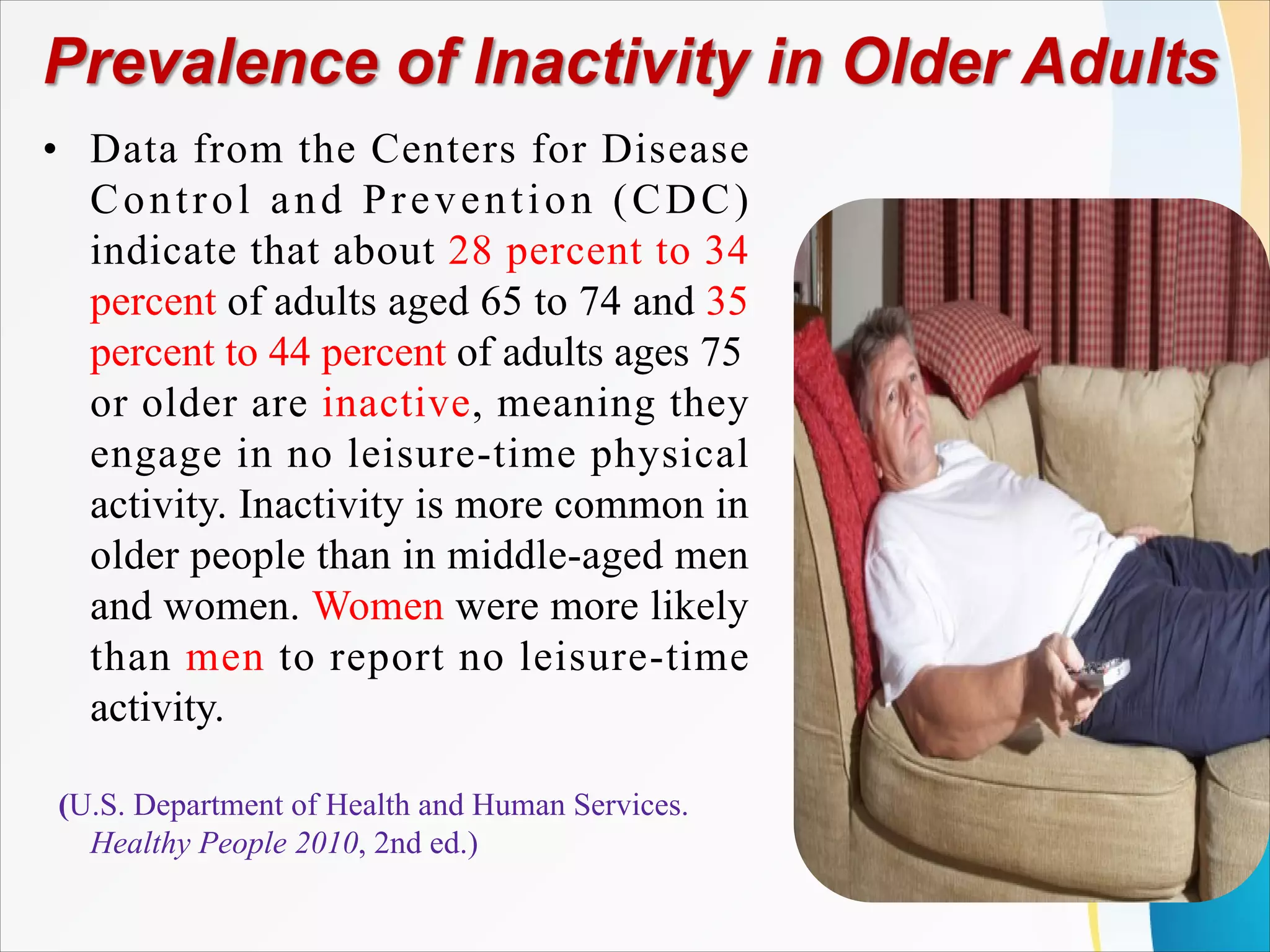
• Data from the Centers for Disease
Control and Prevention (CDC)
indicate that about 28 percent to 34
percent of adults aged 65 to 74 and 35
percent to 44 percent of adults ages 75
or older are inactive, meaning they
engage in no leisure-time physical
activity. Inactivity is more common in
older people than in middle-aged men
and women. Women were more likely
than men to report no leisure-time
activity.
(U.S. Department of Health and Human Services.
Healthy People 2010, 2nd ed.)
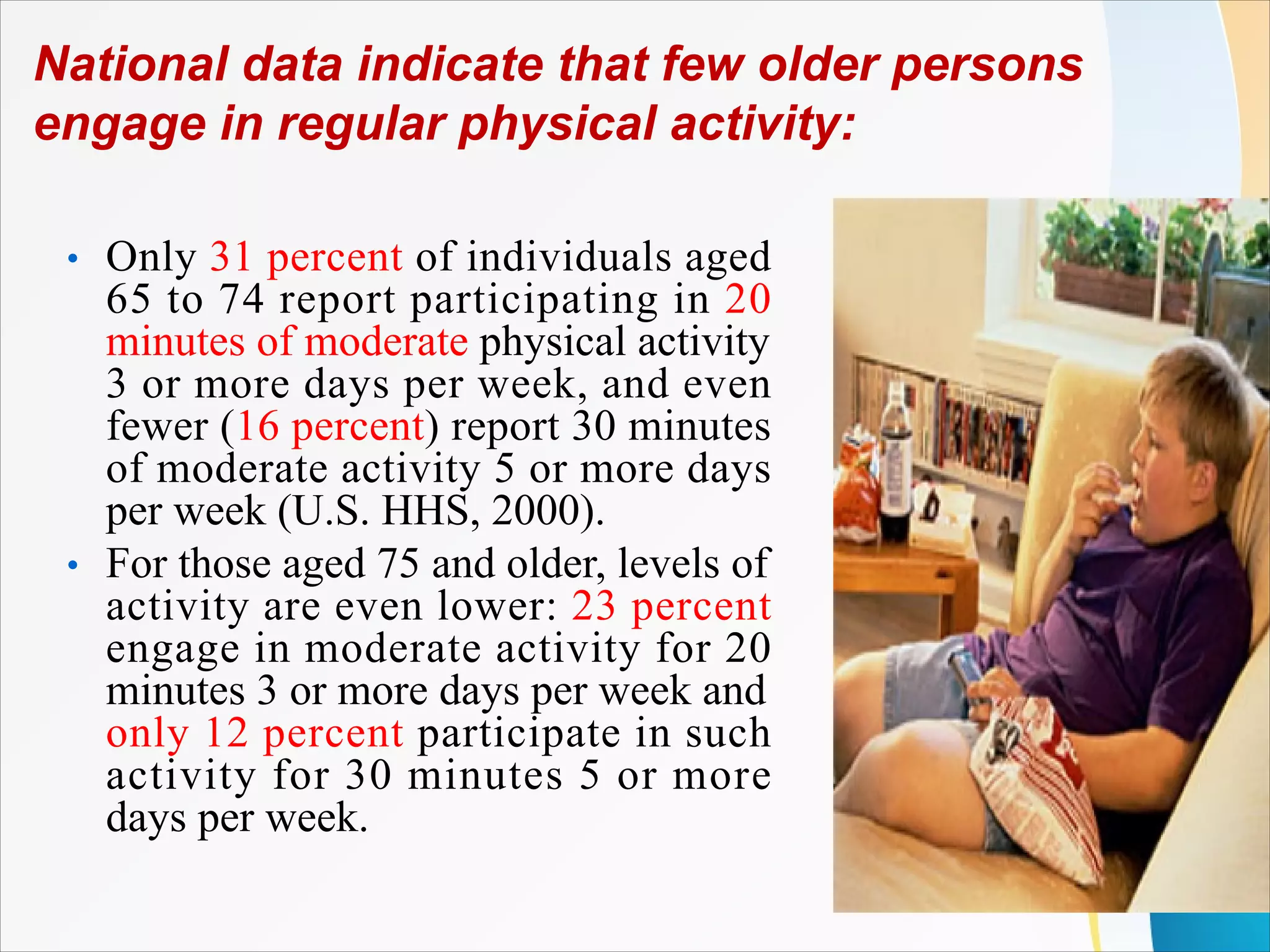
National data indicate that few older persons
engage in regular physical activity:
• Only 31 percent of individuals aged
65 to 74 report participating in 20
minutes of moderate physical activity
3 or more days per week, and even
fewer (16 percent) report 30 minutes
of moderate activity 5 or more days
per week (U.S. HHS, 2000).
• For those aged 75 and older, levels of
activity are even lower: 23 percent
engage in moderate activity for 20
minutes 3 or more days per week and
only 12 percent participate in such
activity for 30 minutes 5 or more
days per week.
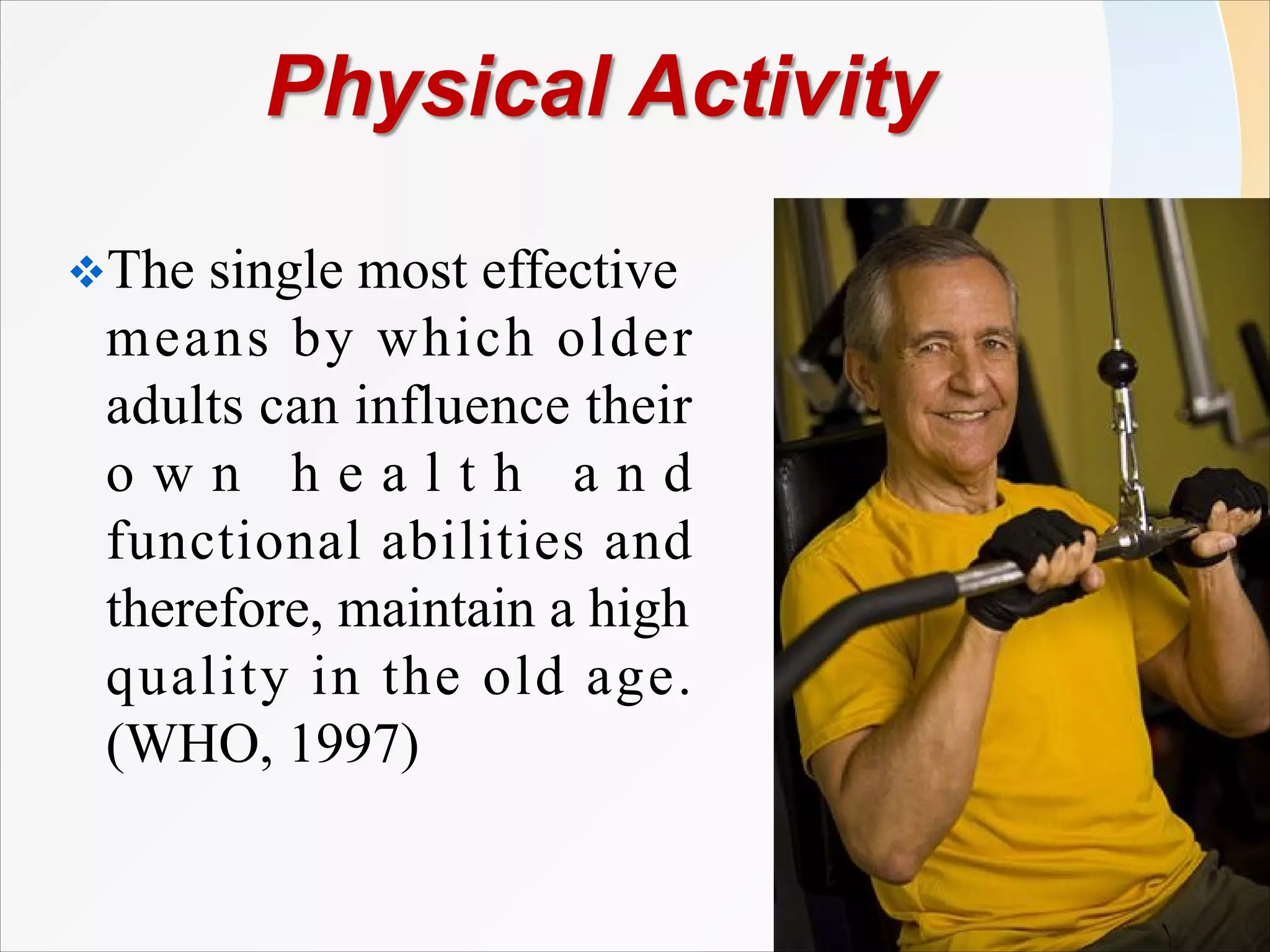
vThe single most effective
means by which older
adults can influence their
o w n h e a l t h a n d
functional abilities and
therefore, maintain a high
quality in the old age.
(WHO, 1997)
• Decreases risk of mortality and
reduces risks of coronary heart
disease, hypertension, colon
cancer, and diabetes mellitus
(The Surgeon General’s Report,
1996)
• Improves mood state (Landers,
& Petruzzello, 1994) and
heightens self efficacy and self-
esteem (McAuley, & Rudolph,
1995)
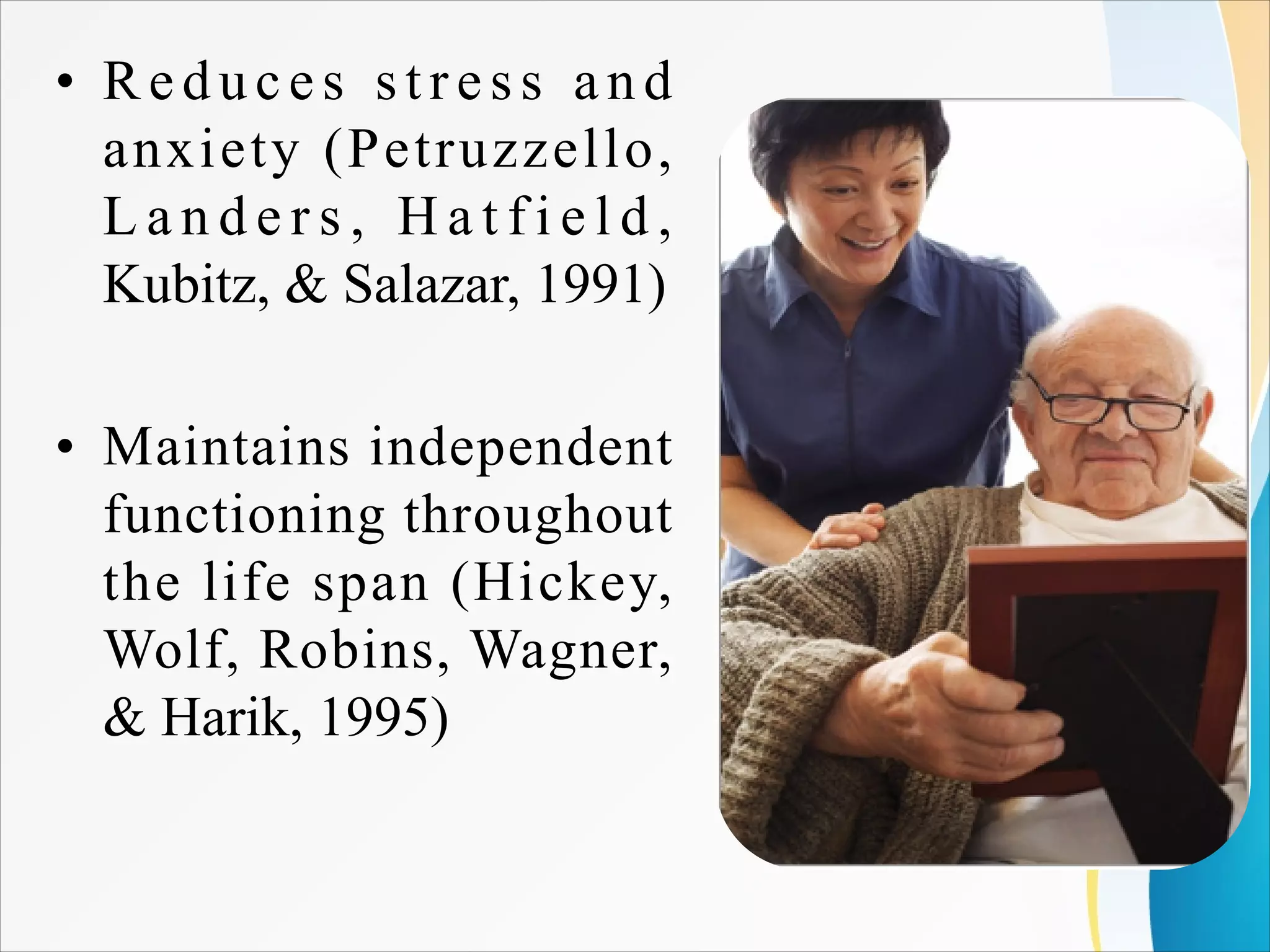
• Reduces stress and
anxiety (Petruzzello,
L a n d e r s , H a t f i e l d ,
Kubitz, & Salazar, 1991)
• Maintains independent
functioning throughout
the life span (Hickey,
Wolf, Robins, Wagner,
& Harik, 1995)
Ø Lower overall mortality. Benefits were greatest among
the most active persons but were also evident for
individuals who reported only moderate activity.
Ø Lower risk of coronary heart disease.
Ø Lower risk of colon cancer.
Ø Lower risk of diabetes.
Ø Lower risk of developing high blood pressure.
Ø Lower risk of obesity.
Ø Improved mood and relief of symptoms of depression.
Ø Improved quality of life and improved functioning.
Ø Improved function in persons with arthritis.
Ø Lower risk of falls and injury.
(Talbot, Morrell, Metter et al., 2002).
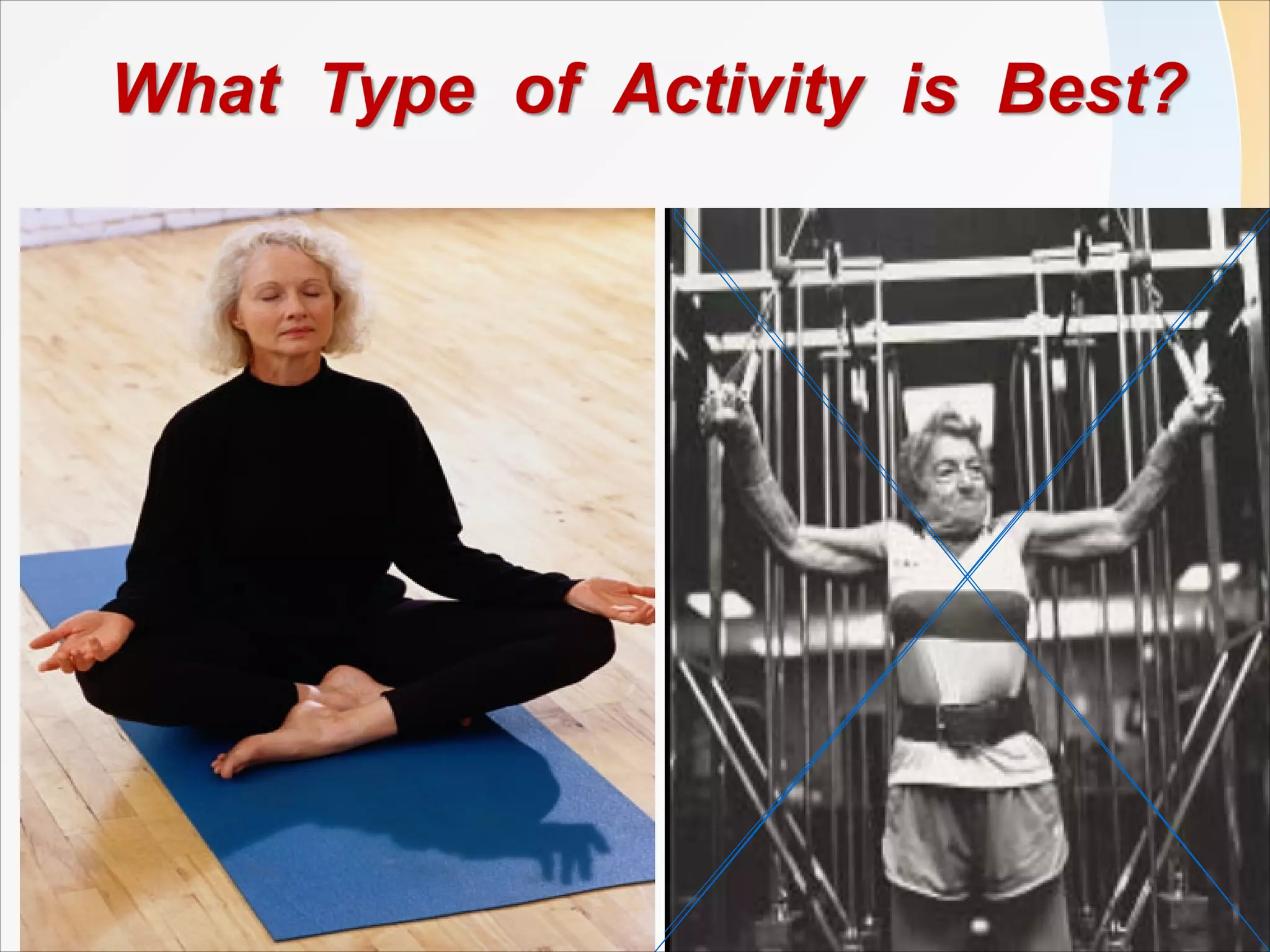
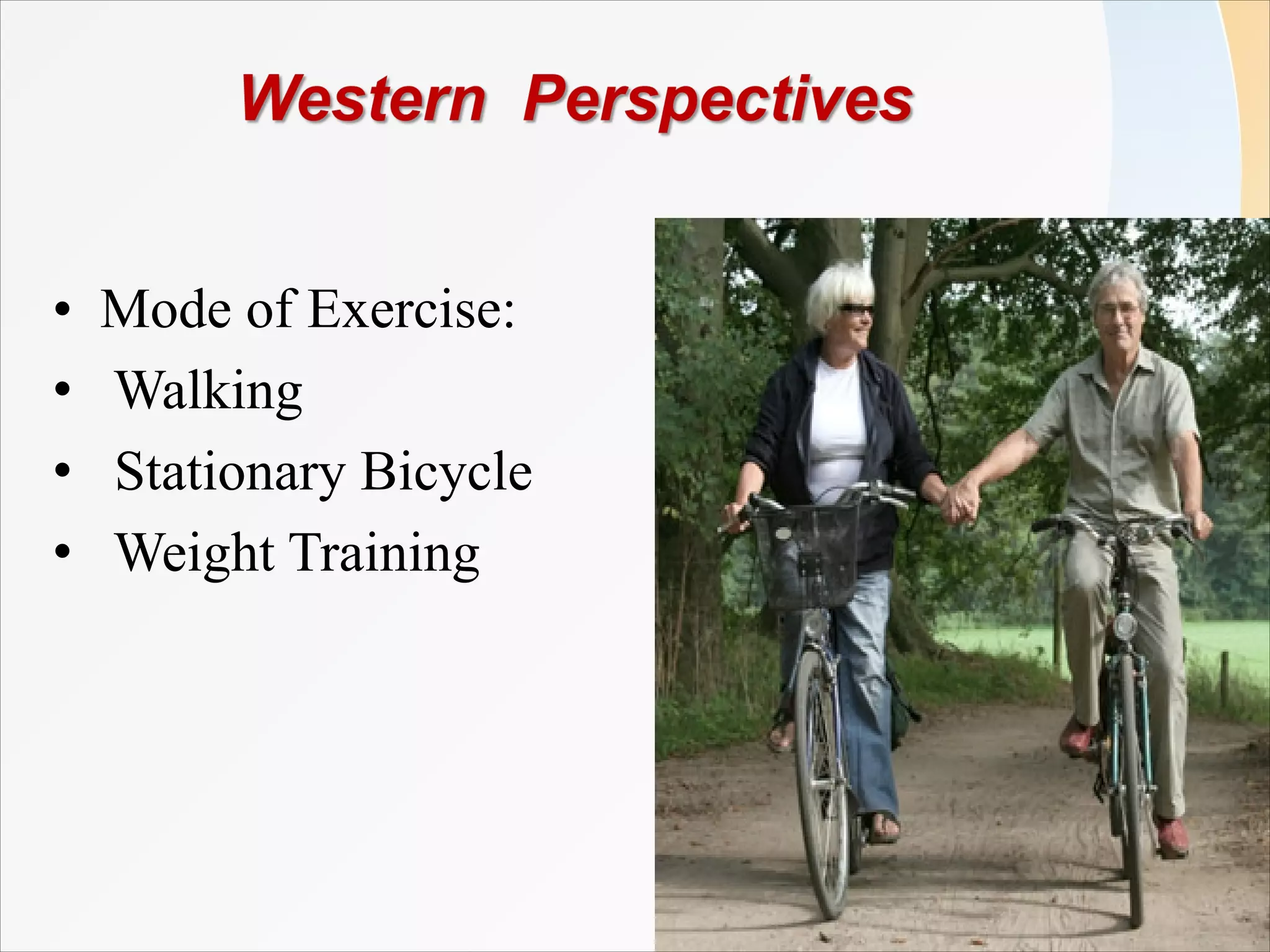
• Mode of Exercise:
• Walking
• Stationary Bicycle
• Weight Training
ØMain Emphasis on
§ Harmony
§ Balance
§ Self-Control
§ Spirit
§ Yoga
Aerobic
Strength
Flexibility
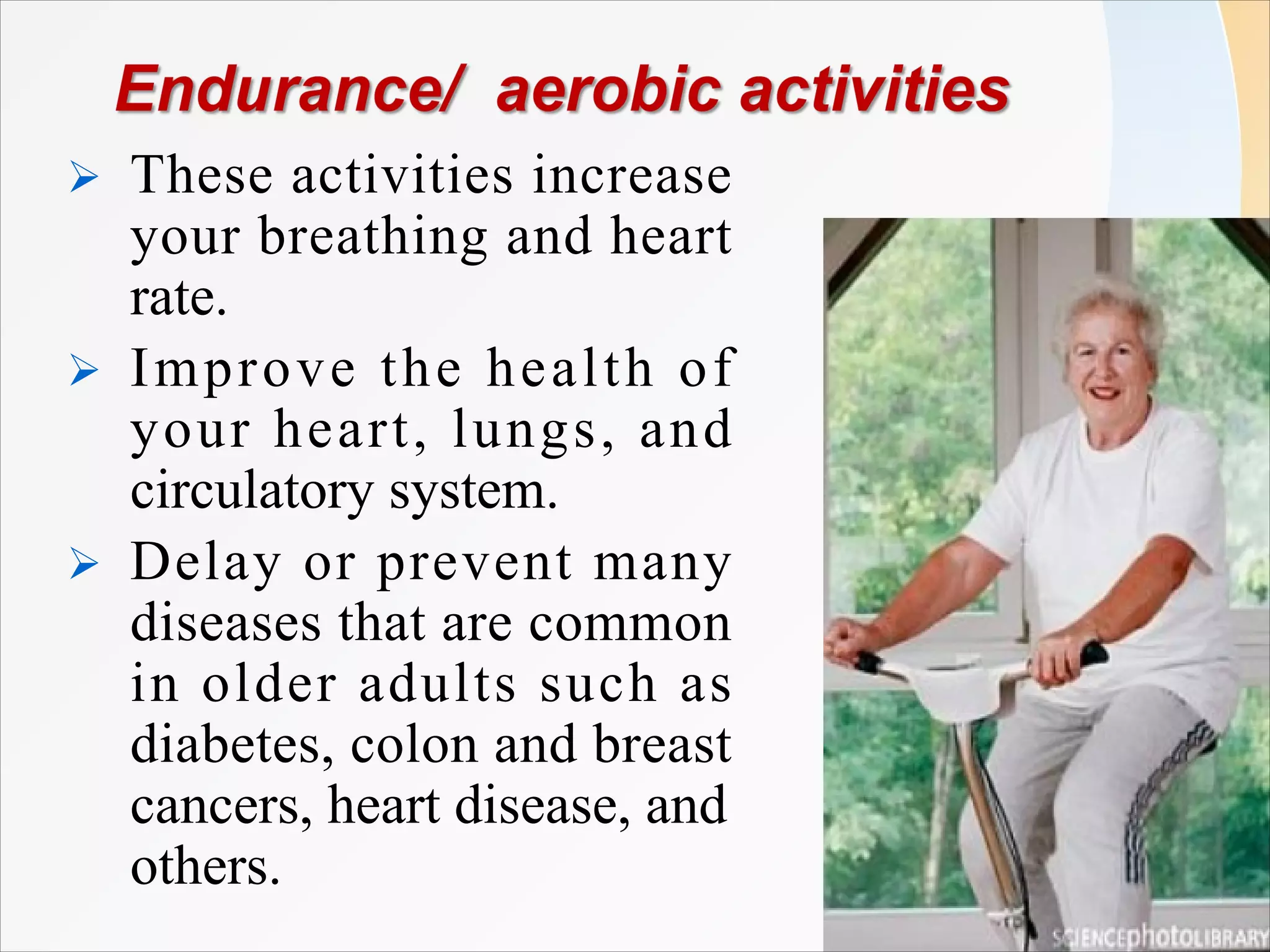
Ø These activities increase
your breathing and heart
rate.
Ø Improve the health of
your heart, lungs, and
circulatory system.
Ø Delay or prevent many
diseases that are common
in older adults such as
diabetes, colon and breast
cancers, heart disease, and
others.
ØActivities includes:
• Brisk walking
• Yard work (mowing )
• Dancing
• Swimming
• Biking
• Climbing stairs or hills
• Playing tennis
• Playing basketball
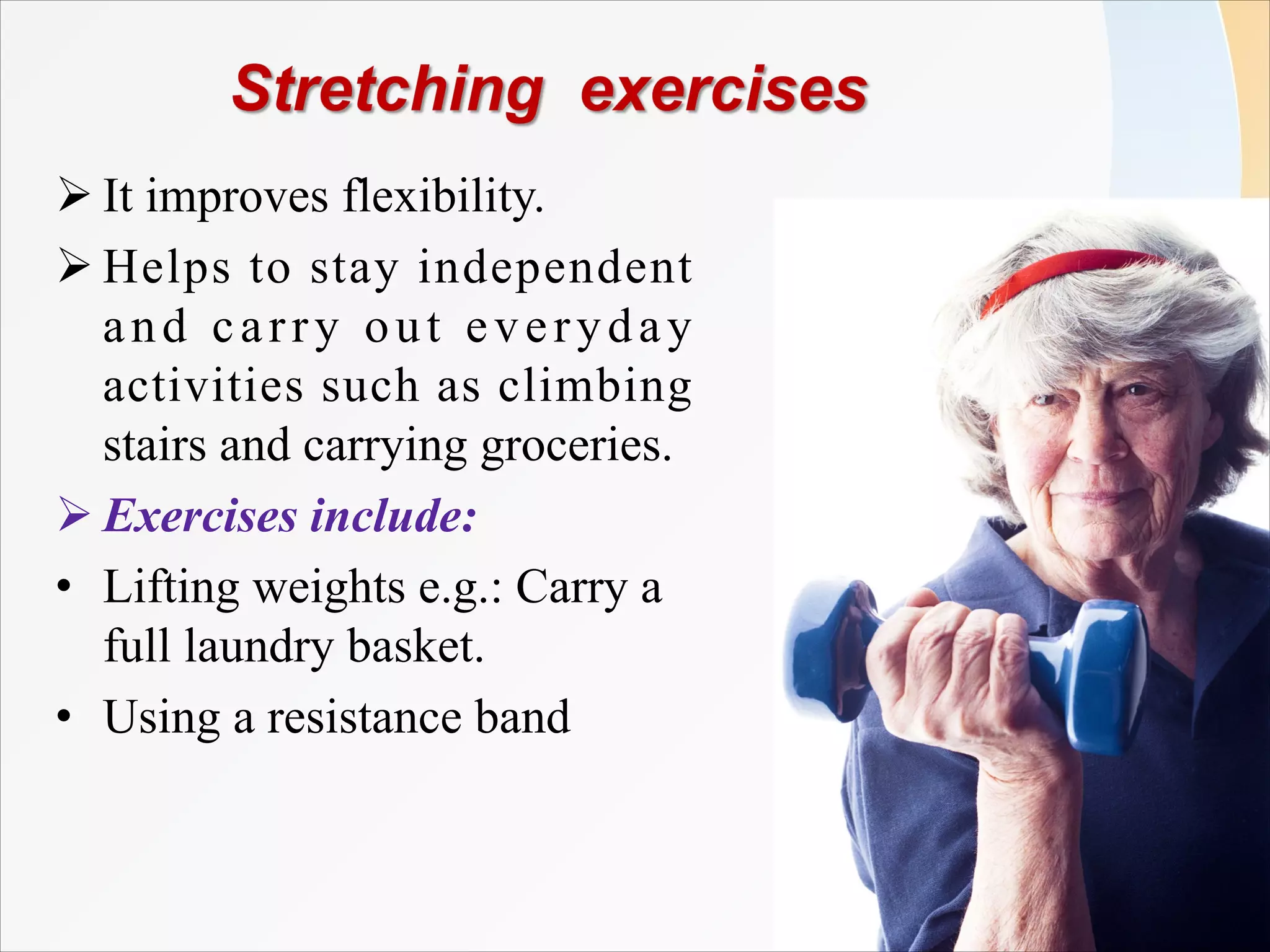
Ø It improves flexibility.
Ø Helps to stay independent
and carry out everyday
activities such as climbing
stairs and carrying groceries.
Ø Exercises include:
• Lifting weights e.g.: Carry a
full laundry basket.
• Using a resistance band
ØBalance exercises help to
prevent falls, a common
problem in older adults.
ØMany lower-body strength
e x e r c i s e s a l s o w i l l
improve your balance.
ØActivities include:
• Standing on one foot
• Heel-to-toe walk
ØAllows one’s body to
stay flexible and limber,
which gives one more
freedom of movement
f o r y o u r r e g u l a r
physical activity.
ØActivities include:
• Shoulder and upper arm
stretch
• Calf stretch
• Yoga
A walking programme for those who have not been
exercising regularly
(seniorIndian.com)
3 times a week
Week Distance (km) mts
1 1/2 na
2 1/2 na
3 3/4 na
4 1 na
5 1 na
6 1 na
7 1 20
8 2 1/2 30
9 3 1/4 40
10 3 1/4 40
11 4 50
12 4 1/2 60
Ø Ask whether there are exercises or activities you should avoid. An
illness or surgery may affect how you exercise. For example, if
you’ve had hip or back surgery, you may need to modify or avoid
some exercises, or if you develop blood clots in your legs, you
will have to restrict your activity for a time. Your doctor can tell
you how to increase your physical activity gradually as you
recover.
Ø Talk about any unexplained symptoms, such as chest pain or
pressure, pain in your joints, dizziness, or shortness of breath.
Postpone exercise until the problem is diagnosed and treated.
Ø Make sure your preventive care is up to date. For example, women
age 65 and older should have regular tests for osteoporosis.
Weight-bearing exercises — such as walking and lifting
weights — are especially helpful for those with osteoporosis.
Ø Understand how any ongoing health
conditions affect exercise and
physical activity. For example, people
with arthritis may need to avoid some
types of activity, especially when
joints are swollen or inflamed. Those
with diabetes may need to adjust their
daily schedule, meal plan, or
medications when planning their
activities.
Ø Talk to your doctor if you think you
might have an uncontrolled medical
condition that might affect the type of
exercise you should be doing. For
example, it is important to know how
to exercise safely if your blood
pressure or diabetes is not under
control.
ØWhen starting an exercise program, begin slowly
with low-intensity exercises.
ØWait at least 2 hours after eating a large meal
before doing strenuous exercise.
ØWear appropriate shoes for your activity and
comfortable, loose-fitting clothing.
ØWarm up with low-intensity exercises at the
beginning of each exercise session.
ØWhen exercising outdoors, pay attention to your
surroundings — consider possible traffic hazards,
the weather, uneven walking surfaces, and
strangers.
ØStop exercising if you:
• Have pain or pressure in
your chest, neck, shoulder,
or arm
• Feel dizzy or sick to your
stomach
• Break out in a cold sweat
• Have muscle cramps
• Feel severe pain in joints,
feet, ankles, or legs
Individual
Medical
system
Home/
community
Ø Assess how much physical activity
your patients are getting and explore
reasons that they aren't more active.
Ø The most promising interventions in
primary care practices include
patient goal setting, written exercise
prescriptions, individually tailored
physical activity regimens, and
mailed or telephone follow up.
Ø Refer patients to community
resources where they can join group
activities to promote and reinforce
physical activity.
v Make activity a daily part of
your life.
v Set specific activity goals. Start
s l o w l y a n d b u i l d u p t o
increasing levels of activity. Try
to be active for 30 minutes a
day on a regular basis.
v Partners can make it more fun,
can provide encouragement,
and help overcome problems
of transportation or safety.
v Consult your clinician about
what level of activity is safe
and appropriate for you.
• Complete physical examination
• Screening test:
• Height weight
• Blood pressure
• Blood sugar
• Thyroid assessment (level of TSH)
• Cholesterol
• ECG
• Colon cancer screening
• Mammogram
• Clinical breast examination
• Tonometry ( eye examination)
• Dental examination
• Immunization (Tetanus Toxoid every 10 years)
• Guidance and Counseling
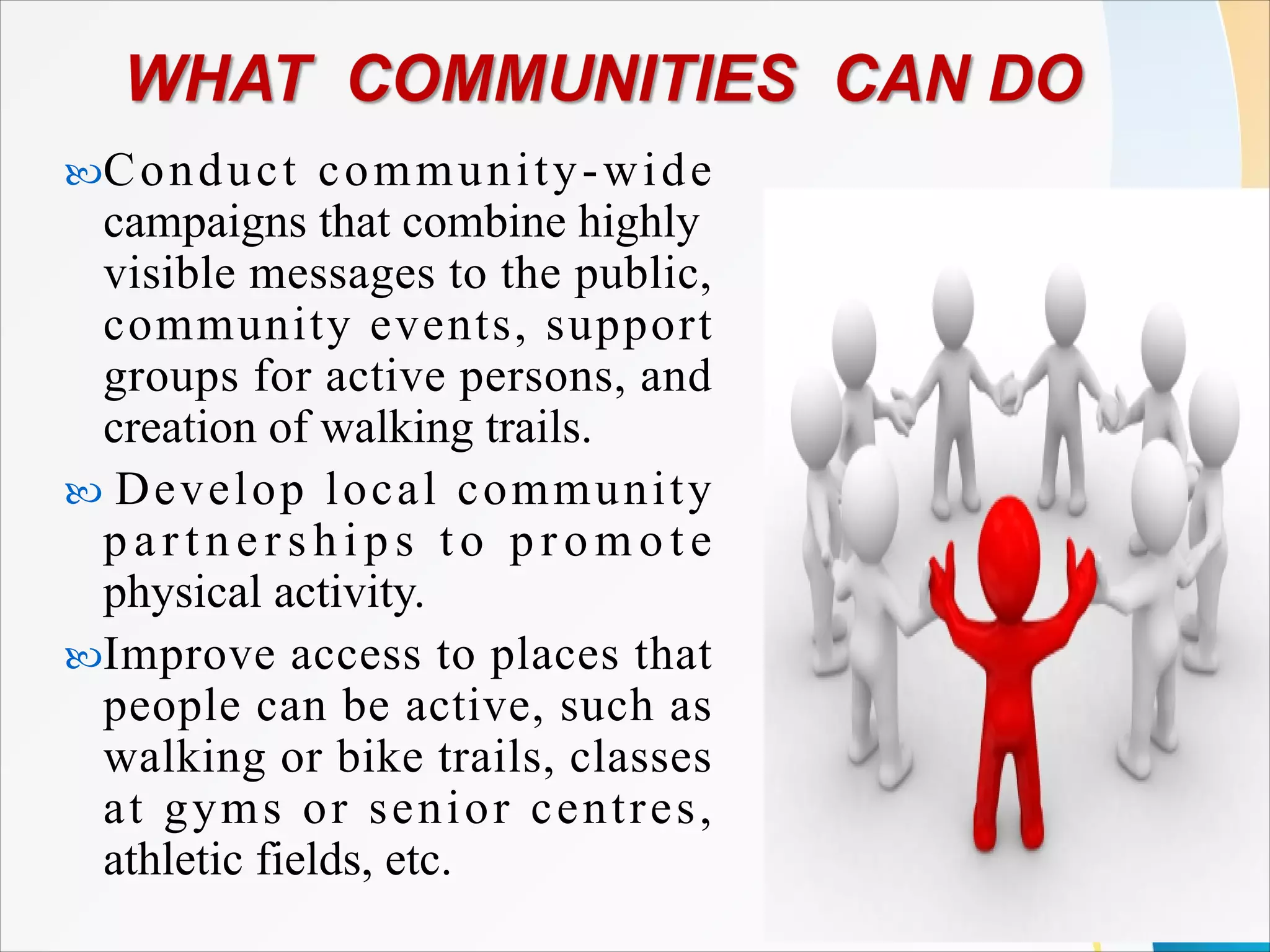
Conduct community-wide
campaigns that combine highly
visible messages to the public,
community events, support
groups for active persons, and
creation of walking trails.
 Develop local community
partnerships to pr om ot e
physical activity.
Improve access to places that
people can be active, such as
walking or bike trails, classes
at gyms or senior centres,
athletic fields, etc.
Physical  activity  and  Successful aging

Physical activity and Successful aging

  • 3.
    • Data fromthe Centers for Disease Control and Prevention (CDC) indicate that about 28 percent to 34 percent of adults aged 65 to 74 and 35 percent to 44 percent of adults ages 75 or older are inactive, meaning they engage in no leisure-time physical activity. Inactivity is more common in older people than in middle-aged men and women. Women were more likely than men to report no leisure-time activity. (U.S. Department of Health and Human Services. Healthy People 2010, 2nd ed.)
  • 4.
    National data indicatethat few older persons engage in regular physical activity: • Only 31 percent of individuals aged 65 to 74 report participating in 20 minutes of moderate physical activity 3 or more days per week, and even fewer (16 percent) report 30 minutes of moderate activity 5 or more days per week (U.S. HHS, 2000). • For those aged 75 and older, levels of activity are even lower: 23 percent engage in moderate activity for 20 minutes 3 or more days per week and only 12 percent participate in such activity for 30 minutes 5 or more days per week.
  • 5.
    vThe single mosteffective means by which older adults can influence their o w n h e a l t h a n d functional abilities and therefore, maintain a high quality in the old age. (WHO, 1997)
  • 6.
    • Decreases riskof mortality and reduces risks of coronary heart disease, hypertension, colon cancer, and diabetes mellitus (The Surgeon General’s Report, 1996) • Improves mood state (Landers, & Petruzzello, 1994) and heightens self efficacy and self- esteem (McAuley, & Rudolph, 1995)
  • 7.
    • Reduces stressand anxiety (Petruzzello, L a n d e r s , H a t f i e l d , Kubitz, & Salazar, 1991) • Maintains independent functioning throughout the life span (Hickey, Wolf, Robins, Wagner, & Harik, 1995)
  • 8.
    Ø Lower overallmortality. Benefits were greatest among the most active persons but were also evident for individuals who reported only moderate activity. Ø Lower risk of coronary heart disease. Ø Lower risk of colon cancer. Ø Lower risk of diabetes. Ø Lower risk of developing high blood pressure. Ø Lower risk of obesity. Ø Improved mood and relief of symptoms of depression. Ø Improved quality of life and improved functioning. Ø Improved function in persons with arthritis. Ø Lower risk of falls and injury. (Talbot, Morrell, Metter et al., 2002).
  • 10.
    • Mode ofExercise: • Walking • Stationary Bicycle • Weight Training
  • 11.
    ØMain Emphasis on §Harmony § Balance § Self-Control § Spirit § Yoga
  • 12.
  • 13.
    Ø These activitiesincrease your breathing and heart rate. Ø Improve the health of your heart, lungs, and circulatory system. Ø Delay or prevent many diseases that are common in older adults such as diabetes, colon and breast cancers, heart disease, and others.
  • 14.
    ØActivities includes: • Briskwalking • Yard work (mowing ) • Dancing • Swimming • Biking • Climbing stairs or hills • Playing tennis • Playing basketball
  • 15.
    Ø It improvesflexibility. Ø Helps to stay independent and carry out everyday activities such as climbing stairs and carrying groceries. Ø Exercises include: • Lifting weights e.g.: Carry a full laundry basket. • Using a resistance band
  • 16.
    ØBalance exercises helpto prevent falls, a common problem in older adults. ØMany lower-body strength e x e r c i s e s a l s o w i l l improve your balance. ØActivities include: • Standing on one foot • Heel-to-toe walk
  • 17.
    ØAllows one’s bodyto stay flexible and limber, which gives one more freedom of movement f o r y o u r r e g u l a r physical activity. ØActivities include: • Shoulder and upper arm stretch • Calf stretch • Yoga
  • 18.
    A walking programmefor those who have not been exercising regularly (seniorIndian.com) 3 times a week Week Distance (km) mts 1 1/2 na 2 1/2 na 3 3/4 na 4 1 na 5 1 na 6 1 na 7 1 20 8 2 1/2 30 9 3 1/4 40 10 3 1/4 40 11 4 50 12 4 1/2 60
  • 19.
    Ø Ask whetherthere are exercises or activities you should avoid. An illness or surgery may affect how you exercise. For example, if you’ve had hip or back surgery, you may need to modify or avoid some exercises, or if you develop blood clots in your legs, you will have to restrict your activity for a time. Your doctor can tell you how to increase your physical activity gradually as you recover. Ø Talk about any unexplained symptoms, such as chest pain or pressure, pain in your joints, dizziness, or shortness of breath. Postpone exercise until the problem is diagnosed and treated. Ø Make sure your preventive care is up to date. For example, women age 65 and older should have regular tests for osteoporosis. Weight-bearing exercises — such as walking and lifting weights — are especially helpful for those with osteoporosis.
  • 20.
    Ø Understand howany ongoing health conditions affect exercise and physical activity. For example, people with arthritis may need to avoid some types of activity, especially when joints are swollen or inflamed. Those with diabetes may need to adjust their daily schedule, meal plan, or medications when planning their activities. Ø Talk to your doctor if you think you might have an uncontrolled medical condition that might affect the type of exercise you should be doing. For example, it is important to know how to exercise safely if your blood pressure or diabetes is not under control.
  • 21.
    ØWhen starting anexercise program, begin slowly with low-intensity exercises. ØWait at least 2 hours after eating a large meal before doing strenuous exercise. ØWear appropriate shoes for your activity and comfortable, loose-fitting clothing. ØWarm up with low-intensity exercises at the beginning of each exercise session. ØWhen exercising outdoors, pay attention to your surroundings — consider possible traffic hazards, the weather, uneven walking surfaces, and strangers.
  • 22.
    ØStop exercising ifyou: • Have pain or pressure in your chest, neck, shoulder, or arm • Feel dizzy or sick to your stomach • Break out in a cold sweat • Have muscle cramps • Feel severe pain in joints, feet, ankles, or legs
  • 23.
  • 24.
    Ø Assess howmuch physical activity your patients are getting and explore reasons that they aren't more active. Ø The most promising interventions in primary care practices include patient goal setting, written exercise prescriptions, individually tailored physical activity regimens, and mailed or telephone follow up. Ø Refer patients to community resources where they can join group activities to promote and reinforce physical activity.
  • 25.
    v Make activitya daily part of your life. v Set specific activity goals. Start s l o w l y a n d b u i l d u p t o increasing levels of activity. Try to be active for 30 minutes a day on a regular basis. v Partners can make it more fun, can provide encouragement, and help overcome problems of transportation or safety. v Consult your clinician about what level of activity is safe and appropriate for you.
  • 33.
    • Complete physicalexamination • Screening test: • Height weight • Blood pressure • Blood sugar • Thyroid assessment (level of TSH) • Cholesterol • ECG • Colon cancer screening • Mammogram • Clinical breast examination • Tonometry ( eye examination) • Dental examination • Immunization (Tetanus Toxoid every 10 years) • Guidance and Counseling
  • 34.
    Conduct community-wide campaigns thatcombine highly visible messages to the public, community events, support groups for active persons, and creation of walking trails.  Develop local community partnerships to pr om ot e physical activity. Improve access to places that people can be active, such as walking or bike trails, classes at gyms or senior centres, athletic fields, etc.