Microsoft Office 2007- Illustrated Introductory, Windows Vista Edition Working with Charts
Plan a chart Create a chart Move and resize a chart Change the chart design Objectives Microsoft Office 2007-Illustrated Introductory, Windows Vista Edition
Objectives Change the chart layout Format a chart Annotate and draw on a chart Create a pie chart Microsoft Office 2007-Illustrated Introductory, Windows Vista Edition
Chart planning guidelines Determine the purpose of the chart and identify the data relationships you want to communicate graphically Determine results you want and decide which chart type is most appropriate Identify the worksheet data you want the chart to illustrate Understand the elements of a chart Planning a Chart Microsoft Office 2007-Illustrated Introductory, Windows Vista Edition
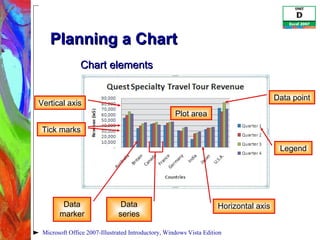
Chart elements The horizontal axis ( x-axis ) is also called the  category axis The vertical axis ( y-axis ) is also called the  value axis The  z-axis  is present in 3-D charts Area inside the horizontal and vertical axes is called the  plot area The scale of measure on the y-axis is identified by  tick marks Planning a Chart Microsoft Office 2007-Illustrated Introductory, Windows Vista Edition
Planning a Chart Chart elements (cont.) A  data point  is the value in a cell you select for your chart A  data marker  visually represents each data point in the chart A group of related data points is a  data series A  legend  makes it easy to identify each data series Microsoft Office 2007-Illustrated Introductory, Windows Vista Edition
Planning a Chart Microsoft Office 2007-Illustrated Introductory, Windows Vista Edition Data marker Horizontal axis Vertical axis Tick marks Data point Legend Plot area Chart elements Data series
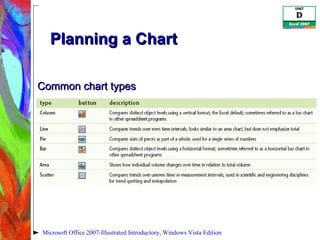
Planning a Chart Microsoft Office 2007-Illustrated Introductory, Windows Vista Edition Common chart types
Creating a Chart To create a chart: Select a range of data Use buttons on the Insert tab of the Ribbon to create and modify a chart An  embedded  chart is one that is inserted directly in the current worksheet Microsoft Office 2007-Illustrated Introductory, Windows Vista Edition
Creating a Chart Sizing handles , the small series of dots at the corners and sides of the chart’s border, indicate that the chart is selected A  chart sheet  is a sheet in a workbook that contains only a chart, which is linked to the workbook data Microsoft Office 2007-Illustrated Introductory, Windows Vista Edition
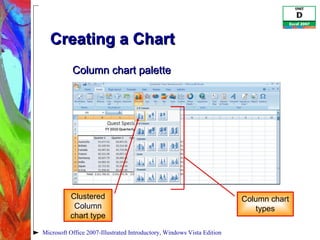
Creating a Chart Microsoft Office 2007-Illustrated Introductory, Windows Vista Edition Clustered Column chart type Column chart types Column chart palette
Moving and Resizing a Chart A chart is a graphic, or drawn object Not located in a specific cell or range An  object  is an independent element on a worksheet Can be moved anywhere worksheet without affecting formulas or data Resize a chart by moving its sizing handles; move a chart by dragging it Microsoft Office 2007-Illustrated Introductory, Windows Vista Edition
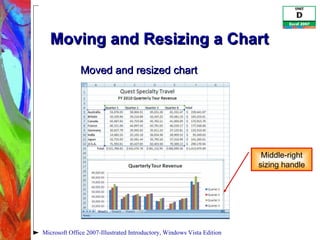
Moving and Resizing a Chart  Microsoft Office 2007-Illustrated Introductory, Windows Vista Edition Middle-right sizing handle Moved and resized chart
Changing the Chart Design Changing data values in the worksheet automatically updates the chart Chart Tools tabs can be used to make specific changes in a chart Microsoft Office 2007-Illustrated Introductory, Windows Vista Edition
Changing the Chart Design  Using the Chart Tools Design tab, you can: Change the chart type Modify the data range and configuration  Change the layout of objects  Choose from coordinating color schemes  Move the location of the chart Microsoft Office 2007-Illustrated Introductory, Windows Vista Edition
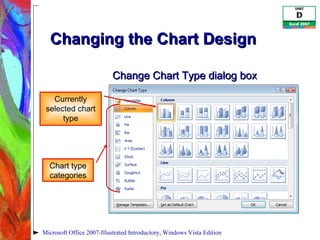
Changing the Chart Design Microsoft Office 2007-Illustrated Introductory, Windows Vista Edition Currently selected chart type Chart type categories Change Chart Type dialog box
Changing the Chart Layout Chart Tools Layout tab makes it easy to create and modify individual chart objects Using the Chart Tools Layout tab, you can: Add shapes and text to a chart Add and modify labels Change the display of axes Microsoft Office 2007-Illustrated Introductory, Windows Vista Edition
Changing the Chart Layout Using the Chart Tools Layout tab, you can (cont.): Modify the fill behind the plot area Eliminate or change the look of gridlines Create titles for the horizontal and vertical axes Add graphics or background color Microsoft Office 2007-Illustrated Introductory, Windows Vista Edition
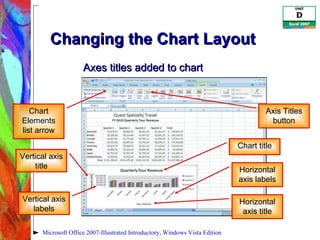
Changing the Chart Layout Microsoft Office 2007-Illustrated Introductory, Windows Vista Edition Axes titles added to chart Vertical axis title Vertical axis labels Chart title Horizontal axis labels Horizontal axis title Chart Elements list arrow Axis Titles button
Formatting a Chart Chart Tools Format tab can be used to make formatting enhancements Change colors in a specific data series Apply a style to a series using the Shape Styles group WordArt, which lets you create curved or stylized text, can be created using the WordArt Styles group Microsoft Office 2007-Illustrated Introductory, Windows Vista Edition
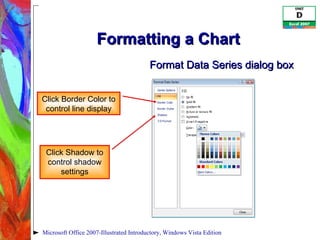
Formatting a Chart Microsoft Office 2007-Illustrated Introductory, Windows Vista Edition Format Data Series dialog box Click Border Color to control line display Click Shadow to control shadow settings
Annotating and Drawing  on a Chart A  text annotation  is a label that you add to a chart to further describe data You can add shapes such as arrows and boxes to a chart Lines and arrows can be used to point out exact locations you want to emphasize Microsoft Office 2007-Illustrated Introductory, Windows Vista Edition
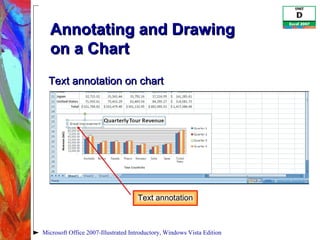
Annotating and Drawing  on a Chart  Microsoft Office 2007-Illustrated Introductory, Windows Vista Edition Text annotation Text annotation on chart
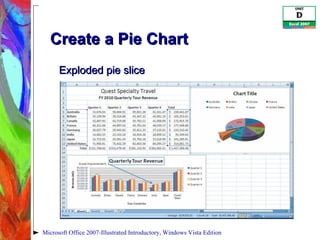
Create a Pie Chart You can create multiple charts based on the same worksheet data Different chart types can be better at emphasizing different parts of the data In a pie chart, emphasize a data point by  exploding , or pulling that slice away from the pie chart In  landscape  orientation, the text runs the long way on the page Microsoft Office 2007-Illustrated Introductory, Windows Vista Edition
Create a Pie Chart Microsoft Office 2007-Illustrated Introductory, Windows Vista Edition Exploded pie slice
Summary Plan a chart Create a chart Move and resize a chart Change the chart design Microsoft Office 2007-Illustrated Introductory, Windows Vista Edition
Summary Change the chart layout Format a chart Annotate and draw on a chart Create a pie chart Microsoft Office 2007-Illustrated Introductory, Windows Vista Edition

Excel 2007 Unit D

  • 1.
    Microsoft Office 2007-Illustrated Introductory, Windows Vista Edition Working with Charts
  • 2.
    Plan a chartCreate a chart Move and resize a chart Change the chart design Objectives Microsoft Office 2007-Illustrated Introductory, Windows Vista Edition
  • 3.
    Objectives Change thechart layout Format a chart Annotate and draw on a chart Create a pie chart Microsoft Office 2007-Illustrated Introductory, Windows Vista Edition
  • 4.
    Chart planning guidelinesDetermine the purpose of the chart and identify the data relationships you want to communicate graphically Determine results you want and decide which chart type is most appropriate Identify the worksheet data you want the chart to illustrate Understand the elements of a chart Planning a Chart Microsoft Office 2007-Illustrated Introductory, Windows Vista Edition
  • 5.
    Chart elements Thehorizontal axis ( x-axis ) is also called the category axis The vertical axis ( y-axis ) is also called the value axis The z-axis is present in 3-D charts Area inside the horizontal and vertical axes is called the plot area The scale of measure on the y-axis is identified by tick marks Planning a Chart Microsoft Office 2007-Illustrated Introductory, Windows Vista Edition
  • 6.
    Planning a ChartChart elements (cont.) A data point is the value in a cell you select for your chart A data marker visually represents each data point in the chart A group of related data points is a data series A legend makes it easy to identify each data series Microsoft Office 2007-Illustrated Introductory, Windows Vista Edition
  • 7.
    Planning a ChartMicrosoft Office 2007-Illustrated Introductory, Windows Vista Edition Data marker Horizontal axis Vertical axis Tick marks Data point Legend Plot area Chart elements Data series
  • 8.
    Planning a ChartMicrosoft Office 2007-Illustrated Introductory, Windows Vista Edition Common chart types
  • 9.
    Creating a ChartTo create a chart: Select a range of data Use buttons on the Insert tab of the Ribbon to create and modify a chart An embedded chart is one that is inserted directly in the current worksheet Microsoft Office 2007-Illustrated Introductory, Windows Vista Edition
  • 10.
    Creating a ChartSizing handles , the small series of dots at the corners and sides of the chart’s border, indicate that the chart is selected A chart sheet is a sheet in a workbook that contains only a chart, which is linked to the workbook data Microsoft Office 2007-Illustrated Introductory, Windows Vista Edition
  • 11.
    Creating a ChartMicrosoft Office 2007-Illustrated Introductory, Windows Vista Edition Clustered Column chart type Column chart types Column chart palette
  • 12.
    Moving and Resizinga Chart A chart is a graphic, or drawn object Not located in a specific cell or range An object is an independent element on a worksheet Can be moved anywhere worksheet without affecting formulas or data Resize a chart by moving its sizing handles; move a chart by dragging it Microsoft Office 2007-Illustrated Introductory, Windows Vista Edition
  • 13.
    Moving and Resizinga Chart Microsoft Office 2007-Illustrated Introductory, Windows Vista Edition Middle-right sizing handle Moved and resized chart
  • 14.
    Changing the ChartDesign Changing data values in the worksheet automatically updates the chart Chart Tools tabs can be used to make specific changes in a chart Microsoft Office 2007-Illustrated Introductory, Windows Vista Edition
  • 15.
    Changing the ChartDesign Using the Chart Tools Design tab, you can: Change the chart type Modify the data range and configuration Change the layout of objects Choose from coordinating color schemes Move the location of the chart Microsoft Office 2007-Illustrated Introductory, Windows Vista Edition
  • 16.
    Changing the ChartDesign Microsoft Office 2007-Illustrated Introductory, Windows Vista Edition Currently selected chart type Chart type categories Change Chart Type dialog box
  • 17.
    Changing the ChartLayout Chart Tools Layout tab makes it easy to create and modify individual chart objects Using the Chart Tools Layout tab, you can: Add shapes and text to a chart Add and modify labels Change the display of axes Microsoft Office 2007-Illustrated Introductory, Windows Vista Edition
  • 18.
    Changing the ChartLayout Using the Chart Tools Layout tab, you can (cont.): Modify the fill behind the plot area Eliminate or change the look of gridlines Create titles for the horizontal and vertical axes Add graphics or background color Microsoft Office 2007-Illustrated Introductory, Windows Vista Edition
  • 19.
    Changing the ChartLayout Microsoft Office 2007-Illustrated Introductory, Windows Vista Edition Axes titles added to chart Vertical axis title Vertical axis labels Chart title Horizontal axis labels Horizontal axis title Chart Elements list arrow Axis Titles button
  • 20.
    Formatting a ChartChart Tools Format tab can be used to make formatting enhancements Change colors in a specific data series Apply a style to a series using the Shape Styles group WordArt, which lets you create curved or stylized text, can be created using the WordArt Styles group Microsoft Office 2007-Illustrated Introductory, Windows Vista Edition
  • 21.
    Formatting a ChartMicrosoft Office 2007-Illustrated Introductory, Windows Vista Edition Format Data Series dialog box Click Border Color to control line display Click Shadow to control shadow settings
  • 22.
    Annotating and Drawing on a Chart A text annotation is a label that you add to a chart to further describe data You can add shapes such as arrows and boxes to a chart Lines and arrows can be used to point out exact locations you want to emphasize Microsoft Office 2007-Illustrated Introductory, Windows Vista Edition
  • 23.
    Annotating and Drawing on a Chart Microsoft Office 2007-Illustrated Introductory, Windows Vista Edition Text annotation Text annotation on chart
  • 24.
    Create a PieChart You can create multiple charts based on the same worksheet data Different chart types can be better at emphasizing different parts of the data In a pie chart, emphasize a data point by exploding , or pulling that slice away from the pie chart In landscape orientation, the text runs the long way on the page Microsoft Office 2007-Illustrated Introductory, Windows Vista Edition
  • 25.
    Create a PieChart Microsoft Office 2007-Illustrated Introductory, Windows Vista Edition Exploded pie slice
  • 26.
    Summary Plan achart Create a chart Move and resize a chart Change the chart design Microsoft Office 2007-Illustrated Introductory, Windows Vista Edition
  • 27.
    Summary Change thechart layout Format a chart Annotate and draw on a chart Create a pie chart Microsoft Office 2007-Illustrated Introductory, Windows Vista Edition