Working with charts
Charts and graphs are another options of presenting your data in the form of
pie charts and column graphs.
Create a Graph:
1. Place cursor where you want
the chart to appear
2. Open the Insert menu and
select Object.
3. When the Object dialog box
appears, click the Create New tab.
4. From the Object Type box,
select Microsoft Graph Chart.
5. Choose Ok.
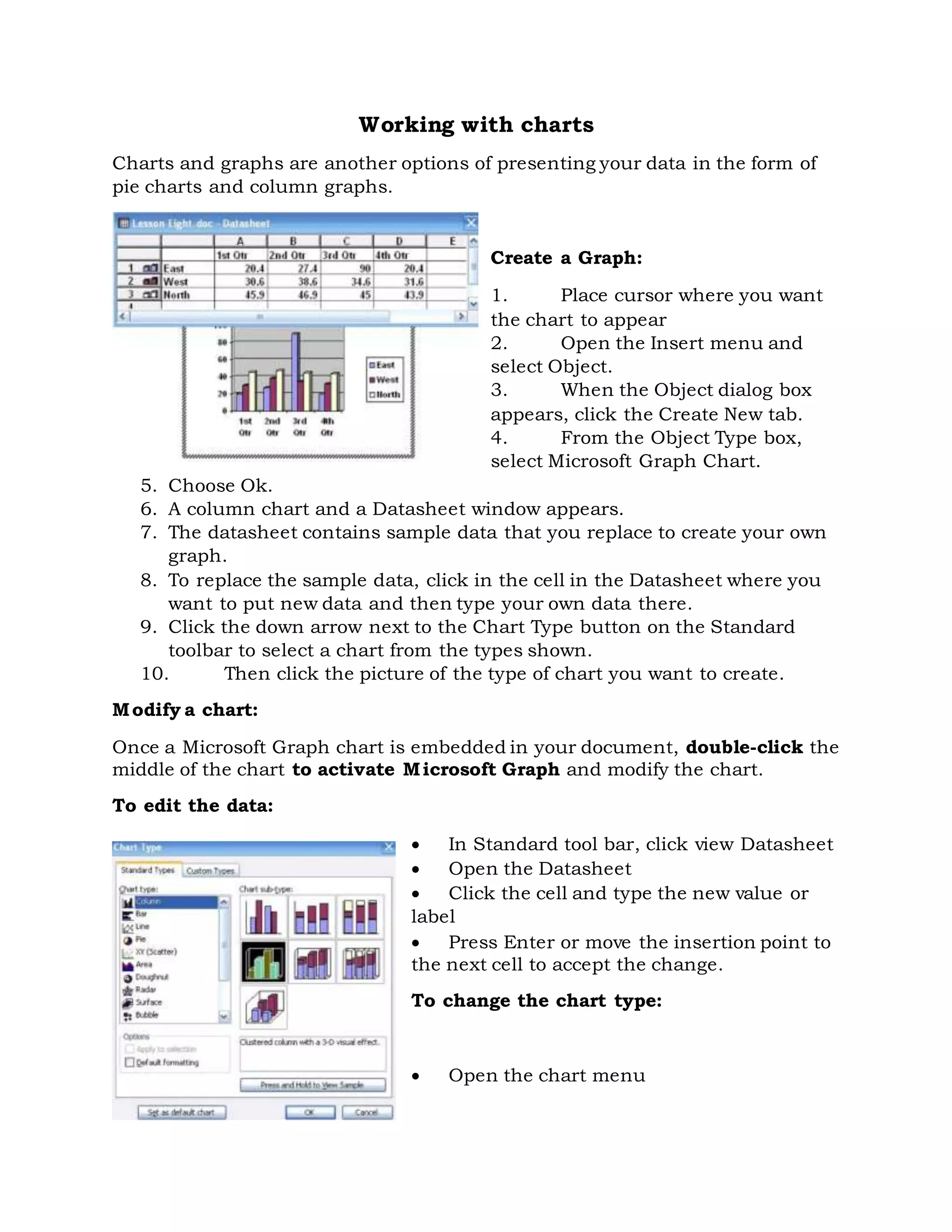
6. A column chart and a Datasheet window appears.
7. The datasheet contains sample data that you replace to create your own
graph.
8. To replace the sample data, click in the cell in the Datasheet where you
want to put new data and then type your own data there.
9. Click the down arrow next to the Chart Type button on the Standard
toolbar to select a chart from the types shown.
10. Then click the picture of the type of chart you want to create.
Modify a chart:
Once a Microsoft Graph chart is embedded in your document, double-click the
middle of the chart to activate Microsoft Graph and modify the chart.
To edit the data:
 In Standard tool bar, click view Datasheet
 Open the Datasheet
 Click the cell and type the new value or
label
 Press Enter or move the insertion point to
the next cell to accept the change.
To change the chart type:
 Open the chart menu
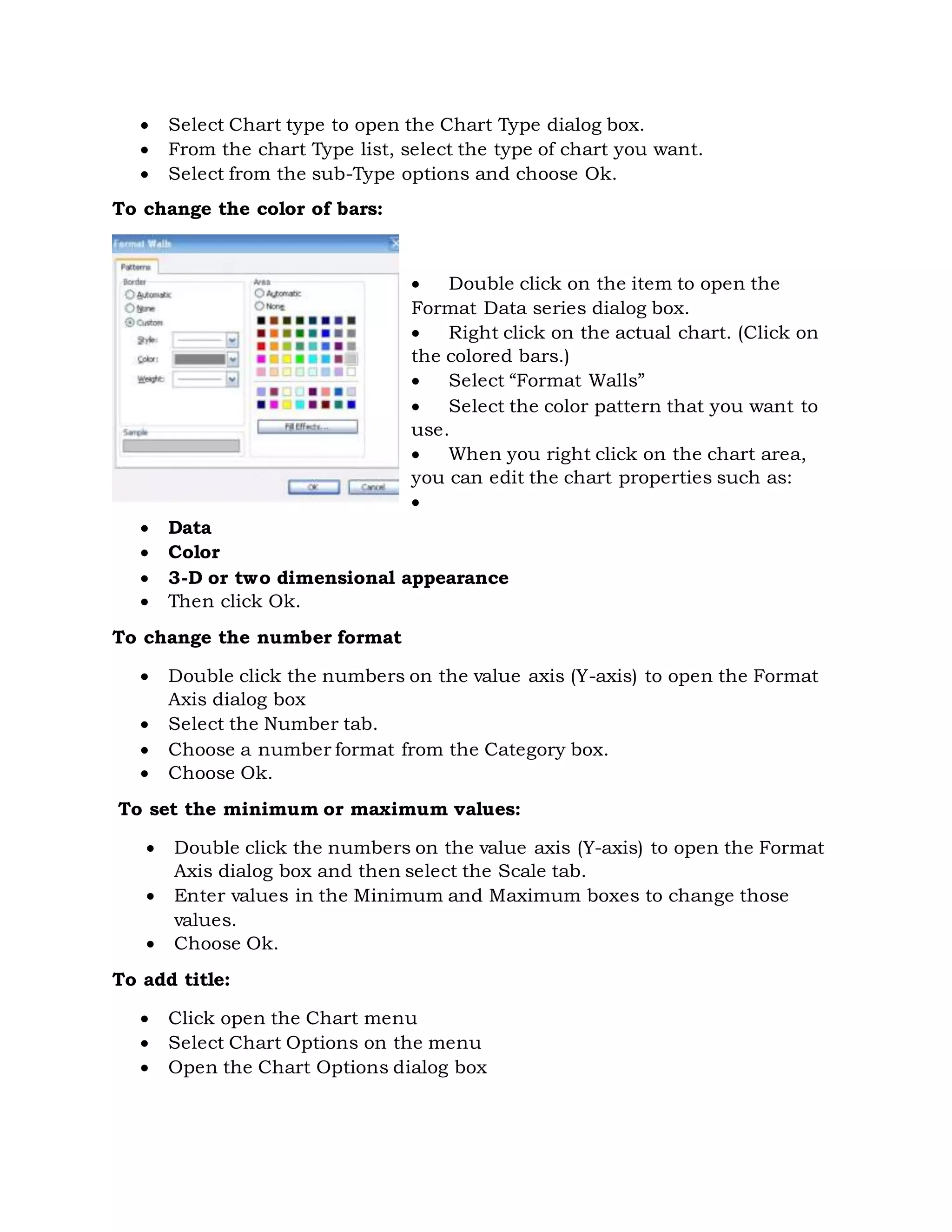
 Select Chart type to open the Chart Type dialog box.
 From the chart Type list, select the type of chart you want.
 Select from the sub-Type options and choose Ok.
To change the color of bars:
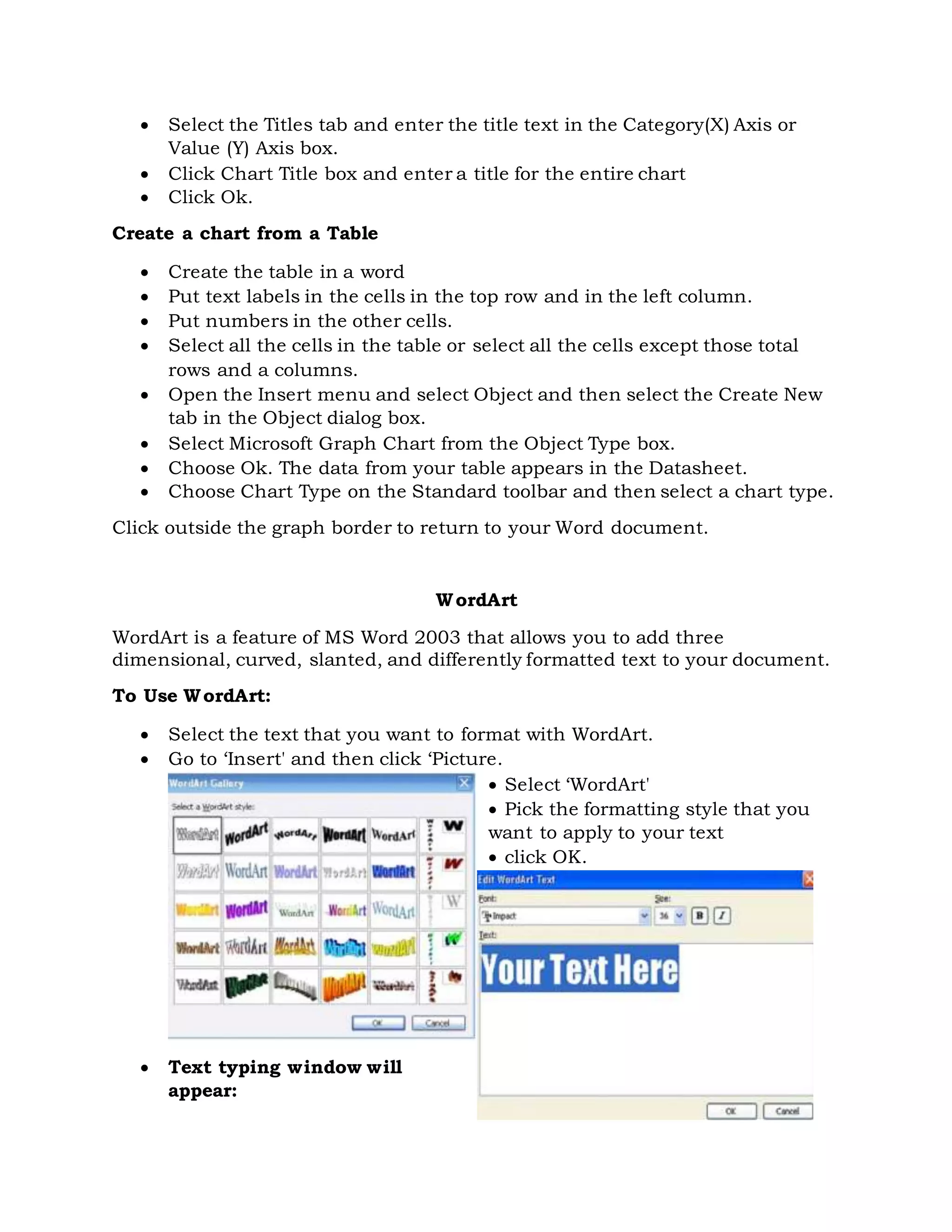
 Double click on the item to open the
Format Data series dialog box.
 Right click on the actual chart. (Click on
the colored bars.)
 Select “Format Walls”
 Select the color pattern that you want to
use.
 When you right click on the chart area,
you can edit the chart properties such as:

 Data
 Color
 3-D or two dimensional appearance
 Then click Ok.
To change the number format
 Double click the numbers on the value axis (Y-axis) to open the Format
Axis dialog box
 Select the Number tab.
 Choose a number format from the Category box.
 Choose Ok.
To set the minimum or maximum values:
 Double click the numbers on the value axis (Y-axis) to open the Format
Axis dialog box and then select the Scale tab.
 Enter values in the Minimum and Maximum boxes to change those
values.
 Choose Ok.
To add title:
 Click open the Chart menu
 Select Chart Options on the menu
 Open the Chart Options dialog box
 Select the Titles tab and enter the title text in the Category(X) Axis or
Value (Y) Axis box.
 Click Chart Title box and enter a title for the entire chart
 Click Ok.
Create a chart from a Table
 Create the table in a word
 Put text labels in the cells in the top row and in the left column.
 Put numbers in the other cells.
 Select all the cells in the table or select all the cells except those total
rows and a columns.
 Open the Insert menu and select Object and then select the Create New
tab in the Object dialog box.
 Select Microsoft Graph Chart from the Object Type box.
 Choose Ok. The data from your table appears in the Datasheet.
 Choose Chart Type on the Standard toolbar and then select a chart type.
Click outside the graph border to return to your Word document.
WordArt
WordArt is a feature of MS Word 2003 that allows you to add three
dimensional, curved, slanted, and differently formatted text to your document.
To Use WordArt:
 Select the text that you want to format with WordArt.
 Go to ‘Insert' and then click ‘Picture.
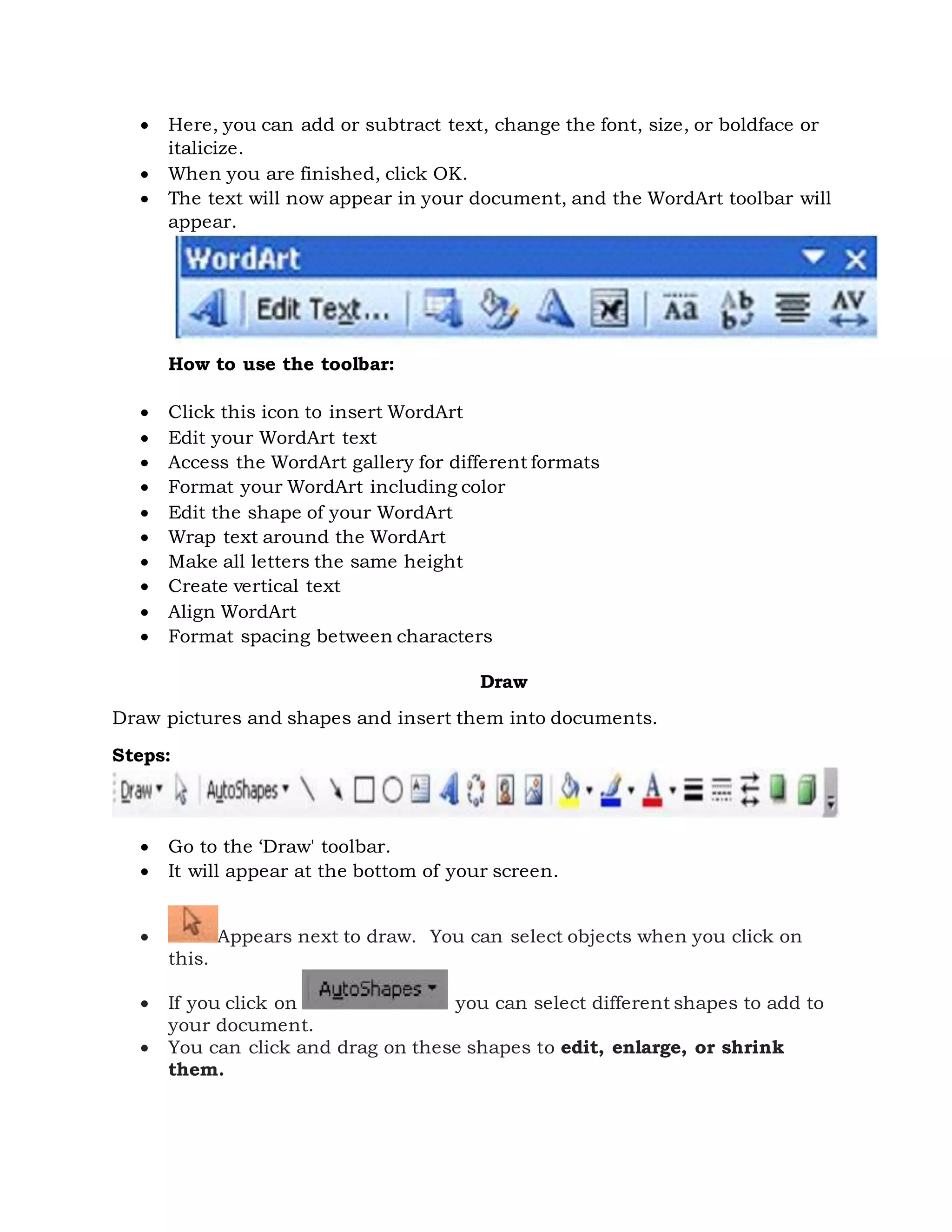
 Select ‘WordArt'
 Pick the formatting style that you
want to apply to your text
 click OK.
 Text typing window will
appear:
 Here, you can add or subtract text, change the font, size, or boldface or
italicize.
 When you are finished, click OK.
 The text will now appear in your document, and the WordArt toolbar will
appear.
How to use the toolbar:
 Click this icon to insert WordArt
 Edit your WordArt text
 Access the WordArt gallery for different formats
 Format your WordArt including color
 Edit the shape of your WordArt
 Wrap text around the WordArt
 Make all letters the same height
 Create vertical text
 Align WordArt
 Format spacing between characters
Draw
Draw pictures and shapes and insert them into documents.
Steps:
 Go to the ‘Draw' toolbar.
 It will appear at the bottom of your screen.
 Appears next to draw. You can select objects when you click on
this.
 If you click on you can select different shapes to add to
your document.
 You can click and drag on these shapes to edit, enlarge, or shrink
them.
 To add a straight line, click
 To add an arrow, click
 To add an oval, click
 To add a text box, click
 Use to insert WordArt
 Use to insert a diagram or chart.
 Inserts clip art.
 Inserts a picture from your files.
 If you want to fill in a shape with color, select and choose the
color.
 The color of the lines.
 Font color.
 Thickness of the lines that outline your shapes.
 Dash style
 Arrow style
 To add a shadow to your shape, click
 To make a shape 3-Dimensional, click
Inserting Graphics:
 Place the cursor where you want to insert thr graphic.
 Click at picture in the Insert menu.
 From the sub-menu select folder or file to open the Insert picture
dialog box.
 From file select the name and specific type of graphic file you want
to use from the listed files, enter the name of the file or highlight
the file.
 Click insert.
Link to file: choose this option to reduce the size of the file by linking to
it.
Insert and link: One benefit of linking is that the graphic in the
document updates immediately if any changes are made to the original
file.
Insert clip Art:
 Place the cursor where you want to insert the clip art picture.
 Open the Insert menu and choose Picture, then choose Clip Art
from the submenu to open the Insert Clip Art dialog box.
 The picture tab is displayed, showing a set of clip art categories.
 Click a category
 from that select one of the clip
 Click insert the clip in your document.
Insert menu--clip Art---clip Art Dialog Box---clip Art categories-
-select a clip--- click Insert.
Insert a Picture
1. Click the location where you want the image to appear
2. From the Insert menu, select Picture » From File...
3. The Insert Picture dialog box appears.
4. Using the Look in pull-down list, locate and select the desired image
5. Click INSERT
6. The image appears in your document.
Positioning Images
Once you have inserted an image into your document, you can easily position
or resize it as needed.
1. Click and hold the center of the image
2. The cursor turns into a four-headed arrow when you are able to move the
image.
3. Drag the image to the desired location
4. Release the mouse button
5. The image is now in the desired location.
Wrapping Text: Menu Option
1. Select the image
2. From the Format menu, select Picture...
The Format Picture dialog box appears.
3. Select the Layout tab
4. Under Wrapping style, select the desired wrapping option
5. Under Horizontal alignment, select the desired alignment option
HINT: For more options, click ADVANCED...
6. Click OK
Wrapping Text: Mouse Option
1. Double click the image
OR
Right click the image » select Format Picture...
2. Select the Layout tab
3. Under Wrapping style, select the desired wrapping option
4. Under Horizontal alignment, select the desired alignment option
HINT: For more options, click ADVANCED...
5. Click OK
Wrapping Text: Toolbar Option
Once you insert an image, the Picture toolbar should automatically appear.
On the Picture toolbar, click TEXT WRAPPING » select the desired wrapping
option

Working with charts in word 2003

  • 1.
    Working with charts Chartsand graphs are another options of presenting your data in the form of pie charts and column graphs. Create a Graph: 1. Place cursor where you want the chart to appear 2. Open the Insert menu and select Object. 3. When the Object dialog box appears, click the Create New tab. 4. From the Object Type box, select Microsoft Graph Chart. 5. Choose Ok. 6. A column chart and a Datasheet window appears. 7. The datasheet contains sample data that you replace to create your own graph. 8. To replace the sample data, click in the cell in the Datasheet where you want to put new data and then type your own data there. 9. Click the down arrow next to the Chart Type button on the Standard toolbar to select a chart from the types shown. 10. Then click the picture of the type of chart you want to create. Modify a chart: Once a Microsoft Graph chart is embedded in your document, double-click the middle of the chart to activate Microsoft Graph and modify the chart. To edit the data:  In Standard tool bar, click view Datasheet  Open the Datasheet  Click the cell and type the new value or label  Press Enter or move the insertion point to the next cell to accept the change. To change the chart type:  Open the chart menu
  • 2.
     Select Charttype to open the Chart Type dialog box.  From the chart Type list, select the type of chart you want.  Select from the sub-Type options and choose Ok. To change the color of bars:  Double click on the item to open the Format Data series dialog box.  Right click on the actual chart. (Click on the colored bars.)  Select “Format Walls”  Select the color pattern that you want to use.  When you right click on the chart area, you can edit the chart properties such as:   Data  Color  3-D or two dimensional appearance  Then click Ok. To change the number format  Double click the numbers on the value axis (Y-axis) to open the Format Axis dialog box  Select the Number tab.  Choose a number format from the Category box.  Choose Ok. To set the minimum or maximum values:  Double click the numbers on the value axis (Y-axis) to open the Format Axis dialog box and then select the Scale tab.  Enter values in the Minimum and Maximum boxes to change those values.  Choose Ok. To add title:  Click open the Chart menu  Select Chart Options on the menu  Open the Chart Options dialog box
  • 3.
     Select theTitles tab and enter the title text in the Category(X) Axis or Value (Y) Axis box.  Click Chart Title box and enter a title for the entire chart  Click Ok. Create a chart from a Table  Create the table in a word  Put text labels in the cells in the top row and in the left column.  Put numbers in the other cells.  Select all the cells in the table or select all the cells except those total rows and a columns.  Open the Insert menu and select Object and then select the Create New tab in the Object dialog box.  Select Microsoft Graph Chart from the Object Type box.  Choose Ok. The data from your table appears in the Datasheet.  Choose Chart Type on the Standard toolbar and then select a chart type. Click outside the graph border to return to your Word document. WordArt WordArt is a feature of MS Word 2003 that allows you to add three dimensional, curved, slanted, and differently formatted text to your document. To Use WordArt:  Select the text that you want to format with WordArt.  Go to ‘Insert' and then click ‘Picture.  Select ‘WordArt'  Pick the formatting style that you want to apply to your text  click OK.  Text typing window will appear:
  • 4.
     Here, youcan add or subtract text, change the font, size, or boldface or italicize.  When you are finished, click OK.  The text will now appear in your document, and the WordArt toolbar will appear. How to use the toolbar:  Click this icon to insert WordArt  Edit your WordArt text  Access the WordArt gallery for different formats  Format your WordArt including color  Edit the shape of your WordArt  Wrap text around the WordArt  Make all letters the same height  Create vertical text  Align WordArt  Format spacing between characters Draw Draw pictures and shapes and insert them into documents. Steps:  Go to the ‘Draw' toolbar.  It will appear at the bottom of your screen.  Appears next to draw. You can select objects when you click on this.  If you click on you can select different shapes to add to your document.  You can click and drag on these shapes to edit, enlarge, or shrink them.
  • 5.
     To adda straight line, click  To add an arrow, click  To add an oval, click  To add a text box, click  Use to insert WordArt  Use to insert a diagram or chart.  Inserts clip art.  Inserts a picture from your files.  If you want to fill in a shape with color, select and choose the color.  The color of the lines.  Font color.  Thickness of the lines that outline your shapes.  Dash style  Arrow style  To add a shadow to your shape, click  To make a shape 3-Dimensional, click Inserting Graphics:  Place the cursor where you want to insert thr graphic.  Click at picture in the Insert menu.  From the sub-menu select folder or file to open the Insert picture dialog box.
  • 6.
     From fileselect the name and specific type of graphic file you want to use from the listed files, enter the name of the file or highlight the file.  Click insert. Link to file: choose this option to reduce the size of the file by linking to it. Insert and link: One benefit of linking is that the graphic in the document updates immediately if any changes are made to the original file. Insert clip Art:  Place the cursor where you want to insert the clip art picture.  Open the Insert menu and choose Picture, then choose Clip Art from the submenu to open the Insert Clip Art dialog box.  The picture tab is displayed, showing a set of clip art categories.  Click a category  from that select one of the clip  Click insert the clip in your document. Insert menu--clip Art---clip Art Dialog Box---clip Art categories- -select a clip--- click Insert. Insert a Picture 1. Click the location where you want the image to appear 2. From the Insert menu, select Picture » From File... 3. The Insert Picture dialog box appears. 4. Using the Look in pull-down list, locate and select the desired image 5. Click INSERT 6. The image appears in your document. Positioning Images Once you have inserted an image into your document, you can easily position or resize it as needed. 1. Click and hold the center of the image
  • 7.
    2. The cursorturns into a four-headed arrow when you are able to move the image. 3. Drag the image to the desired location 4. Release the mouse button 5. The image is now in the desired location. Wrapping Text: Menu Option 1. Select the image 2. From the Format menu, select Picture... The Format Picture dialog box appears. 3. Select the Layout tab 4. Under Wrapping style, select the desired wrapping option 5. Under Horizontal alignment, select the desired alignment option HINT: For more options, click ADVANCED... 6. Click OK Wrapping Text: Mouse Option 1. Double click the image OR Right click the image » select Format Picture... 2. Select the Layout tab 3. Under Wrapping style, select the desired wrapping option 4. Under Horizontal alignment, select the desired alignment option HINT: For more options, click ADVANCED... 5. Click OK Wrapping Text: Toolbar Option Once you insert an image, the Picture toolbar should automatically appear.
  • 8.
    On the Picturetoolbar, click TEXT WRAPPING » select the desired wrapping option