Linux Forensics
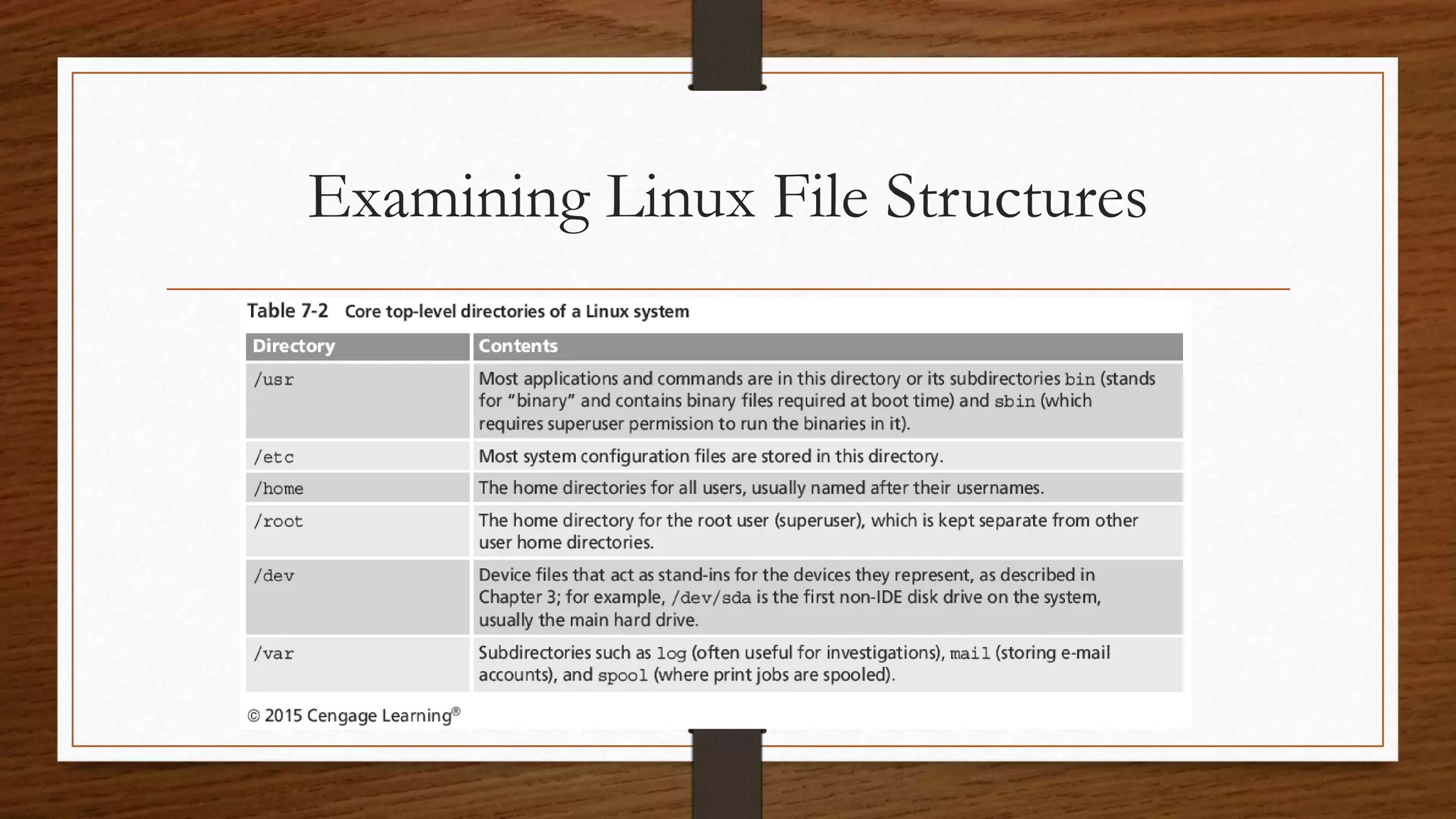
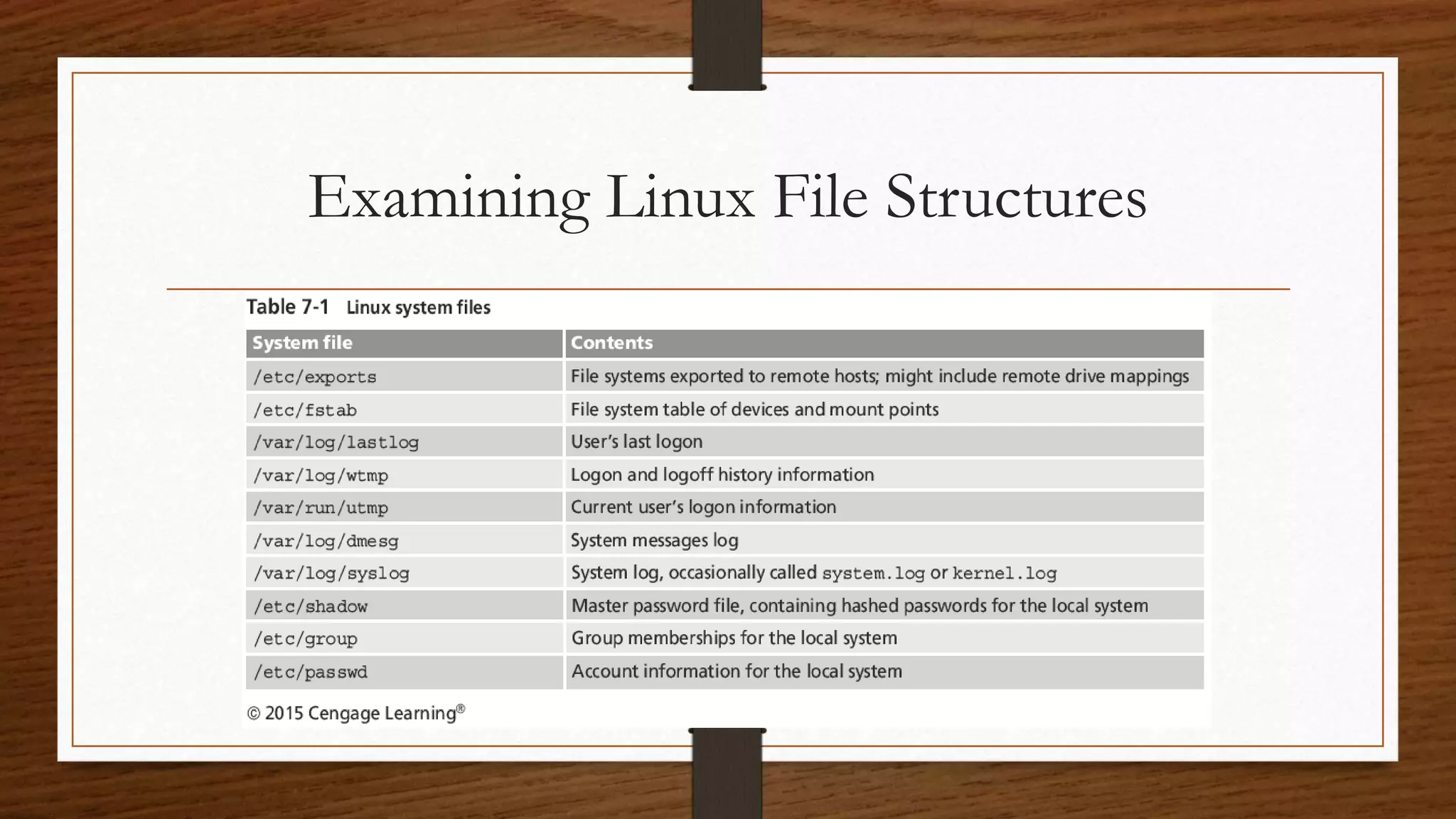
Examining Linux File Structures
• UNIX flavors
• Silicon Graphics, Inc. (SGI) IRIX, Santa Cruz Operation (SCO)
UnixWare, Sun Solaris, IBM AIX, and HP-UX
• Linux distributions
• Ubuntu, Debian, Red Hat, OpenSUSE, and Slackware
• Linux is only the core of the OS
• All UNIX-like OSs have a kernel
• So do all Windows OSs
Examining Linux File Structures
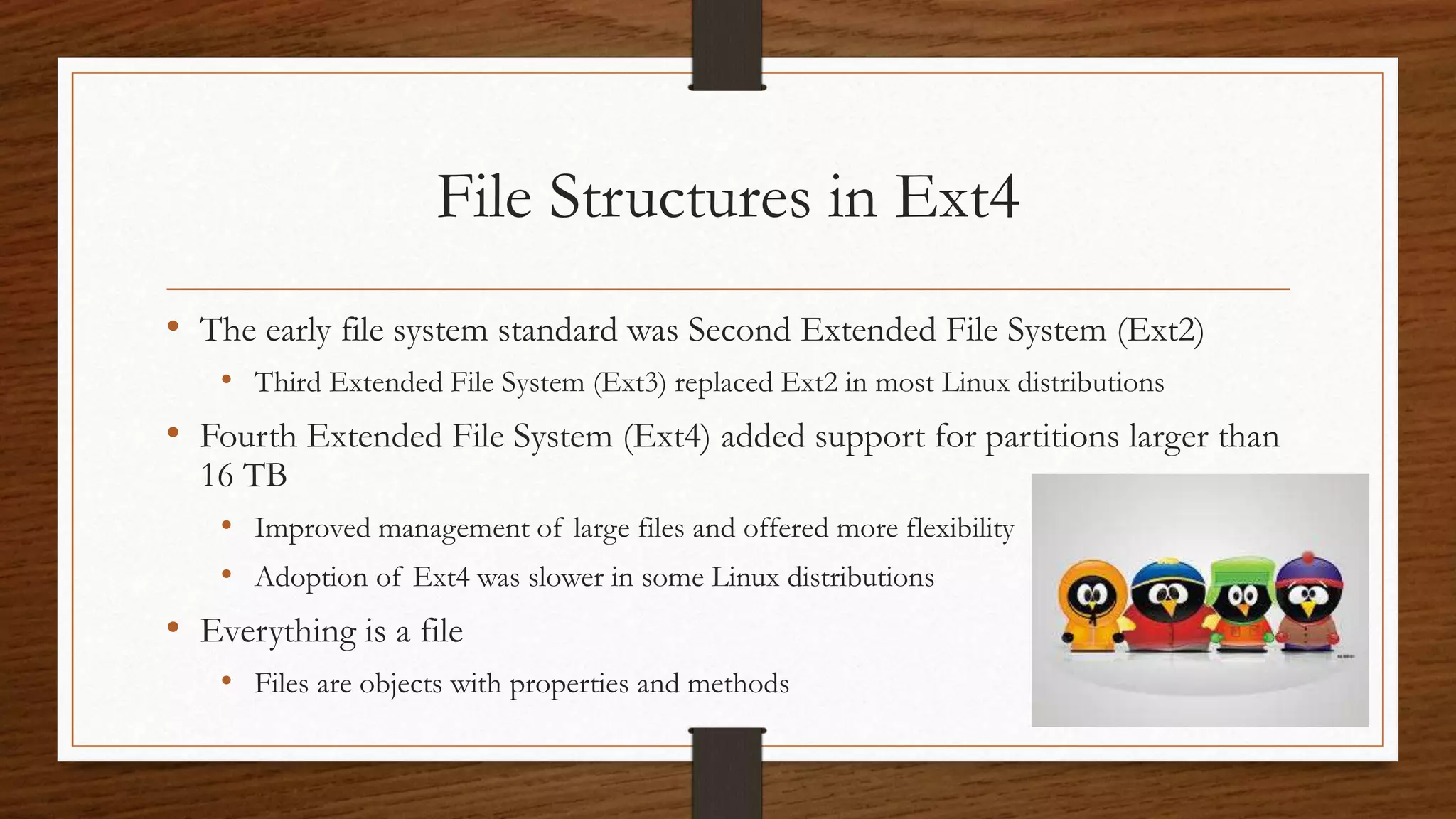
File Structures in Ext4
• The early file system standard was Second Extended File System (Ext2)
• Third Extended File System (Ext3) replaced Ext2 in most Linux distributions
• Fourth Extended File System (Ext4) added support for partitions larger than
16 TB
• Improved management of large files and offered more flexibility
• Adoption of Ext4 was slower in some Linux distributions
• Everything is a file
• Files are objects with properties and methods
File Structures in Ext4
Consists of four components
• Boot block
• Block is a disk allocation unit of at least 512 bytes
• Contains the bootstrap code
• UNIX/Linux computer has only one boot block,
located on the main hard disk
• Superblock
• Indicates disk geometry, available space, and location
of the first inode
• Manages the file system
• Inode blocks
• First data after the superblock
• Assigned to every file allocation unit
• Data blocks
• Where directories and files are stored
• This location is linked directly to
inodes
Inodes
• Contain file and directory metadata
• Also link data stored in data blocks
• An assigned inode contains the following:
• Mode and type of file or directory
• Number of links to a file or directory
• UID and GID of the file’s or directory’s
owner
• Number of bytes in the file or directory
• File’s or directory’s last access time and last
modified timeInode’s last file status change
time
• Block address for the file data
• Indirect, double-indirect, and triple-indirect
block addresses for the file data
• Current usage status of the inode
• Number of actual blocks assigned to a file
• File generation number of version number
• Continuation inode’s link
Inodes
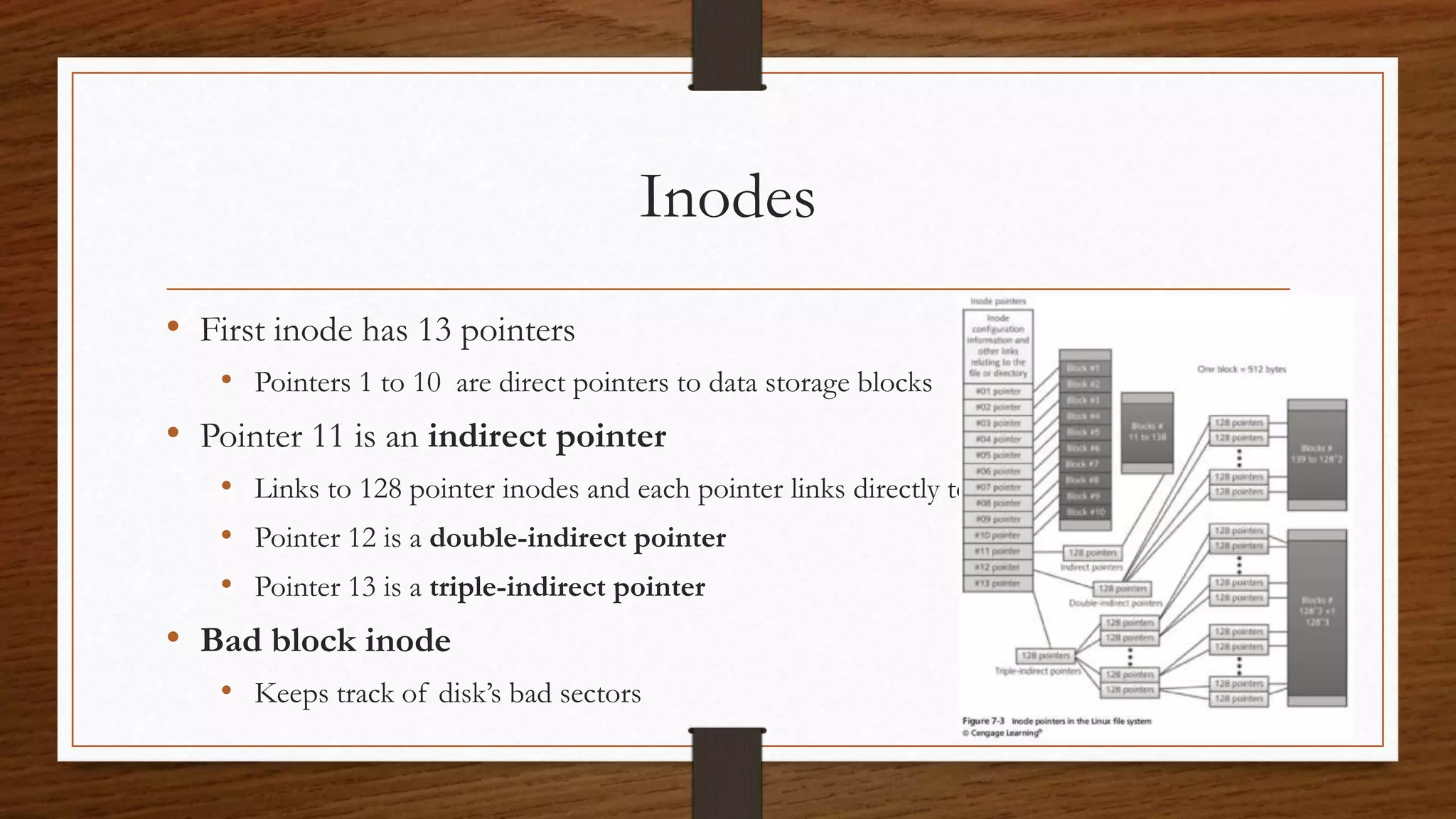
• First inode has 13 pointers
• Pointers 1 to 10 are direct pointers to data storage blocks
• Pointer 11 is an indirect pointer
• Links to 128 pointer inodes and each pointer links directly to 128 blocks
• Pointer 12 is a double-indirect pointer
• Pointer 13 is a triple-indirect pointer
• Bad block inode
• Keeps track of disk’s bad sectors
Hard Links and Symbolic Links
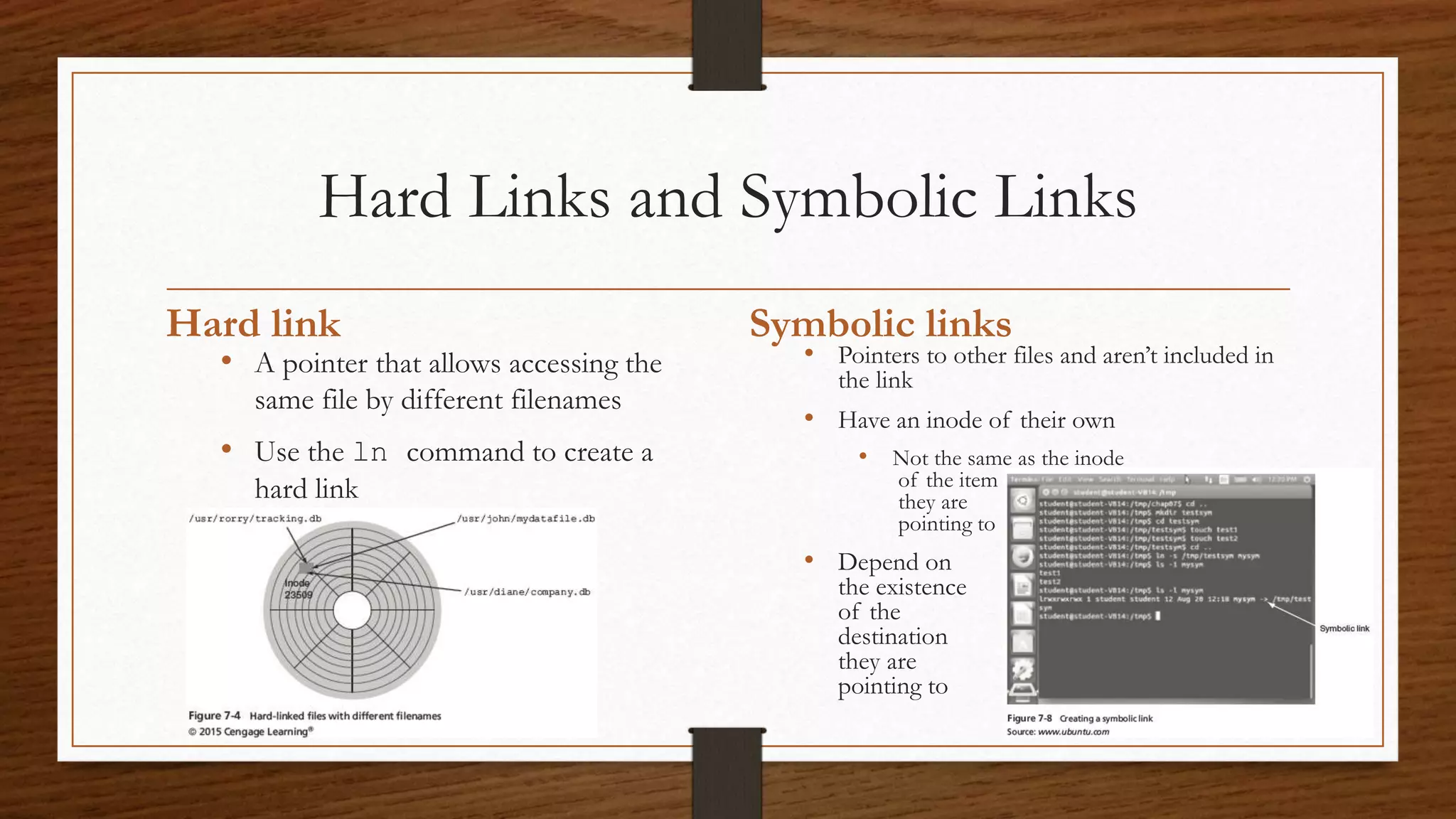
Hard link
• A pointer that allows accessing the
same file by different filenames
• Use the ln command to create a
hard link
Symbolic links
• Pointers to other files and aren’t included in
the link
• Have an inode of their own
• Not the same as the inode
of the item
they are
pointing to
• Depend on
the existence
of the
destination
they are
pointing to
Summary
• UNIX was created to be a multiuser, multithreaded, secure OS
• The Linux kernel is usually packaged with other software components, such as a
GUI and applications
• Linux supports a wide range of file systems
• UNIX and Linux have four components defining the file system: boot block,
superblock, inode block, and data block
• In the Linux file system, a hard link is a pointer that allows accessing the same file
by different filenames

Examining Linux File Structures

  • 1.
  • 2.
    Examining Linux FileStructures • UNIX flavors • Silicon Graphics, Inc. (SGI) IRIX, Santa Cruz Operation (SCO) UnixWare, Sun Solaris, IBM AIX, and HP-UX • Linux distributions • Ubuntu, Debian, Red Hat, OpenSUSE, and Slackware • Linux is only the core of the OS • All UNIX-like OSs have a kernel • So do all Windows OSs
  • 3.
  • 4.
  • 5.
    File Structures inExt4 • The early file system standard was Second Extended File System (Ext2) • Third Extended File System (Ext3) replaced Ext2 in most Linux distributions • Fourth Extended File System (Ext4) added support for partitions larger than 16 TB • Improved management of large files and offered more flexibility • Adoption of Ext4 was slower in some Linux distributions • Everything is a file • Files are objects with properties and methods
  • 6.
    File Structures inExt4 Consists of four components • Boot block • Block is a disk allocation unit of at least 512 bytes • Contains the bootstrap code • UNIX/Linux computer has only one boot block, located on the main hard disk • Superblock • Indicates disk geometry, available space, and location of the first inode • Manages the file system • Inode blocks • First data after the superblock • Assigned to every file allocation unit • Data blocks • Where directories and files are stored • This location is linked directly to inodes
  • 7.
    Inodes • Contain fileand directory metadata • Also link data stored in data blocks • An assigned inode contains the following: • Mode and type of file or directory • Number of links to a file or directory • UID and GID of the file’s or directory’s owner • Number of bytes in the file or directory • File’s or directory’s last access time and last modified timeInode’s last file status change time • Block address for the file data • Indirect, double-indirect, and triple-indirect block addresses for the file data • Current usage status of the inode • Number of actual blocks assigned to a file • File generation number of version number • Continuation inode’s link
  • 8.
    Inodes • First inodehas 13 pointers • Pointers 1 to 10 are direct pointers to data storage blocks • Pointer 11 is an indirect pointer • Links to 128 pointer inodes and each pointer links directly to 128 blocks • Pointer 12 is a double-indirect pointer • Pointer 13 is a triple-indirect pointer • Bad block inode • Keeps track of disk’s bad sectors
  • 9.
    Hard Links andSymbolic Links Hard link • A pointer that allows accessing the same file by different filenames • Use the ln command to create a hard link Symbolic links • Pointers to other files and aren’t included in the link • Have an inode of their own • Not the same as the inode of the item they are pointing to • Depend on the existence of the destination they are pointing to
  • 10.
    Summary • UNIX wascreated to be a multiuser, multithreaded, secure OS • The Linux kernel is usually packaged with other software components, such as a GUI and applications • Linux supports a wide range of file systems • UNIX and Linux have four components defining the file system: boot block, superblock, inode block, and data block • In the Linux file system, a hard link is a pointer that allows accessing the same file by different filenames