OPERATING SYSTEM
Chapter 10: File-System Interface
Chapter 11: File-System Interface
•
•
•
•
•
•

File Concept
Access Methods
Disk and Directory Structure
File-System Mounting
File Sharing
Protection
Objectives
• To explain the function of file systems
• To describe the interfaces to file systems
• To discuss file-system design tradeoffs, including access
methods, file sharing, file locking, and directory
structures
• To explore file-system protection
File Concept
• Contiguous logical address space
Types:
– Data
• numeric
• character
• binary

– Program

• Contents defined by file’s creator
– Many types
• Consider text file, source file, executable file
File Attributes
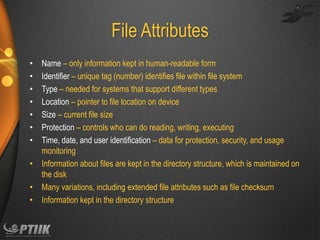
Name – only information kept in human-readable form
Identifier – unique tag (number) identifies file within file system
Type – needed for systems that support different types
Location – pointer to file location on device
Size – current file size
Protection – controls who can do reading, writing, executing
Time, date, and user identification – data for protection, security, and usage
monitoring
• Information about files are kept in the directory structure, which is maintained on
the disk
• Many variations, including extended file attributes such as file checksum
• Information kept in the directory structure
•
•
•
•
•
•
•
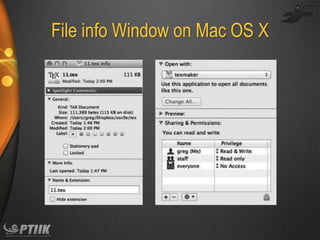
File info Window on Mac OS X
File Operations
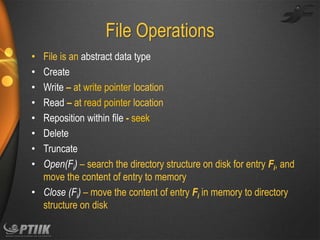
File is an abstract data type
Create
Write – at write pointer location
Read – at read pointer location
Reposition within file - seek
Delete
Truncate
Open(Fi) – search the directory structure on disk for entry Fi, and
move the content of entry to memory
• Close (Fi) – move the content of entry Fi in memory to directory
structure on disk
•
•
•
•
•
•
•
•
Open Files
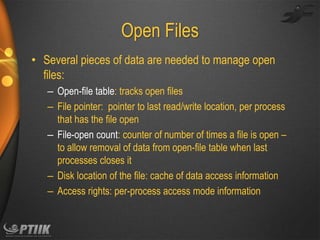
• Several pieces of data are needed to manage open
files:
– Open-file table: tracks open files
– File pointer: pointer to last read/write location, per process
that has the file open
– File-open count: counter of number of times a file is open –
to allow removal of data from open-file table when last
processes closes it
– Disk location of the file: cache of data access information
– Access rights: per-process access mode information
Open File Locking
• Provided by some operating systems and file systems
– Similar to reader-writer locks
– Shared lock similar to reader lock – several processes can
acquire concurrently
– Exclusive lock similar to writer lock

• Mediates access to a file
• Mandatory or advisory:
– Mandatory – access is denied depending on locks held and
requested
– Advisory – processes can find status of locks and decide
what to do
File Types – Name, Extension
File Structure
• None - sequence of words, bytes
• Simple record structure
– Lines
– Fixed length
– Variable length

• Complex Structures
– Formatted document
– Relocatable load file

• Can simulate last two with first method by inserting appropriate
control characters
• Who decides:
– Operating system
– Program
Sequential-access File
Simulation of Sequential Access on
Direct-access File
Other Access Methods
• Can be built on top of base methods
• General involve creation of an index for the file
• Keep index in memory for fast determination of location of data to
be operated on (consider UPC code plus record of data about that
item)
• If too large, index (in memory) of the index (on disk)
• IBM indexed sequential-access method (ISAM)
– Small master index, points to disk blocks of secondary index
– File kept sorted on a defined key
– All done by the OS

• VMS operating system provides index and relative files as another
example (see next slide)
Example of Index and Relative Files
Directory Structure
• A collection of nodes containing information about all
files
Directory

Files

F1

F2

F3

F4
Fn

Both the directory structure and the files reside on disk
Disk Structure
• Disk can be subdivided into partitions
• Disks or partitions can be RAID protected against failure
• Disk or partition can be used raw – without a file system, or
formatted with a file system
• Partitions also known as minidisks, slices
• Entity containing file system known as a volume
• Each volume containing file system also tracks that file system’s
info in device directory or volume table of contents
• As well as general-purpose file systems there are many specialpurpose file systems, frequently all within the same operating
system or computer
A Typical File-system Organization
Types of File Systems
• We mostly talk of general-purpose file systems
• But systems frequently have may file systems, some general- and
some special- purpose
• Consider Solaris has
tmpfs – memory-based volatile FS for fast, temporary I/O
objfs – interface into kernel memory to get kernel symbols for debugging
ctfs – contract file system for managing daemons
lofs – loopback file system allows one FS to be accessed in place of
another
– procfs – kernel interface to process structures
– ufs, zfs – general purpose file systems
–
–
–
–
Operations Performed on Directory
• Search for a file
• Create a file
• Delete a file
• List a directory
• Rename a file
• Traverse the file system
Organize the Directory (Logically) to Obtain
• Efficiency – locating a file quickly
• Naming – convenient to users
– Two users can have same name for different files
– The same file can have several different names

• Grouping – logical grouping of files by properties, (e.g.,
all Java programs, all games, …)
Single-Level Directory
• A single directory for all users

• Naming problem
Grouping problem
Two-Level Directory
• Separate directory for each user

•
•
•
•

Path name
Can have the same file name for different user
Efficient searching
No grouping capability
Tree-Structured Directories
Tree-Structured Directories (Cont.)
• Efficient searching
• Grouping Capability
• Current directory (working directory)
cd /spell/mail/prog
type list
Tree-Structured Directories (Cont.)
• Absolute or relative path name
• Creating a new file is done in current directory
• Delete a file
rm <file-name>
• Creating a new subdirectory is done in current directory
mkdir <dir-name>
Example: if in current directory /mail
mkdir count
mail
prog

copy prt exp count

Deleting “mail”  deleting the entire subtree rooted by “mail”
Acyclic-Graph Directories
• Have shared subdirectories and files
Acyclic-Graph Directories (Cont.)
• Two different names (aliasing)

If dict deletes list  dangling pointer

Solutions:
– Backpointers, so we can delete all pointers
Variable size records a problem
– Backpointers using a daisy chain organization
– Entry-hold-count solution

• New directory entry type
– Link – another name (pointer) to an existing file
– Resolve the link – follow pointer to locate the file
General Graph Directory
General Graph Directory (Cont.)
• How do we guarantee no cycles?
– Allow only links to file not subdirectories
– Garbage collection
– Every time a new link is added use a cycle detection algorithm
to determine whether it is OK
File System Mounting
• A file system must be mounted before it can be accessed
• A unmounted file system (i.e., Fig. 11-11(b)) is mounted
at a mount point
Mount Point
File Sharing
Sharing of files on multi-user systems is desirable
Sharing may be done through a protection scheme
On distributed systems, files may be shared across a network
Network File System (NFS) is a common distributed file-sharing
method
• If multi-user system
•
•
•
•

– User IDs identify users, allowing permissions and protections to be per-user
Group IDs allow users to be in groups, permitting group access rights
– Owner of a file / directory
– Group of a file / directory
File Sharing – Remote File Systems
• Uses networking to allow file system access between systems
– Manually via programs like FTP
– Automatically, seamlessly using distributed file systems
– Semi automatically via the world wide web

• Client-server model allows clients to mount remote file systems from servers
–
–
–
–
–

Server can serve multiple clients
Client and user-on-client identification is insecure or complicated
NFS is standard UNIX client-server file sharing protocol
CIFS is standard Windows protocol
Standard operating system file calls are translated into remote calls

• Distributed Information Systems (distributed naming services) such as LDAP,
DNS, NIS, Active Directory implement unified access to information needed for
remote computing
File Sharing – Failure Modes
• All file systems have failure modes
– For example corruption of directory structures or other nonuser data, called metadata

• Remote file systems add new failure modes, due to
network failure, server failure
• Recovery from failure can involve state information about
status of each remote request
• Stateless protocols such as NFS v3 include all
information in each request, allowing easy recovery but
less security
File Sharing – Consistency Semantics
Specify how multiple users are to access a shared file simultaneously
– Similar to Ch. 5 process synchronization algorithms
• Tend to be less complex due to disk I/O and network latency (for remote file
systems

– Andrew File System (AFS) implemented complex remote file
sharing semantics
– Unix file system (UFS) implements:
• Writes to an open file visible immediately to other users of the same open file
• Sharing file pointer to allow multiple users to read and write concurrently

– AFS has session semantics
• Writes only visible to sessions starting after the file is closed
Protection
• File owner/creator should be able to control:
– what can be done
– by whom

• Types of access
–
–
–
–
–
–

Read
Write
Execute
Append
Delete
List
Access Lists and Groups
• Mode of access: read, write, execute
• Three classes of users on Unix / Linux
a) owner access

7



b) group access

6



c) public access

1



RWX
111
RWX
110
RWX
001

• Ask manager to create a group (unique name), say G,
and add some users to the group.
• For a particular file (say game) or subdirectory, define an
appropriate access.
Access Lists and Groups (Cont.)
owner

group

chmod

761

public

game

Attach a group to a file
chgrp

G

game
Windows 7 Access-Control List Management
A Sample UNIX Directory Listing
End of Chapter 10

Ch10 file system interface

  • 1.
    OPERATING SYSTEM Chapter 10:File-System Interface
  • 2.
    Chapter 11: File-SystemInterface • • • • • • File Concept Access Methods Disk and Directory Structure File-System Mounting File Sharing Protection
  • 3.
    Objectives • To explainthe function of file systems • To describe the interfaces to file systems • To discuss file-system design tradeoffs, including access methods, file sharing, file locking, and directory structures • To explore file-system protection
  • 4.
    File Concept • Contiguouslogical address space Types: – Data • numeric • character • binary – Program • Contents defined by file’s creator – Many types • Consider text file, source file, executable file
  • 5.
    File Attributes Name –only information kept in human-readable form Identifier – unique tag (number) identifies file within file system Type – needed for systems that support different types Location – pointer to file location on device Size – current file size Protection – controls who can do reading, writing, executing Time, date, and user identification – data for protection, security, and usage monitoring • Information about files are kept in the directory structure, which is maintained on the disk • Many variations, including extended file attributes such as file checksum • Information kept in the directory structure • • • • • • •
  • 6.
    File info Windowon Mac OS X
  • 7.
    File Operations File isan abstract data type Create Write – at write pointer location Read – at read pointer location Reposition within file - seek Delete Truncate Open(Fi) – search the directory structure on disk for entry Fi, and move the content of entry to memory • Close (Fi) – move the content of entry Fi in memory to directory structure on disk • • • • • • • •
  • 8.
    Open Files • Severalpieces of data are needed to manage open files: – Open-file table: tracks open files – File pointer: pointer to last read/write location, per process that has the file open – File-open count: counter of number of times a file is open – to allow removal of data from open-file table when last processes closes it – Disk location of the file: cache of data access information – Access rights: per-process access mode information
  • 9.
    Open File Locking •Provided by some operating systems and file systems – Similar to reader-writer locks – Shared lock similar to reader lock – several processes can acquire concurrently – Exclusive lock similar to writer lock • Mediates access to a file • Mandatory or advisory: – Mandatory – access is denied depending on locks held and requested – Advisory – processes can find status of locks and decide what to do
  • 10.
    File Types –Name, Extension
  • 11.
    File Structure • None- sequence of words, bytes • Simple record structure – Lines – Fixed length – Variable length • Complex Structures – Formatted document – Relocatable load file • Can simulate last two with first method by inserting appropriate control characters • Who decides: – Operating system – Program
  • 12.
  • 13.
    Simulation of SequentialAccess on Direct-access File
  • 14.
    Other Access Methods •Can be built on top of base methods • General involve creation of an index for the file • Keep index in memory for fast determination of location of data to be operated on (consider UPC code plus record of data about that item) • If too large, index (in memory) of the index (on disk) • IBM indexed sequential-access method (ISAM) – Small master index, points to disk blocks of secondary index – File kept sorted on a defined key – All done by the OS • VMS operating system provides index and relative files as another example (see next slide)
  • 15.
    Example of Indexand Relative Files
  • 16.
    Directory Structure • Acollection of nodes containing information about all files Directory Files F1 F2 F3 F4 Fn Both the directory structure and the files reside on disk
  • 17.
    Disk Structure • Diskcan be subdivided into partitions • Disks or partitions can be RAID protected against failure • Disk or partition can be used raw – without a file system, or formatted with a file system • Partitions also known as minidisks, slices • Entity containing file system known as a volume • Each volume containing file system also tracks that file system’s info in device directory or volume table of contents • As well as general-purpose file systems there are many specialpurpose file systems, frequently all within the same operating system or computer
  • 18.
  • 19.
    Types of FileSystems • We mostly talk of general-purpose file systems • But systems frequently have may file systems, some general- and some special- purpose • Consider Solaris has tmpfs – memory-based volatile FS for fast, temporary I/O objfs – interface into kernel memory to get kernel symbols for debugging ctfs – contract file system for managing daemons lofs – loopback file system allows one FS to be accessed in place of another – procfs – kernel interface to process structures – ufs, zfs – general purpose file systems – – – –
  • 20.
    Operations Performed onDirectory • Search for a file • Create a file • Delete a file • List a directory • Rename a file • Traverse the file system
  • 21.
    Organize the Directory(Logically) to Obtain • Efficiency – locating a file quickly • Naming – convenient to users – Two users can have same name for different files – The same file can have several different names • Grouping – logical grouping of files by properties, (e.g., all Java programs, all games, …)
  • 22.
    Single-Level Directory • Asingle directory for all users • Naming problem Grouping problem
  • 23.
    Two-Level Directory • Separatedirectory for each user • • • • Path name Can have the same file name for different user Efficient searching No grouping capability
  • 24.
  • 25.
    Tree-Structured Directories (Cont.) •Efficient searching • Grouping Capability • Current directory (working directory) cd /spell/mail/prog type list
  • 26.
    Tree-Structured Directories (Cont.) •Absolute or relative path name • Creating a new file is done in current directory • Delete a file rm <file-name> • Creating a new subdirectory is done in current directory mkdir <dir-name> Example: if in current directory /mail mkdir count mail prog copy prt exp count Deleting “mail”  deleting the entire subtree rooted by “mail”
  • 27.
    Acyclic-Graph Directories • Haveshared subdirectories and files
  • 28.
    Acyclic-Graph Directories (Cont.) •Two different names (aliasing) If dict deletes list  dangling pointer Solutions: – Backpointers, so we can delete all pointers Variable size records a problem – Backpointers using a daisy chain organization – Entry-hold-count solution • New directory entry type – Link – another name (pointer) to an existing file – Resolve the link – follow pointer to locate the file
  • 29.
  • 30.
    General Graph Directory(Cont.) • How do we guarantee no cycles? – Allow only links to file not subdirectories – Garbage collection – Every time a new link is added use a cycle detection algorithm to determine whether it is OK
  • 31.
    File System Mounting •A file system must be mounted before it can be accessed • A unmounted file system (i.e., Fig. 11-11(b)) is mounted at a mount point
  • 32.
  • 33.
    File Sharing Sharing offiles on multi-user systems is desirable Sharing may be done through a protection scheme On distributed systems, files may be shared across a network Network File System (NFS) is a common distributed file-sharing method • If multi-user system • • • • – User IDs identify users, allowing permissions and protections to be per-user Group IDs allow users to be in groups, permitting group access rights – Owner of a file / directory – Group of a file / directory
  • 34.
    File Sharing –Remote File Systems • Uses networking to allow file system access between systems – Manually via programs like FTP – Automatically, seamlessly using distributed file systems – Semi automatically via the world wide web • Client-server model allows clients to mount remote file systems from servers – – – – – Server can serve multiple clients Client and user-on-client identification is insecure or complicated NFS is standard UNIX client-server file sharing protocol CIFS is standard Windows protocol Standard operating system file calls are translated into remote calls • Distributed Information Systems (distributed naming services) such as LDAP, DNS, NIS, Active Directory implement unified access to information needed for remote computing
  • 35.
    File Sharing –Failure Modes • All file systems have failure modes – For example corruption of directory structures or other nonuser data, called metadata • Remote file systems add new failure modes, due to network failure, server failure • Recovery from failure can involve state information about status of each remote request • Stateless protocols such as NFS v3 include all information in each request, allowing easy recovery but less security
  • 36.
    File Sharing –Consistency Semantics Specify how multiple users are to access a shared file simultaneously – Similar to Ch. 5 process synchronization algorithms • Tend to be less complex due to disk I/O and network latency (for remote file systems – Andrew File System (AFS) implemented complex remote file sharing semantics – Unix file system (UFS) implements: • Writes to an open file visible immediately to other users of the same open file • Sharing file pointer to allow multiple users to read and write concurrently – AFS has session semantics • Writes only visible to sessions starting after the file is closed
  • 37.
    Protection • File owner/creatorshould be able to control: – what can be done – by whom • Types of access – – – – – – Read Write Execute Append Delete List
  • 38.
    Access Lists andGroups • Mode of access: read, write, execute • Three classes of users on Unix / Linux a) owner access 7  b) group access 6  c) public access 1  RWX 111 RWX 110 RWX 001 • Ask manager to create a group (unique name), say G, and add some users to the group. • For a particular file (say game) or subdirectory, define an appropriate access.
  • 39.
    Access Lists andGroups (Cont.) owner group chmod 761 public game Attach a group to a file chgrp G game
  • 40.
    Windows 7 Access-ControlList Management
  • 41.
    A Sample UNIXDirectory Listing
  • 42.