
Contiguous
Allocation
1
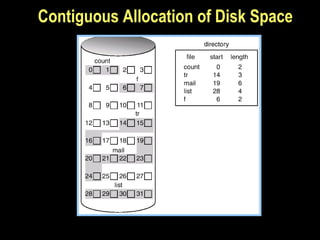
Contiguous Allocation of Disk Space
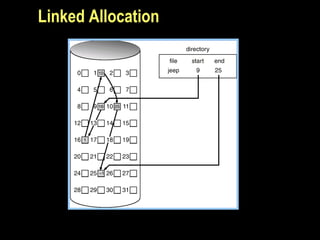
Linked Allocation
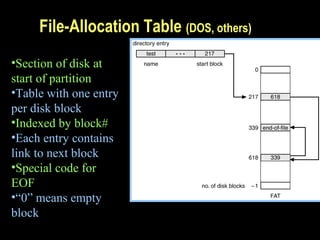
File-Allocation Table (DOS, others)
•Section of disk at
start of partition
•Table with one entry
per disk block
•Indexed by block#
•Each entry contains
link to next block
•Special code for
EOF
•“0” means empty
block
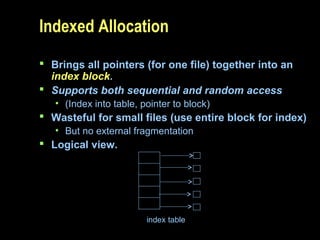
Indexed Allocation
 Brings all pointers (for one file) together into an
index block.
 Supports both sequential and random access
• (Index into table, pointer to block)
 Wasteful for small files (use entire block for index)
• But no external fragmentation
 Logical view.
index table
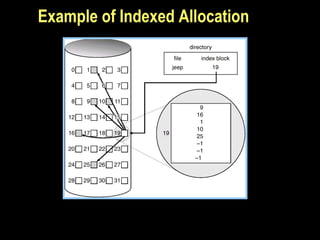
Example of Indexed Allocation
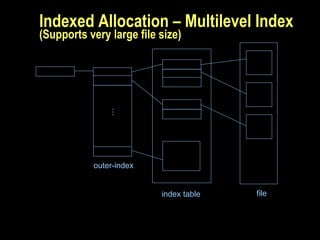
Indexed Allocation – Multilevel Index
(Supports very large file size)

outer-index
index table file
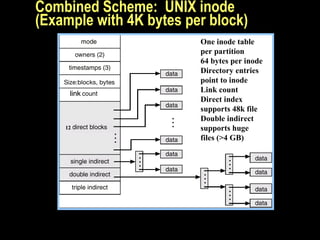
Combined Scheme: UNIX inode
(Example with 4K bytes per block)
1212
linklink
Size:blocks, bytes
One inode table
per partition
64 bytes per inode
Directory entries
point to inode
Link count
Direct index
supports 48k file
Double indirect
supports huge
files (>4 GB)
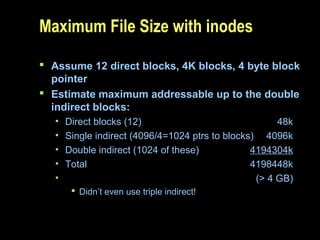
Maximum File Size with inodes
 Assume 12 direct blocks, 4K blocks, 4 byte block
pointer
 Estimate maximum addressable up to the double
indirect blocks:
• Direct blocks (12) 48k
• Single indirect (4096/4=1024 ptrs to blocks) 4096k
• Double indirect (1024 of these) 4194304k
• Total 4198448k
• (> 4 GB)
 Didn’t even use triple indirect!
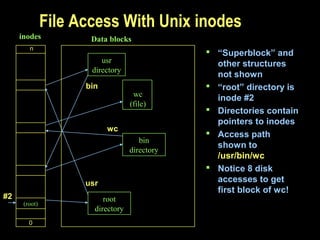
File Access With Unix inodes
 “Superblock” and
other structures
not shown
 “root” directory is
inode #2
 Directories contain
pointers to inodes
 Access path
shown to
/usr/bin/wc
 Notice 8 disk
accesses to get
first block of wc!
inodes
(root)
root
directory
usr
directory
bin
directory
wc
(file)
Data blocks
usr
bin
wc
#2
0
n
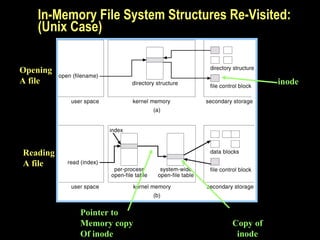
In-Memory File System Structures Re-Visited:
(Unix Case)
Opening
A file
Reading
A file
inode
Copy of
inode
Pointer to
Memory copy
Of inode
Free-Space Management
 Bit vector (n blocks)
…
0 1 2 n-1
bit[i] =

1 ⇒ block[i] free
0 ⇒ block[i] occupied
To find a free block: find the first non-zero
word, locate first 1-bit.
Block number (of first free block) is:
umber of bits per word) * (number of 0-value words) + offset of first 1
Bit Vector (Cont.)
 Bit map requires extra space. Example:
block size = 212
bytes
disk size = 230
bytes (1 gigabyte)
n = 230
/212
= 218
bits (or 32K bytes)
 Easy to get contiguous files
• Just look for consecutive 1’s in bit map
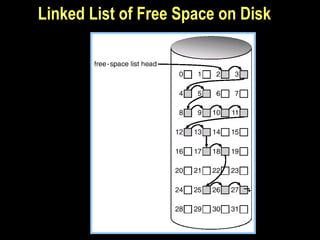
Linked List of Free Space on Disk
Free List Approach
 Linked list
• Hard to find contiguous space easily
• But no waste of space
 Grouping
• Store addresses of n free blocks in the first block
• Last of these addresses is to a block that contains
addresses of another n free blocks
• So many free blocks can be found at one time
 Counting
• Clusters of contiguous free blocks recorded together
• Keep list of first block address, count of contiguous
free ones

Contigious

  • 1.
  • 2.
  • 3.
  • 4.
    File-Allocation Table (DOS,others) •Section of disk at start of partition •Table with one entry per disk block •Indexed by block# •Each entry contains link to next block •Special code for EOF •“0” means empty block
  • 5.
    Indexed Allocation  Bringsall pointers (for one file) together into an index block.  Supports both sequential and random access • (Index into table, pointer to block)  Wasteful for small files (use entire block for index) • But no external fragmentation  Logical view. index table
  • 6.
  • 7.
    Indexed Allocation –Multilevel Index (Supports very large file size)  outer-index index table file
  • 8.
    Combined Scheme: UNIXinode (Example with 4K bytes per block) 1212 linklink Size:blocks, bytes One inode table per partition 64 bytes per inode Directory entries point to inode Link count Direct index supports 48k file Double indirect supports huge files (>4 GB)
  • 9.
    Maximum File Sizewith inodes  Assume 12 direct blocks, 4K blocks, 4 byte block pointer  Estimate maximum addressable up to the double indirect blocks: • Direct blocks (12) 48k • Single indirect (4096/4=1024 ptrs to blocks) 4096k • Double indirect (1024 of these) 4194304k • Total 4198448k • (> 4 GB)  Didn’t even use triple indirect!
  • 10.
    File Access WithUnix inodes  “Superblock” and other structures not shown  “root” directory is inode #2  Directories contain pointers to inodes  Access path shown to /usr/bin/wc  Notice 8 disk accesses to get first block of wc! inodes (root) root directory usr directory bin directory wc (file) Data blocks usr bin wc #2 0 n
  • 11.
    In-Memory File SystemStructures Re-Visited: (Unix Case) Opening A file Reading A file inode Copy of inode Pointer to Memory copy Of inode
  • 12.
    Free-Space Management  Bitvector (n blocks) … 0 1 2 n-1 bit[i] =  1 ⇒ block[i] free 0 ⇒ block[i] occupied To find a free block: find the first non-zero word, locate first 1-bit. Block number (of first free block) is: umber of bits per word) * (number of 0-value words) + offset of first 1
  • 13.
    Bit Vector (Cont.) Bit map requires extra space. Example: block size = 212 bytes disk size = 230 bytes (1 gigabyte) n = 230 /212 = 218 bits (or 32K bytes)  Easy to get contiguous files • Just look for consecutive 1’s in bit map
  • 14.
    Linked List ofFree Space on Disk
  • 15.
    Free List Approach Linked list • Hard to find contiguous space easily • But no waste of space  Grouping • Store addresses of n free blocks in the first block • Last of these addresses is to a block that contains addresses of another n free blocks • So many free blocks can be found at one time  Counting • Clusters of contiguous free blocks recorded together • Keep list of first block address, count of contiguous free ones