PONNADA PUSPALATHA
Assistant Professor
ADITYA INSTITUTE OF TECHNOLOGY AND MANAGEMENT(AUTONOMOUS)
Tekkali, Srikakulam.
Introduction
 Cost-benefit analysis is a set of practical procedures
for guiding public expenditure decisions.
 We want our environment to be clean and safe.
 But ‘how much’ clean and safe ?
 How to measure environmental benefits and costs ?
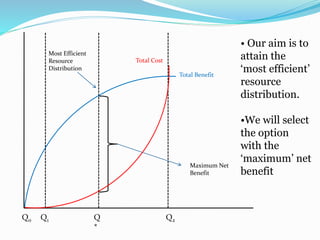
Total Cost
Total Benefit
Maximum Net
Benefit
Q1 Q
*
Q0 Q2
Most Efficient
Resource
Distribution
• Our aim is to
attain the
‘most efficient’
resource
distribution.
•We will select
the option
with the
‘maximum’ net
benefit
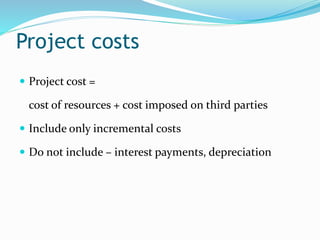
 Project cost =
cost of resources + cost imposed on third parties
 Include only incremental costs
 Do not include – interest payments, depreciation
Project costs
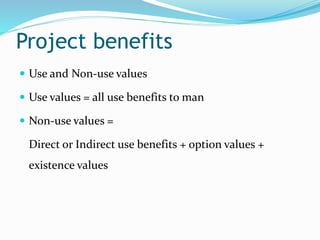
Project benefits
 Use and Non-use values
 Use values = all use benefits to man
 Non-use values =
Direct or Indirect use benefits + option values +
existence values
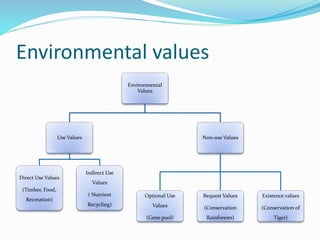
Environmental values
Environmental
Values
Use Values
Direct Use Values
(Timber, Food,
Recreation)
Indirect Use
Values
( Nutrient
Recycling)
Non-use Values
Optional Use
Values
(Gene pool)
Bequest Values
(Conservation
Rainforests)
Existence values
(Conservation of
Tiger)
Secondary benefits
 Result from primary benefits of the project
 e.g. project > higher wages to employees > higher
expenditure > improve quality of life
 Not included in CBA
 Viewed as transfer between communities rather than
net addition to community income
Option values
 Risk is attached to all decisions
 Uncertainty about demand and supply in future
 Pay more to insure demand or supply
 Option value =
value that an individual is willing to pay in excess to
expected use value to preserve an asset
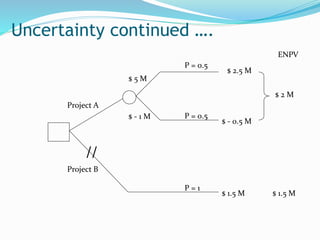
Uncertainty continued ….
Project A
Project B
ENPV
$ 1.5 M
P = 1
P = 0.5
P = 0.5
$ 5 M
$ - 1 M
$ 2 M
$ 2.5 M
$ 1.5 M
$ - 0.5 M
//
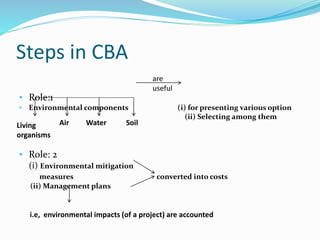
Steps in CBA
• Role:1
• Environmental components (i) for presenting various option
(ii) Selecting among them
• Role: 2
(i) Environmental mitigation
measures converted into costs
(ii) Management plans
are
useful
Living
organisms
Air Water Soil
i.e, environmental impacts (of a project) are accounted
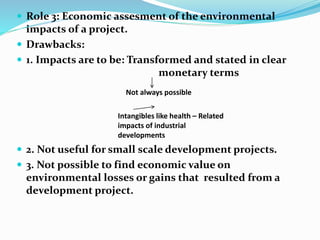
 Role 3: Economic assesment of the environmental
impacts of a project.
 Drawbacks:
 1. Impacts are to be: Transformed and stated in clear
monetary terms
 2. Not useful for small scale development projects.
 3. Not possible to find economic value on
environmental losses or gains that resulted from a
development project.
Not always possible
Intangibles like health – Related
impacts of industrial
developments
 Site evaluation together with Major design options:
 Within (i) economic limitations
 Ii) technical limitations
 That give LEAST ECONOMIC COST to the community
Thank You !
AGSIP 13 – Resource Economics
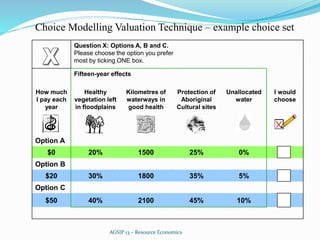
Question X: Options A, B and C.
Please choose the option you prefer
most by ticking ONE box.
Fifteen-year effects
How much
I pay each
year
Healthy
vegetation left
in floodplains
Kilometres of
waterways in
good health
Protection of
Aboriginal
Cultural sites
Unallocated
water
I would
choose
Option A
$0 20% 1500 25% 0%
Option B
$20 30% 1800 35% 5%
Option C
$50 40% 2100 45% 10%
Choice Modelling Valuation Technique – example choice set

Cost benefit analysis (environmental impact assessment)

  • 1.
    PONNADA PUSPALATHA Assistant Professor ADITYAINSTITUTE OF TECHNOLOGY AND MANAGEMENT(AUTONOMOUS) Tekkali, Srikakulam.
  • 2.
    Introduction  Cost-benefit analysisis a set of practical procedures for guiding public expenditure decisions.
  • 3.
     We wantour environment to be clean and safe.  But ‘how much’ clean and safe ?  How to measure environmental benefits and costs ?
  • 4.
    Total Cost Total Benefit MaximumNet Benefit Q1 Q * Q0 Q2 Most Efficient Resource Distribution • Our aim is to attain the ‘most efficient’ resource distribution. •We will select the option with the ‘maximum’ net benefit
  • 5.
     Project cost= cost of resources + cost imposed on third parties  Include only incremental costs  Do not include – interest payments, depreciation Project costs
  • 6.
    Project benefits  Useand Non-use values  Use values = all use benefits to man  Non-use values = Direct or Indirect use benefits + option values + existence values
  • 7.
    Environmental values Environmental Values Use Values DirectUse Values (Timber, Food, Recreation) Indirect Use Values ( Nutrient Recycling) Non-use Values Optional Use Values (Gene pool) Bequest Values (Conservation Rainforests) Existence values (Conservation of Tiger)
  • 8.
    Secondary benefits  Resultfrom primary benefits of the project  e.g. project > higher wages to employees > higher expenditure > improve quality of life  Not included in CBA  Viewed as transfer between communities rather than net addition to community income
  • 9.
    Option values  Riskis attached to all decisions  Uncertainty about demand and supply in future  Pay more to insure demand or supply  Option value = value that an individual is willing to pay in excess to expected use value to preserve an asset
  • 10.
    Uncertainty continued …. ProjectA Project B ENPV $ 1.5 M P = 1 P = 0.5 P = 0.5 $ 5 M $ - 1 M $ 2 M $ 2.5 M $ 1.5 M $ - 0.5 M //
  • 11.
    Steps in CBA •Role:1 • Environmental components (i) for presenting various option (ii) Selecting among them • Role: 2 (i) Environmental mitigation measures converted into costs (ii) Management plans are useful Living organisms Air Water Soil i.e, environmental impacts (of a project) are accounted
  • 12.
     Role 3:Economic assesment of the environmental impacts of a project.  Drawbacks:  1. Impacts are to be: Transformed and stated in clear monetary terms  2. Not useful for small scale development projects.  3. Not possible to find economic value on environmental losses or gains that resulted from a development project. Not always possible Intangibles like health – Related impacts of industrial developments
  • 13.
     Site evaluationtogether with Major design options:  Within (i) economic limitations  Ii) technical limitations  That give LEAST ECONOMIC COST to the community
  • 14.
  • 15.
    AGSIP 13 –Resource Economics Question X: Options A, B and C. Please choose the option you prefer most by ticking ONE box. Fifteen-year effects How much I pay each year Healthy vegetation left in floodplains Kilometres of waterways in good health Protection of Aboriginal Cultural sites Unallocated water I would choose Option A $0 20% 1500 25% 0% Option B $20 30% 1800 35% 5% Option C $50 40% 2100 45% 10% Choice Modelling Valuation Technique – example choice set