
Emergency Response to
Natural Disaster:
Floods, Winds, and
Earthquakes
Nicholas E. Kman, MD FACEP
Medical Team Manager, Ohio Task Force 1
The Ohio State University
Department of Emergency Medicine
Twitter @drnickkman
Disclosures
 Ohio Task Force 1: FEMA Urban Search and
Rescue
2
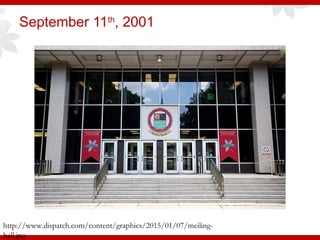
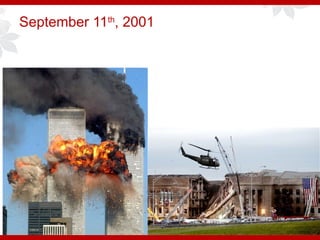
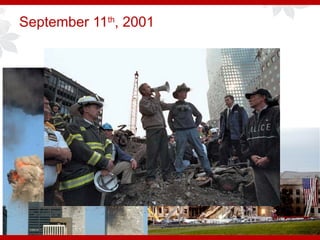
September 11th
, 2001
http://www.dispatch.com/content/graphics/2015/01/07/meiling-
hall.jpg
September 11th
, 2001
September 11th
, 2001
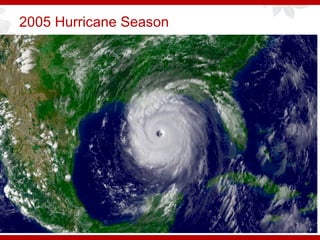
2005 Hurricane Season
6
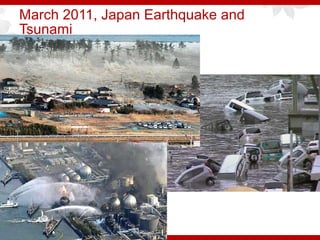
March 2011, Japan Earthquake and
Tsunami
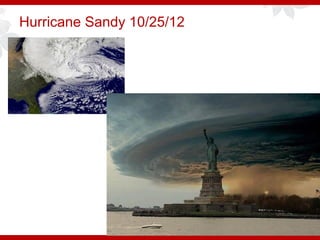
Hurricane Sandy 10/25/12
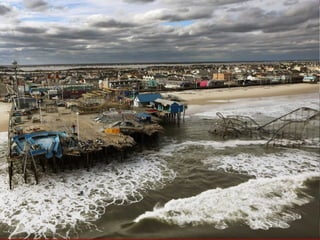
Hurricane Sandy
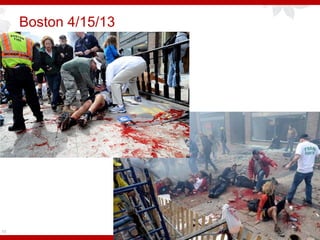
Boston 4/15/13
10
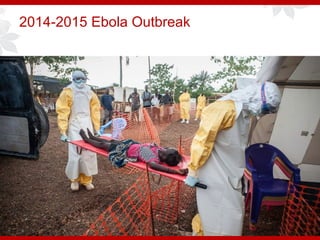
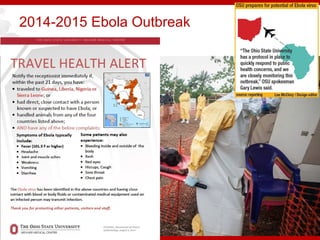
2014-2015 Ebola Outbreak
11
2014-2015 Ebola Outbreak
12
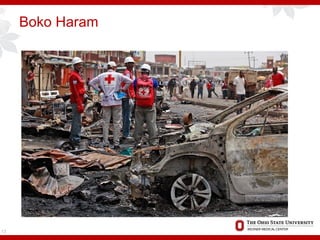
Boko Haram
13
Objectives
 Provide a background on Emergency Preparedness
and Disaster Response since 9/11/01.
 Analyze the Disaster Response Paradigm.
 Discuss Natural Disasters as they relate to
Preparedness.
 Define the injury patterns from Collapsed Buildings:
crush injury, compartment syndrome, and crush
syndrome
 Define the injury patterns from Wind Disasters.
 Describe flooding dangers.
14
What we will not cover!
 Ebola
 Bomb and Blast
 Infectious Agents of Bioterrorism
 Chemical Agents of Terrorism
15
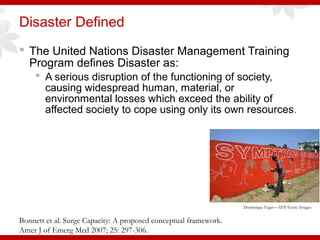
Disaster Defined
 The United Nations Disaster Management Training
Program defines Disaster as:
 A serious disruption of the functioning of society,
causing widespread human, material, or
environmental losses which exceed the ability of
affected society to cope using only its own resources.
Bonnett et al. Surge Capacity: A proposed conceptual framework.
Amer J of Emerg Med 2007; 25: 297-306.
Dominique Faget—AFP/Getty Images
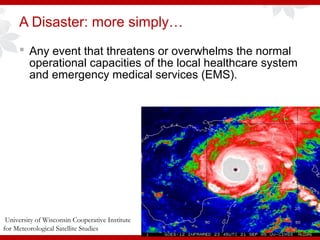
A Disaster: more simply…
 Any event that threatens or overwhelms the normal
operational capacities of the local healthcare system
and emergency medical services (EMS).
University of Wisconsin Cooperative Institute
for Meteorological Satellite Studies
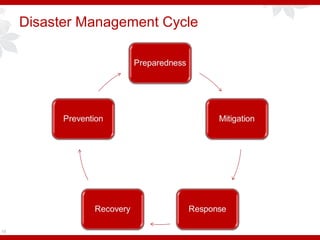
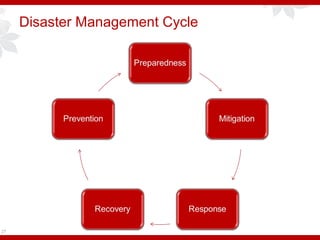
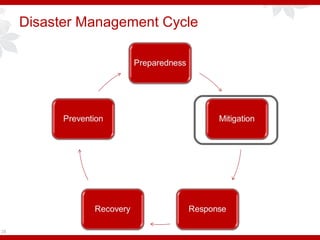
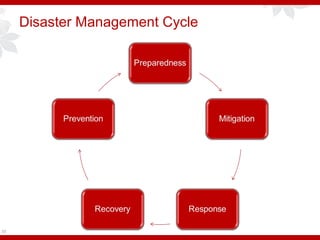
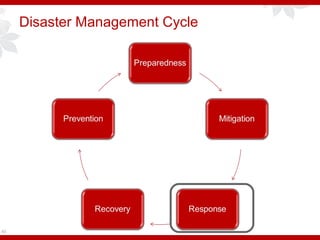
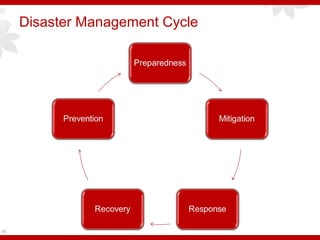
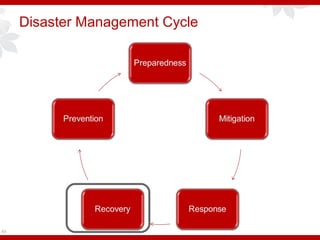
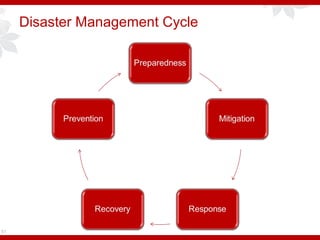
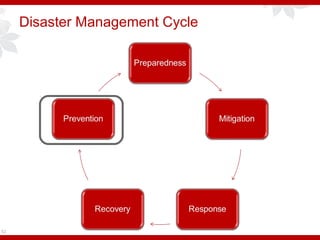
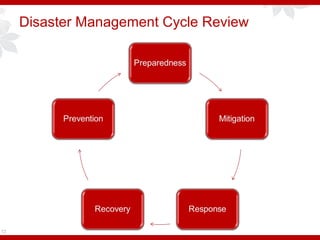
Disaster Management Cycle
18
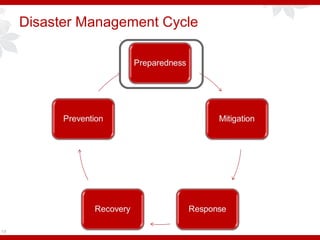
Disaster Management Cycle
19
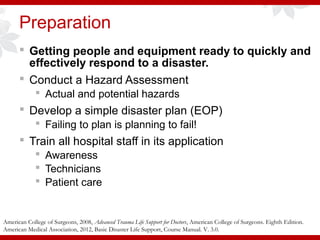
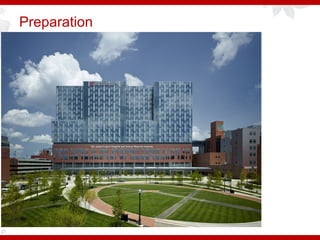
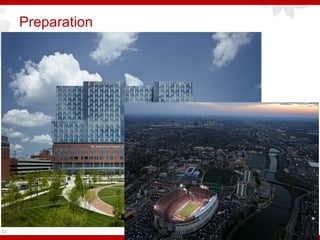
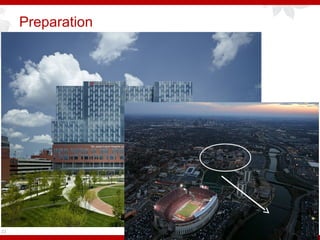
Preparation
 Getting people and equipment ready to quickly and
effectively respond to a disaster.
 Conduct a Hazard Assessment
 Actual and potential hazards
 Develop a simple disaster plan (EOP)
 Failing to plan is planning to fail!
 Train all hospital staff in its application
 Awareness
 Technicians
 Patient care
American College of Surgeons, 2008, Advanced Trauma Life Support for Doctors, American College of Surgeons. Eighth Edition.
American Medical Association, 2012, Basic Disaster Life Support, Course Manual. V. 3.0.
Preparation
21
Preparation
22
Preparation
23
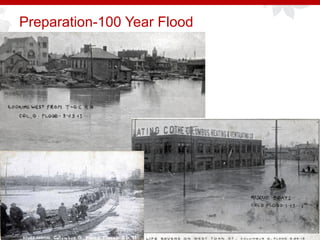
Preparation-100 Year Flood
24
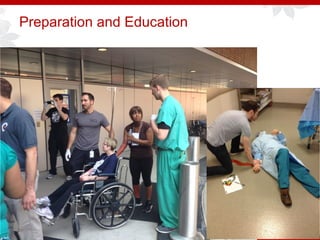
Preparation and Education
25
Preparation and JCAHO
 6 focus areas for hospitals in disaster planning:
o Communications –internal and external to
community care partners, state/federal agencies
o Supplies
o Security – Enabling normal hospital operations and
protection of staff and property
o Staff – Roles and Responsibilities within a standard
Hospital Incident Command Structure
o Utilities – Enabling self-sufficiency for goal of 96
hours
o Clinical Activity – Maintaining care, supporting
vulnerable populations, alternate standards of care
26 http://www.jointcommission.org/emergency_management.aspx
Disaster Management Cycle
27
Disaster Management Cycle
28
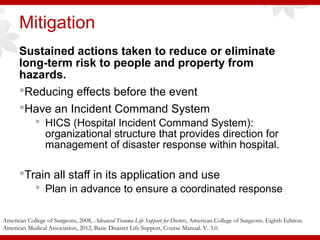
Mitigation
Sustained actions taken to reduce or eliminate
long-term risk to people and property from
hazards.
Reducing effects before the event
Have an Incident Command System
 HICS (Hospital Incident Command System):
organizational structure that provides direction for
management of disaster response within hospital.
Train all staff in its application and use
 Plan in advance to ensure a coordinated response
American College of Surgeons, 2008, Advanced Trauma Life Support for Doctors, American College of Surgeons. Eighth Edition.
American Medical Association, 2012, Basic Disaster Life Support, Course Manual. V. 3.0.
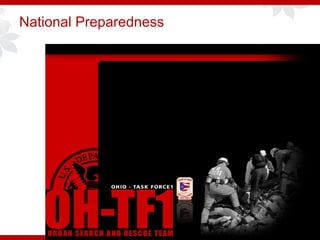
National Preparedness
National Disaster Medical System
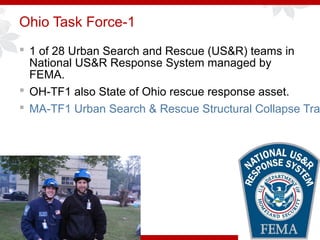
Ohio Task Force-1
 1 of 28 Urban Search and Rescue (US&R) teams in
National US&R Response System managed by
FEMA.
 OH-TF1 also State of Ohio rescue response asset.
 MA-TF1 Urban Search & Rescue Structural Collapse Tra
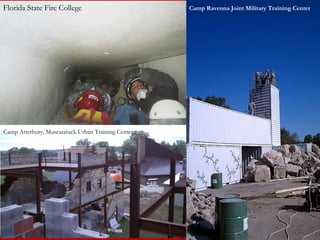
Ropes Training
Camp Ravenna Joint Military Training CenterFlorida State Fire College
Camp Atterbury, Muscatatuck Urban Training Center
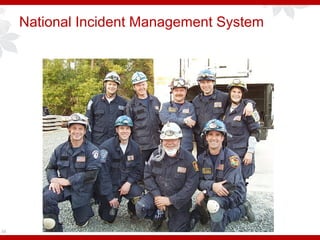
National Incident Management System
34
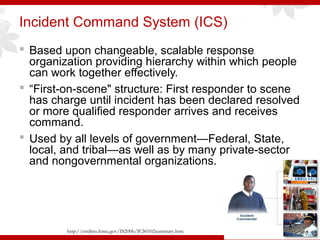
Incident Command System (ICS)
 Set of personnel, policies, procedures, facilities,
and equipment, integrated into common
organizational structure designed to improve
emergency response operations of all types.
 May be used for planned events, natural
disasters, and acts of terrorism.
 Is a key feature of the National Incident
Management System (NIMS 2004).
Incident Command System (ICS)
 Based upon changeable, scalable response
organization providing hierarchy within which people
can work together effectively.
 “First-on-scene" structure: First responder to scene
has charge until incident has been declared resolved
or more qualified responder arrives and receives
command.
 Used by all levels of government—Federal, State,
local, and tribal—as well as by many private-sector
and nongovernmental organizations.
http://emilms.fema.gov/IS200b/ICS0102summary.htm
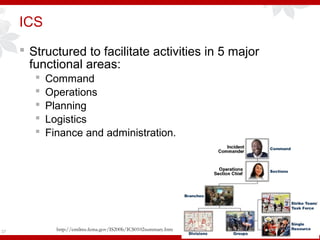
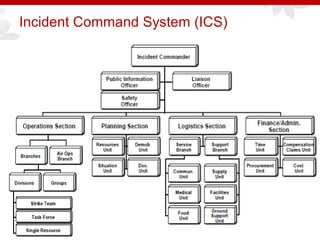
ICS
 Structured to facilitate activities in 5 major
functional areas:
 Command
 Operations
 Planning
 Logistics
 Finance and administration.
37 http://emilms.fema.gov/IS200b/ICS0102summary.htm
Incident Command System (ICS)
Disaster Management Cycle
39
Disaster Management Cycle
40
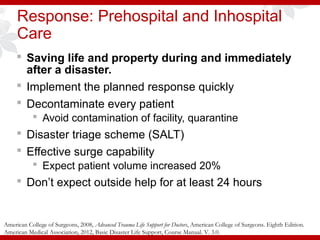
Response: Prehospital and Inhospital
Care
 Saving life and property during and immediately
after a disaster.
 Implement the planned response quickly
 Decontaminate every patient
 Avoid contamination of facility, quarantine
 Disaster triage scheme (SALT)
 Effective surge capability
 Expect patient volume increased 20%
 Don’t expect outside help for at least 24 hours
American College of Surgeons, 2008, Advanced Trauma Life Support for Doctors, American College of Surgeons. Eighth Edition.
American Medical Association, 2012, Basic Disaster Life Support, Course Manual. V. 3.0.
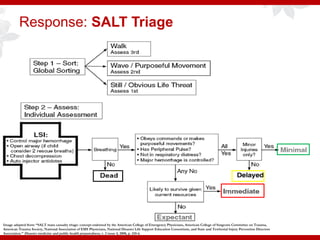
Response: SALT Triage
Image adapted from: “SALT mass casualty triage: concept endorsed by the American College of Emergency Physicians, American College of Surgeons Committee on Trauma,
American Trauma Society, National Association of EMS Physicians, National Disaster Life Support Education Consortium, and State and Territorial Injury Prevention Directors
Association.” Disaster medicine and public health preparedness, v. 2 issue 4, 2008, p. 245-6.
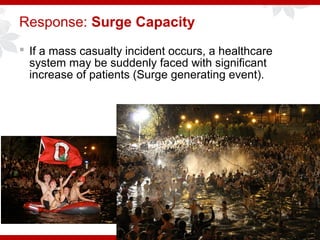
Response: Surge Capacity
 If a mass casualty incident occurs, a healthcare
system may be suddenly faced with significant
increase of patients (Surge generating event).
Response: Surge Capacity
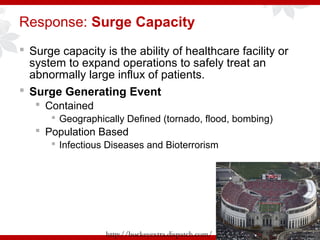
 Surge capacity is the ability of healthcare facility or
system to expand operations to safely treat an
abnormally large influx of patients.
 Surge Generating Event
 Contained
 Geographically Defined (tornado, flood, bombing)
 Population Based
 Infectious Diseases and Bioterrorism
http://buckeyextra.dispatch.com/
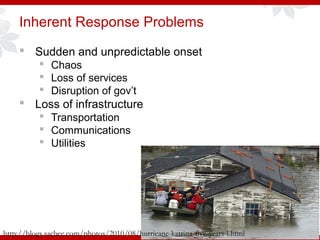
Inherent Response Problems
 Sudden and unpredictable onset
 Chaos
 Loss of services
 Disruption of gov’t
 Loss of infrastructure
 Transportation
 Communications
 Utilities
http://blogs.sacbee.com/photos/2010/08/hurricane-katrina-five-years-l.html
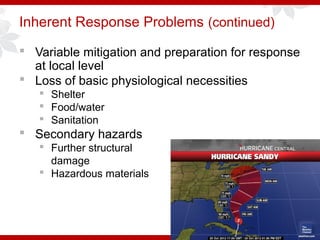
Inherent Response Problems (continued)
 Variable mitigation and preparation for response
at local level
 Loss of basic physiological necessities
 Shelter
 Food/water
 Sanitation
 Secondary hazards
 Further structural
damage
 Hazardous materials
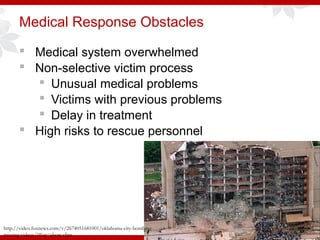
Medical Response Obstacles
 Medical system overwhelmed
 Non-selective victim process
 Unusual medical problems
 Victims with previous problems
 Delay in treatment
 High risks to rescue personnel
http://video.foxnews.com/v/2674051681001/oklahoma-city-bombing-
missing-videos/?#sp=show-clips
Disaster Management Cycle
48
Disaster Management Cycle
49
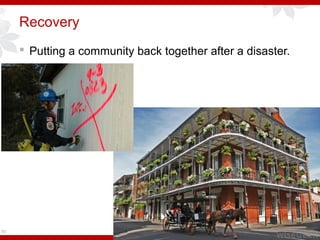
Recovery
 Putting a community back together after a disaster.
50
Disaster Management Cycle
51
Disaster Management Cycle
52
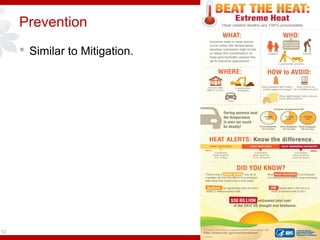
Prevention
 Similar to Mitigation.
53
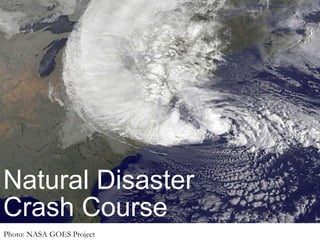
Natural Disaster
Crash Course
Photo: NASA GOES Project
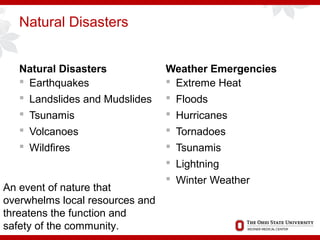
Natural Disasters
Natural Disasters
 Earthquakes
 Landslides and Mudslides
 Tsunamis
 Volcanoes
 Wildfires
Weather Emergencies
 Extreme Heat
 Floods
 Hurricanes
 Tornadoes
 Tsunamis
 Lightning
 Winter Weather
An event of nature that
overwhelms local resources and
threatens the function and
safety of the community.
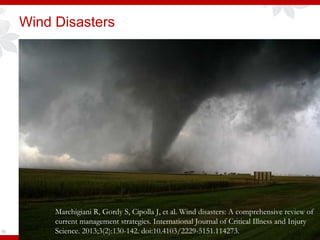
Wind Disasters
56
Marchigiani R, Gordy S, Cipolla J, et al. Wind disasters: A comprehensive review of
current management strategies. International Journal of Critical Illness and Injury
Science. 2013;3(2):130-142. doi:10.4103/2229-5151.114273.
Hurricanes
 Most mortality originates from secondary disasters
(storm surges, flash flooding, and tornados)
triggered by original event.
 In coastal regions, level of hurricane’s storm surge is
strong predictor of mortality.
 Winds are 2nd deadliest aspect.
 Most common non fatal traumatic injury pattern in a‑
hurricane consists of superficial lacerations from
airborne glass and/or other debris.
57
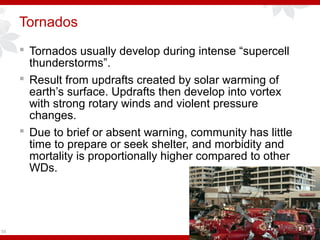
Tornados
 Tornados usually develop during intense “supercell
thunderstorms”.
 Result from updrafts created by solar warming of
earth’s surface. Updrafts then develop into vortex
with strong rotary winds and violent pressure
changes.
 Due to brief or absent warning, community has little
time to prepare or seek shelter, and morbidity and
mortality is proportionally higher compared to other
WDs.
58
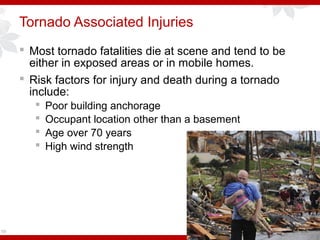
Tornado Associated Injuries
 Most tornado fatalities die at scene and tend to be
either in exposed areas or in mobile homes.
 Risk factors for injury and death during a tornado
include:
 Poor building anchorage
 Occupant location other than a basement
 Age over 70 years
 High wind strength
59
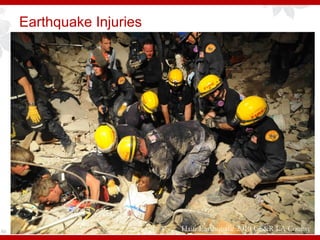
Earthquake Injuries
60 Haiti Earthquake 2010 US&R LA County
Crush Injury
 Lactic acid produced
 Myoglobin, Potassium and other electrolytes
released
 Other toxins created/released (superoxides, O2 free
radicals)
 Capillary leak
 Thromboxane, prostaglandins, and other immune
system substances generated
 Muscle cell enzymes released
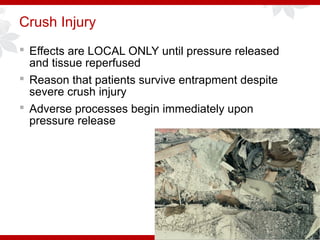
Crush Injury
 Effects are LOCAL ONLY until pressure released
and tissue reperfused
 Reason that patients survive entrapment despite
severe crush injury
 Adverse processes begin immediately upon
pressure release
Effects of Releasing Compressed Tissue
 Immediate:
 Capillary leak
 Hypovolemia/Hypotension
 Shock
 Severe metabolic acidosis: dysrhythmias, V-fib
 High serum potassium: cardiac dysrhythmia or arrest
 Delayed:
 Myoglobin/uric acid/renal toxins: kidney failure
 Other toxins: lung/liver/renal injuries
Cause of Death
 Major
 Hypovolemia
 Dysrhythmia
 Renal failure
 Other
 Adult Respiratory Distress Syndrome (ARDS)
 Sepsis
 Other electrolyte disturbances
 Ischemic tissue infection (gangrene)
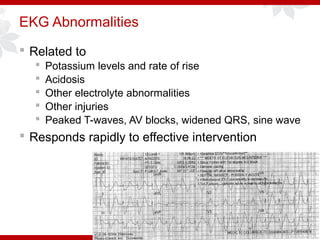
EKG Abnormalities
 Related to
 Potassium levels and rate of rise
 Acidosis
 Other electrolyte abnormalities
 Other injuries
 Peaked T-waves, AV blocks, widened QRS, sine wave
 Responds rapidly to effective intervention
Strategies to Prevent Renal Injury
 Maximize renal perfusion
 IV normal saline
 Diuresis (brisk urine flow)
 Careful alkalinization of urine (pH > 6.5)
 Sodium bicarbonate
 Monitor urine flow and pH (Bladder catheterization if
possible)
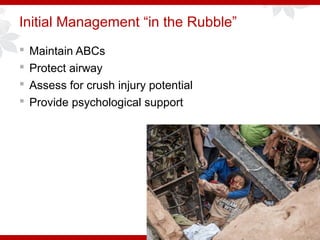
Initial Management “in the Rubble”
 Maintain ABCs
 Protect airway
 Assess for crush injury potential
 Provide psychological support
Initial Management “in the Rubble” (continued)
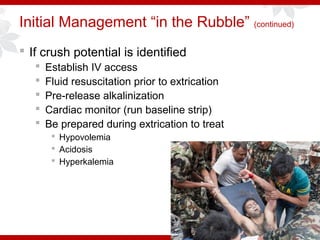
 If crush potential is identified
 Establish IV access
 Fluid resuscitation prior to extrication
 Pre-release alkalinization
 Cardiac monitor (run baseline strip)
 Be prepared during extrication to treat
 Hypovolemia
 Acidosis
 Hyperkalemia
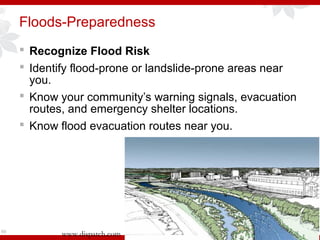
Floods-Preparedness
 Recognize Flood Risk
 Identify flood-prone or landslide-prone areas near
you.
 Know your community’s warning signals, evacuation
routes, and emergency shelter locations.
 Know flood evacuation routes near you.
69
www.dispatch.com
Floods-Response
 Unplug appliances to prevent electrical shock when
power comes back on.
 Gather emergency supplies and follow local radio or
TV updates.
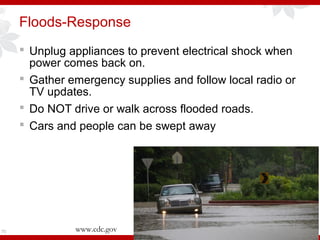
 Do NOT drive or walk across flooded roads.
 Cars and people can be swept away
70 www.cdc.gov
Floods-Response and Recovery
 Practice safe hygiene
 Wash hands with soap and water to prevent germs.
 Listen for information from local officials on how to
safely use water to drink, cook, or clean.
 Use fans, air conditioning units, and dehumidifiers
for drying.
 For cleanup, wear rubber boots and plastic gloves.
Clean walls, hard floors, and other surfaces with
soap and water. Use mixture of 1 cup bleach and 5
gallons water to disinfect.
71 http://emergency.cdc.gov/disasters/floods/readiness.asp
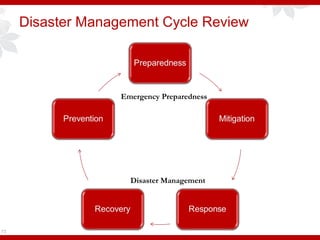
Disaster Management Cycle Review
72
Disaster Management Cycle Review
73
Emergency Preparedness
Disaster Management
Final Pearls
 Have a straightforward disaster plan and
educate everyone in its use.
 Have an incident command structure and drill
often.
 Have a disaster triage scheme, and mobilize
surge resources as needed.
 Have a traffic control system and communication
system.
74
Final Pearls
 Communications-Cell Phones Go Down!
 Redundant modes / systems / equipment
 Supplies-Bring your own
 Ample supply stores / reliable supply chains
 Security
 Control traffic flow / patient, staff safety
 Volunteers
 Physician role is hospital-based patient care
75
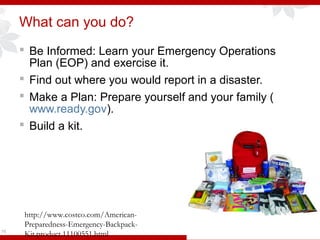
What can you do?
 Be Informed: Learn your Emergency Operations
Plan (EOP) and exercise it.
 Find out where you would report in a disaster.
 Make a Plan: Prepare yourself and your family (
www.ready.gov).
 Build a kit.
76
http://www.costco.com/American-
Preparedness-Emergency-Backpack-
Kit.product.11100551.html
What can you do?
 Get Involved: Join your Emergency Preparedness
Committee.
 Go Regional, then National!
77
References
 FEMA Medical Team Training Student Reference CD (2/2009)
 FEMA WMD for Medical Specialist Training CD
 Franco et al. The National Disaster Medical System: Past, Present, and Suggestions
for the Future. Biosecurity and Bioterrorism: Biodefense Strategy, Practice, Science
2007; 5: 319-325.
 Bonnett et al. Surge Capacity: A proposed conceptual framework. Amer J of Emerg
Med 2007; 25: 297-306.
 ATLS 8th
Edition.
 Kman NE, Bachmann D. “Biosurveillance: A review and Update.” In Special issue:
Advances in Development of Countermeasures for Potential Biothreat Agents.
Advances in preventive medicine, v. 2012, 2012, p. 301408.
 Kman N, Rund D. “Disaster Preparedness 10 years after 9/11: The Experts Weigh In”.
Emergency Medicine. Emerg Med 2011; 43(9): 12-13. (September)
www.emedmag.com.
 Marchigiani R, Gordy S, Cipolla J, et al. Wind disasters: A comprehensive review of
current management strategies. International Journal of Critical Illness and Injury
Science. 2013;3(2):130-142. doi:10.4103/2229-5151.114273
References
 www.fema.gov
 www.cdc.gov
 http://phil.cdc.gov/phil/home.asp
 Marchigiani R, Gordy S, Cipolla J, Kman NE, Stawicki S, et al. "Wind disasters: A
comprehensive review of current management strategies." International journal of
critical illness and injury science. Vol. 3, no. 2. (Apr 2013): 130-142.
 Kman N, Bachmann D, Folley A, Adams J, Greer M. Emergency Preparedness
Simulation Cases for Medical Students: Crush and Organophosphate Exposure.
MedEdPORTAL; 2013. Available from: http://www.mededportal.org/publication/9330.
 Yuri Rojavin, Mark J Seamon, Ravi S Tripathi, Thomas J Papadimos, Sagar
Galwankar, Nicholas Kman, James Cipolla, Michael D Grossman, Raffaele
Marchigiani, Stanislaw P A Stawicki. “Civilian nuclear incidents: An overview of
historical, medical, and scientific aspects.” Journal of emergencies, trauma and shock,
v. 4 issue 2, 2011, p. 260-72.
 Kman NE, Nelson R. Infectious Agents of Bioterrorism: A Review for Emergency
Physicians. Emerg Med Clin N Am 2008; 26: 517-547.
Questions
80

Evolving a strategy for emergency response to natural disaster

  • 1.
    Emergency Response to NaturalDisaster: Floods, Winds, and Earthquakes Nicholas E. Kman, MD FACEP Medical Team Manager, Ohio Task Force 1 The Ohio State University Department of Emergency Medicine Twitter @drnickkman
  • 2.
    Disclosures  Ohio TaskForce 1: FEMA Urban Search and Rescue 2
  • 3.
  • 4.
  • 5.
  • 6.
  • 7.
    March 2011, JapanEarthquake and Tsunami
  • 8.
  • 9.
  • 10.
  • 11.
  • 12.
  • 13.
  • 14.
    Objectives  Provide abackground on Emergency Preparedness and Disaster Response since 9/11/01.  Analyze the Disaster Response Paradigm.  Discuss Natural Disasters as they relate to Preparedness.  Define the injury patterns from Collapsed Buildings: crush injury, compartment syndrome, and crush syndrome  Define the injury patterns from Wind Disasters.  Describe flooding dangers. 14
  • 15.
    What we willnot cover!  Ebola  Bomb and Blast  Infectious Agents of Bioterrorism  Chemical Agents of Terrorism 15
  • 16.
    Disaster Defined  TheUnited Nations Disaster Management Training Program defines Disaster as:  A serious disruption of the functioning of society, causing widespread human, material, or environmental losses which exceed the ability of affected society to cope using only its own resources. Bonnett et al. Surge Capacity: A proposed conceptual framework. Amer J of Emerg Med 2007; 25: 297-306. Dominique Faget—AFP/Getty Images
  • 17.
    A Disaster: moresimply…  Any event that threatens or overwhelms the normal operational capacities of the local healthcare system and emergency medical services (EMS). University of Wisconsin Cooperative Institute for Meteorological Satellite Studies
  • 18.
  • 19.
  • 20.
    Preparation  Getting peopleand equipment ready to quickly and effectively respond to a disaster.  Conduct a Hazard Assessment  Actual and potential hazards  Develop a simple disaster plan (EOP)  Failing to plan is planning to fail!  Train all hospital staff in its application  Awareness  Technicians  Patient care American College of Surgeons, 2008, Advanced Trauma Life Support for Doctors, American College of Surgeons. Eighth Edition. American Medical Association, 2012, Basic Disaster Life Support, Course Manual. V. 3.0.
  • 21.
  • 22.
  • 23.
  • 24.
  • 25.
  • 26.
    Preparation and JCAHO 6 focus areas for hospitals in disaster planning: o Communications –internal and external to community care partners, state/federal agencies o Supplies o Security – Enabling normal hospital operations and protection of staff and property o Staff – Roles and Responsibilities within a standard Hospital Incident Command Structure o Utilities – Enabling self-sufficiency for goal of 96 hours o Clinical Activity – Maintaining care, supporting vulnerable populations, alternate standards of care 26 http://www.jointcommission.org/emergency_management.aspx
  • 27.
  • 28.
  • 29.
    Mitigation Sustained actions takento reduce or eliminate long-term risk to people and property from hazards. Reducing effects before the event Have an Incident Command System  HICS (Hospital Incident Command System): organizational structure that provides direction for management of disaster response within hospital. Train all staff in its application and use  Plan in advance to ensure a coordinated response American College of Surgeons, 2008, Advanced Trauma Life Support for Doctors, American College of Surgeons. Eighth Edition. American Medical Association, 2012, Basic Disaster Life Support, Course Manual. V. 3.0.
  • 30.
  • 31.
  • 32.
    Ohio Task Force-1 1 of 28 Urban Search and Rescue (US&R) teams in National US&R Response System managed by FEMA.  OH-TF1 also State of Ohio rescue response asset.  MA-TF1 Urban Search & Rescue Structural Collapse Tra
  • 33.
    Ropes Training Camp RavennaJoint Military Training CenterFlorida State Fire College Camp Atterbury, Muscatatuck Urban Training Center
  • 34.
  • 35.
    Incident Command System(ICS)  Set of personnel, policies, procedures, facilities, and equipment, integrated into common organizational structure designed to improve emergency response operations of all types.  May be used for planned events, natural disasters, and acts of terrorism.  Is a key feature of the National Incident Management System (NIMS 2004).
  • 36.
    Incident Command System(ICS)  Based upon changeable, scalable response organization providing hierarchy within which people can work together effectively.  “First-on-scene" structure: First responder to scene has charge until incident has been declared resolved or more qualified responder arrives and receives command.  Used by all levels of government—Federal, State, local, and tribal—as well as by many private-sector and nongovernmental organizations. http://emilms.fema.gov/IS200b/ICS0102summary.htm
  • 37.
    ICS  Structured tofacilitate activities in 5 major functional areas:  Command  Operations  Planning  Logistics  Finance and administration. 37 http://emilms.fema.gov/IS200b/ICS0102summary.htm
  • 38.
  • 39.
  • 40.
  • 41.
    Response: Prehospital andInhospital Care  Saving life and property during and immediately after a disaster.  Implement the planned response quickly  Decontaminate every patient  Avoid contamination of facility, quarantine  Disaster triage scheme (SALT)  Effective surge capability  Expect patient volume increased 20%  Don’t expect outside help for at least 24 hours American College of Surgeons, 2008, Advanced Trauma Life Support for Doctors, American College of Surgeons. Eighth Edition. American Medical Association, 2012, Basic Disaster Life Support, Course Manual. V. 3.0.
  • 42.
    Response: SALT Triage Imageadapted from: “SALT mass casualty triage: concept endorsed by the American College of Emergency Physicians, American College of Surgeons Committee on Trauma, American Trauma Society, National Association of EMS Physicians, National Disaster Life Support Education Consortium, and State and Territorial Injury Prevention Directors Association.” Disaster medicine and public health preparedness, v. 2 issue 4, 2008, p. 245-6.
  • 43.
    Response: Surge Capacity If a mass casualty incident occurs, a healthcare system may be suddenly faced with significant increase of patients (Surge generating event).
  • 44.
    Response: Surge Capacity Surge capacity is the ability of healthcare facility or system to expand operations to safely treat an abnormally large influx of patients.  Surge Generating Event  Contained  Geographically Defined (tornado, flood, bombing)  Population Based  Infectious Diseases and Bioterrorism http://buckeyextra.dispatch.com/
  • 45.
    Inherent Response Problems Sudden and unpredictable onset  Chaos  Loss of services  Disruption of gov’t  Loss of infrastructure  Transportation  Communications  Utilities http://blogs.sacbee.com/photos/2010/08/hurricane-katrina-five-years-l.html
  • 46.
    Inherent Response Problems(continued)  Variable mitigation and preparation for response at local level  Loss of basic physiological necessities  Shelter  Food/water  Sanitation  Secondary hazards  Further structural damage  Hazardous materials
  • 47.
    Medical Response Obstacles Medical system overwhelmed  Non-selective victim process  Unusual medical problems  Victims with previous problems  Delay in treatment  High risks to rescue personnel http://video.foxnews.com/v/2674051681001/oklahoma-city-bombing- missing-videos/?#sp=show-clips
  • 48.
  • 49.
  • 50.
    Recovery  Putting acommunity back together after a disaster. 50
  • 51.
  • 52.
  • 53.
  • 54.
  • 55.
    Natural Disasters Natural Disasters Earthquakes  Landslides and Mudslides  Tsunamis  Volcanoes  Wildfires Weather Emergencies  Extreme Heat  Floods  Hurricanes  Tornadoes  Tsunamis  Lightning  Winter Weather An event of nature that overwhelms local resources and threatens the function and safety of the community.
  • 56.
    Wind Disasters 56 Marchigiani R,Gordy S, Cipolla J, et al. Wind disasters: A comprehensive review of current management strategies. International Journal of Critical Illness and Injury Science. 2013;3(2):130-142. doi:10.4103/2229-5151.114273.
  • 57.
    Hurricanes  Most mortalityoriginates from secondary disasters (storm surges, flash flooding, and tornados) triggered by original event.  In coastal regions, level of hurricane’s storm surge is strong predictor of mortality.  Winds are 2nd deadliest aspect.  Most common non fatal traumatic injury pattern in a‑ hurricane consists of superficial lacerations from airborne glass and/or other debris. 57
  • 58.
    Tornados  Tornados usuallydevelop during intense “supercell thunderstorms”.  Result from updrafts created by solar warming of earth’s surface. Updrafts then develop into vortex with strong rotary winds and violent pressure changes.  Due to brief or absent warning, community has little time to prepare or seek shelter, and morbidity and mortality is proportionally higher compared to other WDs. 58
  • 59.
    Tornado Associated Injuries Most tornado fatalities die at scene and tend to be either in exposed areas or in mobile homes.  Risk factors for injury and death during a tornado include:  Poor building anchorage  Occupant location other than a basement  Age over 70 years  High wind strength 59
  • 60.
    Earthquake Injuries 60 HaitiEarthquake 2010 US&R LA County
  • 61.
    Crush Injury  Lacticacid produced  Myoglobin, Potassium and other electrolytes released  Other toxins created/released (superoxides, O2 free radicals)  Capillary leak  Thromboxane, prostaglandins, and other immune system substances generated  Muscle cell enzymes released
  • 62.
    Crush Injury  Effectsare LOCAL ONLY until pressure released and tissue reperfused  Reason that patients survive entrapment despite severe crush injury  Adverse processes begin immediately upon pressure release
  • 63.
    Effects of ReleasingCompressed Tissue  Immediate:  Capillary leak  Hypovolemia/Hypotension  Shock  Severe metabolic acidosis: dysrhythmias, V-fib  High serum potassium: cardiac dysrhythmia or arrest  Delayed:  Myoglobin/uric acid/renal toxins: kidney failure  Other toxins: lung/liver/renal injuries
  • 64.
    Cause of Death Major  Hypovolemia  Dysrhythmia  Renal failure  Other  Adult Respiratory Distress Syndrome (ARDS)  Sepsis  Other electrolyte disturbances  Ischemic tissue infection (gangrene)
  • 65.
    EKG Abnormalities  Relatedto  Potassium levels and rate of rise  Acidosis  Other electrolyte abnormalities  Other injuries  Peaked T-waves, AV blocks, widened QRS, sine wave  Responds rapidly to effective intervention
  • 66.
    Strategies to PreventRenal Injury  Maximize renal perfusion  IV normal saline  Diuresis (brisk urine flow)  Careful alkalinization of urine (pH > 6.5)  Sodium bicarbonate  Monitor urine flow and pH (Bladder catheterization if possible)
  • 67.
    Initial Management “inthe Rubble”  Maintain ABCs  Protect airway  Assess for crush injury potential  Provide psychological support
  • 68.
    Initial Management “inthe Rubble” (continued)  If crush potential is identified  Establish IV access  Fluid resuscitation prior to extrication  Pre-release alkalinization  Cardiac monitor (run baseline strip)  Be prepared during extrication to treat  Hypovolemia  Acidosis  Hyperkalemia
  • 69.
    Floods-Preparedness  Recognize FloodRisk  Identify flood-prone or landslide-prone areas near you.  Know your community’s warning signals, evacuation routes, and emergency shelter locations.  Know flood evacuation routes near you. 69 www.dispatch.com
  • 70.
    Floods-Response  Unplug appliancesto prevent electrical shock when power comes back on.  Gather emergency supplies and follow local radio or TV updates.  Do NOT drive or walk across flooded roads.  Cars and people can be swept away 70 www.cdc.gov
  • 71.
    Floods-Response and Recovery Practice safe hygiene  Wash hands with soap and water to prevent germs.  Listen for information from local officials on how to safely use water to drink, cook, or clean.  Use fans, air conditioning units, and dehumidifiers for drying.  For cleanup, wear rubber boots and plastic gloves. Clean walls, hard floors, and other surfaces with soap and water. Use mixture of 1 cup bleach and 5 gallons water to disinfect. 71 http://emergency.cdc.gov/disasters/floods/readiness.asp
  • 72.
  • 73.
    Disaster Management CycleReview 73 Emergency Preparedness Disaster Management
  • 74.
    Final Pearls  Havea straightforward disaster plan and educate everyone in its use.  Have an incident command structure and drill often.  Have a disaster triage scheme, and mobilize surge resources as needed.  Have a traffic control system and communication system. 74
  • 75.
    Final Pearls  Communications-CellPhones Go Down!  Redundant modes / systems / equipment  Supplies-Bring your own  Ample supply stores / reliable supply chains  Security  Control traffic flow / patient, staff safety  Volunteers  Physician role is hospital-based patient care 75
  • 76.
    What can youdo?  Be Informed: Learn your Emergency Operations Plan (EOP) and exercise it.  Find out where you would report in a disaster.  Make a Plan: Prepare yourself and your family ( www.ready.gov).  Build a kit. 76 http://www.costco.com/American- Preparedness-Emergency-Backpack- Kit.product.11100551.html
  • 77.
    What can youdo?  Get Involved: Join your Emergency Preparedness Committee.  Go Regional, then National! 77
  • 78.
    References  FEMA MedicalTeam Training Student Reference CD (2/2009)  FEMA WMD for Medical Specialist Training CD  Franco et al. The National Disaster Medical System: Past, Present, and Suggestions for the Future. Biosecurity and Bioterrorism: Biodefense Strategy, Practice, Science 2007; 5: 319-325.  Bonnett et al. Surge Capacity: A proposed conceptual framework. Amer J of Emerg Med 2007; 25: 297-306.  ATLS 8th Edition.  Kman NE, Bachmann D. “Biosurveillance: A review and Update.” In Special issue: Advances in Development of Countermeasures for Potential Biothreat Agents. Advances in preventive medicine, v. 2012, 2012, p. 301408.  Kman N, Rund D. “Disaster Preparedness 10 years after 9/11: The Experts Weigh In”. Emergency Medicine. Emerg Med 2011; 43(9): 12-13. (September) www.emedmag.com.  Marchigiani R, Gordy S, Cipolla J, et al. Wind disasters: A comprehensive review of current management strategies. International Journal of Critical Illness and Injury Science. 2013;3(2):130-142. doi:10.4103/2229-5151.114273
  • 79.
    References  www.fema.gov  www.cdc.gov http://phil.cdc.gov/phil/home.asp  Marchigiani R, Gordy S, Cipolla J, Kman NE, Stawicki S, et al. "Wind disasters: A comprehensive review of current management strategies." International journal of critical illness and injury science. Vol. 3, no. 2. (Apr 2013): 130-142.  Kman N, Bachmann D, Folley A, Adams J, Greer M. Emergency Preparedness Simulation Cases for Medical Students: Crush and Organophosphate Exposure. MedEdPORTAL; 2013. Available from: http://www.mededportal.org/publication/9330.  Yuri Rojavin, Mark J Seamon, Ravi S Tripathi, Thomas J Papadimos, Sagar Galwankar, Nicholas Kman, James Cipolla, Michael D Grossman, Raffaele Marchigiani, Stanislaw P A Stawicki. “Civilian nuclear incidents: An overview of historical, medical, and scientific aspects.” Journal of emergencies, trauma and shock, v. 4 issue 2, 2011, p. 260-72.  Kman NE, Nelson R. Infectious Agents of Bioterrorism: A Review for Emergency Physicians. Emerg Med Clin N Am 2008; 26: 517-547.
  • 80.

Editor's Notes

  • #4 My career in Emergency Preparedness started on this day.
  • #5 In total, almost 3,000 people died in the attacks, including the 227 civilians and 19 hijackers aboard the four planes. It also was the deadliest incident for firefighters and for law enforcement officers[4][5] in the history of the United States, with 343 and 72 killed respectively.
  • #6 The U.S. Department of Homeland Security (DHS) is a cabinet department of the United States federal government, created in response to the September 11 attacks, and with the primary responsibilities of protecting the United States and its territories (including protectorates) from and responding to terrorist attacks, man-made accidents, and natural disasters. The Department of Homeland Security, and not the United States Department of the Interior, is equivalent to the Interior ministries of other countries. In fiscal year 2011, DHS was allocated a budget of $98.8 billion and spent, net, $66.4 billion. Where the Department of Defense is charged with military actions abroad, the Department of Homeland Security works in the civilian sphere to protect the United States within, at, and outside its borders. Its stated goal is to prepare for, prevent, and respond to domestic emergencies, particularly terrorism.[1] On March 1, 2003, DHS absorbed the Immigration and Naturalization Service and assumed its duties. In doing so, it divided the enforcement and services functions into two separate and new agencies: Immigration and Customs Enforcement and Citizenship and Immigration Services. The investigative divisions and intelligence gathering units of the INS and Customs Service were merged forming Homeland Security Investigations. Additionally, the border enforcement functions of the INS, including the U.S. Border Patrol, the U.S. Customs Service, and the Animal and Plant Health Inspection Service were consolidated into a new agency under DHS: U.S. Customs and Border Protection. The Federal Protective Service falls under the National Protection and Programs Directorate. With more than 200,000 employees, DHS is the third largest Cabinet department, after the Departments of Defense and Veterans Affairs.[2] Homeland security policy is coordinated at the White House by the Homeland Security Council. Other agencies with significant homeland security responsibilities include the Departments of Health and Human Services, Justice, and Energy. On December 16, 2013, the U.S. Senate confirmed Jeh Johnson as the Secretary of Homeland Security.[3] According to the Homeland Security Research Corporation, the combined financial year 2010 state and local homeland security (HLS) markets, which employ more than 2.2 million first responders, totaled $16.5 billion, whereas the DHS HLS market totaled $13 billion.[4] According to The Washington Post, "DHS has given $31 billion in grants since 2003 to state and local governments for homeland security and to improve their ability to find and protect against terrorists, including $3.8 billion in 2010".[5] According to Peter Andreas, a border theorist, the creation of DHS constituted the most significant government reorganization since the Cold War,[6] and the most substantial reorganization of federal agencies since theNational Security Act of 1947, which placed the different military departments under a secretary of defense and created the National Security Council and Central Intelligence Agency. DHS also constitutes the most diverse merger of federal functions and responsibilities, incorporating 22 government agencies into a single organization.
  • #7 Katrina: At least 1,833 people died in the hurricane and subsequent floods, making it the deadliest U.S. hurricane since the 1928 Okeechobee hurricane; total property damage was estimated at $108 billion (2005 USD),[1] roughly four times the damage brought by Hurricane Andrew in 1992.
  • #11 Rescue workers and medical personnel, on hand to assist runners and bystanders, rushed available aid to wounded victims in the bombings' immediate aftermath. Additional units from Boston EMS and the Boston Fire Department were dispatched to assist responders already on-scene. [29][30] The explosions killed 3 spectators and injured 264 others, who were treated in 27 local hospitals. At least 14 people required amputations, with some suffering traumatic amputations as a direct result of the blasts.
  • #14 Boko Haram killed more than 13,000 civilians between 2009 and 2015, including around 10,000 in 2014, in attacks occurring mainly in northeast Nigeria
  • #15 I hope this helps you find ways to get involved as a physician
  • #16 Happy to provide resources on these topics!
  • #18 With much state apparatus still in tatters after its devastating civil conflict, Liberia is especially ill prepared to deal with a crisis of this unprecedented scale. At least 160 health workers have been infected with the virus and 79 have died, in a nation that counted a paltry single doctor per 100,000 inhabitants at its onset. Landgren pointed out that the challenge also goes beyond the medical response.
  • #21 Flooding in Columbus
  • #26 https://www.dropbox.com/s/arlvoylmyypa96b/Edited%20Disaster%20Drill.avi
  • #30 Mitigation is the effort to reduce loss of life and property by lessening the impact of disasters. Mitigation is taking action now—before the next disaster—to reduce human and financial consequences later (analyzing risk, reducing risk, insuring against risk). Effective mitigation requires that we all understand local risks, address the hard choices, and invest in long-term community well-being. Without mitigation actions, we jeopardize our safety, financial security, and self-reliance.
  • #31 I’m going to frame my understanding of National Preparedness by discussing my role with OH TF1.
  • #32 NDMS’s federal partners include the Federal Emergency Management Agency, Department of Defense (DOD), and the Department of Veterans Affairs (VA). The overall purpose of the NDMS is to supplement an integrated National medical response capability for assisting State and local authorities in dealing with the medical impacts of major peacetime disasters and to provide support to the military and the Department of Veterans Affairs medical systems in caring for casualties evacuated back to the U.S. from overseas armed conventional conflicts.[1] NDMS’s federal partners include the Federal Emergency Management Agency, Department of Defense (DOD), and the Department of Veterans Affairs (VA). NDMS also interfaces with state and local Departments of Health, as well as private hospitals.
  • #33 Team exists under oversight of Miami Valley Fire EMS Alliance & Ohio Emergency Management Agency. 
  • #34 I did this on-line!
  • #35 The National Incident Management System (NIMS) is a systematic, proactive approach to guide departments and agencies at all levels of government, nongovernmental organizations, and the private sector to work together seamlessly and manage incidents involving all threats and hazards—regardless of cause, size, location, or complexity—in order to reduce loss of life, property and harm to the environment. The NIMS is the essential foundation to the National Preparedness System (NPS) and provides the template for the management of incidents and operations in support of all five National Planning Frameworks.
  • #36 The Incident Command System (ICS) is a standardized approach to the command, control, and coordination of emergency response providing a common hierarchy within which responders from multiple agencies can be effective.
  • #37 The Incident Command System (ICS) is a standardized approach to the command, control, and coordination of emergency response providing a common hierarchy within which responders from multiple agencies can be effective.
  • #39 Command Staff: Consists of the Public Information Officer, Safety Officer, and Liaison Officer. Report directly to the Incident Commander. Section: Has responsibility for primary segments of incident management (Operations, Planning, Logistics, Finance/Administration). The Section level is organizationally between Branch and Incident Commander. Branch: Has functional, geographical, or jurisdictional responsibility for major parts of the incident operations. Branch level is organizationally between Section and Division/Group in the Operations Section, and between Section and Units in the Logistics Section. Branches are identified by the use of Roman Numerals, by function, or by jurisdictional name. Division: That organizational level having responsibility for operations within a defined geographic area. The Division level is organizationally between the Strike Team and the Branch. Group: Groups are established to divide the incident into functional areas of operation. Groups are located between Branches (when activated) and Resources in the Operations Section. Unit: That organization element having functional responsibility for a specific incident planning, logistics, or finance/administration activity. Task Force: A group of resources with common communications and a leader that may be pre-established and sent to an incident, or formed at an incident. Strike Team: Specified combinations of the same kind and type of resources, with common communications and a leader. Single Resource: An individual piece of equipment and its personnel complement, or an established crew or team of individuals with an identified work supervisor that can be used on an incident.
  • #43 Image adapted from: “SALT mass casualty triage: concept endorsed by the American College of Emergency Physicians, American College of Surgeons Committee on Trauma, American Trauma Society, National Association of EMS Physicians, National Disaster Life Support Education Consortium, and State and Territorial Injury Prevention Directors Association.” Disaster medicine and public health preparedness, v. 2 issue 4, 2008, p. 245-6.
  • #47 OH-TF 1 brings everything we need.
  • #60 Injury patterns from tornados tend to involve multiple systems.[12] Commonly injured anatomic regions included the chest (45%), abdomen (27%), extremity (91%), and head (45%).[12] Furthermore, trauma severity increases if the victim is thrown rather than struck by flying debris.[12] Most of the serious injuries and deaths are the result of the victims or solid objects becoming airborne or structural collapse, with mortality being most frequently attributed to head trauma, followed by crush injuries to the chest, abdomen, and pelvis.[11,12] Most tornado fatalities die at the scene and tend to be either in exposed areas or in mobile homes.
  • #62 Muscle tissue vulnerable to sustained compression from debris or body weight Timeframe: 1 to 6 hours Amount of muscle tissue Lower extremities Buttocks Entire upper extremity and pectoralis
  • #66 Sodium bicarbonate Glucose + insulin Beta-2-selective catecholamines Calcium (for life-threatening dysrhythmias) Others (Kayexlate/Lasix/dialysis) Follow patient and cardiac monitor parameters