Integrating an Intelligent Tutoring System
into a Virtual World
Parvati Dev, Wm LeRoy Heinrichs,
CliniSpace
Keith Shubeck, Xiangen Hu,
University of Memphis
© 2014, Innovation in Learning, Inc.
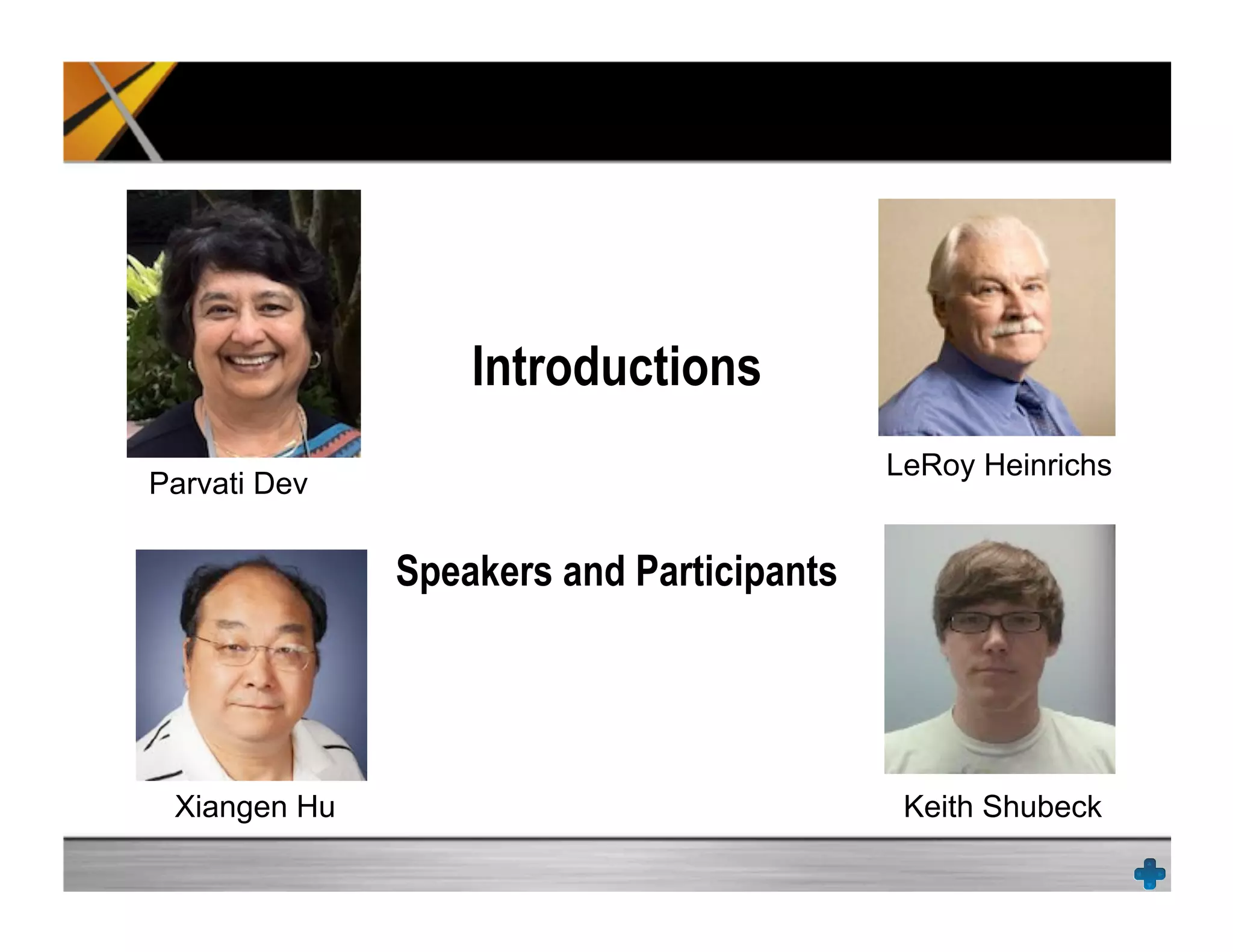
Introductions
Speakers and Participants
Parvati Dev
LeRoy Heinrichs
Keith ShubeckXiangen Hu
Overview
1.  Complex multi-person triage in a mass casualty –
Preview of the problem
2.  Virtualized mass casualty simulation - VCAEST
3.  Immersive virtual simulations – discussion
4.  Review of Intelligent Tutoring Systems
5.  Demonstration of an ITS in VCAEST
6.  Creating the guidance content in an online tutor
7.  Evaluation study - plans
8.  Summary and discussion
CAEST
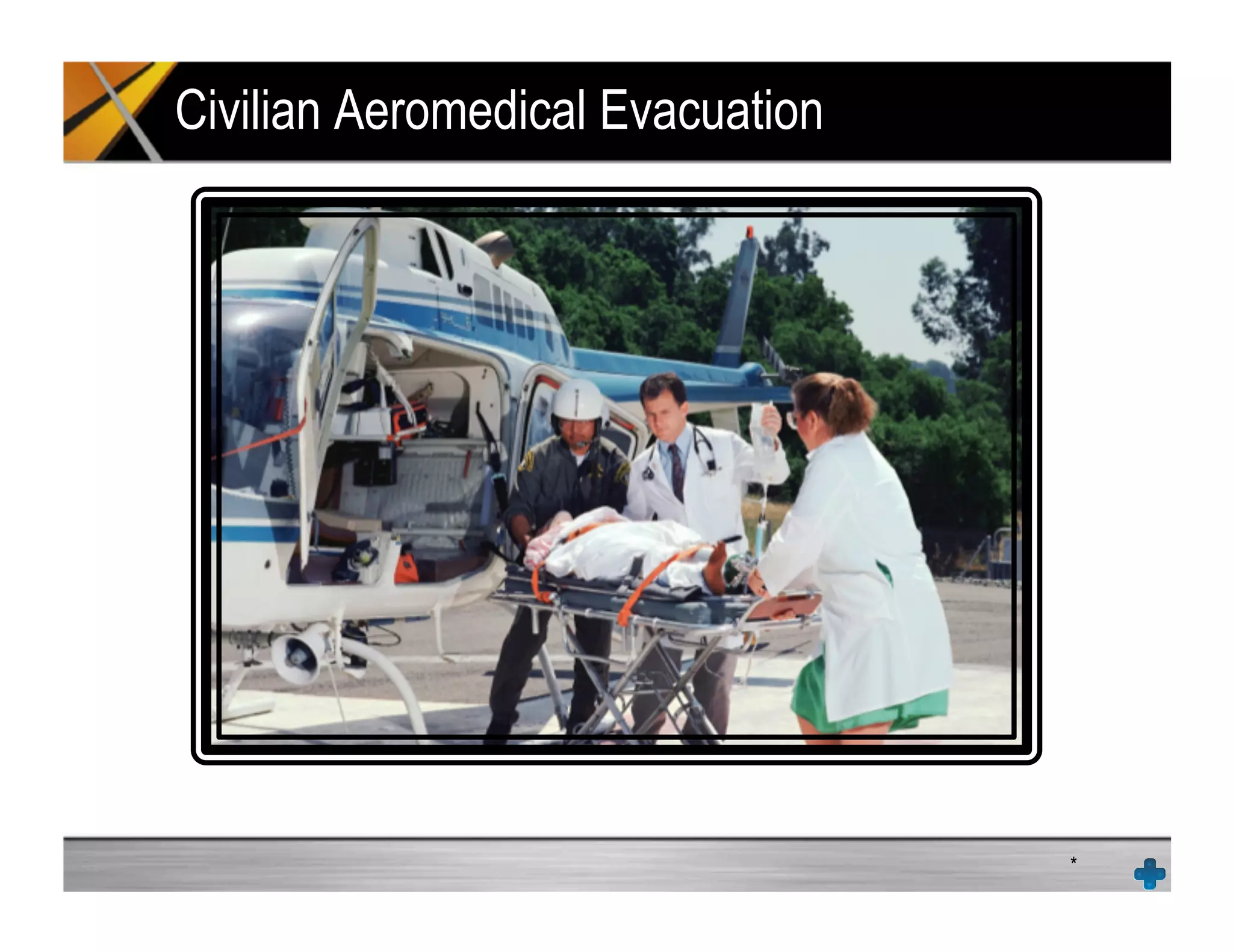
Civilian Aeromedical Evacuation
Sustainment Training
Civilian Aeromedical Evacuation
*
Civilian Aeromedical Evacuation Sustainment Training (CAEST)
*
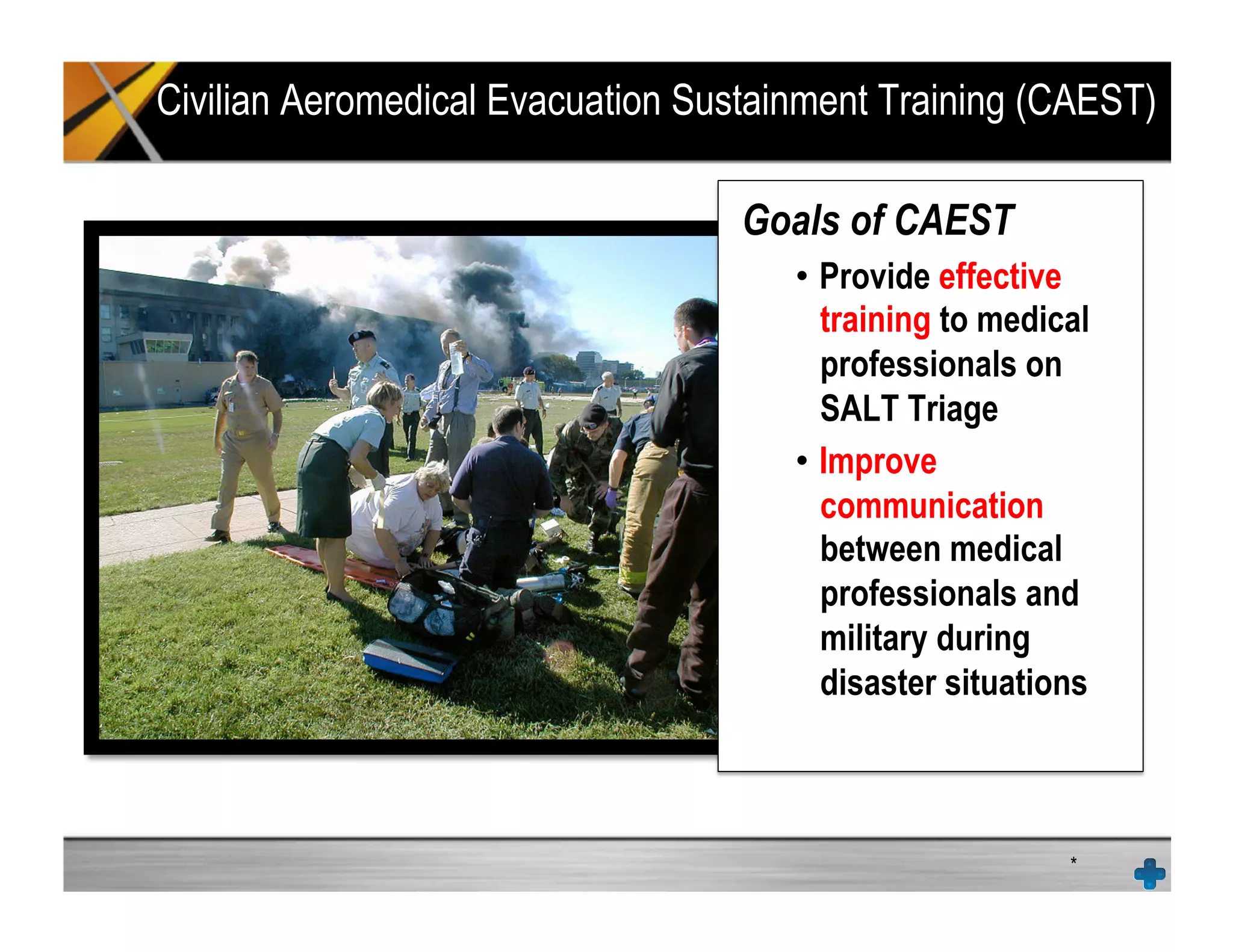
Goals of CAEST
•  Provide effective
training to medical
professionals on
SALT Triage
•  Improve
communication
between medical
professionals and
military during
disaster situations
Mass Casualty and SALT Triage – Background
*
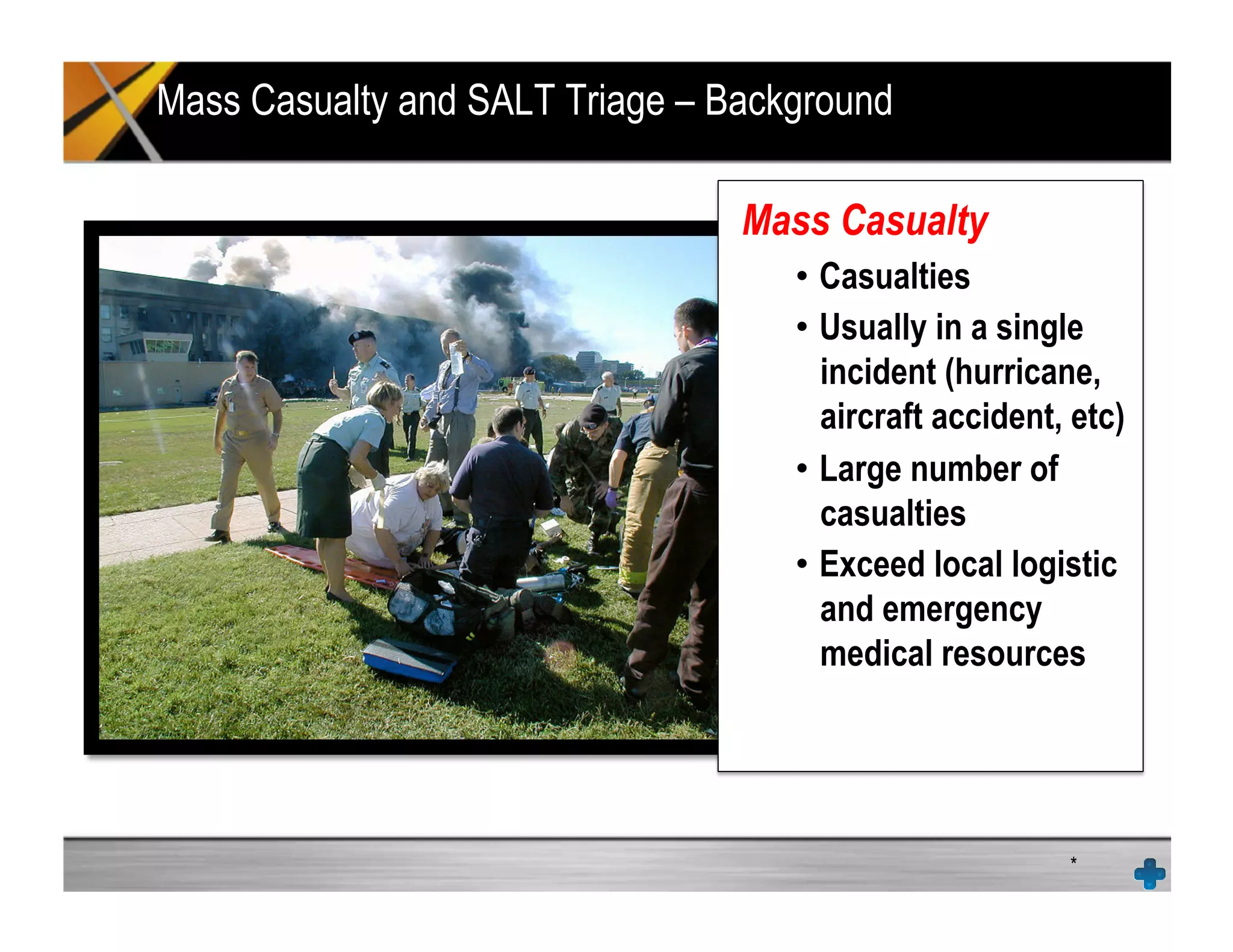
Mass Casualty
•  Casualties
•  Usually in a single
incident (hurricane,
aircraft accident, etc)
•  Large number of
casualties
•  Exceed local logistic
and emergency
medical resources
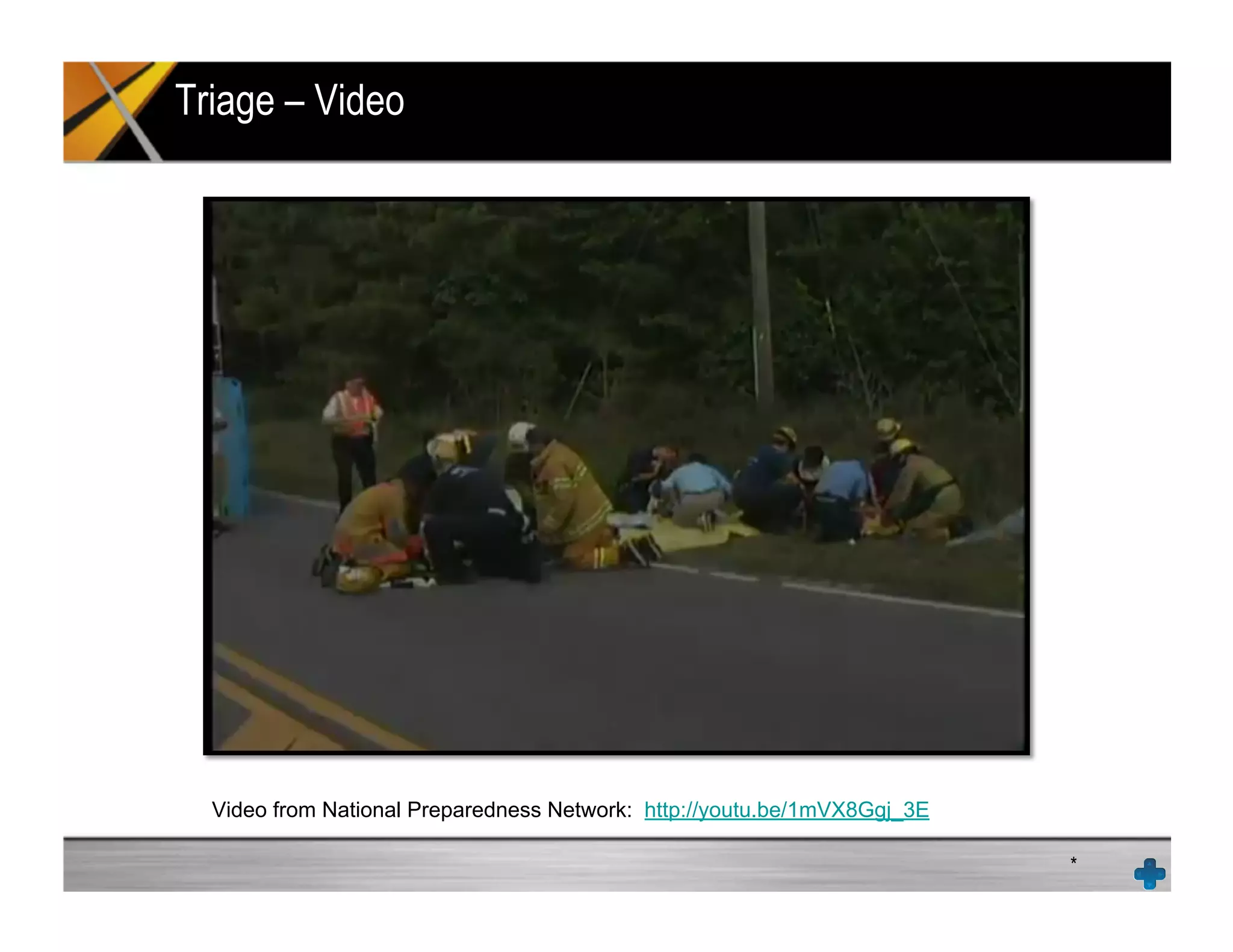
Triage – Video
*
Video from National Preparedness Network: http://youtu.be/1mVX8Ggj_3E
SALT Triage – Background
*
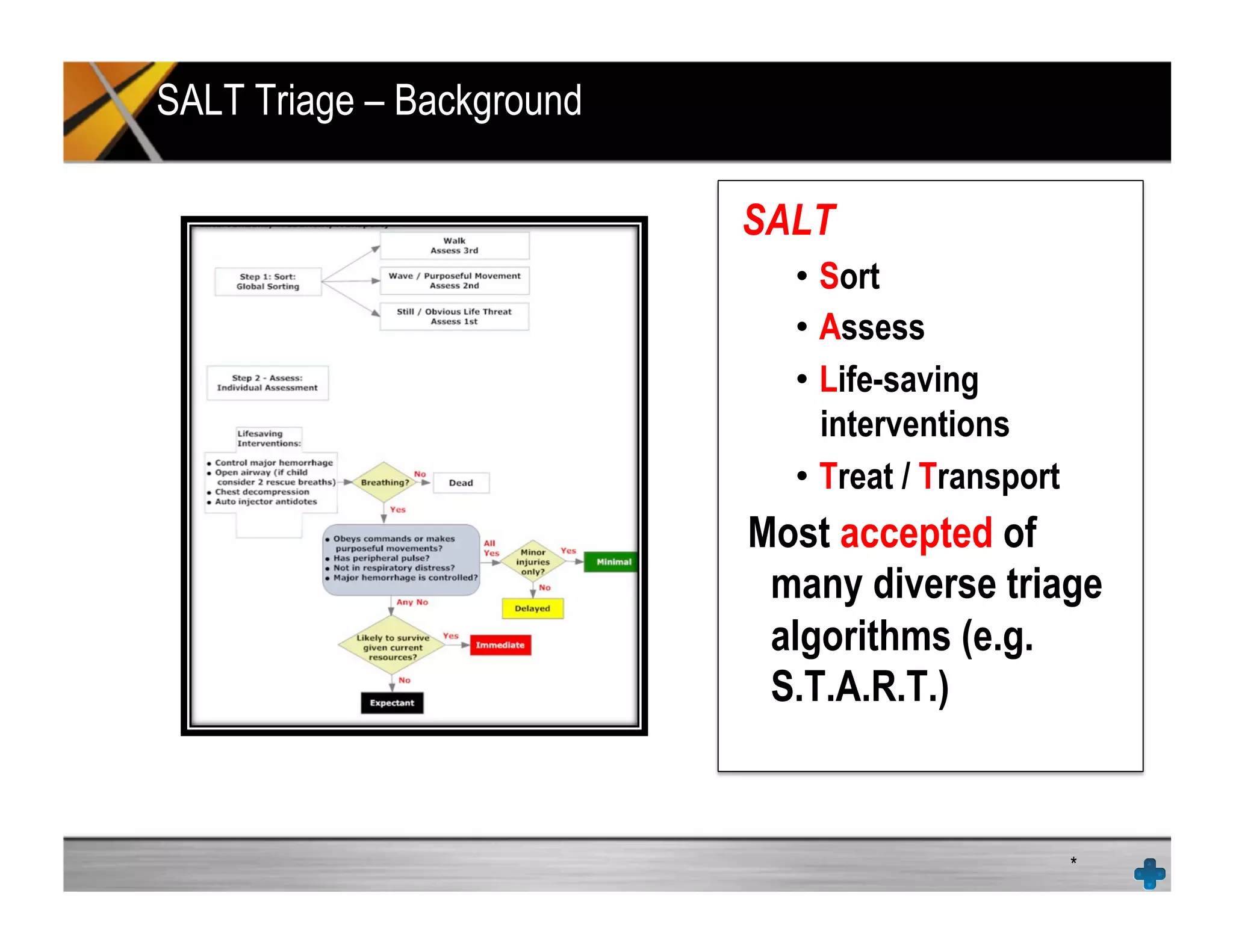
SALT
•  Sort
•  Assess
•  Life-saving
interventions
•  Treat / Transport
Most accepted of
many diverse triage
algorithms (e.g.
S.T.A.R.T.)
SALT Triage – Background
*
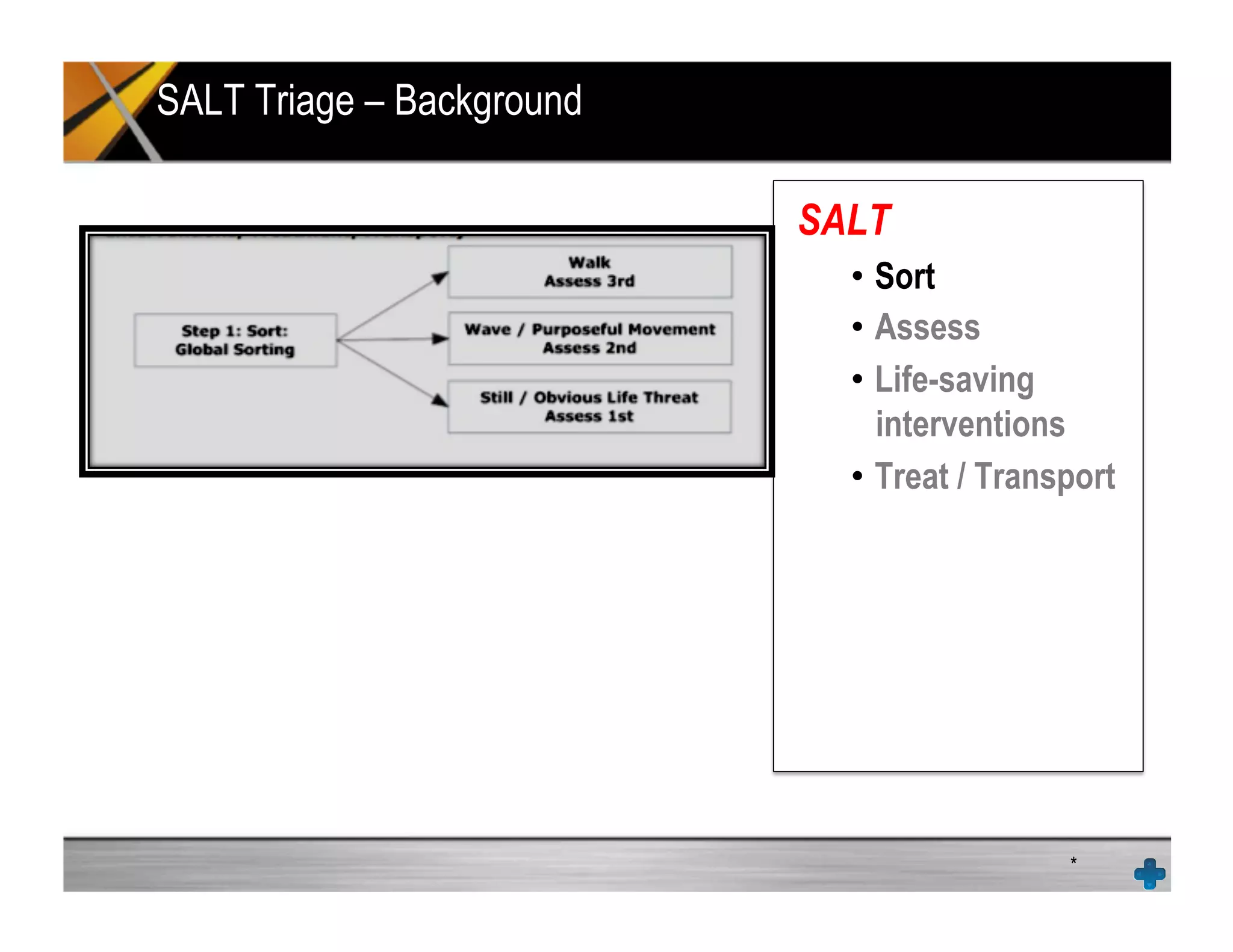
SALT
•  Sort
•  Assess
•  Life-saving
interventions
•  Treat / Transport
SALT Triage – Background
*
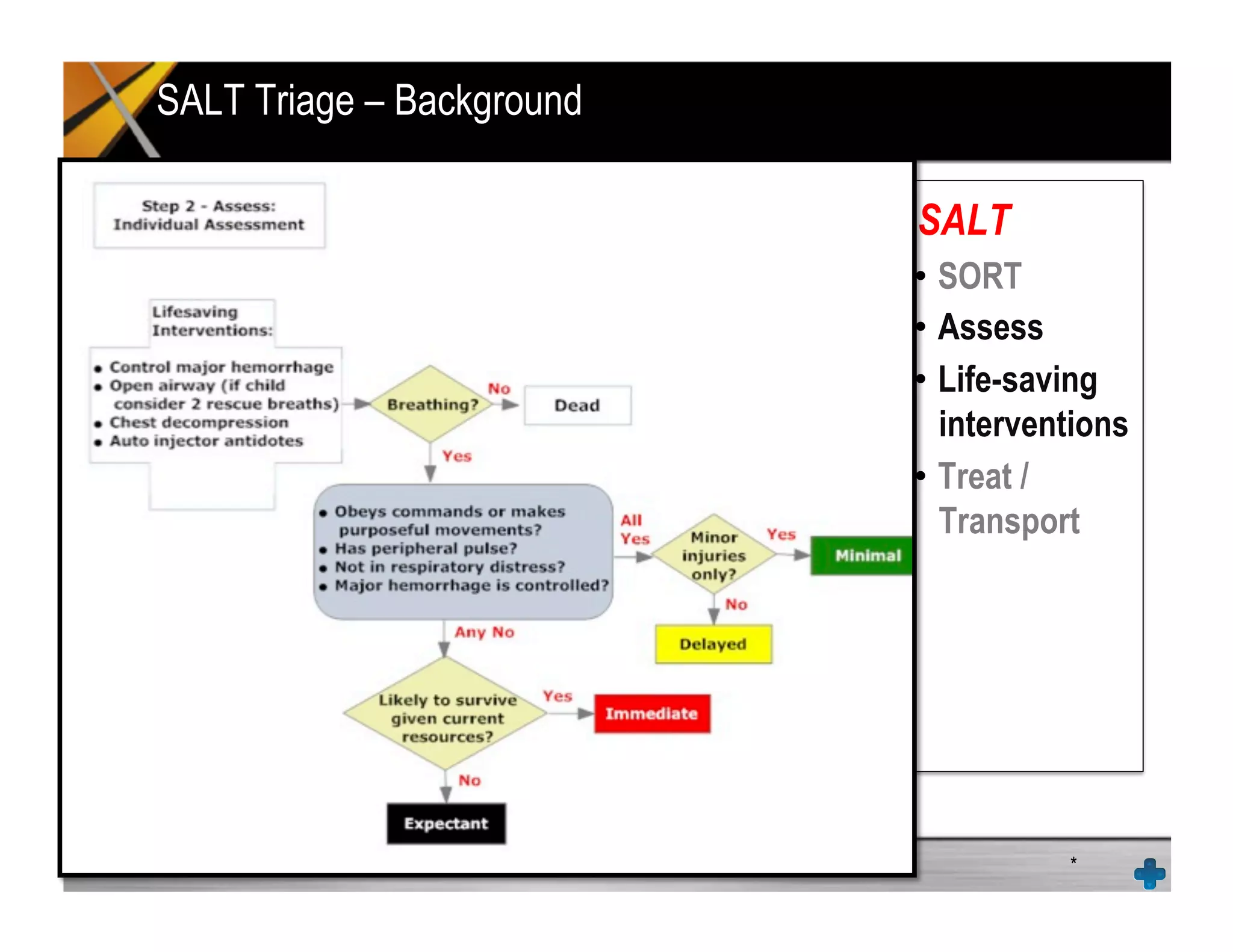
SALT
•  SORT
•  Assess
•  Life-saving
interventions
•  Treat /
Transport
SALT Triage – Background
*
SALT
•  Sort
•  Assess
•  Life-saving
interventions
•  Treat /
Transport
Pic removed
CAEST
What worked – what did not
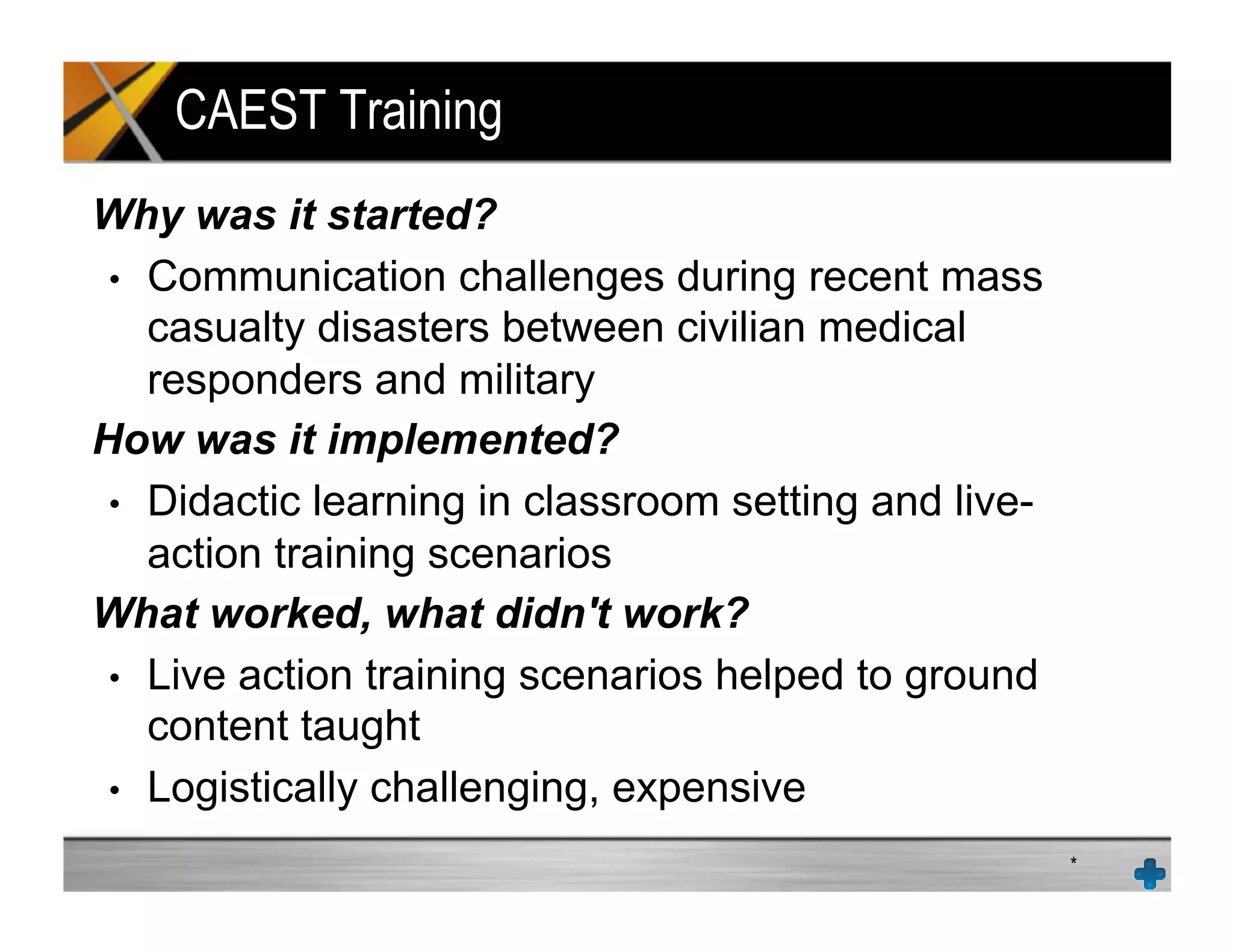
CAEST Training
Why was it started?
•  Communication challenges during recent mass
casualty disasters between civilian medical
responders and military
How was it implemented?
•  Didactic learning in classroom setting and live-
action training scenarios
What worked, what didn't work?
•  Live action training scenarios helped to ground
content taught
•  Logistically challenging, expensive
*
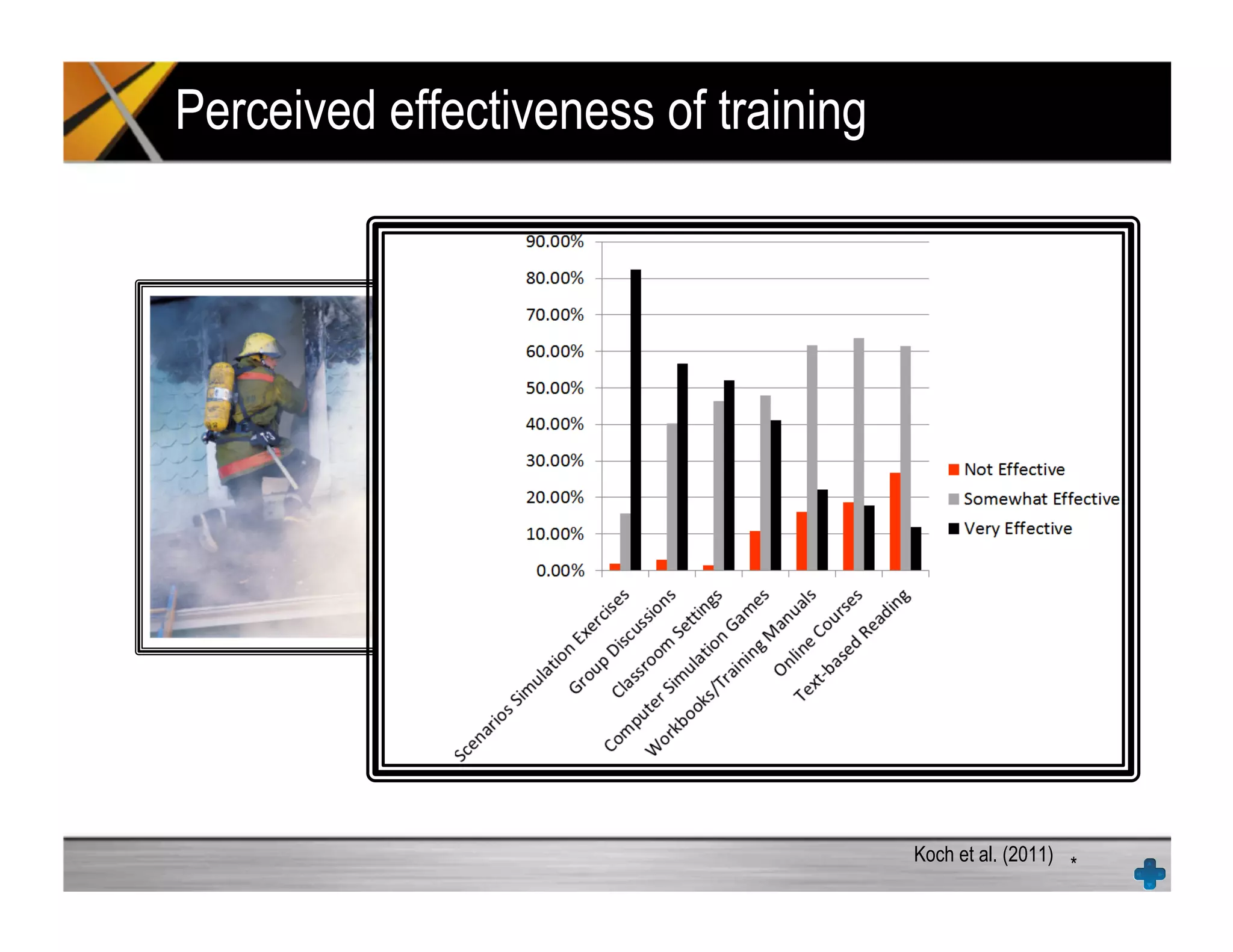
Perceived effectiveness of training
*
Koch et al. (2011)
Perceived effectiveness of training
•  Too expensive
•  Time consuming
•  Inattentive to
individual
learning needs
•  Costly to travel
to and from
*
Live training is often...
[add citation here]
Koch et al. (2011)
Additional Goals of CAEST Training
How can the differences in goals,
roles, and expectations be bridged?
How will differences in jargon,
equipment and standard operating
procedures affect patient care?
VCAEST
Virtual Civilian Aeromedical Evacuation
Sustainment Training
Goal of VCAEST project
Live simulations are highly effective but very expensive…
•  We need an effective, low cost alternative to live simulation
training for healthcare personnel who interface with military
operations in a catastrophe requiring aeromedical evacuation
Achieve this through …
•  Integrating a Web-based virtual 3D environment with an Web-
based intelligent tutoring system
•  Low cost, easily updateable, internet-based
•  Leverage proven learning technologies
•  Make training widely available
•  Marry realistic virtual environments with robust learning
technologies
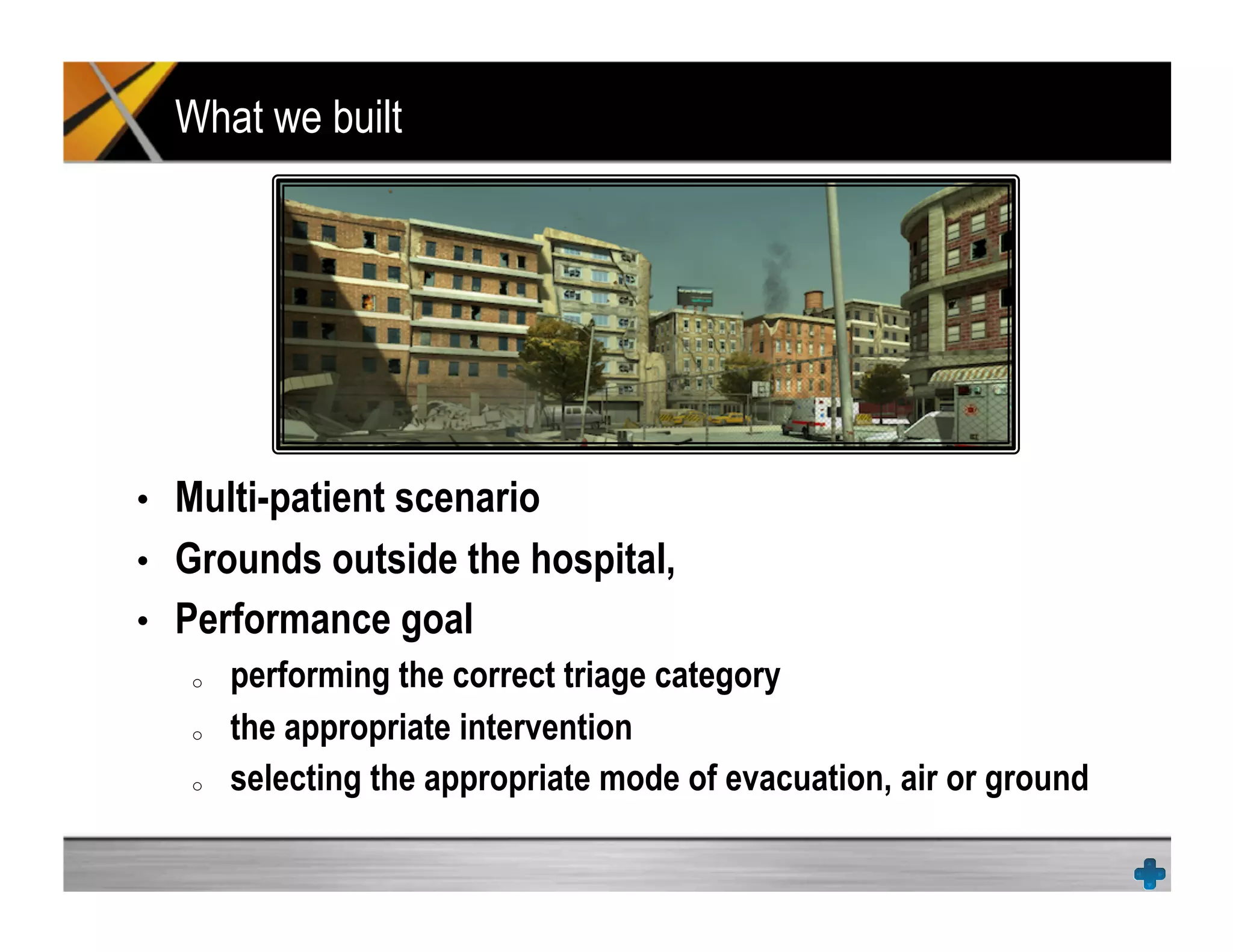
What we built
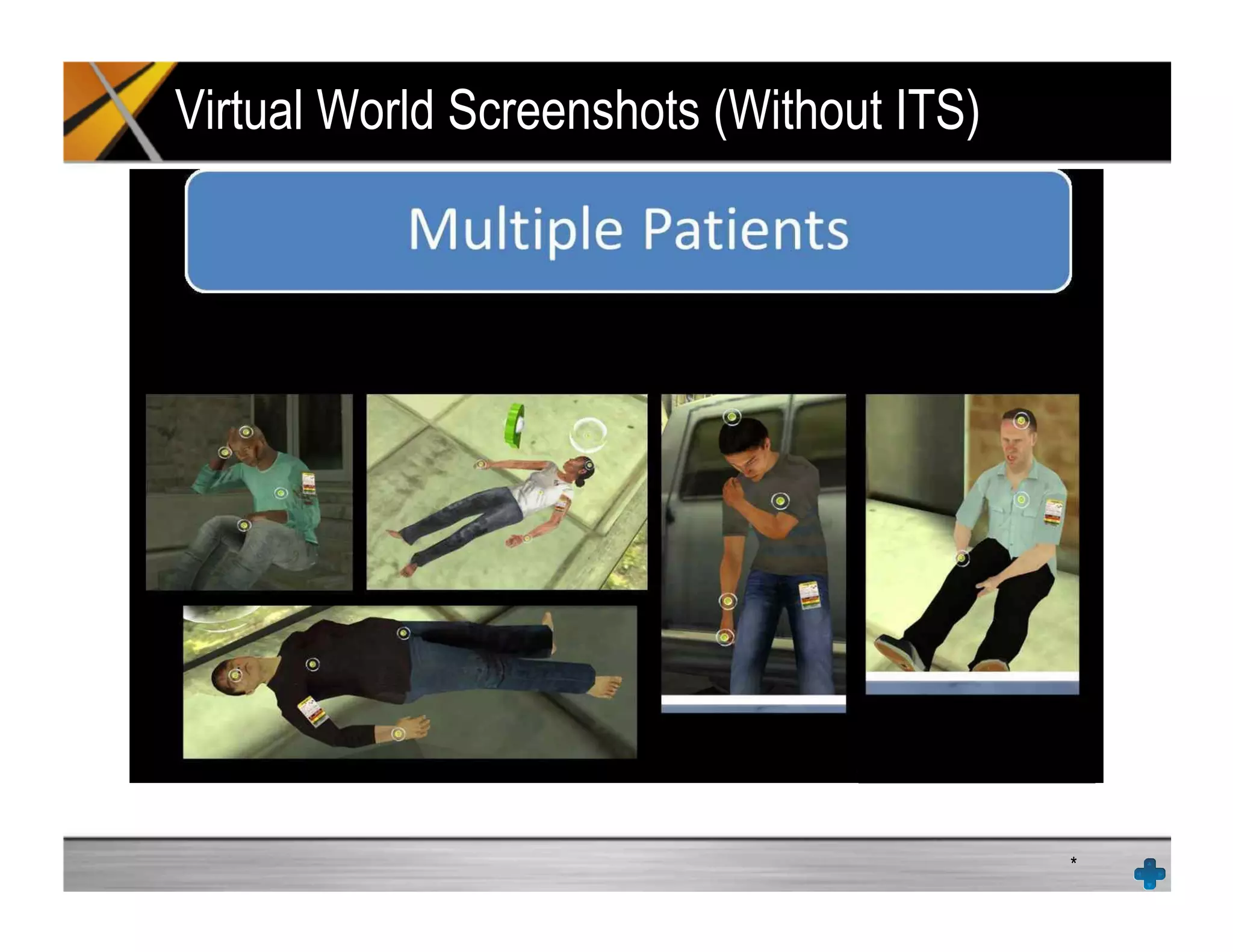
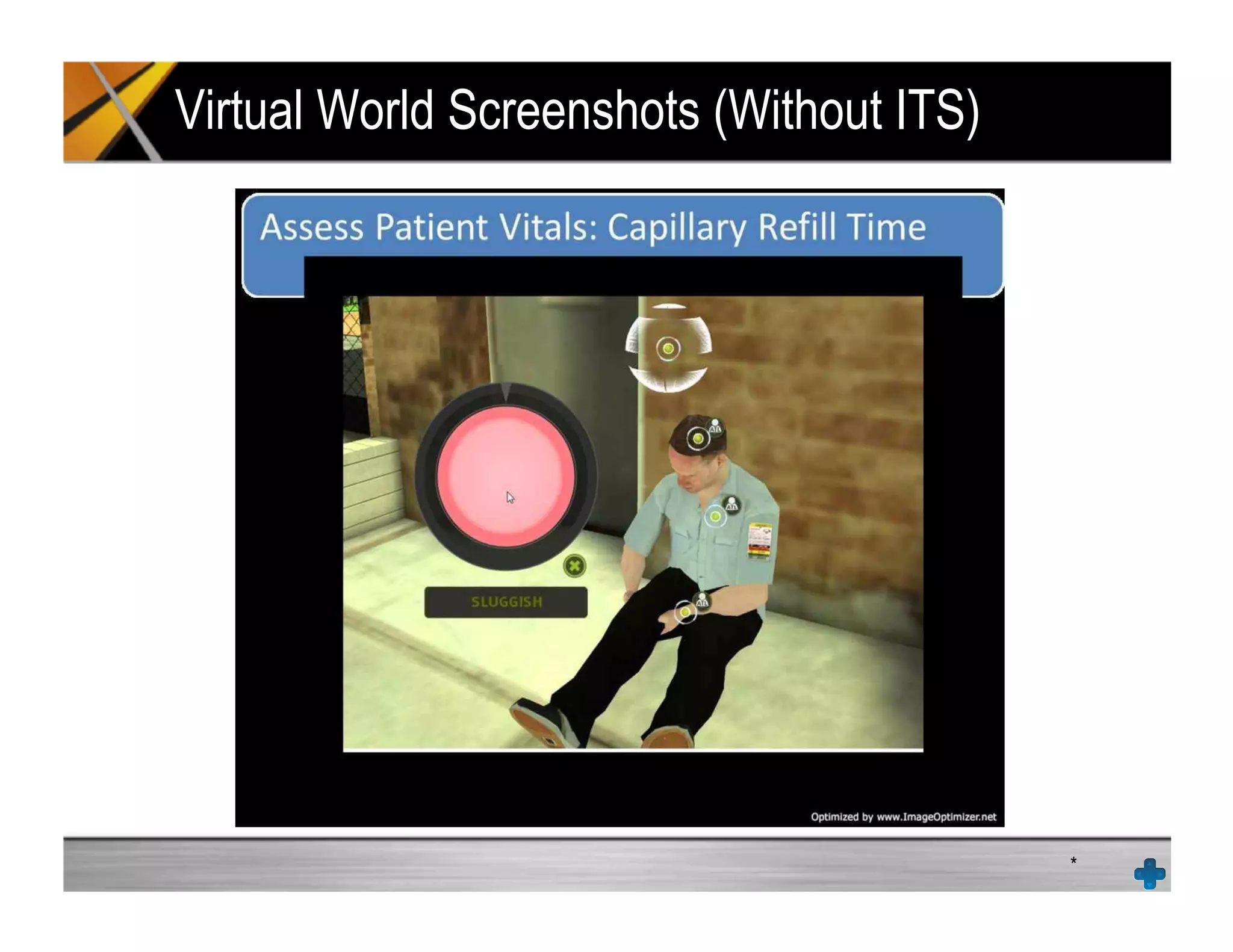
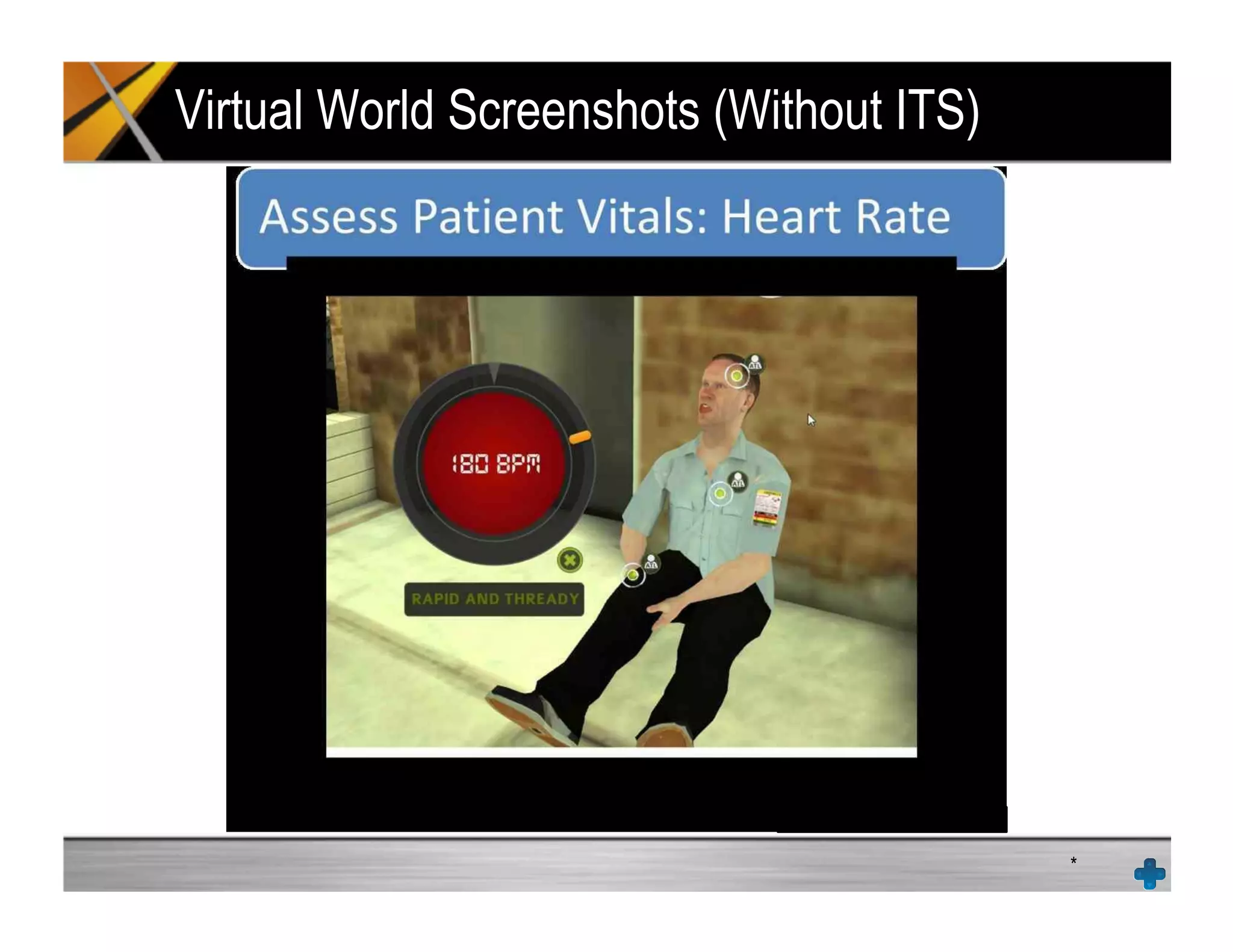
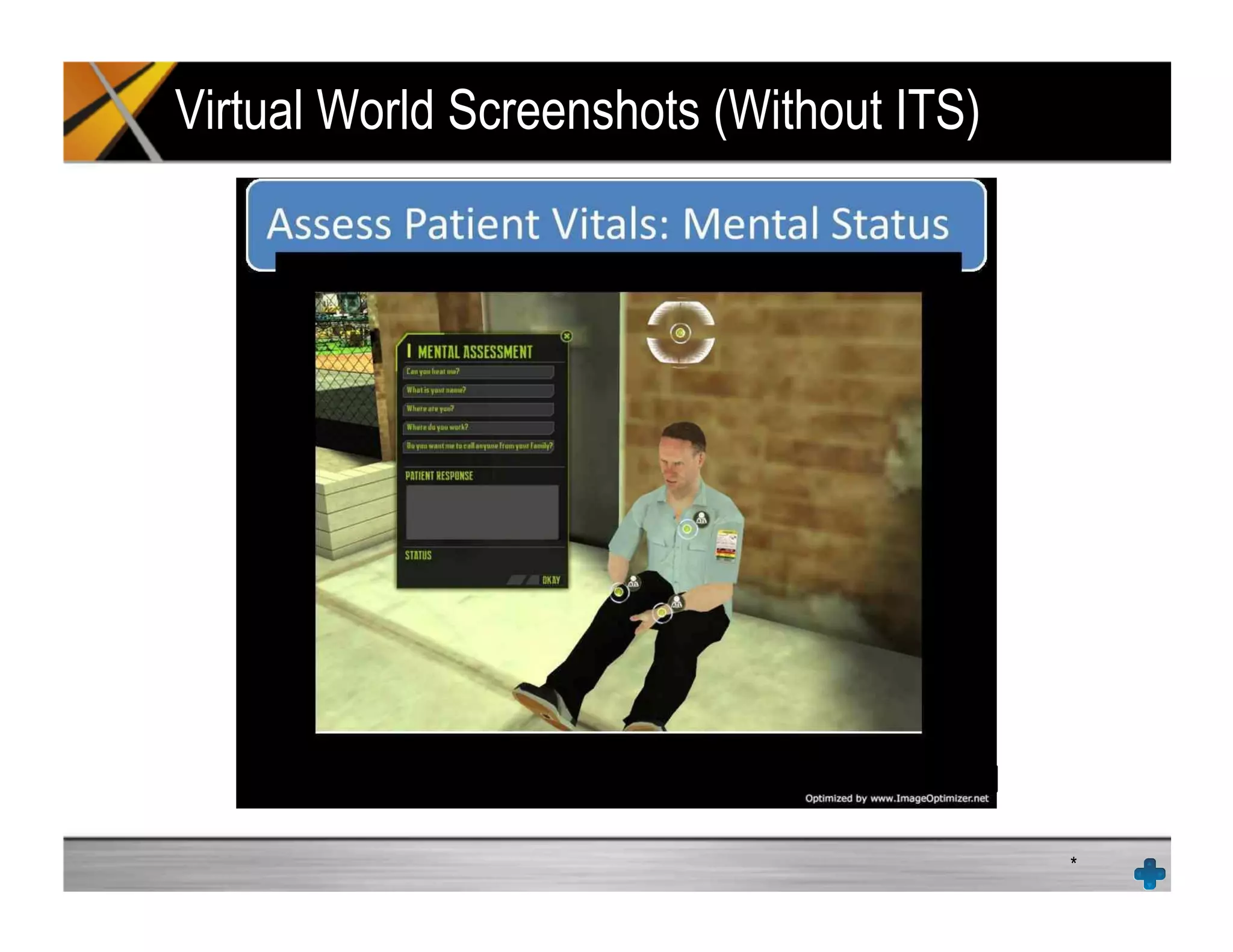
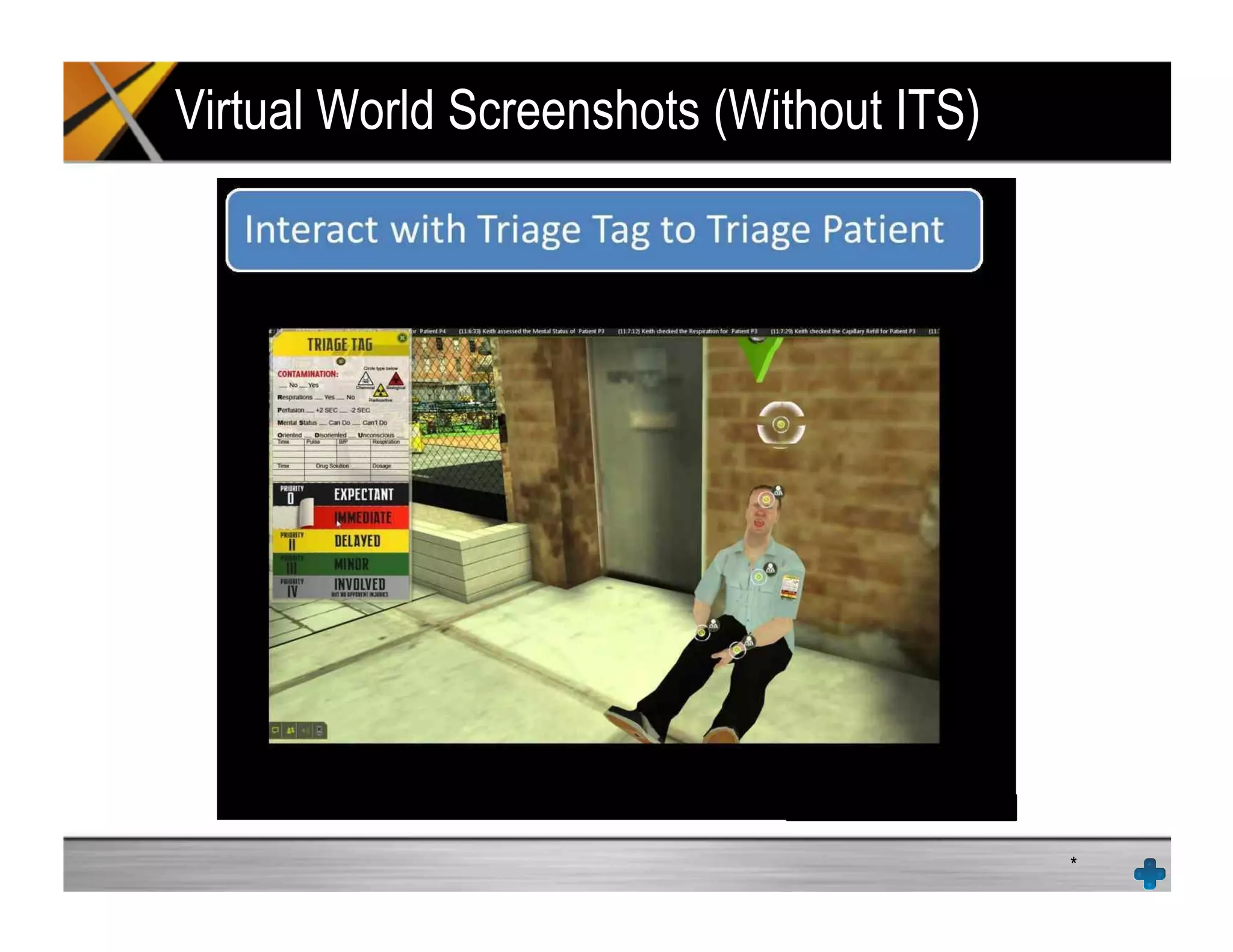
•  Multi-patient scenario
•  Grounds outside the hospital,
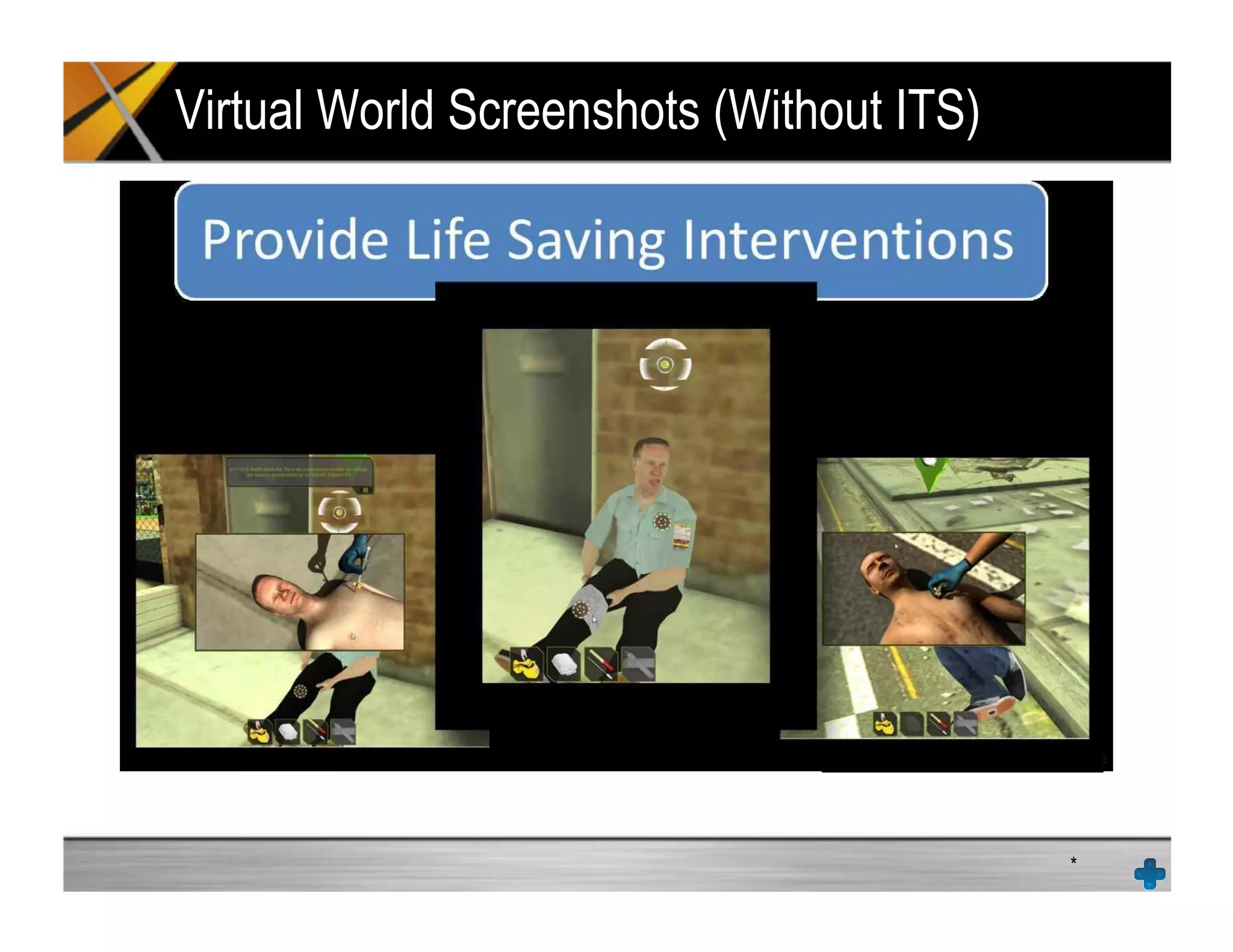
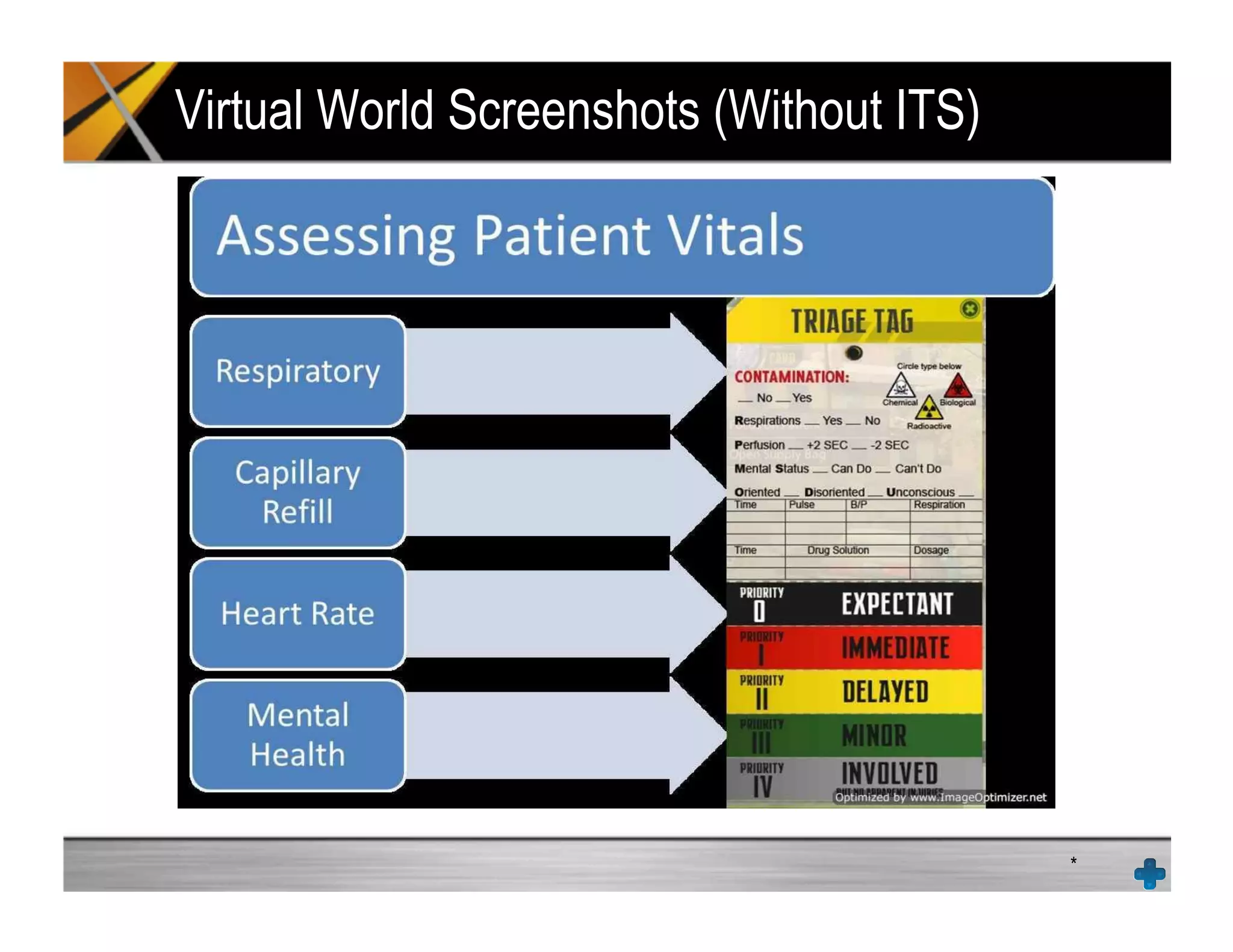
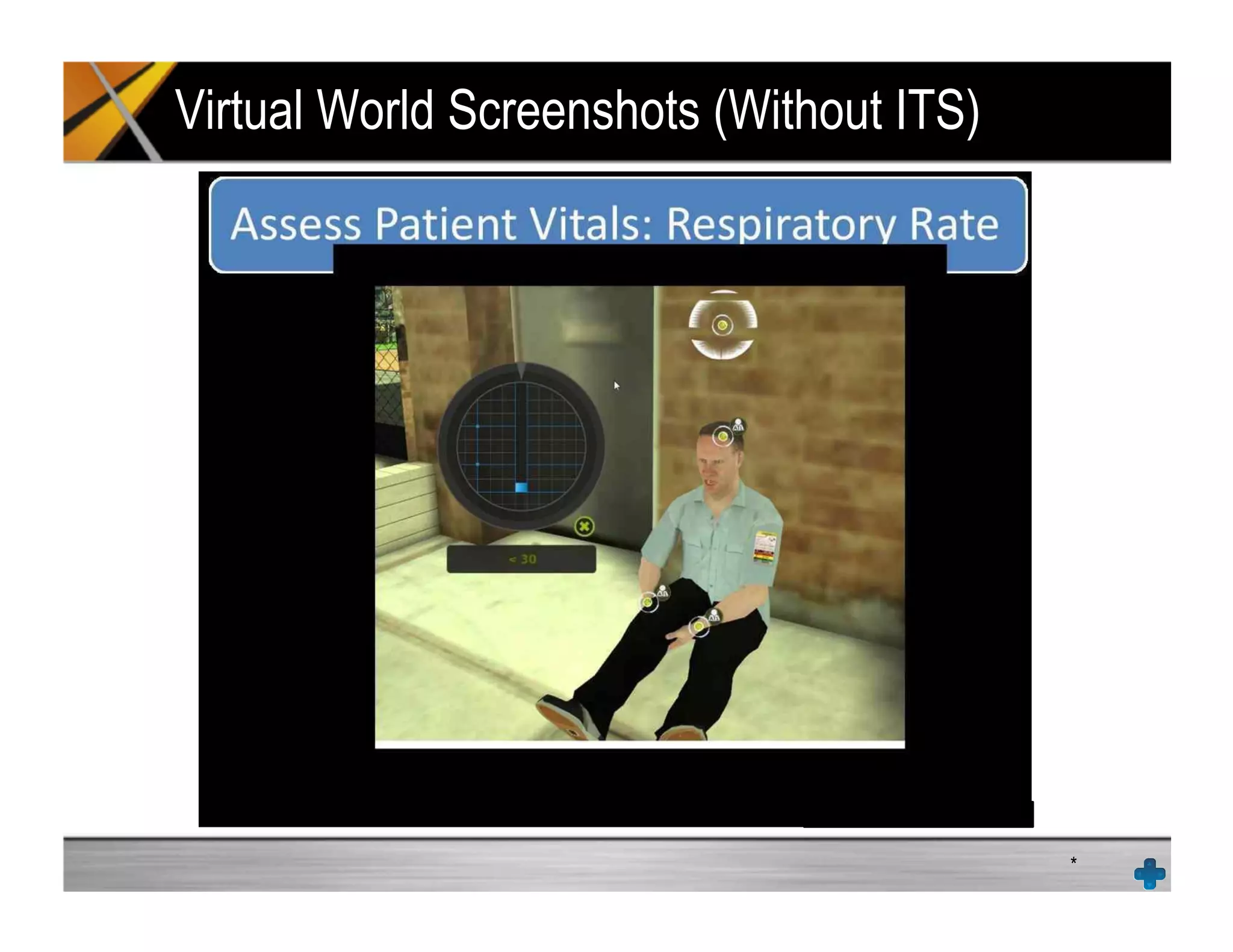
•  Performance goal
o  performing the correct triage category
o  the appropriate intervention
o  selecting the appropriate mode of evacuation, air or ground
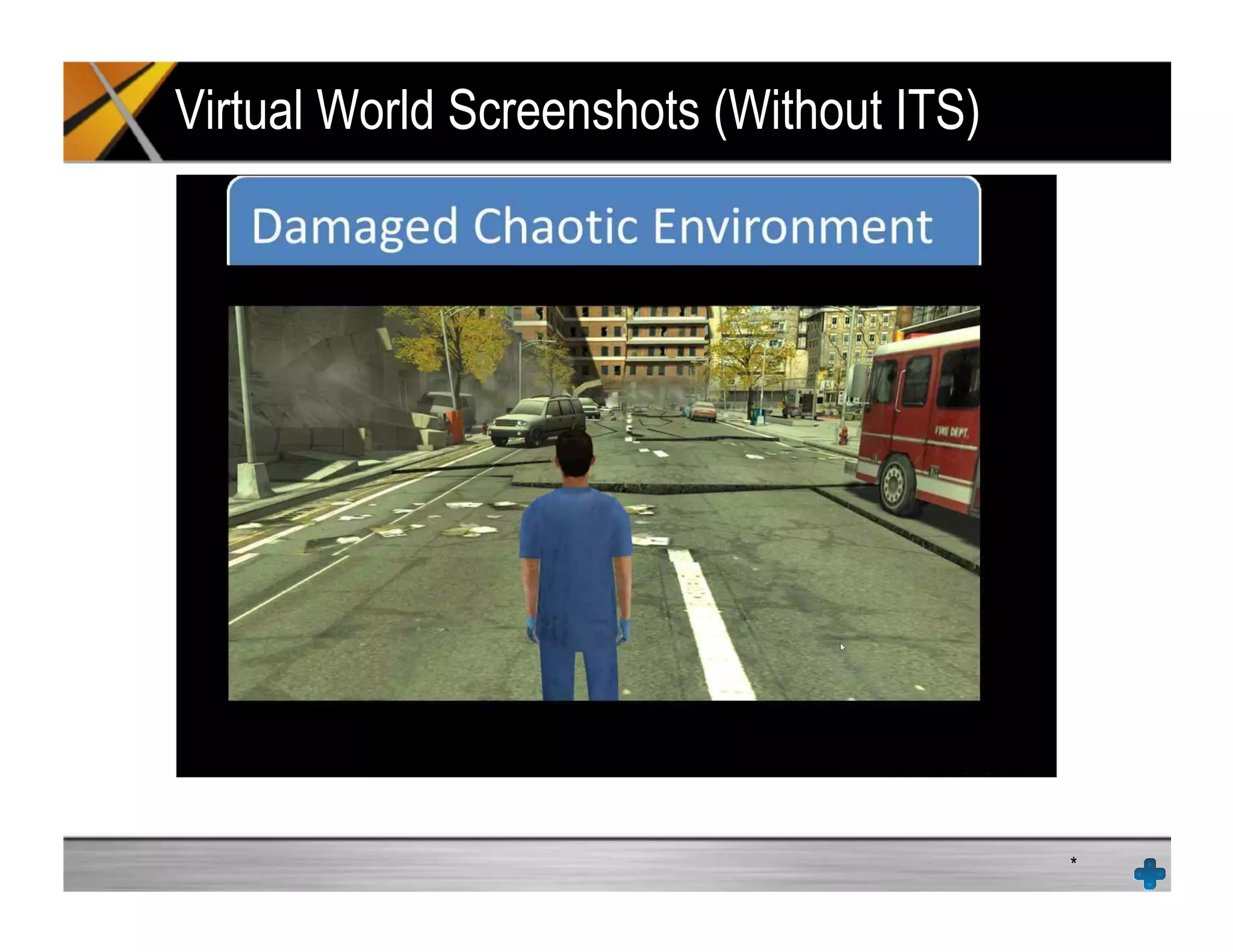
Virtual World Screenshots (Without ITS)
*
Virtual World Screenshots (Without ITS)
*
Virtual World Screenshots (Without ITS)
*
Virtual World Screenshots (Without ITS)
*
Virtual World Screenshots (Without ITS)
*
Virtual World Screenshots (Without ITS)
*
Virtual World Screenshots (Without ITS)
*
Virtual World Screenshots (Without ITS)
*
Virtual World Screenshots (Without ITS)
*
Open
Discussion
Intelligent Tutoring
Systems
Learning Theory, Efficacy of Tutoring, and
Computerized Learning Environments
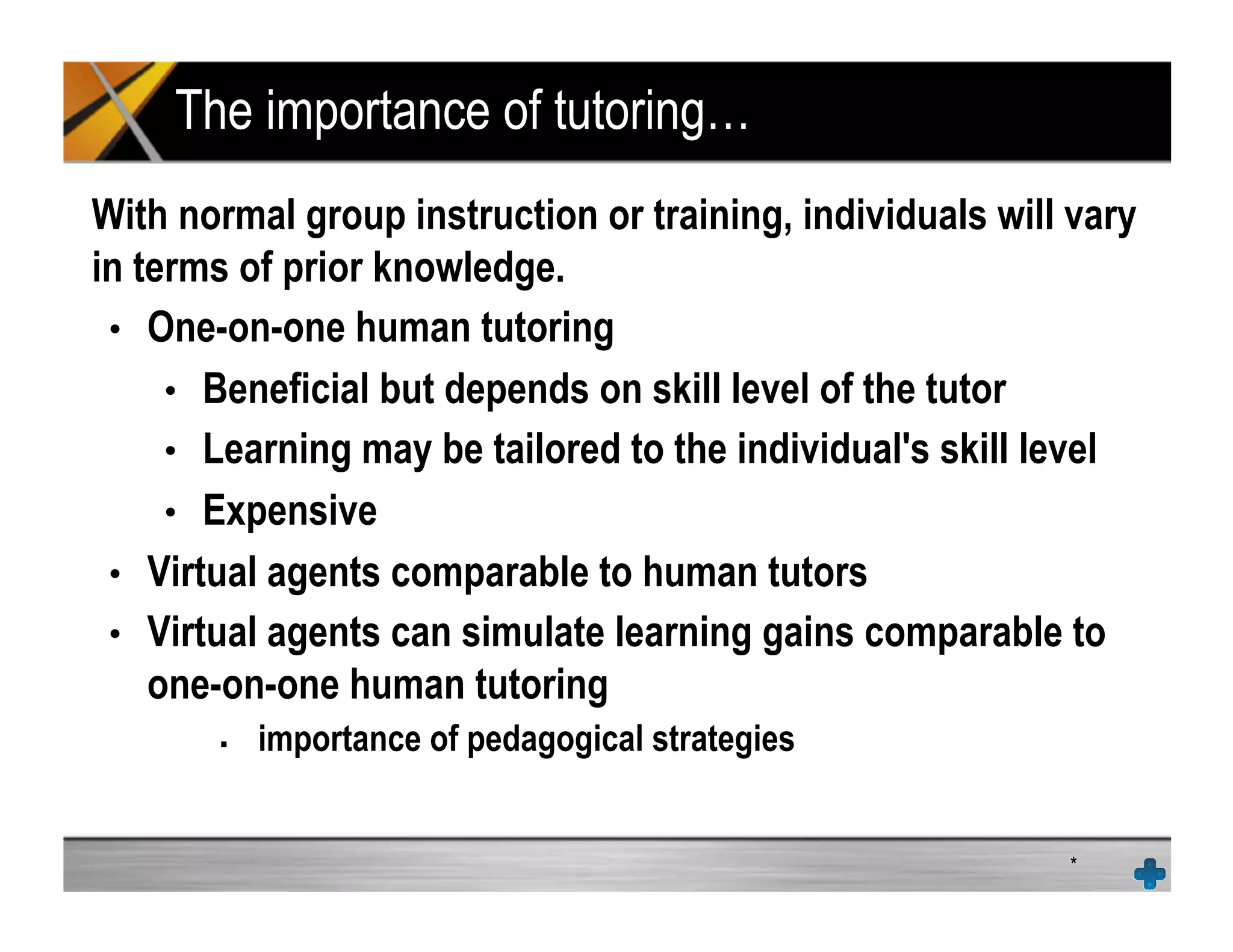
The importance of tutoring…
With normal group instruction or training, individuals will vary
in terms of prior knowledge.
•  One-on-one human tutoring
•  Beneficial but depends on skill level of the tutor
•  Learning may be tailored to the individual's skill level
•  Expensive
•  Virtual agents comparable to human tutors
•  Virtual agents can simulate learning gains comparable to
one-on-one human tutoring
!  importance of pedagogical strategies
*
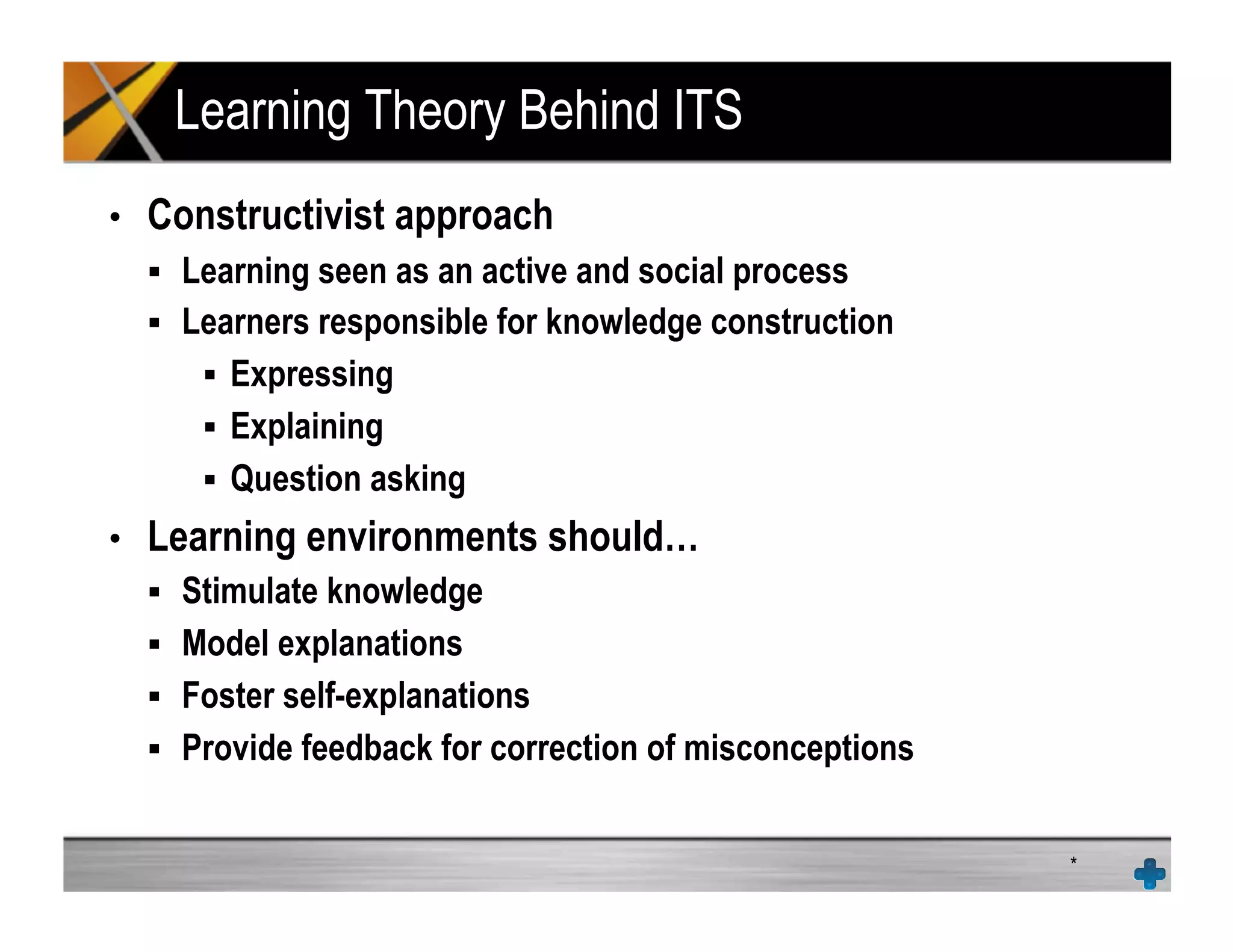
Learning Theory Behind ITS
•  Constructivist approach
!  Learning seen as an active and social process
!  Learners responsible for knowledge construction
!  Expressing
!  Explaining
!  Question asking
•  Learning environments should…
!  Stimulate knowledge
!  Model explanations
!  Foster self-explanations
!  Provide feedback for correction of misconceptions
*
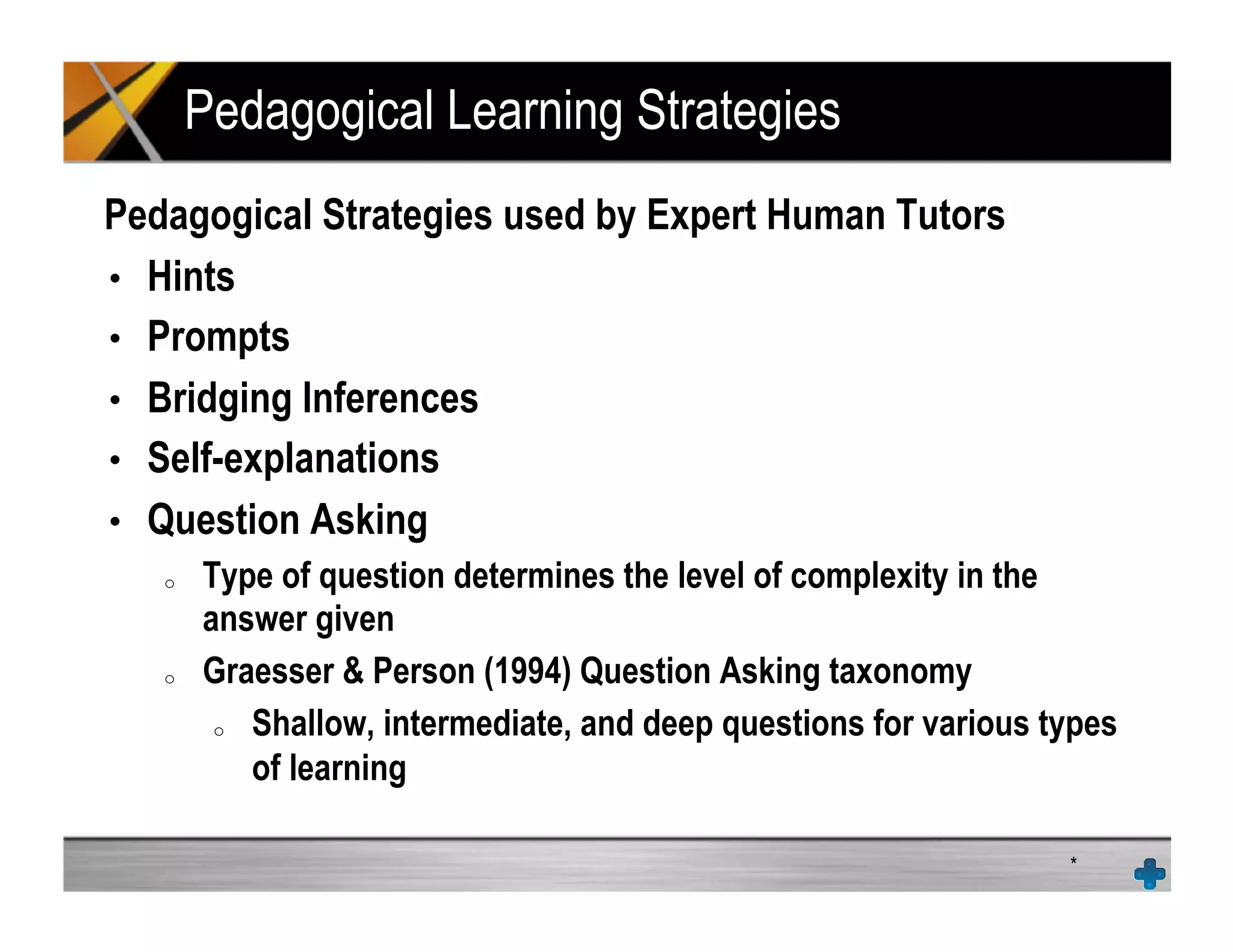
Pedagogical Learning Strategies
Pedagogical Strategies used by Expert Human Tutors
•  Hints
•  Prompts
•  Bridging Inferences
•  Self-explanations
•  Question Asking
o  Type of question determines the level of complexity in the
answer given
o  Graesser & Person (1994) Question Asking taxonomy
o  Shallow, intermediate, and deep questions for various types
of learning
*
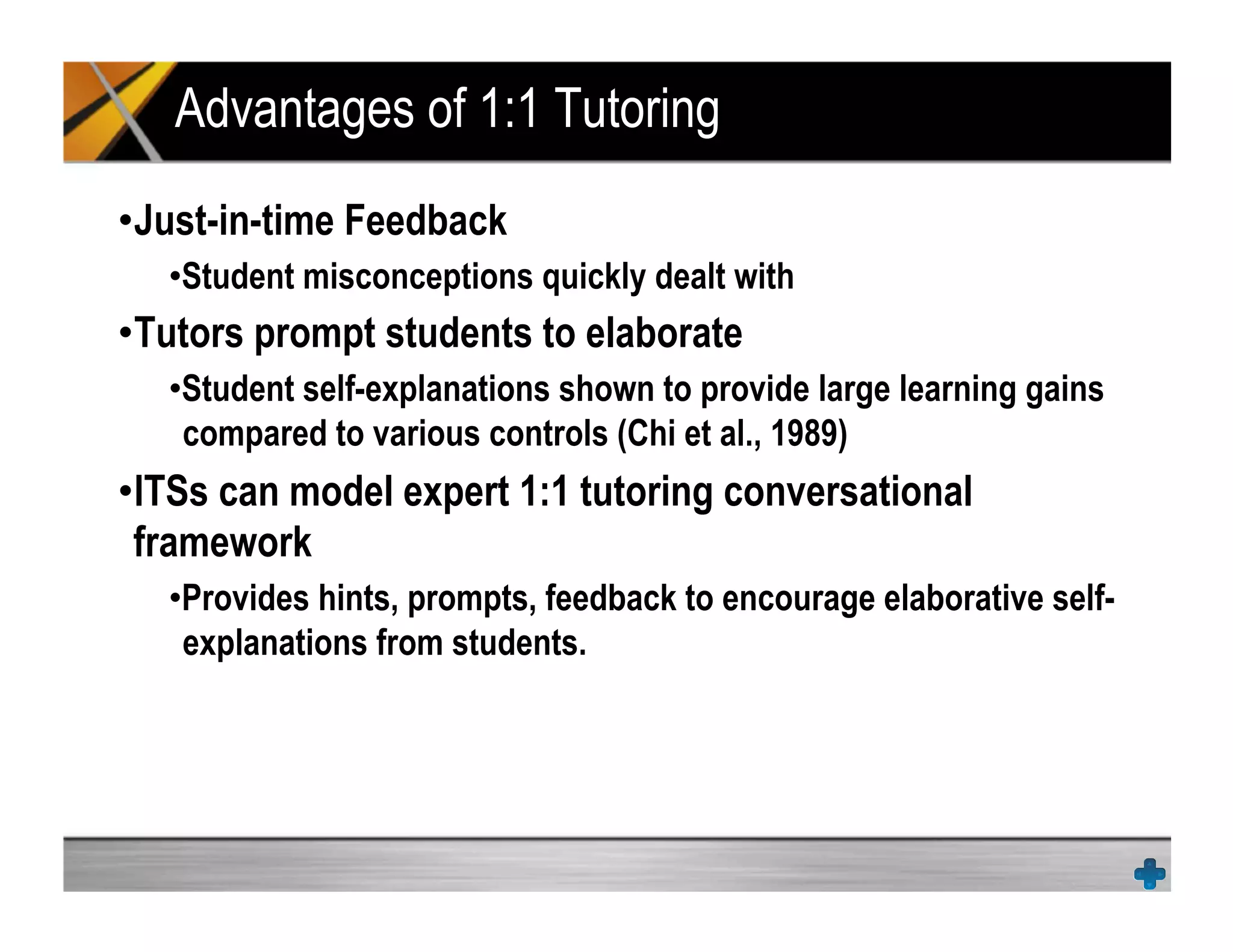
Advantages of 1:1 Tutoring
• Just-in-time Feedback
• Student misconceptions quickly dealt with
• Tutors prompt students to elaborate
• Student self-explanations shown to provide large learning gains
compared to various controls (Chi et al., 1989)
• ITSs can model expert 1:1 tutoring conversational
framework
• Provides hints, prompts, feedback to encourage elaborative self-
explanations from students.
*
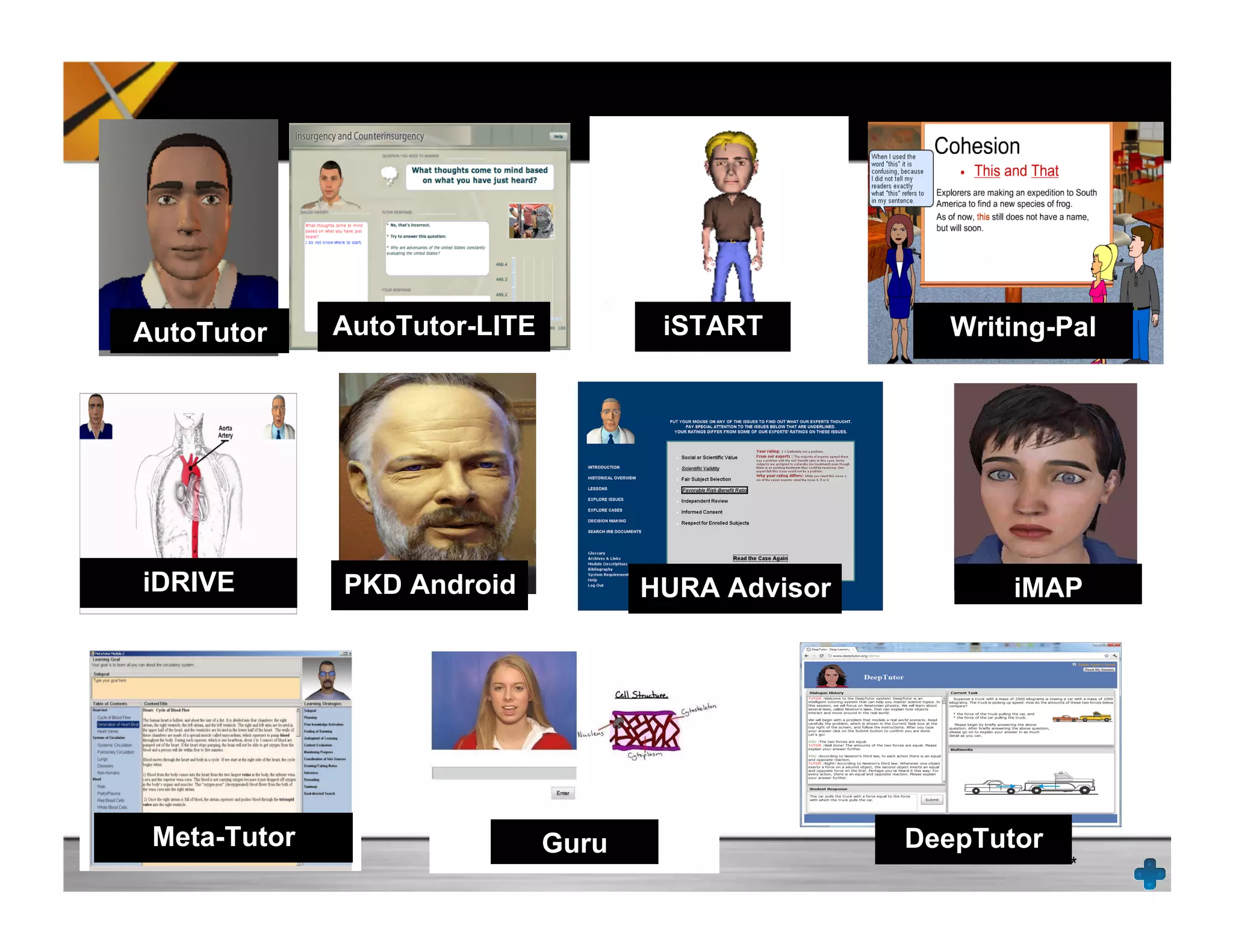
PKD Android
AutoTutor
iMAP
GuruMeta-Tutor
AutoTutor-LITE iSTART
iDRIVE
Writing-Pal
HURA Advisor
DeepTutor
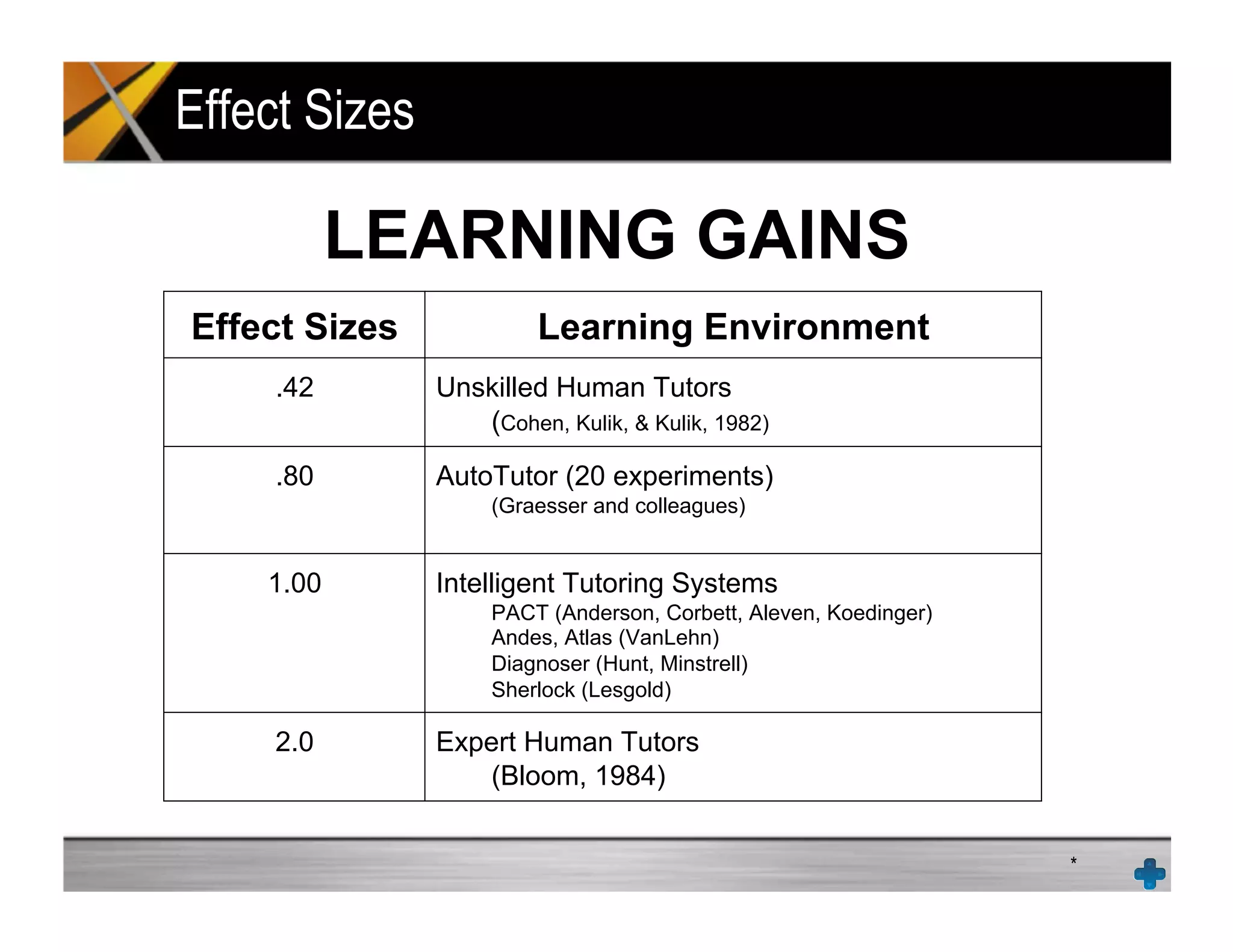
Effect Sizes
*
LEARNING GAINS
Effect Sizes Learning Environment
.42 Unskilled Human Tutors
(Cohen, Kulik, & Kulik, 1982)
.80 AutoTutor (20 experiments)
(Graesser and colleagues)
1.00 Intelligent Tutoring Systems
PACT (Anderson, Corbett, Aleven, Koedinger)
Andes, Atlas (VanLehn)
Diagnoser (Hunt, Minstrell)
Sherlock (Lesgold)
2.0 Expert Human Tutors
(Bloom, 1984)
Under the hood of
Intelligent Tutoring
Systems
Semantic Spaces, Natural Language Processing,
Sharable Knowledge Objects (SKOs), Student Model
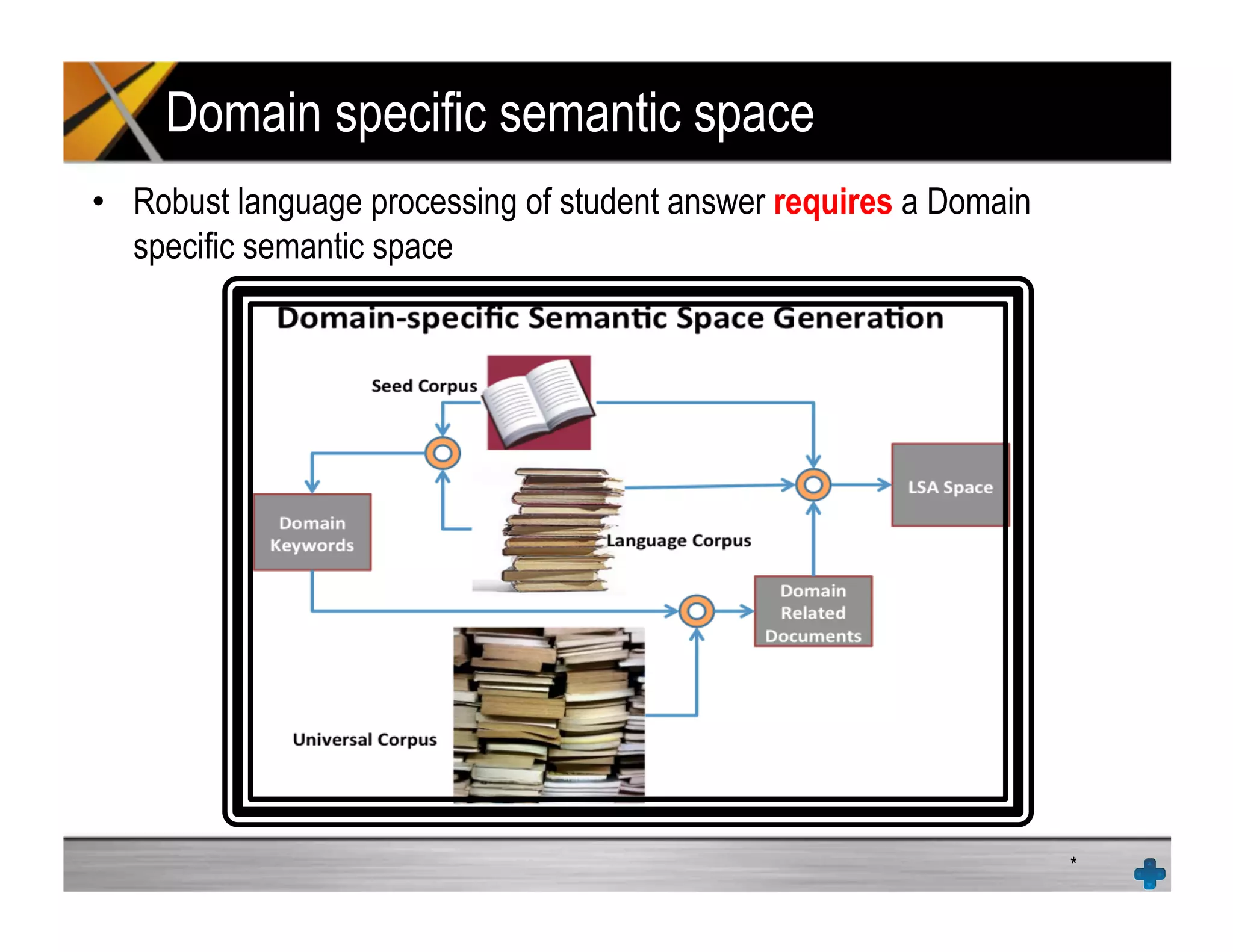
Domain specific semantic space
*
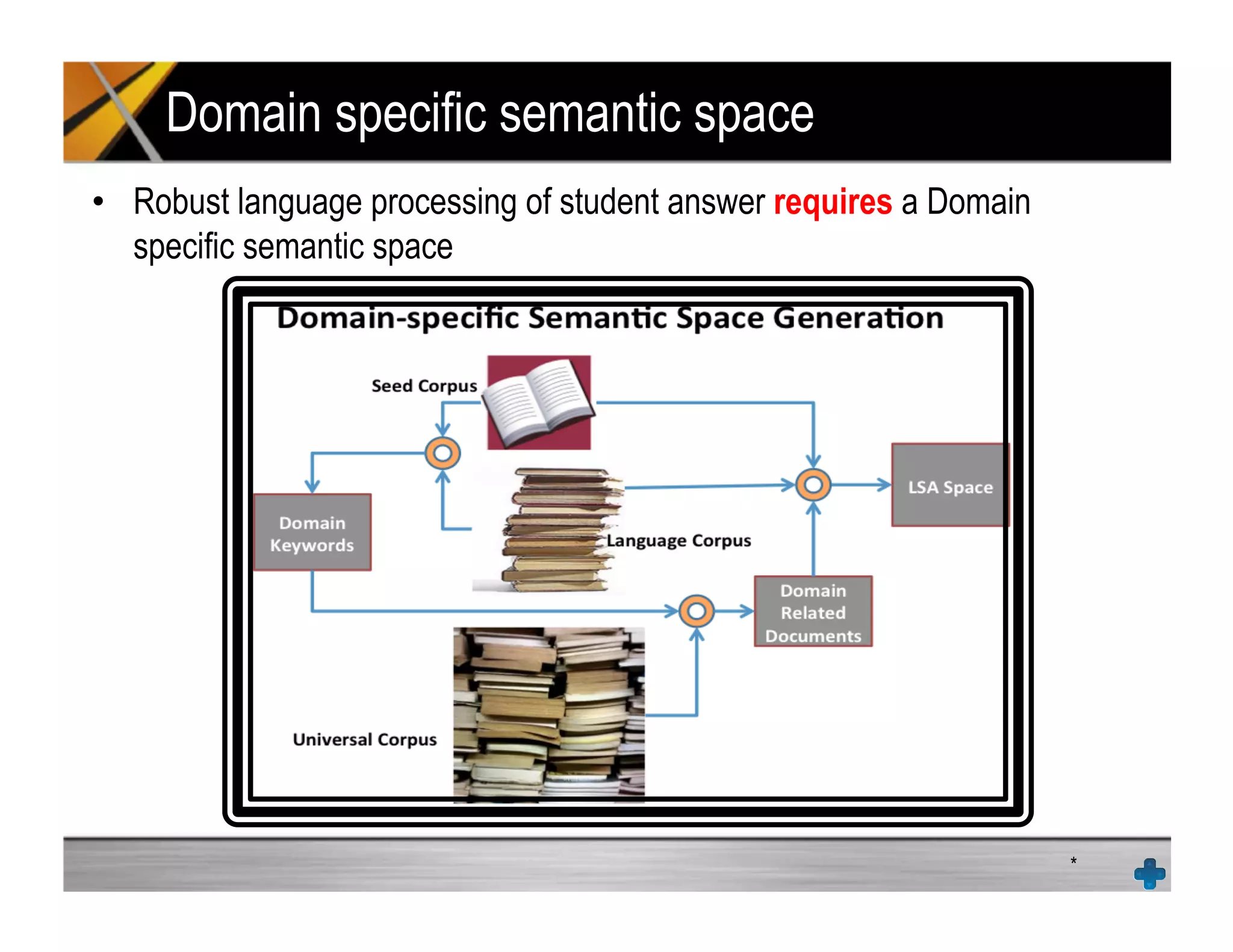
•  Robust language processing of student answer requires a Domain
specific semantic space
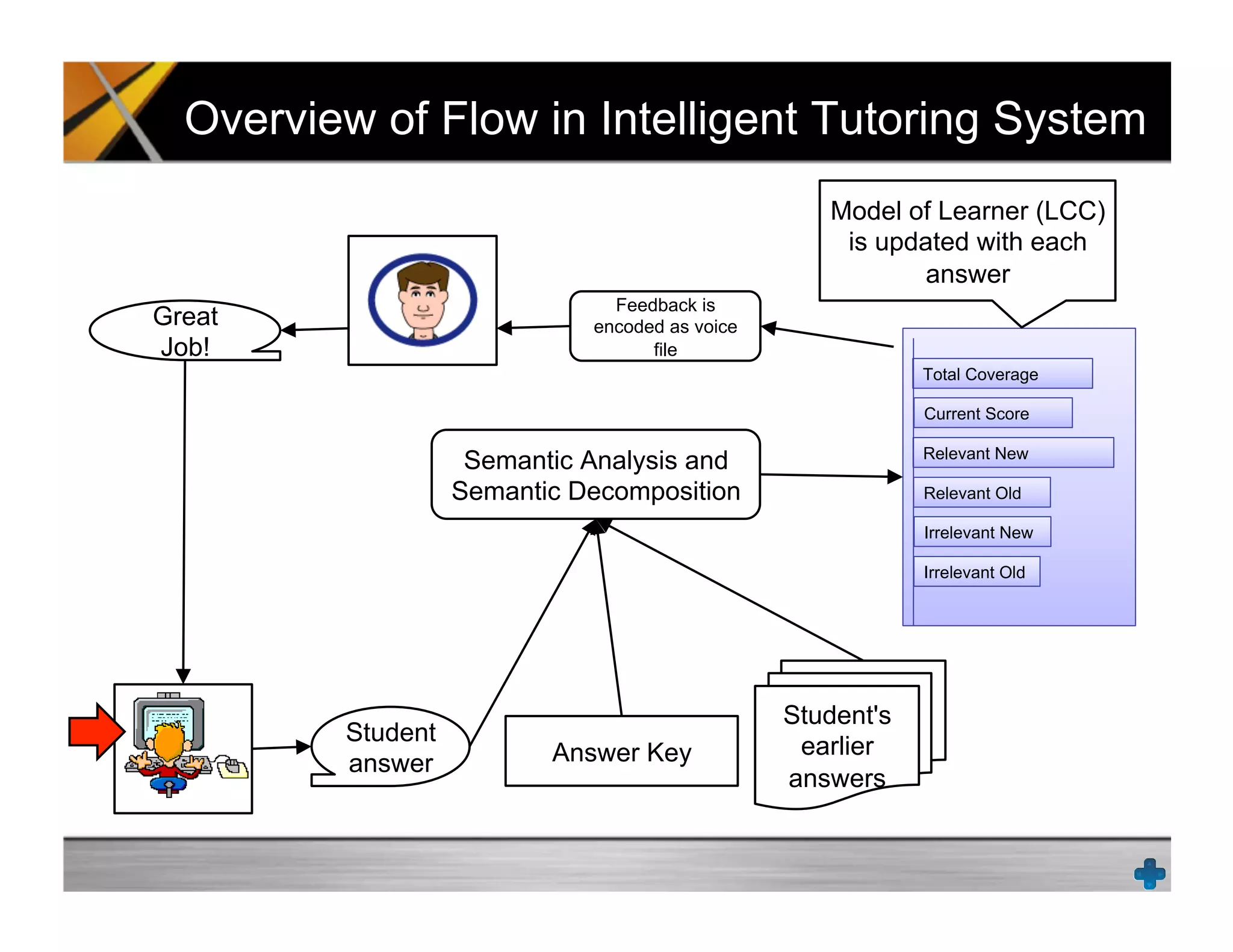
Answer Key
Student
answer
Semantic Analysis and
Semantic Decomposition
Student's
earlier
answers
Great
Job!
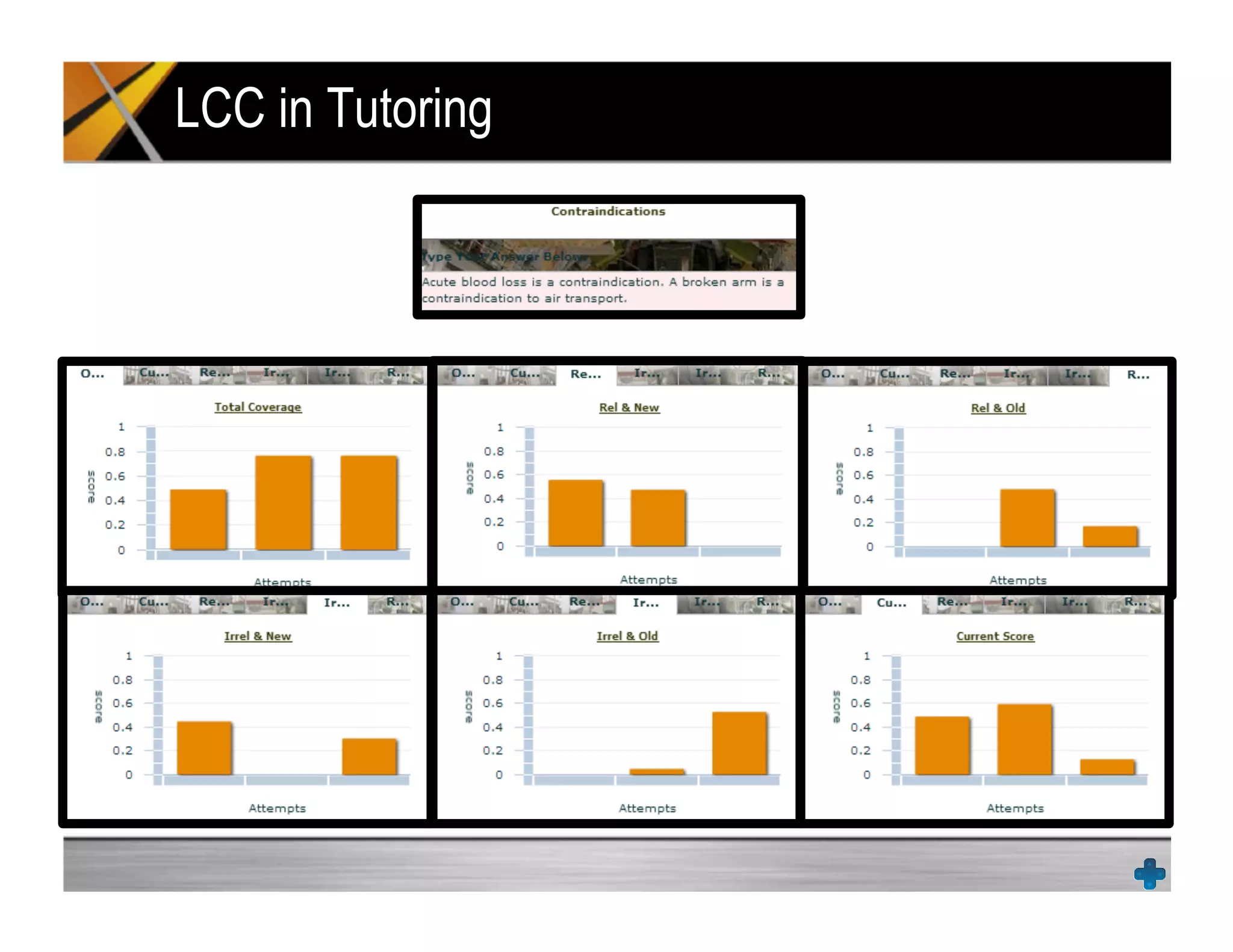
Total Coverage
Current Score
Relevant New
Relevant Old
Irrelevant New
Irrelevant Old
Feedback is
encoded as voice
file
Model of Learner (LCC)
is updated with each
answer
Overview of Flow in Intelligent Tutoring System
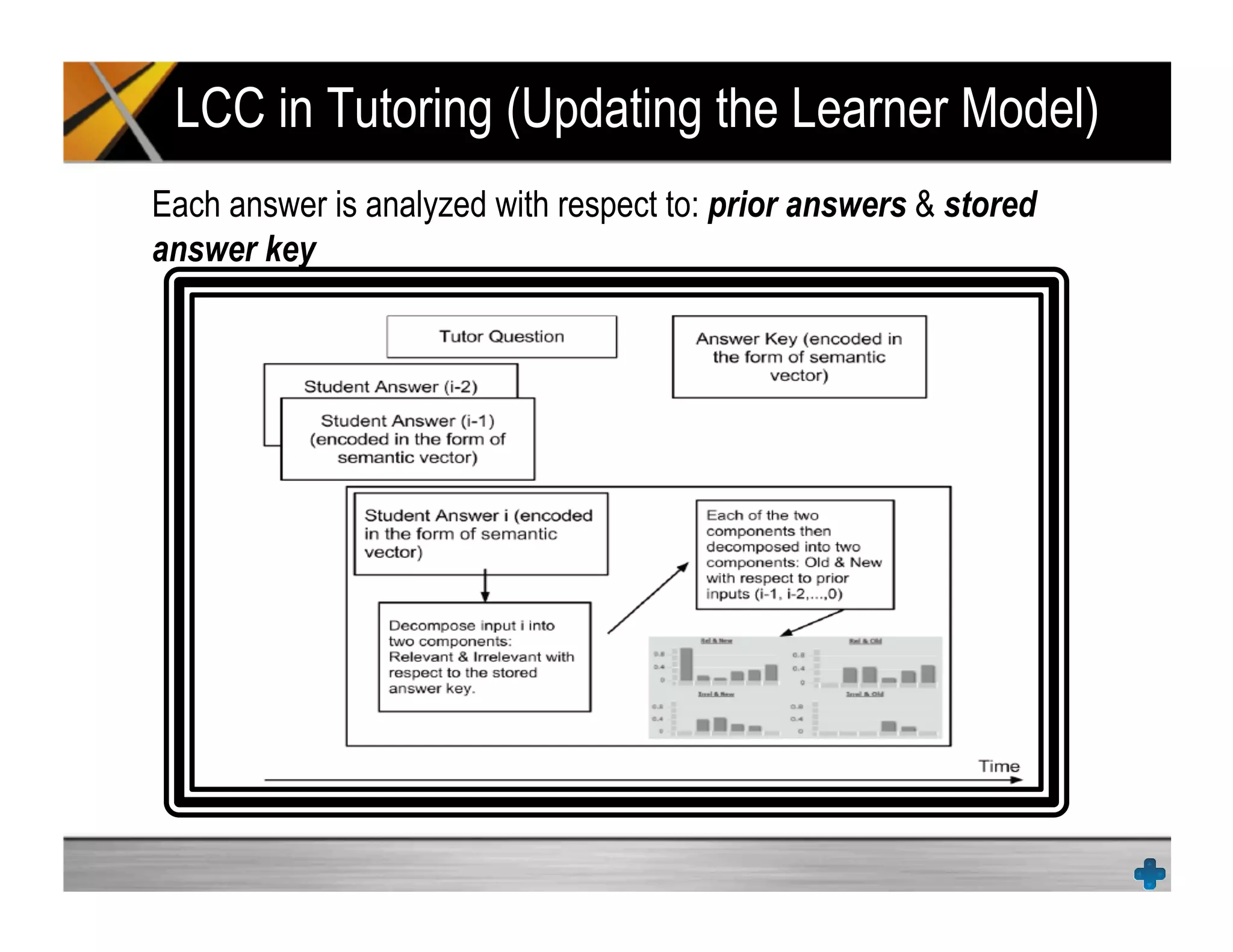
LCC in Tutoring (Updating the Learner Model)
Each answer is analyzed with respect to: prior answers & stored
answer key
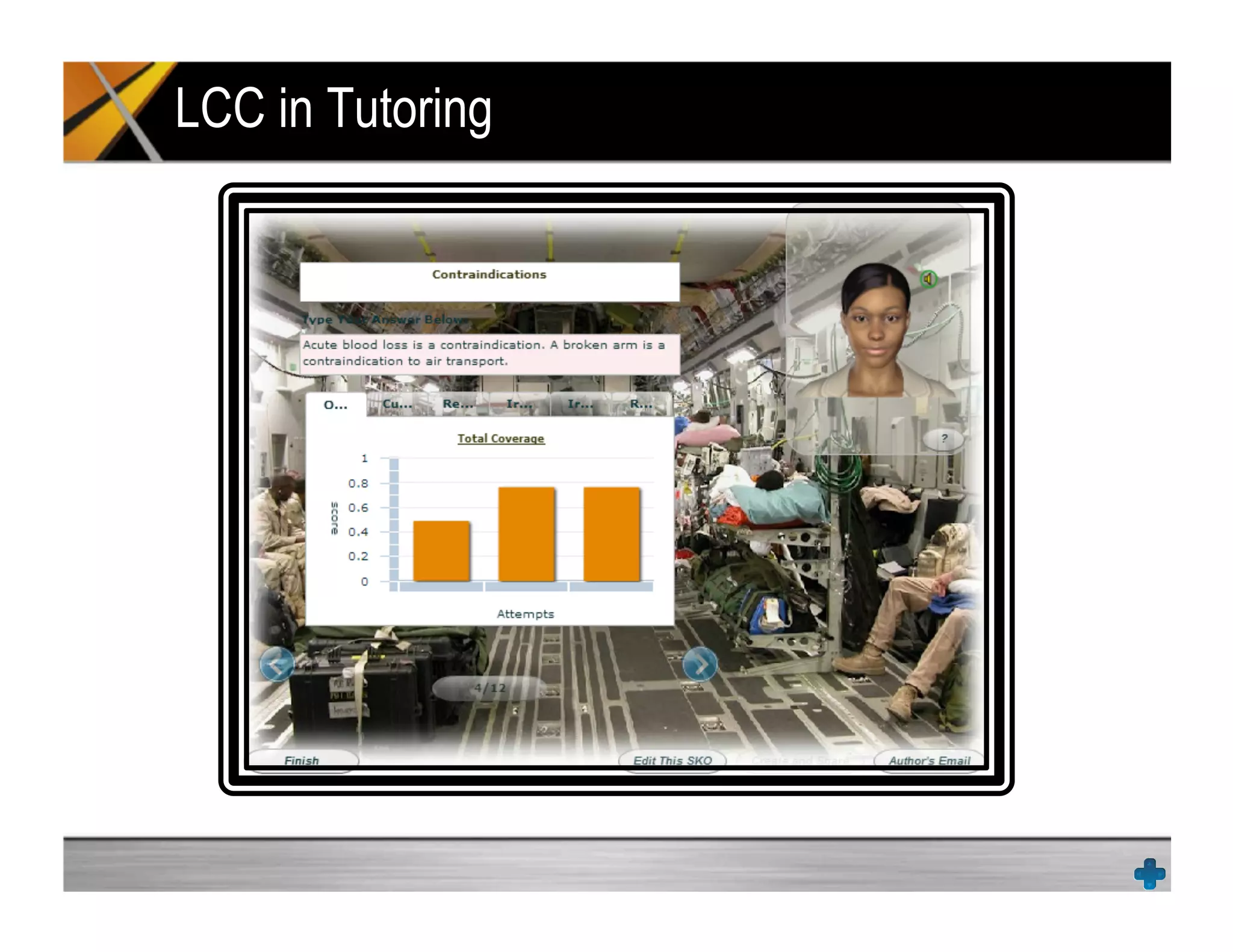
LCC in Tutoring
LCC in Tutoring
Domain specific semantic space
*
•  Robust language processing of student answer requires a Domain
specific semantic space
Background - for those who wish more detail ...
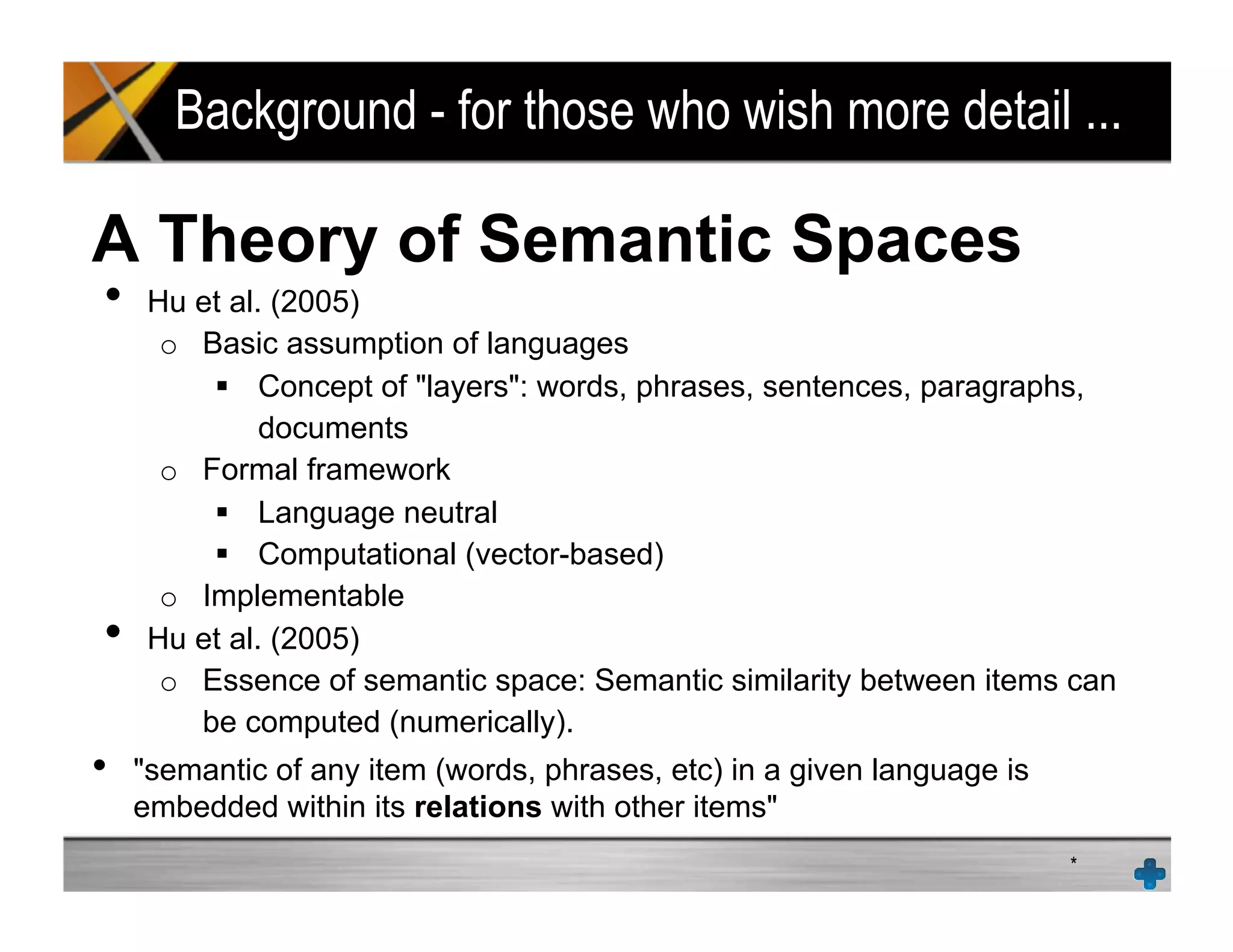
A Theory of Semantic Spaces
•  Hu et al. (2005)
o  Basic assumption of languages
!  Concept of "layers": words, phrases, sentences, paragraphs,
documents
o  Formal framework
!  Language neutral
!  Computational (vector-based)
o  Implementable
•  Hu et al. (2005)
o  Essence of semantic space: Semantic similarity between items can
be computed (numerically).
•  "semantic of any item (words, phrases, etc) in a given language is
embedded within its relations with other items"
*
Accessing ITSs
in a Virtual WorldSharable Knowledge Objects (SKOs)
Shareable Knowledge Objects (SKOs)
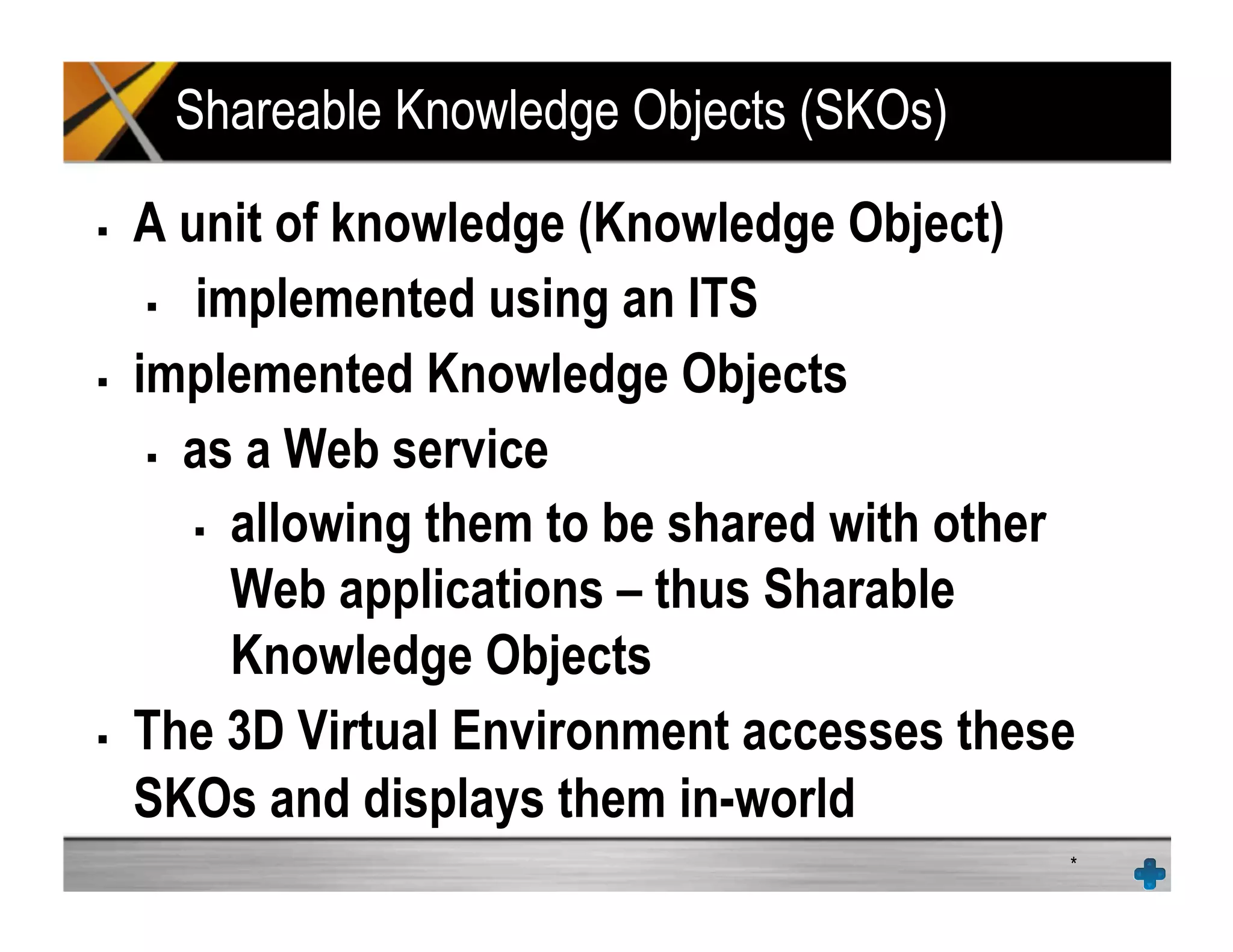
!  A unit of knowledge (Knowledge Object)
!  implemented using an ITS
!  implemented Knowledge Objects
!  as a Web service
!  allowing them to be shared with other
Web applications – thus Sharable
Knowledge Objects
!  The 3D Virtual Environment accesses these
SKOs and displays them in-world
*
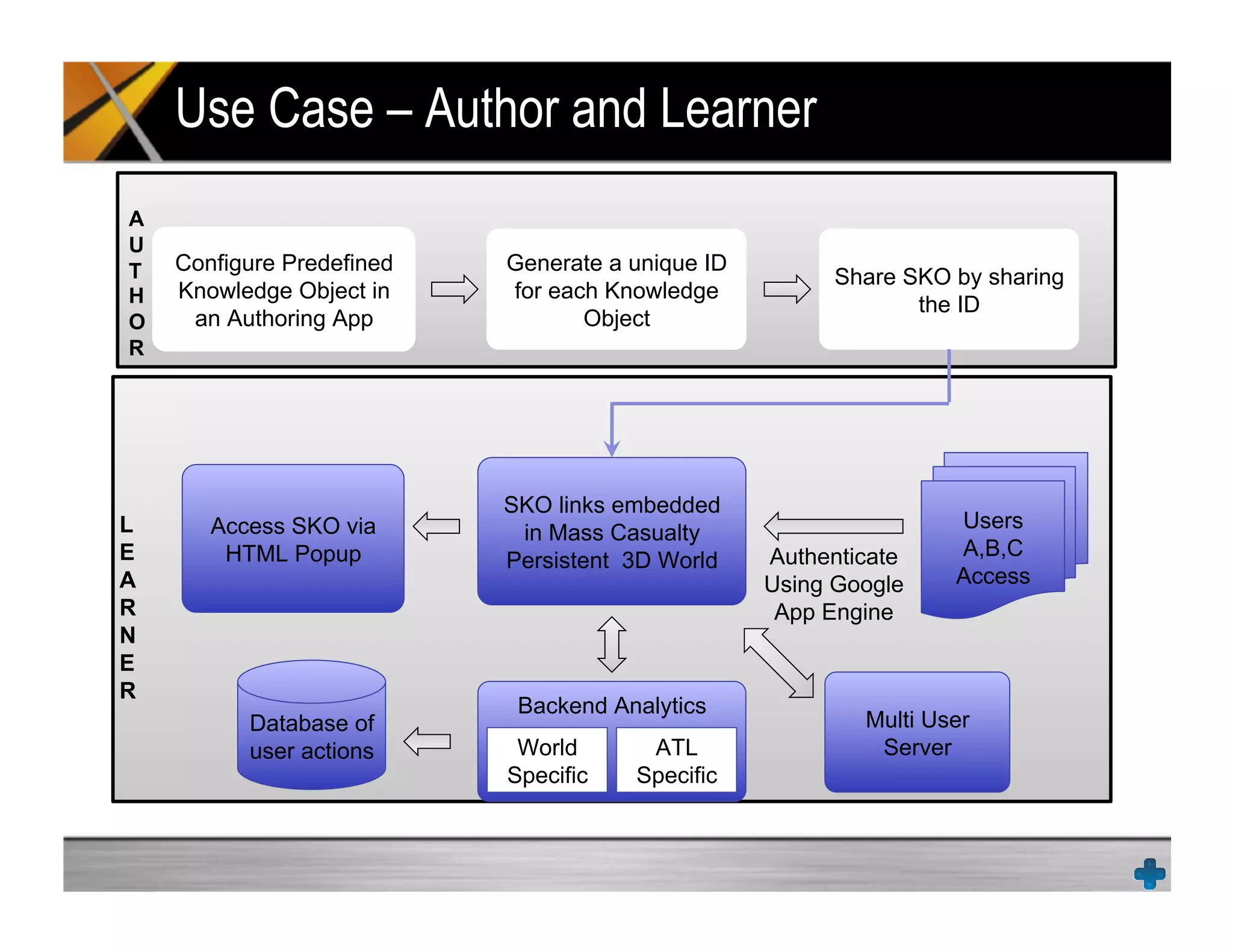
Configure Predefined
Knowledge Object in
an Authoring App
Generate a unique ID
for each Knowledge
Object
Share SKO by sharing
the ID
Users
A,B,C
Access
Authenticate
Using Google
App Engine
SKO links embedded
in Mass Casualty
Persistent 3D World
Backend Analytics
Database of
user actions
Access SKO via
HTML Popup
Multi User
ServerWorld
Specific
ATL
Specific
Use Case – Author and Learner
A
U
T
H
O
R
L
E
A
R
N
E
R
Shareable Knowledge Objects (SKOs)
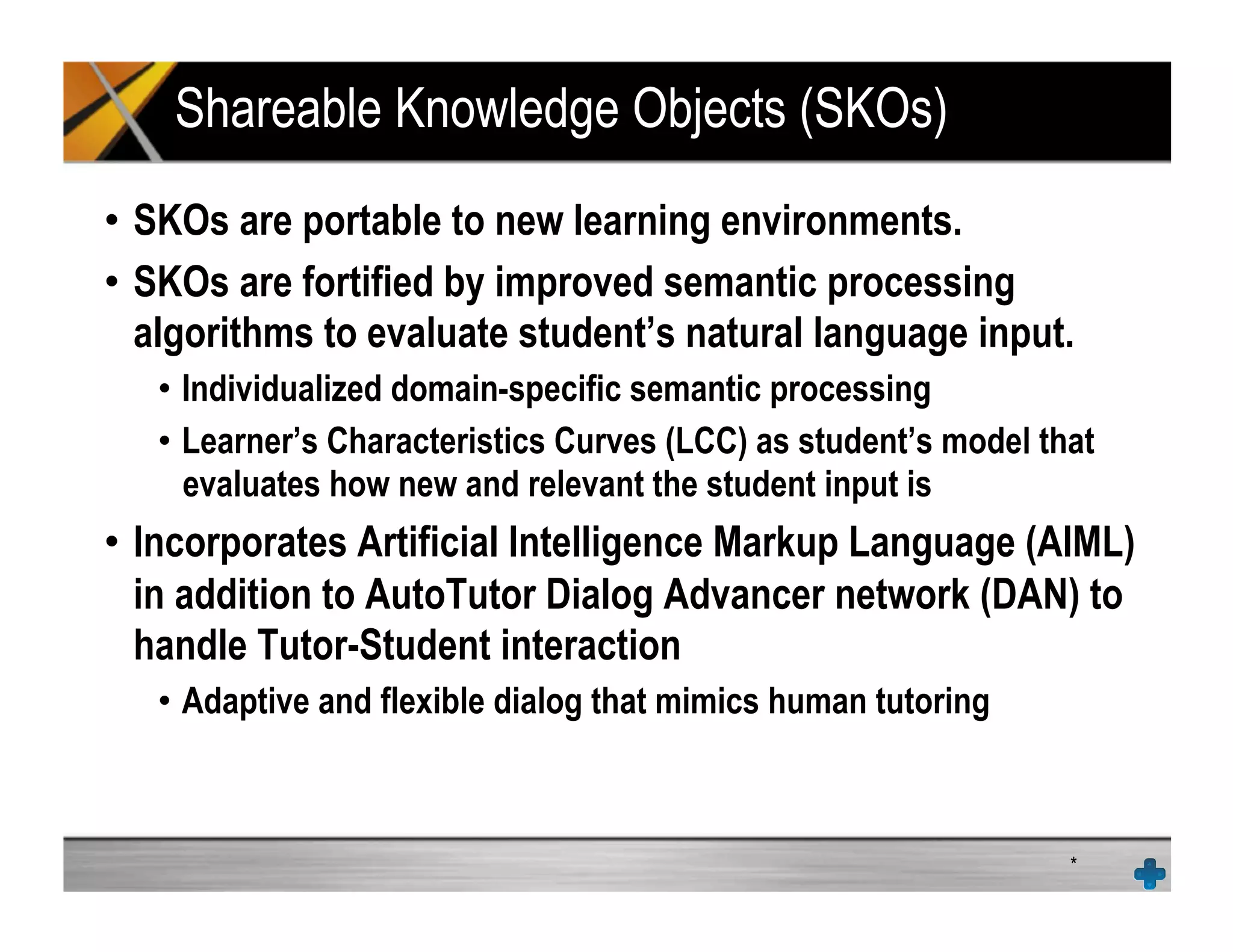
•  SKOs are portable to new learning environments.
•  SKOs are fortified by improved semantic processing
algorithms to evaluate student’s natural language input.
•  Individualized domain-specific semantic processing
•  Learner’s Characteristics Curves (LCC) as student’s model that
evaluates how new and relevant the student input is
•  Incorporates Artificial Intelligence Markup Language (AIML)
in addition to AutoTutor Dialog Advancer network (DAN) to
handle Tutor-Student interaction
•  Adaptive and flexible dialog that mimics human tutoring
*
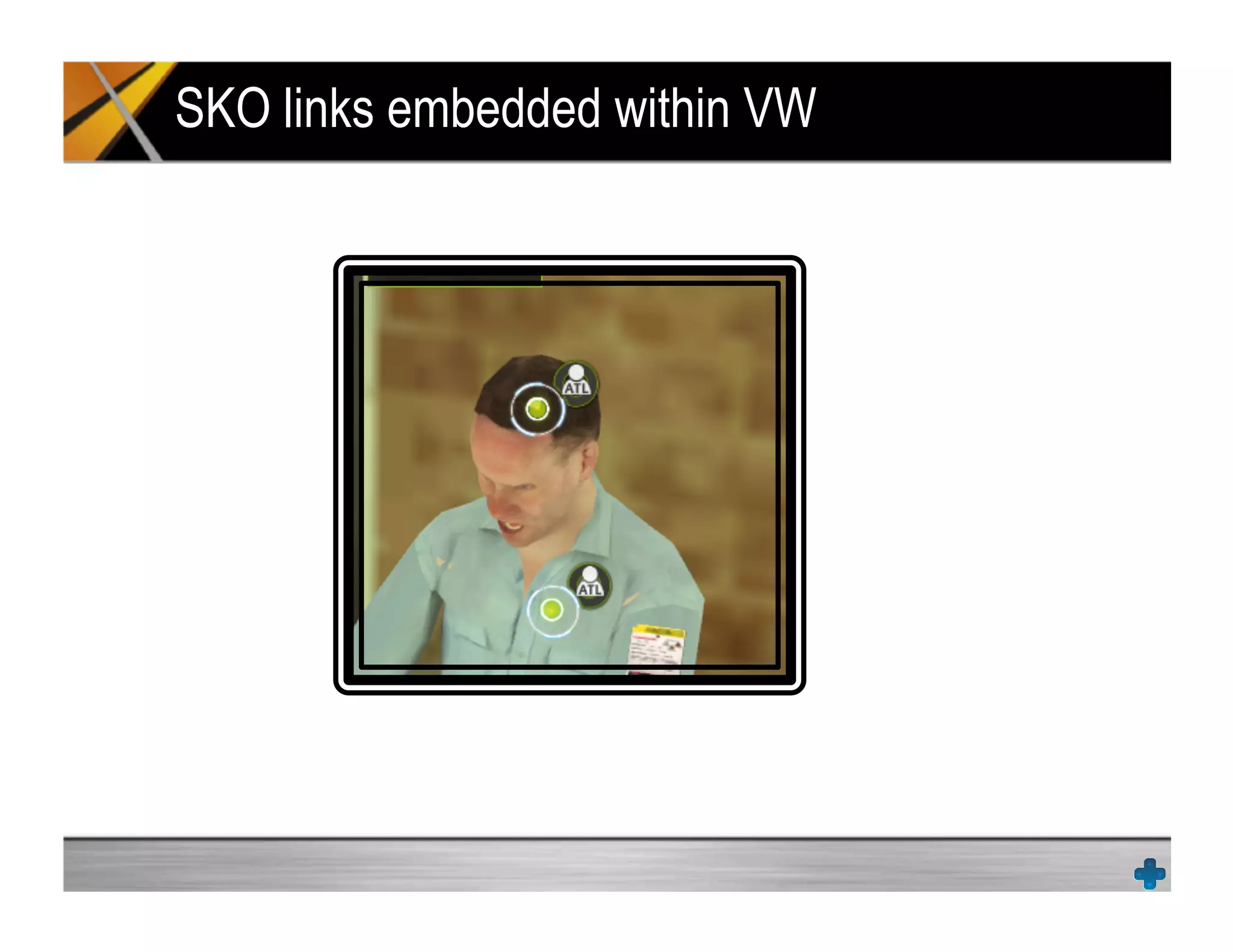
SKO links embedded within VW
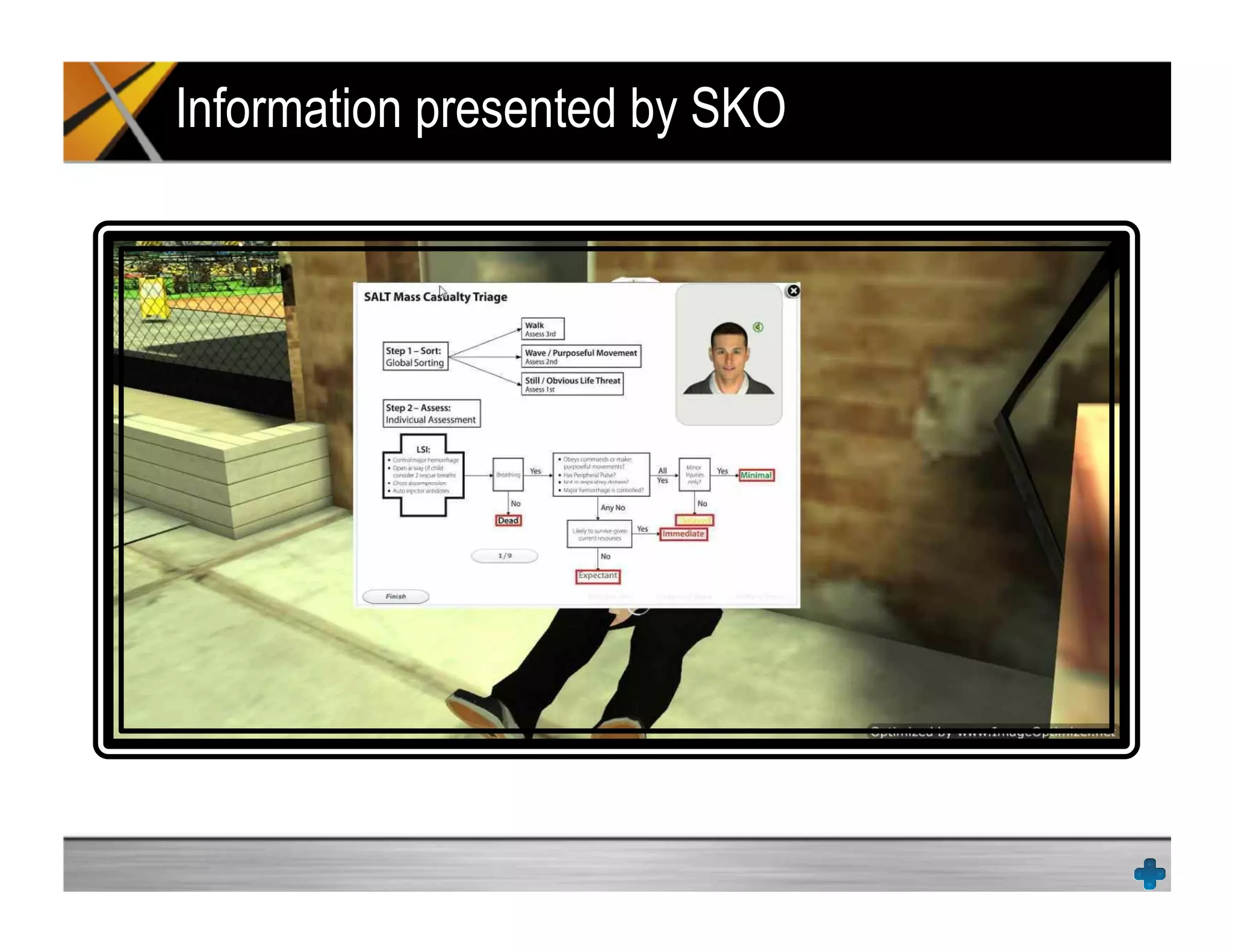
Information presented by SKO
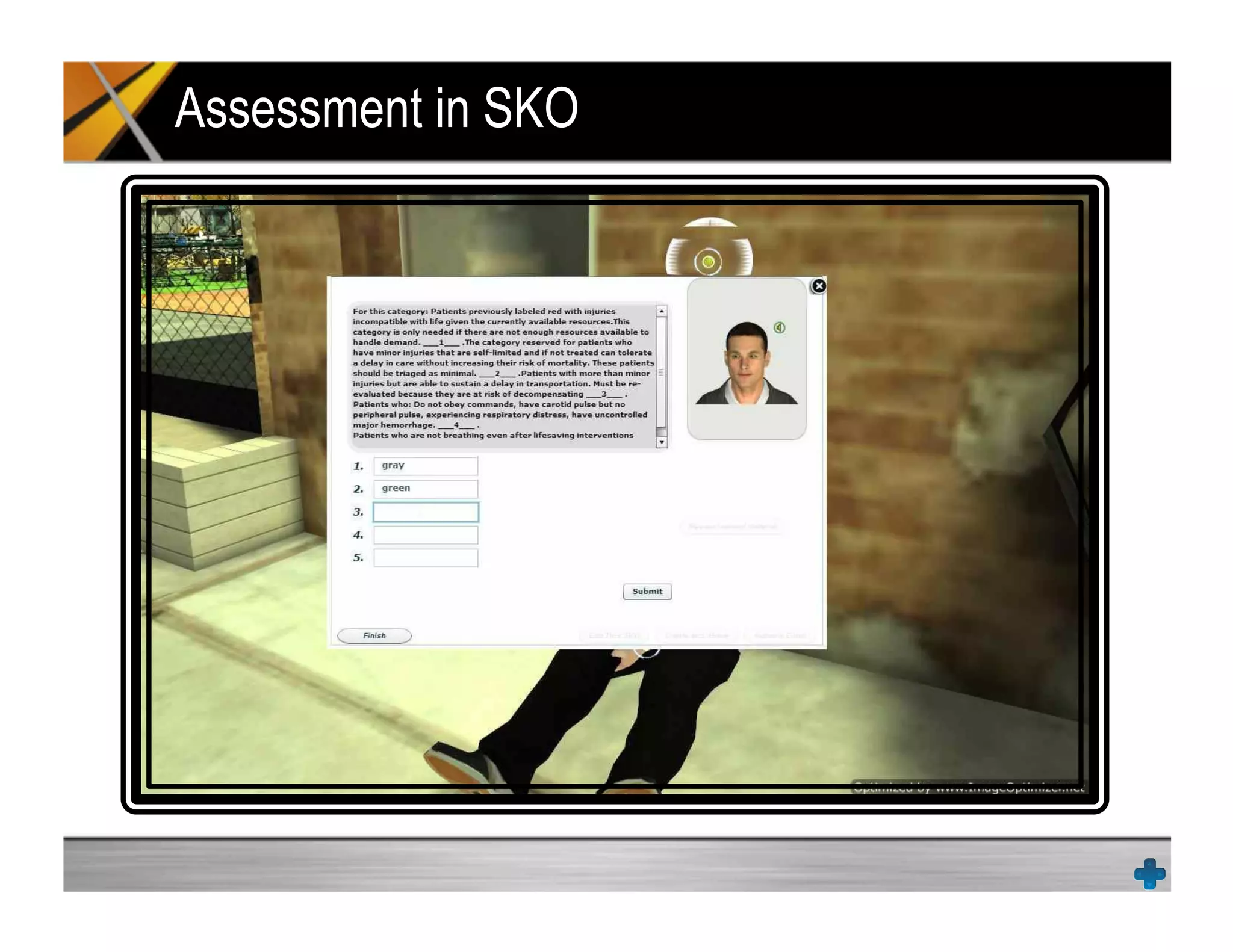
Assessment in SKO
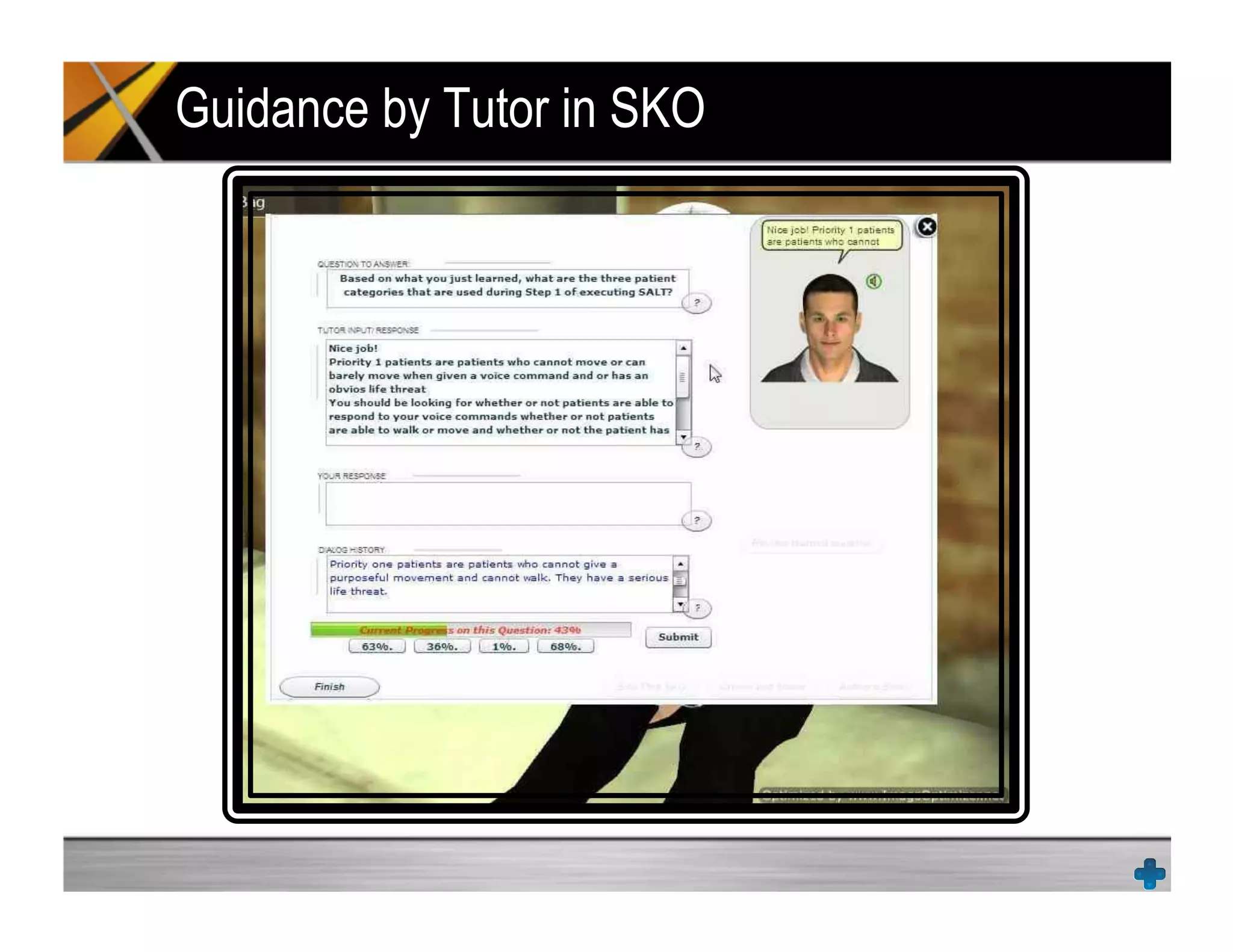
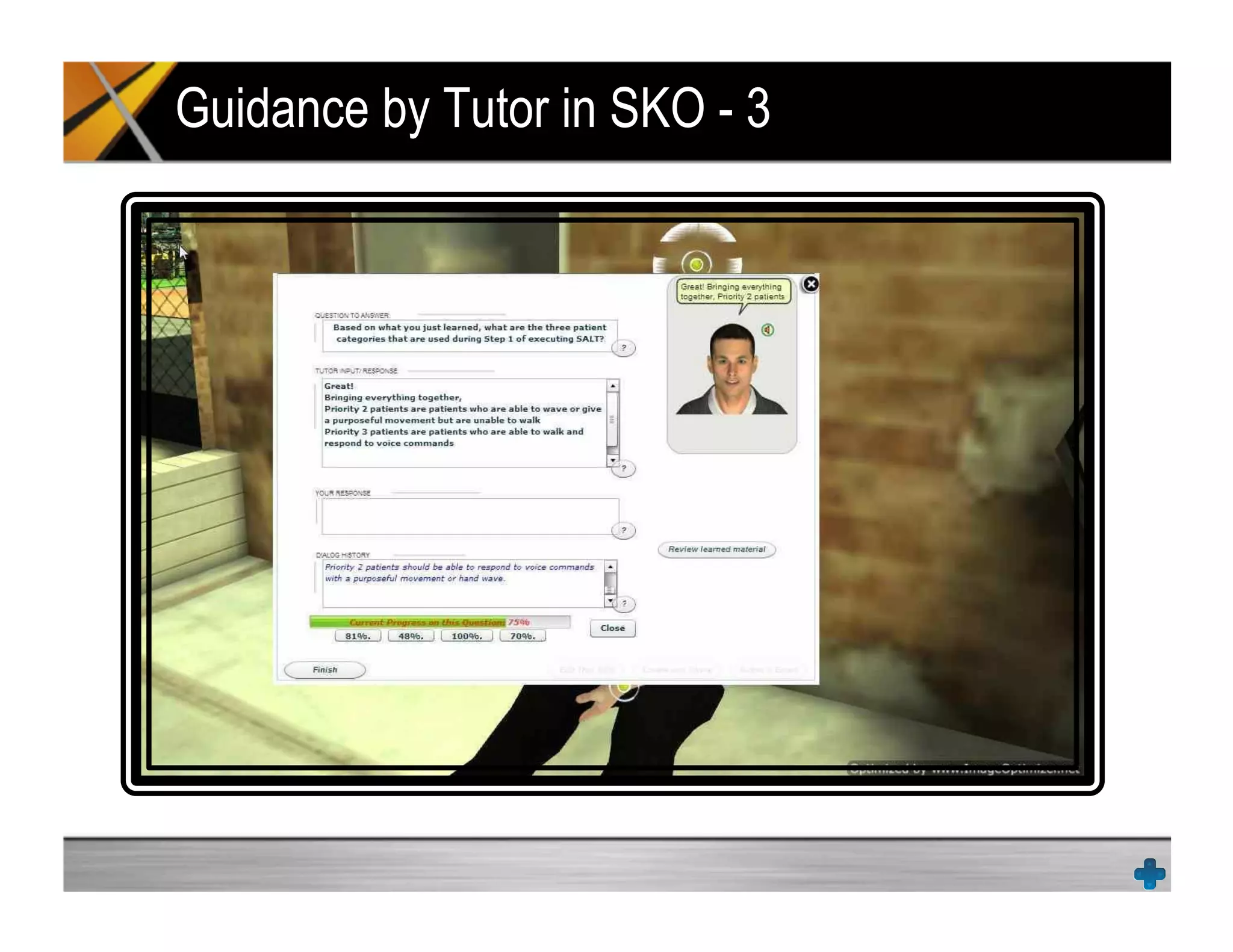
Guidance by Tutor in SKO
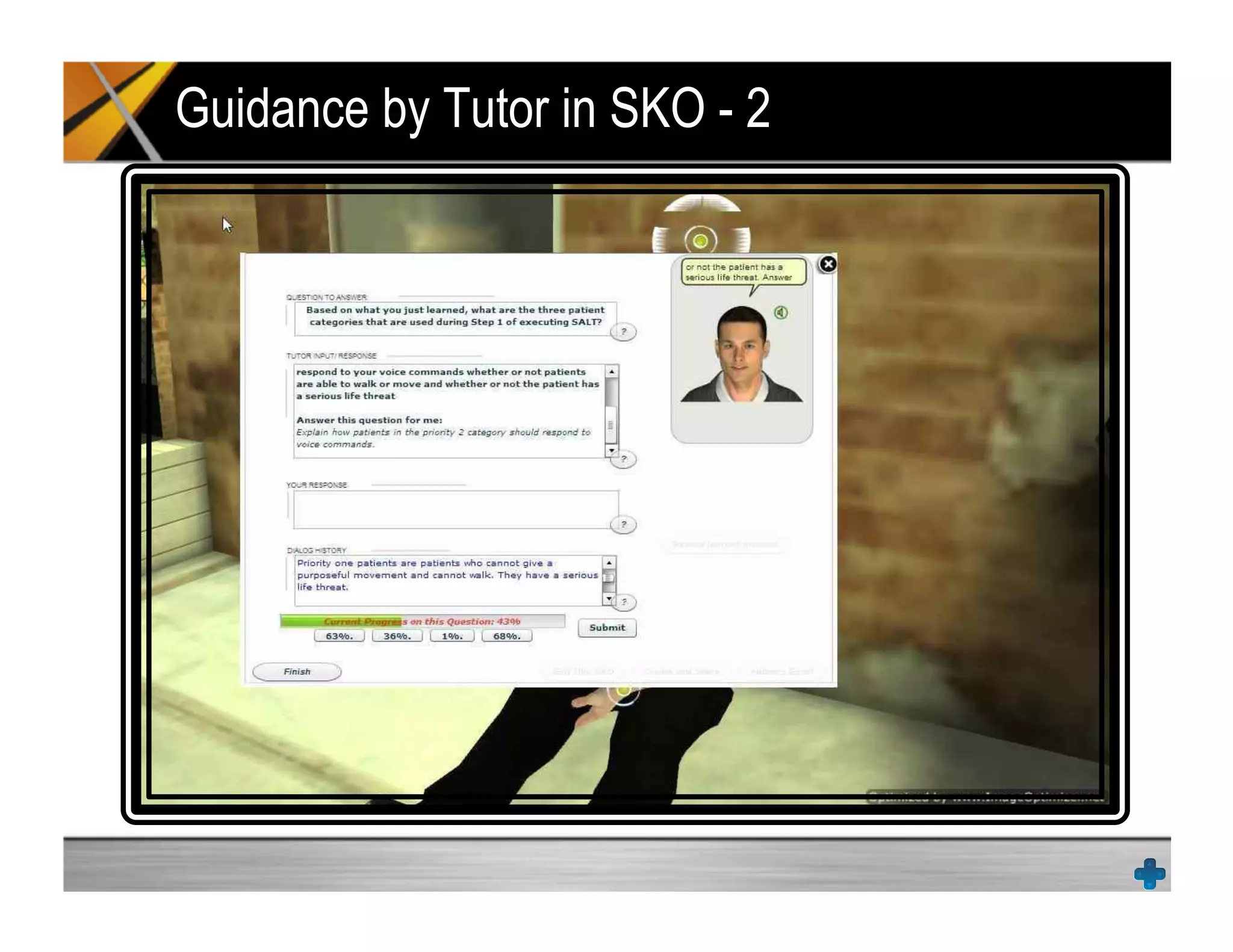
Guidance by Tutor in SKO - 2
Guidance by Tutor in SKO - 3
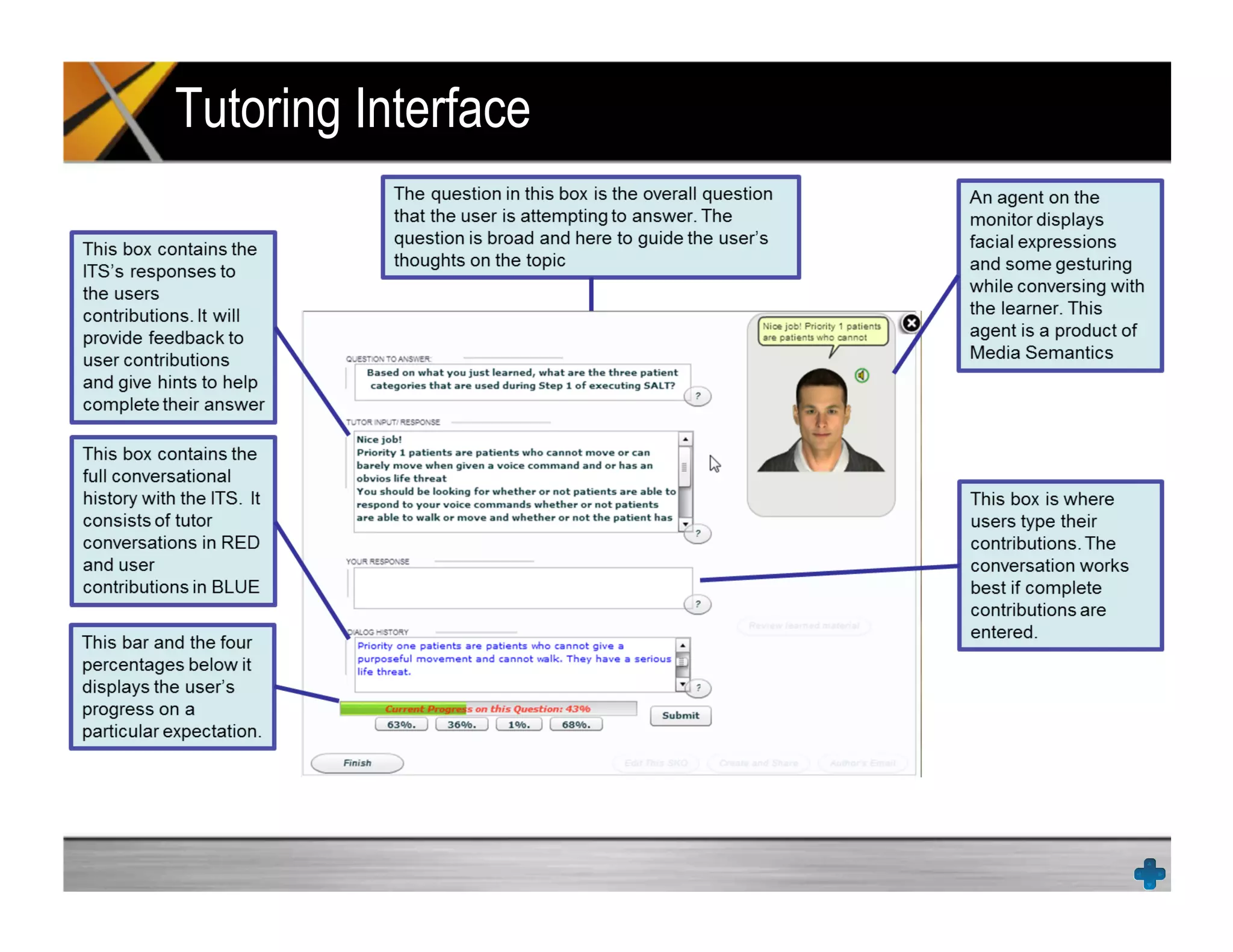
Tutoring Interface
Authoring within
ITSsCreating Sharable Knowledge Objects (SKOs)
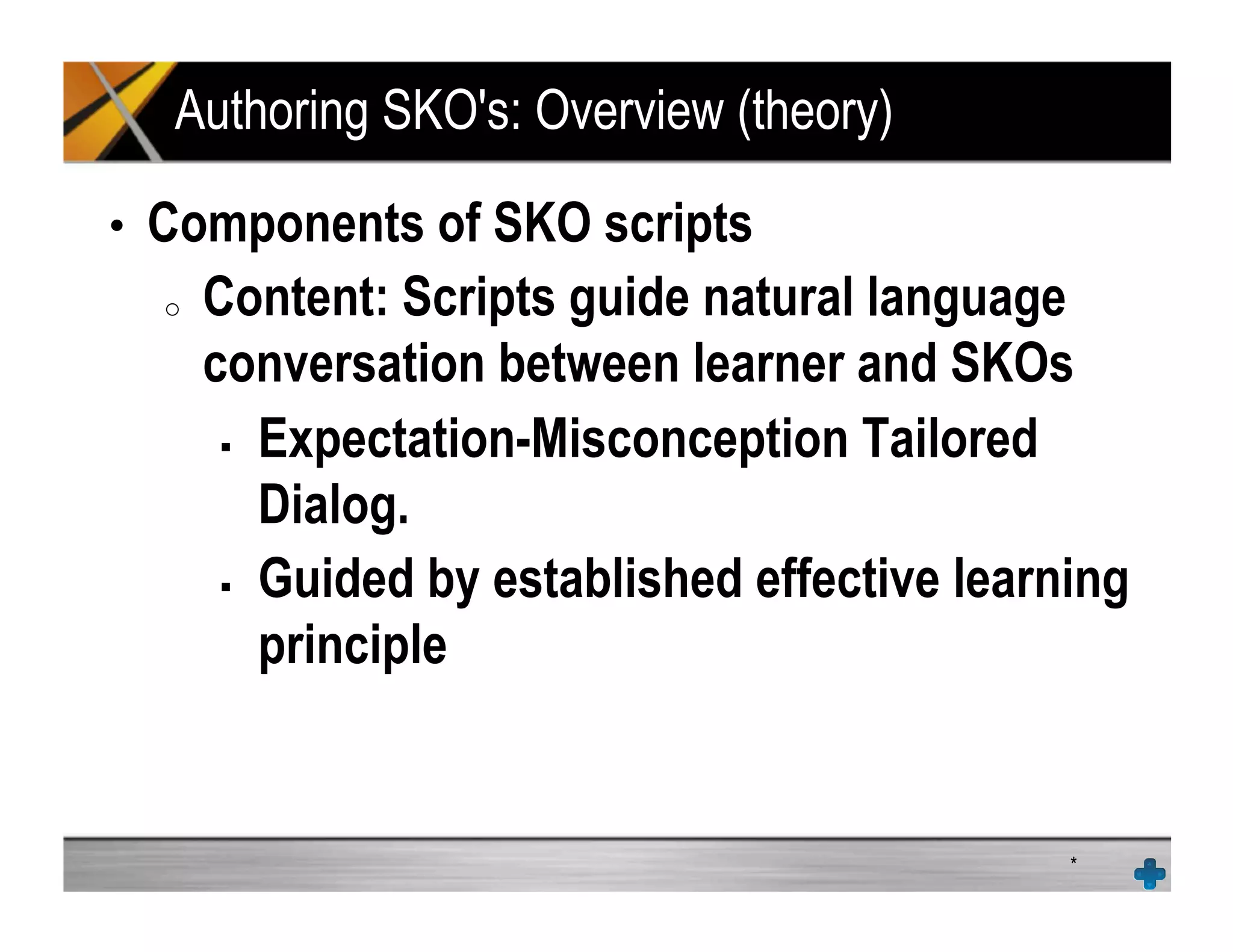
Authoring SKO's: Overview (theory)
•  Components of SKO scripts
o  Content: Scripts guide natural language
conversation between learner and SKOs
!  Expectation-Misconception Tailored
Dialog.
!  Guided by established effective learning
principle
*
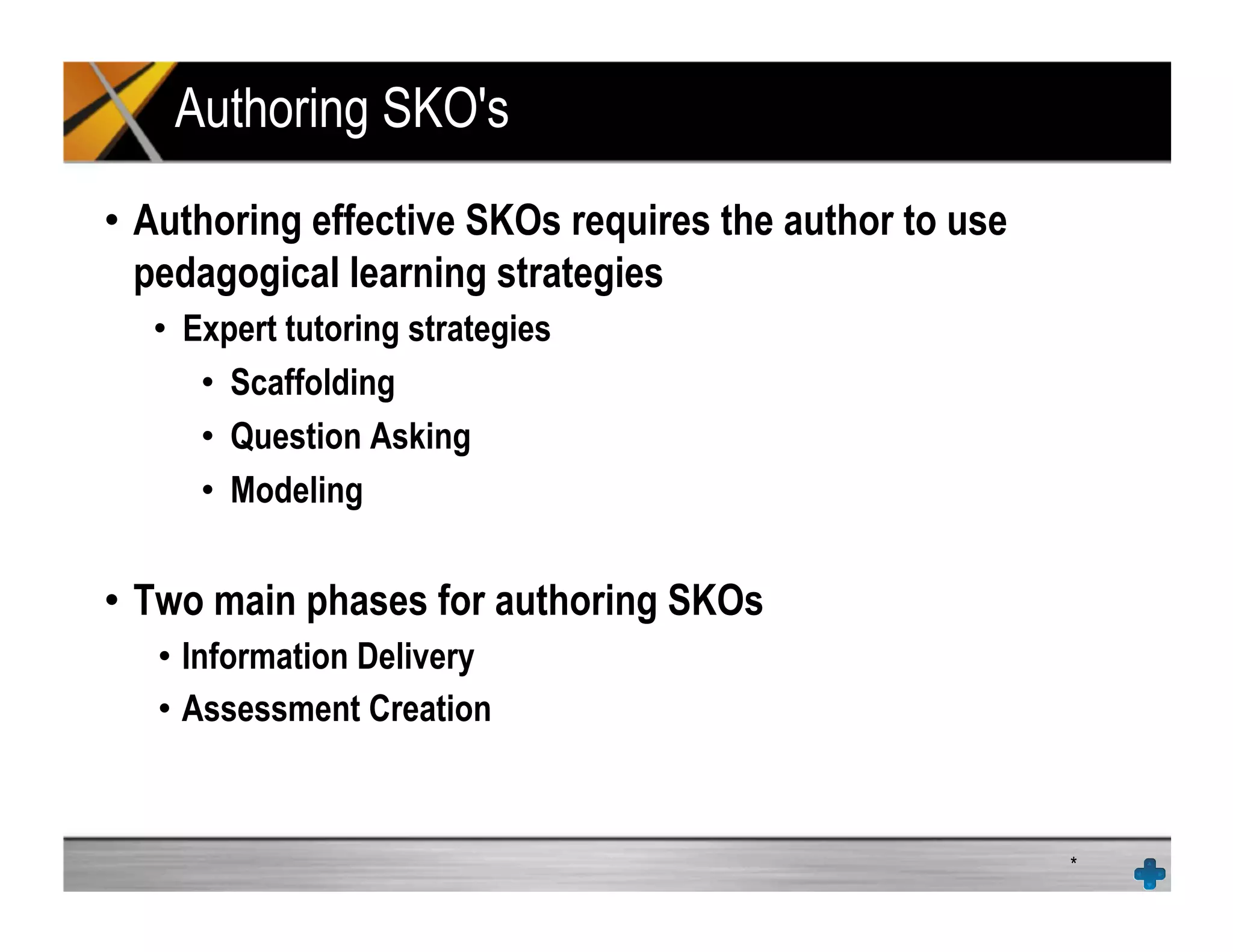
Authoring SKO's
•  Authoring effective SKOs requires the author to use
pedagogical learning strategies
•  Expert tutoring strategies
•  Scaffolding
•  Question Asking
•  Modeling
•  Two main phases for authoring SKOs
•  Information Delivery
•  Assessment Creation
*
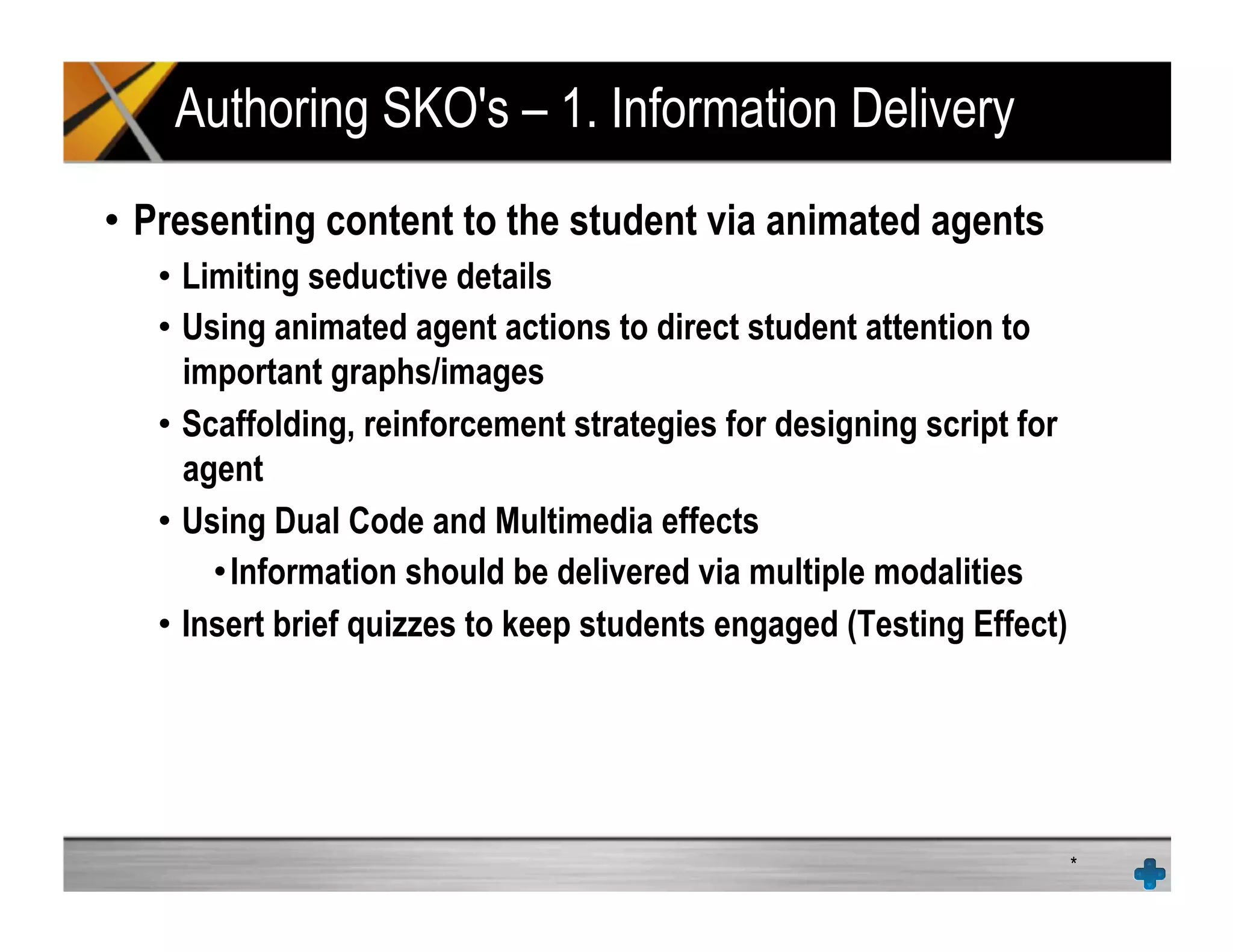
Authoring SKO's – 1. Information Delivery
•  Presenting content to the student via animated agents
•  Limiting seductive details
•  Using animated agent actions to direct student attention to
important graphs/images
•  Scaffolding, reinforcement strategies for designing script for
agent
•  Using Dual Code and Multimedia effects
• Information should be delivered via multiple modalities
•  Insert brief quizzes to keep students engaged (Testing Effect)
*
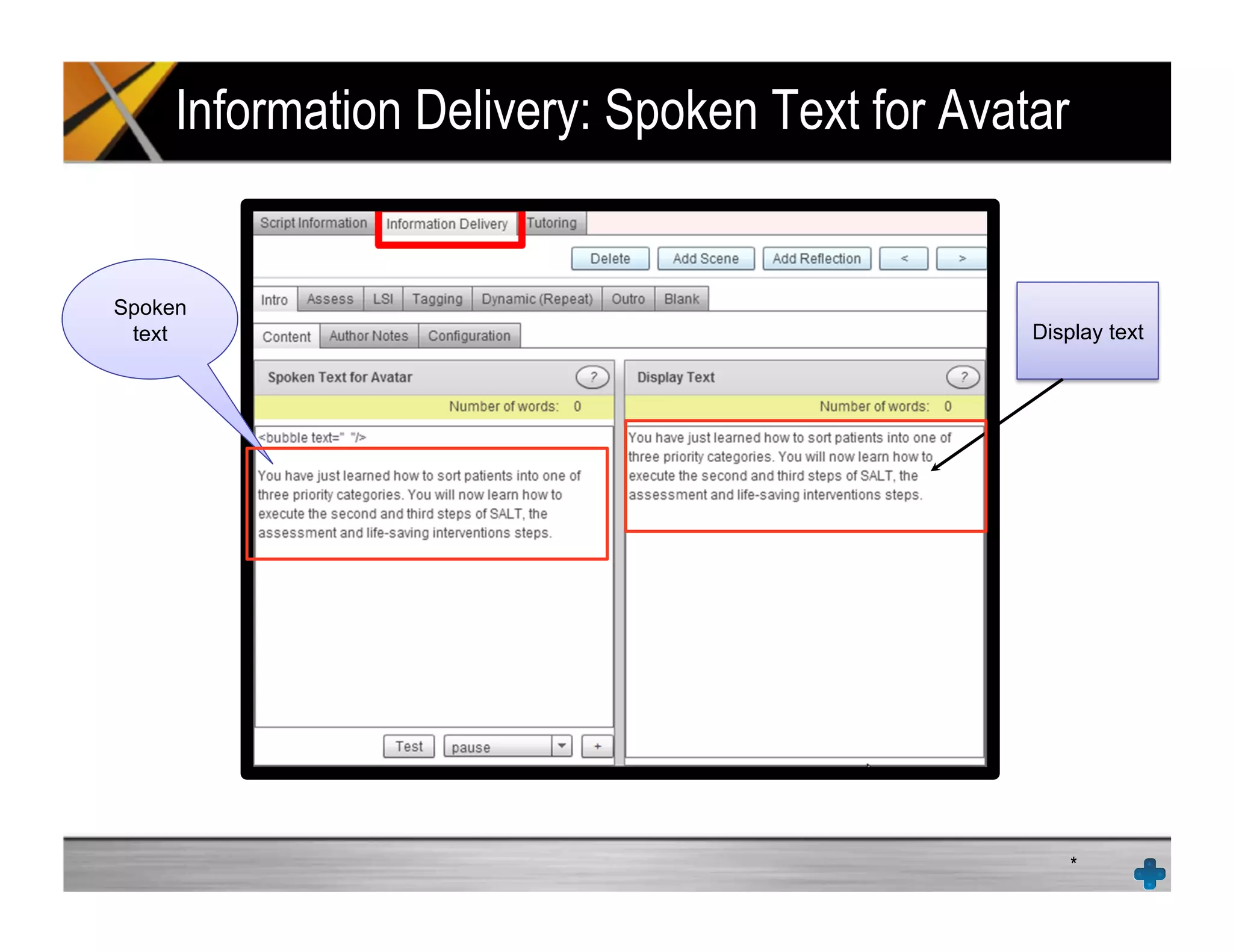
Information Delivery: Spoken Text for Avatar
*
Spoken
text Display text
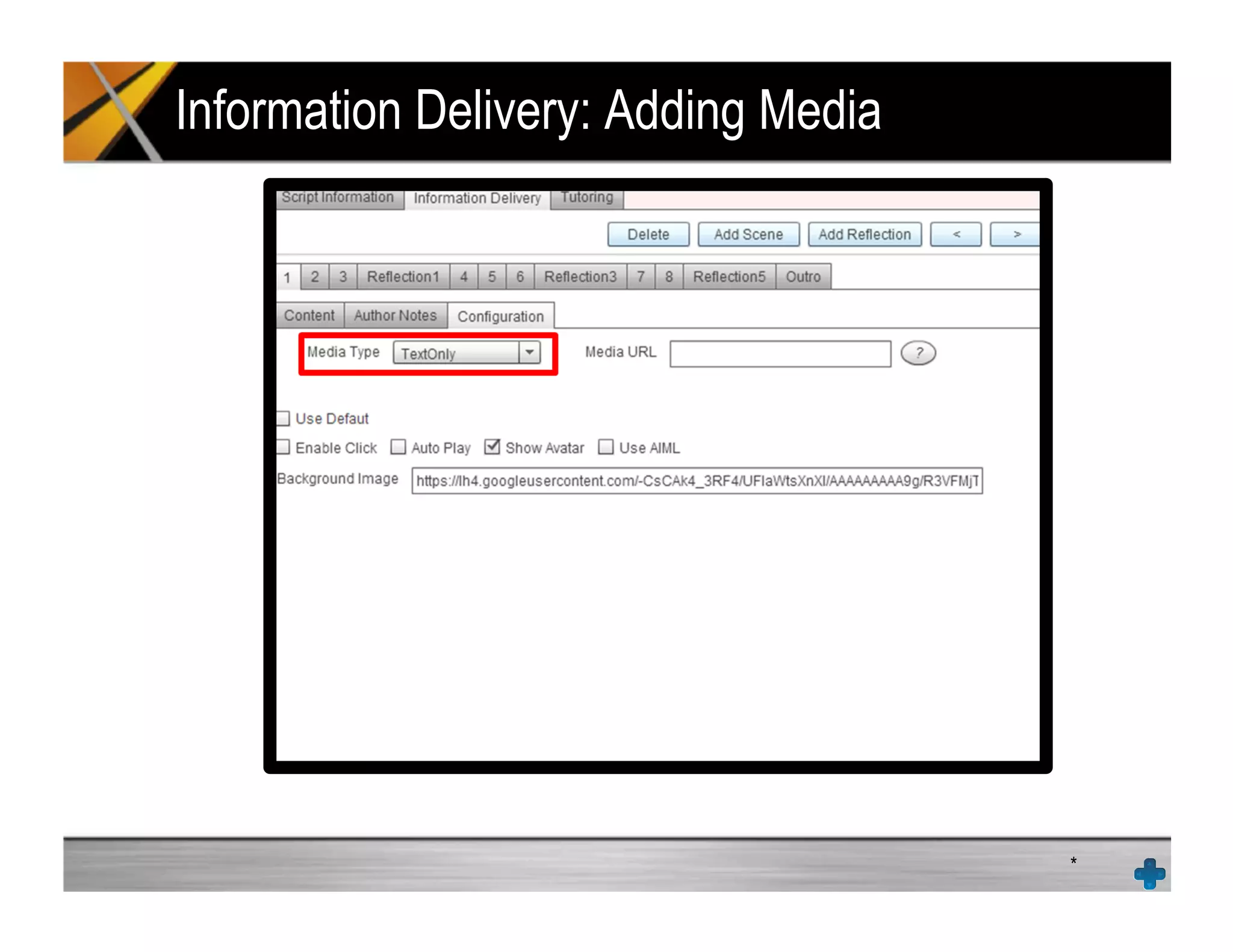
Information Delivery: Adding Media
*
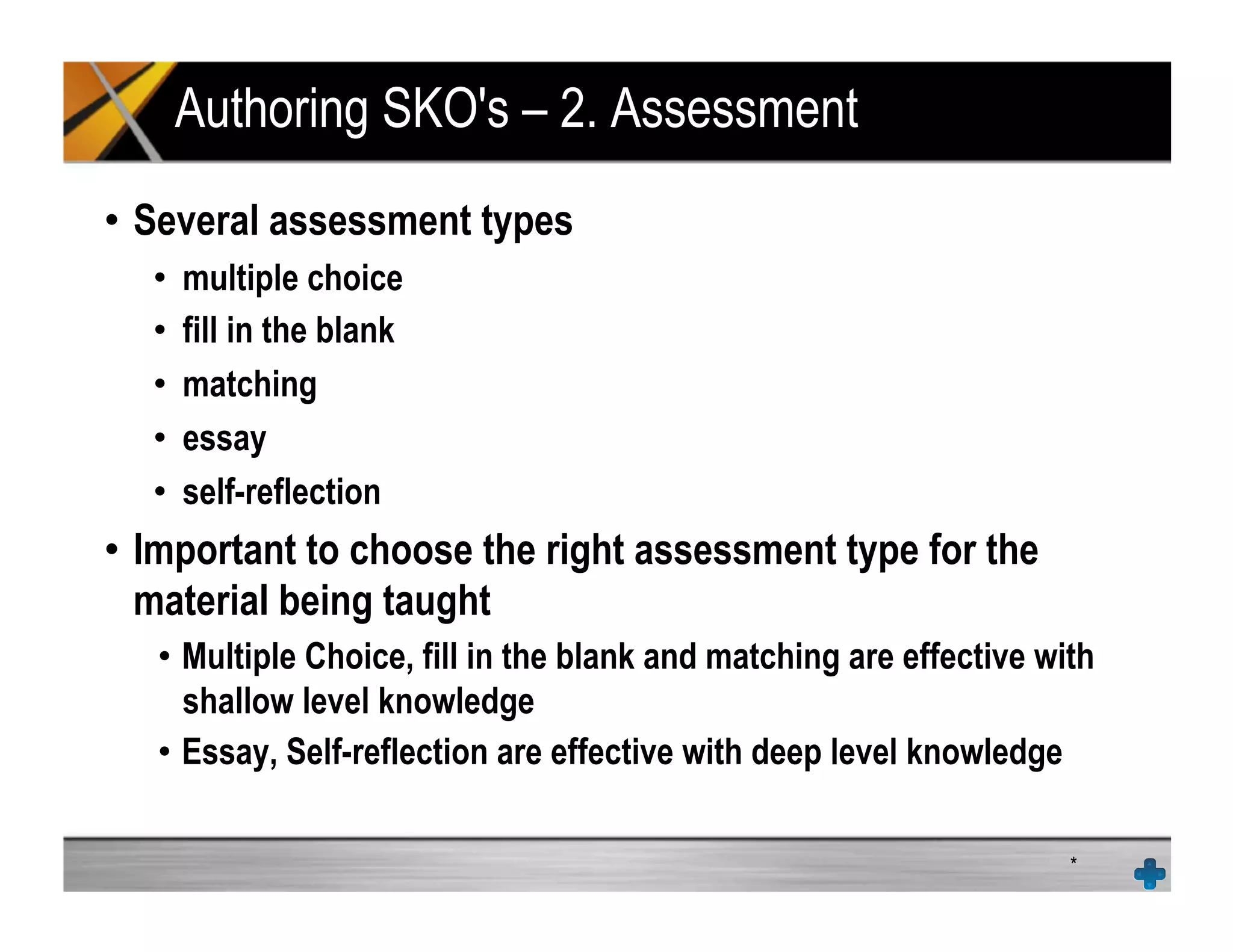
Authoring SKO's – 2. Assessment
•  Several assessment types
•  multiple choice
•  fill in the blank
•  matching
•  essay
•  self-reflection
•  Important to choose the right assessment type for the
material being taught
•  Multiple Choice, fill in the blank and matching are effective with
shallow level knowledge
•  Essay, Self-reflection are effective with deep level knowledge
*
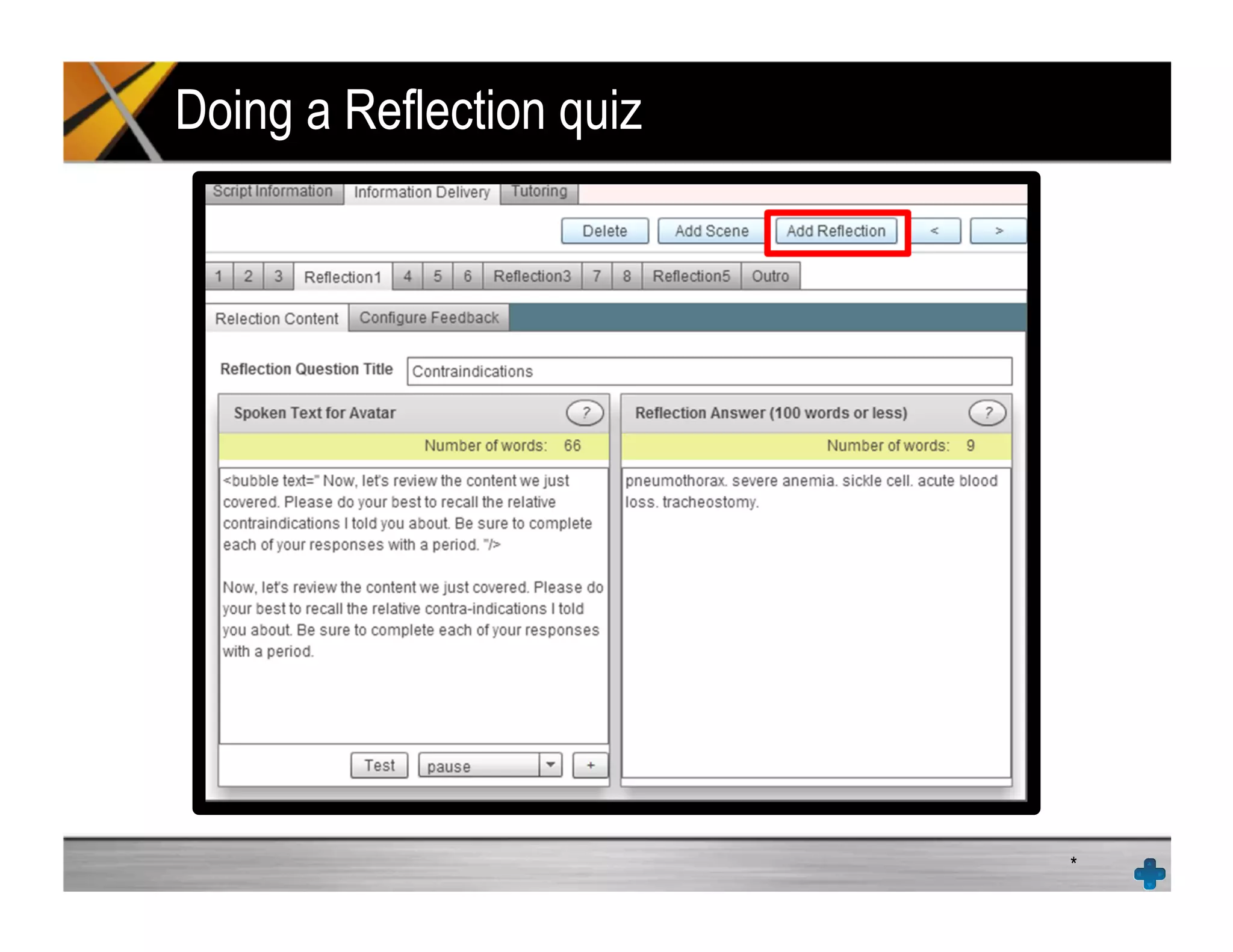
Doing a Reflection quiz
*
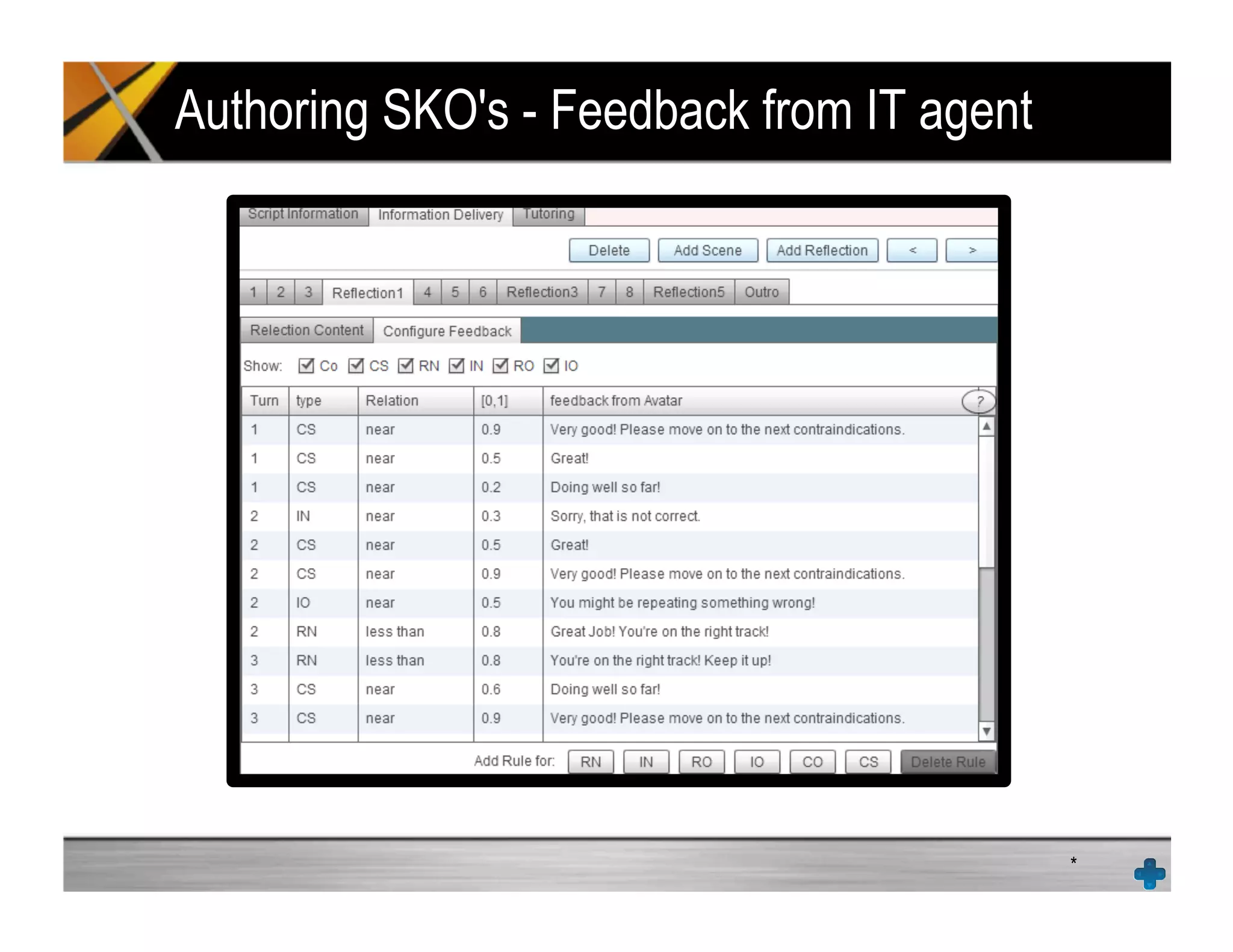
Authoring SKO's - Feedback from IT agent
*
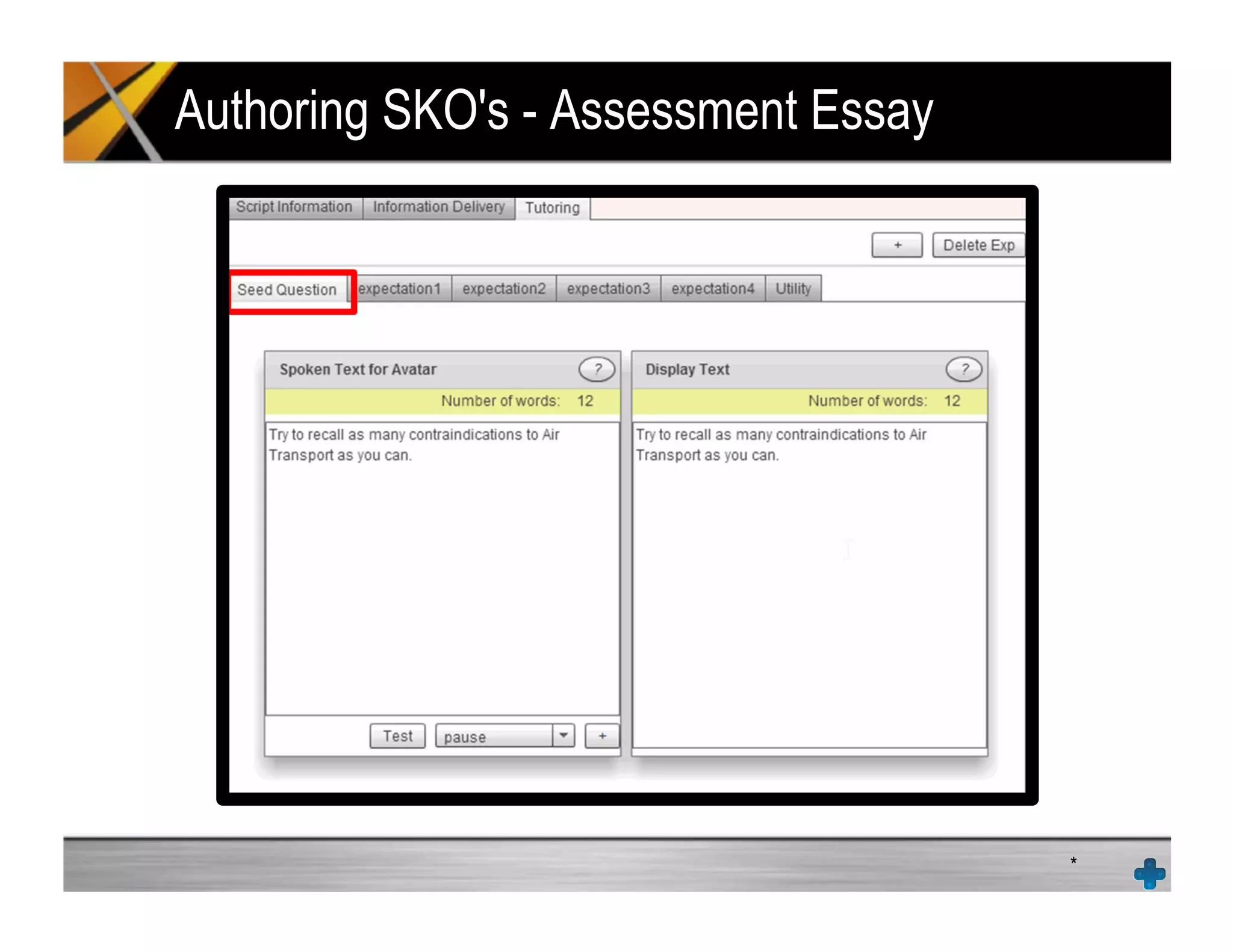
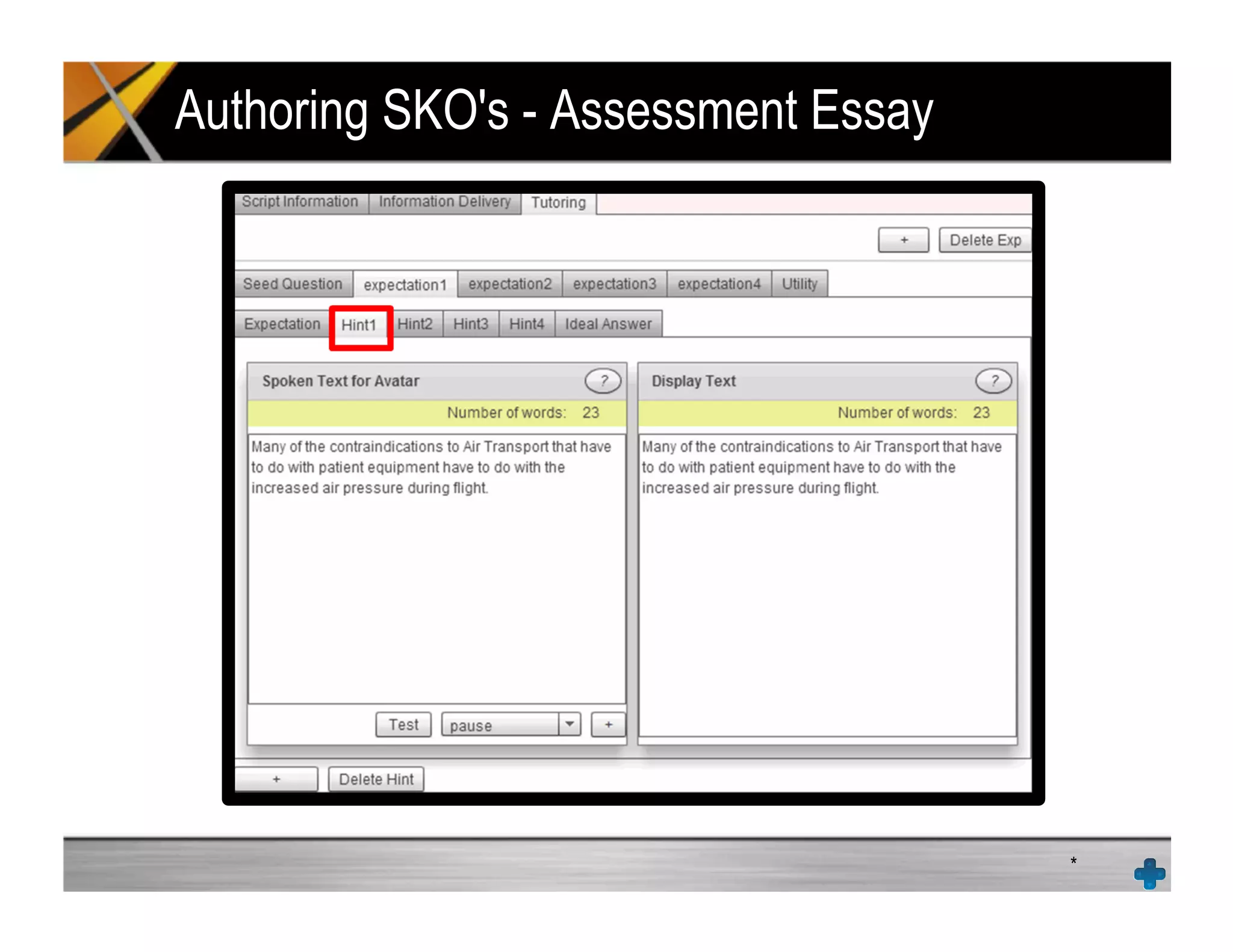
Authoring SKO's - Assessment Essay
*
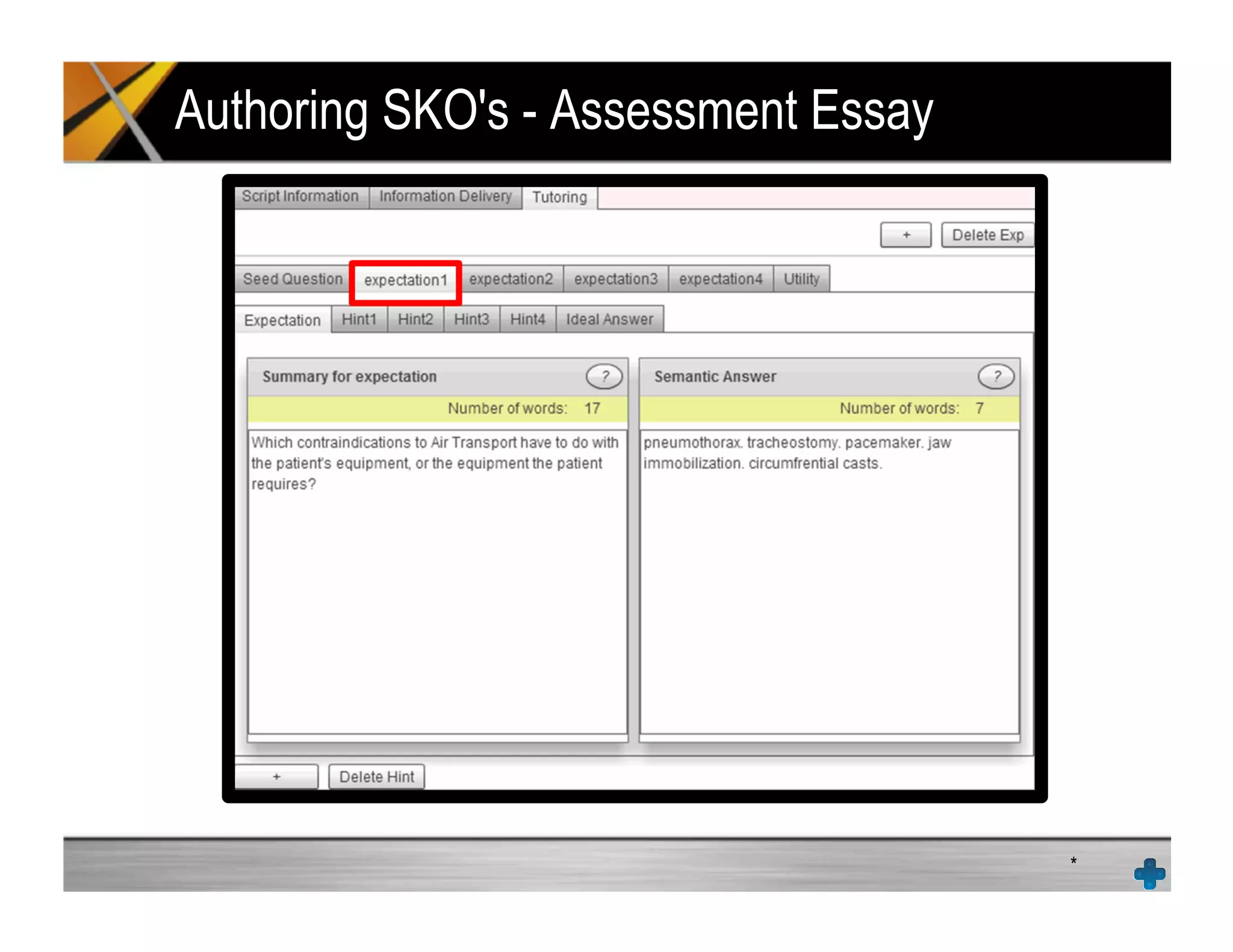
Authoring SKO's - Assessment Essay
*
Authoring SKO's - Assessment Essay
*
Early Evaluation Results
... evaluation studies will be conducted in April 2014
References
D’Mello, S., & Graesser, A. (2013). Design of dialog-based intelligent tutoring systems to simulate human-to-human
Tutoring. In Where Humans Meet Machines (pp. 233-269). Springer New York.
Graesser, A. C., Chipman, P., Haynes, B. C., & Olney, A. (2005). AutoTutor: An intelligent tutoring system with mixed-
initiative dialogue. Education, IEEE Transactions on, 48(4), 612-618.
Graesser, A. C., & Person, N. K. (1994). Question asking during tutoring. American educational research journal, 31(1),
104-137.
Graesser, A. C., Person, N. K., & Magliano, J. P. (1995). Collaborative dialogue patterns in naturalistic one-to-one
tutoring. Applied cognitive psychology, 9(6), 495-522.
Koch, R. Pitts, W., Levy, M., Kirkpatrick, D., Tongumpun, T., & Yacko, A. (2011). Civilian aeromedical evacuation
sustainment training: A survey of professionals regarding curriculum content, format, and implementation.
Prepared for the Department of Defence, Retrieved from
http://www.memphis.edu/nursing/pdfs/CAESTREGIONAL_SURVEY-1.pdf
Hu, X., Cai, Z., Han, L., Craig, S. D., Wang, T., & Graesser, A. C. (2009, July). AutoTutor lite. In Proceedings of the
2009 conference on Artificial Intelligence in Education: Building Learning Systems that Care: From Knowledge
Representation to Affective Modellng (pp. 802-802). IOS Press.
Hu, X., Cai, Z., Graesser, A. C., & Ventura, M. (2005). Similarity between semantic spaces. In Proceedings of the
27th Annual Conference of the Cognitive Science Society (pp. 995-1000).
Person, N. (2007, November). An analysis of expert human tutors. Lecture conducted for Cognitive Brownbag at the
University of Memphis.
Woolf, B. P. (2010). Building intelligent interactive tutors: Student-centered strategies for revolutionizing e-learning.
Morgan Kaufmann.
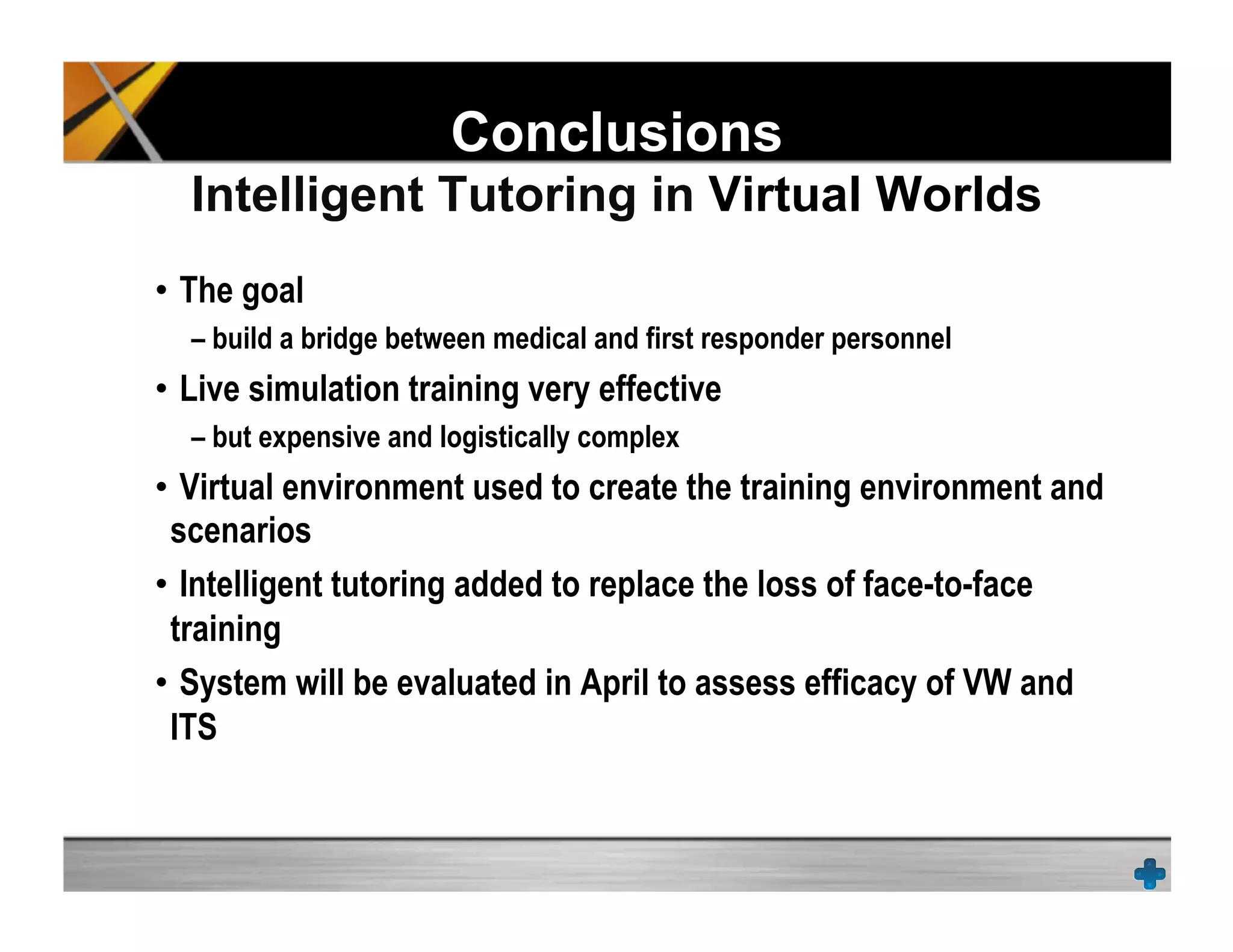
Conclusions
Intelligent Tutoring in Virtual Worlds
•  The goal
– build a bridge between medical and first responder personnel
•  Live simulation training very effective
– but expensive and logistically complex
•  Virtual environment used to create the training environment and
scenarios
•  Intelligent tutoring added to replace the loss of face-to-face
training
•  System will be evaluated in April to assess efficacy of VW and
ITS
Thank You !
Contact information:
parvati at clinispace dot com
xhu at memphis dot edu
Web site:
http://www.clinispace.com
http://clinispace.com/products/mass_casualty.html

Integrating an intelligent tutoring system into a virtual world

  • 1.
    Integrating an IntelligentTutoring System into a Virtual World Parvati Dev, Wm LeRoy Heinrichs, CliniSpace Keith Shubeck, Xiangen Hu, University of Memphis © 2014, Innovation in Learning, Inc.
  • 2.
    Introductions Speakers and Participants ParvatiDev LeRoy Heinrichs Keith ShubeckXiangen Hu
  • 3.
    Overview 1.  Complex multi-persontriage in a mass casualty – Preview of the problem 2.  Virtualized mass casualty simulation - VCAEST 3.  Immersive virtual simulations – discussion 4.  Review of Intelligent Tutoring Systems 5.  Demonstration of an ITS in VCAEST 6.  Creating the guidance content in an online tutor 7.  Evaluation study - plans 8.  Summary and discussion
  • 4.
  • 5.
  • 6.
    Civilian Aeromedical EvacuationSustainment Training (CAEST) * Goals of CAEST •  Provide effective training to medical professionals on SALT Triage •  Improve communication between medical professionals and military during disaster situations
  • 7.
    Mass Casualty andSALT Triage – Background * Mass Casualty •  Casualties •  Usually in a single incident (hurricane, aircraft accident, etc) •  Large number of casualties •  Exceed local logistic and emergency medical resources
  • 8.
    Triage – Video * Videofrom National Preparedness Network: http://youtu.be/1mVX8Ggj_3E
  • 9.
    SALT Triage –Background * SALT •  Sort •  Assess •  Life-saving interventions •  Treat / Transport Most accepted of many diverse triage algorithms (e.g. S.T.A.R.T.)
  • 10.
    SALT Triage –Background * SALT •  Sort •  Assess •  Life-saving interventions •  Treat / Transport
  • 11.
    SALT Triage –Background * SALT •  SORT •  Assess •  Life-saving interventions •  Treat / Transport
  • 12.
    SALT Triage –Background * SALT •  Sort •  Assess •  Life-saving interventions •  Treat / Transport Pic removed
  • 13.
  • 14.
    CAEST Training Why wasit started? •  Communication challenges during recent mass casualty disasters between civilian medical responders and military How was it implemented? •  Didactic learning in classroom setting and live- action training scenarios What worked, what didn't work? •  Live action training scenarios helped to ground content taught •  Logistically challenging, expensive *
  • 15.
    Perceived effectiveness oftraining * Koch et al. (2011)
  • 16.
    Perceived effectiveness oftraining •  Too expensive •  Time consuming •  Inattentive to individual learning needs •  Costly to travel to and from * Live training is often... [add citation here] Koch et al. (2011)
  • 17.
    Additional Goals ofCAEST Training How can the differences in goals, roles, and expectations be bridged? How will differences in jargon, equipment and standard operating procedures affect patient care?
  • 18.
    VCAEST Virtual Civilian AeromedicalEvacuation Sustainment Training
  • 19.
    Goal of VCAESTproject Live simulations are highly effective but very expensive… •  We need an effective, low cost alternative to live simulation training for healthcare personnel who interface with military operations in a catastrophe requiring aeromedical evacuation Achieve this through … •  Integrating a Web-based virtual 3D environment with an Web- based intelligent tutoring system •  Low cost, easily updateable, internet-based •  Leverage proven learning technologies •  Make training widely available •  Marry realistic virtual environments with robust learning technologies
  • 20.
    What we built • Multi-patient scenario •  Grounds outside the hospital, •  Performance goal o  performing the correct triage category o  the appropriate intervention o  selecting the appropriate mode of evacuation, air or ground
  • 21.
  • 22.
  • 23.
  • 24.
  • 25.
  • 26.
  • 27.
  • 28.
  • 29.
  • 30.
  • 31.
    Intelligent Tutoring Systems Learning Theory,Efficacy of Tutoring, and Computerized Learning Environments
  • 32.
    The importance oftutoring… With normal group instruction or training, individuals will vary in terms of prior knowledge. •  One-on-one human tutoring •  Beneficial but depends on skill level of the tutor •  Learning may be tailored to the individual's skill level •  Expensive •  Virtual agents comparable to human tutors •  Virtual agents can simulate learning gains comparable to one-on-one human tutoring !  importance of pedagogical strategies *
  • 33.
    Learning Theory BehindITS •  Constructivist approach !  Learning seen as an active and social process !  Learners responsible for knowledge construction !  Expressing !  Explaining !  Question asking •  Learning environments should… !  Stimulate knowledge !  Model explanations !  Foster self-explanations !  Provide feedback for correction of misconceptions *
  • 34.
    Pedagogical Learning Strategies PedagogicalStrategies used by Expert Human Tutors •  Hints •  Prompts •  Bridging Inferences •  Self-explanations •  Question Asking o  Type of question determines the level of complexity in the answer given o  Graesser & Person (1994) Question Asking taxonomy o  Shallow, intermediate, and deep questions for various types of learning *
  • 35.
    Advantages of 1:1Tutoring • Just-in-time Feedback • Student misconceptions quickly dealt with • Tutors prompt students to elaborate • Student self-explanations shown to provide large learning gains compared to various controls (Chi et al., 1989) • ITSs can model expert 1:1 tutoring conversational framework • Provides hints, prompts, feedback to encourage elaborative self- explanations from students.
  • 36.
  • 37.
    Effect Sizes * LEARNING GAINS EffectSizes Learning Environment .42 Unskilled Human Tutors (Cohen, Kulik, & Kulik, 1982) .80 AutoTutor (20 experiments) (Graesser and colleagues) 1.00 Intelligent Tutoring Systems PACT (Anderson, Corbett, Aleven, Koedinger) Andes, Atlas (VanLehn) Diagnoser (Hunt, Minstrell) Sherlock (Lesgold) 2.0 Expert Human Tutors (Bloom, 1984)
  • 38.
    Under the hoodof Intelligent Tutoring Systems Semantic Spaces, Natural Language Processing, Sharable Knowledge Objects (SKOs), Student Model
  • 39.
    Domain specific semanticspace * •  Robust language processing of student answer requires a Domain specific semantic space
  • 40.
    Answer Key Student answer Semantic Analysisand Semantic Decomposition Student's earlier answers Great Job! Total Coverage Current Score Relevant New Relevant Old Irrelevant New Irrelevant Old Feedback is encoded as voice file Model of Learner (LCC) is updated with each answer Overview of Flow in Intelligent Tutoring System
  • 41.
    LCC in Tutoring(Updating the Learner Model) Each answer is analyzed with respect to: prior answers & stored answer key
  • 42.
  • 43.
  • 44.
    Domain specific semanticspace * •  Robust language processing of student answer requires a Domain specific semantic space
  • 45.
    Background - forthose who wish more detail ... A Theory of Semantic Spaces •  Hu et al. (2005) o  Basic assumption of languages !  Concept of "layers": words, phrases, sentences, paragraphs, documents o  Formal framework !  Language neutral !  Computational (vector-based) o  Implementable •  Hu et al. (2005) o  Essence of semantic space: Semantic similarity between items can be computed (numerically). •  "semantic of any item (words, phrases, etc) in a given language is embedded within its relations with other items" *
  • 46.
    Accessing ITSs in aVirtual WorldSharable Knowledge Objects (SKOs)
  • 47.
    Shareable Knowledge Objects(SKOs) !  A unit of knowledge (Knowledge Object) !  implemented using an ITS !  implemented Knowledge Objects !  as a Web service !  allowing them to be shared with other Web applications – thus Sharable Knowledge Objects !  The 3D Virtual Environment accesses these SKOs and displays them in-world *
  • 48.
    Configure Predefined Knowledge Objectin an Authoring App Generate a unique ID for each Knowledge Object Share SKO by sharing the ID Users A,B,C Access Authenticate Using Google App Engine SKO links embedded in Mass Casualty Persistent 3D World Backend Analytics Database of user actions Access SKO via HTML Popup Multi User ServerWorld Specific ATL Specific Use Case – Author and Learner A U T H O R L E A R N E R
  • 49.
    Shareable Knowledge Objects(SKOs) •  SKOs are portable to new learning environments. •  SKOs are fortified by improved semantic processing algorithms to evaluate student’s natural language input. •  Individualized domain-specific semantic processing •  Learner’s Characteristics Curves (LCC) as student’s model that evaluates how new and relevant the student input is •  Incorporates Artificial Intelligence Markup Language (AIML) in addition to AutoTutor Dialog Advancer network (DAN) to handle Tutor-Student interaction •  Adaptive and flexible dialog that mimics human tutoring *
  • 50.
  • 51.
  • 52.
  • 53.
  • 54.
  • 55.
  • 56.
  • 57.
  • 58.
    Authoring SKO's: Overview(theory) •  Components of SKO scripts o  Content: Scripts guide natural language conversation between learner and SKOs !  Expectation-Misconception Tailored Dialog. !  Guided by established effective learning principle *
  • 59.
    Authoring SKO's •  Authoringeffective SKOs requires the author to use pedagogical learning strategies •  Expert tutoring strategies •  Scaffolding •  Question Asking •  Modeling •  Two main phases for authoring SKOs •  Information Delivery •  Assessment Creation *
  • 60.
    Authoring SKO's –1. Information Delivery •  Presenting content to the student via animated agents •  Limiting seductive details •  Using animated agent actions to direct student attention to important graphs/images •  Scaffolding, reinforcement strategies for designing script for agent •  Using Dual Code and Multimedia effects • Information should be delivered via multiple modalities •  Insert brief quizzes to keep students engaged (Testing Effect) *
  • 61.
    Information Delivery: SpokenText for Avatar * Spoken text Display text
  • 62.
  • 63.
    Authoring SKO's –2. Assessment •  Several assessment types •  multiple choice •  fill in the blank •  matching •  essay •  self-reflection •  Important to choose the right assessment type for the material being taught •  Multiple Choice, fill in the blank and matching are effective with shallow level knowledge •  Essay, Self-reflection are effective with deep level knowledge *
  • 64.
  • 65.
    Authoring SKO's -Feedback from IT agent *
  • 66.
    Authoring SKO's -Assessment Essay *
  • 67.
    Authoring SKO's -Assessment Essay *
  • 68.
    Authoring SKO's -Assessment Essay *
  • 69.
    Early Evaluation Results ...evaluation studies will be conducted in April 2014
  • 70.
    References D’Mello, S., &Graesser, A. (2013). Design of dialog-based intelligent tutoring systems to simulate human-to-human Tutoring. In Where Humans Meet Machines (pp. 233-269). Springer New York. Graesser, A. C., Chipman, P., Haynes, B. C., & Olney, A. (2005). AutoTutor: An intelligent tutoring system with mixed- initiative dialogue. Education, IEEE Transactions on, 48(4), 612-618. Graesser, A. C., & Person, N. K. (1994). Question asking during tutoring. American educational research journal, 31(1), 104-137. Graesser, A. C., Person, N. K., & Magliano, J. P. (1995). Collaborative dialogue patterns in naturalistic one-to-one tutoring. Applied cognitive psychology, 9(6), 495-522. Koch, R. Pitts, W., Levy, M., Kirkpatrick, D., Tongumpun, T., & Yacko, A. (2011). Civilian aeromedical evacuation sustainment training: A survey of professionals regarding curriculum content, format, and implementation. Prepared for the Department of Defence, Retrieved from http://www.memphis.edu/nursing/pdfs/CAESTREGIONAL_SURVEY-1.pdf Hu, X., Cai, Z., Han, L., Craig, S. D., Wang, T., & Graesser, A. C. (2009, July). AutoTutor lite. In Proceedings of the 2009 conference on Artificial Intelligence in Education: Building Learning Systems that Care: From Knowledge Representation to Affective Modellng (pp. 802-802). IOS Press. Hu, X., Cai, Z., Graesser, A. C., & Ventura, M. (2005). Similarity between semantic spaces. In Proceedings of the 27th Annual Conference of the Cognitive Science Society (pp. 995-1000). Person, N. (2007, November). An analysis of expert human tutors. Lecture conducted for Cognitive Brownbag at the University of Memphis. Woolf, B. P. (2010). Building intelligent interactive tutors: Student-centered strategies for revolutionizing e-learning. Morgan Kaufmann.
  • 71.
    Conclusions Intelligent Tutoring inVirtual Worlds •  The goal – build a bridge between medical and first responder personnel •  Live simulation training very effective – but expensive and logistically complex •  Virtual environment used to create the training environment and scenarios •  Intelligent tutoring added to replace the loss of face-to-face training •  System will be evaluated in April to assess efficacy of VW and ITS
  • 72.
    Thank You ! Contactinformation: parvati at clinispace dot com xhu at memphis dot edu Web site: http://www.clinispace.com http://clinispace.com/products/mass_casualty.html