NIMS & ICS Principles Applied to School-Based Emergencies! Presented by David Kondrup
How Many Incidents May Be School-Based
Bad Weather (Natural Events)
Threatening Calls
Threats By Letters or Post Cards
Chemical / Lab Accidents
Health Related Flu or Other Illnesses
Transportation Accident
Fire At your facility Or near your facility
School Violence
School Violence
Incidents Can Also Be Graduation Sporting Events, or any Large Gathering
Emergency Management For Schools In it’s Lessons Learned Information Sharing forum the DHS recommends to School Administrators that they consider the following: An All-Hazards Approach to Planning The National Incident Management System (ICS) The Phases of Emergency Management Community Collaboration The Challenges facing School Emergency Planning
Introduction to NIMS The National Incident Management System (NIMS) is the United States’ system for managing domestic incidents. NIMS is mandated by Homeland Security Presidential Directive 5 NIMS enables community organizations, such as schools, to coordinate the management of incidents with emergency responders across all jurisdictions and functions. Improves coordination and cooperation between entities using a standardized set of concepts, principles and terminology. NIMS
NIMS Concepts and Principles Flexible framework that applies to all phases of incident management. Standardized organizational structures, processes, procedures and systems to promote interoperability NIMS
Six Key Components to NIMS Command and Management Incident Command System (ICS) Multi-agency coordination systems Public information systems Preparedness Planning, training, exercises Personnel qualification and certification standards Equipment acquisition and certification standards Resource management Standards for describing, inventorying, tracking resources Communications and information management Interoperability Supporting Technologies Ongoing Management & Maintenance NIMS
NIMS Compliance-School Districts* *NIMS Compliance Center Guidance Since school districts are an integral part of local government, their use of NIMS should be achieved in close coordination with other components of the local government. School districts are not traditional response organizations and more typically are recipients of first responder services provided by fire and rescue, emergency medical and law enforcement agencies. This traditional relationship should be acknowledged in achieving NIMS compliance within an integrated local government plan for NIMS compliance. School district participation in local government's NIMS preparedness program is essential to ensure that first responder services are delivered to schools in a timely and effective manner. Schools and Districts that receive federal emergency preparedness grants are required to comply with NIMS requirements; those that do not receive these grants are not required to adopt NIMS. School safety experts strongly encourage all schools to become NIMS compliant.
Introduction to ICS for Schools IS-100-SC FEMA’s Emergency Management Institute in cooperation with the U.S. Department of Education developed a course to promote school safety by: Familiarizing you with how ICS principles can be applied in school-based incidents. Preparing you to interface with community response personnel. http://training.fema.gov/EMIWeb/IS/IS100SC.asp
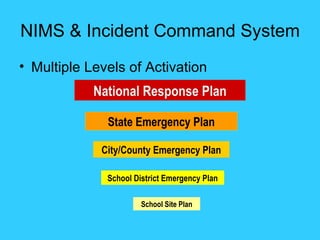
NIMS & Incident Command System Multiple Levels of Activation National Response Plan City/County Emergency Plan School District Emergency Plan School Site Plan State Emergency Plan
Universal for all Incident Types
Incident Command System Definition The Incident Command System (ICS) is a management system designed to enable effective and efficient incident management by integrating a combination of facilities, equipment standards and an incident management organization with five functional areas (command, operations, planning, logistics and finance & administration) for the management of all major incidents.
Incident Command System School and School District  ICS First  Responders   (Fire, Police, EMT) Partners (Mental & Public Health, Parents, Media, etc.)
ICS Impact on Local Agencies All response agencies must use ICS. Personnel will be required to meet national qualification and certification standards to support an incident that transcends interstate jurisdictions.  State and local jurisdictions will be strongly encouraged to implement mutual aid agreements. ICS
ICS Applications Fires, hazardous materials releases, oil spills, and multi-casualty incidents Multi-jurisdictional and multi-agency disasters Search and rescue operations  Law enforcement incidents Natural disasters Planned events ICS
ICS Organization No  correlation with the administrative structure of any other agency or jurisdiction. ICS organization’s uniqueness helps to avoid confusion over different position titles and organizational structures.  Someone who serves as a chief every day may not hold that title when deployed under an ICS structure. ICS
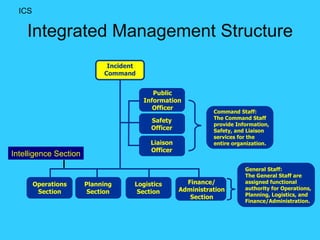
Integrated Management Structure ICS Intelligence Section
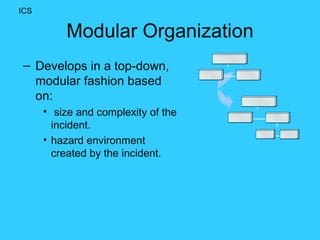
Modular Organization Develops in a top-down,  modular fashion based on:  size and complexity of the incident. hazard environment created by the incident.  ICS
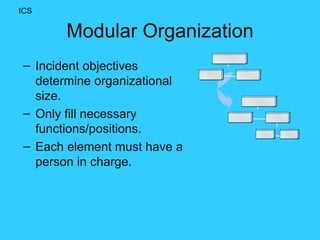
Modular Organization Incident objectives determine organizational size.  Only fill necessary functions/positions. Each element must have a person in charge. ICS
Basic Incident Command System at a School
Sample School or School District Incident Command System Organization
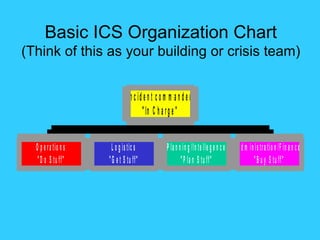
Basic ICS Organization Chart (Think of this as your building or crisis team)
Common Terminology Reduce confusion between day-to-day activities and incident response duties. Common terminology Plain English ICS
Formal Communication Planning Section Chief Logistics Section Chief Finance/Admin Section Chief Branch Director Air Operations Branch Director Incident Commander Safety Officer Liaison Officer Public Information Officer Command Staff General  Staff Service  Branch Director Support Branch Director Operations Section Chief ICS Formal   Communication
When To Use Formal Communication Use formal communication when: Receiving and giving work assignments.  Requesting support or additional resources. Reporting progress of assigned tasks. ICS
Informal Communication Is used to exchange incident or event information only. Is NOT used for: Formal requests for additional resources. Tasking work assignments. Within the ICS organization, critical information must flow freely! ICS
Chain of Command Chain of command is an orderly line of authority within the ranks of the incident management organization.  Authority ICS
Unity of Command Under unity of command, personnel: Report to only  one  supervisor.  Receive work assignments only from their supervisors.  ICS
Unified Command Enables all responsible agencies to manage an incident together  Establishes common  incident objectives and strategies.  Single command structure allows Incident Commanders to analyze intelligence and make joint decisions. Maintains unity of command.  Each employee reports to only one supervisor. ICS Incident Command Post Agency 1  Agency 2  Agency 3 Agency 1  Incident  Commander Agency 2  Incident  Commander Agency 3  Incident  Commander
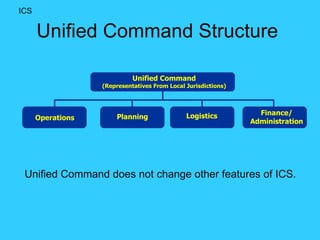
Unified Command Structure   Unified Command does not change other features of ICS. ICS Unified Command (Representatives From Local Jurisdictions) Finance/ Administration Logistics Planning Operations
Unified Command for a School Emergency School Incident Commander (Principal) School District Incident Commander (Superintendent, Security Director) County/City Incident Commander (Police/Fire) School Site Crisis/Emergency Response Team Or (IMT) Public Information Officer District  Emergency Operations Committee (EOC) City/County Incident Management Team (IMT) Public Information Officer
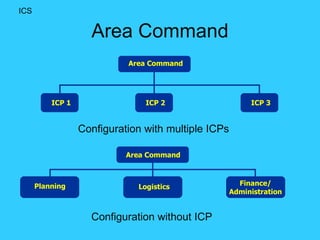
Area Command Sets overall strategy and priorities Allocates resources Ensures proper management Objectives are met Strategies are followed Does not include Operations Section (On-scene) Examples Major incident with multiple ICPs Health emergency that is not site specific ICS
Area Command Configuration with multiple ICPs Configuration without ICP ICS Area Command ICP 1 ICP 2 ICP 3 Area Command Planning  Logistics Finance/ Administration
Manageable Span of Control Span of control:  The number of individuals or resources that one supervisor can manage effectively during an incident. May vary from 3 to 7  subordinates reporting  to a supervisor. Optimum – 5 subordinates  to one supervisor. Resource 2 Resource 3 Resource 1 Supervisor ICS
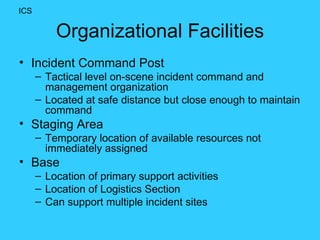
Organizational Facilities Incident Command Post Tactical level on-scene incident command and management organization Located at safe distance but close enough to maintain command Staging Area  Temporary location of available resources not immediately assigned Base  Location of primary support activities Location of Logistics Section Can support multiple incident sites ICS
Organizational Facilities Camp Satellite support sites for food, rest, sanitation, maintenance, etc. Helibase Main facility to support helicopter operations Helispot Satellite facility to support local helicopter operations (i.e., school yard used for med-evac operations) ICS
Position Titles ICS position titles: Provide a common standard for performance expectations. Help to ensure that qualified individuals fill positions. Standardize communication. Describe the responsibilities of the position. ICS
Task Force Combination of  unlike  resources Must have a leader Must have communications Must have transportation Must be within span of control limits ICS
Fire Suppression Task Force ICS
Strike Team Same type and kind  of resources Must have a leader Must have communications Must have transportation (as required) Must be within span of control limits ICS
Dozer Strike Team ICS
Advantages of  Task Forces & Strike Teams Helps maintain effective span of control Assists with resource accountability More effective use of resources Effective way of ordering resources Reduces radio traffic ICS
Incident Commander First responsible person on the scene Responsible for on-scene incident management until relieved by a more qualified person or authority is delegated to another person. Only position that is  always  staffed in ICS applications ICS
Scope of Authority An Incident Commander's scope of authority is derived: From existing laws and agency policies and procedures, and/or Through a delegation of authority from the agency administrator or elected official.  ICS
Authority Authority   is . . . . . . a right or obligation to act on behalf of a department, agency, or jurisdiction. ICS
Delegation of Authority   Grants authority to carry out specific functions. Issued by chief elected official, chief executive officer, or agency administrator in writing or verbally. Allows the Incident Commander to assume command. Does NOT relieve the granting authority of the ultimate responsibility for the incident . ICS Incident Commander Superintendent
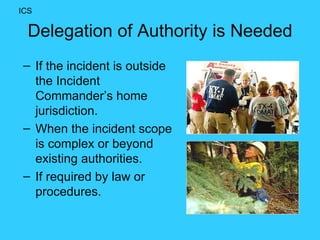
Delegation of Authority is Needed If the incident is outside the Incident Commander’s home jurisdiction. When the incident scope is complex or beyond existing authorities. If required by law or procedures. ICS
Delegation of Authority is Not Needed If the Incident Commander is acting within his or her existing authorities.  An emergency manager may already have the authority to deploy response resources to a small flash flood. A fire chief probably has the authority (as part of the job description) to serve as an Incident Commander at a structure fire. ICS
Delegation of Authority:  Elements   Should include: Legal authorities and restrictions. Financial authorities and restrictions. Reporting requirements. Demographic issues. Political implications. Agency or jurisdictional priorities. Plan for public information management. Process for communications.  Plan for ongoing incident evaluation. ICS Delegation  of Authority
Incident Commander Role The Incident Commander: Provides overall leadership for incident response. Delegates authority to others. Takes general direction from agency administrator/official. ICS
Incident Commander Responsibilities The Incident Commander is specifically responsible for: Ensuring incident safety.  Providing information services to  internal and external stakeholders.  Establishing and maintaining  liaison with other agencies  participating in the incident.   ICS
Incident Commander Responsibilities Managing Incident Priorities Life Safety (victims and responders) Incident Stability Preservation of property and environment ICS
Incident Commander Responsibilities The Incident Commander:  Is responsible for all activities and functions until delegated and assigned to staff. Assesses need for staff. Establishes incident objectives. Directs staff to develop  the Incident Action Plan.  Incident Commander ICS
Changing Incident Commanders Command may change to meet the needs of the incident when incidents: Expand or contract. Change in jurisdiction or discipline. Become more or less complex. A higher ranking person may assume, maintain or reassign command This is a formal process.  ICS
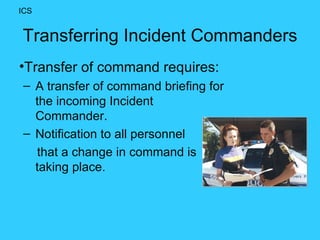
Transferring Incident Commanders Transfer of command requires: A transfer of command briefing for the incoming Incident Commander. Notification to all personnel  that a change in command is taking place. ICS
Command & General Staff ICS Intelligence Section
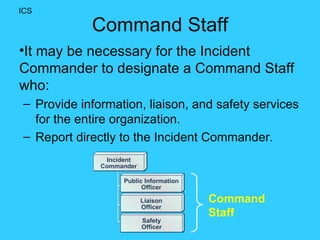
Command Staff It may be necessary for the Incident Commander to designate a Command Staff who: Provide information, liaison, and safety services for the entire organization. Report directly to the Incident Commander. Incident Commander Safety Officer Liaison Officer Public Information Officer ICS Command  Staff
Public Information Officer (PIO) Public Information Officer ICS Advises Incident Commander on information dissemination and  media relations.  Incident  Commander approves information that the PIO releases. Incident Commander Obtains information from and  provides information to Planning Section. Planning Section Chief Obtains information from and provides information to community and media. Community and Media
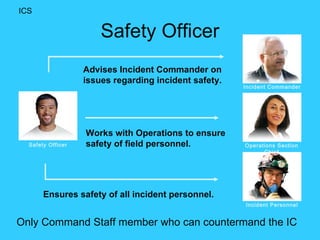
Safety Officer Safety Officer Only Command Staff member who can countermand the IC ICS Advises Incident Commander on issues regarding incident safety. Incident Commander Works with Operations to ensure safety of field personnel.  Operations Section Chief Ensures safety of all incident personnel. Incident Personnel
Liaison Officer Liaison Officer ICS Assists Incident Commander by serving as point of contact for agency representatives who are helping to support the operation. Incident Commander Provides briefings to and answers questions from supporting agencies.  Agency Representative
Incident Action Plan Required MBO tool for every incident to: Specify incident objectives. State activities to be completed.  Cover a specified timeframe, or operational period.  May be oral or written—except  for hazardous materials incidents,  which require a written IAP. ICS
Incident Action Plan   Elements What do we want to do?  Who is responsible for doing it?  How do we communicate with each other?  What is the procedure if someone is injured?  ICS Use standard form ICS-201 Incident Briefing form to document IAP
Operational Period Briefing Conducted at the beginning of each operational period. Presents the Incident Action Plan to supervisors within the Operations Section. Should be concise.  May be referred to as the shift briefing. ICS
Operational Period Briefing Planning Section Chief:   Reviews the agenda and facilitates the briefing. Incident Commander:   Presents incident objectives or confirms existing objectives.  Note :  Objectives may be presented by the Planning Section Chief.
Briefing Checklist Situation Mission/Execution Communications Service/Support Risk Management Questions or Concerns  ICS
After Action Review Required after every event – actual or drill Leads to a corrective action plan. Used to improve basic plan, annexes and Standard Operating Procedures ICS
Multi-agency Coordination Systems   A combination of resources Integrated into a common framework Used to coordinate and support incident management activities Examples Interagency Incident Management Group (IIMG)  Joint Field Office Emergency Operations Center Command & Management
Multiagency Coordination Systems   Support incident management policies and priorities Facilitate logistics support and resource tracking Make resource allocation decisions based on incident management priorities Coordinate incident-related information Coordinate interagency and intergovernmental issues regarding incident management policies, priorities, and strategies Command & Management
EOC Organization   NOTE:  EOC organization does NOT include Operations Section Command & Management EOC Manager Coordination Communications Resource Management Information Management
Mutual-Aid Agreements NIMS states that: Mutual-aid agreements are the means for one jurisdiction to provide resources, facilities, services, and other required support to another jurisdiction during an incident.  Each jurisdiction should be party to a mutual-aid agreement with appropriate jurisdictions from which they expect to receive or to which they expect to provide assistance during an incident. Command & Management
Mutual-Aid Agreements Mutual aid is the  voluntary  provision of resources by agencies or organizations to assist each other when existing resources are  inadequate .  When combined with NIMS-oriented resource management, mutual aid allows jurisdictions to  share  resources among mutual-aid  partners . Command & Management
Preparedness Plans The most common preparedness plans are: Preparedness Plans Emergency Operations Plans (EOPs). Standard operating guidelines (SOGs). Standard operating procedures (SOPs). Jurisdictional or agency policies.  Corrective Action and Mitigation Plans Recovery Plans Preparedness
EOPs are developed at the Federal, State, and local levels to provide a uniform response to all hazards. EOPs written after October 2005 must be consistent with NIMS. Preparedness Emergency Operations Plans
Preparedness Planning Responsibilities   Establish/coordinate plans and protocols Integrate/coordinate activities Establish guidelines and protocols to promote interoperability Adopt guidelines for resource management Establish response priorities Establish/maintain multiagency coordination mechanisms Preparedness
Preparedness Planning   Plans describe how resources will be used. Plans describe mechanisms for: Setting priorities. Integrating entities/functions. Establishing relationships. Ensuring that systems support all incident management activities. Preparedness
Information Derived From Plans Plans may include information about: Hazards and risks in the area.  Resources in the area. Other formal agreements and plans. Contact information for agency administrators and response personnel. Other pertinent information. Preparedness
Required Knowledge The Incident Commander, Command and General Staff members should have a working knowledge of all  preparedness plans and agreements. Preparedness
NIMS Integration Center   Training and Exercises Facilitate development and dissemination of national standards, guidelines, and protocols. Facilitate use of modeling/simulation. Define general training requirements and approved courses. Review/approve discipline-specific training requirements. Preparedness
Resources Resources consist of all personnel and major items of equipment available for assignment to incidents Equipment resources will include the personnel required to operate them Resource Management
Resource Classifications Not available or ready to be assigned (e.g., maintenance issues, rest periods) Ready for immediate assignment and  has been issued all required equipment Currently working on an assignment under the direction of a supervisor Out-of- Service Available Assigned Resource Management
At any incident: The situation must be assessed and the response planned.  Managing resources safely and effectively is the most important consideration. Personnel and equipment should  respond only when requested or when  dispatched by an appropriate  authority . Mobilization Resource Management
Communications & Information Management Common operating picture accessible across jurisdictions and functional agencies Allows incident managers at all levels to make effective, consistent decisions expeditiously Ensures consistency at all levels of incident management Common communications and data standards to ensure accessibility and interoperability Communications
Supporting Technologies Provides an architecture for science and technology support to incident management Interoperability and compatibility Technology support Technology standards Broad-based requirements Strategic planning for research and development Operational scientific support Technical standards Solving operational problems through research and development Technology
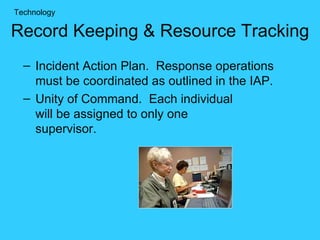
Check-In.  All responders must report in to:  Ensure personnel accountability Track resources Prepare personnel for assignment Locate personnel in case of emergency Organize the demobilization process Personnel check in only once – upon arrival at the incident Following check-in, report to incident supervisor for assignment briefing Record Keeping & Resource Tracking Technology
Incident Action Plan.  Response operations must be coordinated as outlined in the IAP. Unity of Command.  Each individual  will be assigned to only one  supervisor. Record Keeping & Resource Tracking Technology
Record Keeping & Resource Tracking Span of Control.  Supervisors must be able to adequately supervise and control their subordinates, as well as communicate with and manage all resources under their supervision. Resource Tracking.  Supervisors must record and report resource status changes as they occur. Technology
Ongoing Management & Maintenance All users and stakeholders can participate in NIMS Integration Center  Various levels of government Functional disciplines Private entities Process relies on  Lessons learned from actual incidents and exercises Best practices across jurisdictions and functional disciplines Management
More Information David Kondrup 516-507-4322 [email_address] Adelphi University,  Emergency Management Program Contact Richard Rotanz 516-877-4572 [email_address]

School Incident Management Presentation

  • 1.
    NIMS & ICSPrinciples Applied to School-Based Emergencies! Presented by David Kondrup
  • 2.
    How Many IncidentsMay Be School-Based
  • 3.
  • 4.
  • 5.
    Threats By Lettersor Post Cards
  • 6.
    Chemical / LabAccidents
  • 7.
    Health Related Fluor Other Illnesses
  • 8.
  • 9.
    Fire At yourfacility Or near your facility
  • 10.
  • 11.
  • 12.
    Incidents Can AlsoBe Graduation Sporting Events, or any Large Gathering
  • 13.
    Emergency Management ForSchools In it’s Lessons Learned Information Sharing forum the DHS recommends to School Administrators that they consider the following: An All-Hazards Approach to Planning The National Incident Management System (ICS) The Phases of Emergency Management Community Collaboration The Challenges facing School Emergency Planning
  • 14.
    Introduction to NIMSThe National Incident Management System (NIMS) is the United States’ system for managing domestic incidents. NIMS is mandated by Homeland Security Presidential Directive 5 NIMS enables community organizations, such as schools, to coordinate the management of incidents with emergency responders across all jurisdictions and functions. Improves coordination and cooperation between entities using a standardized set of concepts, principles and terminology. NIMS
  • 15.
    NIMS Concepts andPrinciples Flexible framework that applies to all phases of incident management. Standardized organizational structures, processes, procedures and systems to promote interoperability NIMS
  • 16.
    Six Key Componentsto NIMS Command and Management Incident Command System (ICS) Multi-agency coordination systems Public information systems Preparedness Planning, training, exercises Personnel qualification and certification standards Equipment acquisition and certification standards Resource management Standards for describing, inventorying, tracking resources Communications and information management Interoperability Supporting Technologies Ongoing Management & Maintenance NIMS
  • 17.
    NIMS Compliance-School Districts**NIMS Compliance Center Guidance Since school districts are an integral part of local government, their use of NIMS should be achieved in close coordination with other components of the local government. School districts are not traditional response organizations and more typically are recipients of first responder services provided by fire and rescue, emergency medical and law enforcement agencies. This traditional relationship should be acknowledged in achieving NIMS compliance within an integrated local government plan for NIMS compliance. School district participation in local government's NIMS preparedness program is essential to ensure that first responder services are delivered to schools in a timely and effective manner. Schools and Districts that receive federal emergency preparedness grants are required to comply with NIMS requirements; those that do not receive these grants are not required to adopt NIMS. School safety experts strongly encourage all schools to become NIMS compliant.
  • 18.
    Introduction to ICSfor Schools IS-100-SC FEMA’s Emergency Management Institute in cooperation with the U.S. Department of Education developed a course to promote school safety by: Familiarizing you with how ICS principles can be applied in school-based incidents. Preparing you to interface with community response personnel. http://training.fema.gov/EMIWeb/IS/IS100SC.asp
  • 19.
    NIMS & IncidentCommand System Multiple Levels of Activation National Response Plan City/County Emergency Plan School District Emergency Plan School Site Plan State Emergency Plan
  • 20.
    Universal for allIncident Types
  • 21.
    Incident Command SystemDefinition The Incident Command System (ICS) is a management system designed to enable effective and efficient incident management by integrating a combination of facilities, equipment standards and an incident management organization with five functional areas (command, operations, planning, logistics and finance & administration) for the management of all major incidents.
  • 22.
    Incident Command SystemSchool and School District ICS First Responders (Fire, Police, EMT) Partners (Mental & Public Health, Parents, Media, etc.)
  • 23.
    ICS Impact onLocal Agencies All response agencies must use ICS. Personnel will be required to meet national qualification and certification standards to support an incident that transcends interstate jurisdictions. State and local jurisdictions will be strongly encouraged to implement mutual aid agreements. ICS
  • 24.
    ICS Applications Fires,hazardous materials releases, oil spills, and multi-casualty incidents Multi-jurisdictional and multi-agency disasters Search and rescue operations Law enforcement incidents Natural disasters Planned events ICS
  • 25.
    ICS Organization No correlation with the administrative structure of any other agency or jurisdiction. ICS organization’s uniqueness helps to avoid confusion over different position titles and organizational structures. Someone who serves as a chief every day may not hold that title when deployed under an ICS structure. ICS
  • 26.
    Integrated Management StructureICS Intelligence Section
  • 27.
    Modular Organization Developsin a top-down, modular fashion based on: size and complexity of the incident. hazard environment created by the incident. ICS
  • 28.
    Modular Organization Incidentobjectives determine organizational size. Only fill necessary functions/positions. Each element must have a person in charge. ICS
  • 29.
    Basic Incident CommandSystem at a School
  • 30.
    Sample School orSchool District Incident Command System Organization
  • 31.
    Basic ICS OrganizationChart (Think of this as your building or crisis team)
  • 32.
    Common Terminology Reduceconfusion between day-to-day activities and incident response duties. Common terminology Plain English ICS
  • 33.
    Formal Communication PlanningSection Chief Logistics Section Chief Finance/Admin Section Chief Branch Director Air Operations Branch Director Incident Commander Safety Officer Liaison Officer Public Information Officer Command Staff General Staff Service Branch Director Support Branch Director Operations Section Chief ICS Formal Communication
  • 34.
    When To UseFormal Communication Use formal communication when: Receiving and giving work assignments. Requesting support or additional resources. Reporting progress of assigned tasks. ICS
  • 35.
    Informal Communication Isused to exchange incident or event information only. Is NOT used for: Formal requests for additional resources. Tasking work assignments. Within the ICS organization, critical information must flow freely! ICS
  • 36.
    Chain of CommandChain of command is an orderly line of authority within the ranks of the incident management organization. Authority ICS
  • 37.
    Unity of CommandUnder unity of command, personnel: Report to only one supervisor. Receive work assignments only from their supervisors. ICS
  • 38.
    Unified Command Enablesall responsible agencies to manage an incident together Establishes common incident objectives and strategies. Single command structure allows Incident Commanders to analyze intelligence and make joint decisions. Maintains unity of command. Each employee reports to only one supervisor. ICS Incident Command Post Agency 1 Agency 2 Agency 3 Agency 1 Incident Commander Agency 2 Incident Commander Agency 3 Incident Commander
  • 39.
    Unified Command Structure Unified Command does not change other features of ICS. ICS Unified Command (Representatives From Local Jurisdictions) Finance/ Administration Logistics Planning Operations
  • 40.
    Unified Command fora School Emergency School Incident Commander (Principal) School District Incident Commander (Superintendent, Security Director) County/City Incident Commander (Police/Fire) School Site Crisis/Emergency Response Team Or (IMT) Public Information Officer District Emergency Operations Committee (EOC) City/County Incident Management Team (IMT) Public Information Officer
  • 41.
    Area Command Setsoverall strategy and priorities Allocates resources Ensures proper management Objectives are met Strategies are followed Does not include Operations Section (On-scene) Examples Major incident with multiple ICPs Health emergency that is not site specific ICS
  • 42.
    Area Command Configurationwith multiple ICPs Configuration without ICP ICS Area Command ICP 1 ICP 2 ICP 3 Area Command Planning Logistics Finance/ Administration
  • 43.
    Manageable Span ofControl Span of control: The number of individuals or resources that one supervisor can manage effectively during an incident. May vary from 3 to 7 subordinates reporting to a supervisor. Optimum – 5 subordinates to one supervisor. Resource 2 Resource 3 Resource 1 Supervisor ICS
  • 44.
    Organizational Facilities IncidentCommand Post Tactical level on-scene incident command and management organization Located at safe distance but close enough to maintain command Staging Area Temporary location of available resources not immediately assigned Base Location of primary support activities Location of Logistics Section Can support multiple incident sites ICS
  • 45.
    Organizational Facilities CampSatellite support sites for food, rest, sanitation, maintenance, etc. Helibase Main facility to support helicopter operations Helispot Satellite facility to support local helicopter operations (i.e., school yard used for med-evac operations) ICS
  • 46.
    Position Titles ICSposition titles: Provide a common standard for performance expectations. Help to ensure that qualified individuals fill positions. Standardize communication. Describe the responsibilities of the position. ICS
  • 47.
    Task Force Combinationof unlike resources Must have a leader Must have communications Must have transportation Must be within span of control limits ICS
  • 48.
  • 49.
    Strike Team Sametype and kind of resources Must have a leader Must have communications Must have transportation (as required) Must be within span of control limits ICS
  • 50.
  • 51.
    Advantages of Task Forces & Strike Teams Helps maintain effective span of control Assists with resource accountability More effective use of resources Effective way of ordering resources Reduces radio traffic ICS
  • 52.
    Incident Commander Firstresponsible person on the scene Responsible for on-scene incident management until relieved by a more qualified person or authority is delegated to another person. Only position that is always staffed in ICS applications ICS
  • 53.
    Scope of AuthorityAn Incident Commander's scope of authority is derived: From existing laws and agency policies and procedures, and/or Through a delegation of authority from the agency administrator or elected official. ICS
  • 54.
    Authority Authority is . . . . . . a right or obligation to act on behalf of a department, agency, or jurisdiction. ICS
  • 55.
    Delegation of Authority Grants authority to carry out specific functions. Issued by chief elected official, chief executive officer, or agency administrator in writing or verbally. Allows the Incident Commander to assume command. Does NOT relieve the granting authority of the ultimate responsibility for the incident . ICS Incident Commander Superintendent
  • 56.
    Delegation of Authorityis Needed If the incident is outside the Incident Commander’s home jurisdiction. When the incident scope is complex or beyond existing authorities. If required by law or procedures. ICS
  • 57.
    Delegation of Authorityis Not Needed If the Incident Commander is acting within his or her existing authorities. An emergency manager may already have the authority to deploy response resources to a small flash flood. A fire chief probably has the authority (as part of the job description) to serve as an Incident Commander at a structure fire. ICS
  • 58.
    Delegation of Authority: Elements Should include: Legal authorities and restrictions. Financial authorities and restrictions. Reporting requirements. Demographic issues. Political implications. Agency or jurisdictional priorities. Plan for public information management. Process for communications. Plan for ongoing incident evaluation. ICS Delegation of Authority
  • 59.
    Incident Commander RoleThe Incident Commander: Provides overall leadership for incident response. Delegates authority to others. Takes general direction from agency administrator/official. ICS
  • 60.
    Incident Commander ResponsibilitiesThe Incident Commander is specifically responsible for: Ensuring incident safety. Providing information services to internal and external stakeholders. Establishing and maintaining liaison with other agencies participating in the incident. ICS
  • 61.
    Incident Commander ResponsibilitiesManaging Incident Priorities Life Safety (victims and responders) Incident Stability Preservation of property and environment ICS
  • 62.
    Incident Commander ResponsibilitiesThe Incident Commander: Is responsible for all activities and functions until delegated and assigned to staff. Assesses need for staff. Establishes incident objectives. Directs staff to develop the Incident Action Plan. Incident Commander ICS
  • 63.
    Changing Incident CommandersCommand may change to meet the needs of the incident when incidents: Expand or contract. Change in jurisdiction or discipline. Become more or less complex. A higher ranking person may assume, maintain or reassign command This is a formal process. ICS
  • 64.
    Transferring Incident CommandersTransfer of command requires: A transfer of command briefing for the incoming Incident Commander. Notification to all personnel that a change in command is taking place. ICS
  • 65.
    Command & GeneralStaff ICS Intelligence Section
  • 66.
    Command Staff Itmay be necessary for the Incident Commander to designate a Command Staff who: Provide information, liaison, and safety services for the entire organization. Report directly to the Incident Commander. Incident Commander Safety Officer Liaison Officer Public Information Officer ICS Command Staff
  • 67.
    Public Information Officer(PIO) Public Information Officer ICS Advises Incident Commander on information dissemination and media relations. Incident Commander approves information that the PIO releases. Incident Commander Obtains information from and provides information to Planning Section. Planning Section Chief Obtains information from and provides information to community and media. Community and Media
  • 68.
    Safety Officer SafetyOfficer Only Command Staff member who can countermand the IC ICS Advises Incident Commander on issues regarding incident safety. Incident Commander Works with Operations to ensure safety of field personnel. Operations Section Chief Ensures safety of all incident personnel. Incident Personnel
  • 69.
    Liaison Officer LiaisonOfficer ICS Assists Incident Commander by serving as point of contact for agency representatives who are helping to support the operation. Incident Commander Provides briefings to and answers questions from supporting agencies. Agency Representative
  • 70.
    Incident Action PlanRequired MBO tool for every incident to: Specify incident objectives. State activities to be completed. Cover a specified timeframe, or operational period. May be oral or written—except for hazardous materials incidents, which require a written IAP. ICS
  • 71.
    Incident Action Plan Elements What do we want to do? Who is responsible for doing it? How do we communicate with each other? What is the procedure if someone is injured? ICS Use standard form ICS-201 Incident Briefing form to document IAP
  • 72.
    Operational Period BriefingConducted at the beginning of each operational period. Presents the Incident Action Plan to supervisors within the Operations Section. Should be concise. May be referred to as the shift briefing. ICS
  • 73.
    Operational Period BriefingPlanning Section Chief: Reviews the agenda and facilitates the briefing. Incident Commander: Presents incident objectives or confirms existing objectives. Note : Objectives may be presented by the Planning Section Chief.
  • 74.
    Briefing Checklist SituationMission/Execution Communications Service/Support Risk Management Questions or Concerns  ICS
  • 75.
    After Action ReviewRequired after every event – actual or drill Leads to a corrective action plan. Used to improve basic plan, annexes and Standard Operating Procedures ICS
  • 76.
    Multi-agency Coordination Systems A combination of resources Integrated into a common framework Used to coordinate and support incident management activities Examples Interagency Incident Management Group (IIMG) Joint Field Office Emergency Operations Center Command & Management
  • 77.
    Multiagency Coordination Systems Support incident management policies and priorities Facilitate logistics support and resource tracking Make resource allocation decisions based on incident management priorities Coordinate incident-related information Coordinate interagency and intergovernmental issues regarding incident management policies, priorities, and strategies Command & Management
  • 78.
    EOC Organization NOTE: EOC organization does NOT include Operations Section Command & Management EOC Manager Coordination Communications Resource Management Information Management
  • 79.
    Mutual-Aid Agreements NIMSstates that: Mutual-aid agreements are the means for one jurisdiction to provide resources, facilities, services, and other required support to another jurisdiction during an incident. Each jurisdiction should be party to a mutual-aid agreement with appropriate jurisdictions from which they expect to receive or to which they expect to provide assistance during an incident. Command & Management
  • 80.
    Mutual-Aid Agreements Mutualaid is the voluntary provision of resources by agencies or organizations to assist each other when existing resources are inadequate . When combined with NIMS-oriented resource management, mutual aid allows jurisdictions to share resources among mutual-aid partners . Command & Management
  • 81.
    Preparedness Plans Themost common preparedness plans are: Preparedness Plans Emergency Operations Plans (EOPs). Standard operating guidelines (SOGs). Standard operating procedures (SOPs). Jurisdictional or agency policies. Corrective Action and Mitigation Plans Recovery Plans Preparedness
  • 82.
    EOPs are developedat the Federal, State, and local levels to provide a uniform response to all hazards. EOPs written after October 2005 must be consistent with NIMS. Preparedness Emergency Operations Plans
  • 83.
    Preparedness Planning Responsibilities Establish/coordinate plans and protocols Integrate/coordinate activities Establish guidelines and protocols to promote interoperability Adopt guidelines for resource management Establish response priorities Establish/maintain multiagency coordination mechanisms Preparedness
  • 84.
    Preparedness Planning Plans describe how resources will be used. Plans describe mechanisms for: Setting priorities. Integrating entities/functions. Establishing relationships. Ensuring that systems support all incident management activities. Preparedness
  • 85.
    Information Derived FromPlans Plans may include information about: Hazards and risks in the area. Resources in the area. Other formal agreements and plans. Contact information for agency administrators and response personnel. Other pertinent information. Preparedness
  • 86.
    Required Knowledge TheIncident Commander, Command and General Staff members should have a working knowledge of all preparedness plans and agreements. Preparedness
  • 87.
    NIMS Integration Center Training and Exercises Facilitate development and dissemination of national standards, guidelines, and protocols. Facilitate use of modeling/simulation. Define general training requirements and approved courses. Review/approve discipline-specific training requirements. Preparedness
  • 88.
    Resources Resources consistof all personnel and major items of equipment available for assignment to incidents Equipment resources will include the personnel required to operate them Resource Management
  • 89.
    Resource Classifications Notavailable or ready to be assigned (e.g., maintenance issues, rest periods) Ready for immediate assignment and has been issued all required equipment Currently working on an assignment under the direction of a supervisor Out-of- Service Available Assigned Resource Management
  • 90.
    At any incident:The situation must be assessed and the response planned. Managing resources safely and effectively is the most important consideration. Personnel and equipment should respond only when requested or when dispatched by an appropriate authority . Mobilization Resource Management
  • 91.
    Communications & InformationManagement Common operating picture accessible across jurisdictions and functional agencies Allows incident managers at all levels to make effective, consistent decisions expeditiously Ensures consistency at all levels of incident management Common communications and data standards to ensure accessibility and interoperability Communications
  • 92.
    Supporting Technologies Providesan architecture for science and technology support to incident management Interoperability and compatibility Technology support Technology standards Broad-based requirements Strategic planning for research and development Operational scientific support Technical standards Solving operational problems through research and development Technology
  • 93.
    Check-In. Allresponders must report in to: Ensure personnel accountability Track resources Prepare personnel for assignment Locate personnel in case of emergency Organize the demobilization process Personnel check in only once – upon arrival at the incident Following check-in, report to incident supervisor for assignment briefing Record Keeping & Resource Tracking Technology
  • 94.
    Incident Action Plan. Response operations must be coordinated as outlined in the IAP. Unity of Command. Each individual will be assigned to only one supervisor. Record Keeping & Resource Tracking Technology
  • 95.
    Record Keeping &Resource Tracking Span of Control. Supervisors must be able to adequately supervise and control their subordinates, as well as communicate with and manage all resources under their supervision. Resource Tracking. Supervisors must record and report resource status changes as they occur. Technology
  • 96.
    Ongoing Management &Maintenance All users and stakeholders can participate in NIMS Integration Center Various levels of government Functional disciplines Private entities Process relies on Lessons learned from actual incidents and exercises Best practices across jurisdictions and functional disciplines Management
  • 97.
    More Information DavidKondrup 516-507-4322 [email_address] Adelphi University, Emergency Management Program Contact Richard Rotanz 516-877-4572 [email_address]

Editor's Notes

  • #2 Good afternoon ladies & gentlemen Welcome back from your break. First let me thank and recognize the outstanding job done by the other speakers here today: Richard Rotanz – Emergency Management Hazards & the EOC Peter LaDuca – Regulatory Compliance Dr. Alan Groveman – Public Relations during School Emergencies I am David Kondrup (Describe background, education and experience): Masters in CJ, since 1972 involved in law enforcement, rescue, facility operations, HR, private security, NIMS & ICS Training and Liaison, over 20 years with the NYPD and currently a 3 star chief with a 1250 person suburban law enforcement agency. I have served in many incident command positions, and may very well be one of those emergency responders at an emergency that effects you. Today I would like to take some of the mystery out of NIMS, explain to you the principles of Incident Command and convey to you some valuable information that you can use and apply.