
Mentorship in Emergency Medicine:
From Near-Peers to Tiers
Dr. Sarah Ronan-Bentle, MD
Dr. Robbie Paulsen, MD
Dr. Nicholas Kman, MD
@drnickkman
Mentorship in Emergency Medicine:
From Near-Peers to Tiers
Resident and Faculty Panel:
Dr. Laura Espy Bell
Dr. Matthew Stull
With Dr. Robbie Paulsen
Objectives
ď‚§ Describe the formation, organization, structure
and function of group mentorship programs.
ď‚§ Describe 2 such programs who approach this
model in slightly different forms.
ď‚§ Introduce the role of gender in medical student
mentoring (one institutions experience).
ď‚§ Divulge challenges and limitations to group
mentorship programs.
Background
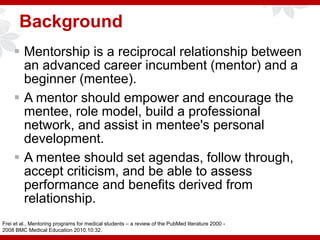
ď‚§ Mentorship is a reciprocal relationship between
an advanced career incumbent (mentor) and a
beginner (mentee).
ď‚§ A mentor should empower and encourage the
mentee, role model, build a professional
network, and assist in mentee's personal
development.
ď‚§ A mentee should set agendas, follow through,
accept criticism, and be able to assess
performance and benefits derived from
relationship.
Frei et al., Mentoring programs for medical students – a review of the PubMed literature 2000 -
2008 BMC Medical Education 2010,10:32.
Background
ď‚§ Mentorship is intended to promote professional
development and career advancement.
ď‚§ Up to 40% of medical students cannot identify a
mentor.
ď‚§ One of the barriers of the mentorship
relationship, “finding a suitable mentor”, can be
solved by starting a mentorship program.
Mentorship Models
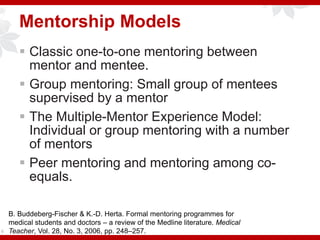
ď‚§ Classic one-to-one mentoring between
mentor and mentee.
ď‚§ Group mentoring: Small group of mentees
supervised by a mentor
ď‚§ The Multiple-Mentor Experience Model:
Individual or group mentoring with a number
of mentors
ď‚§ Peer mentoring and mentoring among co-
equals.
6
B. Buddeberg-Fischer & K.-D. Herta. Formal mentoring programmes for
medical students and doctors – a review of the Medline literature. Medical
Teacher, Vol. 28, No. 3, 2006, pp. 248–257.
Medical Student Mentorship
ď‚§ 2 Reviews showed 9-14 published mentoring
programs for medical students and 7 for
doctors.
ď‚§ Programs pursued different goals and
employed different structures.
ď‚§ % of women among the mentors is given in
only one of the programs.
ď‚§ Conclude that career development should be
stage-specific and goal-oriented.
7
Frei et al., Mentoring programs for medical students – a review of the PubMed literature 2000 -
2008 BMC Medical Education 2010,10:32.
Gender In Mentorship: Background
ď‚§ Approximately 50% of U.S. medical students are
now female, yet gender inequality exists in many
medical specialties
ď‚§ Studies have indicated that one of the primary
barriers to the advancement of women in
medicine is lack of effective mentors.
ď‚§ Female trainees are less likely to identify a
mentor and mentorship programs for women are
rare.
8
Welch JL, Jimenez HL, Walthall J, and Allen SE(2012) The
Women in Emergency Medicine Mentoring Program: An
Innovative Approach to Mentoring. Journal of Graduate Medical
Education: September 2012, Vol. 4, No. 3, pp. 362-366.
Group Mentorship
ď‚§ Can we bridge the gap between medical students
and resident?
ď‚§ Can we improve mentorship of all genders?
ď‚§ Does assigning a mentor really work?
9
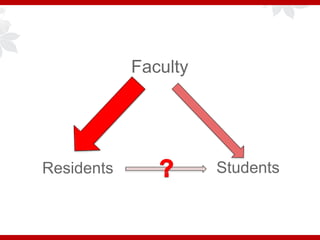
Faculty
Residents Students
Compared to faculty-student pairs, a near-peer
mentoring program should:
ď‚§ Be more casual
ď‚§ Provide a real glimpse into resident life
ď‚§ Improve skills as a mentor and mentee for both
parties
Near-Peer Mentorship
Near-Peer Program Aims
Primary
ď‚§ Provide a realistic
understanding of EM
residency
ď‚§ Guide fourth-year
students through the
residency match
Secondary
ď‚§ Augment emergency
medicine residents’
skills as effective
mentors
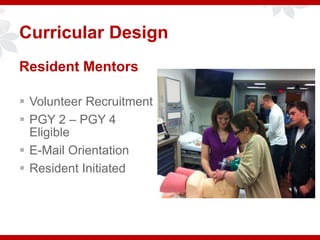
Curricular Design
Resident Mentors
ď‚§ Volunteer Recruitment
 PGY 2 – PGY 4
Eligible
ď‚§ E-Mail Orientation
ď‚§ Resident Initiated
Curricular Design
Student Mentees
 July – October
ď‚§ Home & Away
Rotators
 “Opt Out” Participation
Curricular Design
ď‚§ Expectations
ď‚§ At least one face-
to-face meeting
during clinical
rotation
ď‚§ Continued regular
contact
ď‚§ Mentorship
Guidance
ď‚§ Follow-up e-mails
with mentoring tips
ď‚§ Application
deadline reminders
Program Impact
Student Mentees
ď‚§ Casual and open
relationship
ď‚§ Decreased anxiety
ď‚§ High personal
satisfaction
Resident Mentors
ď‚§ Enhanced mentoring
skills
ď‚§ Insights on receiving
future mentorship
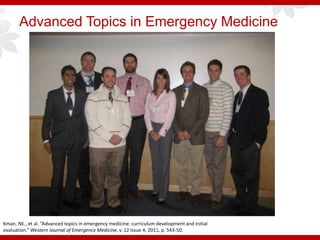
Advanced Topics in Emergency Medicine
Kman, NE., et al. “Advanced topics in emergency medicine: curriculum development and initial
evaluation.” Western Journal of Emergency Medicine, v. 12 issue 4, 2011, p. 543-50.
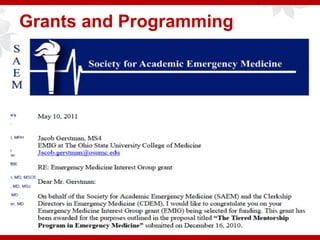
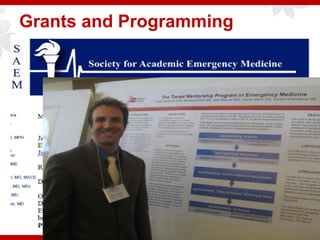
Grants and Programming
The OSU Tiered Mentorship Model
ď‚§ Each tiered group consists of at least one faculty
member, one resident, one ATEM student, and
one or more junior level medical students (MS1-
3) interested in EM.
ď‚§ 11 to 13 total groups.
ď‚§ Students paired with mentors based on EM
interest or pre-existing relationship.
Kman NE, Bernard AB, Khandelwal S, Nagel RW, Martin DR. A
Tiered Mentorship Program Improves Number of Students With
an Identified Mentor. Teaching and Learning in Medicine. Vol. 25,
Iss. 4, 2013.
The OSU Tiered Mentorship Model
ď‚§ Introductory meeting at EMIG: Introductory
questionnaire sent out immediately after to begin
roster of groups.
ď‚§ 1st Small Group Meeting: Introductions,
importance of mentorship and academic goals.
ď‚§ 2nd Small Group Meeting: Lifestyle, hours and
social aspects of their occupation.
ď‚§ EMIG/ATEM Panel Discussion: ATEM students
reflect on experience with the Match.
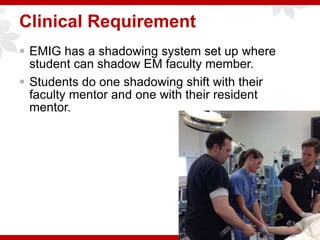
Clinical Requirement
ď‚§ EMIG has a shadowing system set up where
student can shadow EM faculty member.
ď‚§ Students do one shadowing shift with their
faculty mentor and one with their resident
mentor.
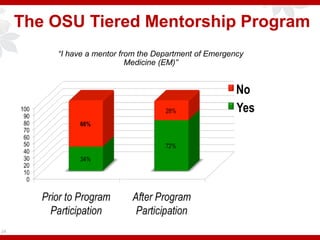
The OSU Tiered Mentorship Program
24
“I have a mentor from the Department of Emergency
Medicine (EM)”
Gender in Mentorship Study
• 12 groups were formed in 2012-2013.
• 3 of the 12 groups were comprised solely of females
• 2 of the groups were male exclusive.
• The remaining, mixed gender groups were
formed based on common interest and included
both males and females.
25
26
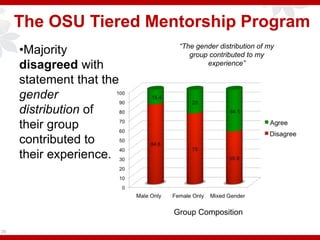
•Majority
disagreed with
statement that the
gender
distribution of
their group
contributed to
their experience.
“The gender distribution of my
group contributed to my
experience”
Group Composition
The OSU Tiered Mentorship Program
27
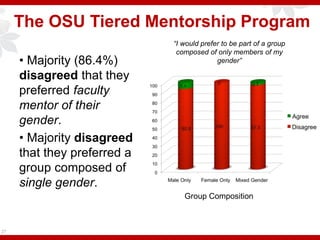
• Majority (86.4%)
disagreed that they
preferred faculty
mentor of their
gender.
• Majority disagreed
that they preferred a
group composed of
single gender.
“I would prefer to be part of a group
composed of only members of my
gender”
Group Composition
The OSU Tiered Mentorship Program
Gender in Mentorship Conclusions
ď‚§ Tiered-mentorship group structure allows
students to identify a faculty member mentor,
the gender of mentor and gender make-up of the
group is less important.
ď‚§ The primary role of gender was not perceived to
be of value to students.
ď‚§ Our findings led to the establishment of all
mixed gender groups for this academic year.
28
Pitfalls and Questions for the Panel
ď‚§ Assigning Mentors
ď‚§ Group Size
ď‚§ Authority Gradient
ď‚§ Does gender matter?
29
References
ď‚§ Kman NE, Bernard AB, Khandelwal S, Nagel RW, Martin
DR. A Tiered Mentorship Program Improves Number of
Students With an Identified Mentor. Teaching and
Learning in Medicine. Vol. 25, Iss. 4, 2013.
 Reisman AB, Gross CP. “Gender differences in the ability
to identify a mentor at morning report: a multi-institutional
survey.” Teach Learn Med. 2002 Fall; 14(4):236-9.
ď‚§ Welch JL, Jimenez HL, Walthall J, and Allen SE(2012)
The Women in Emergency Medicine Mentoring Program:
An Innovative Approach to Mentoring. Journal of
Graduate Medical Education: September 2012, Vol. 4,
No. 3, pp. 362-366.
30
References
ď‚§ Medical School Based Mentoring Programs. AAMC 2010.
 Frei et al. Mentoring programs for medical students – a
review of the PubMed literature 2000 – 2008. BMC
Medical Education 2010, 10:32.
ď‚§ B. Buddeberg-Fischer & K.-D. Herta. Formal mentoring
programmes for medical students and doctors – a review
of the Medline literature. Medical Teacher, Vol. 28, No. 3,
2006, pp. 248–257.
31
Mentorship in Emergency Medicine:
From Near-Peers to Tiers
Resident and Faculty Panel:
Dr. Laura Espy Bell
Dr. Matthew Stull
With Dr. Robbie Paulsen

Group Mentorship Programs in Emergency Medicine

  • 1.
    Mentorship in EmergencyMedicine: From Near-Peers to Tiers Dr. Sarah Ronan-Bentle, MD Dr. Robbie Paulsen, MD Dr. Nicholas Kman, MD @drnickkman
  • 2.
    Mentorship in EmergencyMedicine: From Near-Peers to Tiers Resident and Faculty Panel: Dr. Laura Espy Bell Dr. Matthew Stull With Dr. Robbie Paulsen
  • 3.
    Objectives ď‚§ Describe theformation, organization, structure and function of group mentorship programs. ď‚§ Describe 2 such programs who approach this model in slightly different forms. ď‚§ Introduce the role of gender in medical student mentoring (one institutions experience). ď‚§ Divulge challenges and limitations to group mentorship programs.
  • 4.
    Background  Mentorship isa reciprocal relationship between an advanced career incumbent (mentor) and a beginner (mentee).  A mentor should empower and encourage the mentee, role model, build a professional network, and assist in mentee's personal development.  A mentee should set agendas, follow through, accept criticism, and be able to assess performance and benefits derived from relationship. Frei et al., Mentoring programs for medical students – a review of the PubMed literature 2000 - 2008 BMC Medical Education 2010,10:32.
  • 5.
    Background  Mentorship isintended to promote professional development and career advancement.  Up to 40% of medical students cannot identify a mentor.  One of the barriers of the mentorship relationship, “finding a suitable mentor”, can be solved by starting a mentorship program.
  • 6.
    Mentorship Models  Classicone-to-one mentoring between mentor and mentee.  Group mentoring: Small group of mentees supervised by a mentor  The Multiple-Mentor Experience Model: Individual or group mentoring with a number of mentors  Peer mentoring and mentoring among co- equals. 6 B. Buddeberg-Fischer & K.-D. Herta. Formal mentoring programmes for medical students and doctors – a review of the Medline literature. Medical Teacher, Vol. 28, No. 3, 2006, pp. 248–257.
  • 7.
    Medical Student Mentorship 2 Reviews showed 9-14 published mentoring programs for medical students and 7 for doctors.  Programs pursued different goals and employed different structures.  % of women among the mentors is given in only one of the programs.  Conclude that career development should be stage-specific and goal-oriented. 7 Frei et al., Mentoring programs for medical students – a review of the PubMed literature 2000 - 2008 BMC Medical Education 2010,10:32.
  • 8.
    Gender In Mentorship:Background ď‚§ Approximately 50% of U.S. medical students are now female, yet gender inequality exists in many medical specialties ď‚§ Studies have indicated that one of the primary barriers to the advancement of women in medicine is lack of effective mentors. ď‚§ Female trainees are less likely to identify a mentor and mentorship programs for women are rare. 8 Welch JL, Jimenez HL, Walthall J, and Allen SE(2012) The Women in Emergency Medicine Mentoring Program: An Innovative Approach to Mentoring. Journal of Graduate Medical Education: September 2012, Vol. 4, No. 3, pp. 362-366.
  • 9.
    Group Mentorship ď‚§ Canwe bridge the gap between medical students and resident? ď‚§ Can we improve mentorship of all genders? ď‚§ Does assigning a mentor really work? 9
  • 11.
  • 12.
    Compared to faculty-studentpairs, a near-peer mentoring program should: ď‚§ Be more casual ď‚§ Provide a real glimpse into resident life ď‚§ Improve skills as a mentor and mentee for both parties Near-Peer Mentorship
  • 13.
    Near-Peer Program Aims Primary Provide a realistic understanding of EM residency  Guide fourth-year students through the residency match Secondary  Augment emergency medicine residents’ skills as effective mentors
  • 14.
    Curricular Design Resident Mentors Volunteer Recruitment  PGY 2 – PGY 4 Eligible  E-Mail Orientation  Resident Initiated
  • 15.
    Curricular Design Student Mentees July – October  Home & Away Rotators  “Opt Out” Participation
  • 16.
    Curricular Design ď‚§ Expectations ď‚§At least one face- to-face meeting during clinical rotation ď‚§ Continued regular contact ď‚§ Mentorship Guidance ď‚§ Follow-up e-mails with mentoring tips ď‚§ Application deadline reminders
  • 17.
    Program Impact Student Mentees ď‚§Casual and open relationship ď‚§ Decreased anxiety ď‚§ High personal satisfaction Resident Mentors ď‚§ Enhanced mentoring skills ď‚§ Insights on receiving future mentorship
  • 18.
    Advanced Topics inEmergency Medicine Kman, NE., et al. “Advanced topics in emergency medicine: curriculum development and initial evaluation.” Western Journal of Emergency Medicine, v. 12 issue 4, 2011, p. 543-50.
  • 19.
  • 20.
  • 21.
    The OSU TieredMentorship Model ď‚§ Each tiered group consists of at least one faculty member, one resident, one ATEM student, and one or more junior level medical students (MS1- 3) interested in EM. ď‚§ 11 to 13 total groups. ď‚§ Students paired with mentors based on EM interest or pre-existing relationship. Kman NE, Bernard AB, Khandelwal S, Nagel RW, Martin DR. A Tiered Mentorship Program Improves Number of Students With an Identified Mentor. Teaching and Learning in Medicine. Vol. 25, Iss. 4, 2013.
  • 22.
    The OSU TieredMentorship Model ď‚§ Introductory meeting at EMIG: Introductory questionnaire sent out immediately after to begin roster of groups. ď‚§ 1st Small Group Meeting: Introductions, importance of mentorship and academic goals. ď‚§ 2nd Small Group Meeting: Lifestyle, hours and social aspects of their occupation. ď‚§ EMIG/ATEM Panel Discussion: ATEM students reflect on experience with the Match.
  • 23.
    Clinical Requirement ď‚§ EMIGhas a shadowing system set up where student can shadow EM faculty member. ď‚§ Students do one shadowing shift with their faculty mentor and one with their resident mentor.
  • 24.
    The OSU TieredMentorship Program 24 “I have a mentor from the Department of Emergency Medicine (EM)”
  • 25.
    Gender in MentorshipStudy • 12 groups were formed in 2012-2013. • 3 of the 12 groups were comprised solely of females • 2 of the groups were male exclusive. • The remaining, mixed gender groups were formed based on common interest and included both males and females. 25
  • 26.
    26 •Majority disagreed with statement thatthe gender distribution of their group contributed to their experience. “The gender distribution of my group contributed to my experience” Group Composition The OSU Tiered Mentorship Program
  • 27.
    27 • Majority (86.4%) disagreedthat they preferred faculty mentor of their gender. • Majority disagreed that they preferred a group composed of single gender. “I would prefer to be part of a group composed of only members of my gender” Group Composition The OSU Tiered Mentorship Program
  • 28.
    Gender in MentorshipConclusions ď‚§ Tiered-mentorship group structure allows students to identify a faculty member mentor, the gender of mentor and gender make-up of the group is less important. ď‚§ The primary role of gender was not perceived to be of value to students. ď‚§ Our findings led to the establishment of all mixed gender groups for this academic year. 28
  • 29.
    Pitfalls and Questionsfor the Panel ď‚§ Assigning Mentors ď‚§ Group Size ď‚§ Authority Gradient ď‚§ Does gender matter? 29
  • 30.
    References  Kman NE,Bernard AB, Khandelwal S, Nagel RW, Martin DR. A Tiered Mentorship Program Improves Number of Students With an Identified Mentor. Teaching and Learning in Medicine. Vol. 25, Iss. 4, 2013.  Reisman AB, Gross CP. “Gender differences in the ability to identify a mentor at morning report: a multi-institutional survey.” Teach Learn Med. 2002 Fall; 14(4):236-9.  Welch JL, Jimenez HL, Walthall J, and Allen SE(2012) The Women in Emergency Medicine Mentoring Program: An Innovative Approach to Mentoring. Journal of Graduate Medical Education: September 2012, Vol. 4, No. 3, pp. 362-366. 30
  • 31.
    References  Medical SchoolBased Mentoring Programs. AAMC 2010.  Frei et al. Mentoring programs for medical students – a review of the PubMed literature 2000 – 2008. BMC Medical Education 2010, 10:32.  B. Buddeberg-Fischer & K.-D. Herta. Formal mentoring programmes for medical students and doctors – a review of the Medline literature. Medical Teacher, Vol. 28, No. 3, 2006, pp. 248–257. 31
  • 32.
    Mentorship in EmergencyMedicine: From Near-Peers to Tiers Resident and Faculty Panel: Dr. Laura Espy Bell Dr. Matthew Stull With Dr. Robbie Paulsen