PEER GROUP PRESENTATION
EVIDENCE BASED NURSING
Protiksha Das
M. Sc. Nursing Student
1st Year
DEFINITION
Evidence-based nursing is a lifelong problem-solving
approach to clinical practice that integrates
 A systematic search for as well as critical appraisal and
synthesis of the most relevant and best research (i.e.,
external evidence) to answer a burning clinical question
DEFINITION Cont.
Evidence-based nursing is a lifelong problem-solving
approach to clinical practice that integrates
 One’s own clinical expertise, which includes internal
evidence generated from outcomes management or
quality improvement projects, a thorough patient
assessment, and evaluation and use of available
resources necessary to achieve desired patient outcomes
Patient preferences and values
DEFINITION OF EVIDENCE
 External Evidence
Generated through rigorous research (e.g., RCTs or
cohort studies)
Intended to be generalized to and used in other settings
Important Question - whether clinicians can achieve
results in their own clinical practices that are similar to
those derived from a body of evidence.
DEFINITION OF EVIDENCE Cont.
 Internal Evidence
Typically generated through practice initiatives, such
as outcomes management or quality improvement
projects
Purpose - improving clinical care in the setting in
which it is produced.
COMPONENTS
 Research Evidence and Evidence-Based Theories
Evidence from systematic reviews of RCTs is regarded
as the strongest level of evidence.
Practice decisions about treatments are made based on
these evidences to achieve a desired outcome.
Evidence from descriptive and qualitative studies as
well as from opinion leaders also should be factored
into clinical decisions when RCTs are not available.
COMPONENTS Cont.
 Research Evidence and Evidence-Based Theories
Evidence-based theories (i.e., theories that are
empirically supported through well-designed studies)
should be included as evidence.
Clinical judgment
Internal evidence generated from quality improvement
or as outcomes of management projects
COMPONENTS Cont.
 Clinical Expertise
Clinical reasoning (i.e., the ability to apply the above
information to a clinical issue)
Evaluation and use of available healthcare resources
needed to implement the chosen treatment(s) and
achieve the expected outcome
Patient preferences, values, concerns incorporated
into the evidence-based approach to decision making
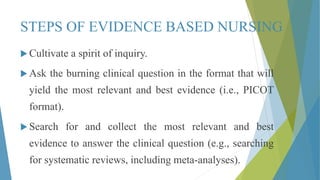
STEPS OF EVIDENCE BASED NURSING
 Cultivate a spirit of inquiry.
 Ask the burning clinical question in the format that will
yield the most relevant and best evidence (i.e., PICOT
format).
 Search for and collect the most relevant and best
evidence to answer the clinical question (e.g., searching
for systematic reviews, including meta-analyses).
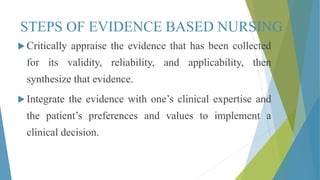
STEPS OF EVIDENCE BASED NURSING
 Critically appraise the evidence that has been collected
for its validity, reliability, and applicability, then
synthesize that evidence.
 Integrate the evidence with one’s clinical expertise and
the patient’s preferences and values to implement a
clinical decision.
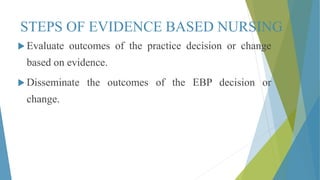
STEPS OF EVIDENCE BASED NURSING
 Evaluate outcomes of the practice decision or change
based on evidence.
 Disseminate the outcomes of the EBP decision or
change.
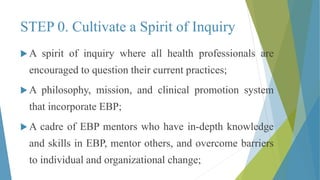
STEP 0. Cultivate a Spirit of Inquiry
 A spirit of inquiry where all health professionals are
encouraged to question their current practices;
 A philosophy, mission, and clinical promotion system
that incorporate EBP;
 A cadre of EBP mentors who have in-depth knowledge
and skills in EBP, mentor others, and overcome barriers
to individual and organizational change;
STEP 0. Cultivate a Spirit of Inquiry Cont.
 An infrastructure that provides tools to enhance EBP
(e.g., computers for searching at the point of care, access
to key databases, ongoing EBP educational and skills
building sessions, EBP rounds and journal clubs);
 Administrative support and leadership that values and
models EBP as well as provides the needed resources to
sustain it;
 Regular recognition of individuals and groups who
consistently implement EBP.
 Format of PICOT is mentioned below.
Patient population
Intervention or Issue of interest
Comparison intervention
Outcome
Time frame
STEP 1. Formulate the PICOT Question
STEP 1. Formulate the PICOT Question Cont.
 Example: "In adult abdominal surgery patients (P-patient
population), what is the effect of splinting with an
elasticized abdominal binder (I-intervention) compared
to a pillow (C-comparison) in reducing pain associated
with ambulation (O-outcome) on the first postoperative
day (T-time frame)?"
STEP 2. Search for the Best Evidence
 Consult online and offline resources to collect large
amounts of clinical information and evidence.
 Seven level of evidence (strongest to weakest) for each
kind of PICOT question
Level I: Evidence from systematic reviews or meta-
analysis of randomized control trials
Level II: Evidence from well-designed randomized
control trials
STEP 2. Search for the Best Evidence Cont.
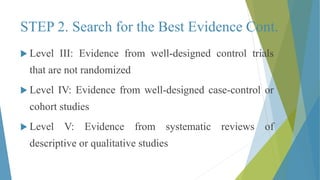
 Level III: Evidence from well-designed control trials
that are not randomized
 Level IV: Evidence from well-designed case-control or
cohort studies
 Level V: Evidence from systematic reviews of
descriptive or qualitative studies
STEP 2. Search for the Best Evidence Cont.
 Level VI: Evidence from single descriptive or qualitative
studies
 Level VII: Evidence from the opinion of authorities
and/or reports of expert committees
STEP 2. Search for the Best Evidence Cont.
 Systematic Review
Strongest level of evidence
Summary of evidence on a particular topic
Conducted by an expert or expert panel using a
rigorous process for identifying, appraising, and
synthesizing studies to answer a specific clinical
question.
Conclusions are drawn about the data gathered.
STEP 2. Search for the Best Evidence Cont.
 Meta-Analysis
 Many systematic reviews incorporate quantitative
methods to summarize the results from multiple
studies
 Generates an overall summary statistic that represents
the effect of the intervention across multiple studies
 More precise than the individual findings from any
one of the contributing studies alone.
STEP 3. Critical Appraisal of Evidence
 Validity: Are the results of the study valid?
If the results as close to the truth as possible
If the study was conducted using the best research
methods possible
 Reliability: What are the results?
Qualitative Studies
Whether the research approach fits the purpose of
the study.
STEP 3. Critical Appraisal of Evidence Cont.
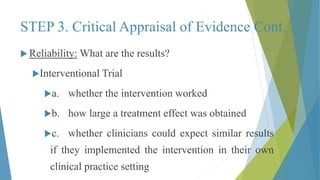
 Reliability: What are the results?
Interventional Trial
a. whether the intervention worked
b. how large a treatment effect was obtained
c. whether clinicians could expect similar results
if they implemented the intervention in their own
clinical practice setting
STEP 3. Critical Appraisal of Evidence Cont.
 Applicability: Will the results help me in caring for my
patients?
Whether the subjects in the study are similar to the
patients for whom care is being delivered,
Whether the benefits are greater than the risks of
treatment (i.e., potential for harm),
STEP 3. Critical Appraisal of Evidence Cont.
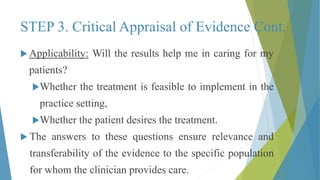
 Applicability: Will the results help me in caring for my
patients?
Whether the treatment is feasible to implement in the
practice setting,
Whether the patient desires the treatment.
 The answers to these questions ensure relevance and
transferability of the evidence to the specific population
for whom the clinician provides care.
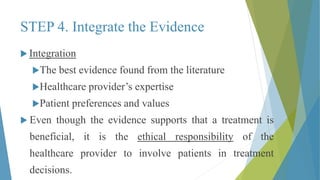
STEP 4. Integrate the Evidence
 Integration
The best evidence found from the literature
Healthcare provider’s expertise
Patient preferences and values
 Even though the evidence supports that a treatment is
beneficial, it is the ethical responsibility of the
healthcare provider to involve patients in treatment
decisions.

STEP 4. Integrate the Evidence Cont.

 A discussion with the patient may reveal his fear of
developing side effects.
 Upon history taking, a comorbidity or contraindication
may be found that increases the risks of that specific
treatment.
 Clinician’s assessment of healthcare resources that are
available to implement a treatment decision is a critical
part of the decision-making process.
STEP 5. Evaluate the Outcomes
 Evaluation of the Evidence-based Initiative
How the change affected patient outcomes
How effective the clinical decision was with a
particular patient in real-world practice setting.
 Measurement of outcomes is important to determine and
document the impact of EBN.
STEP 5. Evaluate the Outcomes Cont.
 If a change in practice based on evidence did not
produce the same findings as demonstrated in rigorous
research, the following questions to be asked.
 Was the treatment administered in exactly the same
way that it was delivered in the study?
 Were the patients in the clinical setting similar to
those in the studies?
STEP 6. Disseminate the Outcomes
 Clinicians may achieve positive outcomes through
making changes in their care based upon evidence.
 If those outcomes are not shared, others do not learn
about the outcomes and clinicians as well as patients in
other settings do not benefit from them.
STEP 6. Disseminate the Outcomes Cont.
 Ways to disseminate outcomes of the practice changes
based on EBN
 Oral and poster presentations at local, regional, and
national conferences
 EBP rounds within their own institutions
 Journal and newsletter publications
BARRIERS
 Lack of EBP knowledge and skills
 Misperceptions or negative attitudes about research and
evidence-based care
 Lack of belief that EBP will result in more positive
outcomes than traditional care
 Voluminous amounts of information in professional
journals
BARRIERS Cont.
 Lack of time and resources to search for and appraise
evidence
 Overwhelming patient loads
 Organizational constraints, such as lack of administrative
support or incentives
BARRIERS Cont.
 Lack of EBP mentors
 Demands from patients for a certain type of treatment
 Peer pressure to continue with practices that are steeped
in tradition
 Resistance to change
 Lack of consequences for not implementing EBP
BARRIERS Cont.
 Lack of autonomy over practice and incentives
 Inadequate EBP content and behavioural skills building
in educational programs along with the continued
teaching of how to conduct rigorous research instead of
teaching an evidence-based approach to care.
FACILITATING CONDITIONS
 Support and encouragement from leadership/
administration that foster a culture for EBP
 Time to critically appraise studies and implement their
findings
 Research reports that are clearly written
 Evidence-based practice mentors who have excellent
EBP skills
FACILITATING CONDITIONS Cont.
 Proper tools to assist with EBP at the point of care (e.g.,
computers dedicated to EBP, computer-based
educational programs)
 Clinical promotion systems that incorporate EBP
competencies for advancement
 Evidence-based clinical practice policies and procedures
 Journal clubs and EBP rounds
OVERCOMING THE BARRIERS
 Assessment of barriers, facilitators, organizational
culture, current clinical practices, readiness for system-
wide implementation of EBN within an organization.
 Education on basics of EBP to create baseline
knowledge and skills.
 Multiple ways of education - education conferences;
interactive workshops, journal articles, textbooks,
informational handouts etc.
OVERCOMING THE BARRIERS Cont.
 Surveys or focus groups to assess their baseline
knowledge, beliefs and behaviors regarding EBN.
 Objective documentation of the status of EBN.
 Continuous funding of translational research by funding
agencies on high priority basis.
 Collaboration of interdisciplinary professionals to
advance EBN.
THANK YOU!

EBN.pptx

  • 1.
    PEER GROUP PRESENTATION EVIDENCEBASED NURSING Protiksha Das M. Sc. Nursing Student 1st Year
  • 2.
    DEFINITION Evidence-based nursing isa lifelong problem-solving approach to clinical practice that integrates  A systematic search for as well as critical appraisal and synthesis of the most relevant and best research (i.e., external evidence) to answer a burning clinical question
  • 3.
    DEFINITION Cont. Evidence-based nursingis a lifelong problem-solving approach to clinical practice that integrates  One’s own clinical expertise, which includes internal evidence generated from outcomes management or quality improvement projects, a thorough patient assessment, and evaluation and use of available resources necessary to achieve desired patient outcomes Patient preferences and values
  • 4.
    DEFINITION OF EVIDENCE External Evidence Generated through rigorous research (e.g., RCTs or cohort studies) Intended to be generalized to and used in other settings Important Question - whether clinicians can achieve results in their own clinical practices that are similar to those derived from a body of evidence.
  • 5.
    DEFINITION OF EVIDENCECont.  Internal Evidence Typically generated through practice initiatives, such as outcomes management or quality improvement projects Purpose - improving clinical care in the setting in which it is produced.
  • 6.
    COMPONENTS  Research Evidenceand Evidence-Based Theories Evidence from systematic reviews of RCTs is regarded as the strongest level of evidence. Practice decisions about treatments are made based on these evidences to achieve a desired outcome. Evidence from descriptive and qualitative studies as well as from opinion leaders also should be factored into clinical decisions when RCTs are not available.
  • 7.
    COMPONENTS Cont.  ResearchEvidence and Evidence-Based Theories Evidence-based theories (i.e., theories that are empirically supported through well-designed studies) should be included as evidence. Clinical judgment Internal evidence generated from quality improvement or as outcomes of management projects
  • 8.
    COMPONENTS Cont.  ClinicalExpertise Clinical reasoning (i.e., the ability to apply the above information to a clinical issue) Evaluation and use of available healthcare resources needed to implement the chosen treatment(s) and achieve the expected outcome Patient preferences, values, concerns incorporated into the evidence-based approach to decision making
  • 9.
    STEPS OF EVIDENCEBASED NURSING  Cultivate a spirit of inquiry.  Ask the burning clinical question in the format that will yield the most relevant and best evidence (i.e., PICOT format).  Search for and collect the most relevant and best evidence to answer the clinical question (e.g., searching for systematic reviews, including meta-analyses).
  • 10.
    STEPS OF EVIDENCEBASED NURSING  Critically appraise the evidence that has been collected for its validity, reliability, and applicability, then synthesize that evidence.  Integrate the evidence with one’s clinical expertise and the patient’s preferences and values to implement a clinical decision.
  • 11.
    STEPS OF EVIDENCEBASED NURSING  Evaluate outcomes of the practice decision or change based on evidence.  Disseminate the outcomes of the EBP decision or change.
  • 12.
    STEP 0. Cultivatea Spirit of Inquiry  A spirit of inquiry where all health professionals are encouraged to question their current practices;  A philosophy, mission, and clinical promotion system that incorporate EBP;  A cadre of EBP mentors who have in-depth knowledge and skills in EBP, mentor others, and overcome barriers to individual and organizational change;
  • 13.
    STEP 0. Cultivatea Spirit of Inquiry Cont.  An infrastructure that provides tools to enhance EBP (e.g., computers for searching at the point of care, access to key databases, ongoing EBP educational and skills building sessions, EBP rounds and journal clubs);  Administrative support and leadership that values and models EBP as well as provides the needed resources to sustain it;  Regular recognition of individuals and groups who consistently implement EBP.
  • 14.
     Format ofPICOT is mentioned below. Patient population Intervention or Issue of interest Comparison intervention Outcome Time frame STEP 1. Formulate the PICOT Question
  • 15.
    STEP 1. Formulatethe PICOT Question Cont.  Example: "In adult abdominal surgery patients (P-patient population), what is the effect of splinting with an elasticized abdominal binder (I-intervention) compared to a pillow (C-comparison) in reducing pain associated with ambulation (O-outcome) on the first postoperative day (T-time frame)?"
  • 16.
    STEP 2. Searchfor the Best Evidence  Consult online and offline resources to collect large amounts of clinical information and evidence.  Seven level of evidence (strongest to weakest) for each kind of PICOT question Level I: Evidence from systematic reviews or meta- analysis of randomized control trials Level II: Evidence from well-designed randomized control trials
  • 17.
    STEP 2. Searchfor the Best Evidence Cont.  Level III: Evidence from well-designed control trials that are not randomized  Level IV: Evidence from well-designed case-control or cohort studies  Level V: Evidence from systematic reviews of descriptive or qualitative studies
  • 18.
    STEP 2. Searchfor the Best Evidence Cont.  Level VI: Evidence from single descriptive or qualitative studies  Level VII: Evidence from the opinion of authorities and/or reports of expert committees
  • 19.
    STEP 2. Searchfor the Best Evidence Cont.  Systematic Review Strongest level of evidence Summary of evidence on a particular topic Conducted by an expert or expert panel using a rigorous process for identifying, appraising, and synthesizing studies to answer a specific clinical question. Conclusions are drawn about the data gathered.
  • 20.
    STEP 2. Searchfor the Best Evidence Cont.  Meta-Analysis  Many systematic reviews incorporate quantitative methods to summarize the results from multiple studies  Generates an overall summary statistic that represents the effect of the intervention across multiple studies  More precise than the individual findings from any one of the contributing studies alone.
  • 21.
    STEP 3. CriticalAppraisal of Evidence  Validity: Are the results of the study valid? If the results as close to the truth as possible If the study was conducted using the best research methods possible  Reliability: What are the results? Qualitative Studies Whether the research approach fits the purpose of the study.
  • 22.
    STEP 3. CriticalAppraisal of Evidence Cont.  Reliability: What are the results? Interventional Trial a. whether the intervention worked b. how large a treatment effect was obtained c. whether clinicians could expect similar results if they implemented the intervention in their own clinical practice setting
  • 23.
    STEP 3. CriticalAppraisal of Evidence Cont.  Applicability: Will the results help me in caring for my patients? Whether the subjects in the study are similar to the patients for whom care is being delivered, Whether the benefits are greater than the risks of treatment (i.e., potential for harm),
  • 24.
    STEP 3. CriticalAppraisal of Evidence Cont.  Applicability: Will the results help me in caring for my patients? Whether the treatment is feasible to implement in the practice setting, Whether the patient desires the treatment.  The answers to these questions ensure relevance and transferability of the evidence to the specific population for whom the clinician provides care.
  • 25.
    STEP 4. Integratethe Evidence  Integration The best evidence found from the literature Healthcare provider’s expertise Patient preferences and values  Even though the evidence supports that a treatment is beneficial, it is the ethical responsibility of the healthcare provider to involve patients in treatment decisions.
  • 26.
    STEP 4. Integratethe Evidence Cont.  A discussion with the patient may reveal his fear of developing side effects.  Upon history taking, a comorbidity or contraindication may be found that increases the risks of that specific treatment.  Clinician’s assessment of healthcare resources that are available to implement a treatment decision is a critical part of the decision-making process.
  • 27.
    STEP 5. Evaluatethe Outcomes  Evaluation of the Evidence-based Initiative How the change affected patient outcomes How effective the clinical decision was with a particular patient in real-world practice setting.  Measurement of outcomes is important to determine and document the impact of EBN.
  • 28.
    STEP 5. Evaluatethe Outcomes Cont.  If a change in practice based on evidence did not produce the same findings as demonstrated in rigorous research, the following questions to be asked.  Was the treatment administered in exactly the same way that it was delivered in the study?  Were the patients in the clinical setting similar to those in the studies?
  • 29.
    STEP 6. Disseminatethe Outcomes  Clinicians may achieve positive outcomes through making changes in their care based upon evidence.  If those outcomes are not shared, others do not learn about the outcomes and clinicians as well as patients in other settings do not benefit from them.
  • 30.
    STEP 6. Disseminatethe Outcomes Cont.  Ways to disseminate outcomes of the practice changes based on EBN  Oral and poster presentations at local, regional, and national conferences  EBP rounds within their own institutions  Journal and newsletter publications
  • 31.
    BARRIERS  Lack ofEBP knowledge and skills  Misperceptions or negative attitudes about research and evidence-based care  Lack of belief that EBP will result in more positive outcomes than traditional care  Voluminous amounts of information in professional journals
  • 32.
    BARRIERS Cont.  Lackof time and resources to search for and appraise evidence  Overwhelming patient loads  Organizational constraints, such as lack of administrative support or incentives
  • 33.
    BARRIERS Cont.  Lackof EBP mentors  Demands from patients for a certain type of treatment  Peer pressure to continue with practices that are steeped in tradition  Resistance to change  Lack of consequences for not implementing EBP
  • 34.
    BARRIERS Cont.  Lackof autonomy over practice and incentives  Inadequate EBP content and behavioural skills building in educational programs along with the continued teaching of how to conduct rigorous research instead of teaching an evidence-based approach to care.
  • 35.
    FACILITATING CONDITIONS  Supportand encouragement from leadership/ administration that foster a culture for EBP  Time to critically appraise studies and implement their findings  Research reports that are clearly written  Evidence-based practice mentors who have excellent EBP skills
  • 36.
    FACILITATING CONDITIONS Cont. Proper tools to assist with EBP at the point of care (e.g., computers dedicated to EBP, computer-based educational programs)  Clinical promotion systems that incorporate EBP competencies for advancement  Evidence-based clinical practice policies and procedures  Journal clubs and EBP rounds
  • 37.
    OVERCOMING THE BARRIERS Assessment of barriers, facilitators, organizational culture, current clinical practices, readiness for system- wide implementation of EBN within an organization.  Education on basics of EBP to create baseline knowledge and skills.  Multiple ways of education - education conferences; interactive workshops, journal articles, textbooks, informational handouts etc.
  • 38.
    OVERCOMING THE BARRIERSCont.  Surveys or focus groups to assess their baseline knowledge, beliefs and behaviors regarding EBN.  Objective documentation of the status of EBN.  Continuous funding of translational research by funding agencies on high priority basis.  Collaboration of interdisciplinary professionals to advance EBN.
  • 39.