SIZE REDUCTION
B. PHARMACY SECOND YEAR
BY- SHALINI K. DHAWALE
D. K. PATIL INSTITUTE OF PHARMACY
SIZE REDUCTION
 Size reduction is the process of reducing large
solid units or substance into smaller unit mass,
coarse particles or fine particles.
 Size reduction process is also termed as
comminution or diminution or pulverisation.
 Process of size reduction:
 Size reduction may be achieved by two
methods:
1. Precipitation method
2. Mechanical process
2 DKPIOP
Advantages of size reduction
 Content uniformity
 Uniform flow
 Effective extraction of drug
 Effective drying
 Improved physical stability
 improved dissolution rate
 Improved rte of absorption
Disadvantages of size reduction
Drug Degradation
Contamination
3 DKPIOP
Factors Affecting
 Hardness
 Toughness
 Abrasiveness
 Stickiness
 Softening temperature
 Material structure
 Moisture content
 Physiological effects
 Purity required
 Bulk density
 Ratio of feed size to product ratio
4 DKPIOP
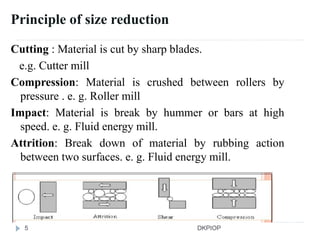
Principle of size reduction
Cutting : Material is cut by sharp blades.
e.g. Cutter mill
Compression: Material is crushed between rollers by
pressure . e. g. Roller mill
Impact: Material is break by hummer or bars at high
speed. e. g. Fluid energy mill.
Attrition: Break down of material by rubbing action
between two surfaces. e. g. Fluid energy mill.
5 DKPIOP
Mechanisms and laws
 The energy requirement for particle size reduction is a
function of input and output of particle size, harness,
strength and other properties of solids.
 Various theories for energy requirements are.
Rittinger’s Theory:
According to this theory energy E required for size
reduction of unit mass is directly proportional to the
new surface area produced.
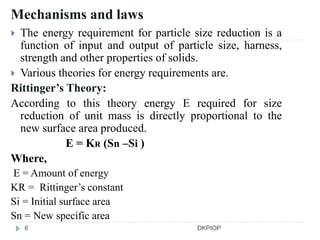
E = KR (Sn –Si )
Where,
E = Amount of energy
KR = Rittinger’s constant
Si = Initial surface area
Sn = New specific area
6 DKPIOP
Bond’s Theory
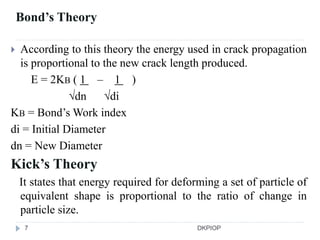
 According to this theory the energy used in crack propagation
is proportional to the new crack length produced.
E = 2KB ( 1 – 1 )
dn di
KB = Bond’s Work index
di = Initial Diameter
dn = New Diameter
Kick’s Theory
It states that energy required for deforming a set of particle of
equivalent shape is proportional to the ratio of change in
particle size.
7 DKPIOP
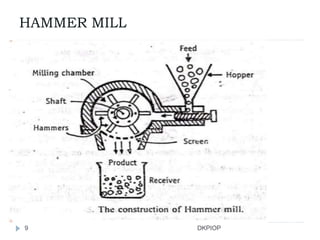
HAMMER MILL
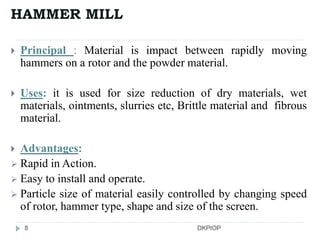
 Principal : Material is impact between rapidly moving
hammers on a rotor and the powder material.
 Uses: it is used for size reduction of dry materials, wet
materials, ointments, slurries etc, Brittle material and fibrous
material.
 Advantages:
 Rapid in Action.
 Easy to install and operate.
 Particle size of material easily controlled by changing speed
of rotor, hammer type, shape and size of the screen.
8 DKPIOP
HAMMER MILL
9 DKPIOP
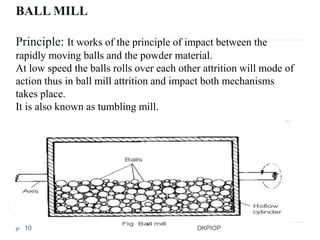
BALL MILL
Principle: It works of the principle of impact between the
rapidly moving balls and the powder material.
At low speed the balls rolls over each other attrition will mode of
action thus in ball mill attrition and impact both mechanisms
takes place.
It is also known as tumbling mill.
10 DKPIOP
Ball mill
 Uses:
 For fine grinding with particle size 100to 5mm
 For preparation of ophthalmic and parenteral product.
 For milling dyes, pigments and insecticides at low speed.
 Advantages
• It can produce very fine powder.
• Used for both wet and dry grinding.
• Toxic substances can be grounded, as cylinder is closed
system.
 Disadvantages:
• Very noisy machine.
• Soft fibrous material cannot be milled.
11 DKPIOP
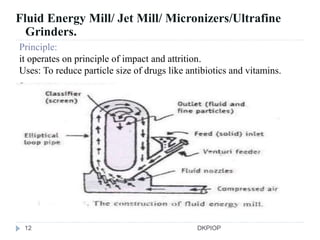
Principle:
it operates on principle of impact and attrition.
Uses: To reduce particle size of drugs like antibiotics and vitamins.
Fluid Energy Mill/ Jet Mill/ Micronizers/Ultrafine
Grinders.
12 DKPIOP
Construction and working of Fluid energy
mill
 It consist of loop of pipe with diameter 20 -200mm
depending on height up to 2 meter. In mill material is
suspended and conveyed at high velocity by air this mill
does not have any moving part.
 Working : the air or inert gas is introduced with very high
pressure through the nozzles.
 Solid are introduced to air stream through inlet.
 Due to high degree of turbulence, impact and attrition force
occurs between particles. The fine particles are collected
through classifier.
 Fluid energy mill reduces the particles to 1 to 20micron.
13 DKPIOP
Fluid energy mill
Advantages:
 Used to grind material to fine powder.
 The particle size of powder can be controlled due to the
use of a classifier.
 There is no wear of the mill and hence there is no
contamination of product.
 It is useful to grinding heat sensitive material such as
vitamins, antibiotics and sulphonamides.
14 DKPIOP
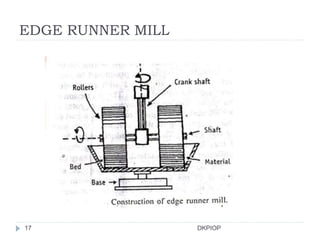
EDGE RUNNER MILL
 Principle: In this mill size reduction is done by crushing
due to heavy weight of stone and shearing force which is
involved during movement of stones.
Construction:
 It consist of two heavy rollers and bed made of stone or
granite.
 The rollers have a central shaft and they revolve on its
axis. The rollers are mounted on horizontal shaft and
move around the bed.
15 DKPIOP
EDGE RUNNER MILL
Working:
 The material to be ground is put on the bed and with the help of
scrapers it is kept in the path of the stone wheels.
 The materials is ground for a definite period and it is then passed
through the sieves to get required size.
Uses:
 It is used for grinding tough drugs to fine powder.
 It is used for plant based products.
 It does not require more attention during operation.
Disadvantages:
 Occupies more space,
 contamination of product may possible
 Not used for sticky materials.
16 DKPIOP
EDGE RUNNER MILL
17 DKPIOP
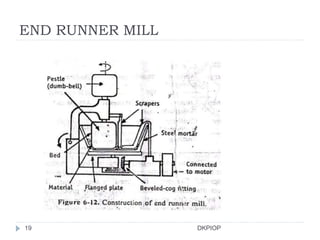
END RUNNER MILL
Principle:
 The material is getting crushed due to weight of heavy pestle
and shearing force which get applied during the movement of
those stones.
Construction and Working
 It can be considered as mechanical mortar pestle
 The mortar is shallow and bottom of pestle is flat rather than
round.
 It consist of bed of stone, vertical cylindrical dumb bell shaped
roll supported by horizontal shaft such that shaft rotated
friction between bed and stone grinding of material.
Uses: used to grind brittle and tough material.
18 DKPIOP
END RUNNER MILL
19 DKPIOP
Thank you …
20 DKPIOP

Size reduction- Advantages, factors affecting, hammer mill, ball mill

  • 1.
    SIZE REDUCTION B. PHARMACYSECOND YEAR BY- SHALINI K. DHAWALE D. K. PATIL INSTITUTE OF PHARMACY
  • 2.
    SIZE REDUCTION  Sizereduction is the process of reducing large solid units or substance into smaller unit mass, coarse particles or fine particles.  Size reduction process is also termed as comminution or diminution or pulverisation.  Process of size reduction:  Size reduction may be achieved by two methods: 1. Precipitation method 2. Mechanical process 2 DKPIOP
  • 3.
    Advantages of sizereduction  Content uniformity  Uniform flow  Effective extraction of drug  Effective drying  Improved physical stability  improved dissolution rate  Improved rte of absorption Disadvantages of size reduction Drug Degradation Contamination 3 DKPIOP
  • 4.
    Factors Affecting  Hardness Toughness  Abrasiveness  Stickiness  Softening temperature  Material structure  Moisture content  Physiological effects  Purity required  Bulk density  Ratio of feed size to product ratio 4 DKPIOP
  • 5.
    Principle of sizereduction Cutting : Material is cut by sharp blades. e.g. Cutter mill Compression: Material is crushed between rollers by pressure . e. g. Roller mill Impact: Material is break by hummer or bars at high speed. e. g. Fluid energy mill. Attrition: Break down of material by rubbing action between two surfaces. e. g. Fluid energy mill. 5 DKPIOP
  • 6.
    Mechanisms and laws The energy requirement for particle size reduction is a function of input and output of particle size, harness, strength and other properties of solids.  Various theories for energy requirements are. Rittinger’s Theory: According to this theory energy E required for size reduction of unit mass is directly proportional to the new surface area produced. E = KR (Sn –Si ) Where, E = Amount of energy KR = Rittinger’s constant Si = Initial surface area Sn = New specific area 6 DKPIOP
  • 7.
    Bond’s Theory  Accordingto this theory the energy used in crack propagation is proportional to the new crack length produced. E = 2KB ( 1 – 1 ) dn di KB = Bond’s Work index di = Initial Diameter dn = New Diameter Kick’s Theory It states that energy required for deforming a set of particle of equivalent shape is proportional to the ratio of change in particle size. 7 DKPIOP
  • 8.
    HAMMER MILL  Principal: Material is impact between rapidly moving hammers on a rotor and the powder material.  Uses: it is used for size reduction of dry materials, wet materials, ointments, slurries etc, Brittle material and fibrous material.  Advantages:  Rapid in Action.  Easy to install and operate.  Particle size of material easily controlled by changing speed of rotor, hammer type, shape and size of the screen. 8 DKPIOP
  • 9.
  • 10.
    BALL MILL Principle: Itworks of the principle of impact between the rapidly moving balls and the powder material. At low speed the balls rolls over each other attrition will mode of action thus in ball mill attrition and impact both mechanisms takes place. It is also known as tumbling mill. 10 DKPIOP
  • 11.
    Ball mill  Uses: For fine grinding with particle size 100to 5mm  For preparation of ophthalmic and parenteral product.  For milling dyes, pigments and insecticides at low speed.  Advantages • It can produce very fine powder. • Used for both wet and dry grinding. • Toxic substances can be grounded, as cylinder is closed system.  Disadvantages: • Very noisy machine. • Soft fibrous material cannot be milled. 11 DKPIOP
  • 12.
    Principle: it operates onprinciple of impact and attrition. Uses: To reduce particle size of drugs like antibiotics and vitamins. Fluid Energy Mill/ Jet Mill/ Micronizers/Ultrafine Grinders. 12 DKPIOP
  • 13.
    Construction and workingof Fluid energy mill  It consist of loop of pipe with diameter 20 -200mm depending on height up to 2 meter. In mill material is suspended and conveyed at high velocity by air this mill does not have any moving part.  Working : the air or inert gas is introduced with very high pressure through the nozzles.  Solid are introduced to air stream through inlet.  Due to high degree of turbulence, impact and attrition force occurs between particles. The fine particles are collected through classifier.  Fluid energy mill reduces the particles to 1 to 20micron. 13 DKPIOP
  • 14.
    Fluid energy mill Advantages: Used to grind material to fine powder.  The particle size of powder can be controlled due to the use of a classifier.  There is no wear of the mill and hence there is no contamination of product.  It is useful to grinding heat sensitive material such as vitamins, antibiotics and sulphonamides. 14 DKPIOP
  • 15.
    EDGE RUNNER MILL Principle: In this mill size reduction is done by crushing due to heavy weight of stone and shearing force which is involved during movement of stones. Construction:  It consist of two heavy rollers and bed made of stone or granite.  The rollers have a central shaft and they revolve on its axis. The rollers are mounted on horizontal shaft and move around the bed. 15 DKPIOP
  • 16.
    EDGE RUNNER MILL Working: The material to be ground is put on the bed and with the help of scrapers it is kept in the path of the stone wheels.  The materials is ground for a definite period and it is then passed through the sieves to get required size. Uses:  It is used for grinding tough drugs to fine powder.  It is used for plant based products.  It does not require more attention during operation. Disadvantages:  Occupies more space,  contamination of product may possible  Not used for sticky materials. 16 DKPIOP
  • 17.
  • 18.
    END RUNNER MILL Principle: The material is getting crushed due to weight of heavy pestle and shearing force which get applied during the movement of those stones. Construction and Working  It can be considered as mechanical mortar pestle  The mortar is shallow and bottom of pestle is flat rather than round.  It consist of bed of stone, vertical cylindrical dumb bell shaped roll supported by horizontal shaft such that shaft rotated friction between bed and stone grinding of material. Uses: used to grind brittle and tough material. 18 DKPIOP
  • 19.
  • 20.