Evaluation TechniquesEvaluation Techniques
INTRODUCTIONINTRODUCTION
Having defined the costs and benefits of a
project in terms of cash flows the focus
now shifts to the assessment of the
projects using the criteria discussed
further.
Appraisal MethodsAppraisal Methods
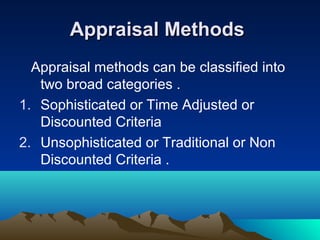
Appraisal methods can be classified into
two broad categories .
1. Sophisticated or Time Adjusted or
Discounted Criteria
2. Unsophisticated or Traditional or Non
Discounted Criteria .
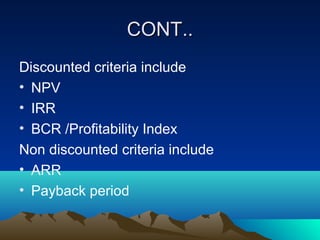
CONT..CONT..
Discounted criteria include
• NPV
• IRR
• BCR /Profitability Index
Non discounted criteria include
• ARR
• Payback period
Net present valueNet present value
The net present value represents the net benefit over and above the
compensation for time and risk .
Therefore the decision rule associated with the net present value
criteria.
• The proposal may be accepted if the net present value of the project
is positive.
• The proposal may be rejected if the net present value is negative.
• If the net present value is zero, it is a point of indifference .
However in practice ,it is rare if ever such a project is accepted such
a situation simply implies that only the original investment has been
recovered .
• If there are 2 or more mutually exclusive projects , the projects with
highest npv must be chosen.
NET PRESENT VALUE
n Ct
NPV = ∑ – Initial investment
t=1 (1 + rt )t
© Centre for Financial Management , Bangalore
NET PRESENT VALUE
The net present value of a project is the sum of the present value of all the cash
flows associated with it. The cash flows are discounted at an appropriate discount
rate (cost of capital)
Naveen Enterprise’s Capital Project ( Cost of Capital=15%)
Year Cash flow Discount factor Present
value
0 -100.00 1.000 -100.00
1 34.00 0.870 29.58
2 32.50 0.756 24.57
3 31.37 0.658 20.64
4 30.53 0.572 17.46
5 79.90 0.497 39.71
Sum = 31.96
Pros Cons
• Reflects the time value of money • Is an absolute measure and not a relative
• Considers the cash flow in its entirety measure
• Squares with the objective of wealth maximisation
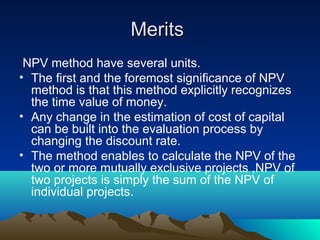
MeritsMerits
NPV method have several units.
• The first and the foremost significance of NPV
method is that this method explicitly recognizes
the time value of money.
• Any change in the estimation of cost of capital
can be built into the evaluation process by
changing the discount rate.
• The method enables to calculate the NPV of the
two or more mutually exclusive projects ,NPV of
two projects is simply the sum of the NPV of
individual projects.
CONT..CONT..
This method of asset selection helps in
achieving the objective of financial
management which is maximization of
shareholders wealth i.e. the decision rule
according to this is in conformity with the
principles of wealth maximization. In other
words NPV decision rule accepts only
those projects which enhance the market
value or has no change in the market
value.
DEFECTSDEFECTS
• The main drawback in this method is the
calculation of the required rate of return to
discount the cash flows .
• The discount rate is the most important
element used in calculation of the present
values because different discount rates
will give different present values. The
relative desirability of a proposal will
change with a change in discount rate.
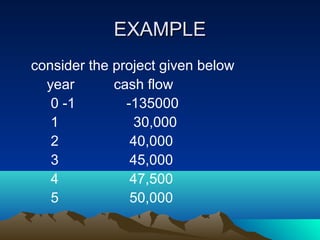
EXAMPLEEXAMPLE
consider the project given below
year cash flow
0 -1 -135000
1 30,000
2 40,000
3 45,000
4 47,500
5 50,000
CONT..CONT..
The net present value of the project with the cost
of capital 15% is 2,938.05 .
As the NPV is positive the project can be
accepted .however if the discount rate increased
by 1% to 16%. The NPV would be -542.34
based on which the project cannot be accepted
In general , the NPV of a conventional project
decreases if the discount rate increases .This is
so because when the discount rate increases
the discounting factors become smaller making
the present value of cash flows smaller .
CONT..CONT..
• Secondly it is an absolute measure.
Between two projects this method favors
projects which has higher NPV ,but it is
likely that this project may also involve a
larger initial outlay .Therefore in case of
projects involving different outlays ,the
present value may not give a dependable
results .
CONT..CONT..
For instance consider the same project x and y whose initial outlays
are Rs 1,35,000 and Rs 43000 respectively if the cost of capital is
15% both the projects yield approximately a NPV of 2938 .Based on
the NPV criteria both the projects are accepted ,when we assume
that the projects under study are mutually exclusive projects and
any one of the project has to be accepted the firm would be
indifferent as to the acceptance of the projects .
However it should be noted that the NPV of Rs 2938 lakh is on
investment of Rs 135000 if it is project x , but to yield the same NPV
in project y we need to put a investment of only 43000 Obviously
since the returns from both the projects are same in present value
terms project y with the smaller initial outlay would be preferred to
project x with a larger outlay.
CONT..CONT..
• Lastly the NPV method may not give satisfactory
results in the two projects having different
economic lives. In general the project with the
shorter project life would be preferable .It may
be likely that a project which has a higher
present value may also have a longer economic
life so that the funds will remain invested for
longer period ,while the alternative proposal may
have shorter life but smaller present value .
In such situation the present value method may
not reflect the worth of alternative proposals.
Benefit cost ratio/ profitability IndexBenefit cost ratio/ profitability Index
IT is time adjusted capital budgeting
technique and is some what similar to the
NPV method. While NPV is based on the
difference between the present value of
cash inflows and the present value of cash
outlays ,BCR measures the present value
of returns per rupee invested.
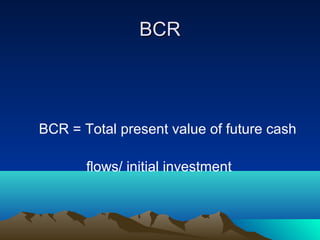
BCRBCR
BCR = Total present value of future cash
flows/ initial investment
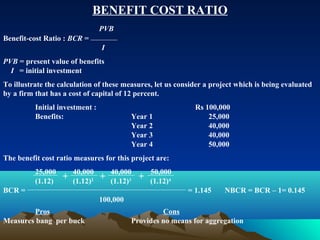
BENEFIT COST RATIO
PVB
Benefit-cost Ratio : BCR =
I
PVB = present value of benefits
I = initial investment
To illustrate the calculation of these measures, let us consider a project which is being evaluated
by a firm that has a cost of capital of 12 percent.
Initial investment : Rs 100,000
Benefits: Year 1 25,000
Year 2 40,000
Year 3 40,000
Year 4 50,000
The benefit cost ratio measures for this project are:
25,000 40,000 40,000 50,000
(1.12) (1.12)2
(1.12)3
(1.12)4
BCR = = 1.145 NBCR = BCR – 1= 0.145
100,000
Pros Cons
Measures bang per buck Provides no means for aggregation
+ + +
MERITSMERITS
Like the other discounted cash flows techniques
,the BCR satisfies almost all requirements of a
sound investment criteria .
All elements of capital budgeting namely time
value of money ,Totality of benefits etc are
considered .It is better evaluation technique than
the NPV in a situation of capital rationing . It is
superior to the NPV method as the former
evaluates the worth of project in terms of their
relative rather than absolute measures
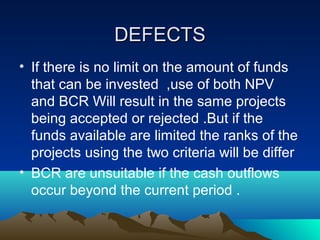
DEFECTSDEFECTS
• If there is no limit on the amount of funds
that can be invested ,use of both NPV
and BCR Will result in the same projects
being accepted or rejected .But if the
funds available are limited the ranks of the
projects using the two criteria will be differ
• BCR are unsuitable if the cash outflows
occur beyond the current period .
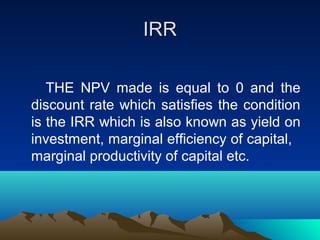
IRRIRR
THE NPV made is equal to 0 and the
discount rate which satisfies the condition
is the IRR which is also known as yield on
investment, marginal efficiency of capital,
marginal productivity of capital etc.
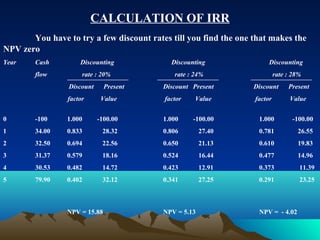
CALCULATION OF IRR
You have to try a few discount rates till you find the one that makes the
NPV zero
Year Cash Discounting Discounting Discounting
flow rate : 20% rate : 24% rate : 28%
Discount Present Discount Present Discount Present
factor Value factor Value factor Value
0 -100 1.000 -100.00 1.000 -100.00 1.000 -100.00
1 34.00 0.833 28.32 0.806 27.40 0.781 26.55
2 32.50 0.694 22.56 0.650 21.13 0.610 19.83
3 31.37 0.579 18.16 0.524 16.44 0.477 14.96
4 30.53 0.482 14.72 0.423 12.91 0.373 11.39
5 79.90 0.402 32.12 0.341 27.25 0.291 23.25
NPV = 15.88 NPV = 5.13 NPV = - 4.02
MERITSMERITS
• It consider the cash flows stream in its
entirety.
• Time value of money is considered .
• Helps in assessing the margin of safety in
a project i.e. it shows how much a project
is earning more than required.
• Variations in the cost of capital does not
change the ranking of projects based on
the IRR.
DEFECTSDEFECTS
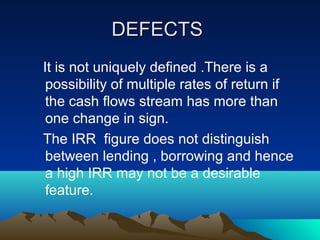
It is not uniquely defined .There is a
possibility of multiple rates of return if
the cash flows stream has more than
one change in sign.
The IRR figure does not distinguish
between lending , borrowing and hence
a high IRR may not be a desirable
feature.
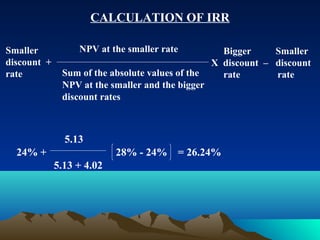
CALCULATION OF IRR
NPV at the smaller rate
Sum of the absolute values of the
NPV at the smaller and the bigger
discount rates
5.13
24% + 28% - 24% = 26.24%
5.13 + 4.02
Bigger Smaller
X discount – discount
rate rate
Smaller
discount +
rate
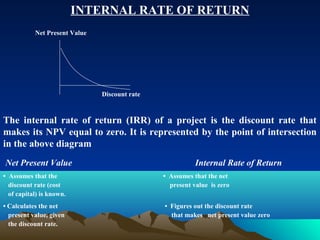
Discount rate
Net Present Value
INTERNAL RATE OF RETURN
The internal rate of return (IRR) of a project is the discount rate that
makes its NPV equal to zero. It is represented by the point of intersection
in the above diagram
Net Present Value Internal Rate of Return
• Assumes that the • Assumes that the net
discount rate (cost present value is zero
of capital) is known.
• Calculates the net • Figures out the discount rate
present value, given that makes net present value zero
the discount rate.
ARRARR
ARR referred to as the Average Rate of
Return or the Return On Investment ,is a
measure of profitability by relating income
to investment , both of which are
measured in accounting terms .
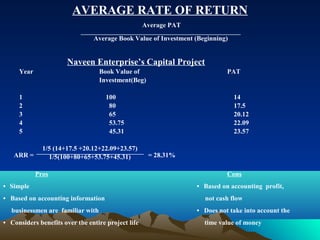
AVERAGE RATE OF RETURN
Average PAT
Average Book Value of Investment (Beginning)
Naveen Enterprise’s Capital Project
Year Book Value of PAT
Investment(Beg)
1 100 14
2 80 17.5
3 65 20.12
4 53.75 22.09
5 45.31 23.57
1/5 (14+17.5 +20.12+22.09+23.57)
1/5(100+80+65+53.75+45.31)
Pros Cons
• Simple • Based on accounting profit,
• Based on accounting information not cash flow
businessmen are familiar with • Does not take into account the
• Considers benefits over the entire project life time value of money
ARR = = 28.31%
MERITSMERITS
• It is simple to calculate and accounting
information is available readily .
• Benefits over the entire life of the project is
considered .
• Post auditing of capital expenditure is
facilitated because it is based on
accounting information.
DEMERITSDEMERITS
• IT is based on accounting profit ,not cash
flows.
• Time value of money is not considered.
• The ARR criteria does not differentiate
projects with respect to the size of
investment required for each project .

Evaluation techniques

  • 1.
  • 2.
    INTRODUCTIONINTRODUCTION Having defined thecosts and benefits of a project in terms of cash flows the focus now shifts to the assessment of the projects using the criteria discussed further.
  • 3.
    Appraisal MethodsAppraisal Methods Appraisalmethods can be classified into two broad categories . 1. Sophisticated or Time Adjusted or Discounted Criteria 2. Unsophisticated or Traditional or Non Discounted Criteria .
  • 4.
    CONT..CONT.. Discounted criteria include •NPV • IRR • BCR /Profitability Index Non discounted criteria include • ARR • Payback period
  • 5.
    Net present valueNetpresent value The net present value represents the net benefit over and above the compensation for time and risk . Therefore the decision rule associated with the net present value criteria. • The proposal may be accepted if the net present value of the project is positive. • The proposal may be rejected if the net present value is negative. • If the net present value is zero, it is a point of indifference . However in practice ,it is rare if ever such a project is accepted such a situation simply implies that only the original investment has been recovered . • If there are 2 or more mutually exclusive projects , the projects with highest npv must be chosen.
  • 6.
    NET PRESENT VALUE nCt NPV = ∑ – Initial investment t=1 (1 + rt )t © Centre for Financial Management , Bangalore
  • 7.
    NET PRESENT VALUE Thenet present value of a project is the sum of the present value of all the cash flows associated with it. The cash flows are discounted at an appropriate discount rate (cost of capital) Naveen Enterprise’s Capital Project ( Cost of Capital=15%) Year Cash flow Discount factor Present value 0 -100.00 1.000 -100.00 1 34.00 0.870 29.58 2 32.50 0.756 24.57 3 31.37 0.658 20.64 4 30.53 0.572 17.46 5 79.90 0.497 39.71 Sum = 31.96 Pros Cons • Reflects the time value of money • Is an absolute measure and not a relative • Considers the cash flow in its entirety measure • Squares with the objective of wealth maximisation
  • 8.
    MeritsMerits NPV method haveseveral units. • The first and the foremost significance of NPV method is that this method explicitly recognizes the time value of money. • Any change in the estimation of cost of capital can be built into the evaluation process by changing the discount rate. • The method enables to calculate the NPV of the two or more mutually exclusive projects ,NPV of two projects is simply the sum of the NPV of individual projects.
  • 9.
    CONT..CONT.. This method ofasset selection helps in achieving the objective of financial management which is maximization of shareholders wealth i.e. the decision rule according to this is in conformity with the principles of wealth maximization. In other words NPV decision rule accepts only those projects which enhance the market value or has no change in the market value.
  • 10.
    DEFECTSDEFECTS • The maindrawback in this method is the calculation of the required rate of return to discount the cash flows . • The discount rate is the most important element used in calculation of the present values because different discount rates will give different present values. The relative desirability of a proposal will change with a change in discount rate.
  • 11.
    EXAMPLEEXAMPLE consider the projectgiven below year cash flow 0 -1 -135000 1 30,000 2 40,000 3 45,000 4 47,500 5 50,000
  • 12.
    CONT..CONT.. The net presentvalue of the project with the cost of capital 15% is 2,938.05 . As the NPV is positive the project can be accepted .however if the discount rate increased by 1% to 16%. The NPV would be -542.34 based on which the project cannot be accepted In general , the NPV of a conventional project decreases if the discount rate increases .This is so because when the discount rate increases the discounting factors become smaller making the present value of cash flows smaller .
  • 13.
    CONT..CONT.. • Secondly itis an absolute measure. Between two projects this method favors projects which has higher NPV ,but it is likely that this project may also involve a larger initial outlay .Therefore in case of projects involving different outlays ,the present value may not give a dependable results .
  • 14.
    CONT..CONT.. For instance considerthe same project x and y whose initial outlays are Rs 1,35,000 and Rs 43000 respectively if the cost of capital is 15% both the projects yield approximately a NPV of 2938 .Based on the NPV criteria both the projects are accepted ,when we assume that the projects under study are mutually exclusive projects and any one of the project has to be accepted the firm would be indifferent as to the acceptance of the projects . However it should be noted that the NPV of Rs 2938 lakh is on investment of Rs 135000 if it is project x , but to yield the same NPV in project y we need to put a investment of only 43000 Obviously since the returns from both the projects are same in present value terms project y with the smaller initial outlay would be preferred to project x with a larger outlay.
  • 15.
    CONT..CONT.. • Lastly theNPV method may not give satisfactory results in the two projects having different economic lives. In general the project with the shorter project life would be preferable .It may be likely that a project which has a higher present value may also have a longer economic life so that the funds will remain invested for longer period ,while the alternative proposal may have shorter life but smaller present value . In such situation the present value method may not reflect the worth of alternative proposals.
  • 16.
    Benefit cost ratio/profitability IndexBenefit cost ratio/ profitability Index IT is time adjusted capital budgeting technique and is some what similar to the NPV method. While NPV is based on the difference between the present value of cash inflows and the present value of cash outlays ,BCR measures the present value of returns per rupee invested.
  • 17.
    BCRBCR BCR = Totalpresent value of future cash flows/ initial investment
  • 18.
    BENEFIT COST RATIO PVB Benefit-costRatio : BCR = I PVB = present value of benefits I = initial investment To illustrate the calculation of these measures, let us consider a project which is being evaluated by a firm that has a cost of capital of 12 percent. Initial investment : Rs 100,000 Benefits: Year 1 25,000 Year 2 40,000 Year 3 40,000 Year 4 50,000 The benefit cost ratio measures for this project are: 25,000 40,000 40,000 50,000 (1.12) (1.12)2 (1.12)3 (1.12)4 BCR = = 1.145 NBCR = BCR – 1= 0.145 100,000 Pros Cons Measures bang per buck Provides no means for aggregation + + +
  • 19.
    MERITSMERITS Like the otherdiscounted cash flows techniques ,the BCR satisfies almost all requirements of a sound investment criteria . All elements of capital budgeting namely time value of money ,Totality of benefits etc are considered .It is better evaluation technique than the NPV in a situation of capital rationing . It is superior to the NPV method as the former evaluates the worth of project in terms of their relative rather than absolute measures
  • 20.
    DEFECTSDEFECTS • If thereis no limit on the amount of funds that can be invested ,use of both NPV and BCR Will result in the same projects being accepted or rejected .But if the funds available are limited the ranks of the projects using the two criteria will be differ • BCR are unsuitable if the cash outflows occur beyond the current period .
  • 21.
    IRRIRR THE NPV madeis equal to 0 and the discount rate which satisfies the condition is the IRR which is also known as yield on investment, marginal efficiency of capital, marginal productivity of capital etc.
  • 22.
    CALCULATION OF IRR Youhave to try a few discount rates till you find the one that makes the NPV zero Year Cash Discounting Discounting Discounting flow rate : 20% rate : 24% rate : 28% Discount Present Discount Present Discount Present factor Value factor Value factor Value 0 -100 1.000 -100.00 1.000 -100.00 1.000 -100.00 1 34.00 0.833 28.32 0.806 27.40 0.781 26.55 2 32.50 0.694 22.56 0.650 21.13 0.610 19.83 3 31.37 0.579 18.16 0.524 16.44 0.477 14.96 4 30.53 0.482 14.72 0.423 12.91 0.373 11.39 5 79.90 0.402 32.12 0.341 27.25 0.291 23.25 NPV = 15.88 NPV = 5.13 NPV = - 4.02
  • 23.
    MERITSMERITS • It considerthe cash flows stream in its entirety. • Time value of money is considered . • Helps in assessing the margin of safety in a project i.e. it shows how much a project is earning more than required. • Variations in the cost of capital does not change the ranking of projects based on the IRR.
  • 24.
    DEFECTSDEFECTS It is notuniquely defined .There is a possibility of multiple rates of return if the cash flows stream has more than one change in sign. The IRR figure does not distinguish between lending , borrowing and hence a high IRR may not be a desirable feature.
  • 25.
    CALCULATION OF IRR NPVat the smaller rate Sum of the absolute values of the NPV at the smaller and the bigger discount rates 5.13 24% + 28% - 24% = 26.24% 5.13 + 4.02 Bigger Smaller X discount – discount rate rate Smaller discount + rate
  • 26.
    Discount rate Net PresentValue INTERNAL RATE OF RETURN The internal rate of return (IRR) of a project is the discount rate that makes its NPV equal to zero. It is represented by the point of intersection in the above diagram Net Present Value Internal Rate of Return • Assumes that the • Assumes that the net discount rate (cost present value is zero of capital) is known. • Calculates the net • Figures out the discount rate present value, given that makes net present value zero the discount rate.
  • 27.
    ARRARR ARR referred toas the Average Rate of Return or the Return On Investment ,is a measure of profitability by relating income to investment , both of which are measured in accounting terms .
  • 28.
    AVERAGE RATE OFRETURN Average PAT Average Book Value of Investment (Beginning) Naveen Enterprise’s Capital Project Year Book Value of PAT Investment(Beg) 1 100 14 2 80 17.5 3 65 20.12 4 53.75 22.09 5 45.31 23.57 1/5 (14+17.5 +20.12+22.09+23.57) 1/5(100+80+65+53.75+45.31) Pros Cons • Simple • Based on accounting profit, • Based on accounting information not cash flow businessmen are familiar with • Does not take into account the • Considers benefits over the entire project life time value of money ARR = = 28.31%
  • 29.
    MERITSMERITS • It issimple to calculate and accounting information is available readily . • Benefits over the entire life of the project is considered . • Post auditing of capital expenditure is facilitated because it is based on accounting information.
  • 30.
    DEMERITSDEMERITS • IT isbased on accounting profit ,not cash flows. • Time value of money is not considered. • The ARR criteria does not differentiate projects with respect to the size of investment required for each project .