 Marketing means such a perfect understanding of
the customers that the product/service fits him
totally & sell itself.
Peter. F Drucker
 Process of planning & executing the conception,
pricing, promotion & distribution of ideas, goods
& services to create exchanges to satisfy
individuals & organisational goals.
 The art & Science of choosing target markets and
getting, keeping & growing customers through
creating, delivering & communicating superior
customer value.
 Entrepreneurial Marketing.
 Formulated Marketing.
 Intrepreneurial Marketing.
 Wit Feeling.
 Opportunity of Self Visualisation.
 Aggressive Marketing Practices.
 Approaching every door to acquire attention.
 Set Policies & Procedures.
 Defined path of proceeding.
 Settled ways.
 Stucked Formulated Marketing techniques
 Lack of creativity/Passion.
 Stagnant Visualisation
 Goods
 Services
 Experiences
 Events
 Persons
 Places
 Properties
 Organisations
 Information
 Ideas
 Production Concept.
 Product Concept.
 Selling Concept.
 Marketing Concept.
 Societal Marketing Concept.
 Widely available
 Low cost
 Mass distribution
 Highly innovative
 Most quality
 High performance
 Best features
 Aggressive Selling.
 High Promotional Efforts.
 For unsought goods.
 Understand Target Market
 Consider customer first
 Get Customer needs/Demands
 Know Customer value
 Integrated Marketing
 Environment Consideration
 Resource Management
 Social consideration
 Ethical Values
 Difference between prospective customer
evaluation of all product’s benefits & the total cost
of the product.
 Perceived monetary value of the sum total of
economic, functional & psychological benefits a
customer expect from the market
 Sum total of costs a customer expects to incur in
evaluating, obtaining, using & disposing of the
given market offering.
Satisfaction
Person’s feeling of pleasure or disappointment
resulting from comparing a product’s perceived
performance (outcome) in relation with his
expectations.
 Focus shift from Partner relationship
Management to Customer relationship
Management
 Developing advertisements (in-house/Ad
agencies)
 Mailing or personal phone.
 Participating in trade shows, fairs, events
 Identify Hot, Warm & cold prospective.
 Conversion of prospects into sales
To control high customer shift/churn
 Define & measure retention rate.
 Identify the cause of attrition.
 Measure the profit the company’s loses when
attrition is high.
Facts about Acquiring & retaining a customer:-
 Acquiring a customer is 5 times expensive than
satisfying the existing one.
 On an average companies lose, 10% of customers
every year.
 A 5% reduction in customer attrition may
increase the profit rate by 25-85%.
Source-ICFAI centre of Management Research. Ref no-MM-052K425
 Increased Revenue
 Decrease in Cost of selling.
 Advertisements.
 Cross selling possibilities. (Potential customer for
Company’s other offerings)
 The present value of the stream of future profits
expected over the customer’s lifetime purchases
 Difference between the benefits a customer
derives & the cost to acquire that product/service.
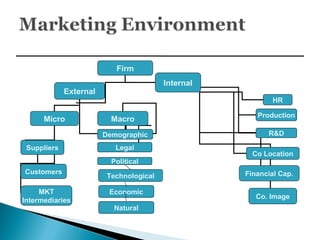
Firm
Internal
External
HR
Production
Financial Cap.
Co Location
R&D
Co. Image
MacroMicro
Suppliers
Customers
MKT
Intermediaries
Demographic
Legal
Political
Technological
Economic
Natural
 HR.
 Production.
 R & D.
 Co. Location
 Financial capabilities.
 Co. Image
 Suppliers
 Customers
 Intermediaries (Wholesaler, Retailer)
 Demographic
 Legal
 Political
 Technological
 Socio-Cultural
 Economic
 Natural
Study of Human population
 Size/Group
 Growth/occupation
 Density
 Gender
 Marital status
 Education level/literacy
 The laws & regulations of a country.
 Legislation.
 Acts.
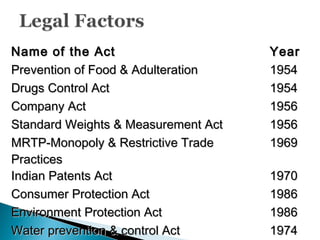
Name of the ActName of the Act YearYear
Prevention of Food & AdulterationPrevention of Food & Adulteration 19541954
Drugs Control ActDrugs Control Act 19541954
Company ActCompany Act 19561956
Standard Weights & Measurement ActStandard Weights & Measurement Act 19561956
MRTP-Monopoly & Restrictive TradeMRTP-Monopoly & Restrictive Trade
PracticesPractices
19691969
Indian Patents ActIndian Patents Act 19701970
Consumer Protection ActConsumer Protection Act 19861986
Environment Protection ActEnvironment Protection Act 19861986
Water prevention & control ActWater prevention & control Act 19741974
 Govt Policies:-
 Domestic Politics.
 International Politics.
Technology refers to use of scientific knowledge &
tools to solve specific problems & perform tasks in
an effective/efficient manner.
 Product (Better design, Quality).
 Price (Reduce Cost).
 Promotion /Advertising (Revolutionized way of
communication-Media).
 Distribution (Bringing Market closer)
Refers to individual’s
 Attitude
 Beliefs
 Norms
 Values
 Lifestyles
 ED measured by Gross Domestic Product.
 Economic Forces impact on Marketers &
Customers.
 Fluctuation (Recession, Depression & Recovery)
affects Firm & Customer.
 Buying power depends upon the availability of
financial resources
 Natural Resources. (Water, Air, Etc)
 Climatic Condition (Weather).
 Pollution
Agenda:-
•Factors influencing Consumer Buying Behavior
•Buying Decision
•Buying decision Process
 Study of how individuals make decision to spend
their valuable resources (time, money & efforts)
on consumption related items.
 Cultural Factors
1.Culture (value, beliefs, behavior, concepts to
common)
2.Subculture (culture followed by group of people)
3.Social class (upper, upper-middle, middle, lower
middle, lower)
 Social factors (Reference group, Family)
 Personal factors (age, occupation & financial
status, lifestyles)
 Psychological Factors (motivation, perception,
attitude)
 Initiator
 Influencer
 Decider
 Buyer
 User
 Maintainer
 Disposer
 Extensive problem solving buying behavior
 Routinized buying behavior
 Variety seeking behavior
 Problem/ need identification
 Information search
 Evaluation of alternatives
 Purchase decision
 Post purchase behavior
Agenda:-
•Concept of OBB
•Difference between Orgz Mkt & Consumer Market
•Classification of Organizational Mkt
•Factors influencing Organisational Buying/ Participants
•Stages of buying
 Organisational buying involves deep & thorough
analysis.
 Products ranging from highly complex machinery
to small components.
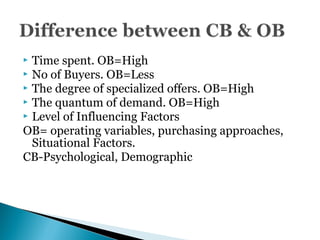
 Time spent. OB=High
 No of Buyers. OB=Less
 The degree of specialized offers. OB=High
 The quantum of demand. OB=High
 Level of Influencing Factors
OB= operating variables, purchasing approaches,
Situational Factors.
CB-Psychological, Demographic
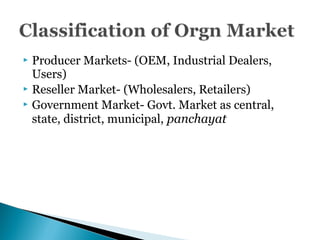
 Producer Markets- (OEM, Industrial Dealers,
Users)
 Reseller Market- (Wholesalers, Retailers)
 Government Market- Govt. Market as central,
state, district, municipal, panchayat
 Environmental-Climatic conditions, Geographic,
Legal,political, Technological, Cultural.
 Organisational:-Systems, procedure, rules,
regulation.
 Social & Personal
 Initiator
 Influencers
 Deciders (Authority to buy)
 Approvers (Authority to implement)
 Buyers
 Users
 Gatekeepers (control the flow of
products/Services)
 Problem recognition
 General need recognition (Quantum)
 Product specification
 Searching of potential Suppliers/ Multiple
sourcing
 Value analysis
 Vendor analysis
 Order routine analysis
 Performance Review
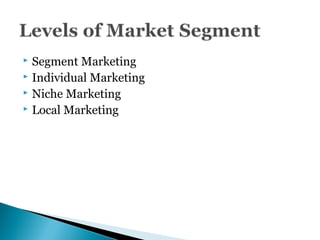
 Segment Marketing
 Individual Marketing
 Niche Marketing
 Local Marketing
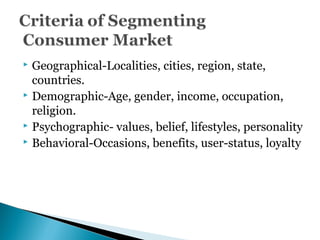
 Geographical-Localities, cities, region, state,
countries.
 Demographic-Age, gender, income, occupation,
religion.
 Psychographic- values, belief, lifestyles, personality
 Behavioral-Occasions, benefits, user-status, loyalty
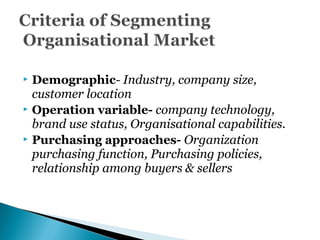
 Demographic- Industry, company size,
customer location
 Operation variable- company technology,
brand use status, Organisational capabilities.
 Purchasing approaches- Organization
purchasing function, Purchasing policies,
relationship among buyers & sellers
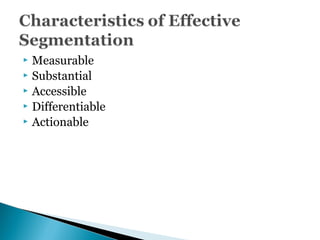
 Measurable
 Substantial
 Accessible
 Differentiable
 Actionable
 Evaluation of Market Segment
 Selecting the Market Segment
1. Single segment concentration-Mercedes
2. Selective specialization-Hyundai-santro,
accent, sonata.
3. Product specialization-Gillette
4. Market specialization-Ordinance factory
5. full Market coverage-Hewlett-
Packard(Rs.3000 small office to home to
heavy duty color printersRs.1000000)
 Ethical choice of market region
 Segment interrelationships & super segments
(Supermarket-groceries, apparels, food, toys, etc)
 Segment by segment invasion plans-Ceat
 Inter-segment Cooperation
Agenda:
•Product differentiation
•Service differentiation
•Personal differentiation
•Channel Differentiation
•Image Differentiation
•Positioning
•Product development life cycles/ strategies
 Process by which companies manufacture &
design the products such a way that makes
customers perceives them as different from those
manufacture by other companies
 On the bases of Product form (size, shape, physical
attributes), design, features, size of package,
quality, Durability.
 On the bases of Customer Service:-
1. Ordering ease
2. Delivery
3. Installation
4. Guarantees/warranties
5. Financial arrangements
6. Customer Training
7. Maintenance / Repairing
8. Disposal
 On the bases of the personnel company has
employed
1. Competence (Possessing the right knowledge &
Skills)
2. Courteousness (Friendly, Respectful,
Considerate)
3. Credibility (Trustworthy)
4. Reliability
5. Responsiveness
 On the bases of distribution channel
1. Coverage
2. Availability
3. Expertise
4. performance
 On the bases of the name, goodwill, brand,
Image.
1. Company’s Management. (CSR, Ethics)
2. Symbols/Logos
3. Atmosphere (Ambience, Lighting, Furnishing)
4. Events
 Its what you do to the mind of the customers.
 Refers to all those activities undertaken by a
marketer to create & maintain the concept of value
regarding its brand in the minds of customers as
against competitors
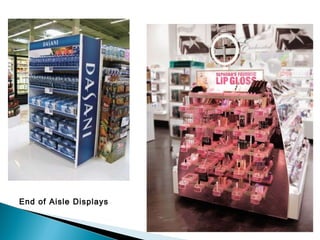
End of Aisle Displays
 Getting into the mind of customer.
 Positioning of a leader.
 Positioning of a follower
 Repositioning the competition. (Sumo Vs Qualis)
 The power of a name. (suitable name-Uncle
Chipps, Timex, Speed, Head & shoulders)
 Under-positioning: Think Small-Volkswagen,
Volvo’s-Drive Safely
 Over-positioning: (Premium Brand)-Tanishq
Jewellery
 Doubtful Positioning-fail to understand what
customers actually want. Le sancy as long lasting
instead of freshness, mildness.
 Confused Positioning- Crystal Pepsi
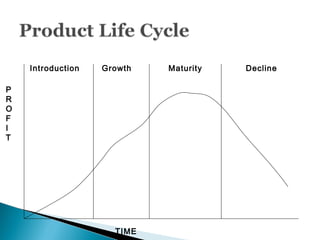
Introduction Growth Maturity Decline
P
R
O
F
I
T
TIME
 Rapid Skimming
Marketer launch the product at higher price with high
Promotion.
 Slow Skimming
Marketer launch the product at higher price with low
Promotion.
 Rapid Penetration
Marketer launch the product at lower price with high
Promotion.
 Restoration of Aggressive pricing, including price
cuts
 Emphasize on Product’s benefits in order to create
a competitive niche
 Enhanced product quality, new features
 New Distribution Channels, New Market
 Abandon weaker products & concentrate more on
profitable products
 Increase promotional efforts, fresh advertisement
campaign, new packaging
 Invest more into R&D to bring about
improvements in the product
 Reducing the no of product- especially those who
are not profitable now
 Cutting promotional budgets & prices
 Cutting down distribution channels with poor
sales.
Agenda:
•Dimensions of New product development
•Stages of new product development
 New to the world
 New Product Lines
 Addition to the existing lines
 Improvement of existing products
 Repositioning
 Cost Reduction
 Idea Generation
 Idea Screening
 Concept testing & analysis
 Product Development
 Test Marketing
 Commercialization
 The act of searching the new idea is Idea
Generation.
 Collection of large no of ideas.
 Sources-Customers, Retailers, wholesaler,
supplier, external.
 Since all ideas are not commercially viable
 Filtration of ideas from the large pool
 Parameters like technical abilities, Market size,
potential competition, compatibility with
existing customers, etc
 Division on the bases of:-
1. Prospective Idea
2. Marginal Idea
3. Rejection
 Submission of idea is submitted for an external
evaluation to get the feedback from the market
in terms of quality, price, attributes, Unique
benefits etc.
 Helps in:-
1. Selecting the strongest concept
2. Eliminating the un-approved concept
3. Determining the desired features of the product
 A working model or prototype is made.
 Testing:-
1. Alpha
2. Beta
3. Gamma
 Product is introduced in few selected market.
 Co bears the following
1. High ad cost
2. High manufacturing cost
3. High distribution cost
 Alteration been made in context of Amount of
production, selection of market, price, Quality
shift, customer preferences.
 Rolling out the product in the entire target market
Agenda:
1. Defining strategic market Planning
2. Scope
3. Process
4. Strategic Marketing planning
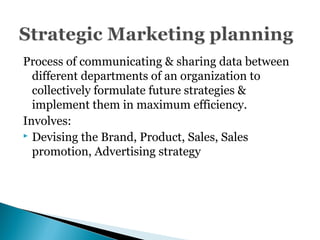
Process of communicating & sharing data between
different departments of an organization to
collectively formulate future strategies &
implement them in maximum efficiency.
Involves:
 Devising the Brand, Product, Sales, Sales
promotion, Advertising strategy
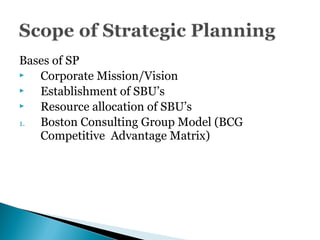
Bases of SP
 Corporate Mission/Vision
 Establishment of SBU’s
 Resource allocation of SBU’s
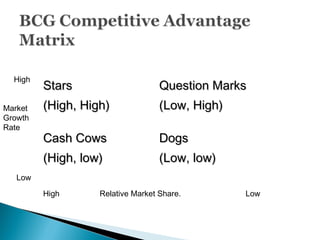
1. Boston Consulting Group Model (BCG
Competitive Advantage Matrix)
StarsStars
(High, High)(High, High)
Question MarksQuestion Marks
(Low, High)(Low, High)
Cash CowsCash Cows
(High, low)(High, low)
DogsDogs
(Low, low)(Low, low)
High Relative Market Share. Low
High
Low
Market
Growth
Rate
Vision statement/Mission/goals & Objectives
 SWOT Analysis
 Strategies
 Strategic Alliances
1. Acquisitions/Mergers
 Implementation
 Feed back & Control
 Analyzing the marketing opportunities
 Developing Marketing strategies
 Planning Marketing Programmes
 Managing The marketing efforts
Agenda:
Concept of Competitive Advantage
Porter’s Five forces Model
Porter’s Generic Competitive Strategies/Designing
Total Quality Management
 Critical advantage a firm possesses in the market
over its competitors.
 Types:
1. Cost Advantage. (Same value at lower price)
2. Differentiation Advantage. (superior value)
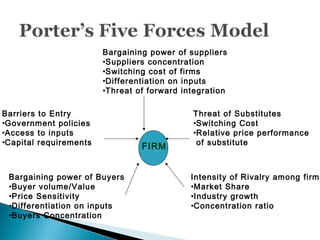
Bargaining power of suppliers
•Suppliers concentration
•Switching cost of firms
•Differentiation on inputs
•Threat of forward integration
Barriers to Entry
•Government policies
•Access to inputs
•Capital requirements
Threat of Substitutes
•Switching Cost
•Relative price performance
of substitute
Bargaining power of Buyers
•Buyer volume/Value
•Price Sensitivity
•Differentiation on inputs
•Buyers Concentration
Intensity of Rivalry among firms
•Market Share
•Industry growth
•Concentration ratio
FIRM
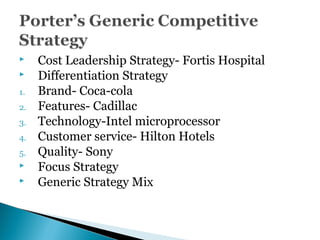
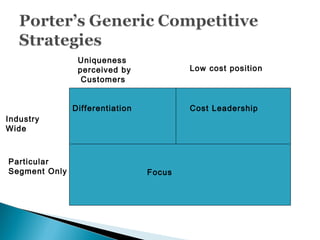
 Cost Leadership Strategy- Fortis Hospital
 Differentiation Strategy
1. Brand- Coca-cola
2. Features- Cadillac
3. Technology-Intel microprocessor
4. Customer service- Hilton Hotels
5. Quality- Sony
 Focus Strategy
 Generic Strategy Mix
Differentiation Cost Leadership
Focus
Particular
Segment Only
Industry
Wide
Low cost position
Uniqueness
perceived by
Customers
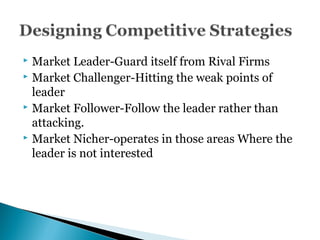
 Market Leader-Guard itself from Rival Firms
 Market Challenger-Hitting the weak points of
leader
 Market Follower-Follow the leader rather than
attacking.
 Market Nicher-operates in those areas Where the
leader is not interested
Agenda:-
•Product Personality
•Product Nature/Classification
•Product Policy
•Product life cycle
 The components of product convey different
meanings to the different customers & project a
distinctive image of the product in the customer’s
eye
 These meanings & Image contribute to the
formation of the Product Personality
 Core Features
 Associated Features
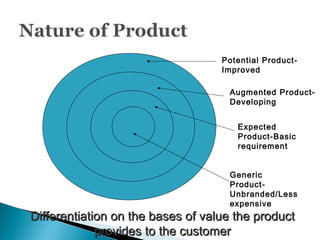
Potential Product-
Improved
Augmented Product-
Developing
Expected
Product-Basic
requirement
Generic
Product-
Unbranded/Less
expensive
Differentiation on the bases of value the productDifferentiation on the bases of value the product
provides to the customerprovides to the customer
 Tangibility & Durability-
1. Durable- Long period
2. Non durable- Short period
3. Services
 Usage
1. Consumer Goods-
Convenience/Shopping/Unsought/Specialty
2. Industrial Goods
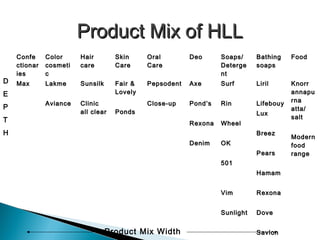
 Product Mix
1. Length-Total no of Items in the portfolio.
2. Width-Total no of product line in portfolio. In
HLL its 9
3. Depth-Assortment of product in sizes, colors,
variations etc
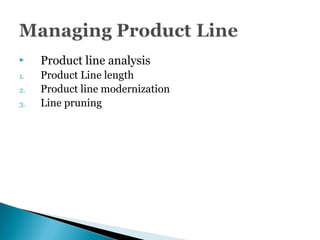
 Product line analysis
1. Product Line length
2. Product line modernization
3. Line pruning
ConfeConfe
ctionarctionar
iesies
ColorColor
cosmeticosmeti
cc
HairHair
carecare
SkinSkin
CareCare
OralOral
CareCare
DeoDeo Soaps/Soaps/
DetergeDeterge
ntnt
BathingBathing
soapssoaps
FoodFood
MaxMax LakmeLakme
AvianceAviance
SunsilkSunsilk
ClinicClinic
all clearall clear
Fair &Fair &
LovelyLovely
PondsPonds
PepsodentPepsodent
Close-upClose-up
AxeAxe
Pond’sPond’s
RexonaRexona
DenimDenim
SurfSurf
RinRin
WheelWheel
OKOK
501501
VimVim
SunlightSunlight
LirilLiril
LifebouyLifebouy
LuxLux
BreezBreez
PearsPears
HamamHamam
RexonaRexona
DoveDove
SavlonSavlon
KnorrKnorr
annapuannapu
rnarna
atta/atta/
saltsalt
ModernModern
foodfood
rangerange
Product Mix Width
D
E
P
T
H
Product Mix of HLLProduct Mix of HLL
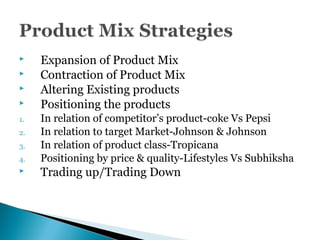
 Expansion of Product Mix
 Contraction of Product Mix
 Altering Existing products
 Positioning the products
1. In relation of competitor’s product-coke Vs Pepsi
2. In relation to target Market-Johnson & Johnson
3. In relation of product class-Tropicana
4. Positioning by price & quality-Lifestyles Vs Subhiksha
 Trading up/Trading Down
 Brand as a concept
 Types of Brands & its challenge
 Brand Equity
 Sponsorship
 Brand strategy decision
 New developments in brand Management
 Packaging
 Labeling
 Offerings from a known name
 A name , term, sign, symbol, design or the
combination of all these three
 It conveys the following:-
Attributes
1. Benefits
2. Values
3. Culture
4. Personality
5. User
 Manufacturer’s Brand-Branded directly by the
manufacturer
 Private/ Reseller Brand-Developed & owned by
reseller
 Generic brands-not specifically advertised by
sellers.
 Combination of assets & liabilities associated that
brand that enhances/ depreciates the value of
brand.
 It has five major determinants:-
Awareness, quality perception, loyalty, patents &
trademarks
 A form of publicity which is done to support/ link
organization's name with a particular event, most
commonly, sporting events or an activity which
evolves large number of public gathering
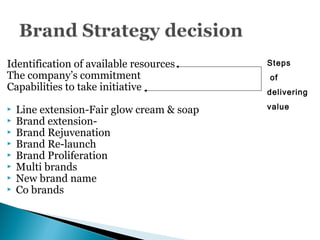
Identification of available resources
The company’s commitment
Capabilities to take initiative
 Line extension-Fair glow cream & soap
 Brand extension-
 Brand Rejuvenation
 Brand Re-launch
 Brand Proliferation
 Multi brands
 New brand name
 Co brands
Steps
of
delivering
value
 Process of the developing a design & a container
for the product.
 A secured, transparent & easy-to-use packaging
helps in having the better sales
 To attract the attention of the customer
 Communicates through verbal & non-verbal tools
 Highlight the utility of the product
 Informs about the content about the product
 Agenda
1. Price & non price competition
2. The process of setting prices
3. Adapting the price
4. Adopting price change
5. Approaches of Price Adjustment
 Price Competition
 Non-price Competition
 Setting price objectives- Survival/ Profit/ ROI/
Market Share/ Status Quo/ Product Quality
 Factors affecting demand differentiation- Price
sensitivity
 Estimating Costs
 Analyzing competitor’s pricing
 Selection of pricing method
Mark up/ Target return/ perceived value/ Going rate/
sealed bid/ Differentiated/ Value/ Market skimming/
Penetrate.
 Selection of pricing policy
Psychological/ transfer
Geographical Pricing
 Cash,
 Counter trade
1. Barter- goods apart from cash
2. Compensation deal- some cash some goods
3. Buy back agreement- some cash some products
manufacture by that plant, technology etc
4. Offset-seller receives full cash but agrees to invest
certain amount in buyer’s country with in stated time
period
 Initiating price cuts
1. Low quality trap
2. Fragile market share trap
3. Shallow pocket trap
 Initiating price increase
 Geographical Pricing
 Promotional Pricing
 Discriminatory Pricing
 Discounts & Allowances
 Experience Curve Pricing
 Product mix Pricing
 Product Line pricing
 Optional features pricing
 Captive product pricing
 Two Part Pricing
 By Product Pricing
 Product Bundled Pricing
Agenda
 Nature of Marketing channels
 Role of Marketing channels
 Designing Distribution Channels
 Channel management
 Multi-channel Marketing System
 Channels Conflict
 A channels facilitates the transfer of ownership &
the physical exchange of products & service.
 Once established, the channels should be adjusted
according to the need of the customers
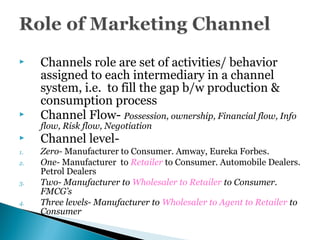
 Channels role are set of activities/ behavior
assigned to each intermediary in a channel
system, i.e. to fill the gap b/w production &
consumption process
 Channel Flow- Possession, ownership, Financial flow, Info
flow, Risk flow, Negotiation
 Channel level-
1. Zero- Manufacturer to Consumer. Amway, Eureka Forbes.
2. One- Manufacturer to Retailer to Consumer. Automobile Dealers.
Petrol Dealers
3. Two- Manufacturer to Wholesaler to Retailer to Consumer.
FMCG’s
4. Three levels- Manufacturer to Wholesaler to Agent to Retailer to
Consumer
 Intensive Distribution- Manufacturer distributes
the goods through many outlets to provide ease of
location.
 Exclusive Distribution- Limited number of
Intermediaries between manufacturer &
Consumer.
 Analyzing customer expectations of Service
output- lot size, convenience, selection, service
 Formulating Objective
 Evaluation of Distribution Environment
 Evaluating channel Alternatives- economic, control,
adaptive criteria

 Channel member selection
 Channel member training
 Member motivation & Evaluation
 Modifying Channel Arrangement
 Where a firms chooses two or more marketing
channel to reach more n more segmented markets.
 Firms tries to achieve wider market coverage,
lower distribution costs, etc
 Ideally firms try to control the businesses of
suppliers & intermediaries.
 Due to constraints like time, money & other
resources its not feasible
 Vertical conflict- when channel members
operating at different level compete for same
market share
 Horizontal channels conflicts- when channel
members operating at same level compete for
same market share.
 Multi channel conflicts- when firms established
two or more channel. e.g. showrooms & factory
outlet
 Negotiation
 Problem-solving strategies
 Persuasive mechanism- give & take
 Legalization strategies
 Cooperation & coordination
 One who sells to other middlemen, institutions &
industrial buyers, usually in fairly large quantities
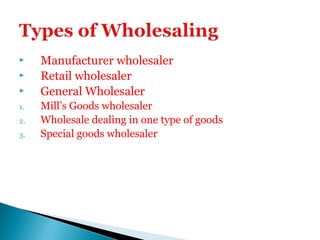
 Manufacturer wholesaler
 Retail wholesaler
 General Wholesaler
1. Mill’s Goods wholesaler
2. Wholesale dealing in one type of goods
3. Special goods wholesaler
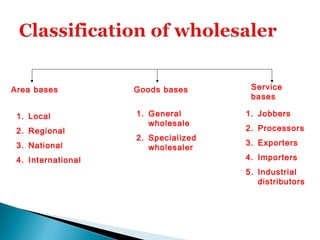
Area bases Goods bases Service
bases
1. Local
2. Regional
3. National
4. International
1. General
wholesale
2. Specialized
wholesaler
1. Jobbers
2. Processors
3. Exporters
4. Importers
5. Industrial
distributors
 Assembling & buying
 Storing or warehousing
 Transporting
 Financing
 Risk bearing
 Providing Market Information
 Dispersing & selling
 Increase in price
 Obstruction in smooth flow of goods
 Interest in many products
 Manipulation of prices
 Large scale retailing
 Trade in small quantities of goods of diverse
nature which is concerned with selling goods to
the final consumers.
 Trade in variety of goods
 Purchase in small quantities
 Sales direct to consumers
 Need of Less capital
 Situated near to consumers
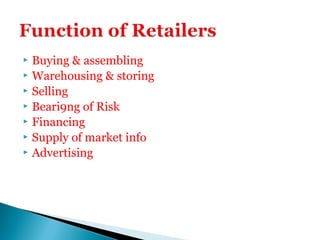
 Buying & assembling
 Warehousing & storing
 Selling
 Beari9ng of Risk
 Financing
 Supply of market info
 Advertising
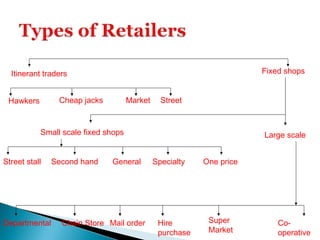
Itinerant traders Fixed shops
Cheap jacks Market StreetHawkers
Small scale fixed shops
Street stall Second hand General Specialty One price
Departmental Chain Store Mail order Hire
purchase
Super
Market
Co-
operative
Large scale
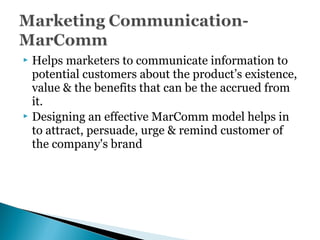
 Helps marketers to communicate information to
potential customers about the product’s existence,
value & the benefits that can be the accrued from
it.
 Designing an effective MarComm model helps in
to attract, persuade, urge & remind customer of
the company's brand
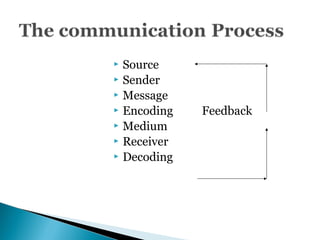
 Source
 Sender
 Message
 Encoding Feedback
 Medium
 Receiver
 Decoding
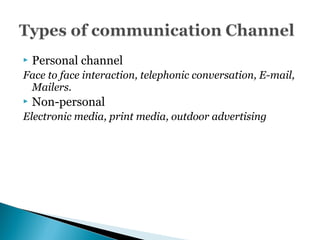
 Personal channel
Face to face interaction, telephonic conversation, E-mail,
Mailers.
 Non-personal
Electronic media, print media, outdoor advertising
 Advertising- Paid form of non-personal
presentation of goods & services by an identified
sponsor
 Sales promotions- Attracting the consumers by
offering them various benefits in the form of
incentives/ adding values to the products.
 Publicity- Non paid form of communicating info
about the company for the product/ company or
both.
 Public Relation- Function of the organization
tends to maintain the goodwill in the market
 Direct Marketing- Organisation communicate
directly with the customer through mail/
telemarketing/ internet
 Personal Selling- selling the product or service
directly to the consumer with face to face
interaction by explaining/ demonstrating them
the features.
 Target audience identification.
 Image analysis
 Determination of communication objective-
1. Awareness 2. knowledge
3. Liking 4. preference
5. Conviction/ Confidence 6. purchase
 Developing Marcom budget-
1. Objective & task method 2. Competitive parity method
3. Percentage sales method 3. Affordable method
 Message content
1. Rational appeal
2. Moral appeal
 Structure
 Format
 Source
 Product Market Type- consumer market,
industrial market.
 Pull-Push strategy
1. Pull strategy-all promotional efforts are directly
towards influencing the customers hence distributors
pull the product from the manufacturers.
2. Push strategy= all promotional efforts are directly
towards the intermediaries hence intermediaries are
motivated by high discounts, special rewards,
recognition.
 The product life Cycle
1. Introduction stage- informs customers through
publicity, advertising, sales promotion strategy.
2. Growth stage- by differentiating them from competitor’s
products/ services
3. Maturity stage- Reminding customer about the presence
of the product in the market. Discounts schemes, etc
4. Decline stage- cost cutting, decreased budget allocation
are considered
 Effectiveness of advertising
Agenda:
•Benefits of Advertising
•Developing an advertisement programme
•ATL, BTL & TTL
•Approaches to create Ad Message
 Creates awareness, interest & Desires for the
offerings in the market
 Message can be repeated several times therefore
creating an impact over the mind of customer.
 Advertising a product in a certain way can add to
its value.
 Boosting the sales of the company
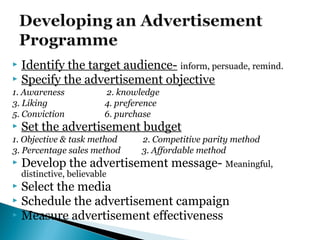
 Identify the target audience- inform, persuade, remind.
 Specify the advertisement objective
1. Awareness 2. knowledge
3. Liking 4. preference
5. Conviction 6. purchase
 Set the advertisement budget
1. Objective & task method 2. Competitive parity method
3. Percentage sales method 3. Affordable method
 Develop the advertisement message- Meaningful,
distinctive, believable
 Select the media
 Schedule the advertisement campaign
 Measure advertisement effectiveness
 Promotional activities carried out through mass
media, such as television, radio and newspaper,
are classed as "above the line" promotion.
 ATL promotions are tailored for a mass audience
 ATL promotions can establish brand identity.
 ATL promotions are also difficult to measure well.
 "Below the line" promotion refers to forms of non-
media communication or advertising.
 BTL promotions are targeted at individuals
according to their needs or preferences.
 BTL can actually lead to a sale.
 BTL promotions are highly measurable, giving
marketers valuable insights into their return-on-
investment.
 "Through the line" refers to an advertising
strategy involving both above and below the line
communications in which one form of
advertising points the target to another form of
advertising thereby crossing the "line”.
 Comparative Advertising
 Inoculative Advertising- Highlighting the weakness
of the competitors
 Refutation Advertising- Disproof
1. Creating Emotions
2. Using Endorsers
 Those sales activities that supplements both the
personal selling & advertisement & coordinate
them & make them effective
 Consumer sales Promotion:
Targeted at the end users. A pull strategy & encourages
the customer to make the purchase
 Trade Sales Promotion:
Targeted at the distribution channel. A push strategy &
encourages the channel members to stock the product
 Consumer sales promotion method:-
Discounts, competitions, draws, free coupons, free gifts,
samples, money refunds, rebate, frequent buyers
incentives, POP material
 Trade Sales Promotion Method
Trade Discounts, Buying allowance, Dealer’s award,
Dealer Listing
Pre Testing research
 Group Discussions
 Hall Tests
 Experimentation
Post Testing research
 Sales evaluation
 Programme Response Measurement
 Retail Audit
 It is imp to consider the impact of sales promotion
activity over total cost of the product
 The timing is crucial
 Adapt the promotional offers to suit the particular
requirements of the market
 Evaluate each promotional offer for each
participant in the distribution channel.
 Use advertising to strengthen the promotion
campaign
 In short run sales promotions-In long run product
innovations.
 Planned & sustained efforts to establish &
maintain goodwill & mutual understanding
between an organisation & its public (News
releases, featured articles, captioned
photograph, press conferences)
 Role of PR:-
1. Identify the relevant public
2. Influence the opinions of the public by
a) Reinforcing the favorable opinions
b) Transforming the neutral opinions of the public
into positive ones.
c) Changing or neutralizing hostile opinion
 Annual Plan control
1. Sales Analysis
2. Market Share Analysis
3. Marketing expense to the Sales Analysis
4. Financial Analysis
5. Market Based Score Card analysis
6. Profitability Control
 Marketing Effectiveness Review- Customer
philosophy, Integrated Marketing Activities, sufficient
marketing info, strategic outlook & operational efficiency
 Marketing Audit- A comprehensive, periodic,
systematic & independent evaluation of a firm’s
marketing activities
 Marketing Excellence Review
 Efficiency Control
 Sales Force Efficiency
 Advertisement Efficiency
 Sales Promotion Efficiency
 Distribution Efficiency
 Online Advertising
1. Forums- libraries, directories, chat rooms
2. News-group
3. Bulletin Boards- electronic notice boards
4. Web communities
5. E-mails
6. Web Casting
 Phenomenon in which manufactures focus on
producing environment friendly products. All
Marketing efforts are directed to achieve this
goals.
 The product strategy, pricing policies, promotional
activities & distribution strategies are directed
towards this effort.
 Marketing research is "the function that links the
consumer, customer, and public to the marketer
through information
 Information used to identify and define marketing
opportunities and problems; generate, refine, and
evaluate marketing actions; monitor marketing
performance; and improve understanding of
marketing as a process.
 Marketing research specifies the information required
to address these issues, designs the method for
collecting information, manages and implements the
data collection process, analyzes the results, and
communicates the findings and their implications."
 Marketing research is the systematic gathering,
recording, and analysis of data about issues relating to
marketing products and services.
 The goal of marketing research is to identify and
assess how changing elements of the marketing mix
impacts customer behavior.
 The term is commonly interchanged with market
research; however, expert practitioners may wish to
draw a distinction, in that market research is
concerned specifically with markets, while marketing
research is concerned specifically about marketing
processes.
 Marketing research is often partitioned into two
sets of categorical pairs,
 Either by target market:
1. Consumer Marketing Research,(B2C)
2. Business Marketing Research, (B2B)
 Or, alternatively, by methodological approach:
1. Qualitative Marketing Research, and
2. Quantitative Marketing Research
 Consumer Marketing Research is a form of
applied sociology that concentrates on
understanding the preferences, attitudes, and
behaviors of consumers in a market-based
economy,
 It carries the objective of understanding the effects
and comparative success of marketing campaigns.
 Business to business (B2B) research is inevitably more
complicated than consumer research. The researchers
need to know what type of multi-faceted approach will
answer the objectives, since seldom is it possible to
find the answers using just one method.
 Finding the right respondents is crucial in B2B
research since they are often busy, and may not want
to participate.
 B2B marketers address a much smaller number of
customers who are very much larger in their
consumption of products than is the case in consumer
markets
 Personal relationships are of critical importance in
B2B markets.
 Qualitative marketing research - generally used for
exploratory purposes - small number of
respondents - not generalizable to the whole
population - statistical significance and confidence
not calculated
 Quantitative marketing research - generally used
to draw conclusions - tests a specific hypothesis -
uses random sampling techniques so as to infer
from the sample to the population - involves a
large number of respondents -
 To provide management with relevant, accurate,
reliable, valid, and current information.
 Marketing research helps the marketing manager
link the marketing variables with the environment
and the consumers.
 It helps remove some of the uncertainty by
providing relevant information about the marketing
variables, environment, and consumers.
 In the absence of relevant information, consumers'
response to marketing programs cannot be
predicted reliably or accurately
framework of the "DECIDE" model which conceptualizes managerial
decision making as a series of six steps.
 Defining=The process of defining the problem or opportunity, along
with the objectives and constraints.
 Enumeration =The possible decision factors that make up the
alternative courses of action (controllable factors) and uncertainties
(uncontrollable factors) are enumerated.
 Collection= Relevant information on the alternatives and possible
outcomes is collected.
 Identification= To identify and select the best alternative based on
chosen criteria or measures of success.
 Development= A detailed plan to develop and implement the
alternative selected is developed and put into effect.
 Evaluation=Last, the outcome of the decision and the decision
process itself are evaluated.
 First, marketing research is systematic. Thus
systematic planning is required at all the stages of
the marketing research process.
 Marketing research is objective. It attempts to
provide accurate information that reflects a true
state of affairs. It should be conducted impartially.
 A Marketing Information System can be
defined as 'a system in which marketing data is
formally gathered, stored, analysed and
distributed to managers in accordance with their
informational needs on a regular basis.
 The term is sometimes defined in a limited way to
refer to a computer based system intended for use
by particular marketing personnel at any
functional level for the purpose of solving
Marketing Problems
A MkIS is created in three phases
 understanding of the information needs of
marketing management
 locating relevant data and transforming this into
usable information.
 making this information available to managers
when, where and how the as they require it.
 Customer relationship management (CRM) is a
widely implemented strategy for managing a
company’s interactions with customers, clients and
sales prospects.
 It involves using technology to organize, automate,
and synchronize business processes—principally sales
activities, but also those for marketing, customer
service, and technical support.
 The overall goals are to find, attract, and win new
clients, nurture and retain those the company already
has, entice former clients back into the fold, and
reduce the costs of marketing and client service.
 A CRM system may be chosen because it is
thought to provide the following advantages:[
 Quality and efficiency
 Decrease in overall costs
 Decision support
 Enterprise agility
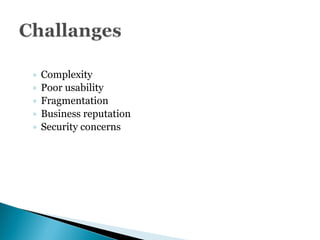
 Customer Attention
◦ Complexity
◦ Poor usability
◦ Fragmentation
◦ Business reputation
◦ Security concerns
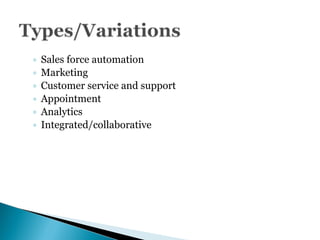
◦ Sales force automation
◦ Marketing
◦ Customer service and support
◦ Appointment
◦ Analytics
◦ Integrated/collaborative
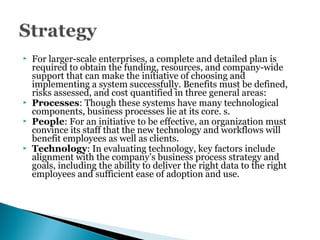
 For larger-scale enterprises, a complete and detailed plan is
required to obtain the funding, resources, and company-wide
support that can make the initiative of choosing and
implementing a system successfully. Benefits must be defined,
risks assessed, and cost quantified in three general areas:
 Processes: Though these systems have many technological
components, business processes lie at its core. s.
 People: For an initiative to be effective, an organization must
convince its staff that the new technology and workflows will
benefit employees as well as clients.
 Technology: In evaluating technology, key factors include
alignment with the company’s business process strategy and
goals, including the ability to deliver the right data to the right
employees and sufficient ease of adoption and use.
 Domestic marketing
 A marketing restricted to the political boundaries of a country, is called
"Domestic Marketing". A company marketing only within its national
boundaries only has to consider domestic competition. Even if that
competition includes companies from foreign markets, it still only has to
focus on the competition that exists in its home market.
 International marketing
 If the exporting departments are becoming successful but the costs of doing
business from headquarters plus time differences, language barriers, and
cultural ignorance are hindering the company’s competitiveness in the
foreign market, then offices could be built in the foreign countries.
 Sometimes companies buy firms in the foreign countries to take advantage
of relationships, storefronts, factories, and personnel already in place.
These offices still report to headquarters in the home market but most of
the marketing mix decisions are made in the individual countries since that
staff is the most knowledgeable about the target markets.
Product
 A global company is one that can create a single product and only have to tweak
elements for different markets. For example, Coca-Cola uses two formulas (one with
sugar, one with corn syrup) for all markets.
Price
 Price will always vary from market to market. Price is affected by many variables: cost
of product development (produced locally or imported), cost of ingredients, cost of
delivery (transportation, tariffs, etc.), and much more.
Placement
 How the product is distributed is also a country-by-country decision influenced by
how the competition is being offered to the target market. Using Coca-Cola as an
example again, not all cultures use vending machines.
Promotion
 After product research, development and creation, promotion (specifically
advertising) is generally the largest line item in a global company’s marketing budget.
At this stage of a company’s development, integrated marketing is the goal.
 Economies of scale in production and distribution
 Lower marketing costs
 Power and scope
 Consistency in brand image
 Ability to leverage good ideas quickly and efficiently
 Uniformity of marketing practices
 Helps to establish relationships outside of the "political arena"
 Helps to encourage ancillary industries to be set up to cater for the needs of
the global player
 Benefits of eMarketing over traditional marketing
 Differences in consumer needs, wants, and usage patterns for products
 Differences in consumer response to marketing mix elements
 Differences in brand and product development and
the competitive environment
 Differences in the legal environment, some of which may conflict with those
of the home market
 Differences in the institutions available, some of which may call for the
creation of entirely new ones (e.g. infrastructure)
 Differences in administrative procedures
 Differences in product placement.
 Differences in the administrative procedures and product placement can
occur
 Who is the customer
 Who buys the product
 At what cost the customers would be comfortable
 How to assess the environmental factors
 Communication strategy, etc
 ASEAN- Association of South East Asian Nations
 NAFTA- North American free Trade Agreement
 EU- European Union
 SAARC- South East association of Regional
Cooperation
 SAFTA- South East free Trade Agreement
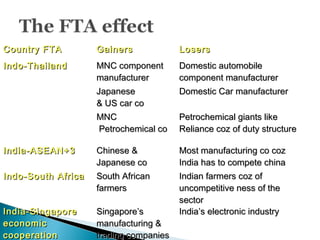
Country FTACountry FTA GainersGainers LosersLosers
Indo-ThailandIndo-Thailand MNC componentMNC component
manufacturermanufacturer
Domestic automobileDomestic automobile
component manufacturercomponent manufacturer
JapaneseJapanese
& US car co& US car co
Domestic Car manufacturerDomestic Car manufacturer
MNCMNC
Petrochemical coPetrochemical co
Petrochemical giants likePetrochemical giants like
Reliance coz of duty structureReliance coz of duty structure
India-ASEAN+3India-ASEAN+3 Chinese &Chinese &
Japanese coJapanese co
Most manufacturing co cozMost manufacturing co coz
India has to compete chinaIndia has to compete china
Indo-South AfricaIndo-South Africa South AfricanSouth African
farmersfarmers
Indian farmers coz ofIndian farmers coz of
uncompetitive ness of theuncompetitive ness of the
sectorsector
India-SingaporeIndia-Singapore
economiceconomic
cooperationcooperation
Singapore’sSingapore’s
manufacturing &manufacturing &
trading companiestrading companies
India’s electronic industryIndia’s electronic industry
 Economic EnvironmentEconomic Environment
 Political EnvironmentPolitical Environment
 Legal & Regulatory EnvironmentLegal & Regulatory Environment
 Technological EnvironmentTechnological Environment
 Direct Exports
 Indirect Exports
 Licensing
 Strategic Alliance
 Joint ventures
1. Mergers
2. Acquisition
 The process of selling of goods and services produced in one
country to other countries
There are two types of exporting: direct and indirect.
 Direct exports
 Direct exports capitalize on economies of scale in production
concentrated in the home country and affording better control
over distribution.
 Direct export works the best if the volumes are small. Large
volumes of export may trigger protectionism. Types of Direct
Exporting.
 Sales representatives represent foreign
suppliers/manufacturers in their local markets for an established
commission on sales.
 Importing distributors purchase product in their own right
and resell it in their local markets to wholesalers, retailers, or
both.
 Advantages of direct exporting:
 Control over selection of foreign markets and
choice of foreign representative companies
 Good information feedback from target market
 Better protection of trademarks, patents, goodwill,
and other intangible property
 Potentially greater sales than with indirect
exporting
 Higher start-up costs and higher risks as opposed
to indirect exporting
 Greater information requirements
 Longer time-to-market as opposed to indirect
exporting[7]
.
 Indirect exports is the process of exporting through domestically based export
intermediaries. The exporter has no control over its products in the foreign market.
 Types of indirect exporting:
 Export trading companies (ETCs) provide support services of the entire export
process for one or more suppliers.
 Export management companies (EMCs) are similar to ETCs in the way that they
usually export for producers. Unlike ETCs, they rarely take on export credit risks and
carry one type of product, not representing competing ones.
 Export merchants are wholesale companies that buy unpackaged products from
suppliers/manufacturers for resale overseas under their own brand names. The
advantage of export merchants is promotion.
 Confirming houses are intermediate sellers that work for foreign buyers. They
receive the product requirements from their clients, negotiate purchases, make
delivery, and pay the suppliers/manufacturers.
 Nonconforming purchasing agents are similar to confirming houses with the
exception that they do not pay the suppliers directly – payments take place between a
supplier/manufacturer and a foreign buyer
 Fast market access
 Concentration of resources for production
 Little or no financial commitment. The export
partner usually covers most expenses associated
with international sales
 Low risk exists for those companies who consider
their domestic market to be more important and
for those companies that are still developing their
R&D, marketing, and sales strategies.
 Higher risk than with direct exporting
 Little or no control over distribution, sales,
marketing, etc. as opposed to direct exporting
 Inability to learn how to operate overseas
 Wrong choice of market and distributor may lead
to inadequate market feedback affecting the
international success of the company
 Potentially lower sales as compared to direct
exporting, due to wrong choice of market and
distributors by export partners[11]
.
 An international licensing agreement allows foreign firms, either
exclusively or non-exclusively to manufacture a proprietor’s product
for a fixed term in a specific market.
 Summarizing, in this foreign market entry mode, a licensor in the
home country makes limited rights or resources available to the
licensee in the host country.
 The rights or resources may include patents, trademarks,
managerial skills, technology, and others that can make it possible
for the licensee to manufacture and sell in the host country a similar
product to the one the licensor has already been producing and
selling in the home country without requiring the licensor to open a
new operation overseas.
 Obtain extra income for technical know-how and
services
 Reach new markets not accessible by export from
existing facilities
 Quickly expand without much risk and large capital
investment
 Pave the way for future investments in the market
 Retain established markets closed by trade restrictions
 Political risk is minimized as the licensee is usually 100%
locally owned
 Is highly attractive for companies that are new in
international business.
 Lower income than in other entry modes
 Loss of control of the licensee manufacture and
marketing operations and practices dealing to loss
of quality
 Risk of having the trademark and reputation
ruined by a incompetent partner
 The foreign partner can also become a competitor
by selling its production in places where the
parental company is already in.
 The Franchising system can be defined as: “A
system in which semi-independent business
owners (franchisees) pay fees and royalties to a
parent company (franchiser) in return for the right
to become identified with its trademark, to sell its
products or services, and often to use its business
format and system.”
 Compared to licensing, franchising agreements tends to
be longer
 The franchisor offers a broader package of rights and
resources which usually includes: equipments,
managerial systems, operation manual, initial trainings,
site approval and all the support necessary for the
franchisee to run its business in the same way it is done
by the franchisor.
 While a licensing agreement involves things such as
intellectual property, trade secrets and others while in
franchising it is limited to trademarks and operating
know-how of the business
 Low political risk
 Low cost
 Allows simultaneous expansion into different
regions of the world
 Well selected partners bring financial investment
as well as managerial capabilities to the operation.
 Franchisees may turn into future competitors
 Demand of franchisees may be scarce when
starting to franchise a company, which can lead to
making agreements with the wrong candidates
 A wrong franchisee may ruin the company’s name
and reputation in the market
 Comparing to other modes such as exporting and
even licensing, international franchising requires a
greater financial investment to attract prospects
and support and manage franchisees[14]
 A turnkey project refers to a project in which clients pay contractors to
design and construct new facilities and train personnel.
 A turnkey project is way for a foreign company to export its process and
technology to other countries by building a plant in that country. Industrial
companies that specialize in complex production technologies normally use
turnkey projects as an entry strategy
 One of the major advantages is the possibility for a company to establish a
plant and earn profits in a foreign country especially in which foreign direct
investment opportunities are limited and lack of expertise in a specific area
exists.
 Potential disadvantages of a turnkey project for a company include risk of
revealing companies secrets to rivals, and takeover of their plant by the host
country. By entering a market with a turnkey project proves that a company
has no long-term interest in the country which can become a disadvantage
if the country proves to be the main market for the output of the exported
process
Includes two types of strategies:
 Greenfield investment
 Acquisitions.
 Greenfield investment is the establishment of a new wholly owned
subsidiary. It is often complex and potentially costly, but it is able to
full control to the firm and has the most potential to provide above
average return.
 “Wholly owned subsidiaries and expatriate staff are preferred in
service industries where close contact with end customers and high
levels of professional skills, specialized know how, and
customization are required.”
 Greenfield investment is more likely preferred
where physical capital intensive plants are
planned. This strategy is attractive if there are no
competitors to buy or the transfer competitive
advantages that consists of embedded
competencies, skills, routines, and culture.
 There are five common objectives in a joint venture: market entry,
risk/reward sharing, technology sharing and joint product
development, and conforming to government regulations. Other
benefits include political connections and distribution channel
access that may depend on relationships.Such alliances often are
favourable when:
 The partners' strategic goals converge while their competitive goals
diverge
 The partners' size, market power, and resources are small compared
to the Industry leaders
 Partners are able to learn from one another while limiting access to
their own proprietary skills
 ownership,
 Control
 length of agreement
 Pricing
 technology transfer
 local firm capabilities
 Resources
 government intentions.
 A strategic alliance is a term used to describe a
variety of cooperative agreements between
different firms, such as shared research, formal
joint ventures, or minority equity participation.
 Three distinguishing characteristics:
 1. They are frequently undertaken between firms
in industrialized nations
 2. The focus is often on creating new products
and/or technologies rather than distributing
existing ones
 3. They are often only created for short term
durations
 Technology Exchange
 Global Competition
 Industry Convergence
 Economies of scale & reduction of risks
 Alliance as an alternative to merger
 The risks of competitive collaboration
 The partnership may be forged to exchange resources
and capabilities such as technology.
 Using investment initiative to erode the other partners
competitive position.
 Strengths gained by learning from one company can be
used against the other.
 Firms may use alliances to acquire its partner. One firm
may target a firm and ally with them to use the
knowledge gained and trust built in the alliance to take
over the other
 Product Strategy
 Pricing strategy
 Place Strategy
 Promotion Strategy
 Holistic Business Marketing is a new paradigm in marketing. It does
not focus on marketing one area of businesses, like holistic businesses only
 a concept of marketing that strives to be an inclusive service which offers
multi layered marketing to best allow for profitability of the company and
alignment of the owners and employees with their values.
 Taking a holistic view of marketing means looking at the business, and the
owners/employees, as a whole to determine how to integrate the parts of
the business into a coherent marketing strategy.
 To be truly holistic, the marketing approach should address all appropriate
venues to get the word out about the business
 These venues should include all traditional marketing approaches, as well
as internet marketing, social media marketing, search engine optimization
for the business website, and relationship marketing.
 Formally or informally coordinated distribution channel where its
independent members work together to achieve greater efficiency and
economies of scale, and to eliminate channel-conflict arising out of
disparate individual objectives.
 Three common types of VMS are:
(1) Administered: coordination between production and distribution firms is
achieved by the size and influence of the dominant firm, without a formal
agreement or ownership.
(2) Contractual: independent production and distribution firms formally agree
to integrate their resources. Franchising is an example of this type.
(3) Corporate: production firm owns a retail chain (forward integration) or a
retail chain owns a production firm (backward integration).

Marketing Management

  • 2.
     Marketing meanssuch a perfect understanding of the customers that the product/service fits him totally & sell itself. Peter. F Drucker
  • 3.
     Process ofplanning & executing the conception, pricing, promotion & distribution of ideas, goods & services to create exchanges to satisfy individuals & organisational goals.
  • 4.
     The art& Science of choosing target markets and getting, keeping & growing customers through creating, delivering & communicating superior customer value.
  • 5.
     Entrepreneurial Marketing. Formulated Marketing.  Intrepreneurial Marketing.
  • 6.
     Wit Feeling. Opportunity of Self Visualisation.  Aggressive Marketing Practices.  Approaching every door to acquire attention.
  • 7.
     Set Policies& Procedures.  Defined path of proceeding.  Settled ways.
  • 8.
     Stucked FormulatedMarketing techniques  Lack of creativity/Passion.  Stagnant Visualisation
  • 9.
     Goods  Services Experiences  Events  Persons  Places  Properties  Organisations  Information  Ideas
  • 10.
     Production Concept. Product Concept.  Selling Concept.  Marketing Concept.  Societal Marketing Concept.
  • 11.
     Widely available Low cost  Mass distribution
  • 12.
     Highly innovative Most quality  High performance  Best features
  • 13.
     Aggressive Selling. High Promotional Efforts.  For unsought goods.
  • 14.
     Understand TargetMarket  Consider customer first  Get Customer needs/Demands  Know Customer value  Integrated Marketing
  • 15.
     Environment Consideration Resource Management  Social consideration  Ethical Values
  • 17.
     Difference betweenprospective customer evaluation of all product’s benefits & the total cost of the product.
  • 18.
     Perceived monetaryvalue of the sum total of economic, functional & psychological benefits a customer expect from the market
  • 19.
     Sum totalof costs a customer expects to incur in evaluating, obtaining, using & disposing of the given market offering.
  • 20.
    Satisfaction Person’s feeling ofpleasure or disappointment resulting from comparing a product’s perceived performance (outcome) in relation with his expectations.
  • 21.
     Focus shiftfrom Partner relationship Management to Customer relationship Management
  • 22.
     Developing advertisements(in-house/Ad agencies)  Mailing or personal phone.  Participating in trade shows, fairs, events  Identify Hot, Warm & cold prospective.  Conversion of prospects into sales
  • 23.
    To control highcustomer shift/churn  Define & measure retention rate.  Identify the cause of attrition.  Measure the profit the company’s loses when attrition is high.
  • 24.
    Facts about Acquiring& retaining a customer:-  Acquiring a customer is 5 times expensive than satisfying the existing one.  On an average companies lose, 10% of customers every year.  A 5% reduction in customer attrition may increase the profit rate by 25-85%. Source-ICFAI centre of Management Research. Ref no-MM-052K425
  • 25.
     Increased Revenue Decrease in Cost of selling.  Advertisements.  Cross selling possibilities. (Potential customer for Company’s other offerings)
  • 26.
     The presentvalue of the stream of future profits expected over the customer’s lifetime purchases
  • 27.
     Difference betweenthe benefits a customer derives & the cost to acquire that product/service.
  • 30.
    Firm Internal External HR Production Financial Cap. Co Location R&D Co.Image MacroMicro Suppliers Customers MKT Intermediaries Demographic Legal Political Technological Economic Natural
  • 31.
     HR.  Production. R & D.  Co. Location  Financial capabilities.  Co. Image
  • 32.
     Suppliers  Customers Intermediaries (Wholesaler, Retailer)
  • 33.
     Demographic  Legal Political  Technological  Socio-Cultural  Economic  Natural
  • 34.
    Study of Humanpopulation  Size/Group  Growth/occupation  Density  Gender  Marital status  Education level/literacy
  • 35.
     The laws& regulations of a country.  Legislation.  Acts.
  • 36.
    Name of theActName of the Act YearYear Prevention of Food & AdulterationPrevention of Food & Adulteration 19541954 Drugs Control ActDrugs Control Act 19541954 Company ActCompany Act 19561956 Standard Weights & Measurement ActStandard Weights & Measurement Act 19561956 MRTP-Monopoly & Restrictive TradeMRTP-Monopoly & Restrictive Trade PracticesPractices 19691969 Indian Patents ActIndian Patents Act 19701970 Consumer Protection ActConsumer Protection Act 19861986 Environment Protection ActEnvironment Protection Act 19861986 Water prevention & control ActWater prevention & control Act 19741974
  • 37.
     Govt Policies:- Domestic Politics.  International Politics.
  • 38.
    Technology refers touse of scientific knowledge & tools to solve specific problems & perform tasks in an effective/efficient manner.  Product (Better design, Quality).  Price (Reduce Cost).  Promotion /Advertising (Revolutionized way of communication-Media).  Distribution (Bringing Market closer)
  • 39.
    Refers to individual’s Attitude  Beliefs  Norms  Values  Lifestyles
  • 40.
     ED measuredby Gross Domestic Product.  Economic Forces impact on Marketers & Customers.  Fluctuation (Recession, Depression & Recovery) affects Firm & Customer.  Buying power depends upon the availability of financial resources
  • 41.
     Natural Resources.(Water, Air, Etc)  Climatic Condition (Weather).  Pollution
  • 42.
    Agenda:- •Factors influencing ConsumerBuying Behavior •Buying Decision •Buying decision Process
  • 43.
     Study ofhow individuals make decision to spend their valuable resources (time, money & efforts) on consumption related items.
  • 44.
     Cultural Factors 1.Culture(value, beliefs, behavior, concepts to common) 2.Subculture (culture followed by group of people) 3.Social class (upper, upper-middle, middle, lower middle, lower)
  • 45.
     Social factors(Reference group, Family)  Personal factors (age, occupation & financial status, lifestyles)  Psychological Factors (motivation, perception, attitude)
  • 46.
     Initiator  Influencer Decider  Buyer  User  Maintainer  Disposer
  • 47.
     Extensive problemsolving buying behavior  Routinized buying behavior  Variety seeking behavior
  • 48.
     Problem/ needidentification  Information search  Evaluation of alternatives  Purchase decision  Post purchase behavior
  • 49.
    Agenda:- •Concept of OBB •Differencebetween Orgz Mkt & Consumer Market •Classification of Organizational Mkt •Factors influencing Organisational Buying/ Participants •Stages of buying
  • 50.
     Organisational buyinginvolves deep & thorough analysis.  Products ranging from highly complex machinery to small components.
  • 51.
     Time spent.OB=High  No of Buyers. OB=Less  The degree of specialized offers. OB=High  The quantum of demand. OB=High  Level of Influencing Factors OB= operating variables, purchasing approaches, Situational Factors. CB-Psychological, Demographic
  • 52.
     Producer Markets-(OEM, Industrial Dealers, Users)  Reseller Market- (Wholesalers, Retailers)  Government Market- Govt. Market as central, state, district, municipal, panchayat
  • 53.
     Environmental-Climatic conditions,Geographic, Legal,political, Technological, Cultural.  Organisational:-Systems, procedure, rules, regulation.  Social & Personal
  • 54.
     Initiator  Influencers Deciders (Authority to buy)  Approvers (Authority to implement)  Buyers  Users  Gatekeepers (control the flow of products/Services)
  • 55.
     Problem recognition General need recognition (Quantum)  Product specification  Searching of potential Suppliers/ Multiple sourcing  Value analysis  Vendor analysis  Order routine analysis  Performance Review
  • 57.
     Segment Marketing Individual Marketing  Niche Marketing  Local Marketing
  • 58.
     Geographical-Localities, cities,region, state, countries.  Demographic-Age, gender, income, occupation, religion.  Psychographic- values, belief, lifestyles, personality  Behavioral-Occasions, benefits, user-status, loyalty
  • 59.
     Demographic- Industry,company size, customer location  Operation variable- company technology, brand use status, Organisational capabilities.  Purchasing approaches- Organization purchasing function, Purchasing policies, relationship among buyers & sellers
  • 60.
     Measurable  Substantial Accessible  Differentiable  Actionable
  • 61.
     Evaluation ofMarket Segment  Selecting the Market Segment 1. Single segment concentration-Mercedes 2. Selective specialization-Hyundai-santro, accent, sonata. 3. Product specialization-Gillette 4. Market specialization-Ordinance factory 5. full Market coverage-Hewlett- Packard(Rs.3000 small office to home to heavy duty color printersRs.1000000)
  • 62.
     Ethical choiceof market region  Segment interrelationships & super segments (Supermarket-groceries, apparels, food, toys, etc)  Segment by segment invasion plans-Ceat  Inter-segment Cooperation
  • 63.
    Agenda: •Product differentiation •Service differentiation •Personaldifferentiation •Channel Differentiation •Image Differentiation •Positioning •Product development life cycles/ strategies
  • 64.
     Process bywhich companies manufacture & design the products such a way that makes customers perceives them as different from those manufacture by other companies  On the bases of Product form (size, shape, physical attributes), design, features, size of package, quality, Durability.
  • 65.
     On thebases of Customer Service:- 1. Ordering ease 2. Delivery 3. Installation 4. Guarantees/warranties 5. Financial arrangements 6. Customer Training 7. Maintenance / Repairing 8. Disposal
  • 66.
     On thebases of the personnel company has employed 1. Competence (Possessing the right knowledge & Skills) 2. Courteousness (Friendly, Respectful, Considerate) 3. Credibility (Trustworthy) 4. Reliability 5. Responsiveness
  • 67.
     On thebases of distribution channel 1. Coverage 2. Availability 3. Expertise 4. performance
  • 68.
     On thebases of the name, goodwill, brand, Image. 1. Company’s Management. (CSR, Ethics) 2. Symbols/Logos 3. Atmosphere (Ambience, Lighting, Furnishing) 4. Events
  • 69.
     Its whatyou do to the mind of the customers.  Refers to all those activities undertaken by a marketer to create & maintain the concept of value regarding its brand in the minds of customers as against competitors
  • 70.
    End of AisleDisplays
  • 71.
     Getting intothe mind of customer.  Positioning of a leader.  Positioning of a follower  Repositioning the competition. (Sumo Vs Qualis)  The power of a name. (suitable name-Uncle Chipps, Timex, Speed, Head & shoulders)
  • 72.
     Under-positioning: ThinkSmall-Volkswagen, Volvo’s-Drive Safely  Over-positioning: (Premium Brand)-Tanishq Jewellery  Doubtful Positioning-fail to understand what customers actually want. Le sancy as long lasting instead of freshness, mildness.  Confused Positioning- Crystal Pepsi
  • 73.
    Introduction Growth MaturityDecline P R O F I T TIME
  • 74.
     Rapid Skimming Marketerlaunch the product at higher price with high Promotion.  Slow Skimming Marketer launch the product at higher price with low Promotion.  Rapid Penetration Marketer launch the product at lower price with high Promotion.
  • 75.
     Restoration ofAggressive pricing, including price cuts  Emphasize on Product’s benefits in order to create a competitive niche  Enhanced product quality, new features  New Distribution Channels, New Market
  • 76.
     Abandon weakerproducts & concentrate more on profitable products  Increase promotional efforts, fresh advertisement campaign, new packaging  Invest more into R&D to bring about improvements in the product
  • 77.
     Reducing theno of product- especially those who are not profitable now  Cutting promotional budgets & prices  Cutting down distribution channels with poor sales.
  • 78.
    Agenda: •Dimensions of Newproduct development •Stages of new product development
  • 79.
     New tothe world  New Product Lines  Addition to the existing lines  Improvement of existing products  Repositioning  Cost Reduction
  • 80.
     Idea Generation Idea Screening  Concept testing & analysis  Product Development  Test Marketing  Commercialization
  • 81.
     The actof searching the new idea is Idea Generation.  Collection of large no of ideas.  Sources-Customers, Retailers, wholesaler, supplier, external.
  • 82.
     Since allideas are not commercially viable  Filtration of ideas from the large pool  Parameters like technical abilities, Market size, potential competition, compatibility with existing customers, etc  Division on the bases of:- 1. Prospective Idea 2. Marginal Idea 3. Rejection
  • 83.
     Submission ofidea is submitted for an external evaluation to get the feedback from the market in terms of quality, price, attributes, Unique benefits etc.  Helps in:- 1. Selecting the strongest concept 2. Eliminating the un-approved concept 3. Determining the desired features of the product
  • 84.
     A workingmodel or prototype is made.  Testing:- 1. Alpha 2. Beta 3. Gamma
  • 85.
     Product isintroduced in few selected market.  Co bears the following 1. High ad cost 2. High manufacturing cost 3. High distribution cost
  • 86.
     Alteration beenmade in context of Amount of production, selection of market, price, Quality shift, customer preferences.  Rolling out the product in the entire target market
  • 87.
    Agenda: 1. Defining strategicmarket Planning 2. Scope 3. Process 4. Strategic Marketing planning
  • 88.
    Process of communicating& sharing data between different departments of an organization to collectively formulate future strategies & implement them in maximum efficiency. Involves:  Devising the Brand, Product, Sales, Sales promotion, Advertising strategy
  • 89.
    Bases of SP Corporate Mission/Vision  Establishment of SBU’s  Resource allocation of SBU’s 1. Boston Consulting Group Model (BCG Competitive Advantage Matrix)
  • 90.
    StarsStars (High, High)(High, High) QuestionMarksQuestion Marks (Low, High)(Low, High) Cash CowsCash Cows (High, low)(High, low) DogsDogs (Low, low)(Low, low) High Relative Market Share. Low High Low Market Growth Rate
  • 91.
    Vision statement/Mission/goals &Objectives  SWOT Analysis  Strategies  Strategic Alliances 1. Acquisitions/Mergers  Implementation  Feed back & Control
  • 92.
     Analyzing themarketing opportunities  Developing Marketing strategies  Planning Marketing Programmes  Managing The marketing efforts
  • 93.
    Agenda: Concept of CompetitiveAdvantage Porter’s Five forces Model Porter’s Generic Competitive Strategies/Designing Total Quality Management
  • 94.
     Critical advantagea firm possesses in the market over its competitors.  Types: 1. Cost Advantage. (Same value at lower price) 2. Differentiation Advantage. (superior value)
  • 95.
    Bargaining power ofsuppliers •Suppliers concentration •Switching cost of firms •Differentiation on inputs •Threat of forward integration Barriers to Entry •Government policies •Access to inputs •Capital requirements Threat of Substitutes •Switching Cost •Relative price performance of substitute Bargaining power of Buyers •Buyer volume/Value •Price Sensitivity •Differentiation on inputs •Buyers Concentration Intensity of Rivalry among firms •Market Share •Industry growth •Concentration ratio FIRM
  • 96.
     Cost LeadershipStrategy- Fortis Hospital  Differentiation Strategy 1. Brand- Coca-cola 2. Features- Cadillac 3. Technology-Intel microprocessor 4. Customer service- Hilton Hotels 5. Quality- Sony  Focus Strategy  Generic Strategy Mix
  • 97.
    Differentiation Cost Leadership Focus Particular SegmentOnly Industry Wide Low cost position Uniqueness perceived by Customers
  • 98.
     Market Leader-Guarditself from Rival Firms  Market Challenger-Hitting the weak points of leader  Market Follower-Follow the leader rather than attacking.  Market Nicher-operates in those areas Where the leader is not interested
  • 99.
  • 100.
     The componentsof product convey different meanings to the different customers & project a distinctive image of the product in the customer’s eye  These meanings & Image contribute to the formation of the Product Personality  Core Features  Associated Features
  • 101.
    Potential Product- Improved Augmented Product- Developing Expected Product-Basic requirement Generic Product- Unbranded/Less expensive Differentiationon the bases of value the productDifferentiation on the bases of value the product provides to the customerprovides to the customer
  • 102.
     Tangibility &Durability- 1. Durable- Long period 2. Non durable- Short period 3. Services  Usage 1. Consumer Goods- Convenience/Shopping/Unsought/Specialty 2. Industrial Goods
  • 103.
     Product Mix 1.Length-Total no of Items in the portfolio. 2. Width-Total no of product line in portfolio. In HLL its 9 3. Depth-Assortment of product in sizes, colors, variations etc
  • 104.
     Product lineanalysis 1. Product Line length 2. Product line modernization 3. Line pruning
  • 105.
    ConfeConfe ctionarctionar iesies ColorColor cosmeticosmeti cc HairHair carecare SkinSkin CareCare OralOral CareCare DeoDeo Soaps/Soaps/ DetergeDeterge ntnt BathingBathing soapssoaps FoodFood MaxMax LakmeLakme AvianceAviance SunsilkSunsilk ClinicClinic allclearall clear Fair &Fair & LovelyLovely PondsPonds PepsodentPepsodent Close-upClose-up AxeAxe Pond’sPond’s RexonaRexona DenimDenim SurfSurf RinRin WheelWheel OKOK 501501 VimVim SunlightSunlight LirilLiril LifebouyLifebouy LuxLux BreezBreez PearsPears HamamHamam RexonaRexona DoveDove SavlonSavlon KnorrKnorr annapuannapu rnarna atta/atta/ saltsalt ModernModern foodfood rangerange Product Mix Width D E P T H Product Mix of HLLProduct Mix of HLL
  • 106.
     Expansion ofProduct Mix  Contraction of Product Mix  Altering Existing products  Positioning the products 1. In relation of competitor’s product-coke Vs Pepsi 2. In relation to target Market-Johnson & Johnson 3. In relation of product class-Tropicana 4. Positioning by price & quality-Lifestyles Vs Subhiksha  Trading up/Trading Down
  • 107.
     Brand asa concept  Types of Brands & its challenge  Brand Equity  Sponsorship  Brand strategy decision  New developments in brand Management  Packaging  Labeling
  • 108.
     Offerings froma known name  A name , term, sign, symbol, design or the combination of all these three  It conveys the following:- Attributes 1. Benefits 2. Values 3. Culture 4. Personality 5. User
  • 109.
     Manufacturer’s Brand-Brandeddirectly by the manufacturer  Private/ Reseller Brand-Developed & owned by reseller  Generic brands-not specifically advertised by sellers.
  • 110.
     Combination ofassets & liabilities associated that brand that enhances/ depreciates the value of brand.  It has five major determinants:- Awareness, quality perception, loyalty, patents & trademarks
  • 111.
     A formof publicity which is done to support/ link organization's name with a particular event, most commonly, sporting events or an activity which evolves large number of public gathering
  • 112.
    Identification of availableresources The company’s commitment Capabilities to take initiative  Line extension-Fair glow cream & soap  Brand extension-  Brand Rejuvenation  Brand Re-launch  Brand Proliferation  Multi brands  New brand name  Co brands Steps of delivering value
  • 114.
     Process ofthe developing a design & a container for the product.  A secured, transparent & easy-to-use packaging helps in having the better sales
  • 115.
     To attractthe attention of the customer  Communicates through verbal & non-verbal tools  Highlight the utility of the product  Informs about the content about the product
  • 116.
     Agenda 1. Price& non price competition 2. The process of setting prices 3. Adapting the price 4. Adopting price change 5. Approaches of Price Adjustment
  • 117.
     Price Competition Non-price Competition
  • 118.
     Setting priceobjectives- Survival/ Profit/ ROI/ Market Share/ Status Quo/ Product Quality  Factors affecting demand differentiation- Price sensitivity  Estimating Costs  Analyzing competitor’s pricing  Selection of pricing method Mark up/ Target return/ perceived value/ Going rate/ sealed bid/ Differentiated/ Value/ Market skimming/ Penetrate.  Selection of pricing policy Psychological/ transfer
  • 119.
    Geographical Pricing  Cash, Counter trade 1. Barter- goods apart from cash 2. Compensation deal- some cash some goods 3. Buy back agreement- some cash some products manufacture by that plant, technology etc 4. Offset-seller receives full cash but agrees to invest certain amount in buyer’s country with in stated time period
  • 120.
     Initiating pricecuts 1. Low quality trap 2. Fragile market share trap 3. Shallow pocket trap  Initiating price increase
  • 121.
     Geographical Pricing Promotional Pricing  Discriminatory Pricing  Discounts & Allowances  Experience Curve Pricing  Product mix Pricing  Product Line pricing  Optional features pricing  Captive product pricing  Two Part Pricing  By Product Pricing  Product Bundled Pricing
  • 122.
    Agenda  Nature ofMarketing channels  Role of Marketing channels  Designing Distribution Channels  Channel management  Multi-channel Marketing System  Channels Conflict
  • 123.
     A channelsfacilitates the transfer of ownership & the physical exchange of products & service.  Once established, the channels should be adjusted according to the need of the customers
  • 124.
     Channels roleare set of activities/ behavior assigned to each intermediary in a channel system, i.e. to fill the gap b/w production & consumption process  Channel Flow- Possession, ownership, Financial flow, Info flow, Risk flow, Negotiation  Channel level- 1. Zero- Manufacturer to Consumer. Amway, Eureka Forbes. 2. One- Manufacturer to Retailer to Consumer. Automobile Dealers. Petrol Dealers 3. Two- Manufacturer to Wholesaler to Retailer to Consumer. FMCG’s 4. Three levels- Manufacturer to Wholesaler to Agent to Retailer to Consumer
  • 125.
     Intensive Distribution-Manufacturer distributes the goods through many outlets to provide ease of location.  Exclusive Distribution- Limited number of Intermediaries between manufacturer & Consumer.
  • 126.
     Analyzing customerexpectations of Service output- lot size, convenience, selection, service  Formulating Objective  Evaluation of Distribution Environment  Evaluating channel Alternatives- economic, control, adaptive criteria 
  • 127.
     Channel memberselection  Channel member training  Member motivation & Evaluation  Modifying Channel Arrangement
  • 128.
     Where afirms chooses two or more marketing channel to reach more n more segmented markets.  Firms tries to achieve wider market coverage, lower distribution costs, etc
  • 129.
     Ideally firmstry to control the businesses of suppliers & intermediaries.  Due to constraints like time, money & other resources its not feasible
  • 130.
     Vertical conflict-when channel members operating at different level compete for same market share  Horizontal channels conflicts- when channel members operating at same level compete for same market share.  Multi channel conflicts- when firms established two or more channel. e.g. showrooms & factory outlet
  • 131.
     Negotiation  Problem-solvingstrategies  Persuasive mechanism- give & take  Legalization strategies  Cooperation & coordination
  • 133.
     One whosells to other middlemen, institutions & industrial buyers, usually in fairly large quantities
  • 134.
     Manufacturer wholesaler Retail wholesaler  General Wholesaler 1. Mill’s Goods wholesaler 2. Wholesale dealing in one type of goods 3. Special goods wholesaler
  • 135.
    Area bases Goodsbases Service bases 1. Local 2. Regional 3. National 4. International 1. General wholesale 2. Specialized wholesaler 1. Jobbers 2. Processors 3. Exporters 4. Importers 5. Industrial distributors
  • 136.
     Assembling &buying  Storing or warehousing  Transporting  Financing  Risk bearing  Providing Market Information  Dispersing & selling
  • 137.
     Increase inprice  Obstruction in smooth flow of goods  Interest in many products  Manipulation of prices  Large scale retailing
  • 138.
     Trade insmall quantities of goods of diverse nature which is concerned with selling goods to the final consumers.
  • 139.
     Trade invariety of goods  Purchase in small quantities  Sales direct to consumers  Need of Less capital  Situated near to consumers
  • 140.
     Buying &assembling  Warehousing & storing  Selling  Beari9ng of Risk  Financing  Supply of market info  Advertising
  • 141.
    Itinerant traders Fixedshops Cheap jacks Market StreetHawkers Small scale fixed shops Street stall Second hand General Specialty One price Departmental Chain Store Mail order Hire purchase Super Market Co- operative Large scale
  • 143.
     Helps marketersto communicate information to potential customers about the product’s existence, value & the benefits that can be the accrued from it.  Designing an effective MarComm model helps in to attract, persuade, urge & remind customer of the company's brand
  • 144.
     Source  Sender Message  Encoding Feedback  Medium  Receiver  Decoding
  • 145.
     Personal channel Faceto face interaction, telephonic conversation, E-mail, Mailers.  Non-personal Electronic media, print media, outdoor advertising
  • 146.
     Advertising- Paidform of non-personal presentation of goods & services by an identified sponsor  Sales promotions- Attracting the consumers by offering them various benefits in the form of incentives/ adding values to the products.  Publicity- Non paid form of communicating info about the company for the product/ company or both.
  • 147.
     Public Relation-Function of the organization tends to maintain the goodwill in the market  Direct Marketing- Organisation communicate directly with the customer through mail/ telemarketing/ internet  Personal Selling- selling the product or service directly to the consumer with face to face interaction by explaining/ demonstrating them the features.
  • 148.
     Target audienceidentification.  Image analysis  Determination of communication objective- 1. Awareness 2. knowledge 3. Liking 4. preference 5. Conviction/ Confidence 6. purchase  Developing Marcom budget- 1. Objective & task method 2. Competitive parity method 3. Percentage sales method 3. Affordable method
  • 149.
     Message content 1.Rational appeal 2. Moral appeal  Structure  Format  Source
  • 150.
     Product MarketType- consumer market, industrial market.  Pull-Push strategy 1. Pull strategy-all promotional efforts are directly towards influencing the customers hence distributors pull the product from the manufacturers. 2. Push strategy= all promotional efforts are directly towards the intermediaries hence intermediaries are motivated by high discounts, special rewards, recognition.
  • 151.
     The productlife Cycle 1. Introduction stage- informs customers through publicity, advertising, sales promotion strategy. 2. Growth stage- by differentiating them from competitor’s products/ services 3. Maturity stage- Reminding customer about the presence of the product in the market. Discounts schemes, etc 4. Decline stage- cost cutting, decreased budget allocation are considered  Effectiveness of advertising
  • 152.
    Agenda: •Benefits of Advertising •Developingan advertisement programme •ATL, BTL & TTL •Approaches to create Ad Message
  • 153.
     Creates awareness,interest & Desires for the offerings in the market  Message can be repeated several times therefore creating an impact over the mind of customer.  Advertising a product in a certain way can add to its value.  Boosting the sales of the company
  • 154.
     Identify thetarget audience- inform, persuade, remind.  Specify the advertisement objective 1. Awareness 2. knowledge 3. Liking 4. preference 5. Conviction 6. purchase  Set the advertisement budget 1. Objective & task method 2. Competitive parity method 3. Percentage sales method 3. Affordable method  Develop the advertisement message- Meaningful, distinctive, believable  Select the media  Schedule the advertisement campaign  Measure advertisement effectiveness
  • 156.
     Promotional activitiescarried out through mass media, such as television, radio and newspaper, are classed as "above the line" promotion.  ATL promotions are tailored for a mass audience  ATL promotions can establish brand identity.  ATL promotions are also difficult to measure well.
  • 157.
     "Below theline" promotion refers to forms of non- media communication or advertising.  BTL promotions are targeted at individuals according to their needs or preferences.  BTL can actually lead to a sale.  BTL promotions are highly measurable, giving marketers valuable insights into their return-on- investment.
  • 158.
     "Through theline" refers to an advertising strategy involving both above and below the line communications in which one form of advertising points the target to another form of advertising thereby crossing the "line”.
  • 159.
     Comparative Advertising Inoculative Advertising- Highlighting the weakness of the competitors  Refutation Advertising- Disproof 1. Creating Emotions 2. Using Endorsers
  • 160.
     Those salesactivities that supplements both the personal selling & advertisement & coordinate them & make them effective
  • 161.
     Consumer salesPromotion: Targeted at the end users. A pull strategy & encourages the customer to make the purchase  Trade Sales Promotion: Targeted at the distribution channel. A push strategy & encourages the channel members to stock the product
  • 162.
     Consumer salespromotion method:- Discounts, competitions, draws, free coupons, free gifts, samples, money refunds, rebate, frequent buyers incentives, POP material  Trade Sales Promotion Method Trade Discounts, Buying allowance, Dealer’s award, Dealer Listing
  • 163.
    Pre Testing research Group Discussions  Hall Tests  Experimentation Post Testing research  Sales evaluation  Programme Response Measurement  Retail Audit
  • 164.
     It isimp to consider the impact of sales promotion activity over total cost of the product  The timing is crucial  Adapt the promotional offers to suit the particular requirements of the market  Evaluate each promotional offer for each participant in the distribution channel.  Use advertising to strengthen the promotion campaign  In short run sales promotions-In long run product innovations.
  • 165.
     Planned &sustained efforts to establish & maintain goodwill & mutual understanding between an organisation & its public (News releases, featured articles, captioned photograph, press conferences)  Role of PR:- 1. Identify the relevant public 2. Influence the opinions of the public by a) Reinforcing the favorable opinions b) Transforming the neutral opinions of the public into positive ones. c) Changing or neutralizing hostile opinion
  • 166.
     Annual Plancontrol 1. Sales Analysis 2. Market Share Analysis 3. Marketing expense to the Sales Analysis 4. Financial Analysis 5. Market Based Score Card analysis 6. Profitability Control
  • 167.
     Marketing EffectivenessReview- Customer philosophy, Integrated Marketing Activities, sufficient marketing info, strategic outlook & operational efficiency  Marketing Audit- A comprehensive, periodic, systematic & independent evaluation of a firm’s marketing activities  Marketing Excellence Review
  • 168.
     Efficiency Control Sales Force Efficiency  Advertisement Efficiency  Sales Promotion Efficiency  Distribution Efficiency
  • 169.
     Online Advertising 1.Forums- libraries, directories, chat rooms 2. News-group 3. Bulletin Boards- electronic notice boards 4. Web communities 5. E-mails 6. Web Casting
  • 170.
     Phenomenon inwhich manufactures focus on producing environment friendly products. All Marketing efforts are directed to achieve this goals.  The product strategy, pricing policies, promotional activities & distribution strategies are directed towards this effort.
  • 172.
     Marketing researchis "the function that links the consumer, customer, and public to the marketer through information  Information used to identify and define marketing opportunities and problems; generate, refine, and evaluate marketing actions; monitor marketing performance; and improve understanding of marketing as a process.  Marketing research specifies the information required to address these issues, designs the method for collecting information, manages and implements the data collection process, analyzes the results, and communicates the findings and their implications."
  • 173.
     Marketing researchis the systematic gathering, recording, and analysis of data about issues relating to marketing products and services.  The goal of marketing research is to identify and assess how changing elements of the marketing mix impacts customer behavior.  The term is commonly interchanged with market research; however, expert practitioners may wish to draw a distinction, in that market research is concerned specifically with markets, while marketing research is concerned specifically about marketing processes.
  • 174.
     Marketing researchis often partitioned into two sets of categorical pairs,  Either by target market: 1. Consumer Marketing Research,(B2C) 2. Business Marketing Research, (B2B)  Or, alternatively, by methodological approach: 1. Qualitative Marketing Research, and 2. Quantitative Marketing Research
  • 175.
     Consumer MarketingResearch is a form of applied sociology that concentrates on understanding the preferences, attitudes, and behaviors of consumers in a market-based economy,  It carries the objective of understanding the effects and comparative success of marketing campaigns.
  • 176.
     Business tobusiness (B2B) research is inevitably more complicated than consumer research. The researchers need to know what type of multi-faceted approach will answer the objectives, since seldom is it possible to find the answers using just one method.  Finding the right respondents is crucial in B2B research since they are often busy, and may not want to participate.  B2B marketers address a much smaller number of customers who are very much larger in their consumption of products than is the case in consumer markets  Personal relationships are of critical importance in B2B markets.
  • 177.
     Qualitative marketingresearch - generally used for exploratory purposes - small number of respondents - not generalizable to the whole population - statistical significance and confidence not calculated  Quantitative marketing research - generally used to draw conclusions - tests a specific hypothesis - uses random sampling techniques so as to infer from the sample to the population - involves a large number of respondents -
  • 178.
     To providemanagement with relevant, accurate, reliable, valid, and current information.  Marketing research helps the marketing manager link the marketing variables with the environment and the consumers.  It helps remove some of the uncertainty by providing relevant information about the marketing variables, environment, and consumers.  In the absence of relevant information, consumers' response to marketing programs cannot be predicted reliably or accurately
  • 179.
    framework of the"DECIDE" model which conceptualizes managerial decision making as a series of six steps.  Defining=The process of defining the problem or opportunity, along with the objectives and constraints.  Enumeration =The possible decision factors that make up the alternative courses of action (controllable factors) and uncertainties (uncontrollable factors) are enumerated.  Collection= Relevant information on the alternatives and possible outcomes is collected.  Identification= To identify and select the best alternative based on chosen criteria or measures of success.  Development= A detailed plan to develop and implement the alternative selected is developed and put into effect.  Evaluation=Last, the outcome of the decision and the decision process itself are evaluated.
  • 180.
     First, marketingresearch is systematic. Thus systematic planning is required at all the stages of the marketing research process.  Marketing research is objective. It attempts to provide accurate information that reflects a true state of affairs. It should be conducted impartially.
  • 181.
     A MarketingInformation System can be defined as 'a system in which marketing data is formally gathered, stored, analysed and distributed to managers in accordance with their informational needs on a regular basis.  The term is sometimes defined in a limited way to refer to a computer based system intended for use by particular marketing personnel at any functional level for the purpose of solving Marketing Problems
  • 182.
    A MkIS iscreated in three phases  understanding of the information needs of marketing management  locating relevant data and transforming this into usable information.  making this information available to managers when, where and how the as they require it.
  • 183.
     Customer relationshipmanagement (CRM) is a widely implemented strategy for managing a company’s interactions with customers, clients and sales prospects.  It involves using technology to organize, automate, and synchronize business processes—principally sales activities, but also those for marketing, customer service, and technical support.  The overall goals are to find, attract, and win new clients, nurture and retain those the company already has, entice former clients back into the fold, and reduce the costs of marketing and client service.
  • 184.
     A CRMsystem may be chosen because it is thought to provide the following advantages:[  Quality and efficiency  Decrease in overall costs  Decision support  Enterprise agility  Customer Attention
  • 185.
    ◦ Complexity ◦ Poorusability ◦ Fragmentation ◦ Business reputation ◦ Security concerns
  • 186.
    ◦ Sales forceautomation ◦ Marketing ◦ Customer service and support ◦ Appointment ◦ Analytics ◦ Integrated/collaborative
  • 187.
     For larger-scaleenterprises, a complete and detailed plan is required to obtain the funding, resources, and company-wide support that can make the initiative of choosing and implementing a system successfully. Benefits must be defined, risks assessed, and cost quantified in three general areas:  Processes: Though these systems have many technological components, business processes lie at its core. s.  People: For an initiative to be effective, an organization must convince its staff that the new technology and workflows will benefit employees as well as clients.  Technology: In evaluating technology, key factors include alignment with the company’s business process strategy and goals, including the ability to deliver the right data to the right employees and sufficient ease of adoption and use.
  • 189.
     Domestic marketing A marketing restricted to the political boundaries of a country, is called "Domestic Marketing". A company marketing only within its national boundaries only has to consider domestic competition. Even if that competition includes companies from foreign markets, it still only has to focus on the competition that exists in its home market.  International marketing  If the exporting departments are becoming successful but the costs of doing business from headquarters plus time differences, language barriers, and cultural ignorance are hindering the company’s competitiveness in the foreign market, then offices could be built in the foreign countries.  Sometimes companies buy firms in the foreign countries to take advantage of relationships, storefronts, factories, and personnel already in place. These offices still report to headquarters in the home market but most of the marketing mix decisions are made in the individual countries since that staff is the most knowledgeable about the target markets.
  • 190.
    Product  A globalcompany is one that can create a single product and only have to tweak elements for different markets. For example, Coca-Cola uses two formulas (one with sugar, one with corn syrup) for all markets. Price  Price will always vary from market to market. Price is affected by many variables: cost of product development (produced locally or imported), cost of ingredients, cost of delivery (transportation, tariffs, etc.), and much more. Placement  How the product is distributed is also a country-by-country decision influenced by how the competition is being offered to the target market. Using Coca-Cola as an example again, not all cultures use vending machines. Promotion  After product research, development and creation, promotion (specifically advertising) is generally the largest line item in a global company’s marketing budget. At this stage of a company’s development, integrated marketing is the goal.
  • 191.
     Economies ofscale in production and distribution  Lower marketing costs  Power and scope  Consistency in brand image  Ability to leverage good ideas quickly and efficiently  Uniformity of marketing practices  Helps to establish relationships outside of the "political arena"  Helps to encourage ancillary industries to be set up to cater for the needs of the global player  Benefits of eMarketing over traditional marketing
  • 192.
     Differences inconsumer needs, wants, and usage patterns for products  Differences in consumer response to marketing mix elements  Differences in brand and product development and the competitive environment  Differences in the legal environment, some of which may conflict with those of the home market  Differences in the institutions available, some of which may call for the creation of entirely new ones (e.g. infrastructure)  Differences in administrative procedures  Differences in product placement.  Differences in the administrative procedures and product placement can occur
  • 193.
     Who isthe customer  Who buys the product  At what cost the customers would be comfortable  How to assess the environmental factors  Communication strategy, etc
  • 194.
     ASEAN- Associationof South East Asian Nations  NAFTA- North American free Trade Agreement  EU- European Union  SAARC- South East association of Regional Cooperation  SAFTA- South East free Trade Agreement
  • 195.
    Country FTACountry FTAGainersGainers LosersLosers Indo-ThailandIndo-Thailand MNC componentMNC component manufacturermanufacturer Domestic automobileDomestic automobile component manufacturercomponent manufacturer JapaneseJapanese & US car co& US car co Domestic Car manufacturerDomestic Car manufacturer MNCMNC Petrochemical coPetrochemical co Petrochemical giants likePetrochemical giants like Reliance coz of duty structureReliance coz of duty structure India-ASEAN+3India-ASEAN+3 Chinese &Chinese & Japanese coJapanese co Most manufacturing co cozMost manufacturing co coz India has to compete chinaIndia has to compete china Indo-South AfricaIndo-South Africa South AfricanSouth African farmersfarmers Indian farmers coz ofIndian farmers coz of uncompetitive ness of theuncompetitive ness of the sectorsector India-SingaporeIndia-Singapore economiceconomic cooperationcooperation Singapore’sSingapore’s manufacturing &manufacturing & trading companiestrading companies India’s electronic industryIndia’s electronic industry
  • 196.
     Economic EnvironmentEconomicEnvironment  Political EnvironmentPolitical Environment  Legal & Regulatory EnvironmentLegal & Regulatory Environment  Technological EnvironmentTechnological Environment
  • 197.
     Direct Exports Indirect Exports  Licensing  Strategic Alliance  Joint ventures 1. Mergers 2. Acquisition
  • 198.
     The processof selling of goods and services produced in one country to other countries There are two types of exporting: direct and indirect.  Direct exports  Direct exports capitalize on economies of scale in production concentrated in the home country and affording better control over distribution.  Direct export works the best if the volumes are small. Large volumes of export may trigger protectionism. Types of Direct Exporting.  Sales representatives represent foreign suppliers/manufacturers in their local markets for an established commission on sales.  Importing distributors purchase product in their own right and resell it in their local markets to wholesalers, retailers, or both.
  • 199.
     Advantages ofdirect exporting:  Control over selection of foreign markets and choice of foreign representative companies  Good information feedback from target market  Better protection of trademarks, patents, goodwill, and other intangible property  Potentially greater sales than with indirect exporting
  • 200.
     Higher start-upcosts and higher risks as opposed to indirect exporting  Greater information requirements  Longer time-to-market as opposed to indirect exporting[7] .
  • 201.
     Indirect exportsis the process of exporting through domestically based export intermediaries. The exporter has no control over its products in the foreign market.  Types of indirect exporting:  Export trading companies (ETCs) provide support services of the entire export process for one or more suppliers.  Export management companies (EMCs) are similar to ETCs in the way that they usually export for producers. Unlike ETCs, they rarely take on export credit risks and carry one type of product, not representing competing ones.  Export merchants are wholesale companies that buy unpackaged products from suppliers/manufacturers for resale overseas under their own brand names. The advantage of export merchants is promotion.  Confirming houses are intermediate sellers that work for foreign buyers. They receive the product requirements from their clients, negotiate purchases, make delivery, and pay the suppliers/manufacturers.  Nonconforming purchasing agents are similar to confirming houses with the exception that they do not pay the suppliers directly – payments take place between a supplier/manufacturer and a foreign buyer
  • 202.
     Fast marketaccess  Concentration of resources for production  Little or no financial commitment. The export partner usually covers most expenses associated with international sales  Low risk exists for those companies who consider their domestic market to be more important and for those companies that are still developing their R&D, marketing, and sales strategies.
  • 203.
     Higher riskthan with direct exporting  Little or no control over distribution, sales, marketing, etc. as opposed to direct exporting  Inability to learn how to operate overseas  Wrong choice of market and distributor may lead to inadequate market feedback affecting the international success of the company  Potentially lower sales as compared to direct exporting, due to wrong choice of market and distributors by export partners[11] .
  • 204.
     An internationallicensing agreement allows foreign firms, either exclusively or non-exclusively to manufacture a proprietor’s product for a fixed term in a specific market.  Summarizing, in this foreign market entry mode, a licensor in the home country makes limited rights or resources available to the licensee in the host country.  The rights or resources may include patents, trademarks, managerial skills, technology, and others that can make it possible for the licensee to manufacture and sell in the host country a similar product to the one the licensor has already been producing and selling in the home country without requiring the licensor to open a new operation overseas.
  • 205.
     Obtain extraincome for technical know-how and services  Reach new markets not accessible by export from existing facilities  Quickly expand without much risk and large capital investment  Pave the way for future investments in the market  Retain established markets closed by trade restrictions  Political risk is minimized as the licensee is usually 100% locally owned  Is highly attractive for companies that are new in international business.
  • 206.
     Lower incomethan in other entry modes  Loss of control of the licensee manufacture and marketing operations and practices dealing to loss of quality  Risk of having the trademark and reputation ruined by a incompetent partner  The foreign partner can also become a competitor by selling its production in places where the parental company is already in.
  • 207.
     The Franchisingsystem can be defined as: “A system in which semi-independent business owners (franchisees) pay fees and royalties to a parent company (franchiser) in return for the right to become identified with its trademark, to sell its products or services, and often to use its business format and system.”
  • 208.
     Compared tolicensing, franchising agreements tends to be longer  The franchisor offers a broader package of rights and resources which usually includes: equipments, managerial systems, operation manual, initial trainings, site approval and all the support necessary for the franchisee to run its business in the same way it is done by the franchisor.  While a licensing agreement involves things such as intellectual property, trade secrets and others while in franchising it is limited to trademarks and operating know-how of the business
  • 209.
     Low politicalrisk  Low cost  Allows simultaneous expansion into different regions of the world  Well selected partners bring financial investment as well as managerial capabilities to the operation.
  • 210.
     Franchisees mayturn into future competitors  Demand of franchisees may be scarce when starting to franchise a company, which can lead to making agreements with the wrong candidates  A wrong franchisee may ruin the company’s name and reputation in the market  Comparing to other modes such as exporting and even licensing, international franchising requires a greater financial investment to attract prospects and support and manage franchisees[14]
  • 211.
     A turnkeyproject refers to a project in which clients pay contractors to design and construct new facilities and train personnel.  A turnkey project is way for a foreign company to export its process and technology to other countries by building a plant in that country. Industrial companies that specialize in complex production technologies normally use turnkey projects as an entry strategy  One of the major advantages is the possibility for a company to establish a plant and earn profits in a foreign country especially in which foreign direct investment opportunities are limited and lack of expertise in a specific area exists.  Potential disadvantages of a turnkey project for a company include risk of revealing companies secrets to rivals, and takeover of their plant by the host country. By entering a market with a turnkey project proves that a company has no long-term interest in the country which can become a disadvantage if the country proves to be the main market for the output of the exported process
  • 212.
    Includes two typesof strategies:  Greenfield investment  Acquisitions.  Greenfield investment is the establishment of a new wholly owned subsidiary. It is often complex and potentially costly, but it is able to full control to the firm and has the most potential to provide above average return.  “Wholly owned subsidiaries and expatriate staff are preferred in service industries where close contact with end customers and high levels of professional skills, specialized know how, and customization are required.”
  • 213.
     Greenfield investmentis more likely preferred where physical capital intensive plants are planned. This strategy is attractive if there are no competitors to buy or the transfer competitive advantages that consists of embedded competencies, skills, routines, and culture.
  • 214.
     There arefive common objectives in a joint venture: market entry, risk/reward sharing, technology sharing and joint product development, and conforming to government regulations. Other benefits include political connections and distribution channel access that may depend on relationships.Such alliances often are favourable when:  The partners' strategic goals converge while their competitive goals diverge  The partners' size, market power, and resources are small compared to the Industry leaders  Partners are able to learn from one another while limiting access to their own proprietary skills
  • 215.
     ownership,  Control length of agreement  Pricing  technology transfer  local firm capabilities  Resources  government intentions.
  • 216.
     A strategicalliance is a term used to describe a variety of cooperative agreements between different firms, such as shared research, formal joint ventures, or minority equity participation.  Three distinguishing characteristics:  1. They are frequently undertaken between firms in industrialized nations  2. The focus is often on creating new products and/or technologies rather than distributing existing ones  3. They are often only created for short term durations
  • 217.
     Technology Exchange Global Competition  Industry Convergence  Economies of scale & reduction of risks  Alliance as an alternative to merger
  • 218.
     The risksof competitive collaboration  The partnership may be forged to exchange resources and capabilities such as technology.  Using investment initiative to erode the other partners competitive position.  Strengths gained by learning from one company can be used against the other.  Firms may use alliances to acquire its partner. One firm may target a firm and ally with them to use the knowledge gained and trust built in the alliance to take over the other
  • 219.
     Product Strategy Pricing strategy  Place Strategy  Promotion Strategy
  • 220.
     Holistic BusinessMarketing is a new paradigm in marketing. It does not focus on marketing one area of businesses, like holistic businesses only  a concept of marketing that strives to be an inclusive service which offers multi layered marketing to best allow for profitability of the company and alignment of the owners and employees with their values.  Taking a holistic view of marketing means looking at the business, and the owners/employees, as a whole to determine how to integrate the parts of the business into a coherent marketing strategy.  To be truly holistic, the marketing approach should address all appropriate venues to get the word out about the business  These venues should include all traditional marketing approaches, as well as internet marketing, social media marketing, search engine optimization for the business website, and relationship marketing.
  • 221.
     Formally orinformally coordinated distribution channel where its independent members work together to achieve greater efficiency and economies of scale, and to eliminate channel-conflict arising out of disparate individual objectives.  Three common types of VMS are: (1) Administered: coordination between production and distribution firms is achieved by the size and influence of the dominant firm, without a formal agreement or ownership. (2) Contractual: independent production and distribution firms formally agree to integrate their resources. Franchising is an example of this type. (3) Corporate: production firm owns a retail chain (forward integration) or a retail chain owns a production firm (backward integration).