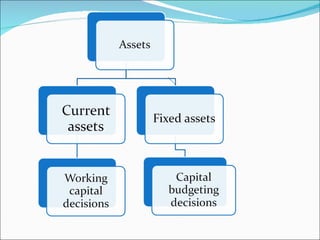
Procurement of fund+ Allocation of funds Investment in various assets
 
1. Funds are invested in long term assets. 2. Funds are invested in present times in anticipating of  future profit. 3. Such decision affect profitability of the firm. 4. Involvement of large amount of funds. 5. Irreversible nature. 6. Difficult to make investment decisions.
1. Accept Reject decision.  2.Mutually  competitive  decisions. 3. Priority order decisions.
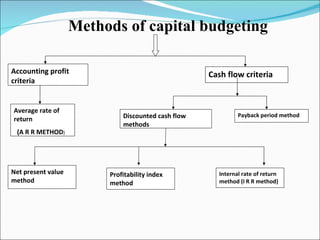
Methods of capital budgeting Accounting profit criteria Cash flow criteria Average rate of return  (A R R METHOD ) Discounted cash flow methods Payback period method Net present value method Profitability index method  Internal rate of return method (I R R method)
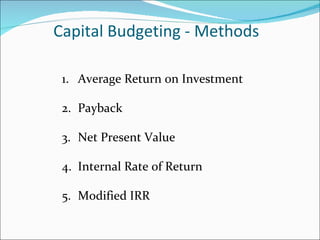
Capital Budgeting - Methods 1. Average Return on Investment 2. Payback 3. Net Present Value 4. Internal Rate of Return 5. Modified IRR
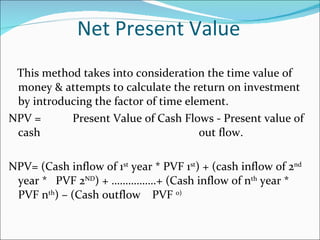
Net Present Value This method takes into consideration the time value of money & attempts to calculate the return on investment by introducing the factor of time element. NPV = Present Value of Cash Flows - Present value of cash  out flow. NPV= (Cash inflow of 1 st  year * PVF 1 st ) + (cash inflow of 2 nd  year *  PVF 2 ND ) + …………….+ (Cash inflow of n th  year *  PVF n th ) – (Cash outflow  PVF  0)
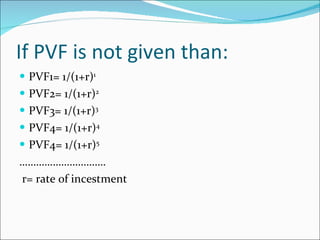
If PVF is not given than: PVF1= 1/(1+r) 1 PVF2= 1/(1+r) 2 PVF3= 1/(1+r) 3 PVF4= 1/(1+r) 4 PVF4= 1/(1+r) 5 ………………………… . r= rate of incestment
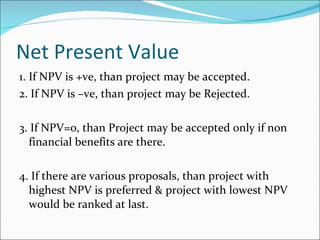
Net Present Value 1. If NPV is +ve, than project may be accepted. 2. If NPV is –ve, than project may be Rejected. 3. If NPV=0, than Project may be accepted only if non financial benefits are there. 4. If there are various proposals, than project with highest NPV is preferred & project with lowest NPV would be ranked at last.
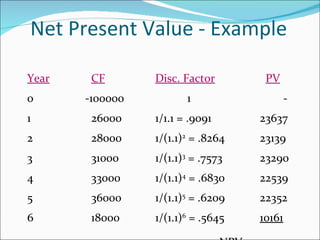
Net Present Value - Example Year CF Disc. Factor   PV 0   -100000 1 - 1 26000 1/1.1 = .9091   23637 2 28000 1/(1.1) 2  = .8264   23139 3 31000 1/(1.1) 3  = .7573   23290 4 33000 1/(1.1) 4  = .6830   22539 5 36000 1/(1.1) 5  = .6209   22352 6 18000 1/(1.1) 6  = .5645   10161 NPV =  25121
Net Present Value Advantages It recognize the time value of money. It takes into consideration the objective of maximum profit. Full life of the project is taken into consideration. Disadvantages It is difficult method. It is not easy to determinate the appropriate discount rate.
It is also time adjusting method of evaluating the investment proposals. Profitability index also called as benefit cost ratio or ‘desirability factor’ is the relationship between present value of cash inflow and present value of cash outflow.  Profitability index =  Present value of cash inflows  Present value of cash outflows
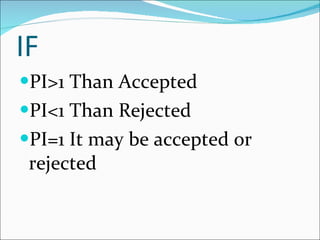
IF PI>1 Than Accepted PI<1 Than Rejected PI=1 It may be accepted or rejected
Profitability Index Advantages: This method is the improvement in net present value method. It also take into account the time value of money. Disadvantages: It is similar to the net present  value method, it can not determine the discount rate.

Capital budgeting 2

  • 1.
    Procurement of fund+Allocation of funds Investment in various assets
  • 2.
  • 3.
    1. Funds areinvested in long term assets. 2. Funds are invested in present times in anticipating of future profit. 3. Such decision affect profitability of the firm. 4. Involvement of large amount of funds. 5. Irreversible nature. 6. Difficult to make investment decisions.
  • 4.
    1. Accept Rejectdecision. 2.Mutually competitive decisions. 3. Priority order decisions.
  • 5.
    Methods of capitalbudgeting Accounting profit criteria Cash flow criteria Average rate of return (A R R METHOD ) Discounted cash flow methods Payback period method Net present value method Profitability index method Internal rate of return method (I R R method)
  • 6.
    Capital Budgeting -Methods 1. Average Return on Investment 2. Payback 3. Net Present Value 4. Internal Rate of Return 5. Modified IRR
  • 7.
    Net Present ValueThis method takes into consideration the time value of money & attempts to calculate the return on investment by introducing the factor of time element. NPV = Present Value of Cash Flows - Present value of cash out flow. NPV= (Cash inflow of 1 st year * PVF 1 st ) + (cash inflow of 2 nd year * PVF 2 ND ) + …………….+ (Cash inflow of n th year * PVF n th ) – (Cash outflow PVF 0)
  • 8.
    If PVF isnot given than: PVF1= 1/(1+r) 1 PVF2= 1/(1+r) 2 PVF3= 1/(1+r) 3 PVF4= 1/(1+r) 4 PVF4= 1/(1+r) 5 ………………………… . r= rate of incestment
  • 9.
    Net Present Value1. If NPV is +ve, than project may be accepted. 2. If NPV is –ve, than project may be Rejected. 3. If NPV=0, than Project may be accepted only if non financial benefits are there. 4. If there are various proposals, than project with highest NPV is preferred & project with lowest NPV would be ranked at last.
  • 10.
    Net Present Value- Example Year CF Disc. Factor PV 0 -100000 1 - 1 26000 1/1.1 = .9091 23637 2 28000 1/(1.1) 2 = .8264 23139 3 31000 1/(1.1) 3 = .7573 23290 4 33000 1/(1.1) 4 = .6830 22539 5 36000 1/(1.1) 5 = .6209 22352 6 18000 1/(1.1) 6 = .5645 10161 NPV = 25121
  • 11.
    Net Present ValueAdvantages It recognize the time value of money. It takes into consideration the objective of maximum profit. Full life of the project is taken into consideration. Disadvantages It is difficult method. It is not easy to determinate the appropriate discount rate.
  • 12.
    It is alsotime adjusting method of evaluating the investment proposals. Profitability index also called as benefit cost ratio or ‘desirability factor’ is the relationship between present value of cash inflow and present value of cash outflow. Profitability index = Present value of cash inflows Present value of cash outflows
  • 13.
    IF PI>1 ThanAccepted PI<1 Than Rejected PI=1 It may be accepted or rejected
  • 14.
    Profitability Index Advantages:This method is the improvement in net present value method. It also take into account the time value of money. Disadvantages: It is similar to the net present value method, it can not determine the discount rate.