LIBERALIZATION, PRIVATIZATION AND
GLOBALIZATIONAND ITS IMPACT ON
INDIAN ECONOMY
NIP (LPG)
By:-
Dr P.V Khatri
(Acting Principal ,Swami Shraddhanand College)
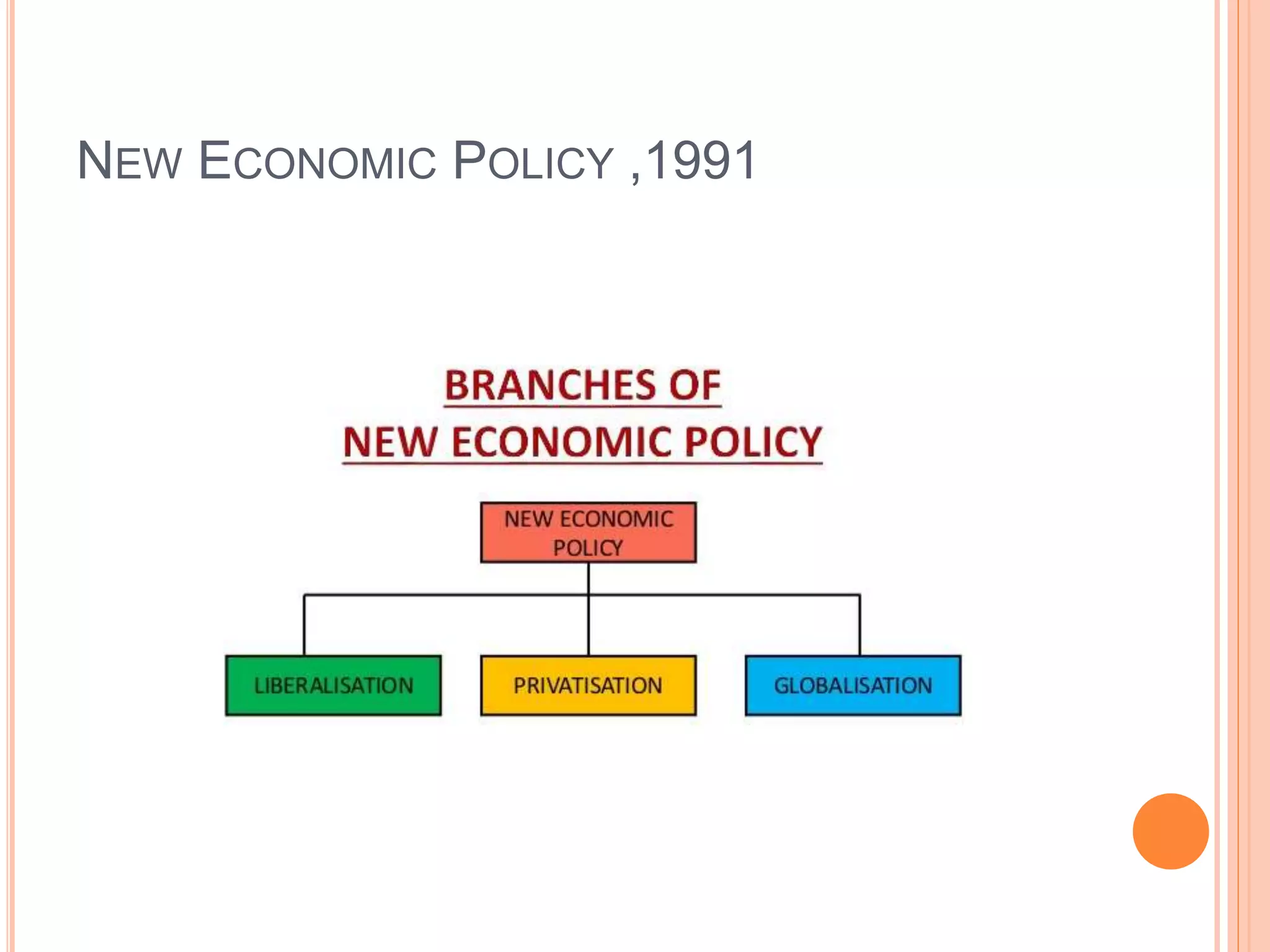
NEW ECONOMIC POLICY ,1991
NEW ECONOMIC POLICY(1991)-
LIBERALIZATION ,PRIVATIZATION AND
GLOBALIZATION (LPG)
LPG phenomenon was first initiated in the Indian Economy
in 1991 by the union finance minister Dr. Manmohan
singh
 There was decline in the country’s
 export earnings
 national income
 industrial output.
That is when the government decided to introduce the New
Industrial Policy (NIP) in 1991 to start liberalizing the
Indian economy
NEED FOR LPG
 Initiate rapid economic growth to raise the standard
of living, reduce the widespread un. Become self-
reliant and set up a strong industrial base with
emphasis on heavy and basic industries;
 Achieve balanced regional development by
establishing industries across the country;
 Reduce inequalities of income and wealth;
 . Adopt a socialist pattern of development — based
on equality and prevent exploitation of man by man.
 employment and poverty stalking the land;
THE MAJOR OBJECTIVE OF THE NEW
ECONOMIC POLICY
 1. Utilizing fully the indigenous capabilities of entrepreneurs.
 2. Fostering research and development efforts for the
development of indigenous technologies.
 3. Raising investments.
 4. Removing regulator system and other weaknesses.
 5. Improvement in efficiency and productivity.
 6. Controlling monopolistic power.
 7. Assigning the right areas for the public sector undertakings.
 8. Ensuring welfare as also skills and facilities to the workers
to enable them to face new technologies.
 9. Retaining the capacity to earn our own foreign exchange
through exports.
 10. To achieve self-reliance
LIBERALIZATION
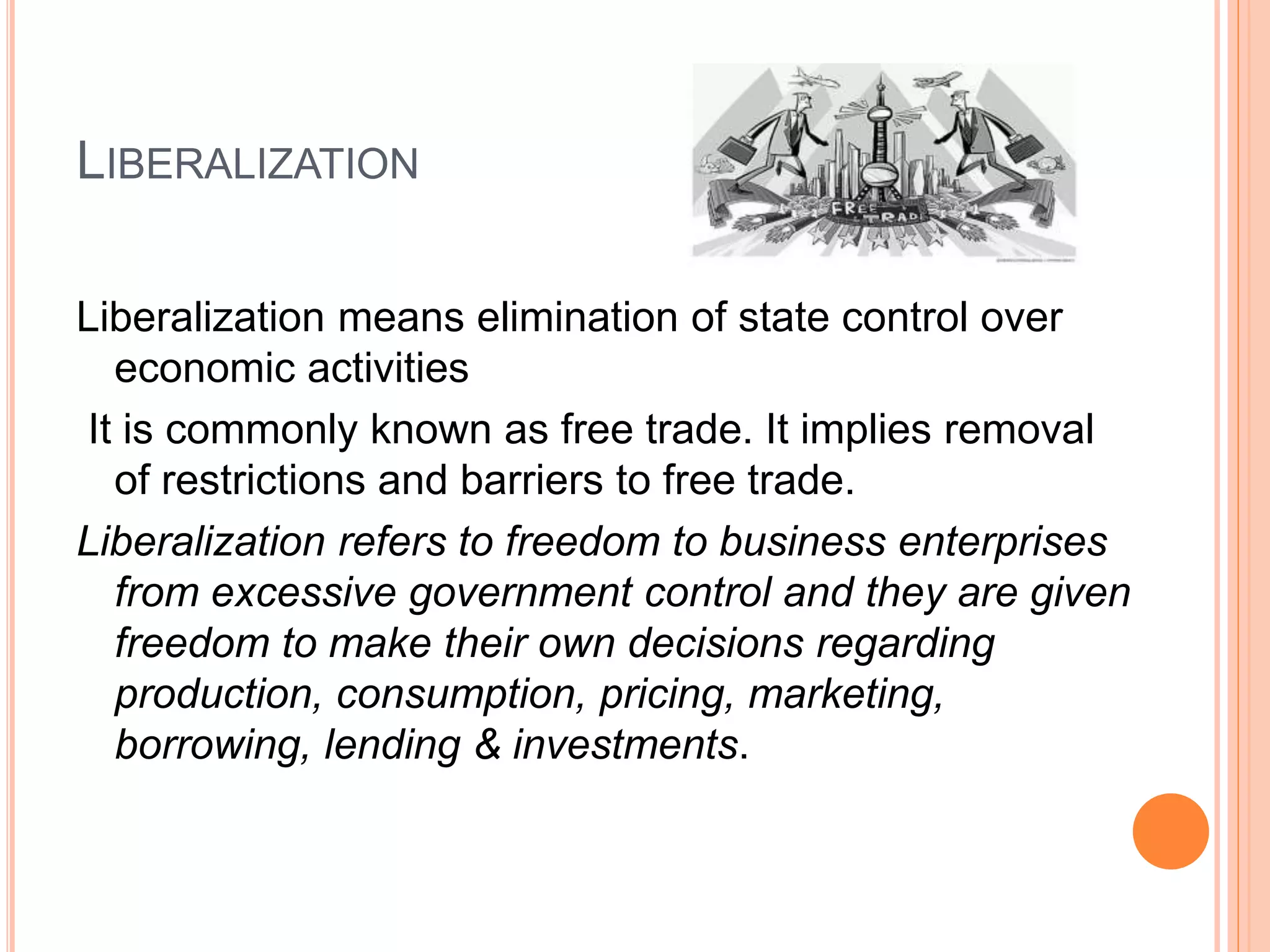
Liberalization means elimination of state control over
economic activities
It is commonly known as free trade. It implies removal
of restrictions and barriers to free trade.
Liberalization refers to freedom to business enterprises
from excessive government control and they are given
freedom to make their own decisions regarding
production, consumption, pricing, marketing,
borrowing, lending & investments.
FEATURES OF THE POLICY OF
LIBERALISATION :
1.Abolition of licensing
NIP’1991 abolished licensing for most industries
except 6 industries of strategic significance. They
include
 Alcohol,
 Cigarettes,
 Industrial explosives,
 Defense products ,
 Drugs and pharmaceuticals,
 Hazardous chemicals and certain others reserved
for the public sector.
2.LIBERALIZATION OF FOREIGN INVESTMENT
Automatic approvals were given for Foreign Direct
Investment (FDI) to flow into the country. FDI
including sectors such as
 Hotel and tourism,
 Infrastructure,
 Software development .etc.
 Use of foreign brand name or trade mark was
permitted for sale of goods
3.RELAXATION OF LOCATION RESTRICTIONS
There is no requirement for obtaining approval from
the Central Government for setting up industries
anywhere in the country except those specified
under compulsory licensing or in cities with
population exceeding1 million. Polluting industries
were required to be located 25 kms away from the
city peripheries if the city population was greater
than 1 million.
0THER FEATURES OF LIBERALIZATION
 Freedom in deciding the scale of business activities i.e.,
no restrictions on expansion or contraction of business
activities,
 Removal of restrictions on the movement of goods and
services,
 Freedom in fixing the prices of goods and services,
 Reduction in tax rates and lifting of unnecessary controls
over the economy,
 Simplifying procedures for imports and exports, and
 Making it easier to attract foreign capital and technology
to India.
 Free flow of foreign investment.
PRIVATIZATION
The transfer of ownership, property or business from
the government to the private sector is termed
privatization
. The government ceases to be the owner of the entity
or business
FEATURES OF PRIVATIZATION
 Decentralization the transfer of the ownership of
productive assets to the private sector.
 Entry of private sector industries into the areas
exclusive reserved for the state sector or which are
considered exclusive monopolies of state.
 Limiting the scope of the public sector or no more
diversification of existing public sector
understandings.
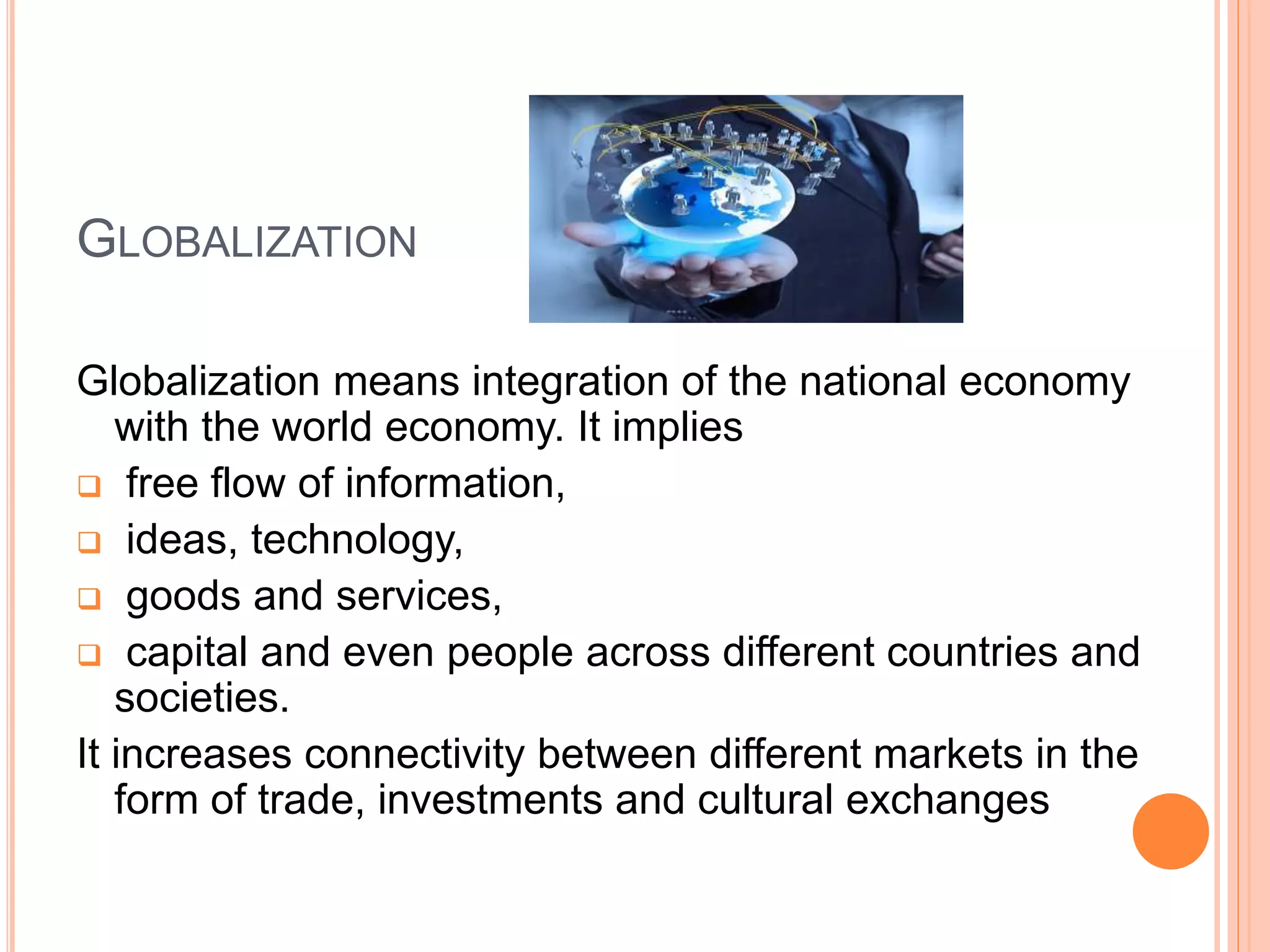
GLOBALIZATION
Globalization means integration of the national economy
with the world economy. It implies
 free flow of information,
 ideas, technology,
 goods and services,
 capital and even people across different countries and
societies.
It increases connectivity between different markets in the
form of trade, investments and cultural exchanges
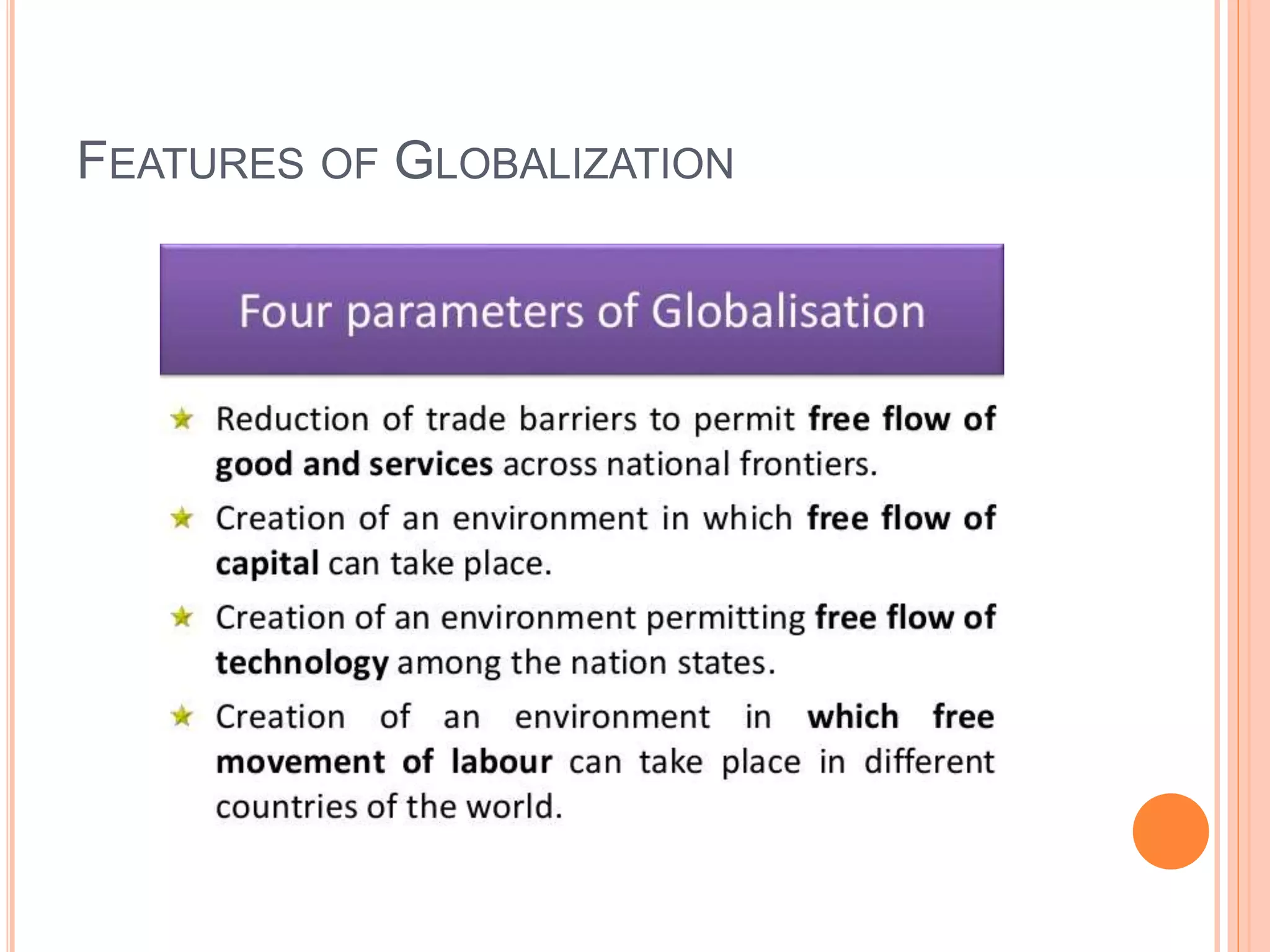
FEATURES OF GLOBALIZATION
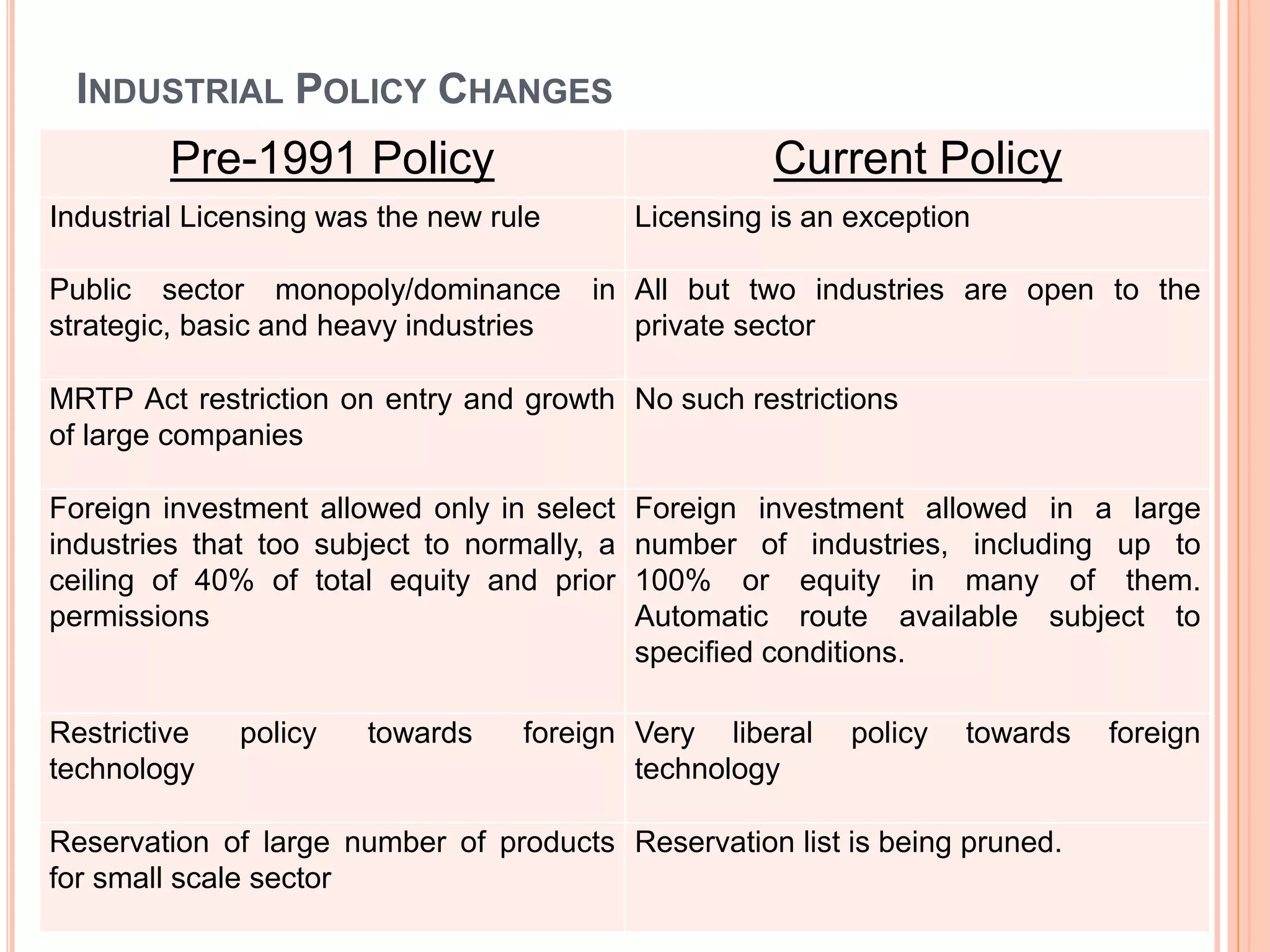
INDUSTRIAL POLICY CHANGES
Pre-1991 Policy Current Policy
Industrial Licensing was the new rule Licensing is an exception
Public sector monopoly/dominance in
strategic, basic and heavy industries
All but two industries are open to the
private sector
MRTP Act restriction on entry and growth
of large companies
No such restrictions
Foreign investment allowed only in select
industries that too subject to normally, a
ceiling of 40% of total equity and prior
permissions
Foreign investment allowed in a large
number of industries, including up to
100% or equity in many of them.
Automatic route available subject to
specified conditions.
Restrictive policy towards foreign
technology
Very liberal policy towards foreign
technology
Reservation of large number of products
for small scale sector
Reservation list is being pruned.
POSITIVE IMPACT OF LPG ON INDIAN
ECONOMY
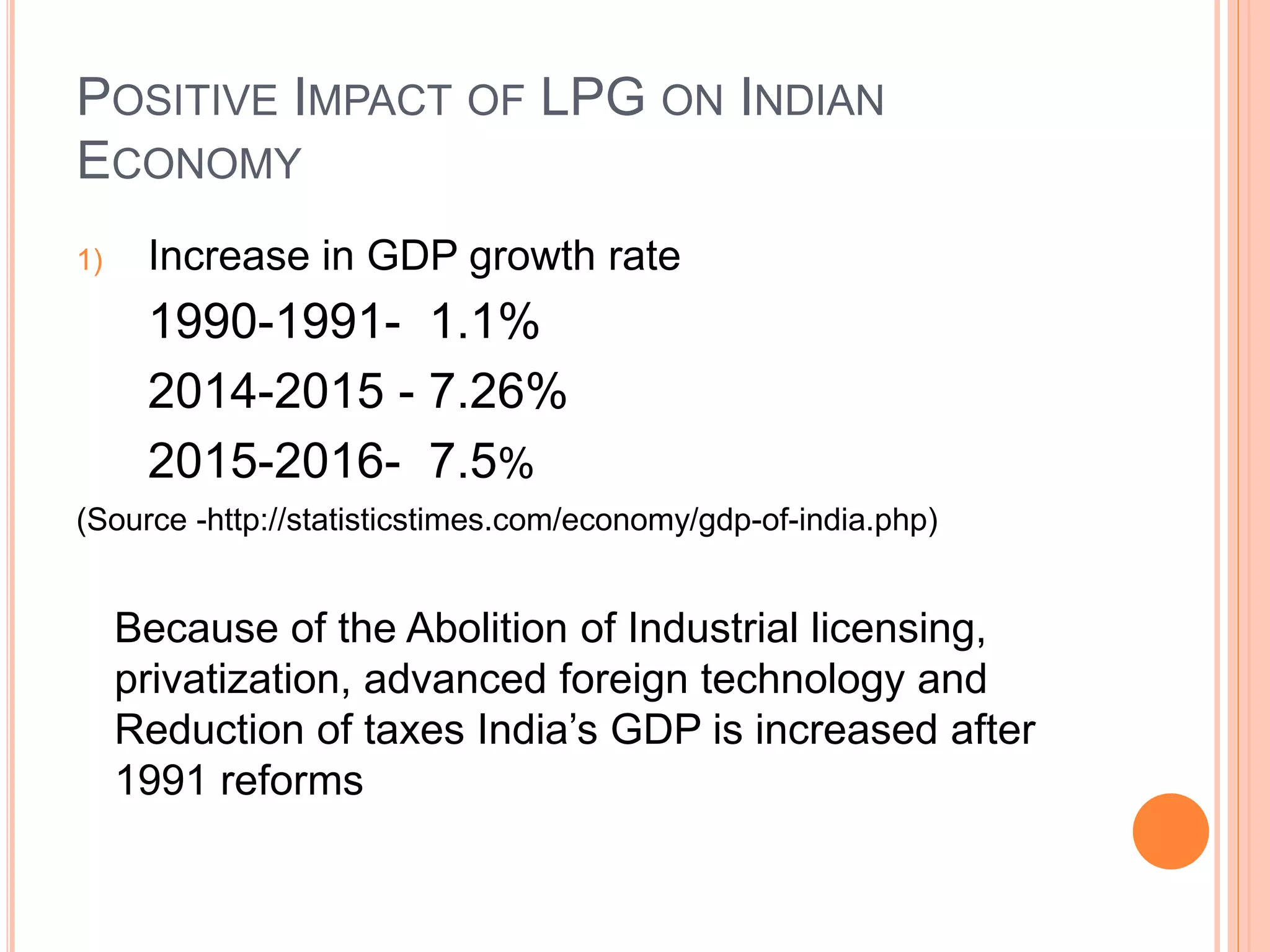
1) Increase in GDP growth rate
1990-1991- 1.1%
2014-2015 - 7.26%
2015-2016- 7.5%
(Source -http://statisticstimes.com/economy/gdp-of-india.php)
Because of the Abolition of Industrial licensing,
privatization, advanced foreign technology and
Reduction of taxes India’s GDP is increased after
1991 reforms
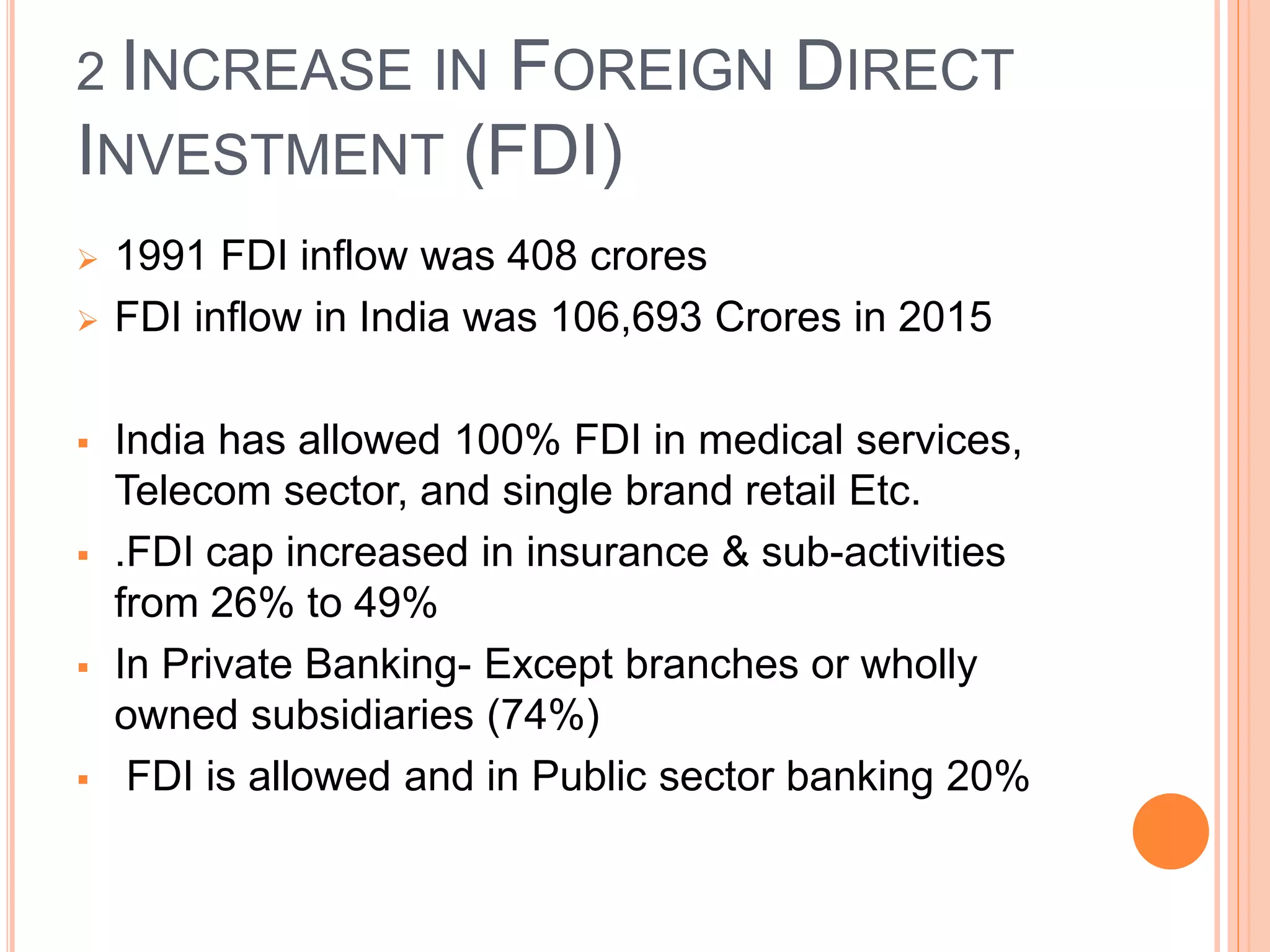
2 INCREASE IN FOREIGN DIRECT
INVESTMENT (FDI)
 1991 FDI inflow was 408 crores
 FDI inflow in India was 106,693 Crores in 2015
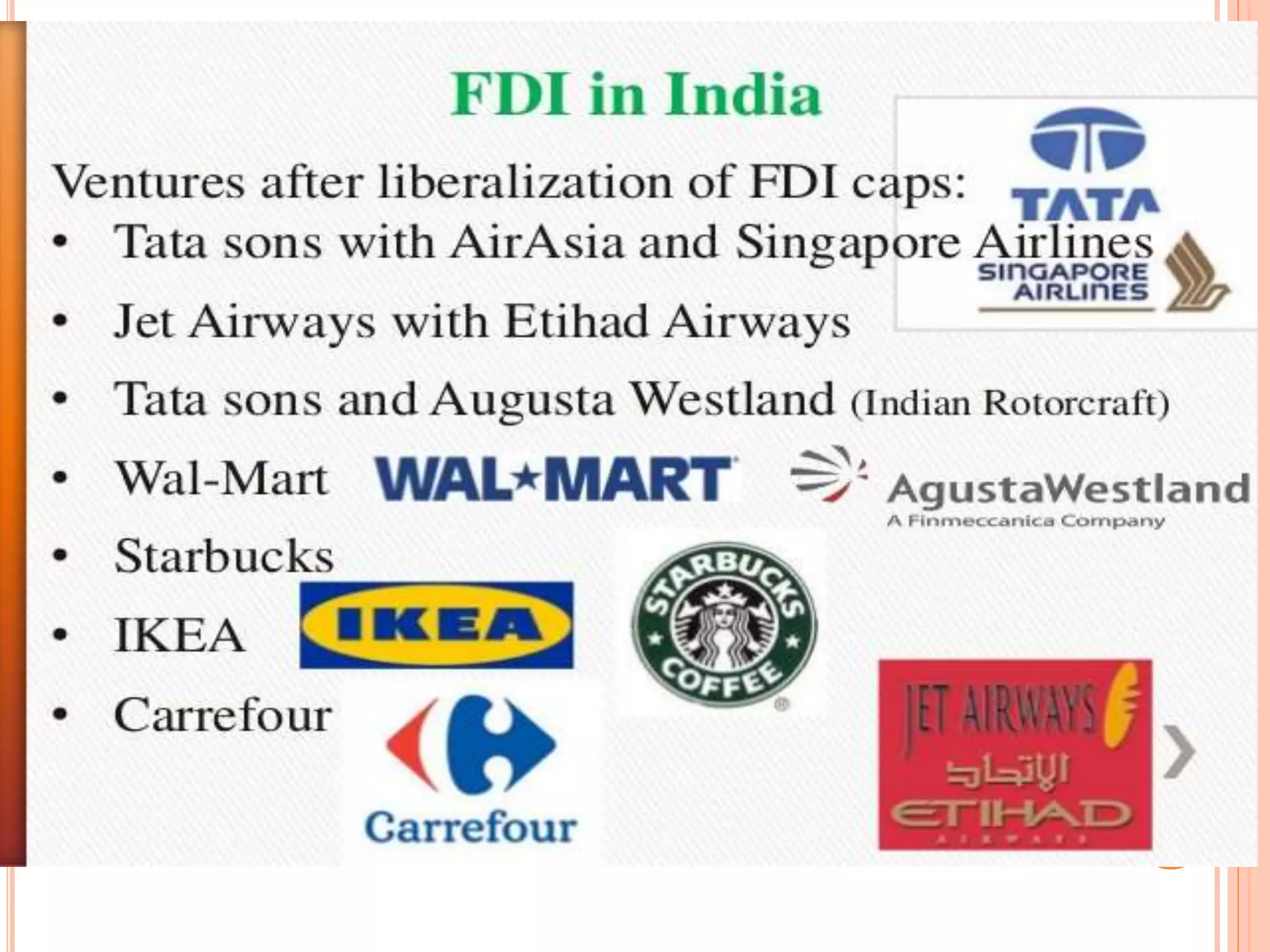
 India has allowed 100% FDI in medical services,
Telecom sector, and single brand retail Etc.
 .FDI cap increased in insurance & sub-activities
from 26% to 49%
 In Private Banking- Except branches or wholly
owned subsidiaries (74%)
 FDI is allowed and in Public sector banking 20%
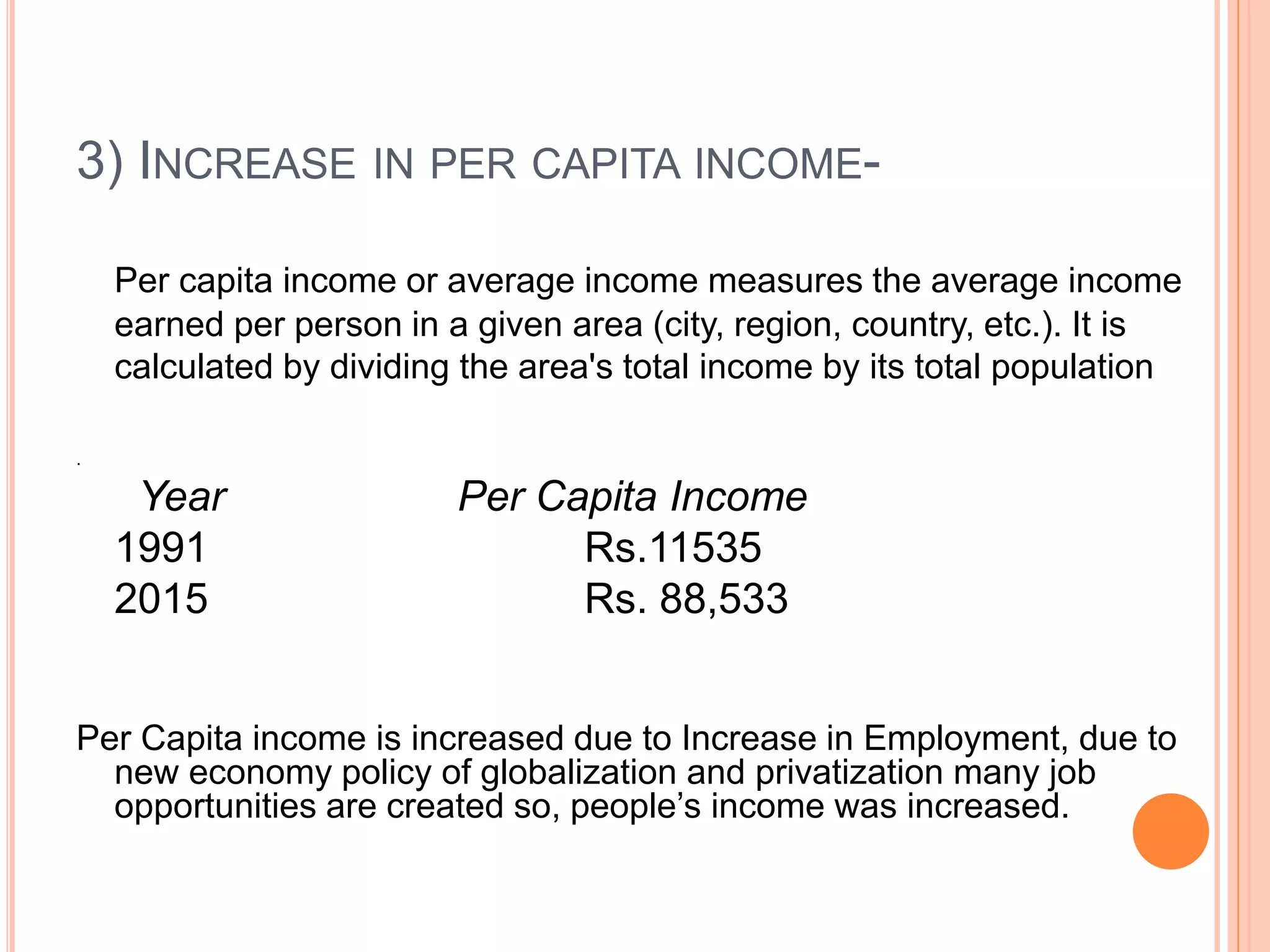
3) INCREASE IN PER CAPITA INCOME-
Per capita income or average income measures the average income
earned per person in a given area (city, region, country, etc.). It is
calculated by dividing the area's total income by its total population
.
Year Per Capita Income
1991 Rs.11535
2015 Rs. 88,533
Per Capita income is increased due to Increase in Employment, due to
new economy policy of globalization and privatization many job
opportunities are created so, people’s income was increased.
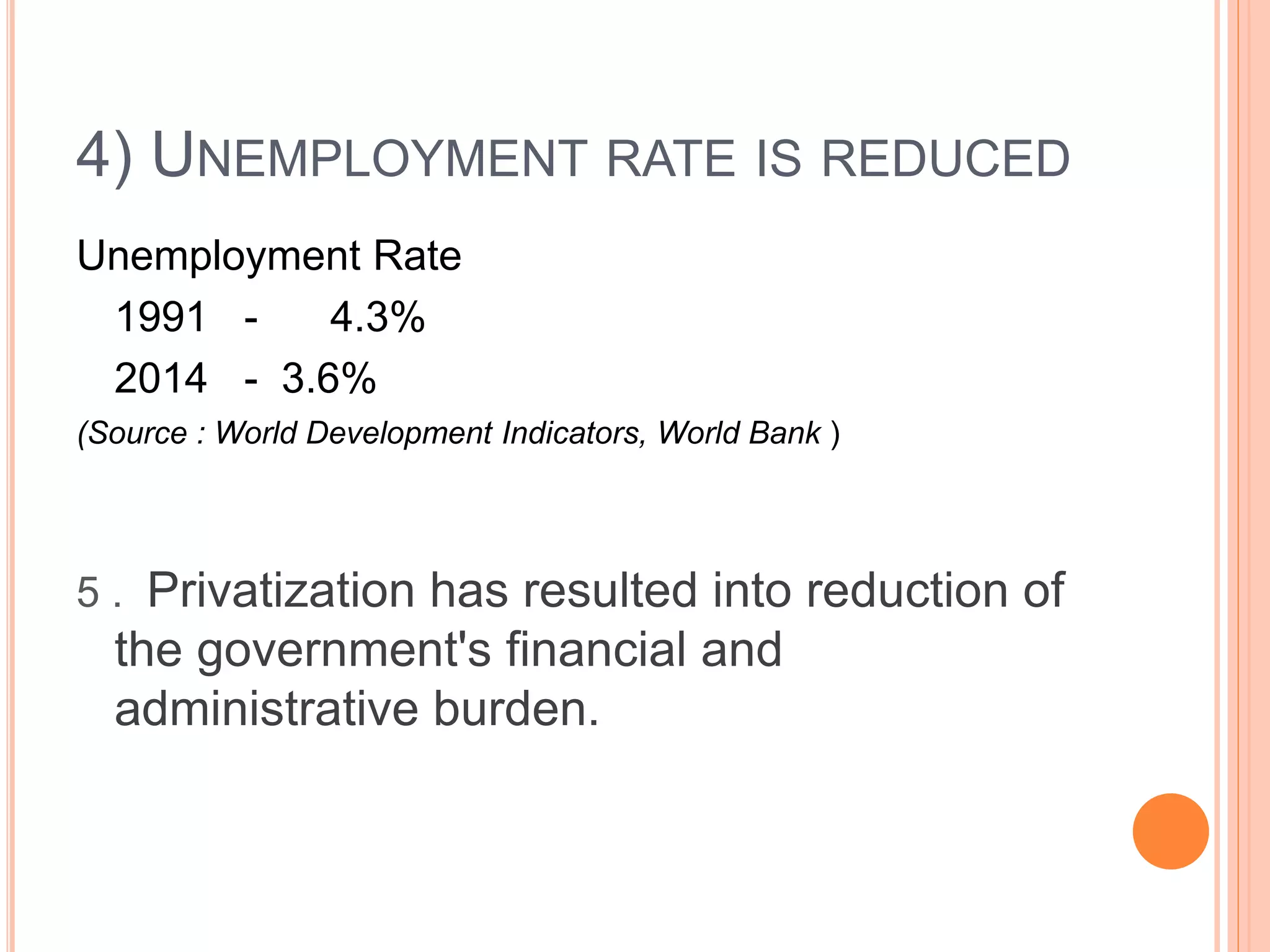
4) UNEMPLOYMENT RATE IS REDUCED
Unemployment Rate
1991 - 4.3%
2014 - 3.6%
(Source : World Development Indicators, World Bank )
5 . Privatization has resulted into reduction of
the government's financial and
administrative burden.
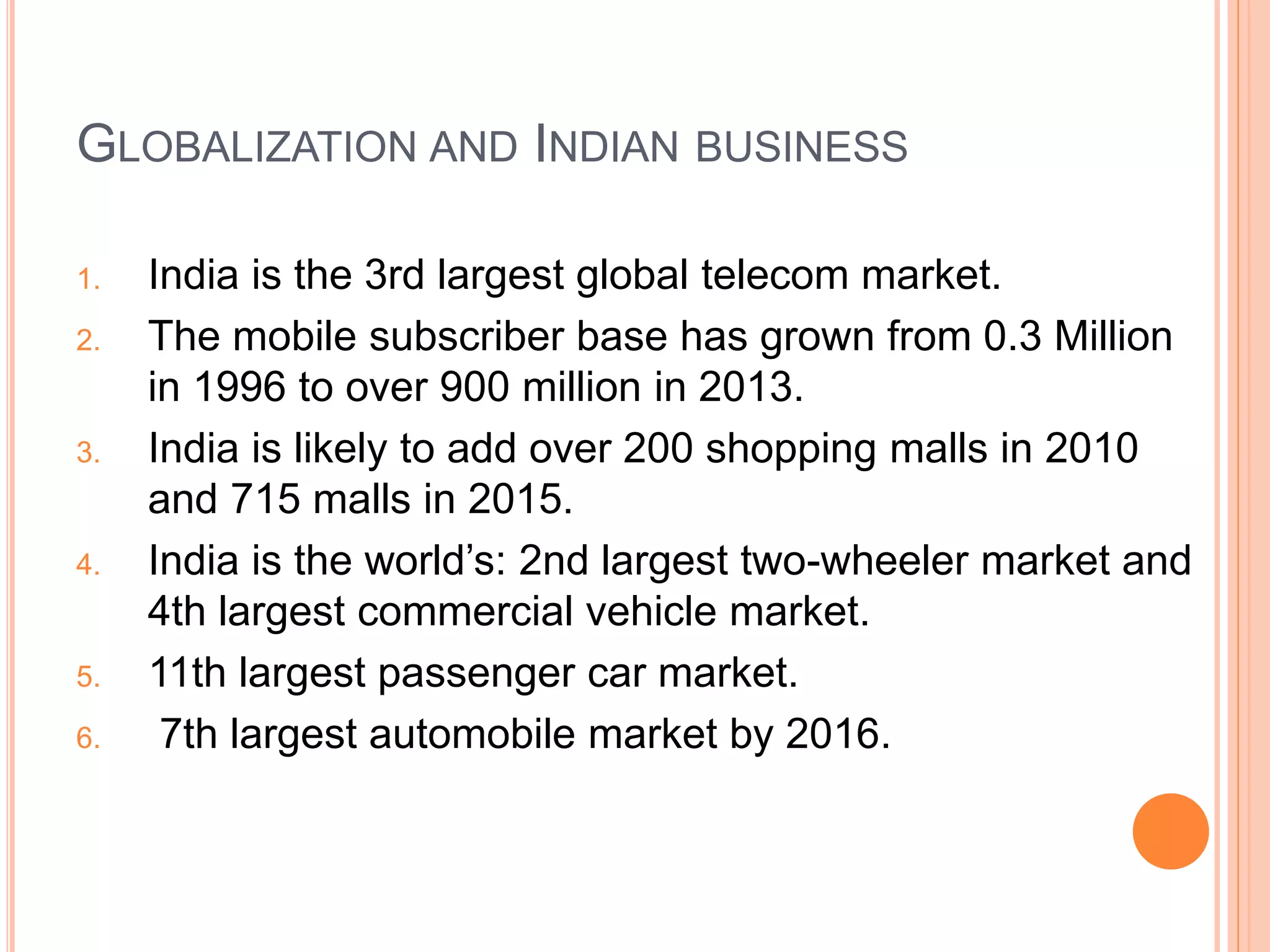
GLOBALIZATION AND INDIAN BUSINESS
1. India is the 3rd largest global telecom market.
2. The mobile subscriber base has grown from 0.3 Million
in 1996 to over 900 million in 2013.
3. India is likely to add over 200 shopping malls in 2010
and 715 malls in 2015.
4. India is the world’s: 2nd largest two-wheeler market and
4th largest commercial vehicle market.
5. 11th largest passenger car market.
6. 7th largest automobile market by 2016.
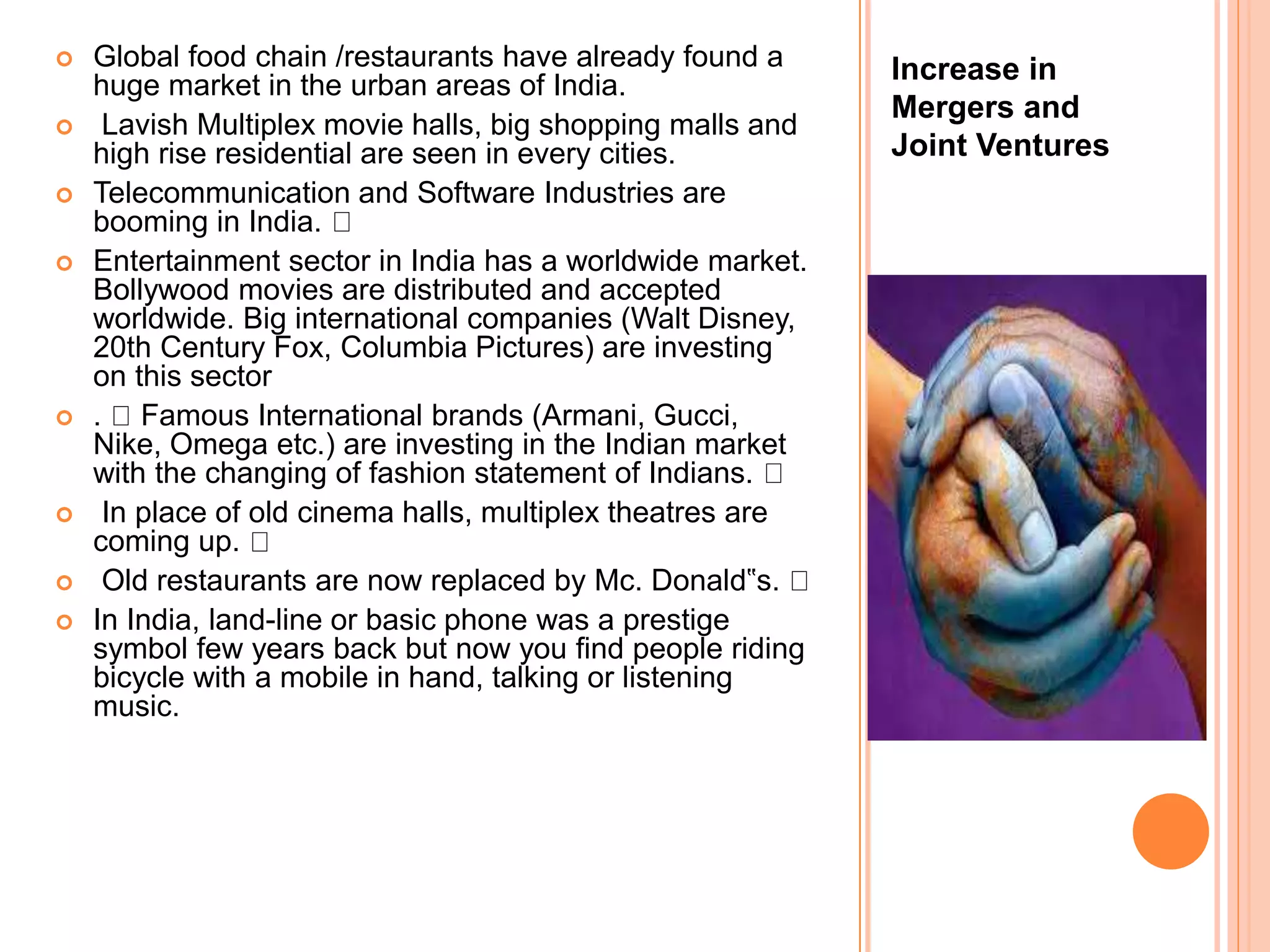
Increase in
Mergers and
Joint Ventures
 Global food chain /restaurants have already found a
huge market in the urban areas of India.
 Lavish Multiplex movie halls, big shopping malls and
high rise residential are seen in every cities.
 Telecommunication and Software Industries are
booming in India.
 Entertainment sector in India has a worldwide market.
Bollywood movies are distributed and accepted
worldwide. Big international companies (Walt Disney,
20th Century Fox, Columbia Pictures) are investing
on this sector
 . Famous International brands (Armani, Gucci,
Nike, Omega etc.) are investing in the Indian market
with the changing of fashion statement of Indians.
 In place of old cinema halls, multiplex theatres are
coming up.
 Old restaurants are now replaced by Mc. Donald‟s.
 In India, land-line or basic phone was a prestige
symbol few years back but now you find people riding
bicycle with a mobile in hand, talking or listening
music.
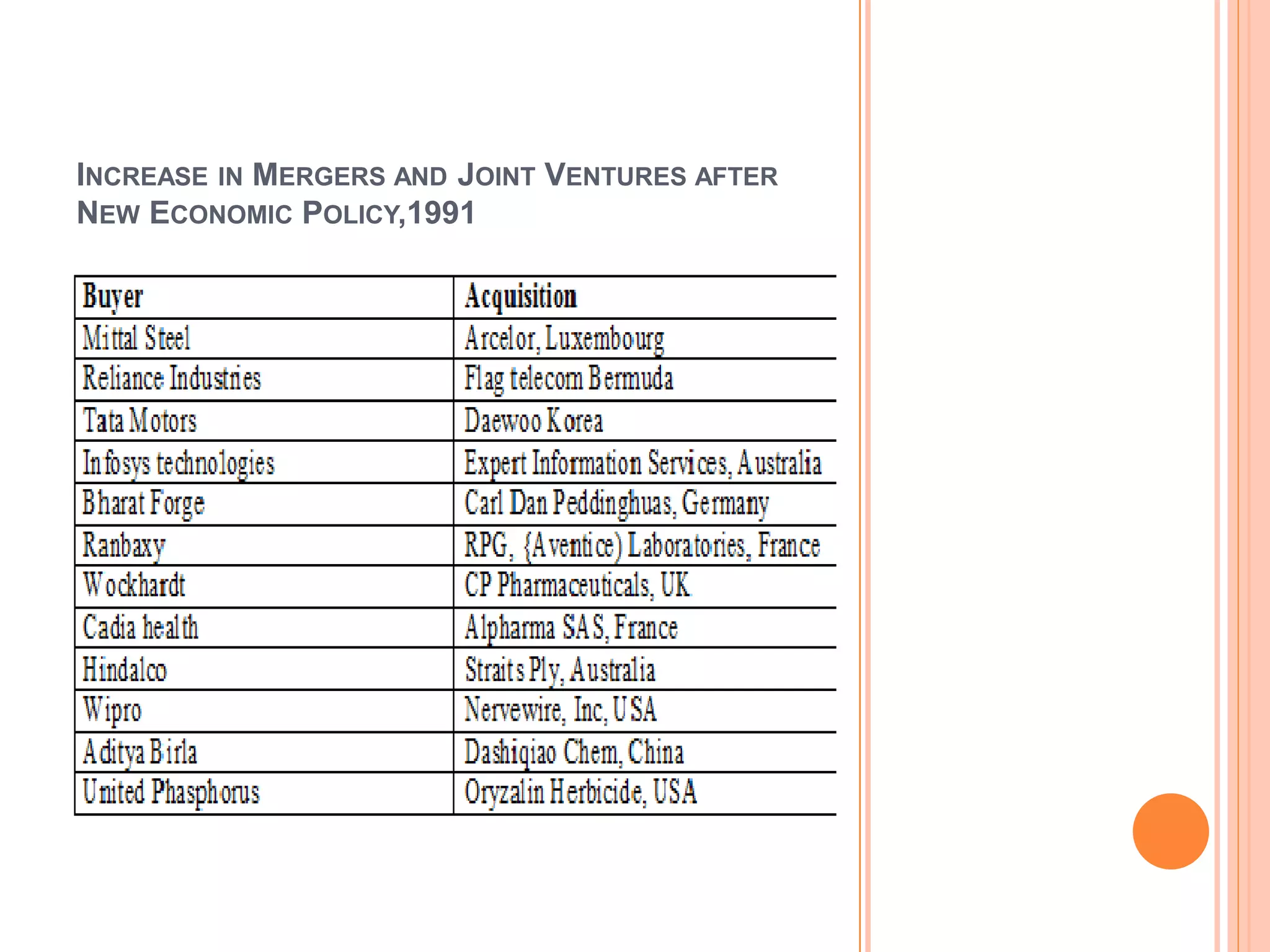
INCREASE IN MERGERS AND JOINT VENTURES AFTER
NEW ECONOMIC POLICY,1991
TECHNOLOGICAL IMPACT OF
GLOBALIZATION IN INDIA
 Scientific and technological innovations have made life
quite comfortable, fast and enjoyable.
 Internet facility is everywhere and extension of internet
facilities even to rural areas.
 Access to television grew from 20% of the urban
population (1991) to 90% of the urban population
(2009). Even in the rural areas satellite television has a
grown up market.
 internationalization of financial markets
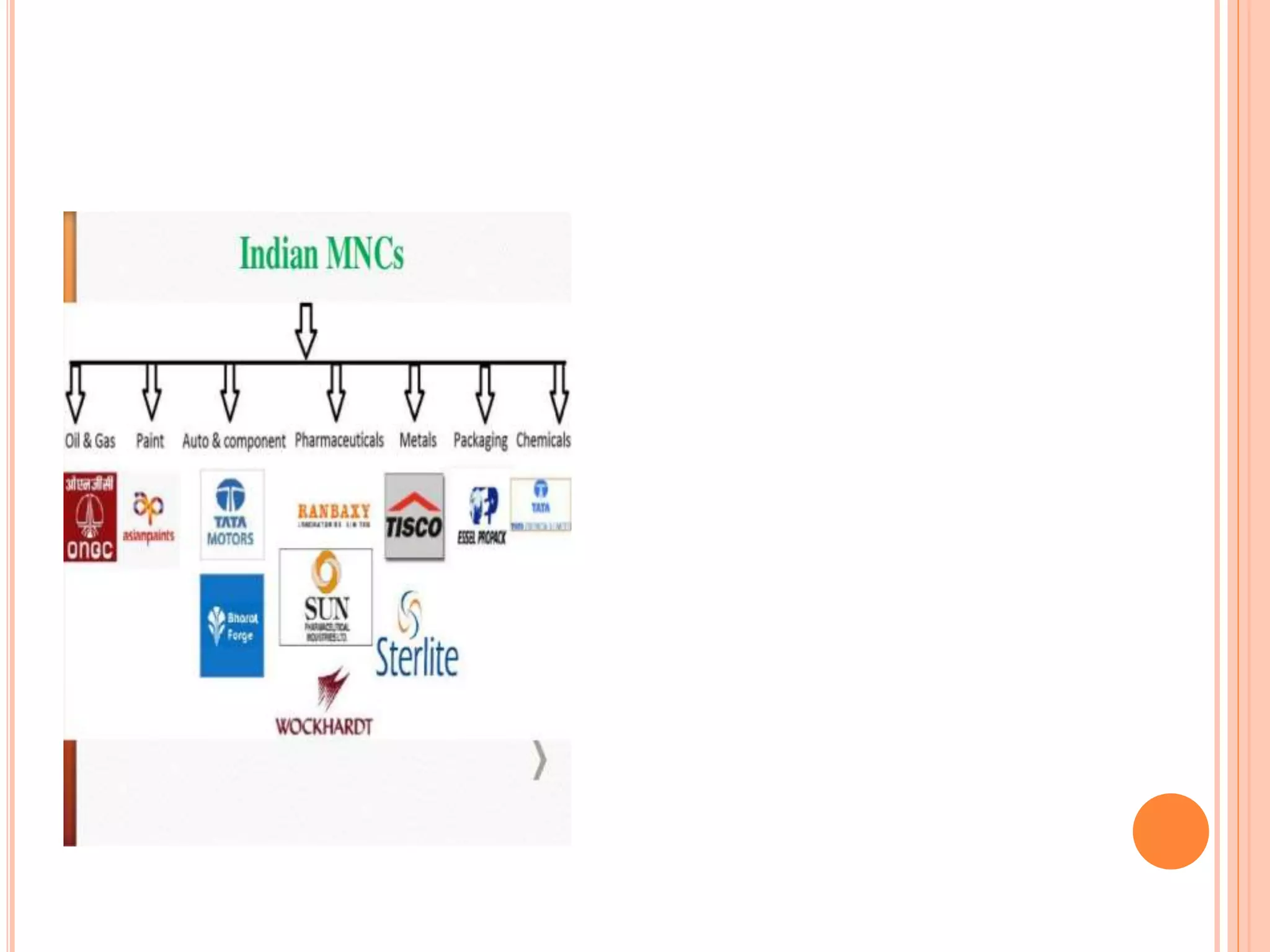
 growing importance of MNCs
 popularization of mass media and communication
technologies such as cell phones, credit cards and e-
commerce which has transformed the way we do
business today.
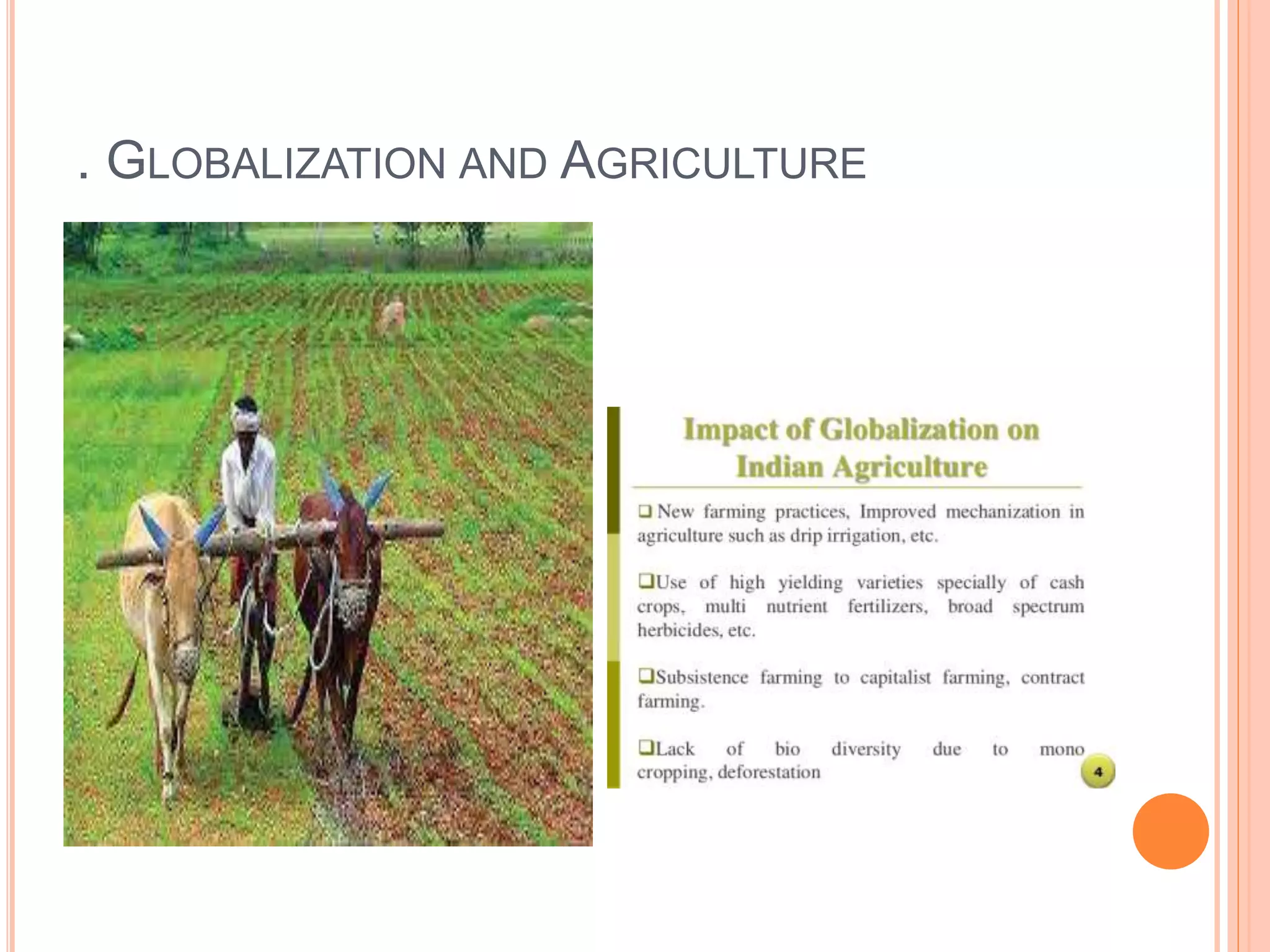
. GLOBALIZATION AND AGRICULTURE
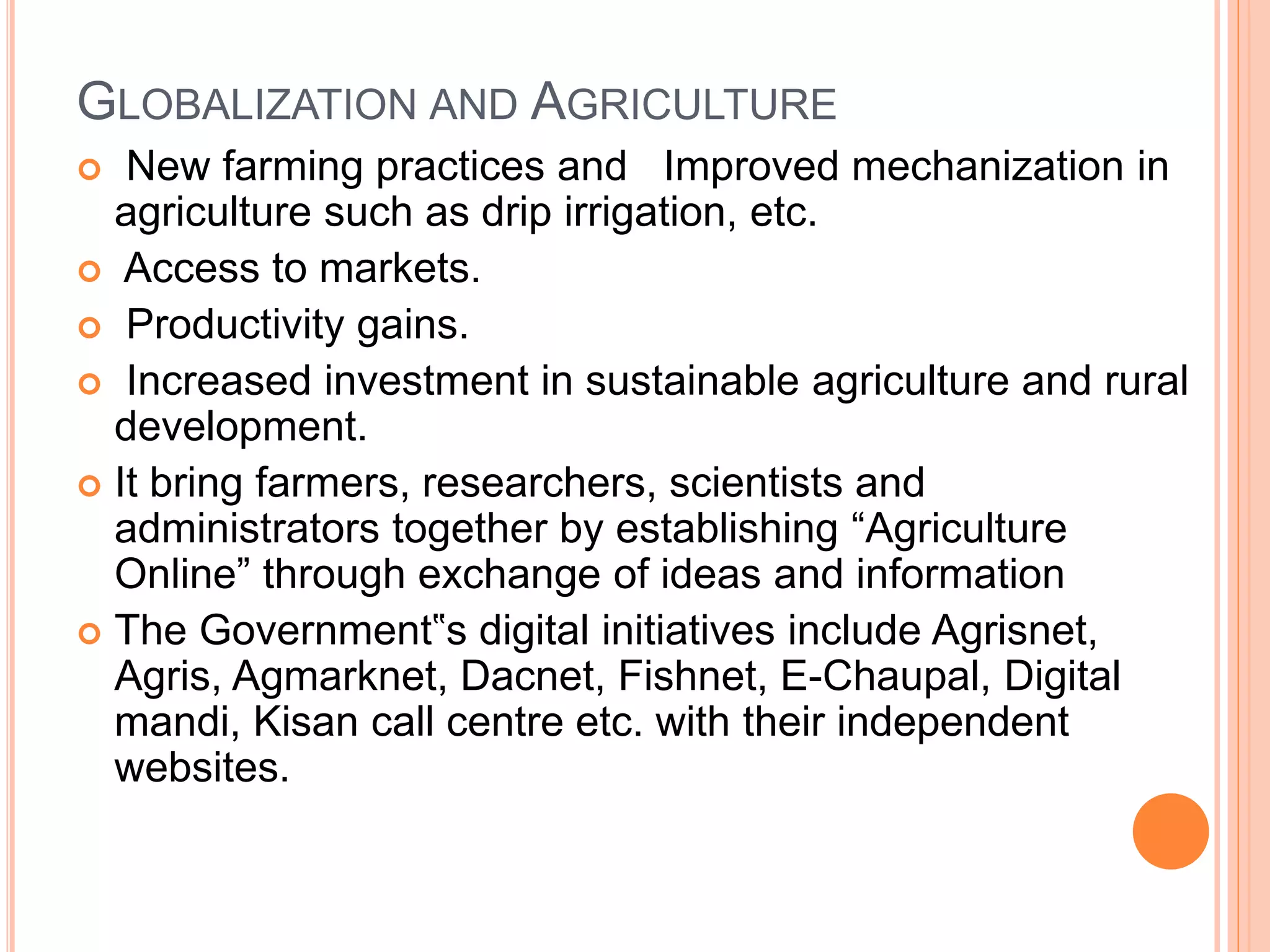
GLOBALIZATION AND AGRICULTURE
 New farming practices and Improved mechanization in
agriculture such as drip irrigation, etc.
 Access to markets.
 Productivity gains.
 Increased investment in sustainable agriculture and rural
development.
 It bring farmers, researchers, scientists and
administrators together by establishing “Agriculture
Online” through exchange of ideas and information
 The Government‟s digital initiatives include Agrisnet,
Agris, Agmarknet, Dacnet, Fishnet, E-Chaupal, Digital
mandi, Kisan call centre etc. with their independent
websites.
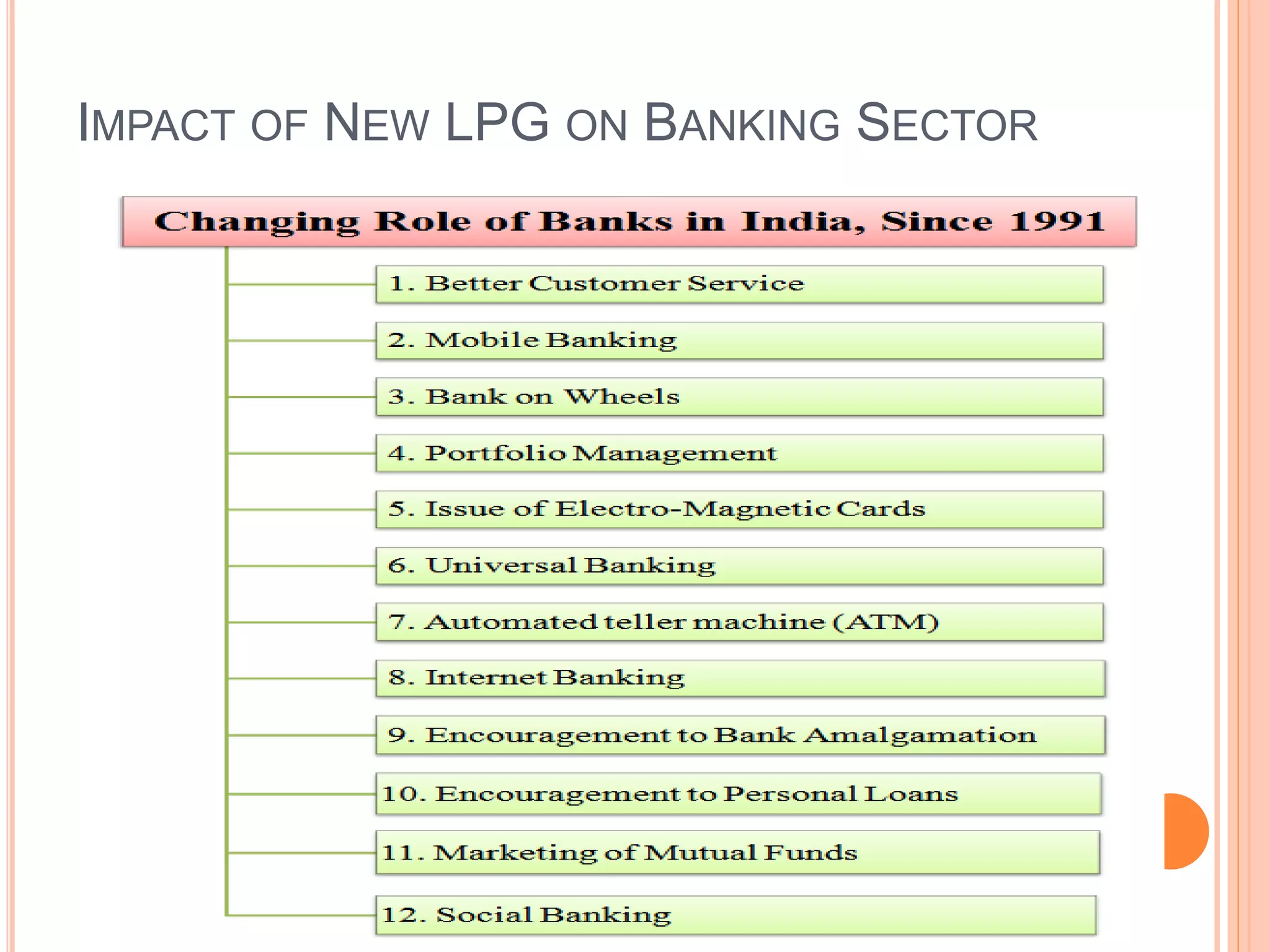
IMPACT OF NEW LPG ON BANKING SECTOR
 ATMs, Internet banking, mobile banking and
social banking have made "anytime anywhere
banking"
 Further, in banking too India has been a gainer.
Since reforms, there have been three rounds of
License Grants for private banks.
 Private Banks such as ICICI, HDFC, Yes Bank and
also foreign banks, raised standards of Indian
Banking Industry.
 Now there is cut through competition in the
banking industry, and public sector banks are more
responsive to customers.
IMPACT OF NEW LPG ON BANKING SECTOR
 Here too IT is on path of bringing banking
revolution.
 New government schemes like Pradhan Mantri
Jandhan Yojana aims to achieve their targets by
using Adhaar Card.
 Having said this, Public Sector Banks still remain
major lender in the country.
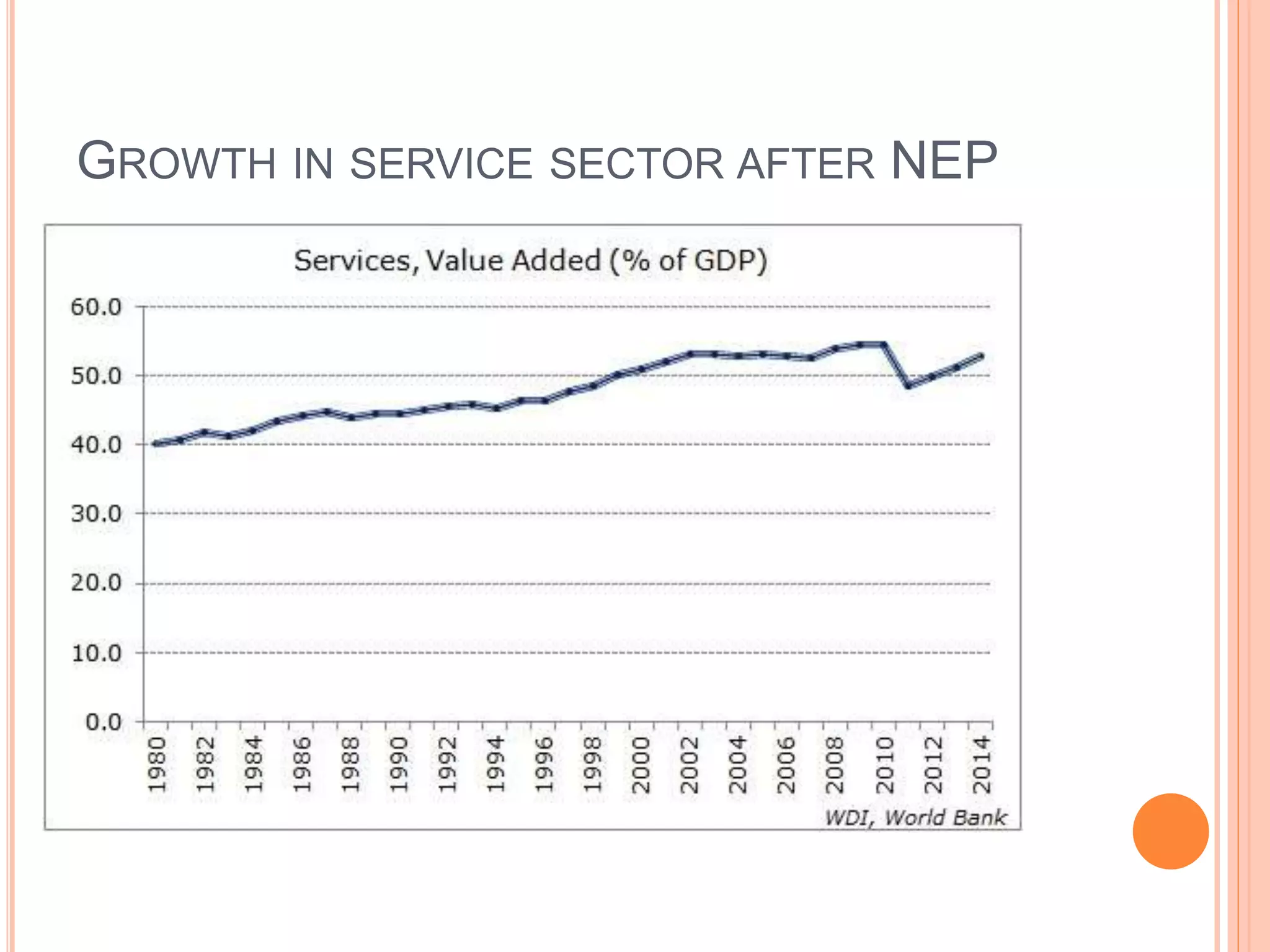
NEP(LPG)- SERVICE SECTOR GROWTH
The services sector is now the largest and fastest
growing sector of the economy, contributing more
than 50% to the GDP
India’s Central Statistics Office classifies the
services sector into four main industries:
1) restaurants, hotels and trade
2) storage, communication and transportation
3) finance, insurance, business services and real
estate
4) social, personal and community services.
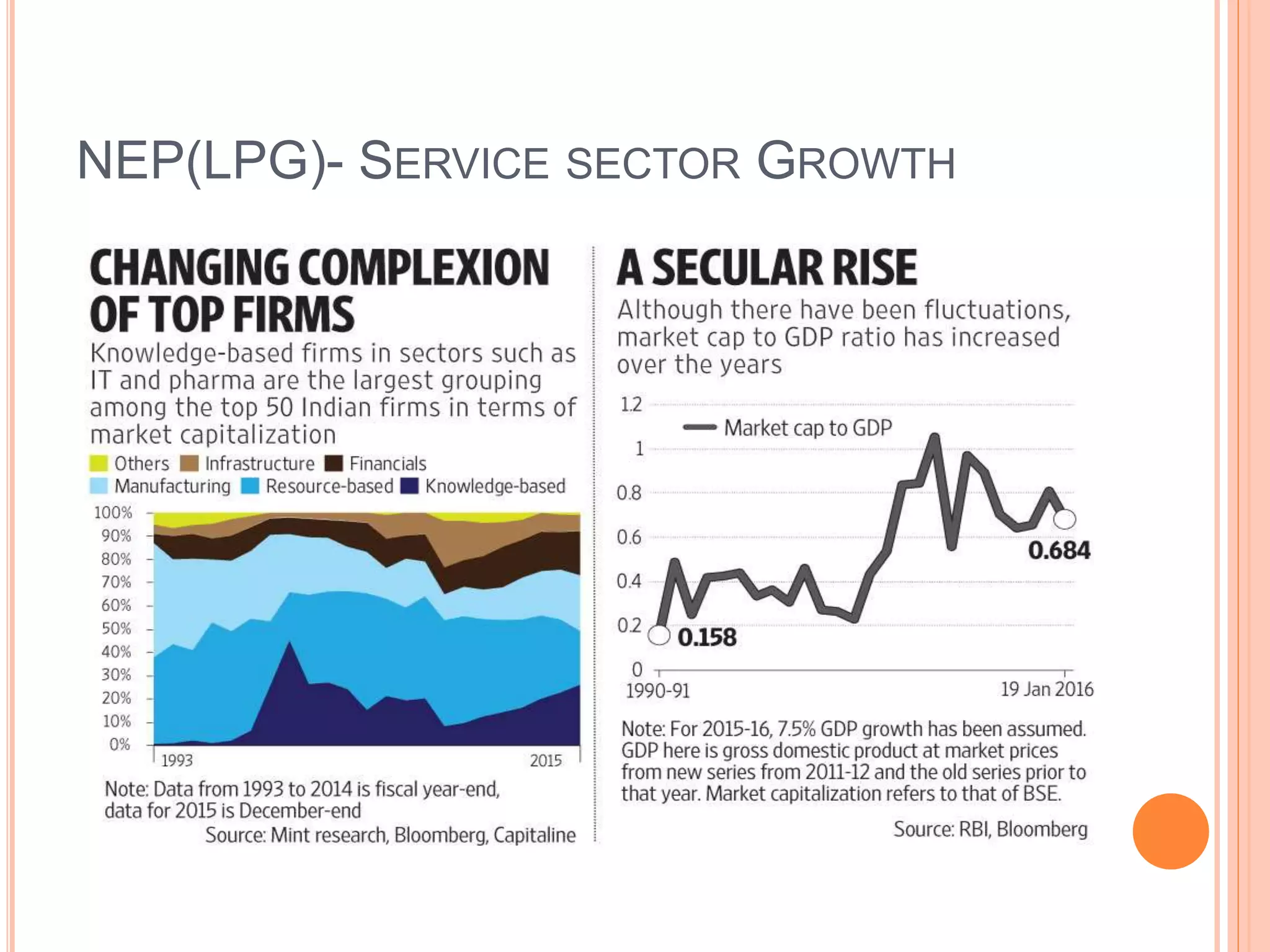
NEP(LPG)- SERVICE SECTOR GROWTH
IMPACT OF LPG ON IMPORT AND EXPORTS
 India has the second fastest growing services
sector with its compound annual growth rate at nine
per cent, just below China’s 10.9 per cent, during
the last 11-year period from 2001 to 2012, the
Economic Survey for 2013-14 said. Russia at 5.4
per cent is a distant third.
GROWTH IN SERVICE SECTOR AFTER NEP
CONCLUSION
The advent of globalization as a result of
liberalization and privatization has both positive and
negative impact on the economy. one group of
people argue that globalization provides greater
opportunities ,new markets ,better technology etc
while other group feel that it does not protect
domestic industries .From Indian prospective
,globalization improved our condition of living open
up employment in the field of
IT,Telecommunication,Hospitality ,Banking and
others .
Thank You

LIBERALIZATION, PRIVATIZATION AND GLOBALIZATIONAND ITS IMPACT ON INDIAN ECONOMY NIP (LPG)

  • 1.
    LIBERALIZATION, PRIVATIZATION AND GLOBALIZATIONANDITS IMPACT ON INDIAN ECONOMY NIP (LPG) By:- Dr P.V Khatri (Acting Principal ,Swami Shraddhanand College)
  • 2.
  • 3.
    NEW ECONOMIC POLICY(1991)- LIBERALIZATION,PRIVATIZATION AND GLOBALIZATION (LPG) LPG phenomenon was first initiated in the Indian Economy in 1991 by the union finance minister Dr. Manmohan singh  There was decline in the country’s  export earnings  national income  industrial output. That is when the government decided to introduce the New Industrial Policy (NIP) in 1991 to start liberalizing the Indian economy
  • 4.
    NEED FOR LPG Initiate rapid economic growth to raise the standard of living, reduce the widespread un. Become self- reliant and set up a strong industrial base with emphasis on heavy and basic industries;  Achieve balanced regional development by establishing industries across the country;  Reduce inequalities of income and wealth;  . Adopt a socialist pattern of development — based on equality and prevent exploitation of man by man.  employment and poverty stalking the land;
  • 5.
    THE MAJOR OBJECTIVEOF THE NEW ECONOMIC POLICY  1. Utilizing fully the indigenous capabilities of entrepreneurs.  2. Fostering research and development efforts for the development of indigenous technologies.  3. Raising investments.  4. Removing regulator system and other weaknesses.  5. Improvement in efficiency and productivity.  6. Controlling monopolistic power.  7. Assigning the right areas for the public sector undertakings.  8. Ensuring welfare as also skills and facilities to the workers to enable them to face new technologies.  9. Retaining the capacity to earn our own foreign exchange through exports.  10. To achieve self-reliance
  • 6.
    LIBERALIZATION Liberalization means eliminationof state control over economic activities It is commonly known as free trade. It implies removal of restrictions and barriers to free trade. Liberalization refers to freedom to business enterprises from excessive government control and they are given freedom to make their own decisions regarding production, consumption, pricing, marketing, borrowing, lending & investments.
  • 7.
    FEATURES OF THEPOLICY OF LIBERALISATION : 1.Abolition of licensing NIP’1991 abolished licensing for most industries except 6 industries of strategic significance. They include  Alcohol,  Cigarettes,  Industrial explosives,  Defense products ,  Drugs and pharmaceuticals,  Hazardous chemicals and certain others reserved for the public sector.
  • 8.
    2.LIBERALIZATION OF FOREIGNINVESTMENT Automatic approvals were given for Foreign Direct Investment (FDI) to flow into the country. FDI including sectors such as  Hotel and tourism,  Infrastructure,  Software development .etc.  Use of foreign brand name or trade mark was permitted for sale of goods
  • 9.
    3.RELAXATION OF LOCATIONRESTRICTIONS There is no requirement for obtaining approval from the Central Government for setting up industries anywhere in the country except those specified under compulsory licensing or in cities with population exceeding1 million. Polluting industries were required to be located 25 kms away from the city peripheries if the city population was greater than 1 million.
  • 10.
    0THER FEATURES OFLIBERALIZATION  Freedom in deciding the scale of business activities i.e., no restrictions on expansion or contraction of business activities,  Removal of restrictions on the movement of goods and services,  Freedom in fixing the prices of goods and services,  Reduction in tax rates and lifting of unnecessary controls over the economy,  Simplifying procedures for imports and exports, and  Making it easier to attract foreign capital and technology to India.  Free flow of foreign investment.
  • 12.
    PRIVATIZATION The transfer ofownership, property or business from the government to the private sector is termed privatization . The government ceases to be the owner of the entity or business
  • 13.
    FEATURES OF PRIVATIZATION Decentralization the transfer of the ownership of productive assets to the private sector.  Entry of private sector industries into the areas exclusive reserved for the state sector or which are considered exclusive monopolies of state.  Limiting the scope of the public sector or no more diversification of existing public sector understandings.
  • 15.
    GLOBALIZATION Globalization means integrationof the national economy with the world economy. It implies  free flow of information,  ideas, technology,  goods and services,  capital and even people across different countries and societies. It increases connectivity between different markets in the form of trade, investments and cultural exchanges
  • 16.
  • 21.
    INDUSTRIAL POLICY CHANGES Pre-1991Policy Current Policy Industrial Licensing was the new rule Licensing is an exception Public sector monopoly/dominance in strategic, basic and heavy industries All but two industries are open to the private sector MRTP Act restriction on entry and growth of large companies No such restrictions Foreign investment allowed only in select industries that too subject to normally, a ceiling of 40% of total equity and prior permissions Foreign investment allowed in a large number of industries, including up to 100% or equity in many of them. Automatic route available subject to specified conditions. Restrictive policy towards foreign technology Very liberal policy towards foreign technology Reservation of large number of products for small scale sector Reservation list is being pruned.
  • 22.
    POSITIVE IMPACT OFLPG ON INDIAN ECONOMY 1) Increase in GDP growth rate 1990-1991- 1.1% 2014-2015 - 7.26% 2015-2016- 7.5% (Source -http://statisticstimes.com/economy/gdp-of-india.php) Because of the Abolition of Industrial licensing, privatization, advanced foreign technology and Reduction of taxes India’s GDP is increased after 1991 reforms
  • 23.
    2 INCREASE INFOREIGN DIRECT INVESTMENT (FDI)  1991 FDI inflow was 408 crores  FDI inflow in India was 106,693 Crores in 2015  India has allowed 100% FDI in medical services, Telecom sector, and single brand retail Etc.  .FDI cap increased in insurance & sub-activities from 26% to 49%  In Private Banking- Except branches or wholly owned subsidiaries (74%)  FDI is allowed and in Public sector banking 20%
  • 24.
    3) INCREASE INPER CAPITA INCOME- Per capita income or average income measures the average income earned per person in a given area (city, region, country, etc.). It is calculated by dividing the area's total income by its total population . Year Per Capita Income 1991 Rs.11535 2015 Rs. 88,533 Per Capita income is increased due to Increase in Employment, due to new economy policy of globalization and privatization many job opportunities are created so, people’s income was increased.
  • 25.
    4) UNEMPLOYMENT RATEIS REDUCED Unemployment Rate 1991 - 4.3% 2014 - 3.6% (Source : World Development Indicators, World Bank ) 5 . Privatization has resulted into reduction of the government's financial and administrative burden.
  • 26.
    GLOBALIZATION AND INDIANBUSINESS 1. India is the 3rd largest global telecom market. 2. The mobile subscriber base has grown from 0.3 Million in 1996 to over 900 million in 2013. 3. India is likely to add over 200 shopping malls in 2010 and 715 malls in 2015. 4. India is the world’s: 2nd largest two-wheeler market and 4th largest commercial vehicle market. 5. 11th largest passenger car market. 6. 7th largest automobile market by 2016.
  • 27.
    Increase in Mergers and JointVentures  Global food chain /restaurants have already found a huge market in the urban areas of India.  Lavish Multiplex movie halls, big shopping malls and high rise residential are seen in every cities.  Telecommunication and Software Industries are booming in India.  Entertainment sector in India has a worldwide market. Bollywood movies are distributed and accepted worldwide. Big international companies (Walt Disney, 20th Century Fox, Columbia Pictures) are investing on this sector  . Famous International brands (Armani, Gucci, Nike, Omega etc.) are investing in the Indian market with the changing of fashion statement of Indians.  In place of old cinema halls, multiplex theatres are coming up.  Old restaurants are now replaced by Mc. Donald‟s.  In India, land-line or basic phone was a prestige symbol few years back but now you find people riding bicycle with a mobile in hand, talking or listening music.
  • 28.
    INCREASE IN MERGERSAND JOINT VENTURES AFTER NEW ECONOMIC POLICY,1991
  • 29.
    TECHNOLOGICAL IMPACT OF GLOBALIZATIONIN INDIA  Scientific and technological innovations have made life quite comfortable, fast and enjoyable.  Internet facility is everywhere and extension of internet facilities even to rural areas.  Access to television grew from 20% of the urban population (1991) to 90% of the urban population (2009). Even in the rural areas satellite television has a grown up market.  internationalization of financial markets  growing importance of MNCs  popularization of mass media and communication technologies such as cell phones, credit cards and e- commerce which has transformed the way we do business today.
  • 30.
  • 31.
    GLOBALIZATION AND AGRICULTURE New farming practices and Improved mechanization in agriculture such as drip irrigation, etc.  Access to markets.  Productivity gains.  Increased investment in sustainable agriculture and rural development.  It bring farmers, researchers, scientists and administrators together by establishing “Agriculture Online” through exchange of ideas and information  The Government‟s digital initiatives include Agrisnet, Agris, Agmarknet, Dacnet, Fishnet, E-Chaupal, Digital mandi, Kisan call centre etc. with their independent websites.
  • 32.
    IMPACT OF NEWLPG ON BANKING SECTOR
  • 33.
    IMPACT OF NEWLPG ON BANKING SECTOR  ATMs, Internet banking, mobile banking and social banking have made "anytime anywhere banking"  Further, in banking too India has been a gainer. Since reforms, there have been three rounds of License Grants for private banks.  Private Banks such as ICICI, HDFC, Yes Bank and also foreign banks, raised standards of Indian Banking Industry.  Now there is cut through competition in the banking industry, and public sector banks are more responsive to customers.
  • 34.
    IMPACT OF NEWLPG ON BANKING SECTOR  Here too IT is on path of bringing banking revolution.  New government schemes like Pradhan Mantri Jandhan Yojana aims to achieve their targets by using Adhaar Card.  Having said this, Public Sector Banks still remain major lender in the country.
  • 35.
    NEP(LPG)- SERVICE SECTORGROWTH The services sector is now the largest and fastest growing sector of the economy, contributing more than 50% to the GDP India’s Central Statistics Office classifies the services sector into four main industries: 1) restaurants, hotels and trade 2) storage, communication and transportation 3) finance, insurance, business services and real estate 4) social, personal and community services.
  • 36.
  • 37.
    IMPACT OF LPGON IMPORT AND EXPORTS  India has the second fastest growing services sector with its compound annual growth rate at nine per cent, just below China’s 10.9 per cent, during the last 11-year period from 2001 to 2012, the Economic Survey for 2013-14 said. Russia at 5.4 per cent is a distant third.
  • 38.
    GROWTH IN SERVICESECTOR AFTER NEP
  • 39.
    CONCLUSION The advent ofglobalization as a result of liberalization and privatization has both positive and negative impact on the economy. one group of people argue that globalization provides greater opportunities ,new markets ,better technology etc while other group feel that it does not protect domestic industries .From Indian prospective ,globalization improved our condition of living open up employment in the field of IT,Telecommunication,Hospitality ,Banking and others .
  • 40.