Capital budgeting
NEED/ SIGNICANCE OF CAPITAL BUDGETING
 Maximization of shareholder’s wealth
 Large investment of funds
 Long time period
 Irreversible Decisions
 Selection of Best Investment Proposal
CAPITAL BUDGETING PROCESS
PROCESS
Investment
Proposals
Screen
Proposals
Evaluate
Various
Proposals
Fix Priorities
Final Approval
Implement The
Proposals
Review
Performance
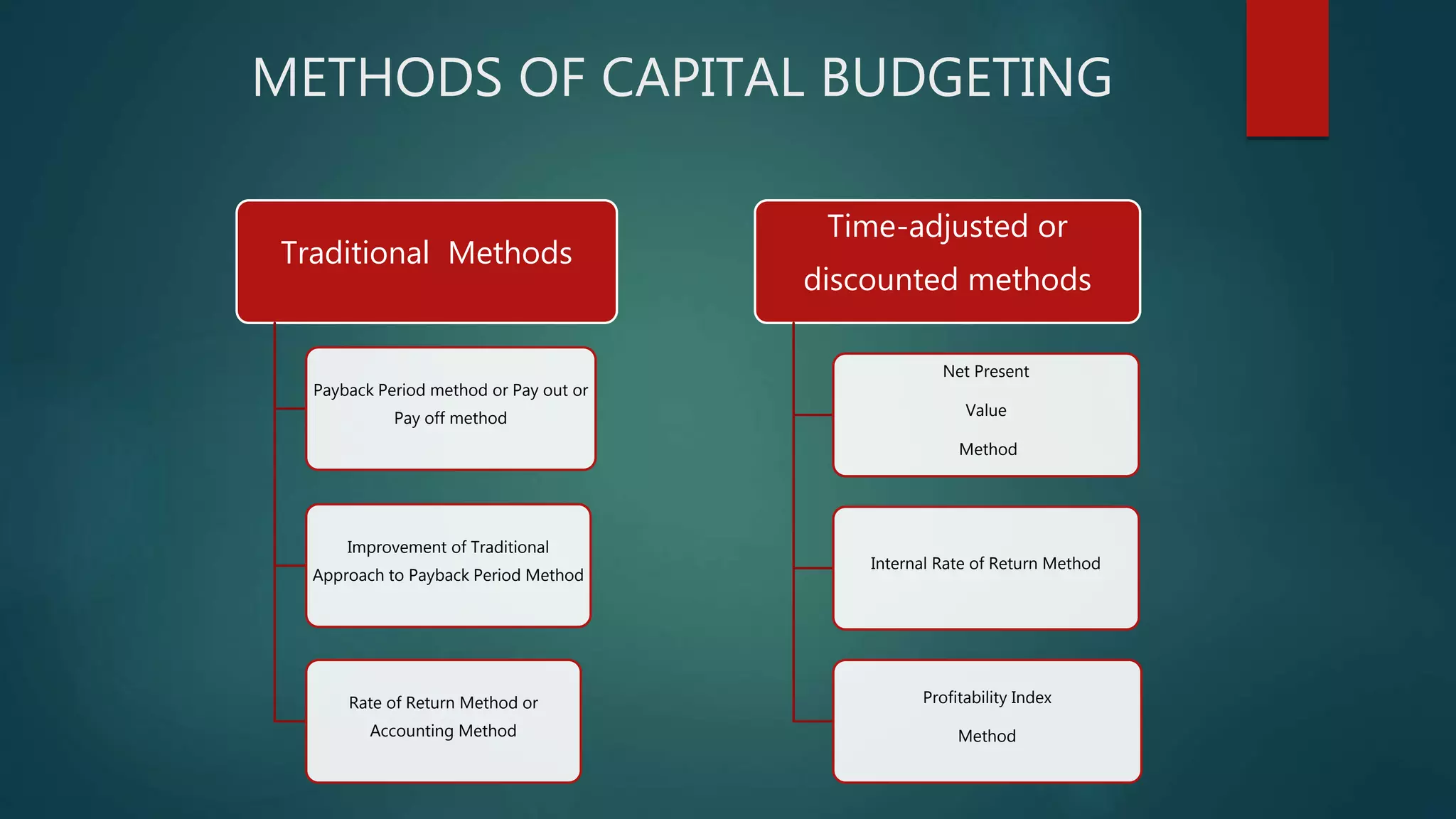
METHODS OF CAPITAL BUDGETING
Traditional Methods
Payback Period method or Pay out or
Pay off method
Improvement of Traditional
Approach to Payback Period Method
Rate of Return Method or
Accounting Method
Time-adjusted or
discounted methods
Net Present
Value
Method
Internal Rate of Return Method
Profitability Index
Method
1. PAYBACK PERIOD METHOD
Payback period is the most popular traditional method of evaluating
investment proposals. Under this method, investment proposals are ranked
according to the length of their payback period.
Step 1: Calculate Payback Period of Each Project:
Payback period of a project refers to the number of years required to recover
the initial investment in that project.
Case (a): If the project generates constant annual cash inflows:
Payback Period =
Initial Investment in the Project
Annual Cash Inflows
Initial Investment in the Project: Original Cost of the Assets
Annual Cash Inflows: Net Profits before depreciation and after
tax
Case (b): If the project generates unequal annual cash inflows:
Calculate cumulative cash inflows of project during its life.
Payback Period = No. of years in which the cumulative cash
inflows becomes equal to the original cost of the
project/asset.
Step 2: Select the Project which have a Shorter Payback Period:
After ascertaining the payback periods of different projects, the next
step is to select the project which has the shortest payback period.
• Simple
• Cost effective
• Identify more-risky and less-risky
projects
MERITS
• Not consider the time value of
money
• Profits are not taken into account
• Not possible to fix a standard
DEMERITS
2. POST PAYBACK PROFITABILITY METHOD
Step 1: Calculate Post Payback Profits of Each Project
Post payback profits refers to the profits (cash inflows) earned by the project
after its payback periods.
Post Payback Profits =
Total cash inflows of the project during its whole life – Investment in the
Project
Or
Annual Cash Inflows (Estimated Life of the Project/ Asset – Payback period)
Step 2: Ascertain Post Payback Profitability Index of Each Project
Post payback profitability index =
𝑃𝑜𝑠𝑡 𝑃𝑎𝑦𝑏𝑎𝑐𝑘 𝑃𝑟𝑜𝑓𝑖𝑡𝑠
𝐼𝑛𝑣𝑒𝑠𝑡𝑚𝑒𝑛𝑡 𝑖𝑛 𝑡ℎ𝑒 𝑝𝑟𝑜𝑗𝑒𝑐𝑡
Step 3: Select the Project which has Higher Post Pay- back Profitability
Index
After ascertaining the post pay- back profitability index of different
projects, the last step is to select that project which gives the
highest pay-back profitability index.
3. ACCOUNTING OR AVERAGE RATE
OF RETURN (ARR) METHOD
Accounting or Average Rate of Return (based on net investment):
Step 1: Calculate average annual profits
Average Annual Profits =
Total profits after depreciation and tax
No. of Years
Step 2: Calculate net investment in project
Net Investment in Project = Initial investment/Cost of Project – Scrap Value
Step 3: Calculate average rate of return (ARR)
Average Rate of Return on Investment =
Average Annual Profits X 100
Net Investment in Project
Step 4: In case of independent projects, choose the project if ARR >
Minimum required rate of return. In case of mutually exclusive
projects, select the project with highest ARR.
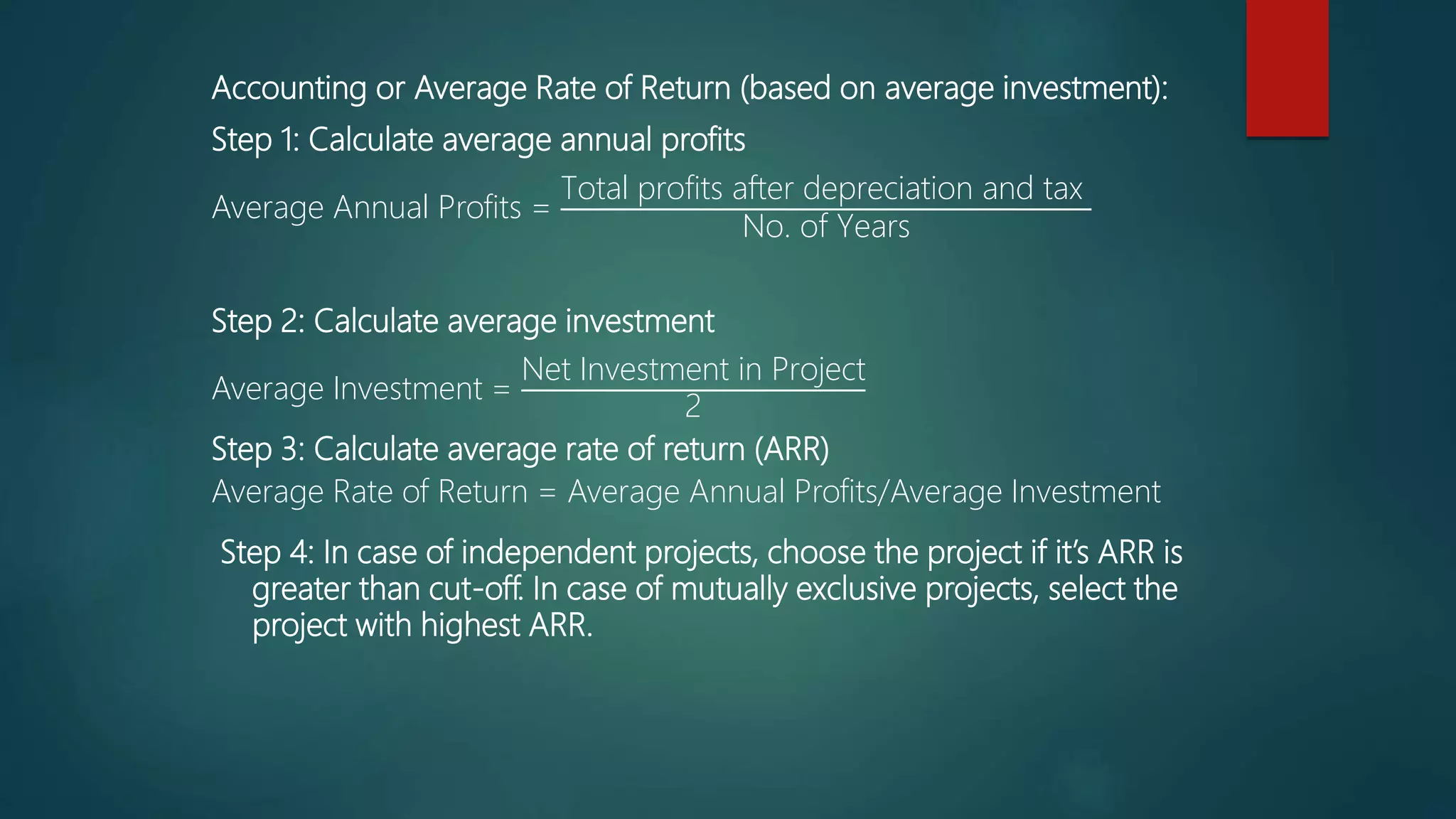
Accounting or Average Rate of Return (based on average investment):
Step 1: Calculate average annual profits
Average Annual Profits =
Total profits after depreciation and tax
No. of Years
Step 2: Calculate average investment
Average Investment =
Net Investment in Project
2
Step 3: Calculate average rate of return (ARR)
Average Rate of Return = Average Annual Profits/Average Investment
Step 4: In case of independent projects, choose the project if it’s ARR is
greater than cut-off. In case of mutually exclusive projects, select the
project with highest ARR.
• Simple and easy
• Consider the total profits
MERITS
• Ignores the time value of
money
• Considers accounting profits
rather than cash flows
DEMERITS
6. NET PRESENT VALUE (NPV)
METHOD
Net present value method is considered to be the best method for
evaluating the investment proposals, as it takes into consideration
the time value of money. Under this method, the following steps are
taken to analyze the profitability of an investment or project:
Step 1: Select an appropriate discount rate
First step under NPV method is to select an appropriate discount rate.
Discount rate also known as cut off rate or minimum required rate
of return is determined by the company after taking into
consideration various factors like interest rate prevailing in the
market, opportunity cost of capital etc.
Step 2: Compute the present value of future cash inflows from the
project
Cash inflows means earnings before depreciation and after tax
excepted from the project.
Present Value= Cash Inflows X Present Value of Re 1 at discount rate
Step 3: Compute the present value of cash outflows
Cash outflows means investments made by the company in the
As the investments are usually made in the initial stage, so the
present value of cash outflows will be the same as the cost of
project.
Step 4: Compute the net present value (NPV) of the project
NPV = Present value of cash inflows – Present value of cash outflows
Mathematical formula for calculation of NPV is as follows:
𝑁𝑃𝑉 = −𝐶0 +
𝐶𝑡
(1 + 𝑟)𝑛
Step 5: Accept or reject the proposal
In case the NPV is positive, the project should be accepted.
if the NPV is negative, the project should be rejected. If projects are
mutually exclusive, accept the one with the highest NPV.
Symbolically,
Accept the Proposal = If, NPV > Zero
Reject the Proposal = If, NPV < Zero
• Consider the time value of
money
• Accept only NPV is positive
• Consider cash flows
MERITS
• Complex
• Difficult to correctly estimate the
future cash inflows
DEMERITS
7. PROFITABILITY INDEX METHOD
Case (a) Gross Profitability Index
Gross Profitability Index =
Present value of Cash Inflows
Present value of Cash Outflows
Decision:
If Gross Profitability Index > 1 Accept the Project
If Gross Profitability Index < 1 Reject the Project
Case (b) Net Profitability Index
Net Profitability Index = Net Present Value
Initial Cash Outlay
Or
Gross Profitability Index – 1
Decision:
If Net Profitability Index > 0 Accept the Project
If Net Profitability Index < 0 Reject the Project
8. INTERNAL RATE OF RETURN
(IRR) METHOD
Internal rate of return (IRR) can be defined as that rate of discount at which
the present value of cash inflows is equal to the present value of cash
outflows. In other words, it is the rate that gives a net present value (NPV)
of zero.
Step 1: Find out the initial investments in the project/ asset and estimate its
future annual cash inflows (i.e. profits before depreciation but after tax)
Step 2: Determine IRR i.e. rate of discount at which the present value
of cash outflows. This rate is calculated as follow:
Case (a): When the annual cash inflows are uniform over the life of the
asset:
Step(a): Calculate present value factor
PV Factor = Initial Investment
Annual Cash Inflow
Step (b): Find out IRR by locating the PV factor in present value
table.
Case (b); When the annual cash inflows are not uniform:
Step (a); Take a trial rate (i.e. arbitrary assumed discounted rate).
Step (b): Calculate NPV at above rate. If NPV is positive, apply higher
rate. If NPV is negative, apply lower rate.
Step (c): By repeated efforts, find two trial rates. For finding out the
exact IRR, the following formula should be used:
IRR =LR+ NPV at LR X (HR-LR )
PV at LR – PV at HR
HR = Higher Rate
LR = Lower Rate
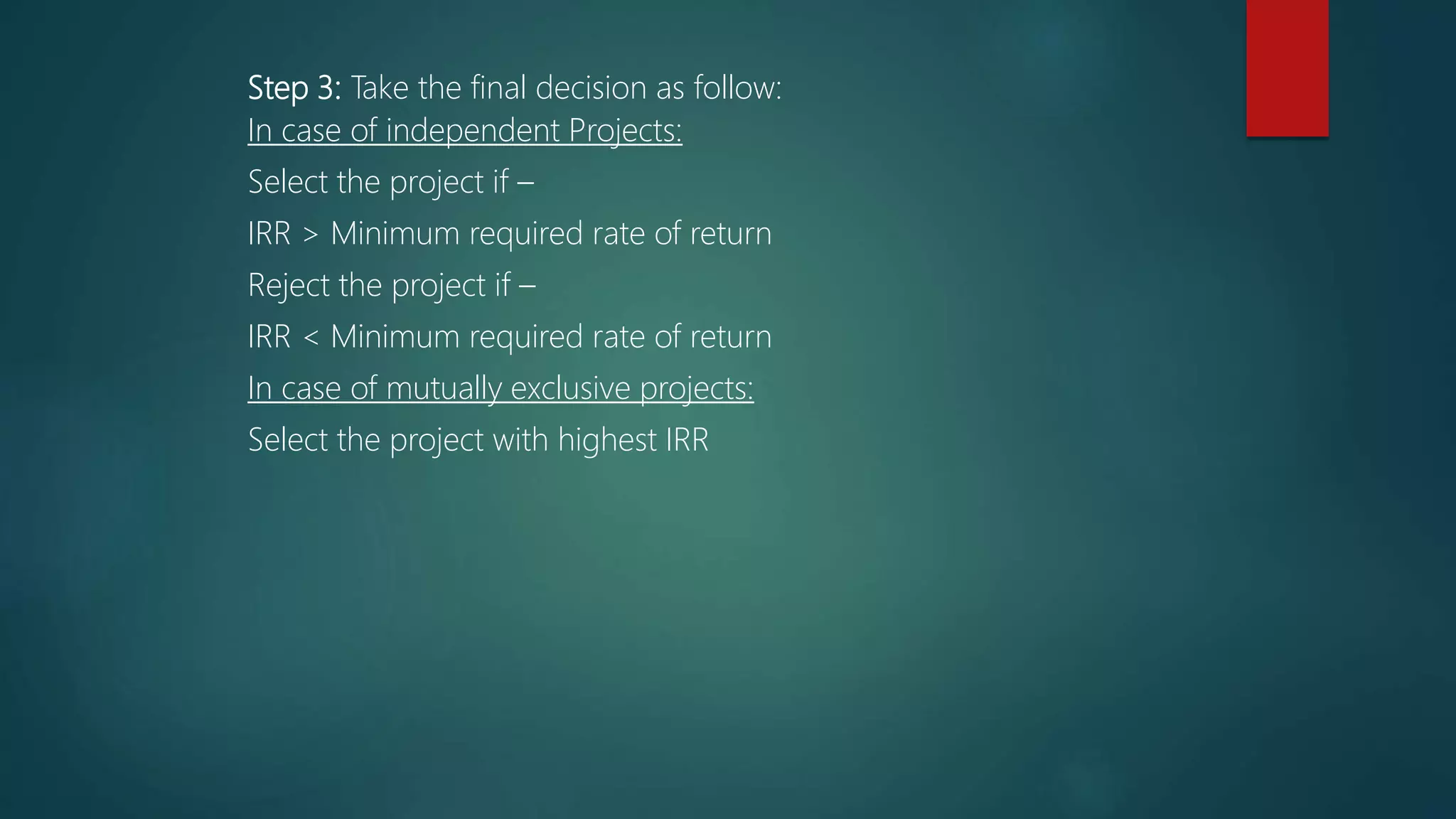
Step 3: Take the final decision as follow:
In case of independent Projects:
Select the project if –
IRR > Minimum required rate of return
Reject the project if –
IRR < Minimum required rate of return
In case of mutually exclusive projects:
Select the project with highest IRR
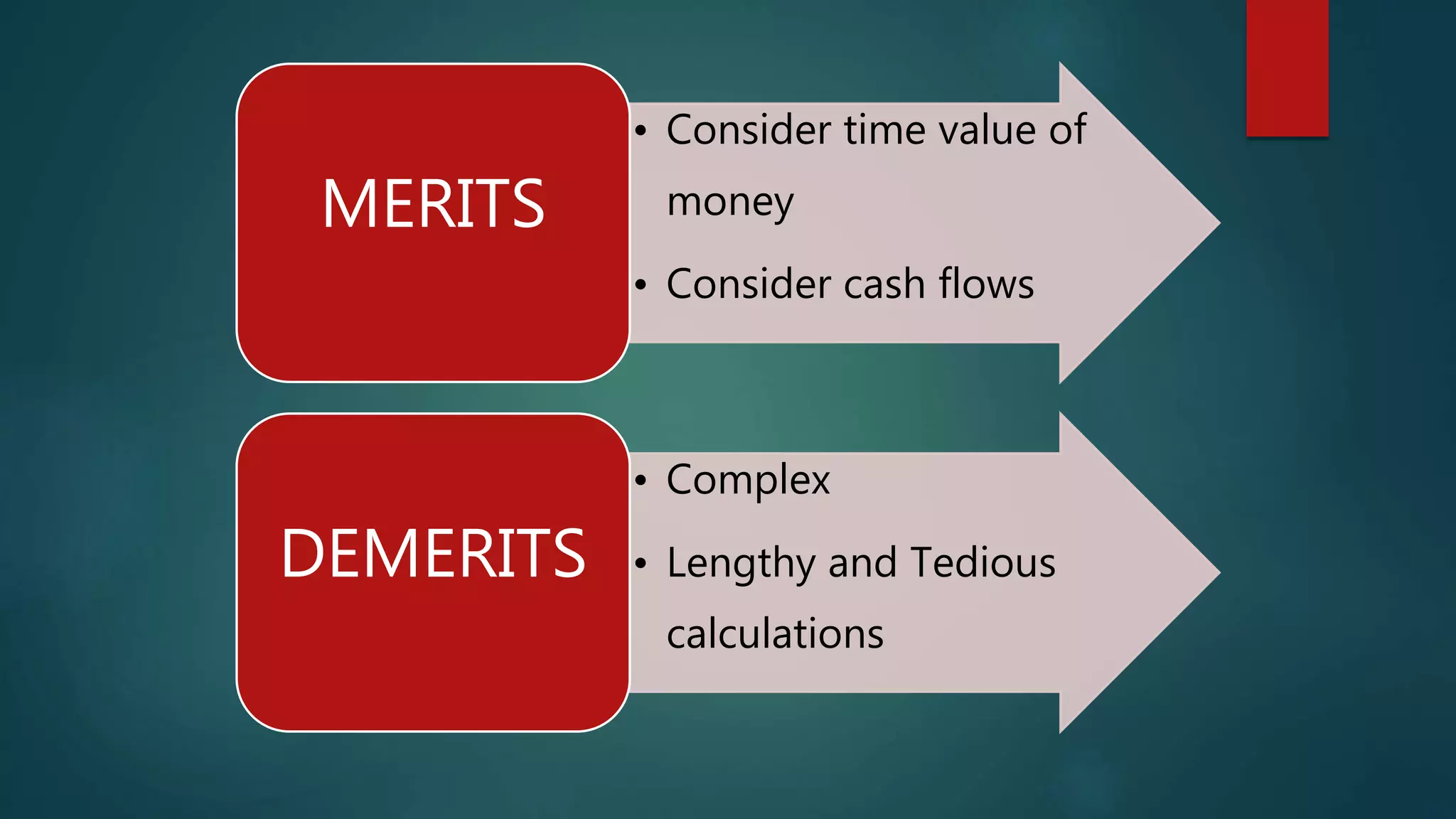
• Consider time value of
money
• Consider cash flows
MERITS
• Complex
• Lengthy and Tedious
calculations
DEMERITS
SIMILARITIES BETWEEN NPV or IRR
 Modern methods: Both are modern methods of capital budgeting
 Time value of money: Both methods take into consideration the
time value of money.
 Discounting of cash flows: Both methods involves the discounting
of cash flows into present values.
 Similar Results: Both methods will give same results in terms of
acceptance or rejection of an investment proposal in the following
cases:
 When the investment proposals are independent (i.e. projects are
not mutually exclusive).
 When the investment proposals involve cash outflows in the initial
period followed by a series of cash inflows.
COMPARISON BETWEEN NPP or IRR
 Discount Rate: In the NPV method the present value is determined by discounting the
future cash flows at a pre-determined rate. But in case of IRR method discount rate is
not pre-determined but is found by repeated trials.
 Assumptions: NPV method is based upon the assumptions that all the future cash
inflows are reinvested at cut off rate. IRR method is based upon the assumption that the
all future cash inflows are reinvested at IRR.
 Contradictory Results: In case of Mutually exclusive investment proposals, the NPV
method may favour one project while IRR method may favour another project.
 When projects under consideration require different cash outlays.
 When projects under consideration have different expected lives.
 When projects under consideration have different patterns of cash flows.
FACTORS INFLUENCING CAPITAL
BUDGETING
Urgency
Degree of certainty
Intangible
factors
Legal factors
Availability of
funds
Future Earnings
Obsolescence
Research and
Development
Projects
Cost
Considerations
CAPITAL RATIONING
Capital rationing refers to a situation where a firm is not in a position to invest
in all profitable projects due to the constraints on availability of funds. The
resources are always limited and the demand for them far exceeds their
availability.
LIMITATIONS OF CAPITAL BUDGETING
1) All the techniques of capital budgeting presume that various
investment proposals under consideration are mutually exclusive
which may not practically be true in some particular circumstances.
2) The techniques of capital budgeting require estimation of future
cash inflows and outflows.
3) There are certain factors like morale of the employees, goodwill of
the firm, etc, which cannot be correctly quantified but which other
wise substantially influence the capital decision.
4) Urgency is another limitation in the evaluation of capital investment
decisions.

5) Uncertainty and risk pose the biggest limitation to the techniques of
capital budgeting.

Captial budgeting

  • 1.
  • 2.
    NEED/ SIGNICANCE OFCAPITAL BUDGETING  Maximization of shareholder’s wealth  Large investment of funds  Long time period  Irreversible Decisions  Selection of Best Investment Proposal
  • 3.
    CAPITAL BUDGETING PROCESS PROCESS Investment Proposals Screen Proposals Evaluate Various Proposals FixPriorities Final Approval Implement The Proposals Review Performance
  • 4.
    METHODS OF CAPITALBUDGETING Traditional Methods Payback Period method or Pay out or Pay off method Improvement of Traditional Approach to Payback Period Method Rate of Return Method or Accounting Method Time-adjusted or discounted methods Net Present Value Method Internal Rate of Return Method Profitability Index Method
  • 5.
    1. PAYBACK PERIODMETHOD Payback period is the most popular traditional method of evaluating investment proposals. Under this method, investment proposals are ranked according to the length of their payback period. Step 1: Calculate Payback Period of Each Project: Payback period of a project refers to the number of years required to recover the initial investment in that project.
  • 6.
    Case (a): Ifthe project generates constant annual cash inflows: Payback Period = Initial Investment in the Project Annual Cash Inflows Initial Investment in the Project: Original Cost of the Assets Annual Cash Inflows: Net Profits before depreciation and after tax Case (b): If the project generates unequal annual cash inflows: Calculate cumulative cash inflows of project during its life. Payback Period = No. of years in which the cumulative cash inflows becomes equal to the original cost of the project/asset.
  • 7.
    Step 2: Selectthe Project which have a Shorter Payback Period: After ascertaining the payback periods of different projects, the next step is to select the project which has the shortest payback period.
  • 8.
    • Simple • Costeffective • Identify more-risky and less-risky projects MERITS • Not consider the time value of money • Profits are not taken into account • Not possible to fix a standard DEMERITS
  • 9.
    2. POST PAYBACKPROFITABILITY METHOD Step 1: Calculate Post Payback Profits of Each Project Post payback profits refers to the profits (cash inflows) earned by the project after its payback periods. Post Payback Profits = Total cash inflows of the project during its whole life – Investment in the Project Or Annual Cash Inflows (Estimated Life of the Project/ Asset – Payback period)
  • 10.
    Step 2: AscertainPost Payback Profitability Index of Each Project Post payback profitability index = 𝑃𝑜𝑠𝑡 𝑃𝑎𝑦𝑏𝑎𝑐𝑘 𝑃𝑟𝑜𝑓𝑖𝑡𝑠 𝐼𝑛𝑣𝑒𝑠𝑡𝑚𝑒𝑛𝑡 𝑖𝑛 𝑡ℎ𝑒 𝑝𝑟𝑜𝑗𝑒𝑐𝑡 Step 3: Select the Project which has Higher Post Pay- back Profitability Index After ascertaining the post pay- back profitability index of different projects, the last step is to select that project which gives the highest pay-back profitability index.
  • 11.
    3. ACCOUNTING ORAVERAGE RATE OF RETURN (ARR) METHOD Accounting or Average Rate of Return (based on net investment): Step 1: Calculate average annual profits Average Annual Profits = Total profits after depreciation and tax No. of Years Step 2: Calculate net investment in project Net Investment in Project = Initial investment/Cost of Project – Scrap Value
  • 12.
    Step 3: Calculateaverage rate of return (ARR) Average Rate of Return on Investment = Average Annual Profits X 100 Net Investment in Project Step 4: In case of independent projects, choose the project if ARR > Minimum required rate of return. In case of mutually exclusive projects, select the project with highest ARR.
  • 13.
    Accounting or AverageRate of Return (based on average investment): Step 1: Calculate average annual profits Average Annual Profits = Total profits after depreciation and tax No. of Years Step 2: Calculate average investment Average Investment = Net Investment in Project 2 Step 3: Calculate average rate of return (ARR) Average Rate of Return = Average Annual Profits/Average Investment Step 4: In case of independent projects, choose the project if it’s ARR is greater than cut-off. In case of mutually exclusive projects, select the project with highest ARR.
  • 14.
    • Simple andeasy • Consider the total profits MERITS • Ignores the time value of money • Considers accounting profits rather than cash flows DEMERITS
  • 15.
    6. NET PRESENTVALUE (NPV) METHOD Net present value method is considered to be the best method for evaluating the investment proposals, as it takes into consideration the time value of money. Under this method, the following steps are taken to analyze the profitability of an investment or project: Step 1: Select an appropriate discount rate First step under NPV method is to select an appropriate discount rate. Discount rate also known as cut off rate or minimum required rate of return is determined by the company after taking into consideration various factors like interest rate prevailing in the market, opportunity cost of capital etc.
  • 16.
    Step 2: Computethe present value of future cash inflows from the project Cash inflows means earnings before depreciation and after tax excepted from the project. Present Value= Cash Inflows X Present Value of Re 1 at discount rate Step 3: Compute the present value of cash outflows Cash outflows means investments made by the company in the As the investments are usually made in the initial stage, so the present value of cash outflows will be the same as the cost of project.
  • 17.
    Step 4: Computethe net present value (NPV) of the project NPV = Present value of cash inflows – Present value of cash outflows Mathematical formula for calculation of NPV is as follows: 𝑁𝑃𝑉 = −𝐶0 + 𝐶𝑡 (1 + 𝑟)𝑛
  • 18.
    Step 5: Acceptor reject the proposal In case the NPV is positive, the project should be accepted. if the NPV is negative, the project should be rejected. If projects are mutually exclusive, accept the one with the highest NPV. Symbolically, Accept the Proposal = If, NPV > Zero Reject the Proposal = If, NPV < Zero
  • 19.
    • Consider thetime value of money • Accept only NPV is positive • Consider cash flows MERITS • Complex • Difficult to correctly estimate the future cash inflows DEMERITS
  • 20.
    7. PROFITABILITY INDEXMETHOD Case (a) Gross Profitability Index Gross Profitability Index = Present value of Cash Inflows Present value of Cash Outflows Decision: If Gross Profitability Index > 1 Accept the Project If Gross Profitability Index < 1 Reject the Project
  • 21.
    Case (b) NetProfitability Index Net Profitability Index = Net Present Value Initial Cash Outlay Or Gross Profitability Index – 1 Decision: If Net Profitability Index > 0 Accept the Project If Net Profitability Index < 0 Reject the Project
  • 22.
    8. INTERNAL RATEOF RETURN (IRR) METHOD Internal rate of return (IRR) can be defined as that rate of discount at which the present value of cash inflows is equal to the present value of cash outflows. In other words, it is the rate that gives a net present value (NPV) of zero. Step 1: Find out the initial investments in the project/ asset and estimate its future annual cash inflows (i.e. profits before depreciation but after tax)
  • 23.
    Step 2: DetermineIRR i.e. rate of discount at which the present value of cash outflows. This rate is calculated as follow: Case (a): When the annual cash inflows are uniform over the life of the asset: Step(a): Calculate present value factor PV Factor = Initial Investment Annual Cash Inflow Step (b): Find out IRR by locating the PV factor in present value table.
  • 24.
    Case (b); Whenthe annual cash inflows are not uniform: Step (a); Take a trial rate (i.e. arbitrary assumed discounted rate). Step (b): Calculate NPV at above rate. If NPV is positive, apply higher rate. If NPV is negative, apply lower rate. Step (c): By repeated efforts, find two trial rates. For finding out the exact IRR, the following formula should be used: IRR =LR+ NPV at LR X (HR-LR ) PV at LR – PV at HR HR = Higher Rate LR = Lower Rate
  • 25.
    Step 3: Takethe final decision as follow: In case of independent Projects: Select the project if – IRR > Minimum required rate of return Reject the project if – IRR < Minimum required rate of return In case of mutually exclusive projects: Select the project with highest IRR
  • 26.
    • Consider timevalue of money • Consider cash flows MERITS • Complex • Lengthy and Tedious calculations DEMERITS
  • 27.
    SIMILARITIES BETWEEN NPVor IRR  Modern methods: Both are modern methods of capital budgeting  Time value of money: Both methods take into consideration the time value of money.  Discounting of cash flows: Both methods involves the discounting of cash flows into present values.  Similar Results: Both methods will give same results in terms of acceptance or rejection of an investment proposal in the following cases:  When the investment proposals are independent (i.e. projects are not mutually exclusive).  When the investment proposals involve cash outflows in the initial period followed by a series of cash inflows.
  • 28.
    COMPARISON BETWEEN NPPor IRR  Discount Rate: In the NPV method the present value is determined by discounting the future cash flows at a pre-determined rate. But in case of IRR method discount rate is not pre-determined but is found by repeated trials.  Assumptions: NPV method is based upon the assumptions that all the future cash inflows are reinvested at cut off rate. IRR method is based upon the assumption that the all future cash inflows are reinvested at IRR.  Contradictory Results: In case of Mutually exclusive investment proposals, the NPV method may favour one project while IRR method may favour another project.  When projects under consideration require different cash outlays.  When projects under consideration have different expected lives.  When projects under consideration have different patterns of cash flows.
  • 29.
    FACTORS INFLUENCING CAPITAL BUDGETING Urgency Degreeof certainty Intangible factors Legal factors Availability of funds Future Earnings Obsolescence Research and Development Projects Cost Considerations
  • 30.
    CAPITAL RATIONING Capital rationingrefers to a situation where a firm is not in a position to invest in all profitable projects due to the constraints on availability of funds. The resources are always limited and the demand for them far exceeds their availability.
  • 31.
    LIMITATIONS OF CAPITALBUDGETING 1) All the techniques of capital budgeting presume that various investment proposals under consideration are mutually exclusive which may not practically be true in some particular circumstances. 2) The techniques of capital budgeting require estimation of future cash inflows and outflows. 3) There are certain factors like morale of the employees, goodwill of the firm, etc, which cannot be correctly quantified but which other wise substantially influence the capital decision. 4) Urgency is another limitation in the evaluation of capital investment decisions. 5) Uncertainty and risk pose the biggest limitation to the techniques of capital budgeting.